Content
Artificial Intelligence
Introduction
Components of Artificial Intelligence
Characteristics of Artificial Intelligence Systems
Intelligent Agents
Types of Intelligent Agents
3.
Introduction
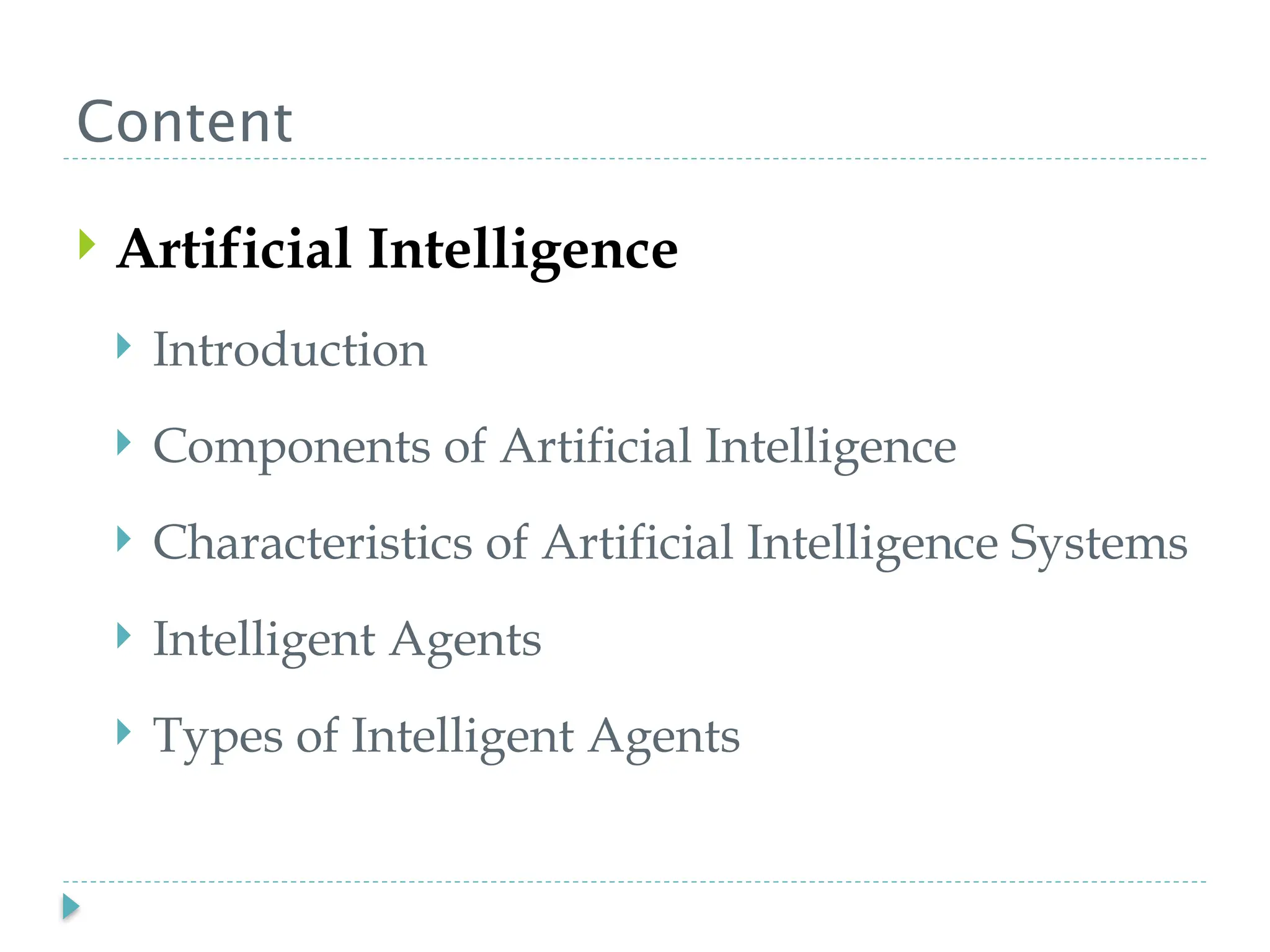
HUMAN
INTELLIGENCE
Homo sapiens—man thewise—
Human intelligence is so important.
For thousands of years, we the human have tried to
understand how we think; that is, how a mere
handful of matter can perceive, understand, predict, and
manipulate a world far larger and more complicated than
itself.
ARTIFICIAL
INTELLIGENCE
The field of artificial intelligence, or AI, goes further still: it
attempts not just to understand but also to build intelligent
entities.
4.
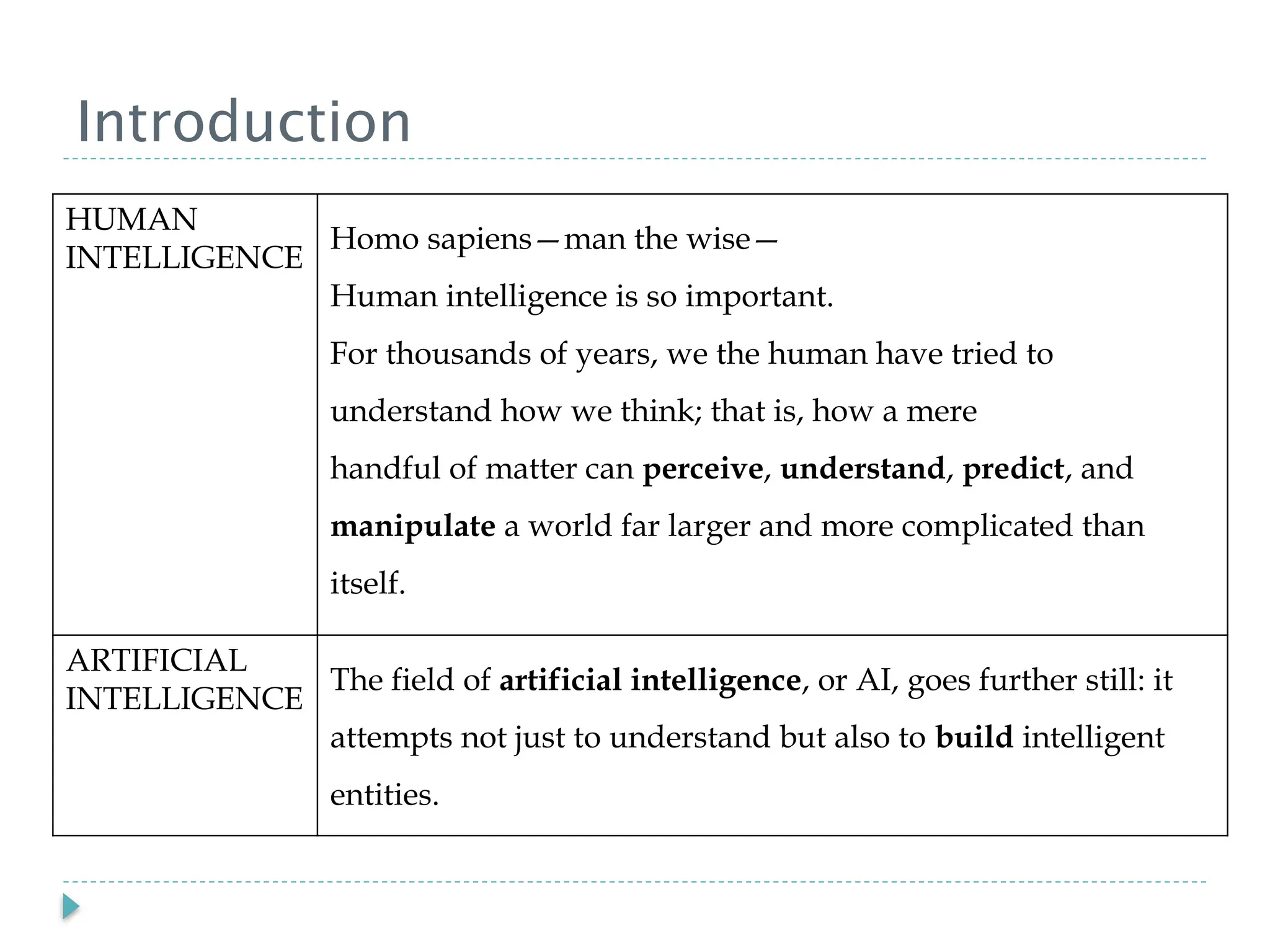
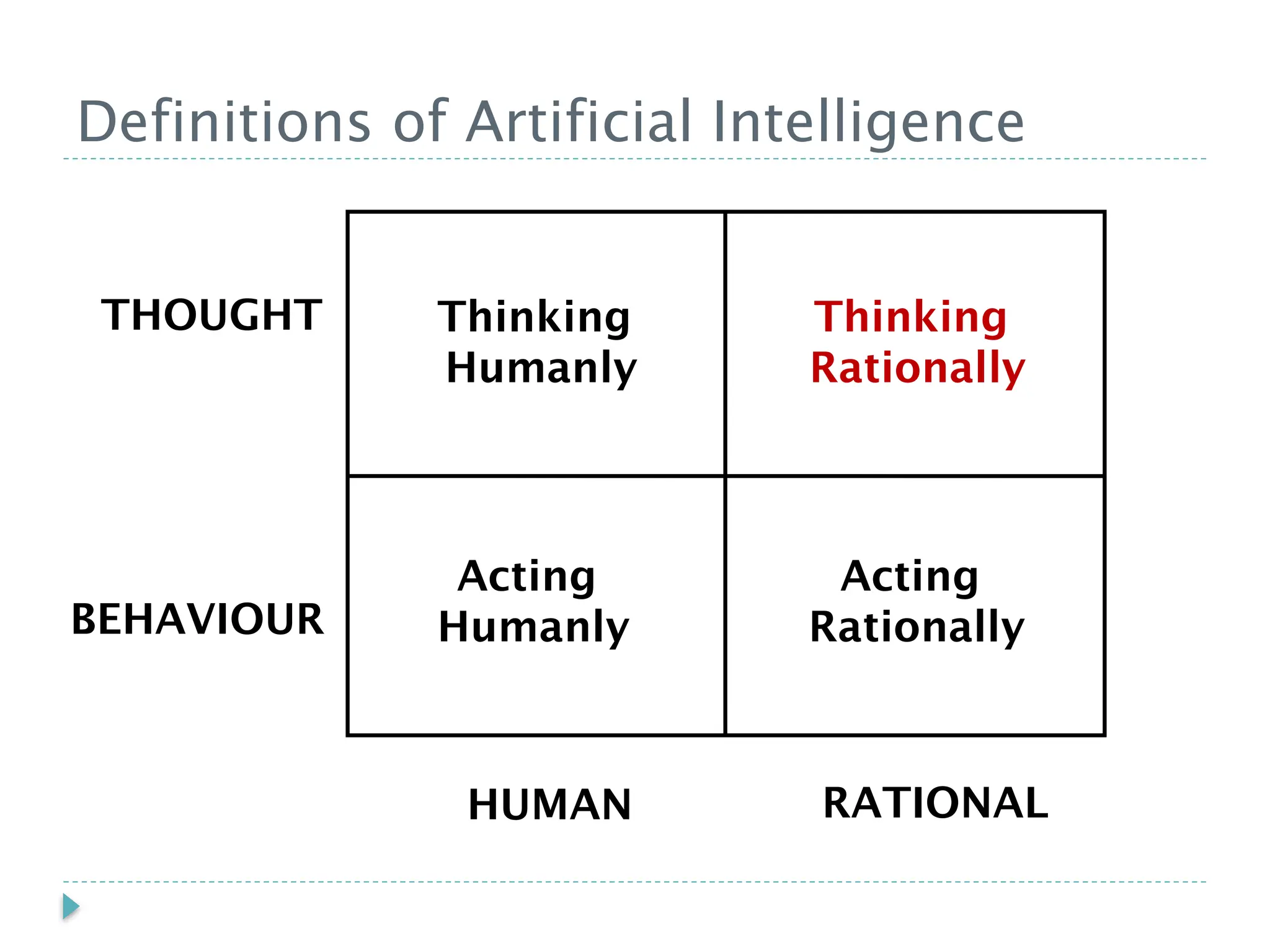
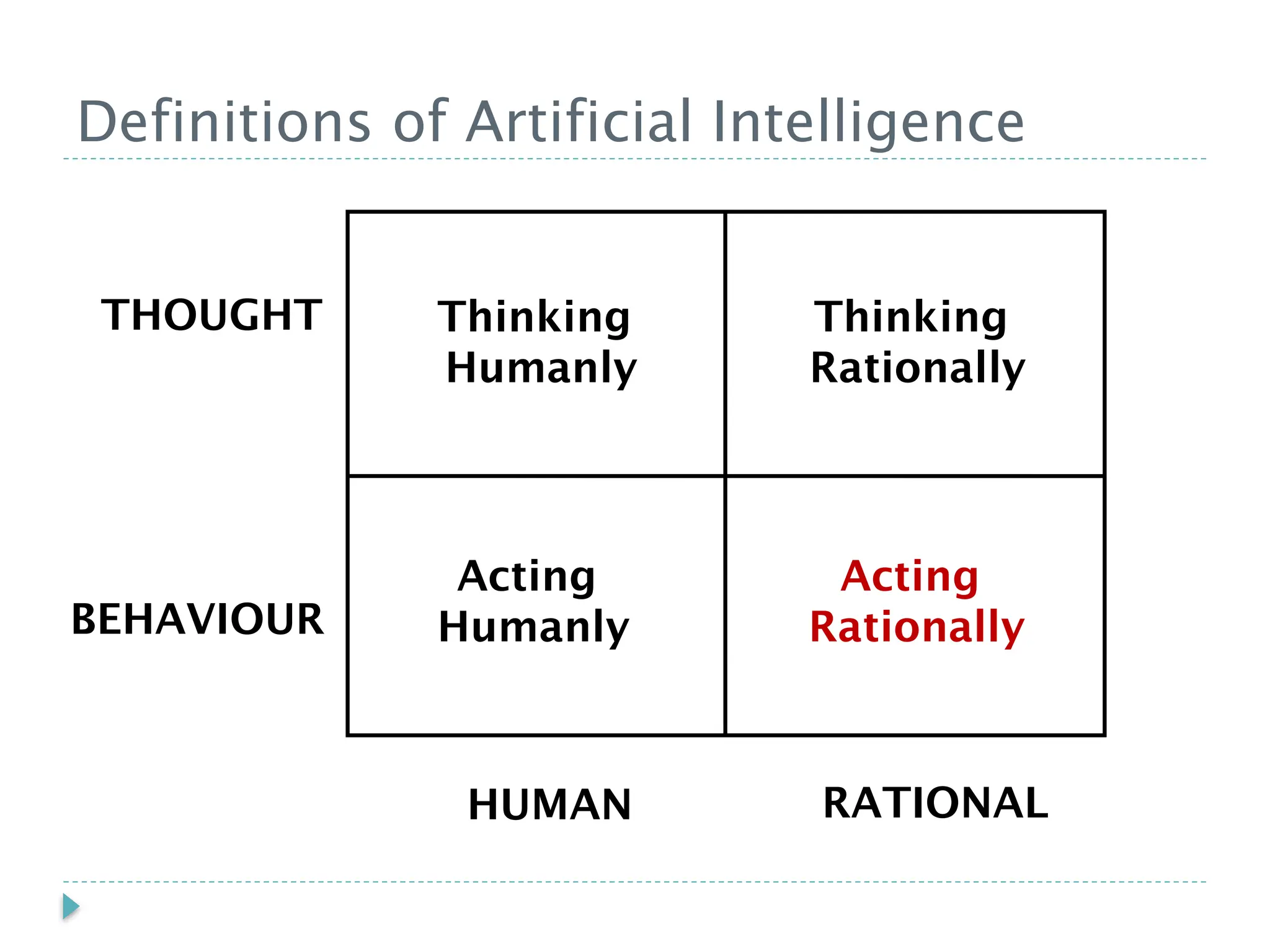
Definitions of ArtificialIntelligence
Acting
Rationally
Thinking
Humanly
Thinking
Rationally
Acting
Humanly
THOUGHT
BEHAVIOUR
HUMAN RATIONAL
5.
Artificial Intelligence :Thinking
Humanly
Haugeland, 1985 : The exciting new effort to make
computers think . . . machines with minds, in the full
and literal sense.”
Bellman, 1978: “[The automation of] activities that
we associate with human thinking, activities such as
decision-making, problem solving, learning . . .”
6.
Definitions of ArtificialIntelligence
Acting
Rationally
Thinking
Humanly
Thinking
Rationally
Acting
Humanly
THOUGHT
BEHAVIOUR
HUMAN RATIONAL
7.
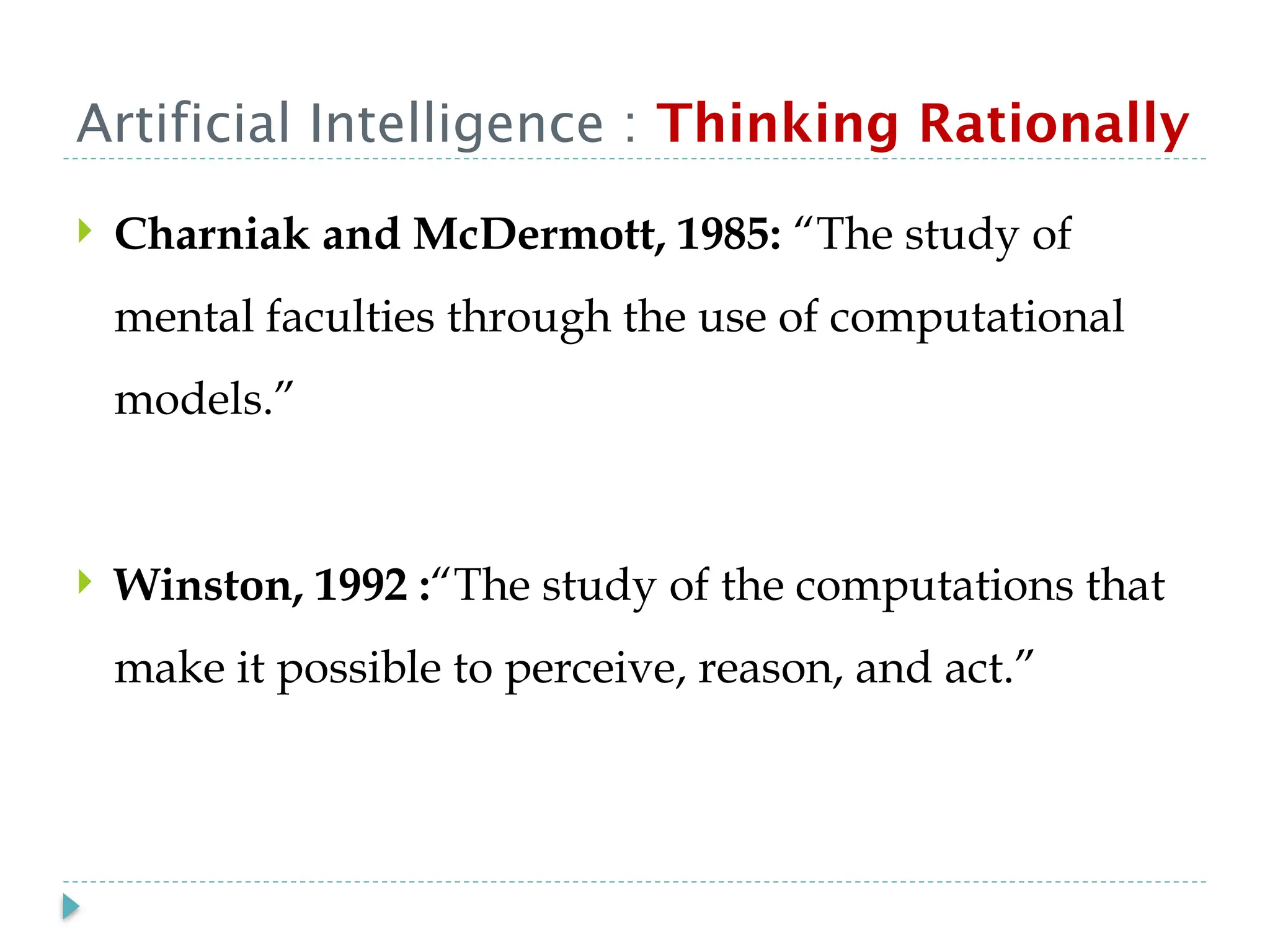
Artificial Intelligence :Thinking Rationally
Charniak and McDermott, 1985: “The study of
mental faculties through the use of computational
models.”
Winston, 1992 :“The study of the computations that
make it possible to perceive, reason, and act.”
8.
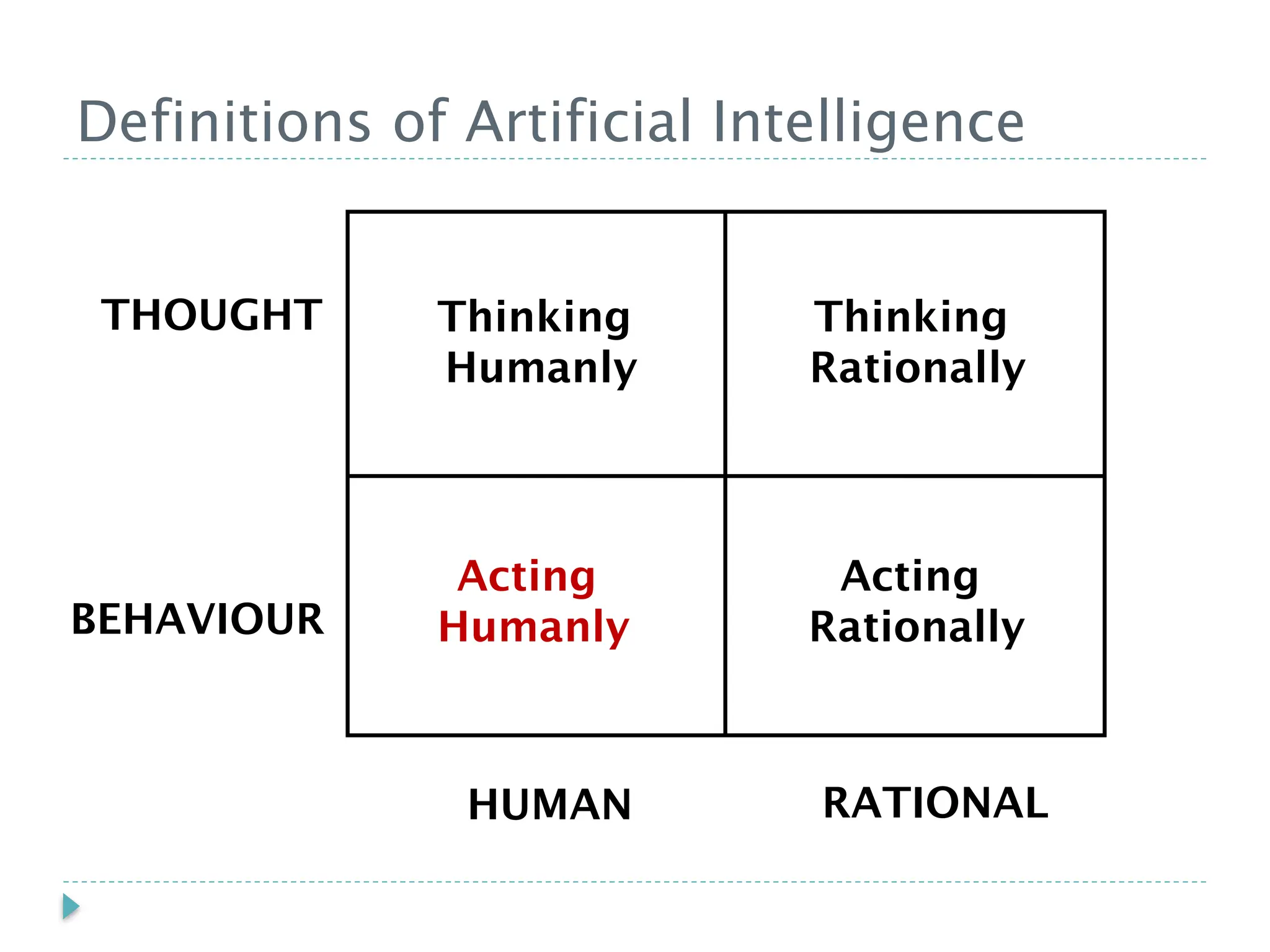
Definitions of ArtificialIntelligence
Acting
Rationally
Thinking
Humanly
Thinking
Rationally
Acting
Humanly
THOUGHT
BEHAVIOUR
HUMAN RATIONAL
9.
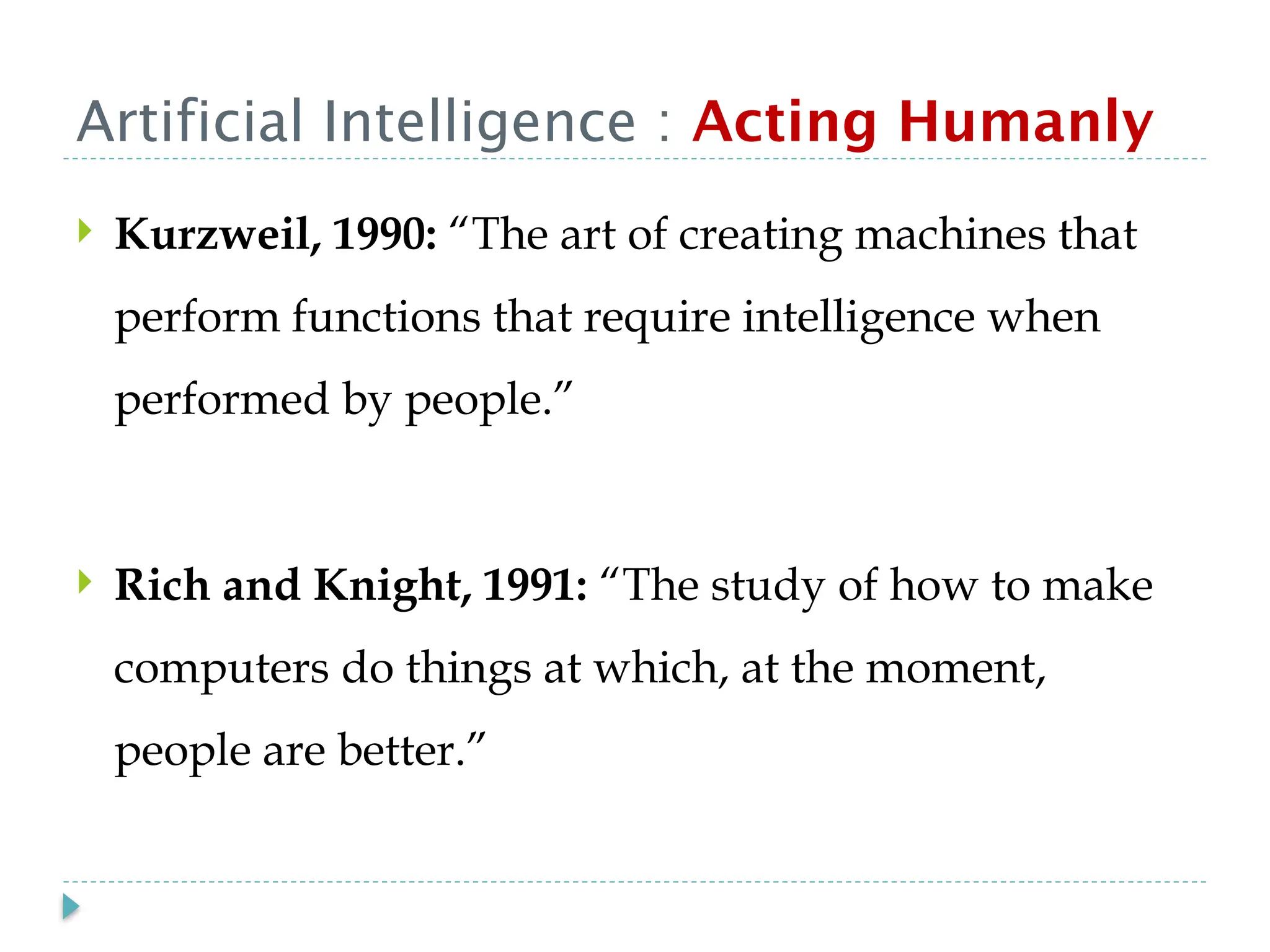
Artificial Intelligence :Acting Humanly
Kurzweil, 1990: “The art of creating machines that
perform functions that require intelligence when
performed by people.”
Rich and Knight, 1991: “The study of how to make
computers do things at which, at the moment,
people are better.”
10.
Definitions of ArtificialIntelligence
Acting
Rationally
Thinking
Humanly
Thinking
Rationally
Acting
Humanly
THOUGHT
BEHAVIOUR
HUMAN RATIONAL
11.
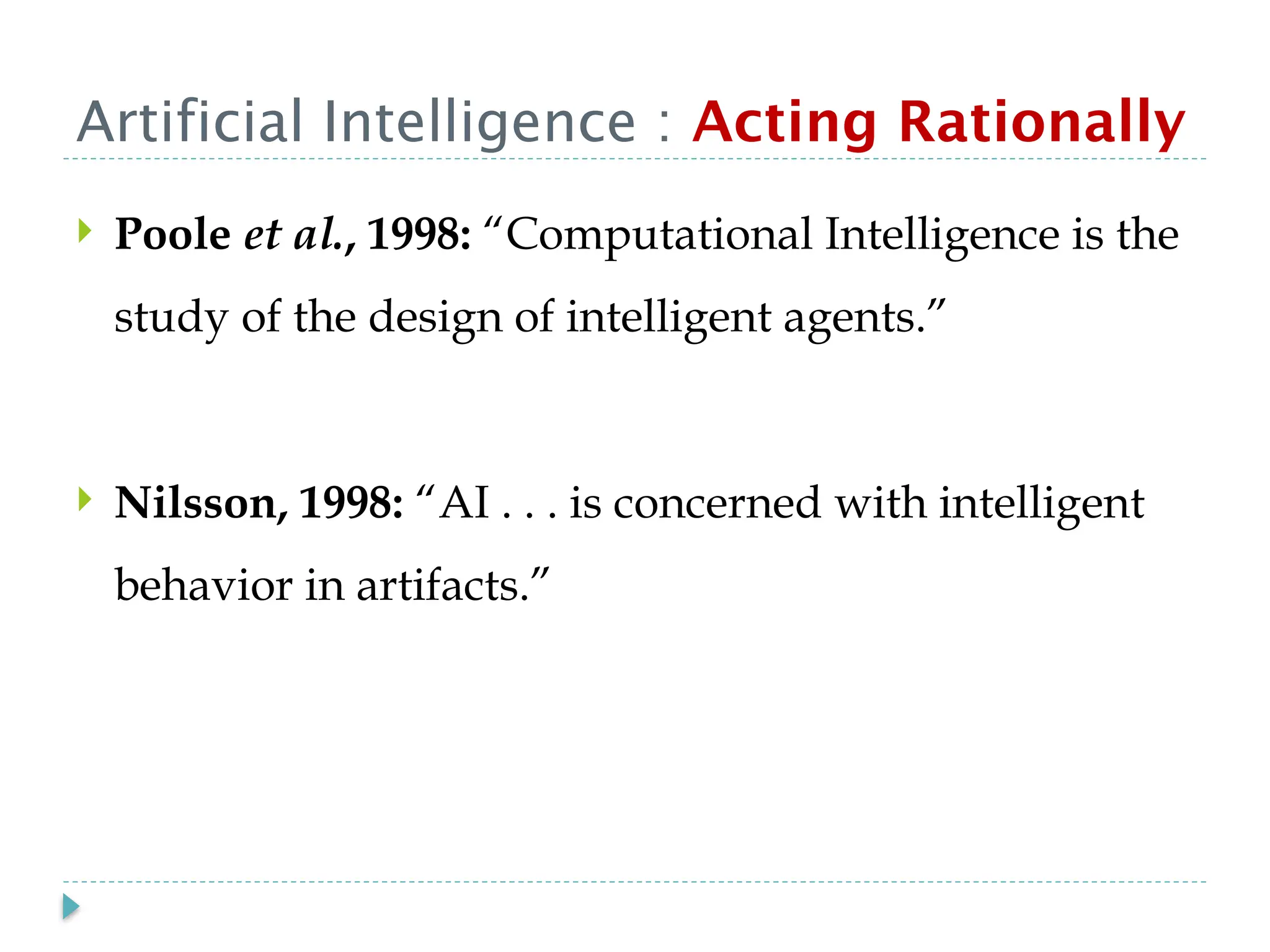
Artificial Intelligence :Acting Rationally
Poole et al., 1998: “Computational Intelligence is the
study of the design of intelligent agents.”
Nilsson, 1998: “AI . . . is concerned with intelligent
behavior in artifacts.”
12.
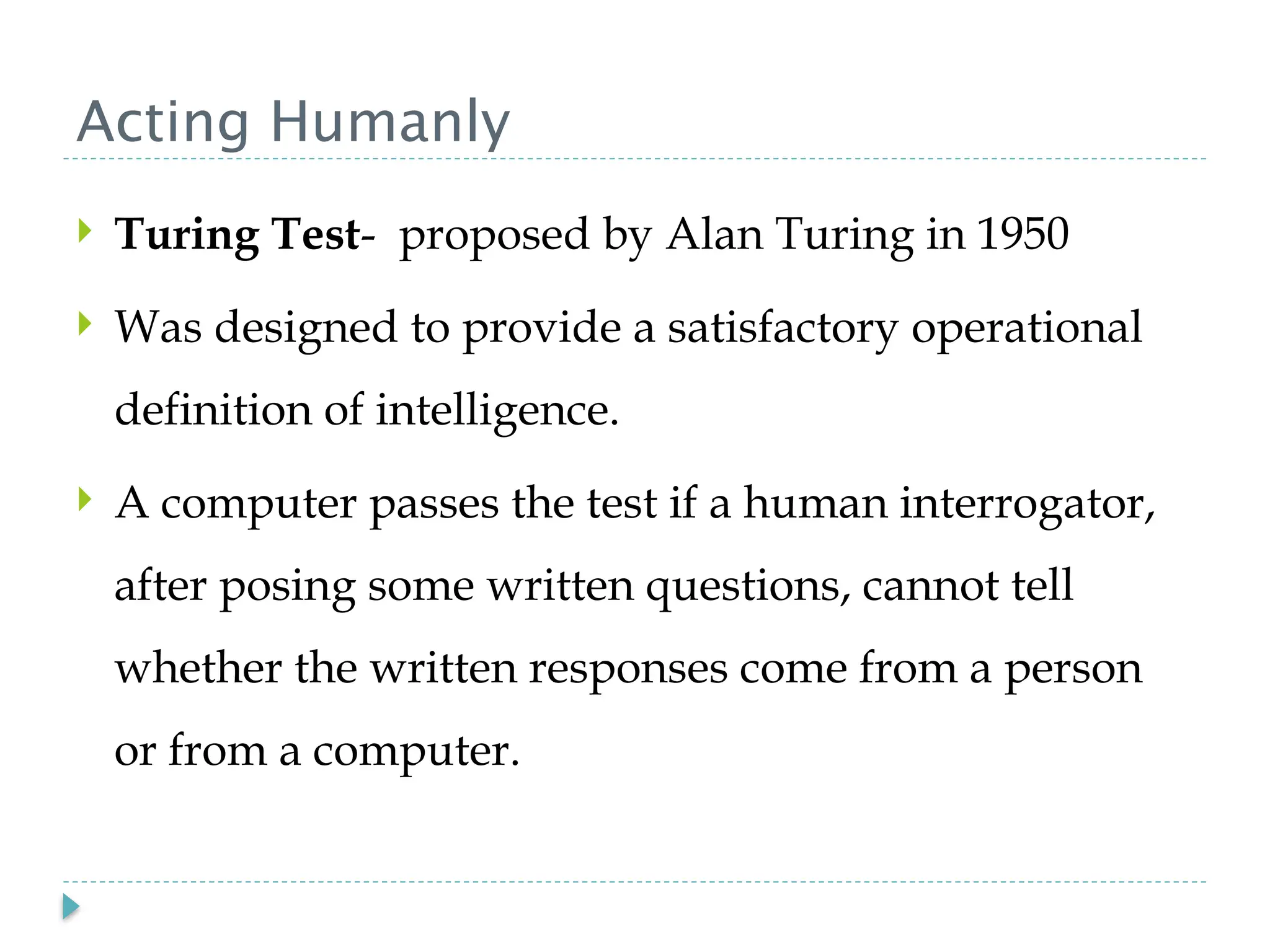
Acting Humanly
TuringTest- proposed by Alan Turing in 1950
Was designed to provide a satisfactory operational
definition of intelligence.
A computer passes the test if a human interrogator,
after posing some written questions, cannot tell
whether the written responses come from a person
or from a computer.
13.
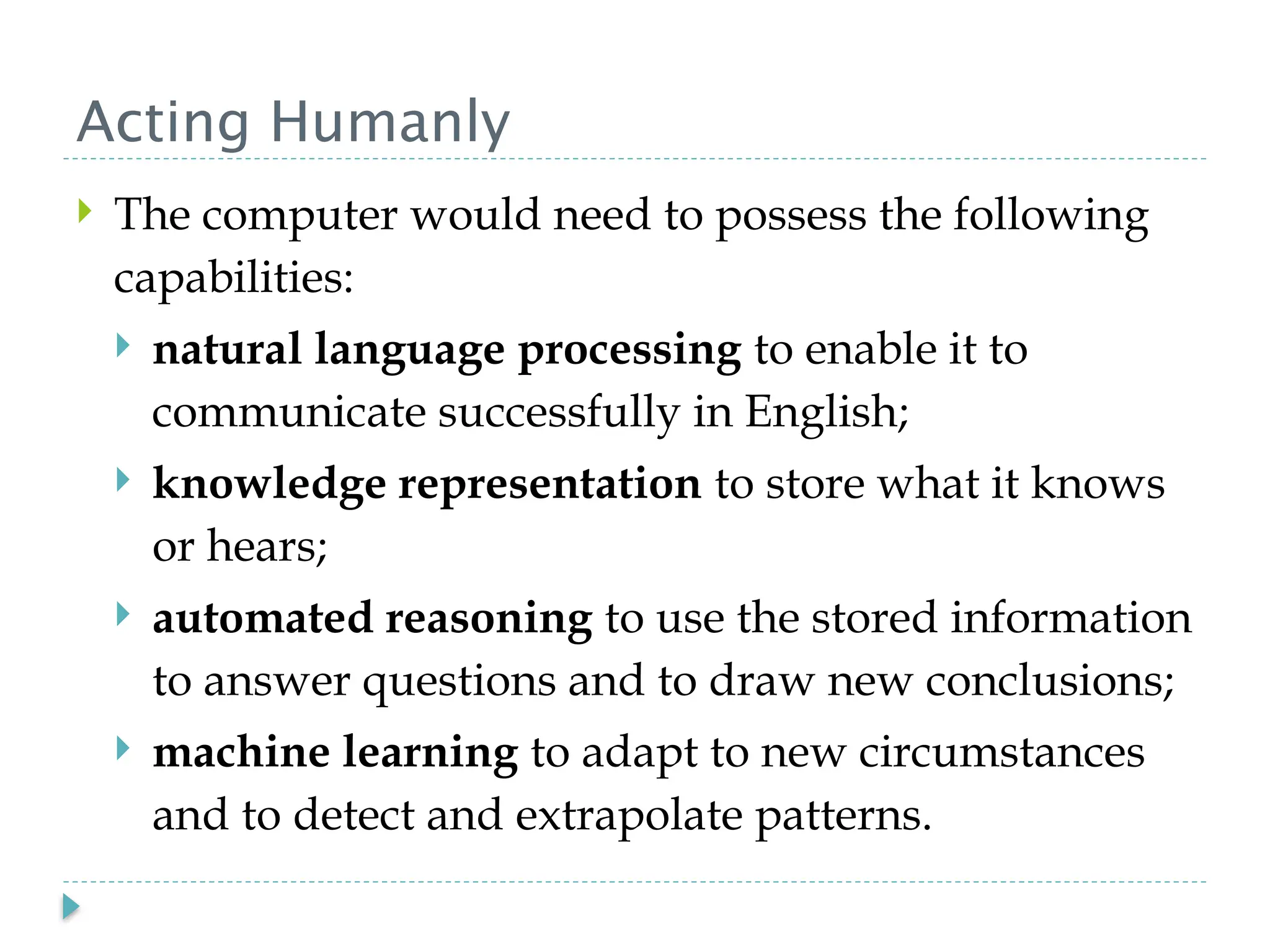
Acting Humanly
Thecomputer would need to possess the following
capabilities:
natural language processing to enable it to
communicate successfully in English;
knowledge representation to store what it knows
or hears;
automated reasoning to use the stored information
to answer questions and to draw new conclusions;
machine learning to adapt to new circumstances
and to detect and extrapolate patterns.
14.
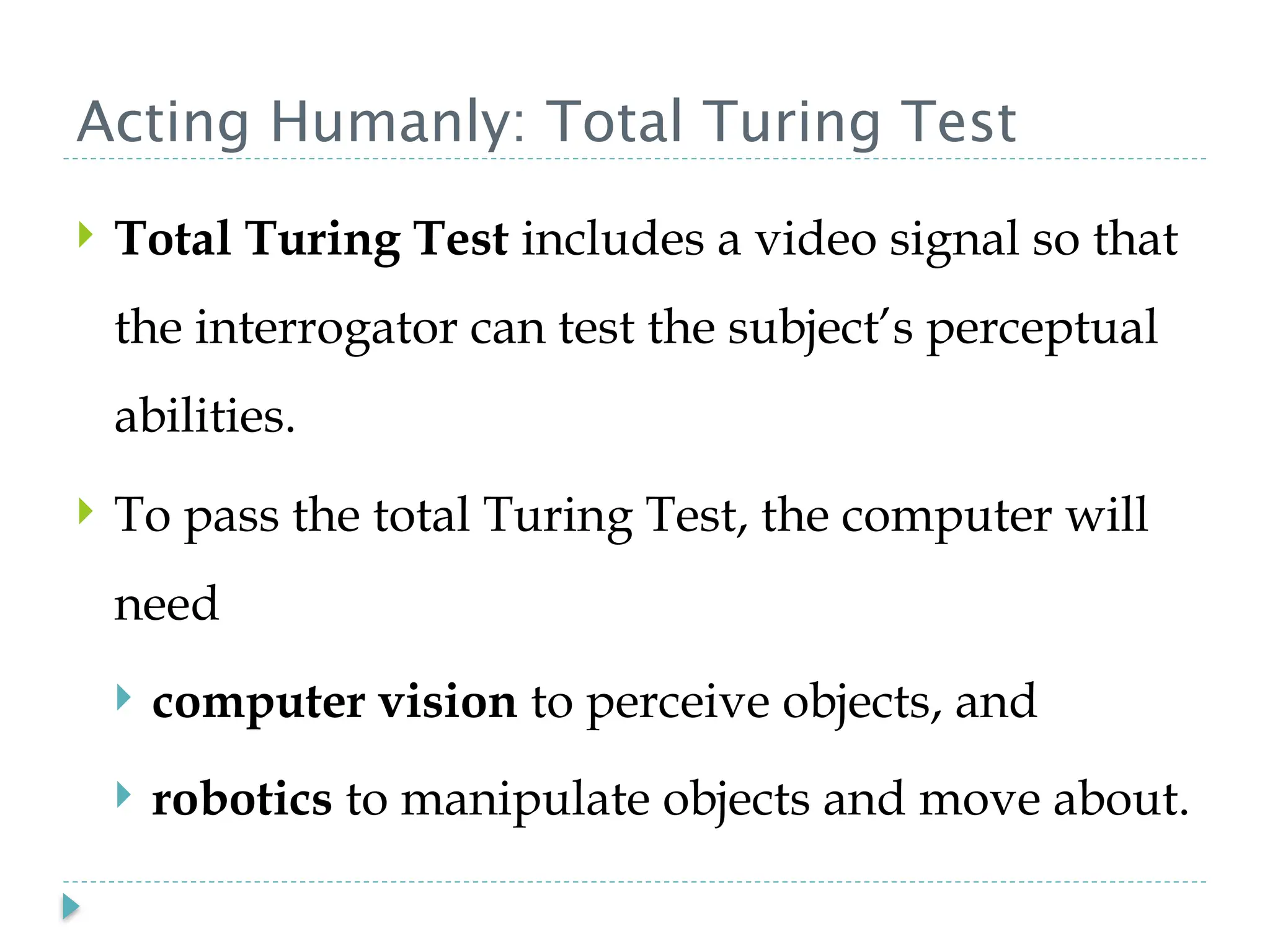
Acting Humanly: TotalTuring Test
Total Turing Test includes a video signal so that
the interrogator can test the subject’s perceptual
abilities.
To pass the total Turing Test, the computer will
need
computer vision to perceive objects, and
robotics to manipulate objects and move about.
15.
Acting Humanly
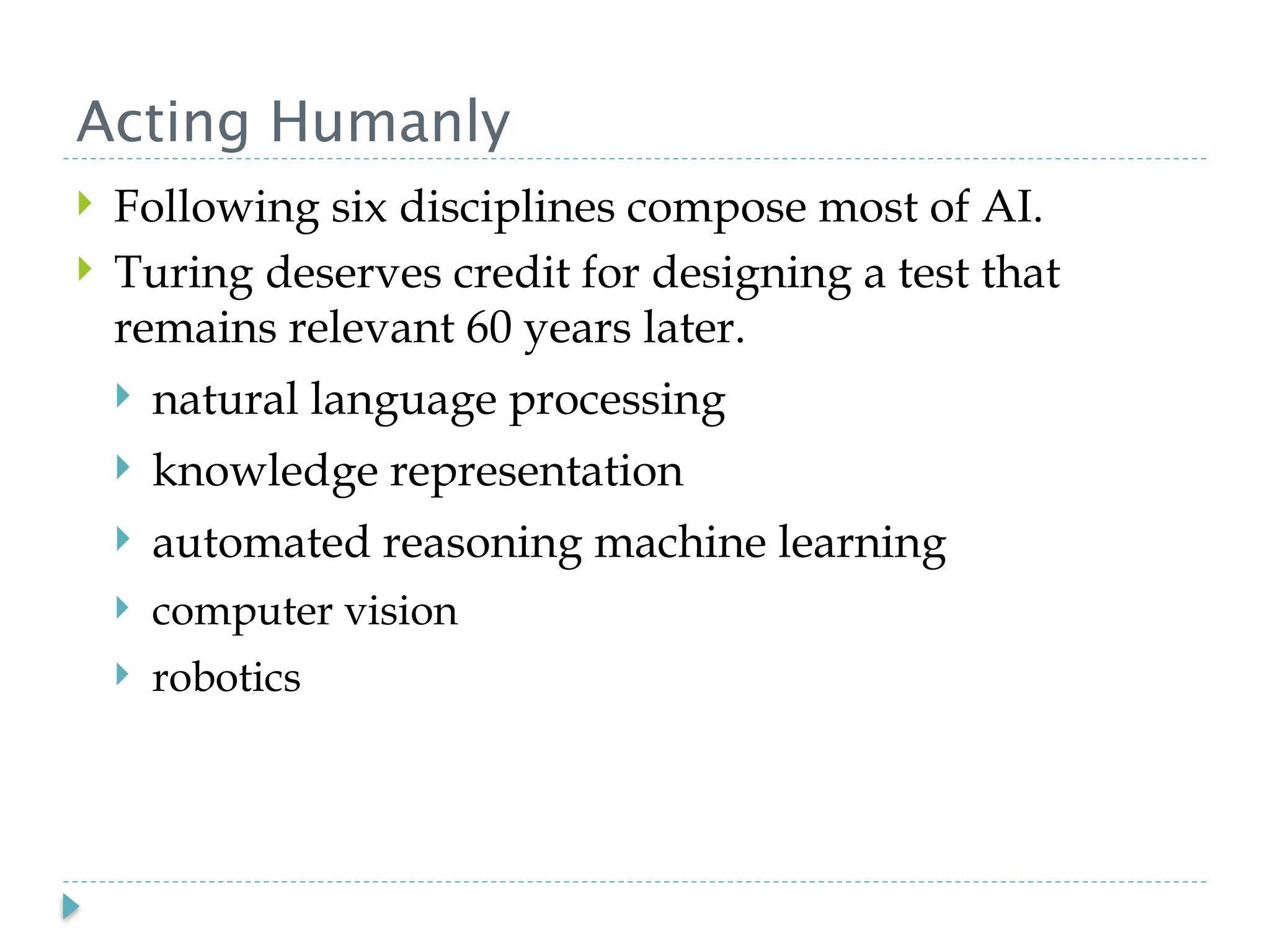
Followingsix disciplines compose most of AI.
Turing deserves credit for designing a test that
remains relevant 60 years later.
natural language processing
knowledge representation
automated reasoning machine learning
computer vision
robotics
16.
Thinking Humanly
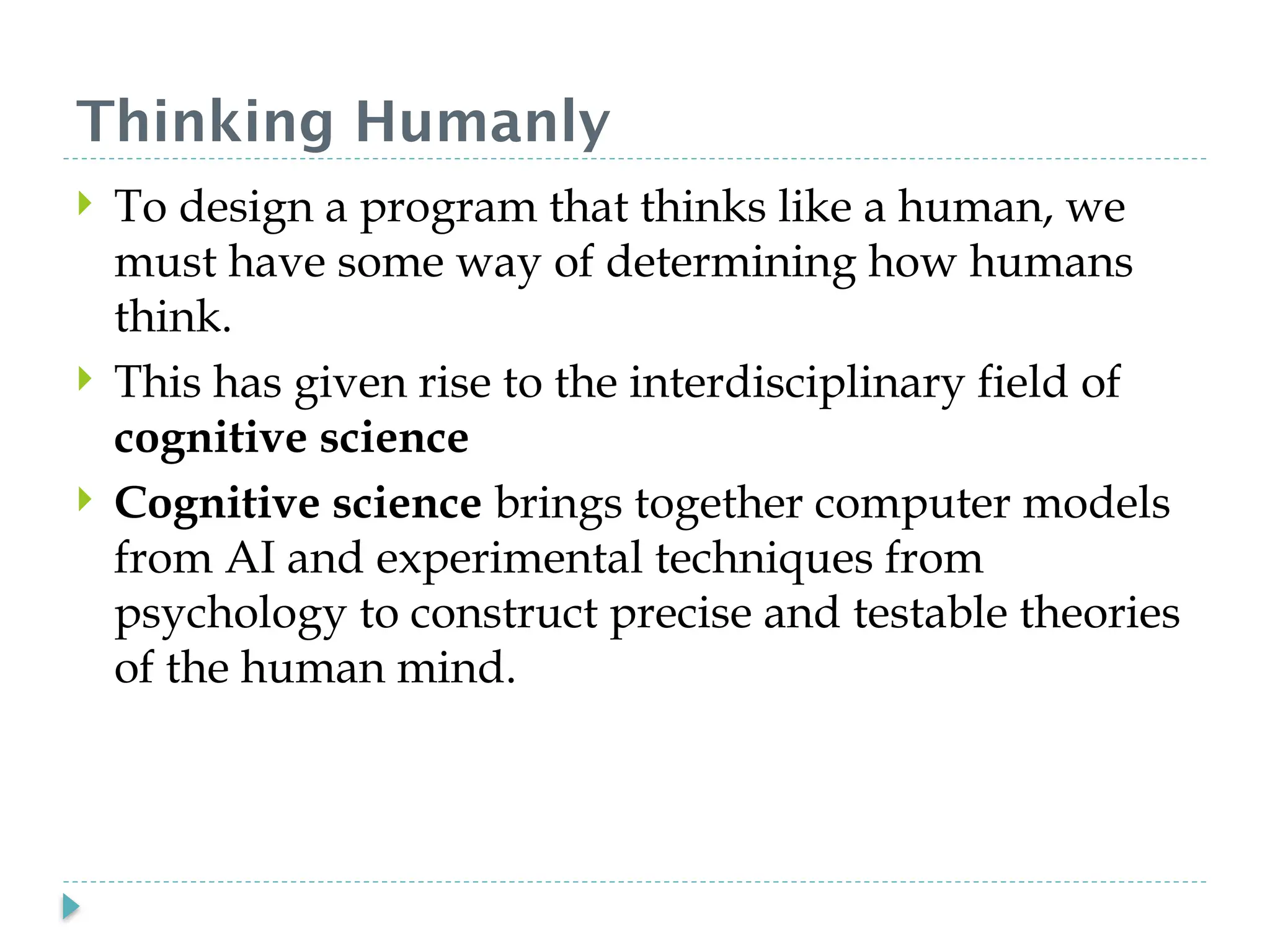
Todesign a program that thinks like a human, we
must have some way of determining how humans
think.
This has given rise to the interdisciplinary field of
cognitive science
Cognitive science brings together computer models
from AI and experimental techniques from
psychology to construct precise and testable theories
of the human mind.
17.
Thinking Rationally
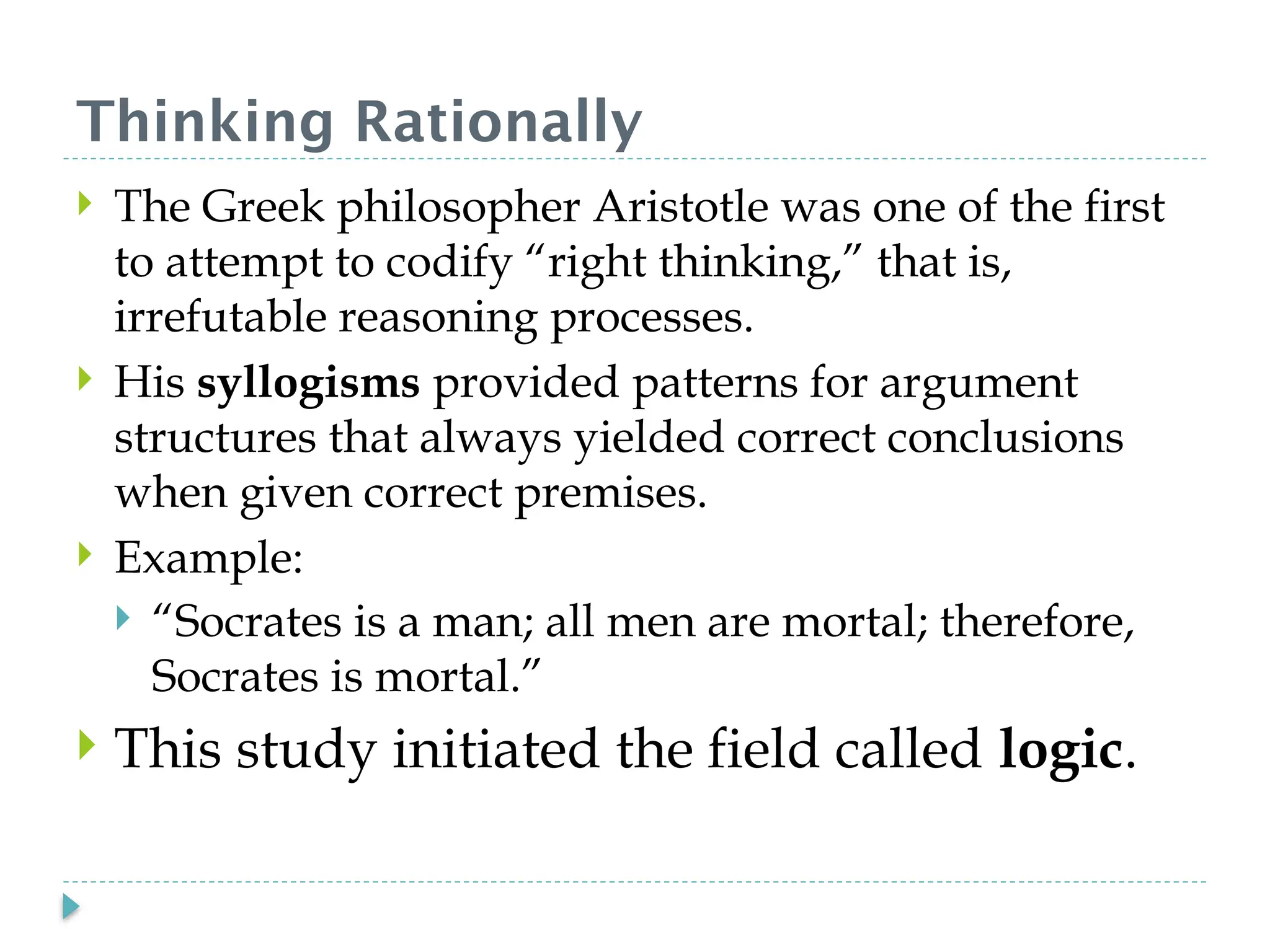
TheGreek philosopher Aristotle was one of the first
to attempt to codify “right thinking,” that is,
irrefutable reasoning processes.
His syllogisms provided patterns for argument
structures that always yielded correct conclusions
when given correct premises.
Example:
“Socrates is a man; all men are mortal; therefore,
Socrates is mortal.”
This study initiated the field called logic.
18.
Thinking Rationally
By1965, programs existed that could, in principle,
solve any solvable problem described in logical
notation.
The so-called logicist tradition within artificial
intelligence hopes to build on such programs to
create intelligent systems.
19.
Acting Rationally
Anagent is just something that acts
A rational agent is one that acts so as to achieve the
best outcome or, when there is uncertainty, the best
expected outcome.
20.
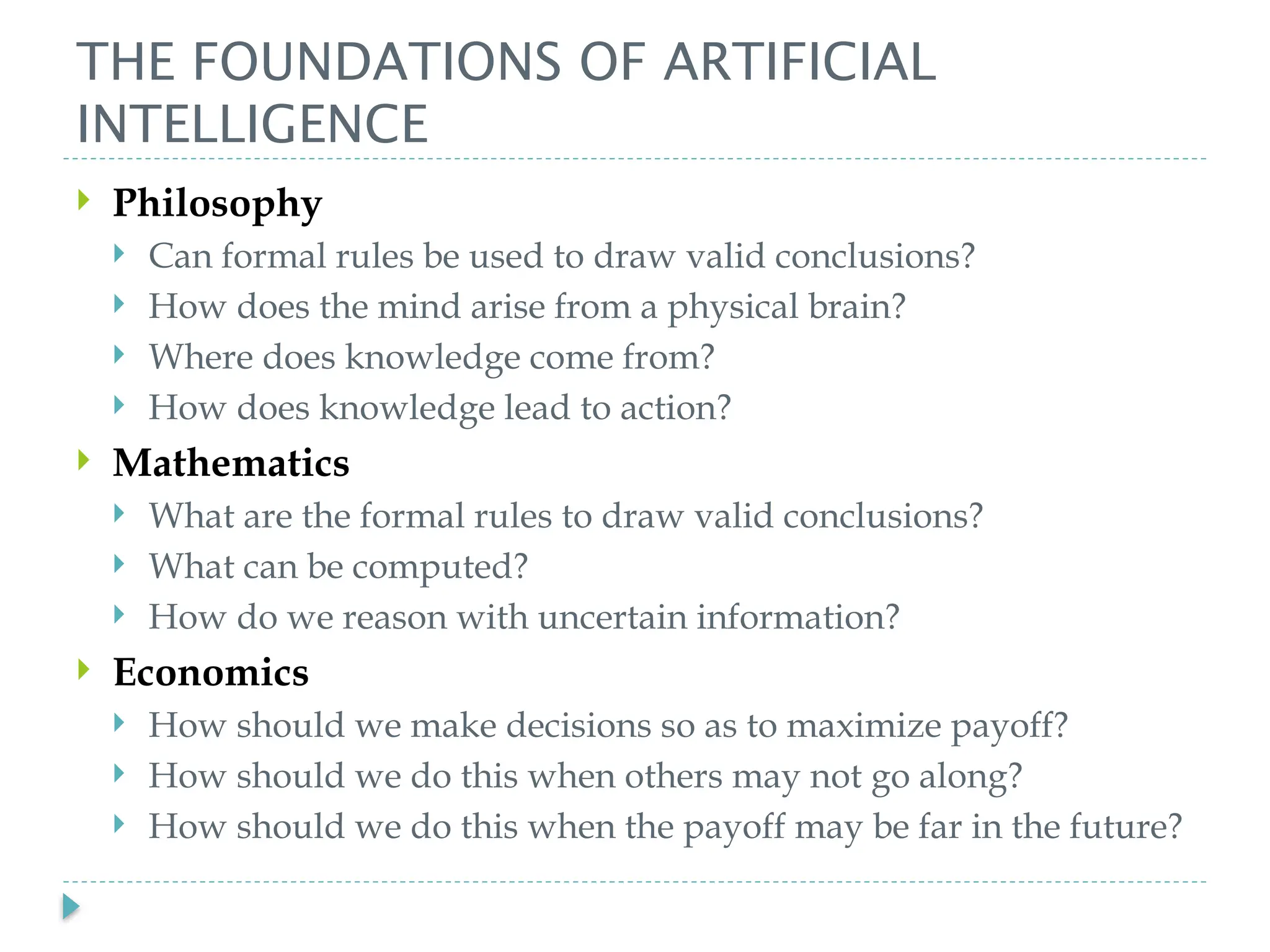
THE FOUNDATIONS OFARTIFICIAL
INTELLIGENCE
Philosophy
Can formal rules be used to draw valid conclusions?
How does the mind arise from a physical brain?
Where does knowledge come from?
How does knowledge lead to action?
Mathematics
What are the formal rules to draw valid conclusions?
What can be computed?
How do we reason with uncertain information?
Economics
How should we make decisions so as to maximize payoff?
How should we do this when others may not go along?
How should we do this when the payoff may be far in the future?
21.
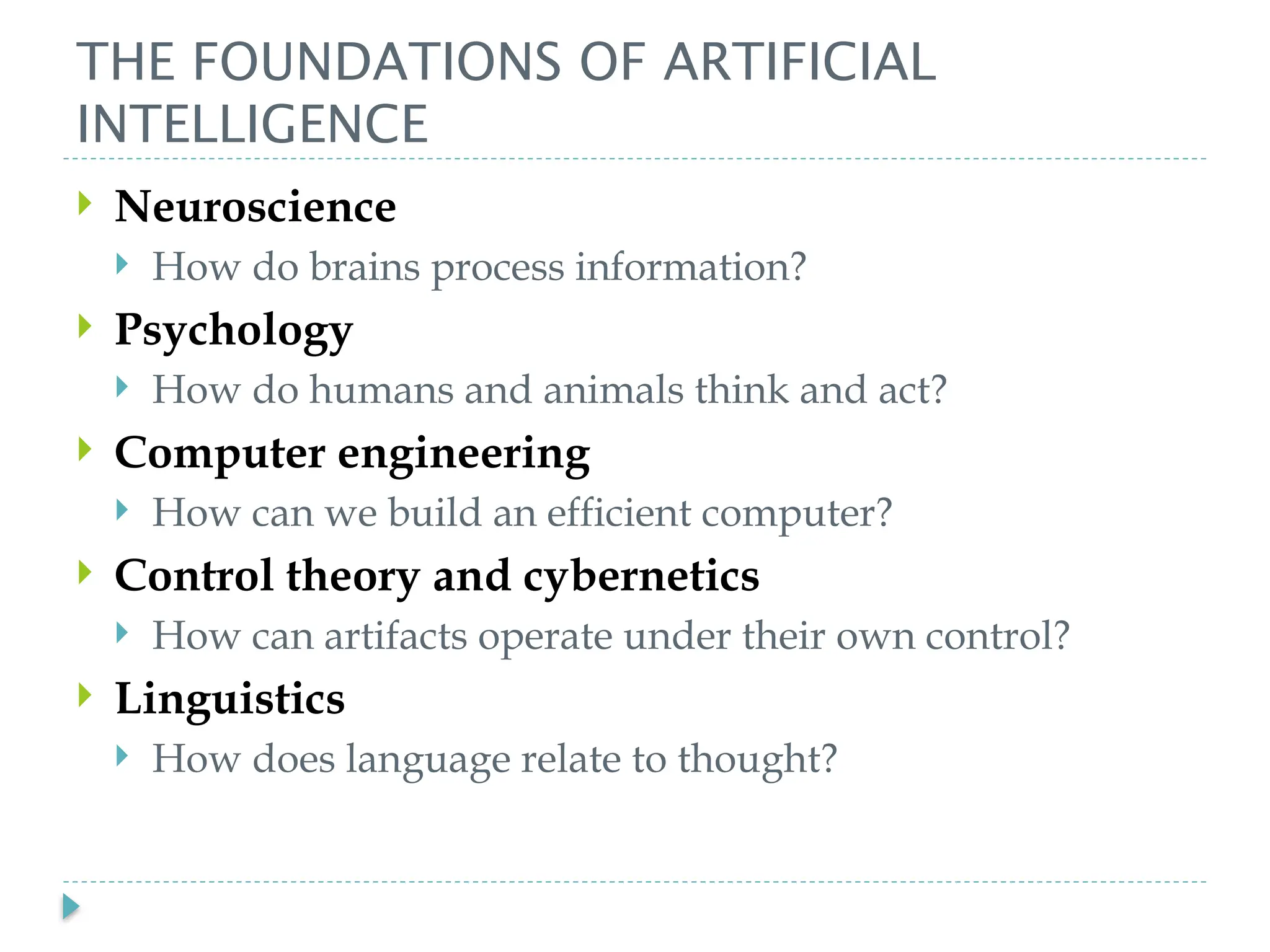
THE FOUNDATIONS OFARTIFICIAL
INTELLIGENCE
Neuroscience
How do brains process information?
Psychology
How do humans and animals think and act?
Computer engineering
How can we build an efficient computer?
Control theory and cybernetics
How can artifacts operate under their own control?
Linguistics
How does language relate to thought?
22.
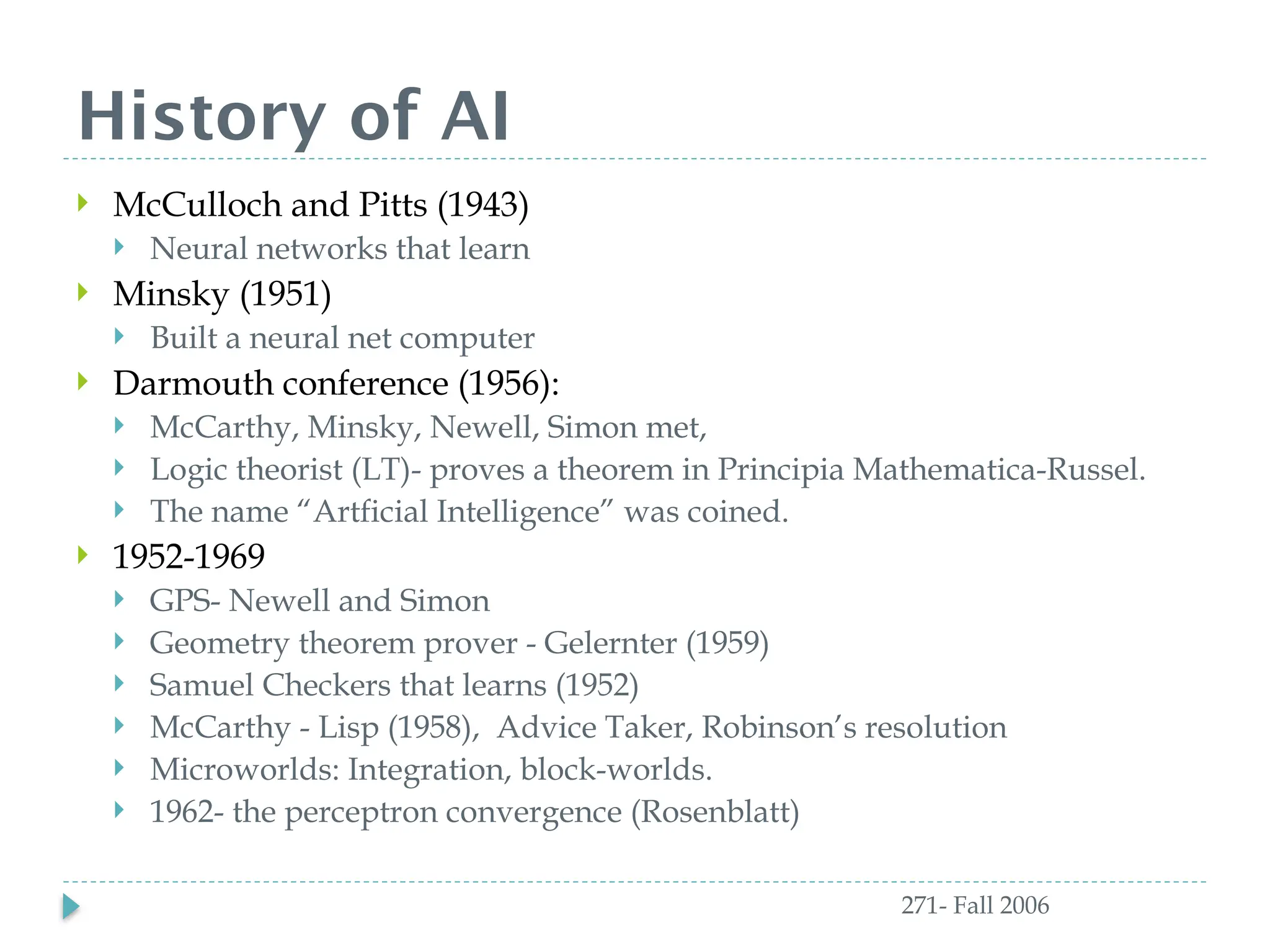
History of AI
271-Fall 2006
McCulloch and Pitts (1943)
Neural networks that learn
Minsky (1951)
Built a neural net computer
Darmouth conference (1956):
McCarthy, Minsky, Newell, Simon met,
Logic theorist (LT)- proves a theorem in Principia Mathematica-Russel.
The name “Artficial Intelligence” was coined.
1952-1969
GPS- Newell and Simon
Geometry theorem prover - Gelernter (1959)
Samuel Checkers that learns (1952)
McCarthy - Lisp (1958), Advice Taker, Robinson’s resolution
Microworlds: Integration, block-worlds.
1962- the perceptron convergence (Rosenblatt)
23.
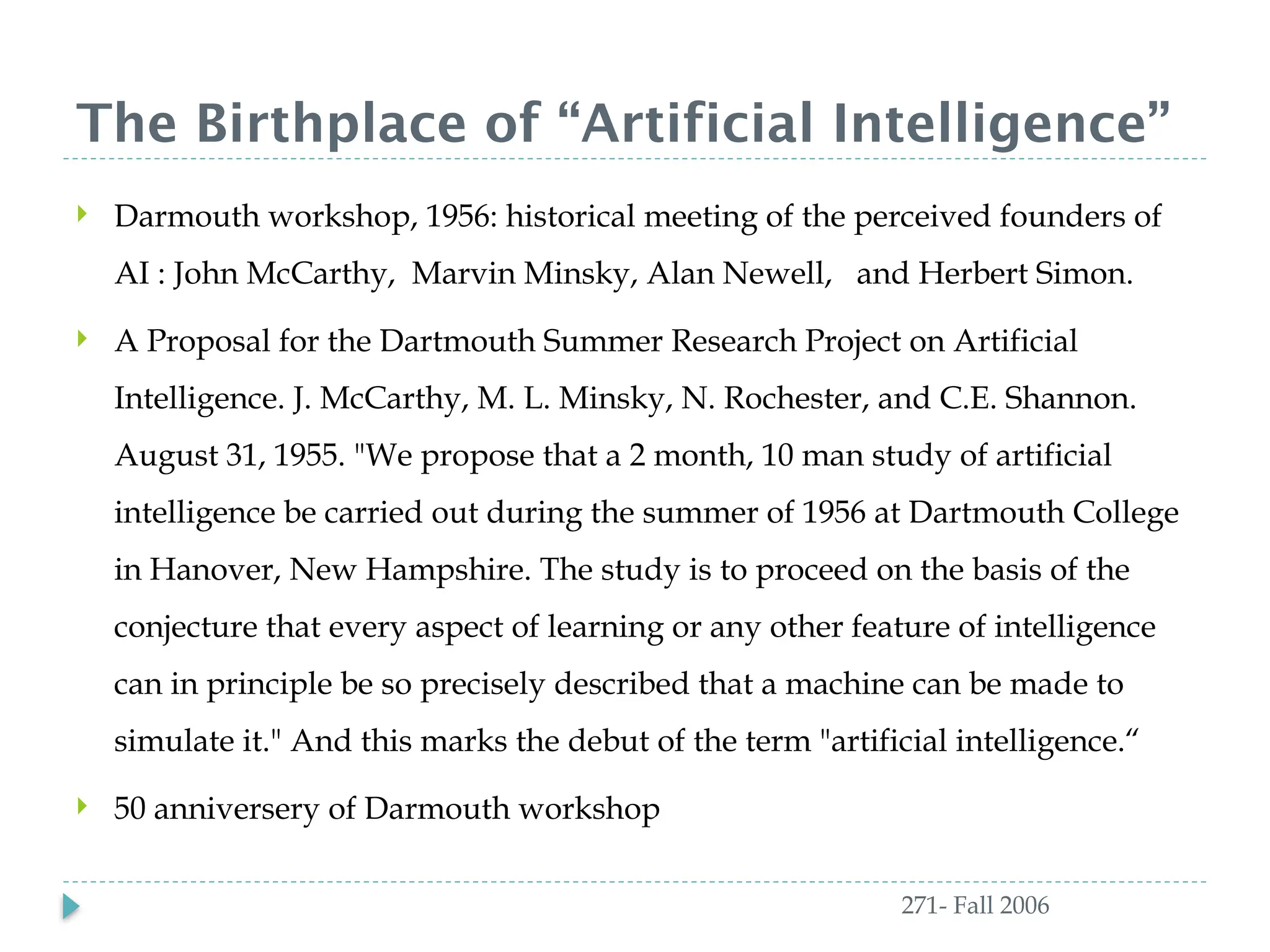
The Birthplace of“Artificial Intelligence”
271- Fall 2006
Darmouth workshop, 1956: historical meeting of the perceived founders of
AI : John McCarthy, Marvin Minsky, Alan Newell, and Herbert Simon.
A Proposal for the Dartmouth Summer Research Project on Artificial
Intelligence. J. McCarthy, M. L. Minsky, N. Rochester, and C.E. Shannon.
August 31, 1955. "We propose that a 2 month, 10 man study of artificial
intelligence be carried out during the summer of 1956 at Dartmouth College
in Hanover, New Hampshire. The study is to proceed on the basis of the
conjecture that every aspect of learning or any other feature of intelligence
can in principle be so precisely described that a machine can be made to
simulate it." And this marks the debut of the term "artificial intelligence.“
50 anniversery of Darmouth workshop
24.
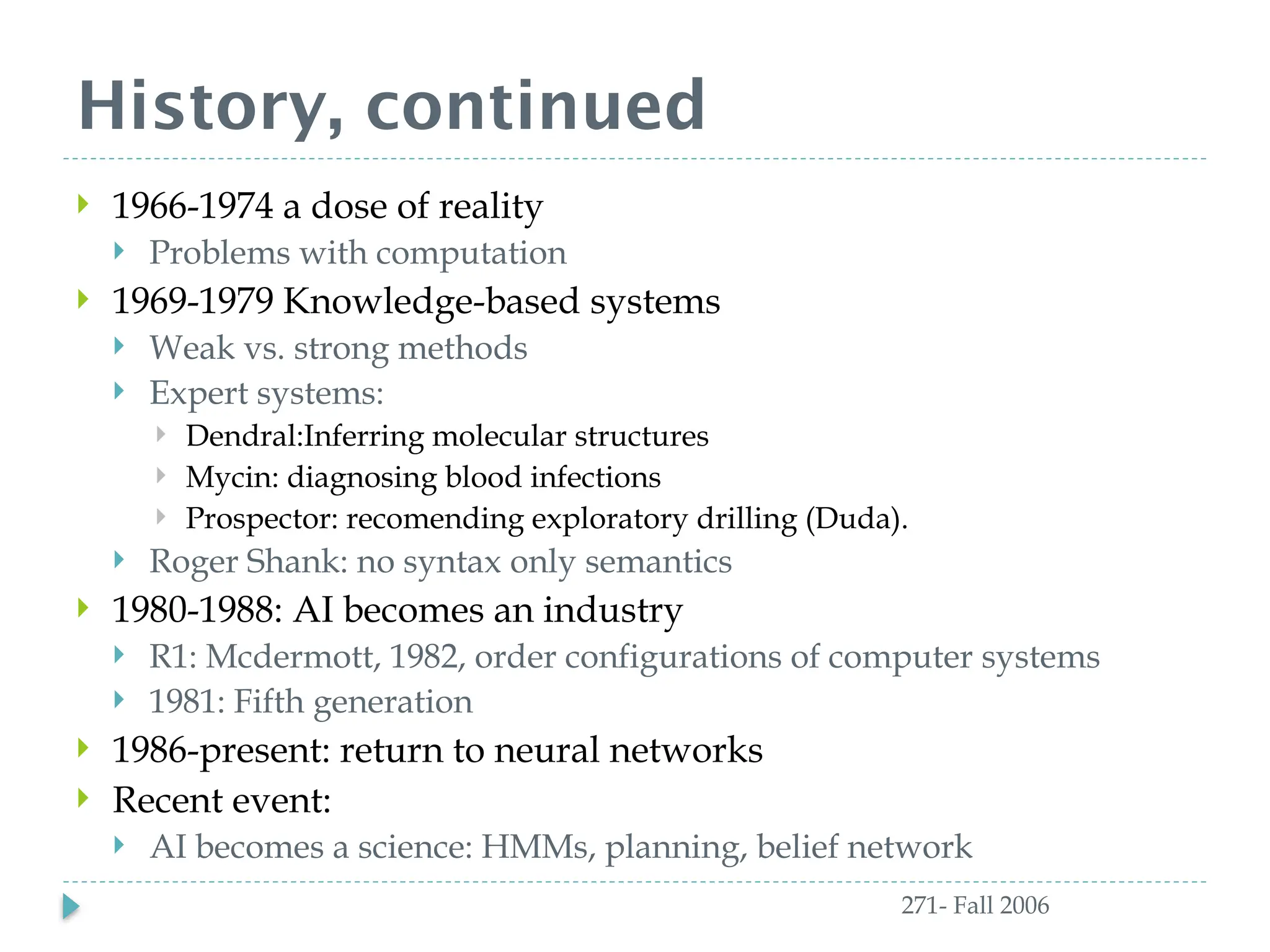
History, continued
271- Fall2006
1966-1974 a dose of reality
Problems with computation
1969-1979 Knowledge-based systems
Weak vs. strong methods
Expert systems:
Dendral:Inferring molecular structures
Mycin: diagnosing blood infections
Prospector: recomending exploratory drilling (Duda).
Roger Shank: no syntax only semantics
1980-1988: AI becomes an industry
R1: Mcdermott, 1982, order configurations of computer systems
1981: Fifth generation
1986-present: return to neural networks
Recent event:
AI becomes a science: HMMs, planning, belief network
25.
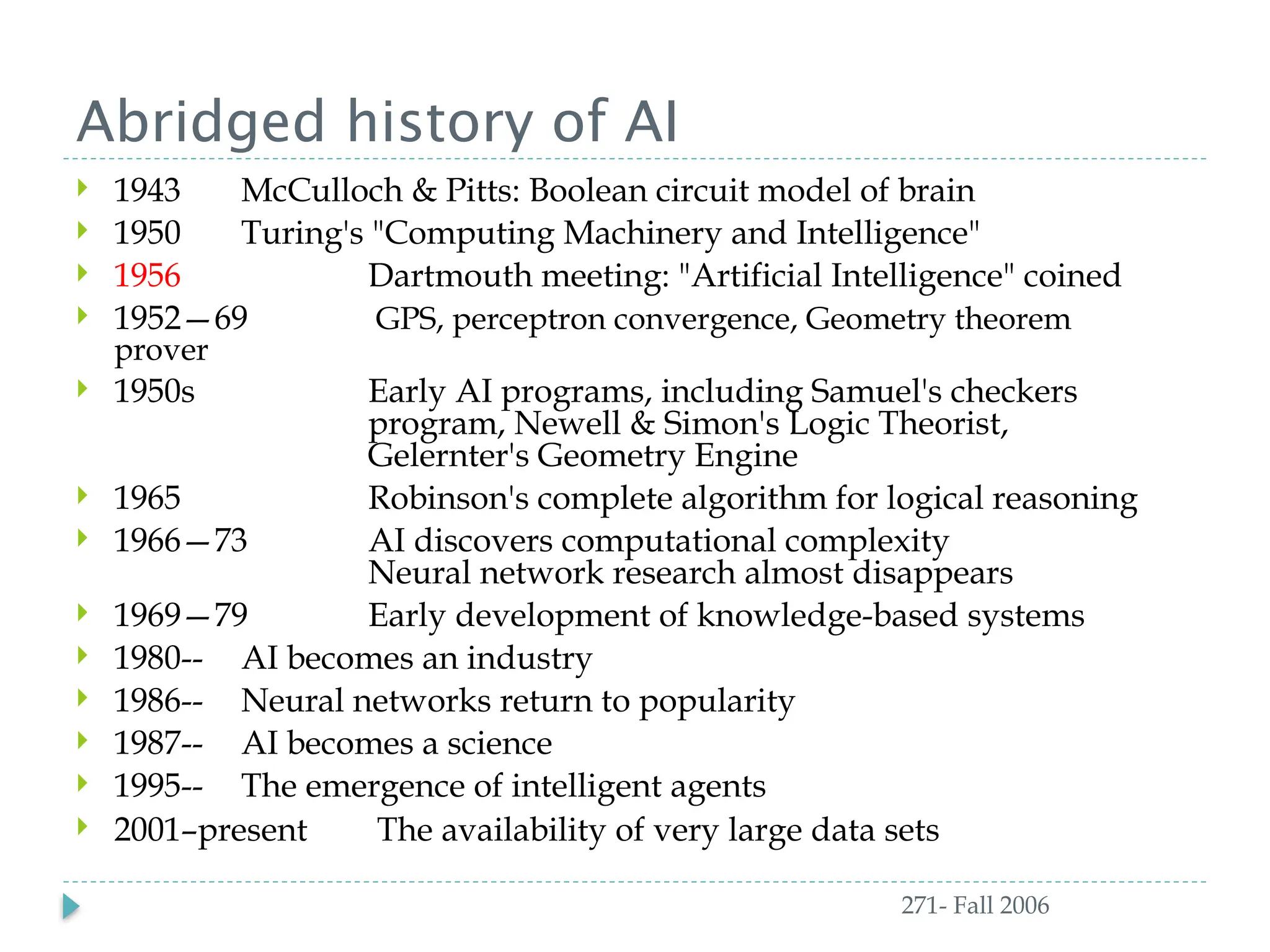
Abridged history ofAI
271- Fall 2006
1943 McCulloch & Pitts: Boolean circuit model of brain
1950 Turing's "Computing Machinery and Intelligence"
1956 Dartmouth meeting: "Artificial Intelligence" coined
1952—69 GPS, perceptron convergence, Geometry theorem
prover
1950s Early AI programs, including Samuel's checkers
program, Newell & Simon's Logic Theorist,
Gelernter's Geometry Engine
1965 Robinson's complete algorithm for logical reasoning
1966—73 AI discovers computational complexity
Neural network research almost disappears
1969—79 Early development of knowledge-based systems
1980-- AI becomes an industry
1986-- Neural networks return to popularity
1987-- AI becomes a science
1995-- The emergence of intelligent agents
2001–present The availability of very large data sets
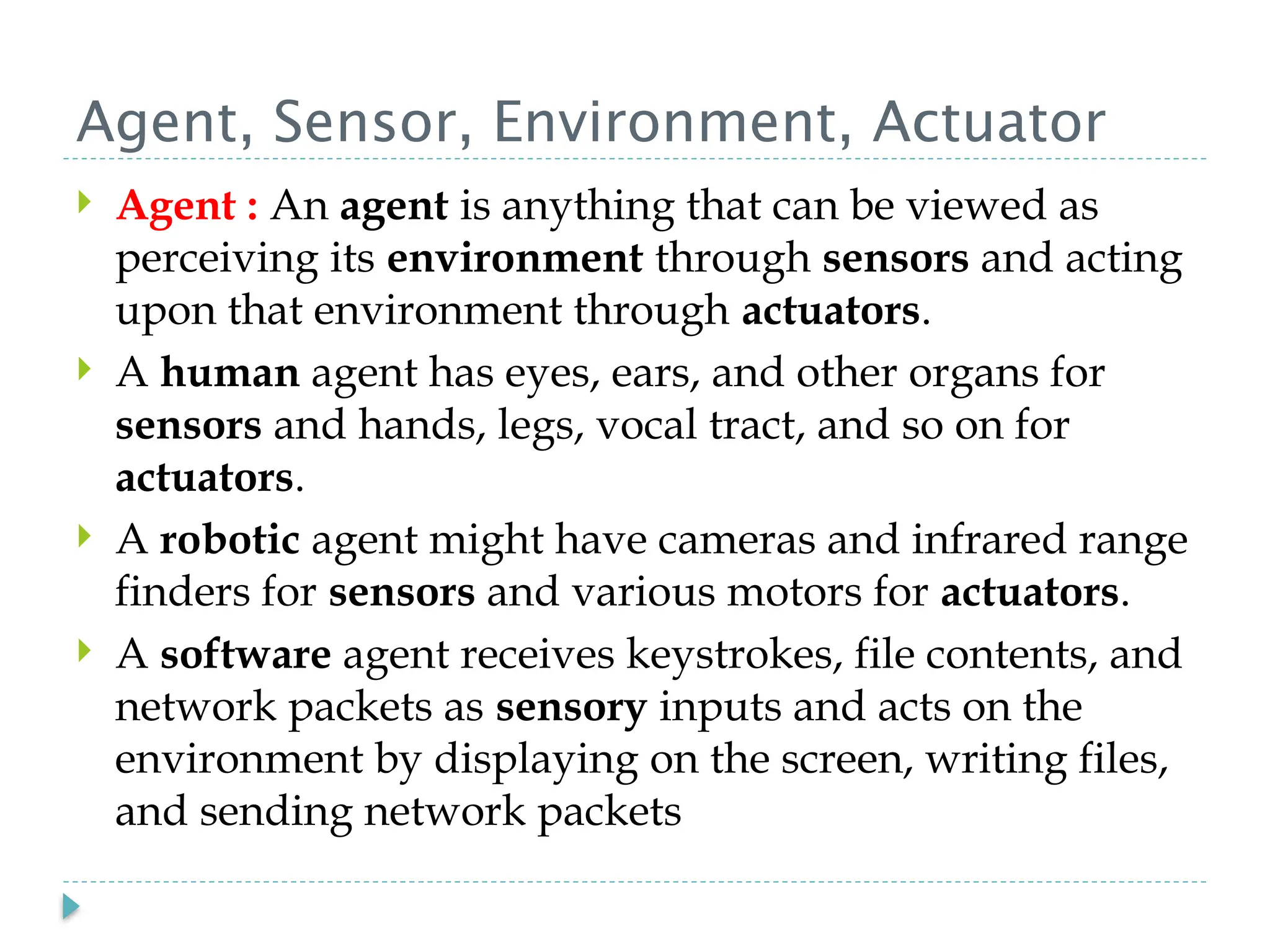
Agent, Sensor, Environment,Actuator
Agent : An agent is anything that can be viewed as
perceiving its environment through sensors and acting
upon that environment through actuators.
A human agent has eyes, ears, and other organs for
sensors and hands, legs, vocal tract, and so on for
actuators.
A robotic agent might have cameras and infrared range
finders for sensors and various motors for actuators.
A software agent receives keystrokes, file contents, and
network packets as sensory inputs and acts on the
environment by displaying on the screen, writing files,
and sending network packets
28.
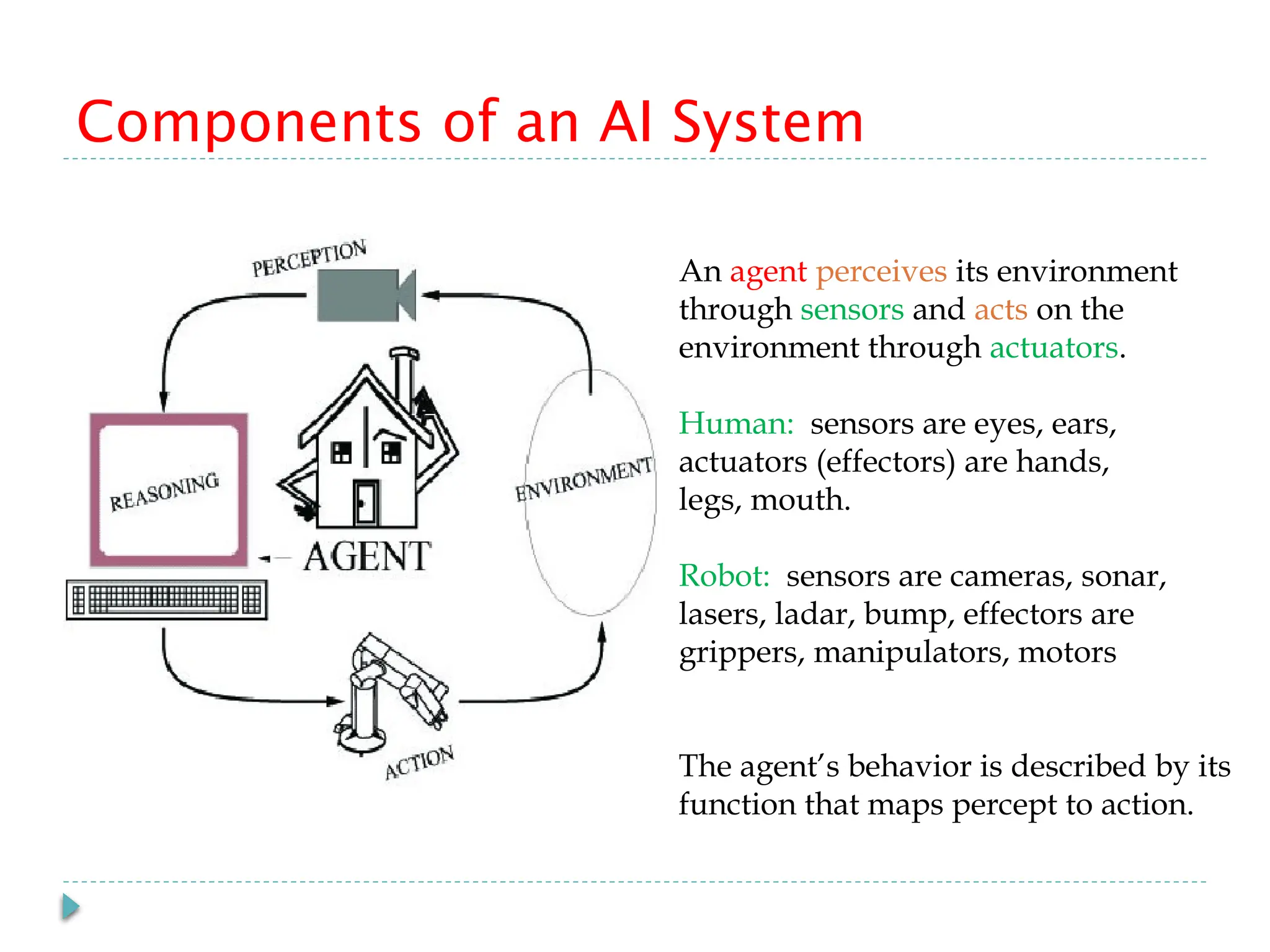
Components of anAI System
An agent perceives its environment
through sensors and acts on the
environment through actuators.
Human: sensors are eyes, ears,
actuators (effectors) are hands,
legs, mouth.
Robot: sensors are cameras, sonar,
lasers, ladar, bump, effectors are
grippers, manipulators, motors
The agent’s behavior is described by its
function that maps percept to action.
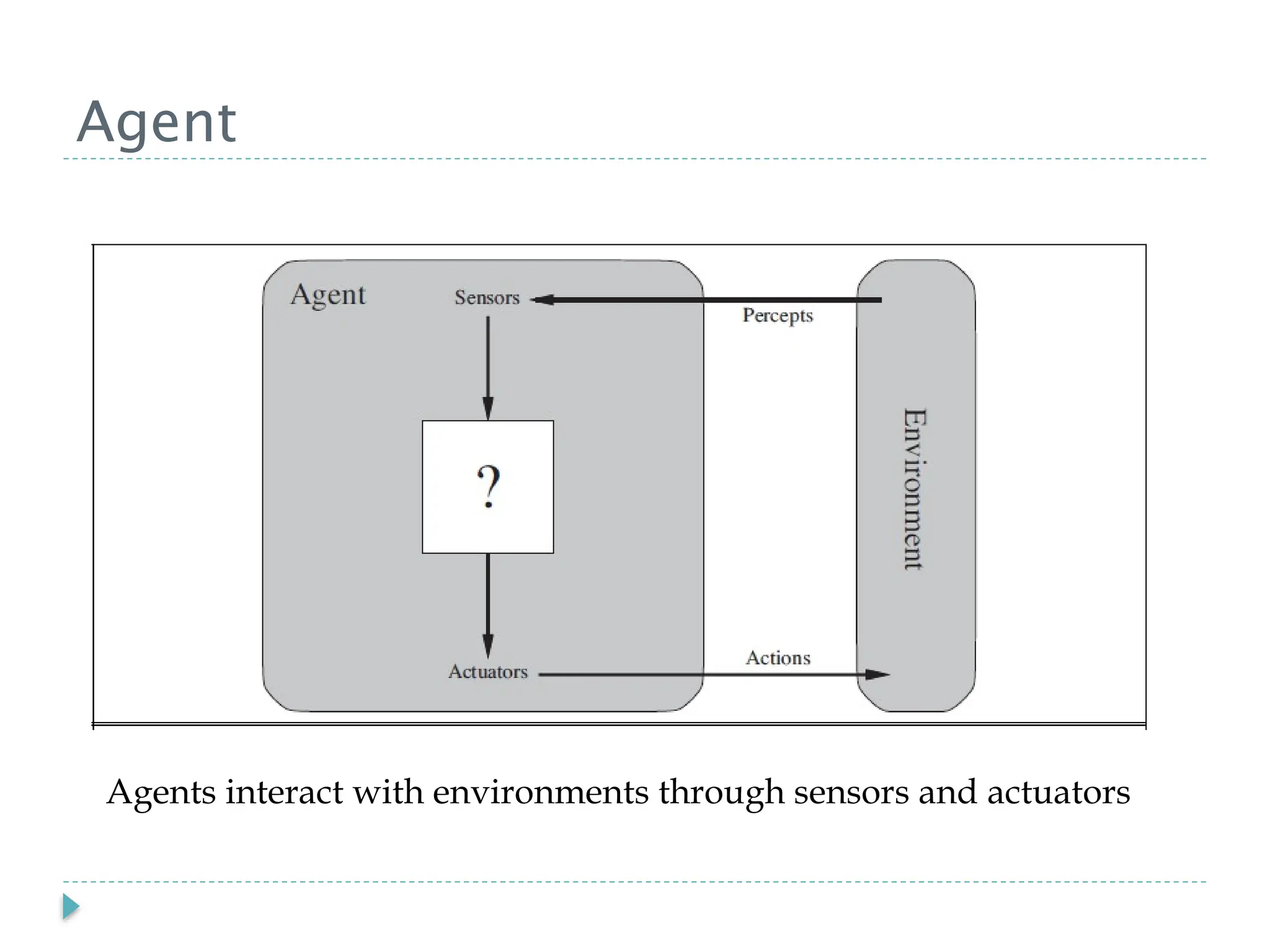
Agent
We usethe term percept to refer to the agent’s
perceptual inputs at any given instant.
An agent’s percept sequence is the complete history
of everything the agent has ever perceived.
In general, an agent’s choice of action at any given
instant can depend on the entire percept sequence
observed to date, but not on anything it hasn’t perceived.
Editor's Notes
#23 A Proposal for the Dartmouth Summer Research Project on Artificial Intelligence. J. McCarthy, M. L. Minsky, N. Rochester, and C.E. Shannon. August 31, 1955. "We propose that a 2 month, 10 man study of artificial intelligence be carried out during the summer of 1956 at Dartmouth College in Hanover, New Hampshire. The study is to proceed on the basis of the conjecture that every aspect of learning or any other feature of intelligence can in principle be so precisely described that a machine can be made to simulate it." And this marks the debut of the term "artificial intelligence.“
#28 LADAR is Laser Detection and Ranging
Light radar by uses light
![Artificial Intelligence : Thinking
Humanly
Haugeland, 1985 : The exciting new effort to make
computers think . . . machines with minds, in the full
and literal sense.”
Bellman, 1978: “[The automation of] activities that
we associate with human thinking, activities such as
decision-making, problem solving, learning . . .”](https://image.slidesharecdn.com/1introduction-250806172112-1792b3c2/75/1_Introduction-to-advance-data-techniques-pptx-5-2048.jpg)


![[DSC Europe 25] Bassam Maharmeh - Artificial Intelligence: Opportunities and ...](https://cdn.slidesharecdn.com/ss_thumbnails/thhfmr2fqpawzj7hsjpg-5-251211083048-2c23204f-thumbnail.jpg?width=640&height=640&fit=bounds)


![[DSC Europe 25] Branko Urosevic -Rethinking Financial Talent: Integrating Cod...](https://cdn.slidesharecdn.com/ss_thumbnails/8jjrus8ttko6qj64f58f-3-251212103250-642c6374-thumbnail.jpg?width=640&height=640&fit=bounds)
![[DSC Europe 25] Tatevik Maytesyan - How to actually use AI in marketing: gett...](https://cdn.slidesharecdn.com/ss_thumbnails/tjo626lsqdgfntbgl2mw-4-251216103155-e36cd239-thumbnail.jpg?width=640&height=640&fit=bounds)
![[DSC Europe 25] Dusan Nesic - Securing Tomorrow’s Infrastructure: Why Cyber-P...](https://cdn.slidesharecdn.com/ss_thumbnails/qikbszfftyowjm2q6duw-1-251211083848-8f2ead6b-thumbnail.jpg?width=640&height=640&fit=bounds)
![[DSC Europe 25] Jovan Bogicevic - Legacy to AI-Driven Defense: Transforming D...](https://cdn.slidesharecdn.com/ss_thumbnails/rsarluadt563hntyfc8q-3-251211083849-3e7bc4c0-thumbnail.jpg?width=640&height=640&fit=bounds)


![[DSC Europe 25] Miodrag Pesovic & Vladislav Radonjic - Federated Data Archite...](https://cdn.slidesharecdn.com/ss_thumbnails/gsbe3y5it5uhndi4e08e-1-251212103249-f1008e0c-thumbnail.jpg?width=640&height=640&fit=bounds)
![[DSC Europe 25] Jon Dajci - Bridging TradFi and DeFi: Building the Future of ...](https://cdn.slidesharecdn.com/ss_thumbnails/fqmhfvlbqhkihjvqvhmu-7-251211083849-6af7e325-thumbnail.jpg?width=640&height=640&fit=bounds)


![[DSC Europe 25] Kaja Kandare - LLM as a judge.pptx](https://cdn.slidesharecdn.com/ss_thumbnails/arxyccaxsdsd1ba99wjw-7-251212104007-2b4e3f64-thumbnail.jpg?width=640&height=640&fit=bounds)
