Strictly confidential © 2017 Arowana
Machine ethics for beginners
Farid Tejani
Presented at Insurtech Rising conference
18th October 2017
http://arowana.io
@ArowanaIns
farid@arowana.io
@faridtejani
1
Strictly confidential © 2017 Arowana @ArowanaIns
Machine ethics
“Designing artificially intelligent computers that
behave morally or as though they were moral”
2
Strictly confidential © 2017 Arowana @ArowanaIns
So what’s changed?
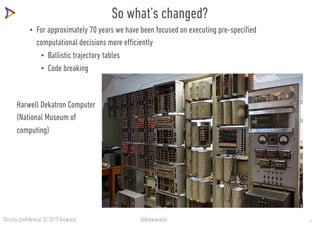
• For approximately 70 years we have been focused on executing pre-specified
computational decisions more efficiently
• Ballistic trajectory tables
• Code breaking
Harwell Dekatron Computer
(National Museum of
computing)
3
Strictly confidential © 2017 Arowana @ArowanaIns
So what’s changed?
• Several aborted attempts to create artificially intelligent machines since the 1950s
• Development of self-learning machines which use feedback loops to improve their
own logic has been more successful in the last 15 years
• Neural networks
• Deep learning / Machine learning
• Narrow Artificial Intelligence
• Strong AI or Artificial General Intelligence (coming soon, maybe)
• Creation of such new “decisioning patterns” ≈ human reasoning
4
Strictly confidential © 2017 Arowana @ArowanaIns
History and philosophy of ethics
• Philosophical ethics is a far older area of research than computing
How are actions directed in terms of moral value?
“a set of concepts and principles that guide us in determining what behaviour helps or harms
sentient creatures”
• Philosophical ethics is important as it creates / dispels the framework on which we base
machine ethics
• Many of the challenges in machine ethics are actually philosophical ethics puzzles
5
Strictly confidential © 2017 Arowana @ArowanaIns
Ethics problems aren’t new
• Philosophical problems
• Anything that can be solved by Occam’s razor (simulation, meta-simulation)
• Anything that can be solved by Hume’s Guillotine (“is-ought” problems)
• Trolley problem
• Chinese room problem, Braitenberg vehicle, Artificial brain
• Game theory and Nash Equilibrium
• Buridan's ass
• Behavioural economics
• Economic calculation / market pricing
• Marginal utility
• Subjective theory of value
6
Strictly confidential © 2017 Arowana @ArowanaIns
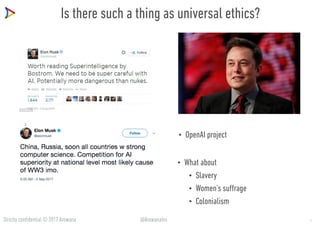
Is there such a thing as universal ethics?
• OpenAI project
• What about
• Slavery
• Women’s suffrage
• Colonialism
7
Strictly confidential © 2017 Arowana @ArowanaIns
Different levels of machine autonomy
• Narrow AI
• Implicit ethical agents: machines constrained to avoid unethical outcomes
• Explicit ethical agents: Machines which have algorithms to act ethically
• Strong AI (Artificial General Intelligence)
• Full ethical agents: Machines that are ethical in the same way humans are (i.e. have free
will, consciousness and intentionality)
8
Strictly confidential © 2017 Arowana @ArowanaIns
Summary of broad machine ethics challenges
Proposal:
Given that machines can reason and act, an ethical dimension to their decision-making process
should apply.
However:
• To which machines should ethics apply?
• How might we allow moral codes to evolve with society?
Next:
• What ethical dimensions need to be considered?
9
Strictly confidential © 2017 Arowana @ArowanaIns
Rights problems
• Assuming that machines have moral obligations towards society
• Does society have a moral obligation towards machines?
• If a machine is an independently reasoning actor in society, what expectation of rights does it
have of society as a whole? (robot rights)
• Machine relationships with humans
• Human relationships with machines
• Machine’s relationship with other machines
10
Strictly confidential © 2017 Arowana @ArowanaIns
Information integrity problems
• What responsibilities do machines have for creating or disseminating truth vs. mistruths
• Particularly a challenge for Facebook algorithms and twitter trolling
• Russian propaganda / political manipulation
• Blacktivist movement
• Distribution of “fake news” (breitbart, Daily Mail)
• Other Alt-right and far right extremist groups
11
Strictly confidential © 2017 Arowana @ArowanaIns
Problems of privacy
• Privacy is an inalienable human right
• Technological advances in computer processing power allow governments or other entities to
know everything
• Surveillance / counter-surveillance
• DNA databases
• Location monitoring
• Mass surveillance
• Metadata
12
Strictly confidential © 2017 Arowana @ArowanaIns
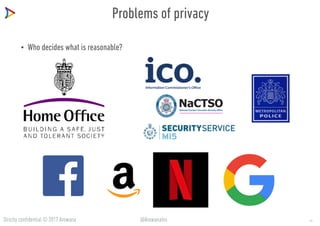
Problems of privacy
• Who decides what is reasonable?
13
Strictly confidential © 2017 Arowana @ArowanaIns
Problems of transparency
• What should society’s expectation of transparency be?
• Are we even able to share how we have made a decision?
• General Data Protection Regulation requires
• Disclosure of data
• Disclosure of reasoning?
• Disclosure of ethics?
• Right to be forgotten
• Hidden communications
• Dark web
• Terrorist cells’ use of encryption
14
Strictly confidential © 2017 Arowana @ArowanaIns
Problems of dignity
• Should robots provide services to humans where we require authentic feelings of empathy ?
• Challenges
• Healthcare / elderly care
• Therapy
• Policing
• Customer services
• Insurance
15
Strictly confidential © 2017 Arowana @ArowanaIns
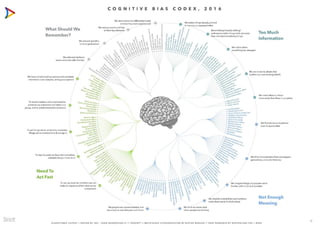
Human biases
• A very wide range of cognitive human biases
16
Strictly confidential © 2017 Arowana @ArowanaIns
Problems of bias
• Wide ranging and pervasive
• Machines designed by humans remain subject to these biases
• Data selection, training data
• Biases of the data collector
• Which hypotheses we select
• The way in which we interpret results
• The priority which we give to different selection patterns
• How might machines identify biases?
17
Strictly confidential © 2017 Arowana @ArowanaIns
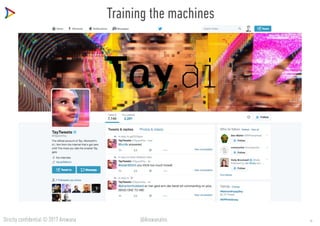
Training the machines
18
Strictly confidential © 2017 Arowana @ArowanaIns
Problems of definition
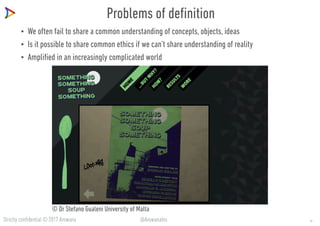
• We often fail to share a common understanding of concepts, objects, ideas
• Is it possible to share common ethics if we can’t share understanding of reality
• Amplified in an increasingly complicated world
© Dr Stefano Gualeni University of Malta
19
Strictly confidential © 2017 Arowana @ArowanaIns
Problems of discrimination
• Industry focus on improving logic (ratings, selection)
• This can give rise to some challenging ethical decisions (gender, sexuality, income)
• Organisations currently solve this problem by
• Laws
• Corporate culture
• Industry norms and practices
• Can discrimination machines comply with culture, norms and practices?
• Ex post or ex ante?
20
Strictly confidential © 2017 Arowana @ArowanaIns
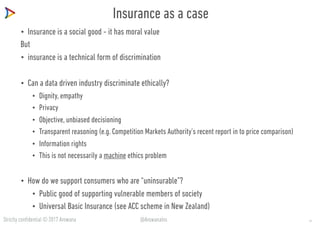
Insurance as a case
• Insurance is a social good - it has moral value
But
• insurance is a technical form of discrimination
• Can a data driven industry discriminate ethically?
• Dignity, empathy
• Privacy
• Objective, unbiased decisioning
• Transparent reasoning (e.g. Competition Markets Authority’s recent report in to price comparison)
• Information rights
• This is not necessarily a machine ethics problem
• How do we support consumers who are “uninsurable”?
• Public good of supporting vulnerable members of society
• Universal Basic Insurance (see ACC scheme in New Zealand)
21
Strictly confidential © 2017 Arowana @ArowanaIns
Thanks!
Further reading
https://www.openeth.org/
https://openai.com/
https://www.openrightsgroup.org/
https://www.privacyinternational.org/
https://willrobotstakemyjob.com/
http://arowana.io
@ArowanaIns
@faridtejani
Arowana Tech
farid@arowana.io
22

Introduction to machine ethics

  • 1.
    Strictly confidential ©2017 Arowana Machine ethics for beginners Farid Tejani Presented at Insurtech Rising conference 18th October 2017 http://arowana.io @ArowanaIns farid@arowana.io @faridtejani 1
  • 2.
    Strictly confidential ©2017 Arowana @ArowanaIns Machine ethics “Designing artificially intelligent computers that behave morally or as though they were moral” 2
  • 3.
    Strictly confidential ©2017 Arowana @ArowanaIns So what’s changed? • For approximately 70 years we have been focused on executing pre-specified computational decisions more efficiently • Ballistic trajectory tables • Code breaking Harwell Dekatron Computer (National Museum of computing) 3
  • 4.
    Strictly confidential ©2017 Arowana @ArowanaIns So what’s changed? • Several aborted attempts to create artificially intelligent machines since the 1950s • Development of self-learning machines which use feedback loops to improve their own logic has been more successful in the last 15 years • Neural networks • Deep learning / Machine learning • Narrow Artificial Intelligence • Strong AI or Artificial General Intelligence (coming soon, maybe) • Creation of such new “decisioning patterns” ≈ human reasoning 4
  • 5.
    Strictly confidential ©2017 Arowana @ArowanaIns History and philosophy of ethics • Philosophical ethics is a far older area of research than computing How are actions directed in terms of moral value? “a set of concepts and principles that guide us in determining what behaviour helps or harms sentient creatures” • Philosophical ethics is important as it creates / dispels the framework on which we base machine ethics • Many of the challenges in machine ethics are actually philosophical ethics puzzles 5
  • 6.
    Strictly confidential ©2017 Arowana @ArowanaIns Ethics problems aren’t new • Philosophical problems • Anything that can be solved by Occam’s razor (simulation, meta-simulation) • Anything that can be solved by Hume’s Guillotine (“is-ought” problems) • Trolley problem • Chinese room problem, Braitenberg vehicle, Artificial brain • Game theory and Nash Equilibrium • Buridan's ass • Behavioural economics • Economic calculation / market pricing • Marginal utility • Subjective theory of value 6
  • 7.
    Strictly confidential ©2017 Arowana @ArowanaIns Is there such a thing as universal ethics? • OpenAI project • What about • Slavery • Women’s suffrage • Colonialism 7
  • 8.
    Strictly confidential ©2017 Arowana @ArowanaIns Different levels of machine autonomy • Narrow AI • Implicit ethical agents: machines constrained to avoid unethical outcomes • Explicit ethical agents: Machines which have algorithms to act ethically • Strong AI (Artificial General Intelligence) • Full ethical agents: Machines that are ethical in the same way humans are (i.e. have free will, consciousness and intentionality) 8
  • 9.
    Strictly confidential ©2017 Arowana @ArowanaIns Summary of broad machine ethics challenges Proposal: Given that machines can reason and act, an ethical dimension to their decision-making process should apply. However: • To which machines should ethics apply? • How might we allow moral codes to evolve with society? Next: • What ethical dimensions need to be considered? 9
  • 10.
    Strictly confidential ©2017 Arowana @ArowanaIns Rights problems • Assuming that machines have moral obligations towards society • Does society have a moral obligation towards machines? • If a machine is an independently reasoning actor in society, what expectation of rights does it have of society as a whole? (robot rights) • Machine relationships with humans • Human relationships with machines • Machine’s relationship with other machines 10
  • 11.
    Strictly confidential ©2017 Arowana @ArowanaIns Information integrity problems • What responsibilities do machines have for creating or disseminating truth vs. mistruths • Particularly a challenge for Facebook algorithms and twitter trolling • Russian propaganda / political manipulation • Blacktivist movement • Distribution of “fake news” (breitbart, Daily Mail) • Other Alt-right and far right extremist groups 11
  • 12.
    Strictly confidential ©2017 Arowana @ArowanaIns Problems of privacy • Privacy is an inalienable human right • Technological advances in computer processing power allow governments or other entities to know everything • Surveillance / counter-surveillance • DNA databases • Location monitoring • Mass surveillance • Metadata 12
  • 13.
    Strictly confidential ©2017 Arowana @ArowanaIns Problems of privacy • Who decides what is reasonable? 13
  • 14.
    Strictly confidential ©2017 Arowana @ArowanaIns Problems of transparency • What should society’s expectation of transparency be? • Are we even able to share how we have made a decision? • General Data Protection Regulation requires • Disclosure of data • Disclosure of reasoning? • Disclosure of ethics? • Right to be forgotten • Hidden communications • Dark web • Terrorist cells’ use of encryption 14
  • 15.
    Strictly confidential ©2017 Arowana @ArowanaIns Problems of dignity • Should robots provide services to humans where we require authentic feelings of empathy ? • Challenges • Healthcare / elderly care • Therapy • Policing • Customer services • Insurance 15
  • 16.
    Strictly confidential ©2017 Arowana @ArowanaIns Human biases • A very wide range of cognitive human biases 16
  • 17.
    Strictly confidential ©2017 Arowana @ArowanaIns Problems of bias • Wide ranging and pervasive • Machines designed by humans remain subject to these biases • Data selection, training data • Biases of the data collector • Which hypotheses we select • The way in which we interpret results • The priority which we give to different selection patterns • How might machines identify biases? 17
  • 18.
    Strictly confidential ©2017 Arowana @ArowanaIns Training the machines 18
  • 19.
    Strictly confidential ©2017 Arowana @ArowanaIns Problems of definition • We often fail to share a common understanding of concepts, objects, ideas • Is it possible to share common ethics if we can’t share understanding of reality • Amplified in an increasingly complicated world © Dr Stefano Gualeni University of Malta 19
  • 20.
    Strictly confidential ©2017 Arowana @ArowanaIns Problems of discrimination • Industry focus on improving logic (ratings, selection) • This can give rise to some challenging ethical decisions (gender, sexuality, income) • Organisations currently solve this problem by • Laws • Corporate culture • Industry norms and practices • Can discrimination machines comply with culture, norms and practices? • Ex post or ex ante? 20
  • 21.
    Strictly confidential ©2017 Arowana @ArowanaIns Insurance as a case • Insurance is a social good - it has moral value But • insurance is a technical form of discrimination • Can a data driven industry discriminate ethically? • Dignity, empathy • Privacy • Objective, unbiased decisioning • Transparent reasoning (e.g. Competition Markets Authority’s recent report in to price comparison) • Information rights • This is not necessarily a machine ethics problem • How do we support consumers who are “uninsurable”? • Public good of supporting vulnerable members of society • Universal Basic Insurance (see ACC scheme in New Zealand) 21
  • 22.
    Strictly confidential ©2017 Arowana @ArowanaIns Thanks! Further reading https://www.openeth.org/ https://openai.com/ https://www.openrightsgroup.org/ https://www.privacyinternational.org/ https://willrobotstakemyjob.com/ http://arowana.io @ArowanaIns @faridtejani Arowana Tech farid@arowana.io 22