Artificial Intelligence
CSE-345
1. What is intelligence? [Wikipedia]
 Also called intellect
 An umbrella term used to describe a property of the mind that encompasses many
related abilities, such as the capacities
 to reason,
 to plan,
 to solve problems,
 to thinkabstractly,
 to comprehendideas,
 to use language,and
 to learn
2. What is intelligence? [Dictionary]
 Ability to acquire, understand & apply knowledge, or the ability to exercise thought &
reason
3. What’s involvedin Intelligence?
 Ability to interact with the real world
o to perceive, understand, and act
 e.g., speech recognition and image understanding
 Reasoning and Planning
o modeling the external world, given input
o solving new problems, planning, and making decisions
o ability to deal with unexpected problems, uncertainties
 Learning and Adaptation
o we are continuously learning and adapting
o our internal models are always being “updated”
 e.g., a baby learning to categorize and recognize animals
4. Goals of AI
a) System that think like humans
b) Systems that think rationally
c) Systems that act like humans
d) Systems that act rationally
5. Thinking humanly: Cognitive Science
Effort to make computer think; i.e. the machine with minds, in the full and literal sense.
Focus is not just on behavior and I/O, but looks at reasoning process
Computational model as to how result were obtained.
Goal is not just to produce human-like behavior, but to produce a sequence of steps of
the reasoning process, similar to the steps followed by a human in solving the same
task.
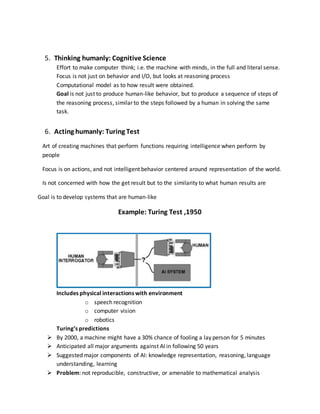
6. Acting humanly: Turing Test
Art of creating machines that perform functions requiring intelligence when perform by
people
Focus is on actions, and not intelligent behavior centered around representation of the world.
Is not concerned with how the get result but to the similarity to what human results are
Goal is to develop systems that are human-like
Example: Turing Test ,1950
Includes physical interactions with environment
o speech recognition
o computer vision
o robotics
Turing’s predictions
 By 2000, a machine might have a 30% chance of fooling a lay person for 5 minutes
 Anticipated all major arguments against AI in following 50 years
 Suggested major components of AI: knowledge representation, reasoning, language
understanding, learning
 Problem: not reproducible, constructive, or amenable to mathematical analysis
7. Thinking rationally:Laws of Thought
 Study of mental faculties through the use of computational models; i.e. study of the
computations that make it possible to perceive , reason, and act.
 Focus is on inference mechanism that are provably correct and guarantee an optimal
solution.
 Develop systems of representation to allow inference to be like “Socrates is a man. All
men are mortal. Therefore, Socrates is mortal.”
 Goal is to formalize the reasoning process as a system of logical rules and procedures for
inference.
The issues is, not all problem can be solved just by reasoning and inferences.
8. Acting rationally:Rational Agent
 Rational behavior: doing the right thing
 The right thing: that which is expected to maximize goal achievement, given the
available information
 Doesn't necessarily involve thinking-e.g., blinking reflex-but thinking should be in the
service of rational action
Aristotle (NicomacheanEthics):
Everyart and everyinquiry,andsimilarlyeveryactionandpursuit,isthoughttoaimat some
good
9. Strong AI vs. Weak AI
 AI research aims to create AI that can replicate human intelligence completely.
 Strong AI
– refers to a machine that approaches or supersedes human intelligence
– if it can do typical human tasks
– if it can apply a wide range of back ground knowledge and
– if it has some degree of self-consciousness.
– aims to build machine whose overall ability is indistinguishable from that of
human being.
 Weak AI
– refers to the use of software to study or accomplish specific problem solving or
reasoning tasks that do not encompass the full range of human cognitive abilities
e.g. a chess program
– does not achieve self abilities; it is merely an intelligent, a specific problem solver
1. The machine can actually think and
perform tasks on its own just like a
human being.
1. The devices cannot follow these tasks
on their own but are made to look
intelligent.
2. An algorithm is stored by a computer
program.
2. Tasks are entered manually to be
performed.
3. There are no proper examples of
Strong AI.
3. An automatic car or remote control
devices.
4. Initial Stage 4. Advanced Stage
10. AI prehistory(Foundationsof AI)
 Philosophy- Logic, methods of reasoning, mind as physical system, foundations of
learning, language, rationality.
 Mathematics- Formal representation and proof, algorithms,
computation, (un)decidability, (in)tractability
 Probability/Statistics- (un)decidability, (in)tractability probability.
 Psychology- howdopeople behave,perceive,processcognitive information, represent
knowledge.
 Economics- utility,decisiontheory,rational economicagents
.
 Linguistics- knowledge representation grammar.
 Neuroscience- plastic physical substrate for mental activity.
 Control theory- homeostatic systems, stability simple optimal agent designs.
11. Is AI important?
Most important developments of this century
It will affect the lives of most individuals in civilized countries by the end of the century
And countries leading in the development of AI by then will emerge as the dominant
economic powers of the world
Became apparent to many world’s leading economic countries (during late 1970’s)
Japan (Fifth generation)
UK (Alvey Project)
Canada, Russia, Italy, France,
Singapore etc
USA (MCC, DARPA, ALV)
 Task Domains:
 M
u
n
d
a
n
e
T
a
s
k
s
 P
e
r
c
e
p
t
i
o
n
-
V
i
s
i
o
n
-
S
p
e
e
c
h
 N
a
t
u
r
a
l Language
-Understanding
-Generation
-Translation
 Commonsense reasoning
 Robot control/HRI
 Formal Tasks
 Games
-Chess
-Backgammon
-Checkers
- Go
 Mathematics
-Geometry
-Logic
-Integral Calculus
- Proving properties of programs
 Expert Tasks
 Engineering
 Scientific analysis
 Medical diagnosis
 Financial analysis
Chapter-2: IntelligentAgents
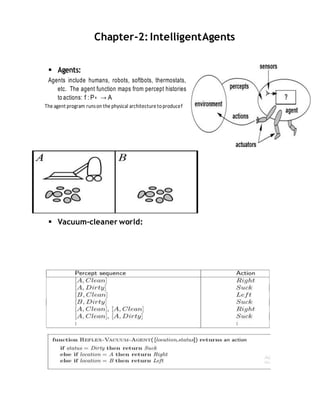
 Agents:
Agents include humans, robots, softbots, thermostats,
etc. The agent function maps from percept histories
to actions: f : P∗ → A
The agent program runson the physical architecture toproducef
 Vacuum-cleaner world:

Artificial intelligence

  • 1.
    Artificial Intelligence CSE-345 1. Whatis intelligence? [Wikipedia]  Also called intellect  An umbrella term used to describe a property of the mind that encompasses many related abilities, such as the capacities  to reason,  to plan,  to solve problems,  to thinkabstractly,  to comprehendideas,  to use language,and  to learn 2. What is intelligence? [Dictionary]  Ability to acquire, understand & apply knowledge, or the ability to exercise thought & reason 3. What’s involvedin Intelligence?  Ability to interact with the real world o to perceive, understand, and act  e.g., speech recognition and image understanding  Reasoning and Planning o modeling the external world, given input o solving new problems, planning, and making decisions o ability to deal with unexpected problems, uncertainties  Learning and Adaptation o we are continuously learning and adapting o our internal models are always being “updated”  e.g., a baby learning to categorize and recognize animals 4. Goals of AI a) System that think like humans b) Systems that think rationally c) Systems that act like humans d) Systems that act rationally
  • 2.
    5. Thinking humanly:Cognitive Science Effort to make computer think; i.e. the machine with minds, in the full and literal sense. Focus is not just on behavior and I/O, but looks at reasoning process Computational model as to how result were obtained. Goal is not just to produce human-like behavior, but to produce a sequence of steps of the reasoning process, similar to the steps followed by a human in solving the same task. 6. Acting humanly: Turing Test Art of creating machines that perform functions requiring intelligence when perform by people Focus is on actions, and not intelligent behavior centered around representation of the world. Is not concerned with how the get result but to the similarity to what human results are Goal is to develop systems that are human-like Example: Turing Test ,1950 Includes physical interactions with environment o speech recognition o computer vision o robotics Turing’s predictions  By 2000, a machine might have a 30% chance of fooling a lay person for 5 minutes  Anticipated all major arguments against AI in following 50 years  Suggested major components of AI: knowledge representation, reasoning, language understanding, learning  Problem: not reproducible, constructive, or amenable to mathematical analysis
  • 3.
    7. Thinking rationally:Lawsof Thought  Study of mental faculties through the use of computational models; i.e. study of the computations that make it possible to perceive , reason, and act.  Focus is on inference mechanism that are provably correct and guarantee an optimal solution.  Develop systems of representation to allow inference to be like “Socrates is a man. All men are mortal. Therefore, Socrates is mortal.”  Goal is to formalize the reasoning process as a system of logical rules and procedures for inference. The issues is, not all problem can be solved just by reasoning and inferences. 8. Acting rationally:Rational Agent  Rational behavior: doing the right thing  The right thing: that which is expected to maximize goal achievement, given the available information  Doesn't necessarily involve thinking-e.g., blinking reflex-but thinking should be in the service of rational action Aristotle (NicomacheanEthics): Everyart and everyinquiry,andsimilarlyeveryactionandpursuit,isthoughttoaimat some good 9. Strong AI vs. Weak AI  AI research aims to create AI that can replicate human intelligence completely.  Strong AI – refers to a machine that approaches or supersedes human intelligence – if it can do typical human tasks – if it can apply a wide range of back ground knowledge and – if it has some degree of self-consciousness. – aims to build machine whose overall ability is indistinguishable from that of human being.  Weak AI – refers to the use of software to study or accomplish specific problem solving or reasoning tasks that do not encompass the full range of human cognitive abilities e.g. a chess program – does not achieve self abilities; it is merely an intelligent, a specific problem solver
  • 4.
    1. The machinecan actually think and perform tasks on its own just like a human being. 1. The devices cannot follow these tasks on their own but are made to look intelligent. 2. An algorithm is stored by a computer program. 2. Tasks are entered manually to be performed. 3. There are no proper examples of Strong AI. 3. An automatic car or remote control devices. 4. Initial Stage 4. Advanced Stage 10. AI prehistory(Foundationsof AI)  Philosophy- Logic, methods of reasoning, mind as physical system, foundations of learning, language, rationality.  Mathematics- Formal representation and proof, algorithms, computation, (un)decidability, (in)tractability  Probability/Statistics- (un)decidability, (in)tractability probability.  Psychology- howdopeople behave,perceive,processcognitive information, represent knowledge.  Economics- utility,decisiontheory,rational economicagents .  Linguistics- knowledge representation grammar.  Neuroscience- plastic physical substrate for mental activity.  Control theory- homeostatic systems, stability simple optimal agent designs. 11. Is AI important? Most important developments of this century It will affect the lives of most individuals in civilized countries by the end of the century And countries leading in the development of AI by then will emerge as the dominant economic powers of the world Became apparent to many world’s leading economic countries (during late 1970’s) Japan (Fifth generation) UK (Alvey Project) Canada, Russia, Italy, France, Singapore etc USA (MCC, DARPA, ALV)  Task Domains:
  • 5.
     M u n d a n e T a s k s  P e r c e p t i o n - V i s i o n - S p e e c h N a t u r a l Language -Understanding -Generation -Translation  Commonsense reasoning  Robot control/HRI  Formal Tasks  Games -Chess -Backgammon -Checkers - Go  Mathematics -Geometry -Logic -Integral Calculus - Proving properties of programs  Expert Tasks  Engineering  Scientific analysis  Medical diagnosis  Financial analysis
  • 6.
    Chapter-2: IntelligentAgents  Agents: Agentsinclude humans, robots, softbots, thermostats, etc. The agent function maps from percept histories to actions: f : P∗ → A The agent program runson the physical architecture toproducef  Vacuum-cleaner world: