Today
o What isartificial intelligence?
o What can AI do?
o State of art AI
o History of AI
o Agent and Environment.
o Generative AI
o Agentic AI
3.
o Artificial intelligence(AI) is the theory and
development of computer systems capable of
performing tasks that historically required human
intelligence, such as recognizing speech, making
decisions, and identifying patterns.
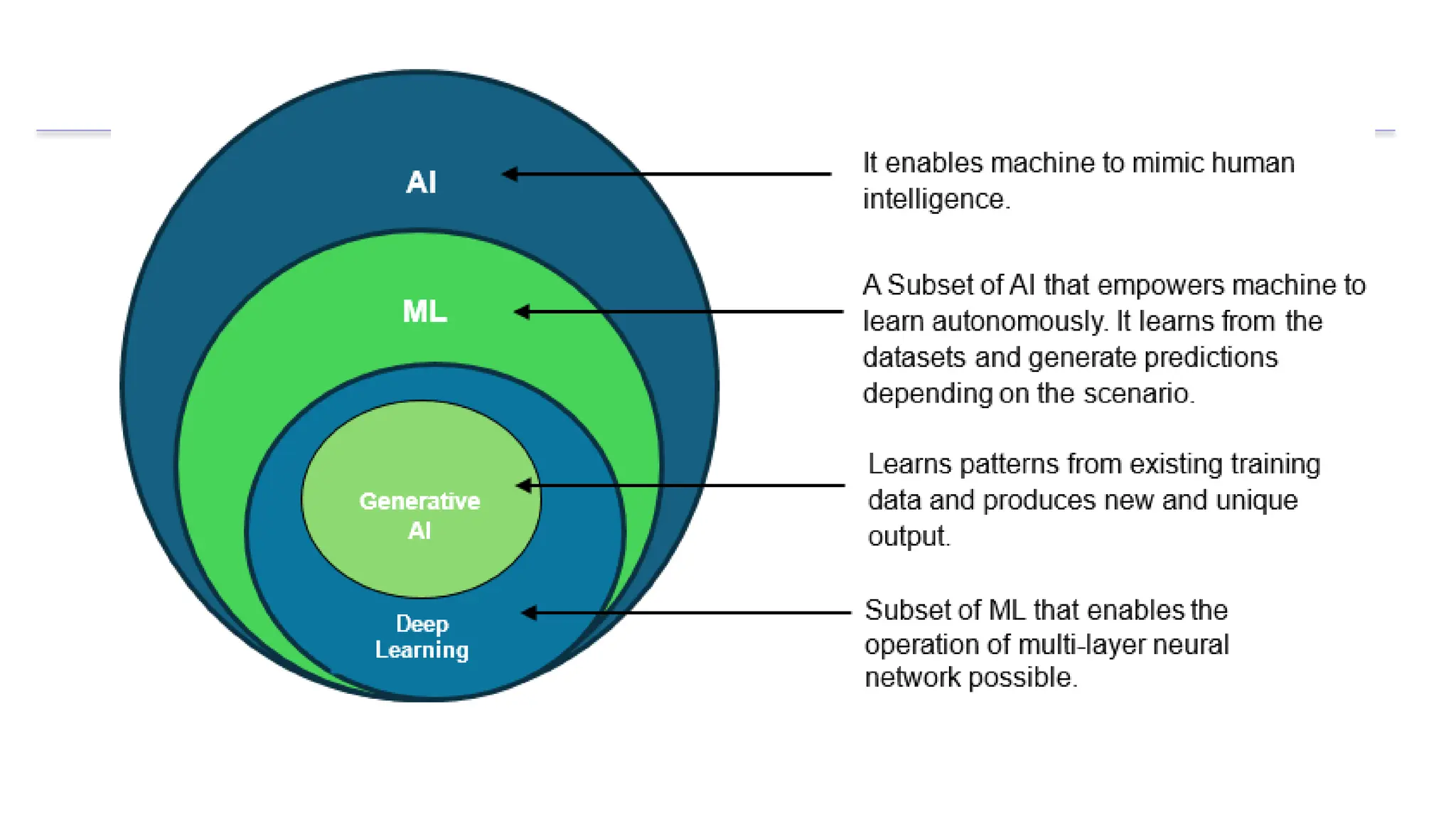
o AI is an umbrella term that encompasses a wide variety
of technologies, including machine learning,
deep learning, and natural language processing (NLP).
4.
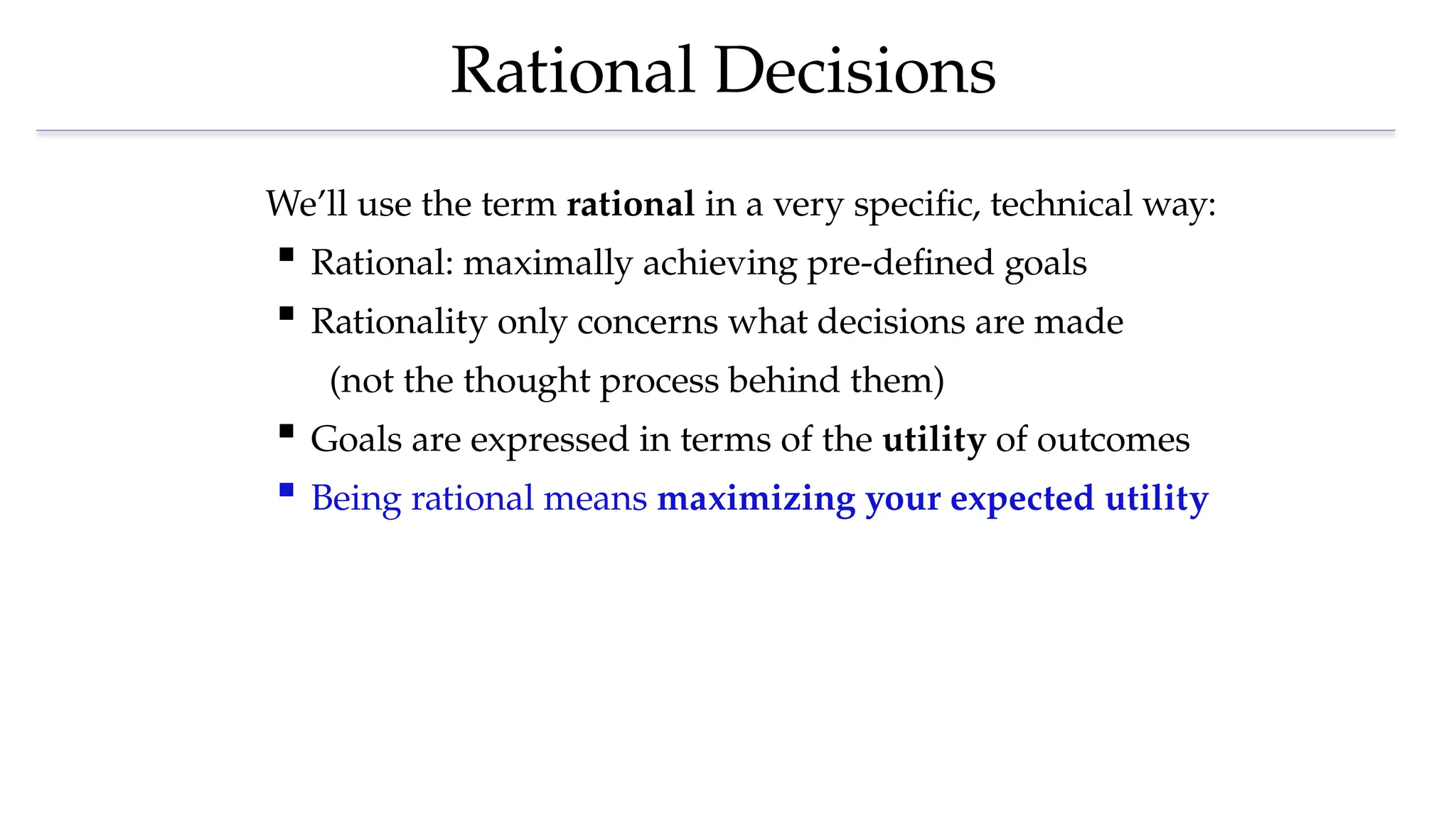
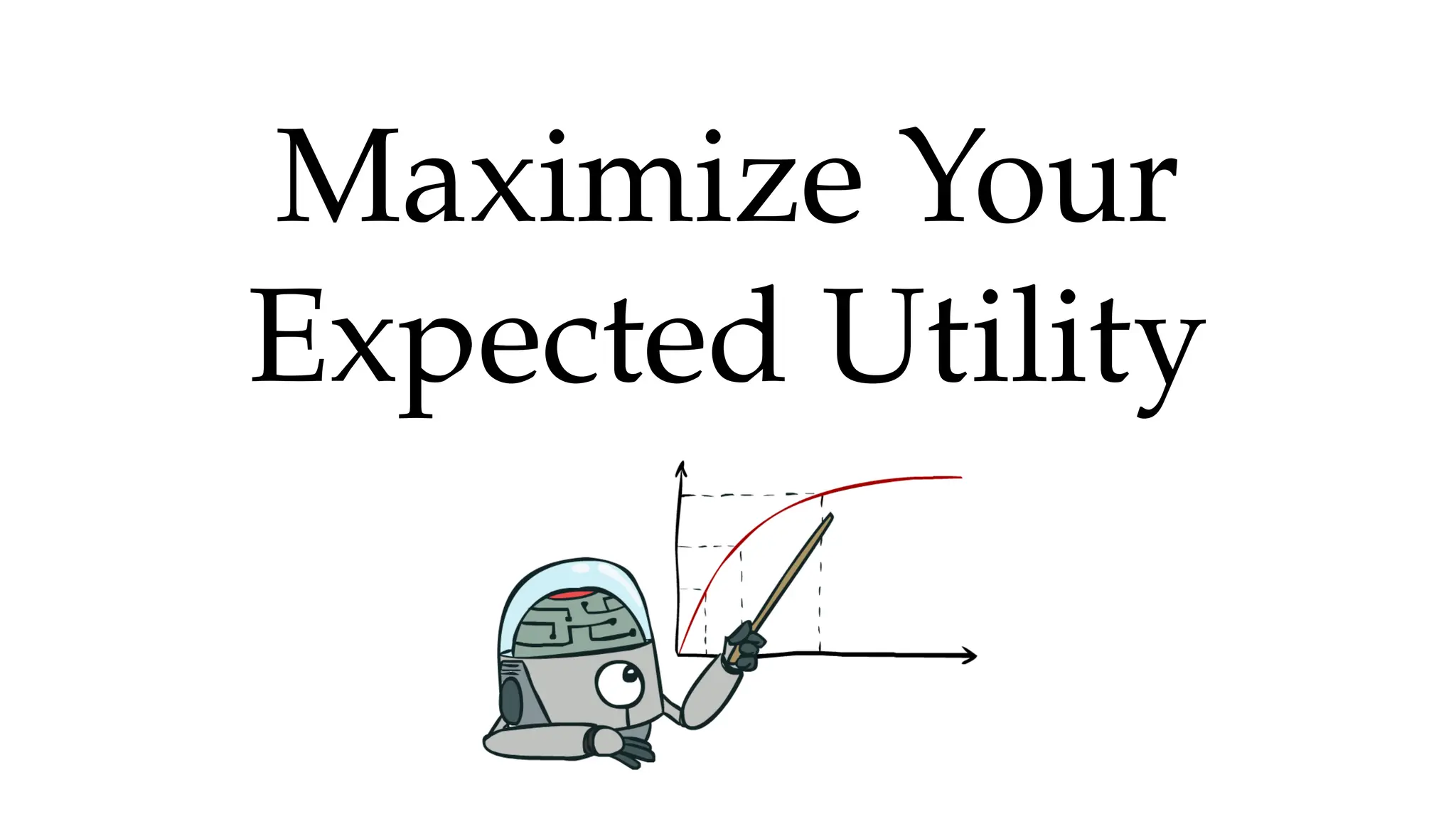
Rational Decisions
We’ll usethe term rational in a very specific, technical way:
Rational: maximally achieving pre-defined goals
Rationality only concerns what decisions are made
(not the thought process behind them)
Goals are expressed in terms of the utility of outcomes
Being rational means maximizing your expected utility
5.
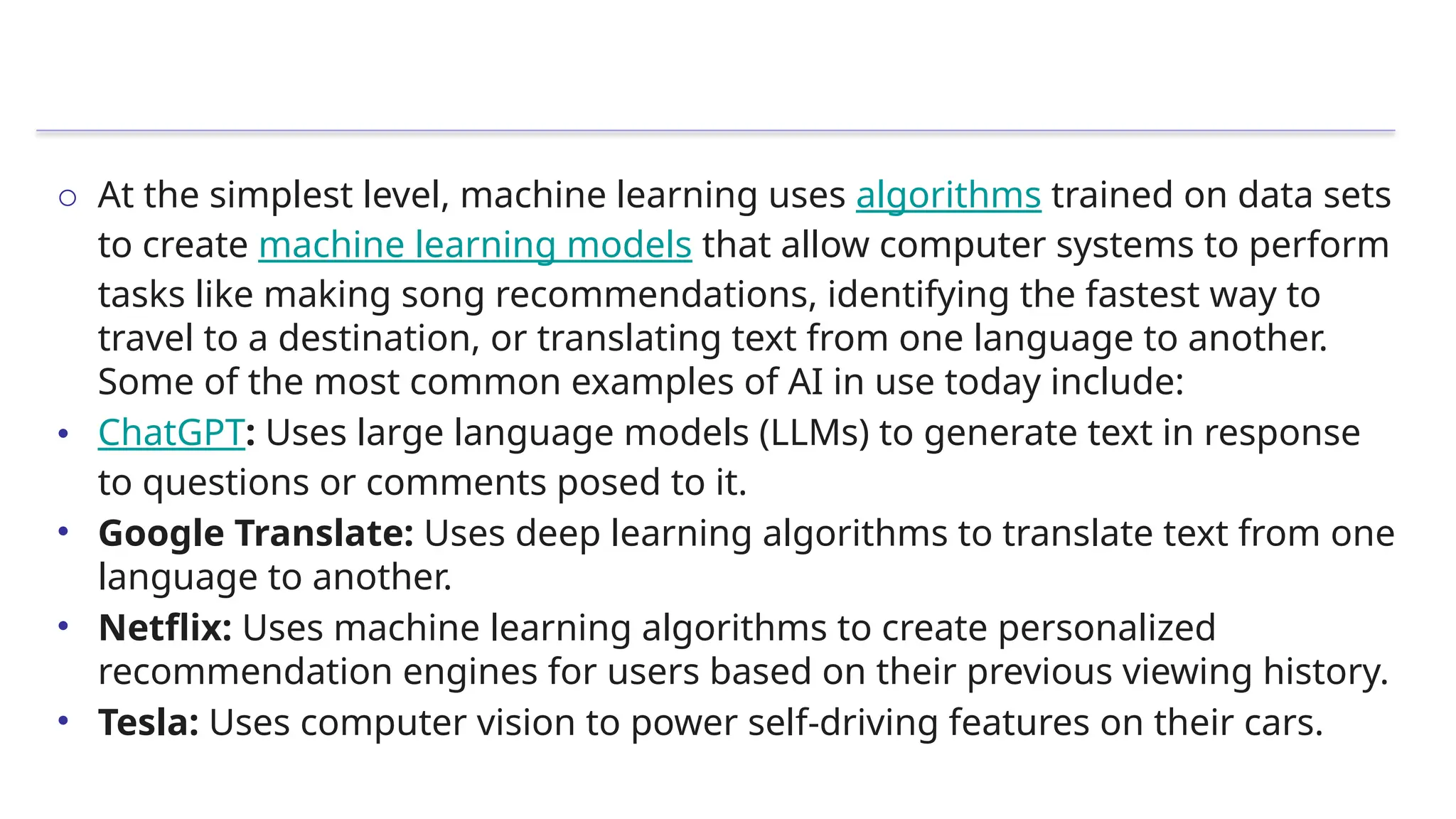
o At thesimplest level, machine learning uses algorithms trained on data sets
to create machine learning models that allow computer systems to perform
tasks like making song recommendations, identifying the fastest way to
travel to a destination, or translating text from one language to another.
Some of the most common examples of AI in use today include:
• ChatGPT: Uses large language models (LLMs) to generate text in response
to questions or comments posed to it.
• Google Translate: Uses deep learning algorithms to translate text from one
language to another.
• Netflix: Uses machine learning algorithms to create personalized
recommendation engines for users based on their previous viewing history.
• Tesla: Uses computer vision to power self-driving features on their cars.
6.
Artificial general intelligence(AGI)
o Artificial general intelligence (AGI) refers to a theoretical
state in which computer systems will be able to achieve
or exceed human intelligence. In other words, AGI is
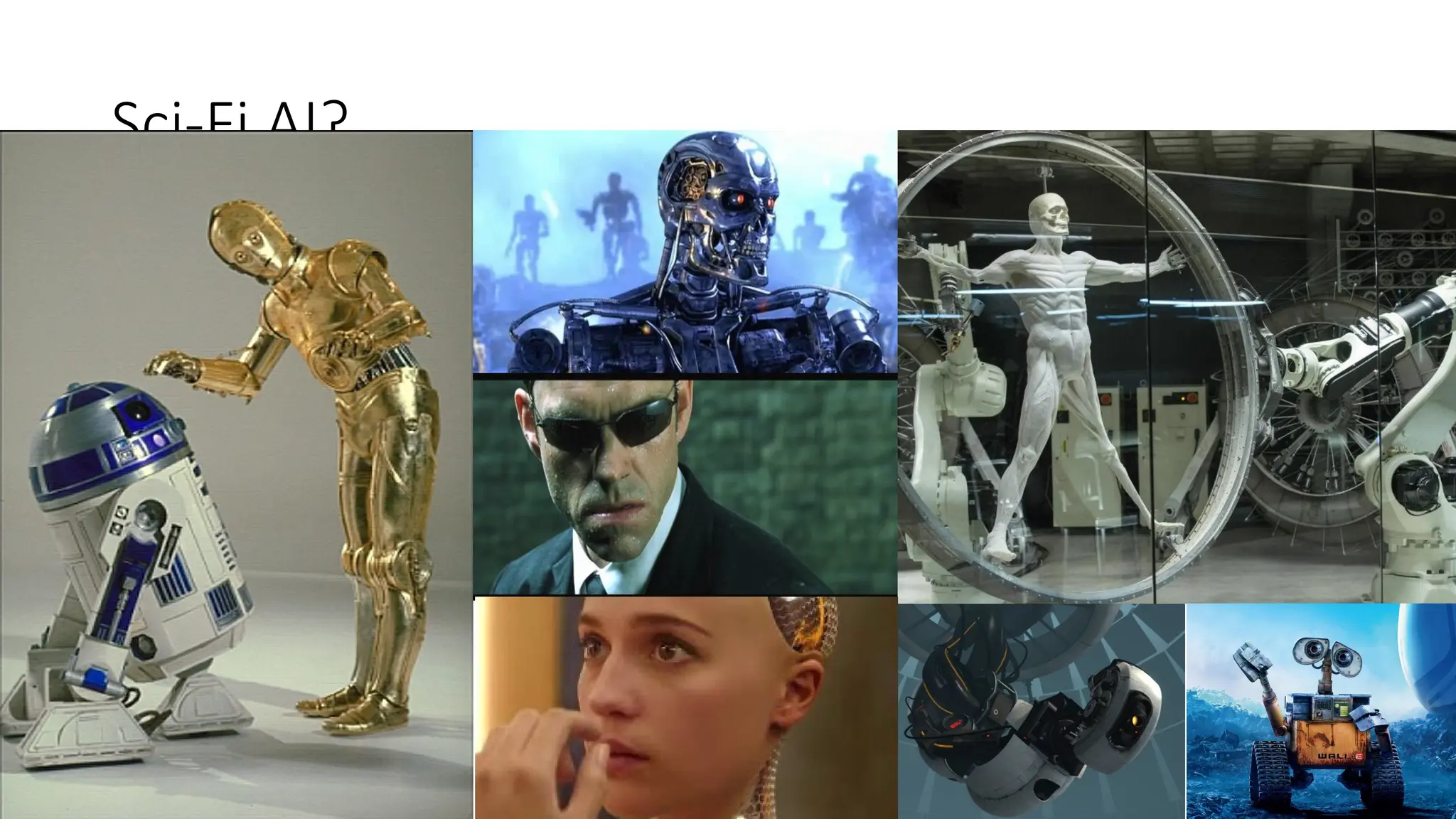
“true” artificial intelligence as depicted in countless
science fiction novels, television shows, movies, and
comics.
7.
Artificial Narrow Intelligence.Weak AI
o ANI is also referred to as Narrow AI or Weak AI. This type
of artificial intelligence is one that focuses primarily on
one single narrow task, with a limited range of abilities.
If you think of an example of AI that exists in our lives
right now, it is ANI. This is the only type out of the three
that is currently around. This includes all kinds of Natural
Language or Siri.
8.
Artificial Super Intelligence
oThis is where it gets a little theoretical and a touch scary.
ASI refers to AI technology that will match and then
surpass the human mind. To be classed as an ASI, the
technology would have to be more capable than a
human in every single way possible. Not only could these
AI things carry out tasks, but they would even be capable
of having emotions and relationships.
9.
Type of AI(By definition)
o System that think rationally
o System that think like human
o System that acts like human
o System that acts rationally.
10.
Thinking humanly: CognitiveScience
o1960s “cognitive revolution”: information-processing psychology replaced prevailing orthodoxy of behaviorism
o Requires scientific theories of internal activities of the brain – What level of abstraction? “Knowledge”
or “circuits”?
o– How to validate? Requires
o1) Predicting and testing behavior of human subjects (top-down) or 2) Direct identification from neurological
data (bottom-up)
oBoth approaches (roughly, Cognitive Science and Cognitive Neuroscience) are now distinct from AI
11.
Thinking rationally: Lawsof Thought
oNormative (or prescriptive) rather than descriptive Aristotle: what are correct arguments/thought
processes?
oSeveral Greek schools developed various forms of logic:
onotation and rules of derivation for thoughts;
omay or may not have proceeded to the idea of mechanization Direct line through mathematics and philosophy
to modern AI
12.
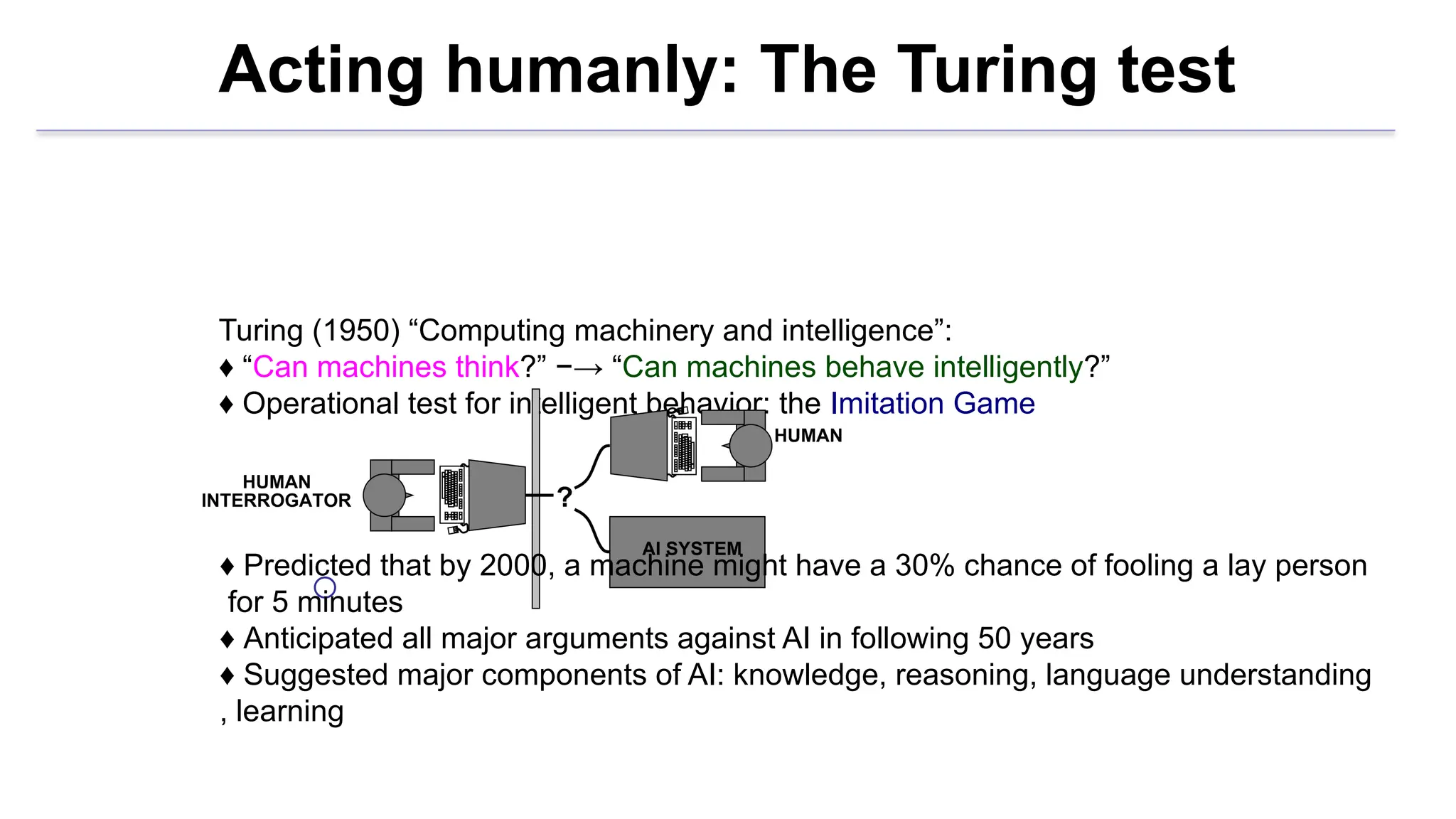
Acting humanly: TheTuring test
o
Turing (1950) “Computing machinery and intelligence”:
♦ “Can machines think?” −→ “Can machines behave intelligently?”
♦ Operational test for intelligent behavior: the Imitation Game
♦ Predicted that by 2000, a machine might have a 30% chance of fooling a lay person
for 5 minutes
♦ Anticipated all major arguments against AI in following 50 years
♦ Suggested major components of AI: knowledge, reasoning, language understanding
, learning
13.
Agents, a Definition
oAn agent is a computer system that is
capable of independent action on behalf of
its user or owner (figuring out what
needs to be done to satisfy design
objectives, rather than constantly being
told)
14.
Multiagent Systems, aDefinition
o A multiagent system is one that
consists of a number of agents, which
interact with one-another
o In the most general case, agents will be
acting on behalf of users with different
goals and motivations
o To successfully interact, they will
require the ability to cooperate,
coordinate, and negotiate with each other,
much as people do
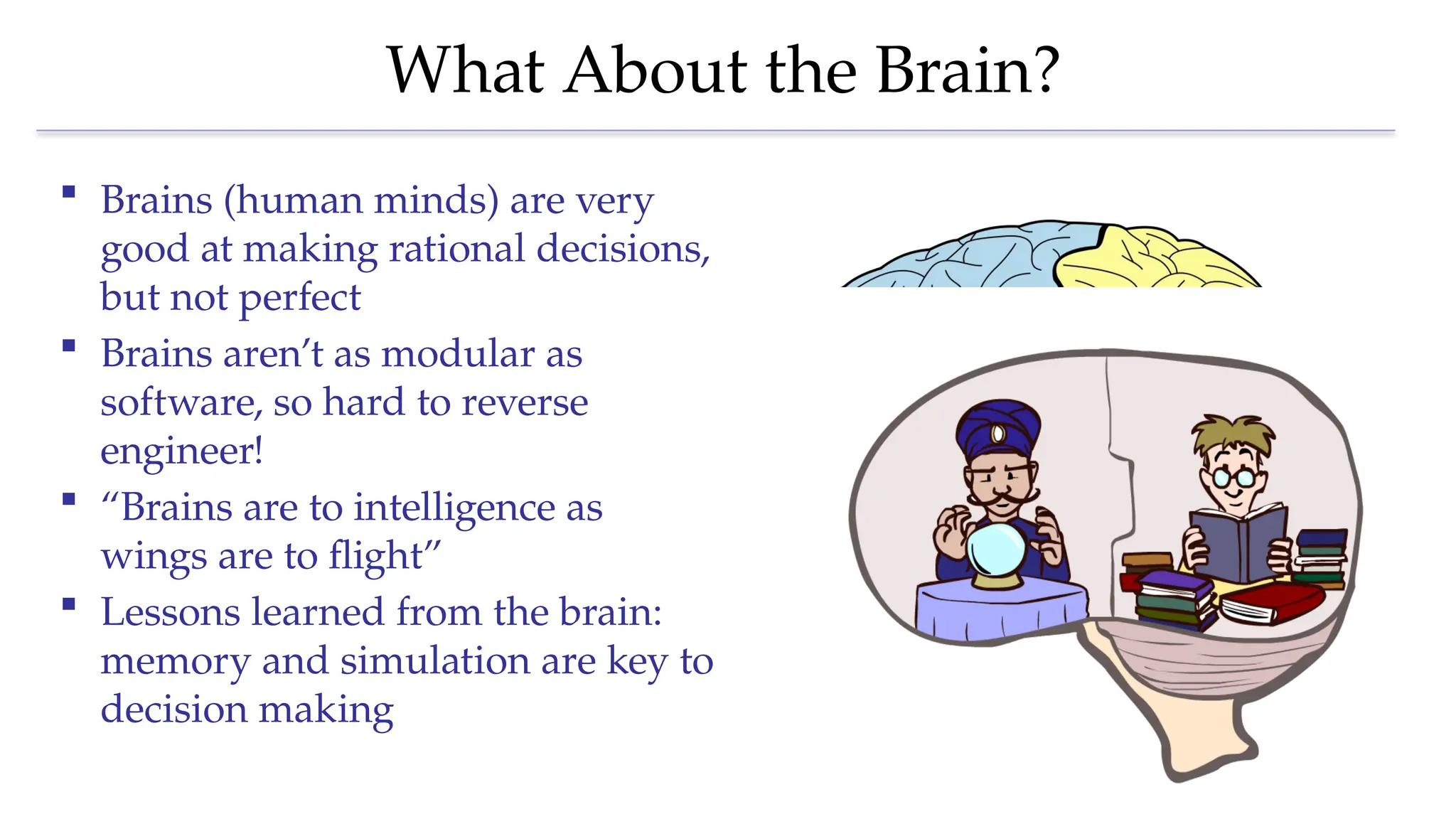
What About theBrain?
Brains (human minds) are very
good at making rational decisions,
but not perfect
Brains aren’t as modular as
software, so hard to reverse
engineer!
“Brains are to intelligence as
wings are to flight”
Lessons learned from the brain:
memory and simulation are key to
decision making
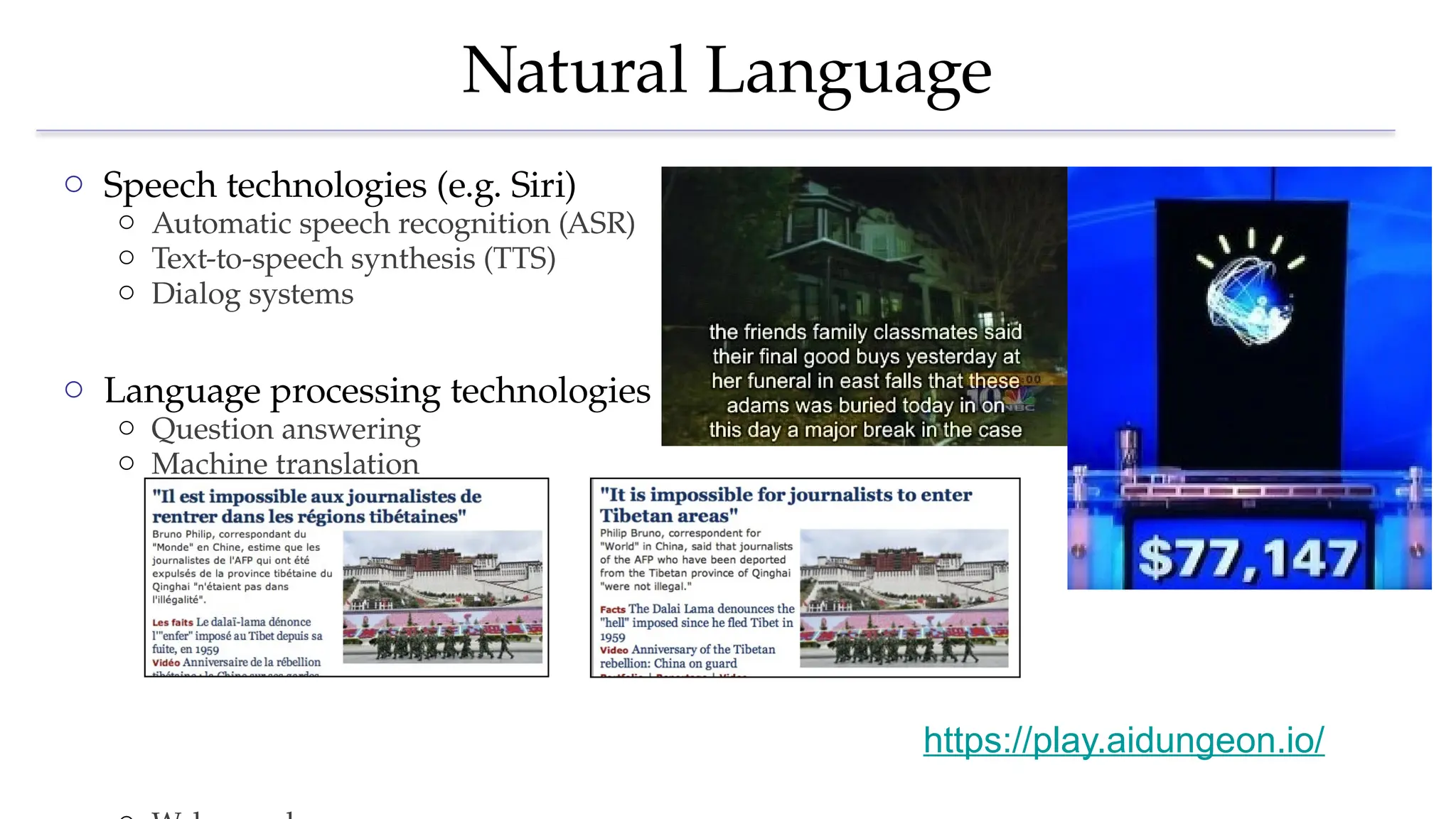
Natural Language
o Speechtechnologies (e.g. Siri)
o Automatic speech recognition (ASR)
o Text-to-speech synthesis (TTS)
o Dialog systems
o Language processing technologies
o Question answering
o Machine translation
https://play.aidungeon.io/
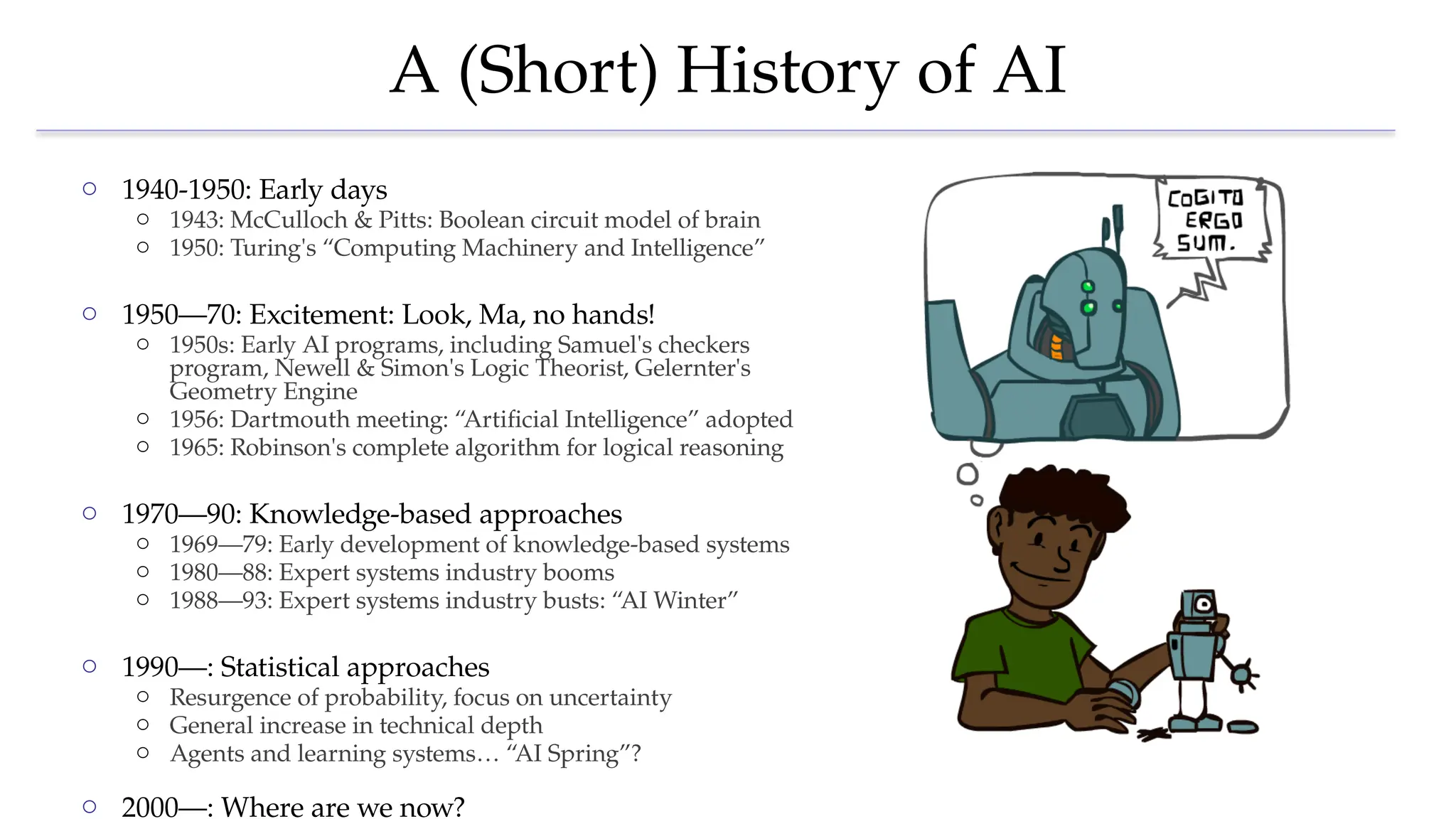
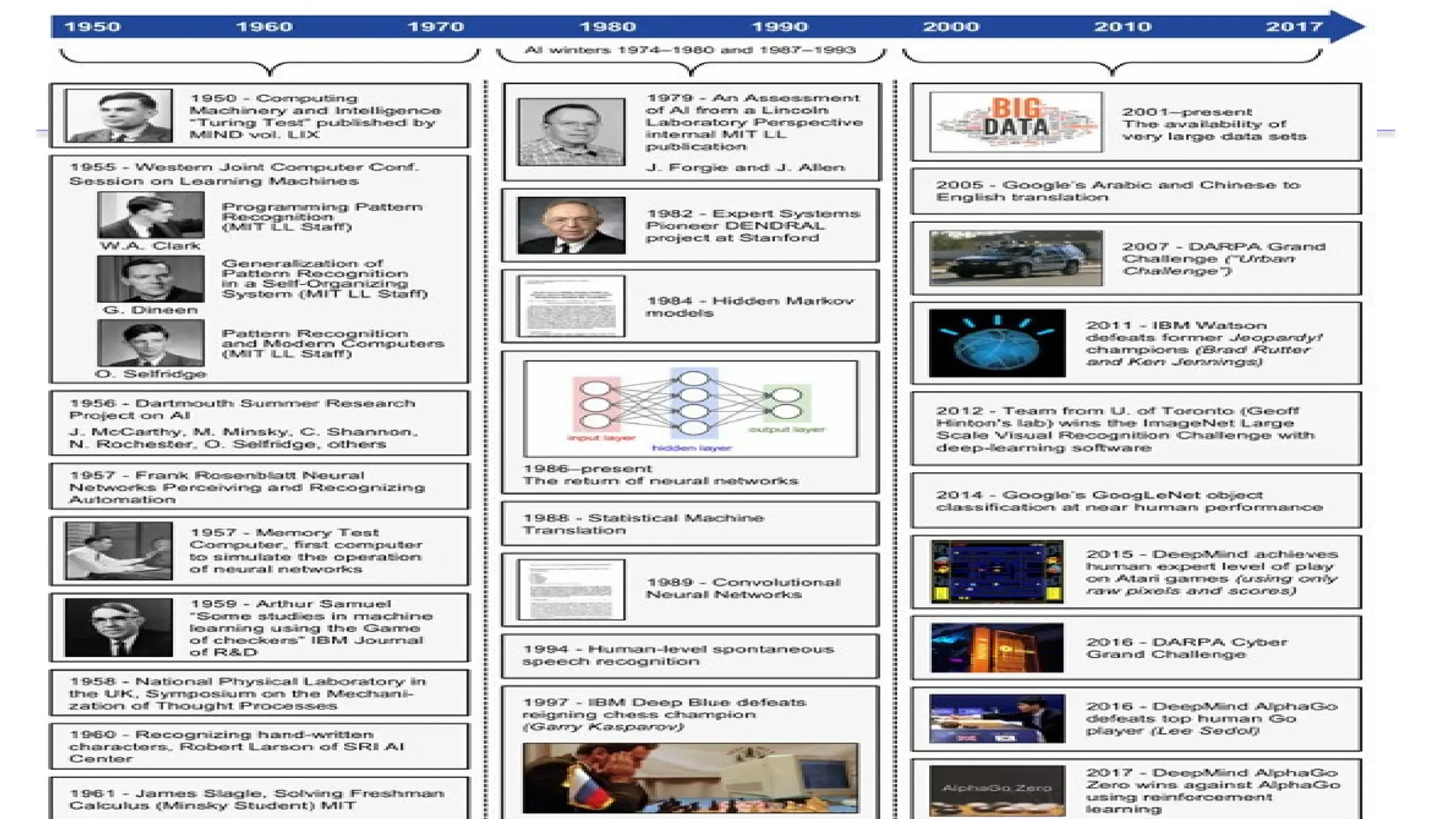
A (Short) Historyof AI
o 1940-1950: Early days
o 1943: McCulloch & Pitts: Boolean circuit model of brain
o 1950: Turing's “Computing Machinery and Intelligence”
o 1950—70: Excitement: Look, Ma, no hands!
o 1950s: Early AI programs, including Samuel's checkers
program, Newell & Simon's Logic Theorist, Gelernter's
Geometry Engine
o 1956: Dartmouth meeting: “Artificial Intelligence” adopted
o 1965: Robinson's complete algorithm for logical reasoning
o 1970—90: Knowledge-based approaches
o 1969—79: Early development of knowledge-based systems
o 1980—88: Expert systems industry booms
o 1988—93: Expert systems industry busts: “AI Winter”
o 1990—: Statistical approaches
o Resurgence of probability, focus on uncertainty
o General increase in technical depth
o Agents and learning systems… “AI Spring”?
o 2000—: Where are we now?
Designing Rational Agents
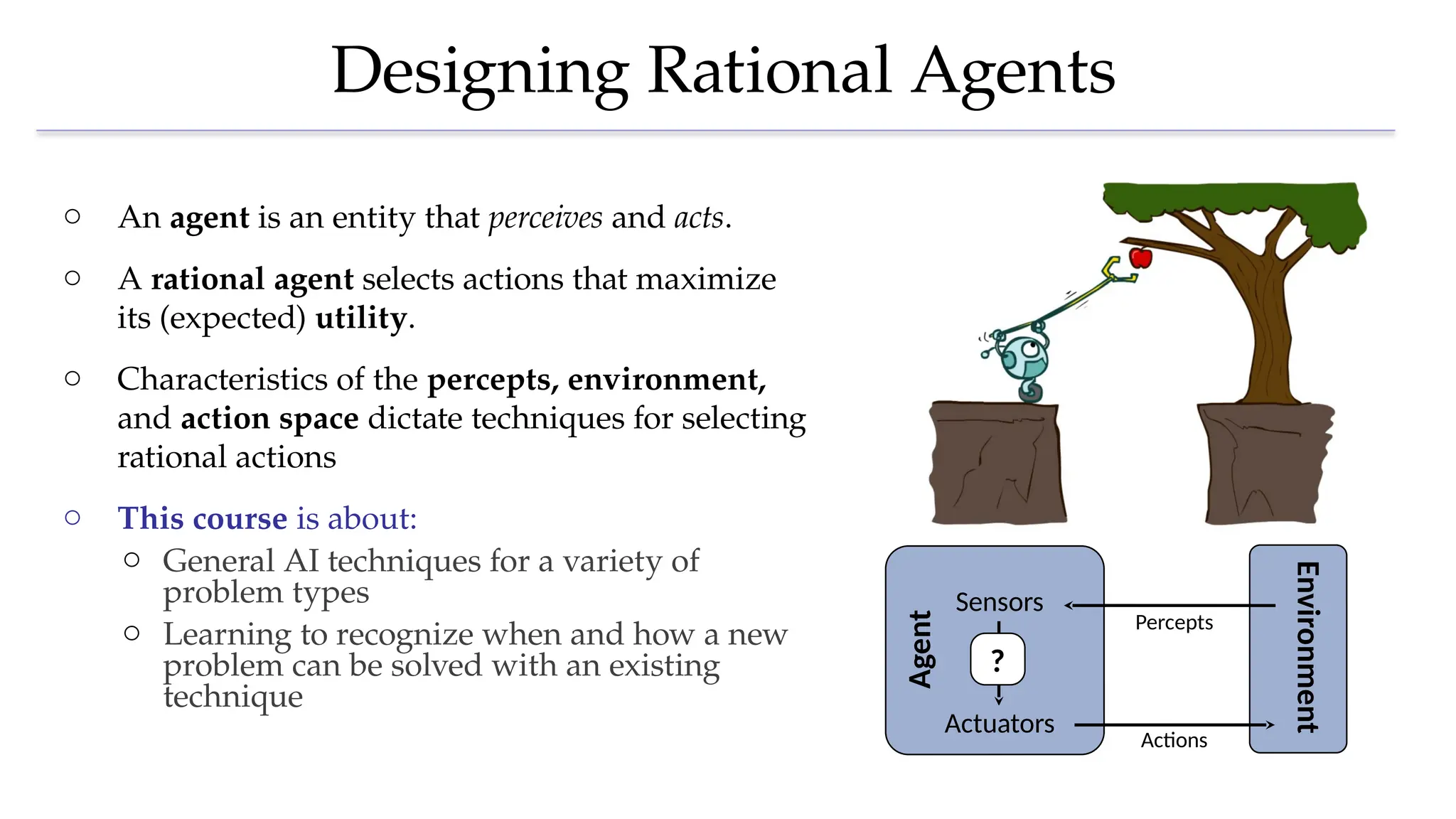
oAn agent is an entity that perceives and acts.
o A rational agent selects actions that maximize
its (expected) utility.
o Characteristics of the percepts, environment,
and action space dictate techniques for selecting
rational actions
o This course is about:
o General AI techniques for a variety of
problem types
o Learning to recognize when and how a new
problem can be solved with an existing
technique
Agent
?
Sensors
Actuators
Environment
Percepts
Actions
Generative AI
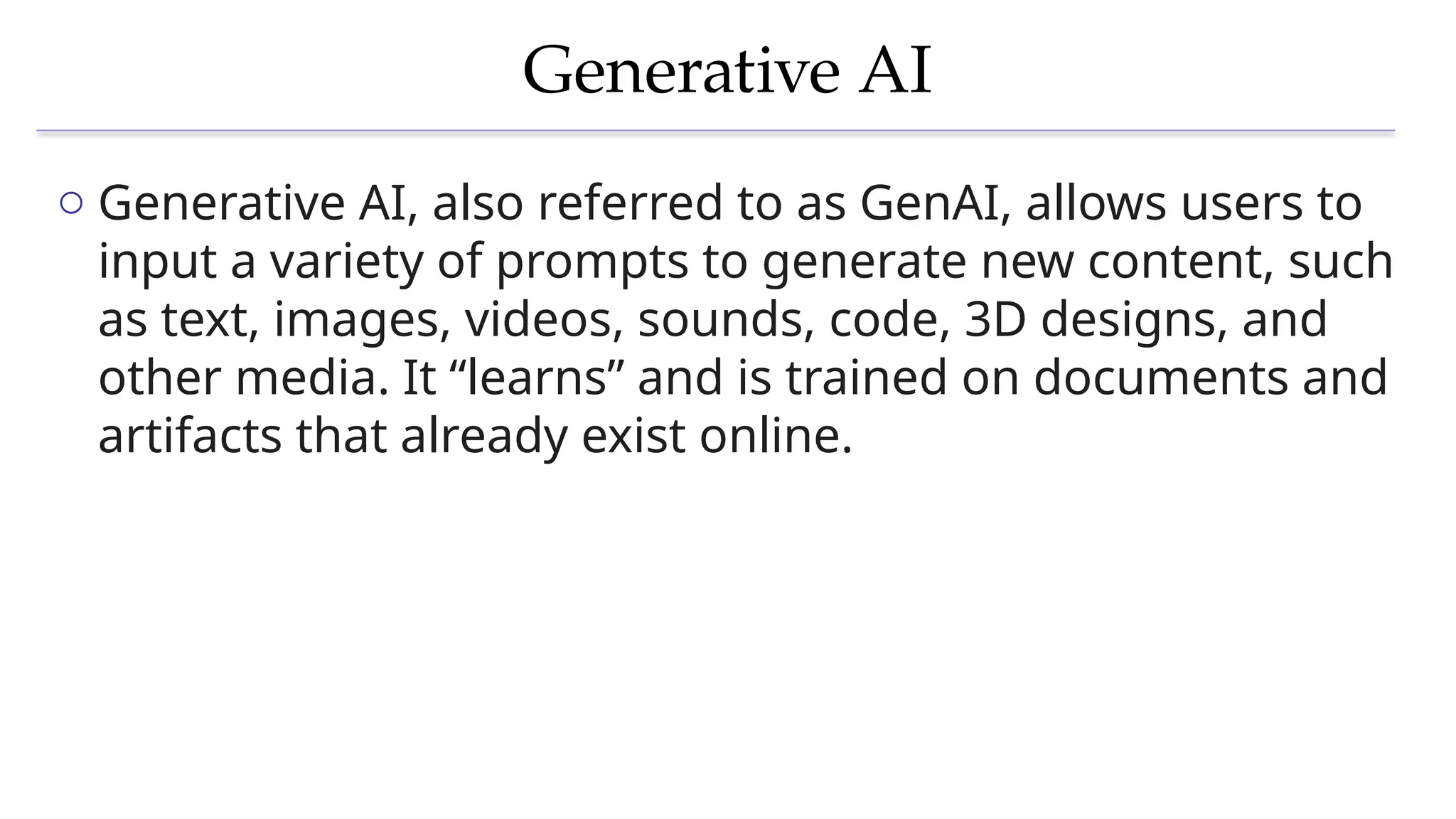
o GenerativeAI, also referred to as GenAI, allows users to
input a variety of prompts to generate new content, such
as text, images, videos, sounds, code, 3D designs, and
other media. It “learns” and is trained on documents and
artifacts that already exist online.
29.
How does generativeAI work?
o Generative AI models use neural networks to identify
patterns in existing data to generate new content.
Trained on unsupervised and semi-supervised learning
approaches, organizations can create foundation models
from large, unlabeled data sets, essentially forming a
base for AI systems to perform tasks [1].
o Some examples of foundation models include LLMs,
GANs, VAEs, and Multimodal, which power tools like
ChatGPT, DALL-E, and more. ChatGPT draws data from
GPT-3 and enables users to generate a story based on a
30.
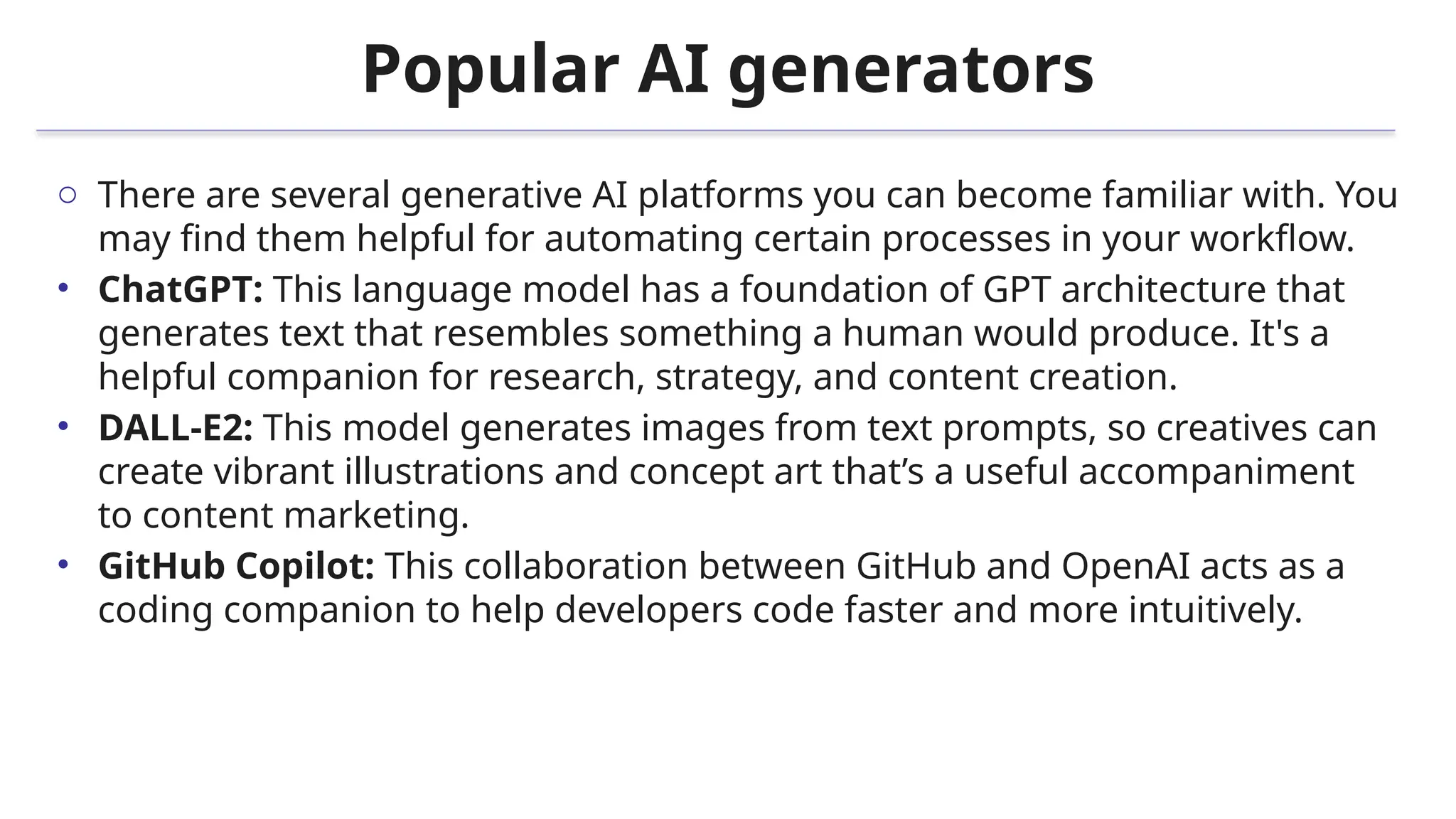
Popular AI generators
oThere are several generative AI platforms you can become familiar with. You
may find them helpful for automating certain processes in your workflow.
• ChatGPT: This language model has a foundation of GPT architecture that
generates text that resembles something a human would produce. It's a
helpful companion for research, strategy, and content creation.
• DALL-E2: This model generates images from text prompts, so creatives can
create vibrant illustrations and concept art that’s a useful accompaniment
to content marketing.
• GitHub Copilot: This collaboration between GitHub and OpenAI acts as a
coding companion to help developers code faster and more intuitively.
31.
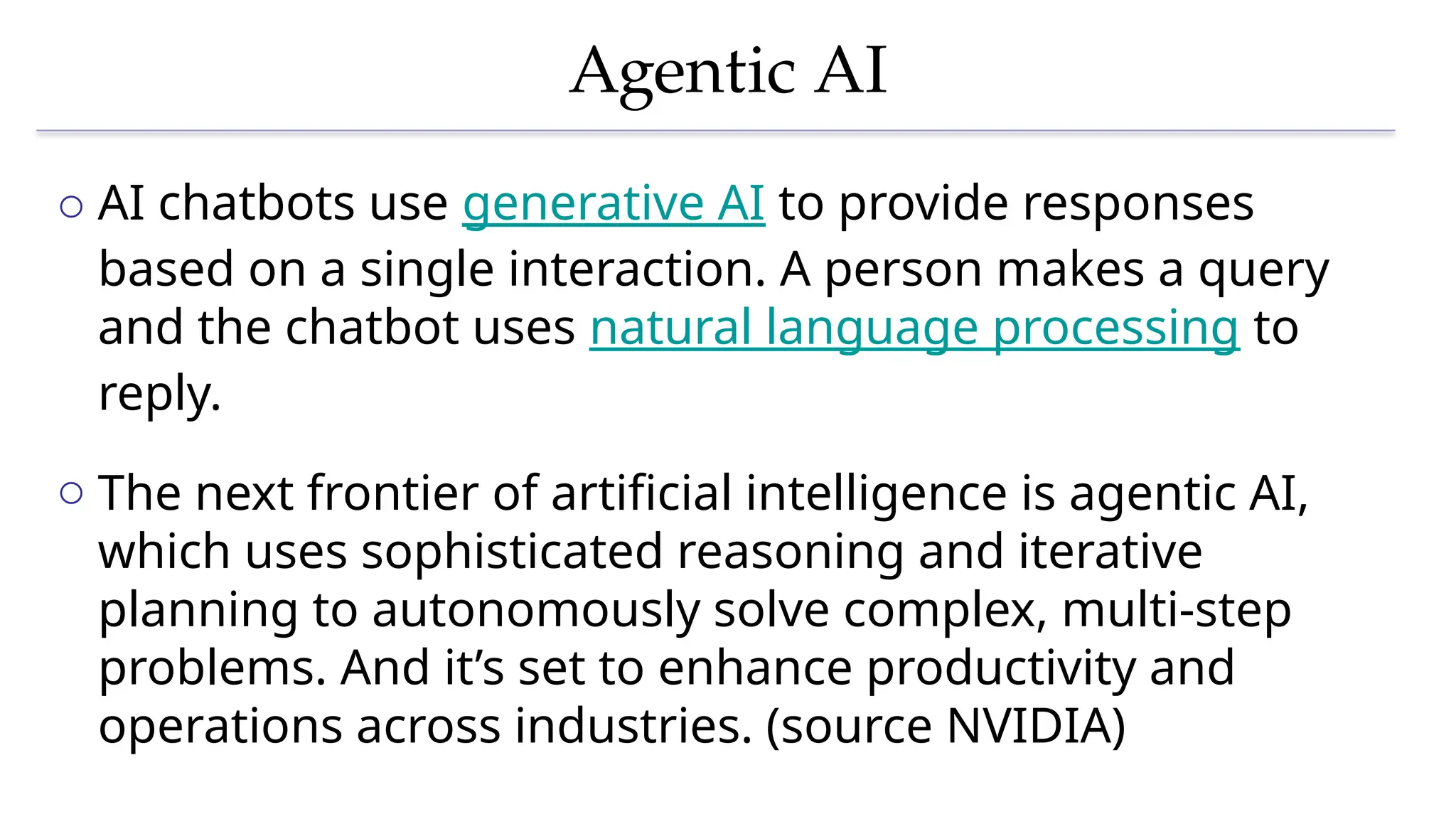
Agentic AI
o AIchatbots use generative AI to provide responses
based on a single interaction. A person makes a query
and the chatbot uses natural language processing to
reply.
o The next frontier of artificial intelligence is agentic AI,
which uses sophisticated reasoning and iterative
planning to autonomously solve complex, multi-step
problems. And it’s set to enhance productivity and
operations across industries. (source NVIDIA)
cont.
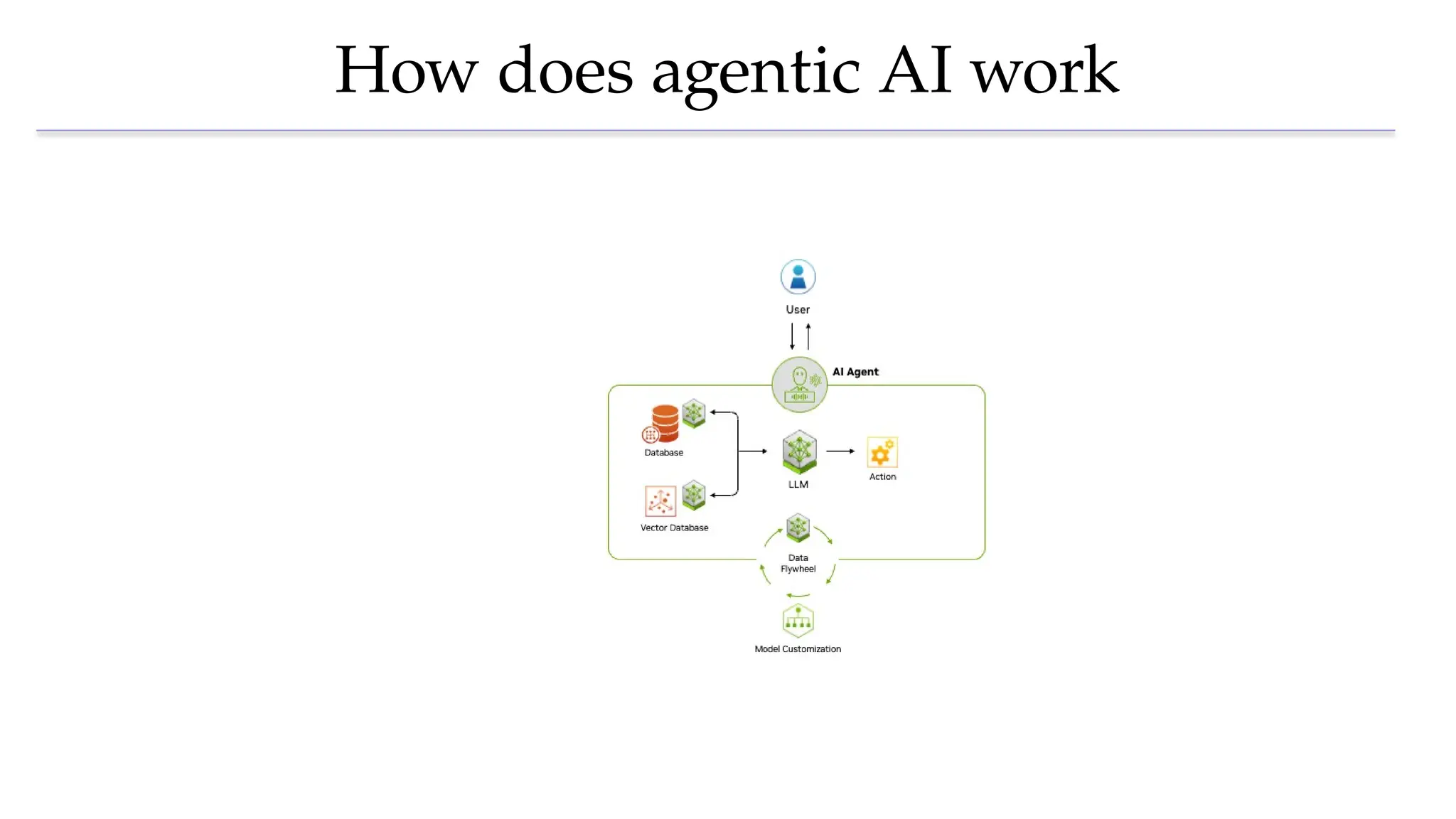
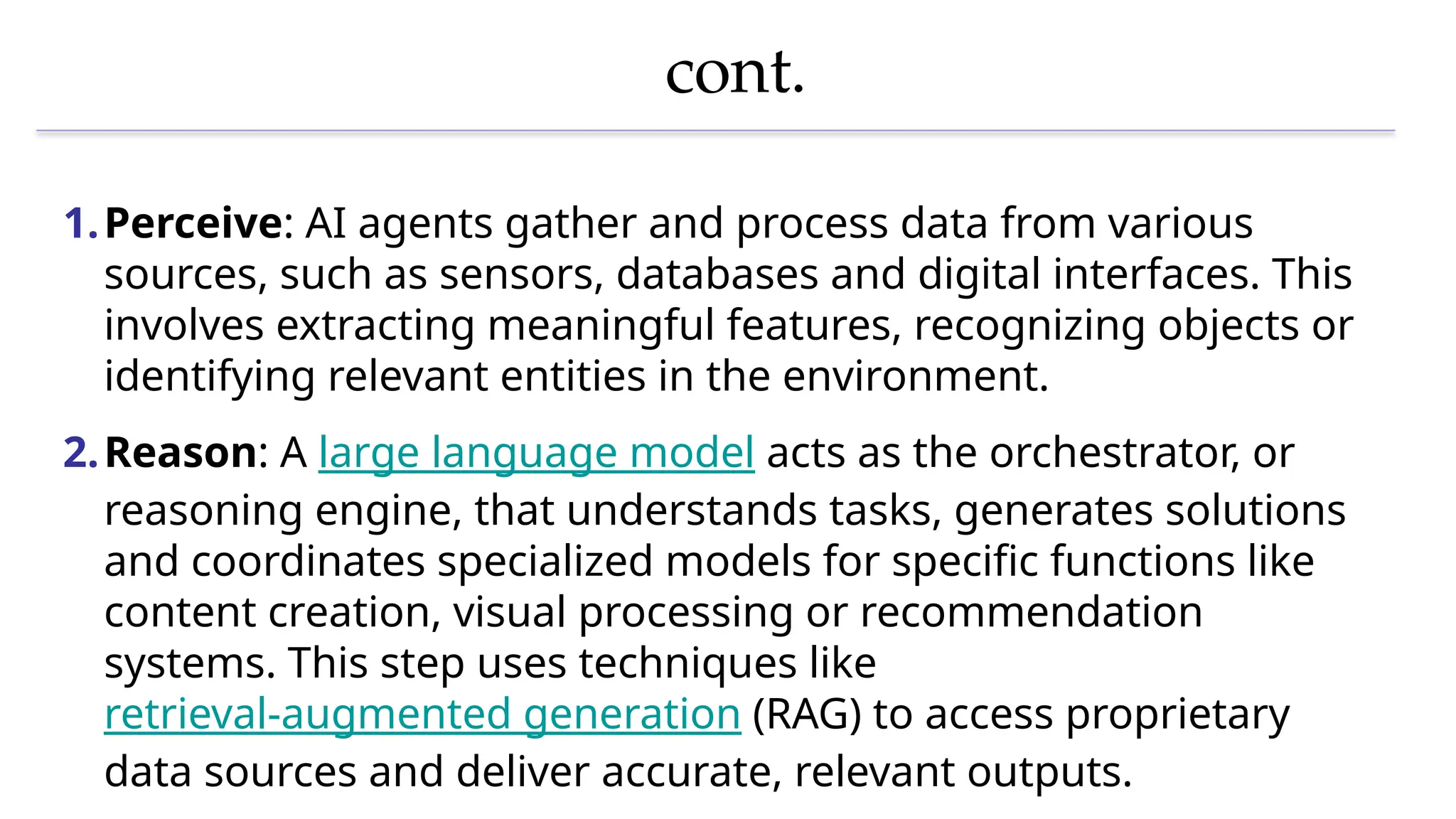
1.Perceive: AI agentsgather and process data from various
sources, such as sensors, databases and digital interfaces. This
involves extracting meaningful features, recognizing objects or
identifying relevant entities in the environment.
2.Reason: A large language model acts as the orchestrator, or
reasoning engine, that understands tasks, generates solutions
and coordinates specialized models for specific functions like
content creation, visual processing or recommendation
systems. This step uses techniques like
retrieval-augmented generation (RAG) to access proprietary
data sources and deliver accurate, relevant outputs.
34.
cont
3. Act: Byintegrating with external tools and software via
application programming interfaces, agentic AI can quickly execute
tasks based on the plans it has formulated. Guardrails can be built
into AI agents to help ensure they execute tasks correctly. For
example, a customer service AI agent may be able to process
claims up to a certain amount, while claims above the amount
would have to be approved by a human.
4. Learn: Agentic AI continuously improves through a feedback
loop, or
“data flywheel,” where the data generated from its interactions is
fed into the system to enhance models. This ability to adapt and
Editor's Notes
#4 Not about building machines that don’t get angry
Example of utilities. 10 for A, 1 for each Friday with friends
People being rational.
#15 Distill course to maximize expected utility.
Make these 4 better
#16 Brains are the existence proof that AI can be made, much like birds were the existence proof to flight.
But they are hard!
Lessons:
Memory – do not forget valuable info
Simulation – extrapolating from past info, generalize, transfer, infer, many words that will later be central to the course
Stopped making wings that flap
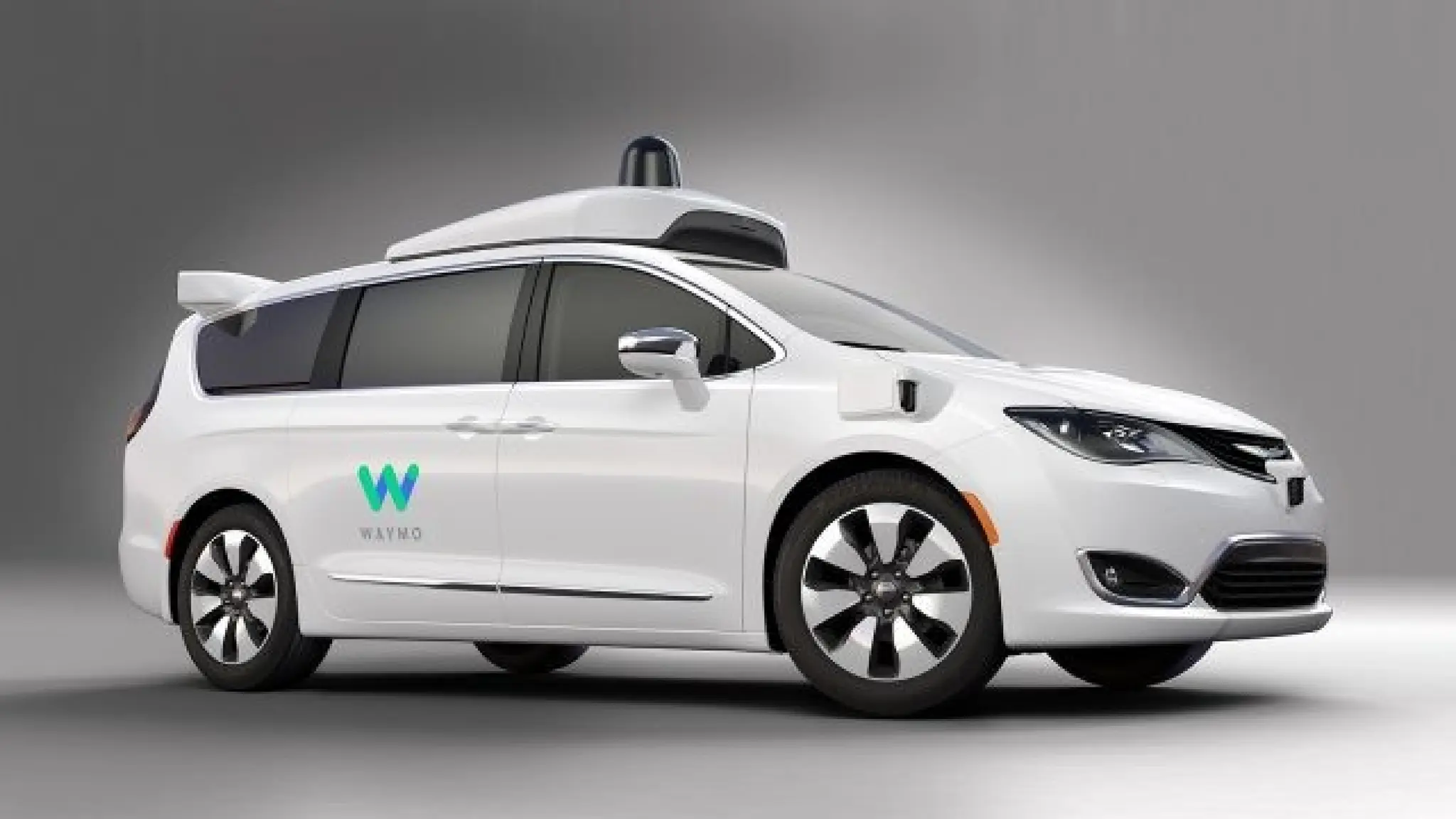
#18 Robots look like this. We have autonomous cars that figure out how to take us to our destination
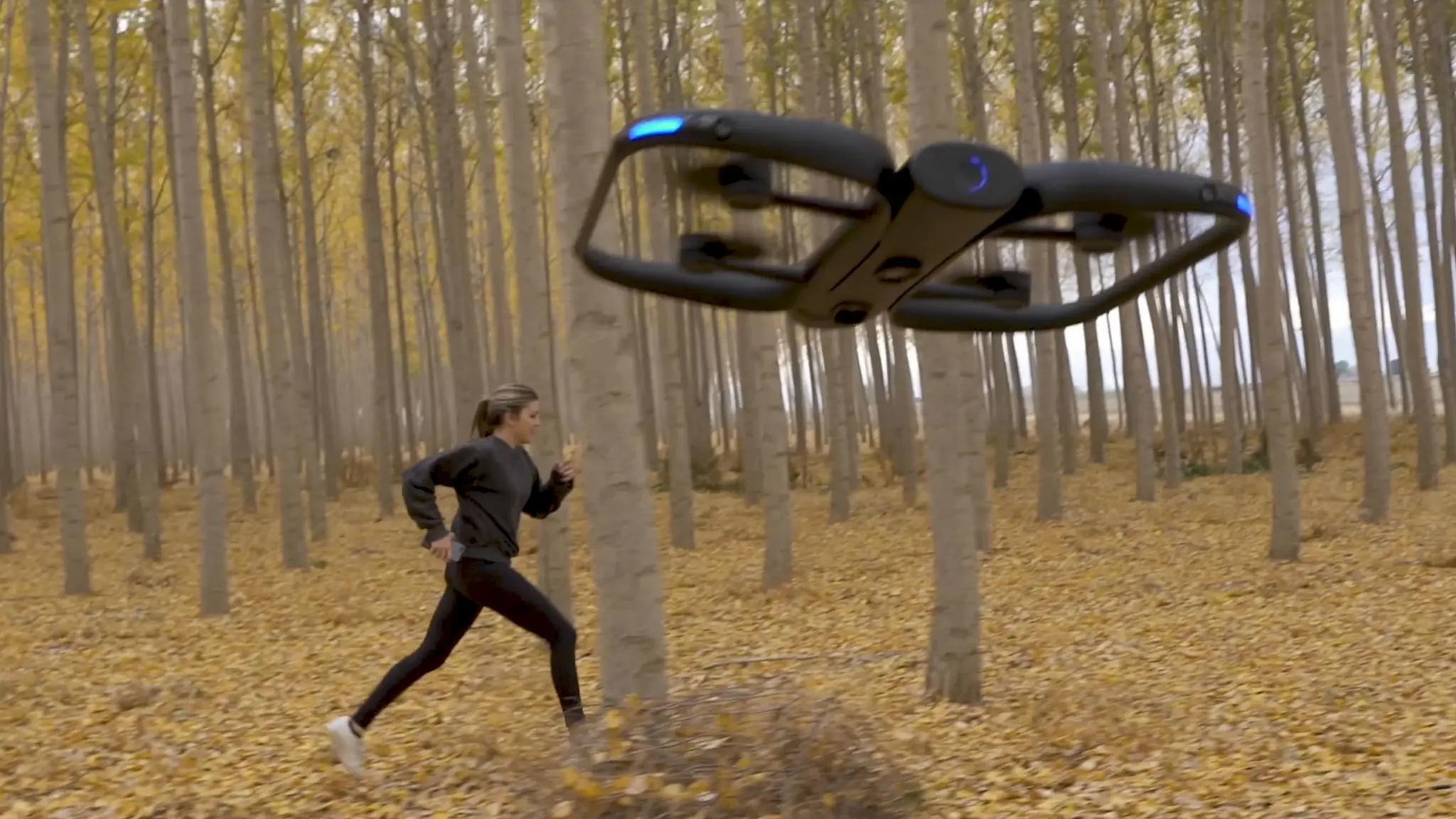
#19 Or drones that record cool videos of us as we do outdoor activities
So what is powering all of this? That’s what this course is for.
#20 Deepfake
chatbot examples
Do you know about IBM watson, Ken Jennings. Impressive because...
Expensive wayto win $70k
Figure out what she said, pertty good, hard to get intent
engaged in day to day basis
My favorite application is AI dungeon – you write commands to your fictional character and it becomes sort of like a book.
I can’t wait for something like this to work with images or clips (where technology is not far behind)
#21 Very Impressive:
Form of prediction and deicion.
#22 Computation with circuits, brain was like a bunch of circuits
Less computation than your watch; could barely do anything , but we thought we’re right there
Write stuff down, they start contradicting; winter
Statistics, uncertainty
Computation with artificial neurons, brain was like a bunch of real neurons
#25 Agent perceives and acts – like you, like the automatic hallway lights,
What goes in this box?
Rational agent - also you, like your puppy, hopefully the ai creations in this class and my research.
Percepts, env, and action space determine problem
General AI techniques for a variety of problem types
Learning to recognize when and how a new problem can be solved with an existing technique
#26 Google maps route planning – not physically embodied
Independent decisions: typical ml prediction, e.g. spam filtering
![AI
Rational
Agents
[decisions]
Robots
[physically
embodied]
Machine Learning
[learning decisions;
sometimes independent]
NLP
Computer
Vision
Human-AI
Interaction](https://image.slidesharecdn.com/artificialintelligence-lecture1-250413043130-d586b006/75/Artificial-Intelligence-lecture-1-from-BUKC-lecture-1-26-2048.jpg)
![How does generative AI work?
o Generative AI models use neural networks to identify
patterns in existing data to generate new content.
Trained on unsupervised and semi-supervised learning
approaches, organizations can create foundation models
from large, unlabeled data sets, essentially forming a
base for AI systems to perform tasks [1].
o Some examples of foundation models include LLMs,
GANs, VAEs, and Multimodal, which power tools like
ChatGPT, DALL-E, and more. ChatGPT draws data from
GPT-3 and enables users to generate a story based on a](https://image.slidesharecdn.com/artificialintelligence-lecture1-250413043130-d586b006/75/Artificial-Intelligence-lecture-1-from-BUKC-lecture-1-29-2048.jpg)