Introduction to Artificial
Intelligence
HARSHITA SHARMA
Assignment 1
 Elaborate on any two application areas of Artificial Intelligence.
 Perform a SWOT analysis of AI.
Assignments are to be submitted in hard copy and should be handwritten.
Intelligence
 the ability to understand and learn well, and to form judgments and opinions
based on reason.
 the ability to apply knowledge to manipulate one's environment or to think
abstractly as measured by objective criteria (such as tests).
 Intelligence, as we know, is the ability to acquire and apply knowledge.
Knowledge is the information acquired through experience. Experience is the
knowledge gained through exposure(training).
 Intelligence is composed of:
 Reasoning
 Learning
 Problem Solving
 Perception
 Linguistic Intelligence
Artificial Intelligence
 to make computers intelligent so that they can act intelligently!
 If the computers can, somehow, solve real-world problems, by improving on
their own from past experiences, they would be called “intelligent”.
Thus, the AI systems are more generic(rather than specific), can “think” and
are more flexible.
 Many tools are used in AI, including versions of search and mathematical
optimization, logic, and methods based on probability and economics. The AI
field draws upon computer science, mathematics, psychology, linguistics,
philosophy, neuroscience, artificial psychology, and many others.
 The word Artificial Intelligence comprises two words “Artificial” and
“Intelligence”. Artificial refers to something which is made by human or non-
natural thing and Intelligence means the ability to understand or think. AI is
not a system but it is implemented in the system.
 There can be so many definitions of AI, one definition can be “It is the study
of how to train the computers so that computers can do things which at
present human can do better.” Therefore It is an intelligence where we want
to add all the capabilities to machines that humans contain.
 AI is a branch of data science that specializes in creating smart machines that
are capable of executing a broad range of tasks that typically need human
intelligence and reasoning capabilities.
 Artificial intelligence is the simulation of human intelligence processes by
machines, especially computer systems.
 According to the father of Artificial Intelligence, John McCarthy, it is “The
science and engineering of making intelligent machines, especially intelligent
computer programs”.
 Artificial Intelligence is a way of making a computer, a computer-controlled
robot, or a software think intelligently, in the similar manner the intelligent
humans think.
Agents in AI
 Artificial intelligence is defined as the study of rational agents. A rational
agent could be anything that makes decisions, as a person, firm, machine, or
software. It carries out an action with the best outcome after considering
past and current percepts(agent’s perceptual inputs at a given instance). An
AI system is composed of an agent and its environment. The agents act in
their environment. The environment may contain other agents.
 Agent = Architecture + Agent Program
 An agent is anything that can be viewed as :
 perceiving its environment through sensors and
 acting upon that environment through actuators
 Note: Every agent can perceive its own actions (but not always the effects)
 Architecture is the machinery that the agent executes on. It is a device with
sensors and actuators, for example, a robotic car, a camera, a PC. Agent
program is an implementation of an agent function. An agent function is a
map from the percept sequence(history of all that an agent has perceived to
date) to an action.
 Examples of Agent:
 A software agent has Keystrokes, file contents, received network packages
which act as sensors and displays on the screen, files, sent network packets
acting as actuators.
 A Human-agent has eyes, ears, and other organs which act as sensors, and
hands, legs, mouth, and other body parts acting as actuators.
 A Robotic agent has Cameras and infrared range finders which act as sensors
and various motors acting as actuators.
Classification of AI
 1. Based on the Capabilities of AI.
 Artificial narrow Intelligence.
 Artificial General Intelligence.
 Artificial Super Intelligence.
 2. Based on Functionality of AI.
 Reactive machines.
 Limited memory.
 Theory of mind.
 Self-awareness.
Based on the Capabilities of AI
 1. Artificial Narrow Intelligence: ANI also called “Weak” AI is that the AI that
exists in our world today. Narrow AI is AI that programmed to perform one
task whether it’s checking the weather, having the ability to play chess, or
analyzing data to write down the journalistic report. It can attend a task in
real-time, but they pull information from a selected perform outside of the
only task that they’re designed to perform.ANI system can attend to a task in
the period however they pull info from a specific data set. These systems
don’t perform outside of the sole task that they’re designed to perform.
Based on the Capabilities of AI
 2. Artificial General Intelligence: AGN also called strong AI it refers to
machines that exhibit human intelligence. we will say that AGI can
successfully perform any intellectual; a task that a person’s being can. this is
often the type of AI that we see in movies like “Her” or other sci-fi movies
during which humans interact with machines and OS that are conscious,
sentiment, and driven by emotional and self-awareness. It is expected to be
ready to reason, solve problems, make judgments under uncertainty in
decision-making and artistic, imaginative.but for machines to realize true
human-like intelligence.
 3. Artificial Super Intelligence: ASI will be human intelligence in all aspects
from creativity, to general wisdom, to problem-solving. Machines are going to
be capable of exhibiting intelligence that we have a tendency to haven’t seen
within the brightest amongst. This is the kind of AI that a lot of individuals
square measure upset concerning, and also the form of AI that individuals like
Elon musk assume can cause the extinction of the human race.
Based on the Functionality of AI
 1. Reactive Machines: Reactive machines created by IBM in the mid-
1980s.These machines are the foremost basic sort of AI system. this suggests
that they can’t form memories or use past experiences to influence present -
made a choice, they will only react to currently existing situations hence
“Reactive”. An existing sort of a reactive machine is deep blue, chess playing
by the supercomputer.
 2. Limited Memory: It is comprised of machine learning models that device
derives knowledge from previously-learned information, stored data, or
events. Unlike reactive machines, limited memory learns from the past by
observing actions or data fed to them to create experiential knowledge.
Based on the Functionality of AI
 3. Theory of Mind: In this sort of AI decision-making ability adequate to the
extent of the human mind, but by machines. while some machines currently
exhibit humanlike capabilities like voice assistants, as an example, none are
fully capable of holding conversations relative to human standards. One
component of human conversation has the emotional capacity or sounding
and behaving sort of a person would in standard conversations of
conversation.
 4. Self-Awareness: This AI involves machines that have human-level
consciousness. this type of AI isn’t currently alive but would be considered
the foremost advanced sort of AI known to man.
Goals
 Goals of AI
 To Create Expert Systems − The systems which exhibit intelligent behavior,
learn, demonstrate, explain, and advice its users.
 To Implement Human Intelligence in Machines − Creating systems that
understand, think, learn, and behave like humans.
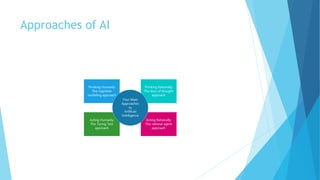
Approaches of AI
 Acting humanly (The Turing Test approach): This approach was designed by
Alan Turing. The ideology behind this approach is that a computer passes the
test if a human interrogator, after asking some written questions, cannot
identify whether the written responses come from a human or from a
computer.
 Acting humanly- When a computer acts perfectly like a human being, and it
is difficult to differentiate between two by using technologies such as natural
language processing, automated reasoning, machine learning and automated
reasoning. The Turing test, called an imitation game, determines whether a
machine can demonstrate human intelligence or not without any physical
contact.
 Thinking humanly (The cognitive modeling approach): The idea behind this
approach is to determine whether the computer thinks like a human.
 Thinking humanly – When a computer thinks just as a human and performs
tasks usually performed with human intelligence such as driving a car. The
method to determine how humans think, cognitive modeling approach is used
based on three techniques- Introspection, Psychological testing, and Brain
imaging. This category of thinking humanly is also used in psychology and
healthcare to create realistic simulations when required.
 Acting rationally (The rational agent approach): The idea behind this
approach is to determine whether the computer acts rationally i.e. with
logical reasoning.
 Acting Rationally- The study of how humans act in uncertainty or complexity
relies completely on rational agents. As with rational thought, actions depend
on conditions, environmental factors, and existing data to maximize the
expected value of its performance. It normally relies on black-box or
engineering approach to successfully accomplish the goal.
 Thinking rationally (The “laws of thought” approach): The idea behind this
approach is to determine whether the computer thinks rationally i.e. with
logical reasoning.
 Thinking rationally- The typical study of how human thinks use some
standards helping in creating a guideline of human behavior. A person is
considered rational (reasonable, sensible, and with a good sense of judgment)
and the computer thinks rationally as per the recorded behavior and solves
problems logically. In other words, the solving of a specific problem is quite
different from solving it in practice and computers take help of that rational
thought to perform.
Brief History
 Maturation of Artificial Intelligence (1943-1952)
 Year 1943: The first work which is now recognized as AI was done by Warren
McCulloch and Walter pits in 1943. They proposed a model of artificial
neurons.
 Year 1949: Donald Hebb demonstrated an updating rule for modifying the
connection strength between neurons. His rule is now called Hebbian
learning.
 Year 1950: The Alan Turing who was an English mathematician and pioneered
Machine learning in 1950. Alan Turing publishes "Computing Machinery and
Intelligence" in which he proposed a test. The test can check the machine's
ability to exhibit intelligent behavior equivalent to human intelligence, called
a Turing test.
 The birth of Artificial Intelligence (1952-1956)
 Year 1955: An Allen Newell and Herbert A. Simon created the "first artificial
intelligence program"Which was named as "Logic Theorist". This program had
proved 38 of 52 Mathematics theorems, and find new and more elegant proofs
for some theorems.
 Year 1956: The word "Artificial Intelligence" first adopted by American
Computer scientist John McCarthy at the Dartmouth Conference. For the first
time, AI coined as an academic field.
 At that time high-level computer languages such as FORTRAN, LISP, or COBOL
were invented. And the enthusiasm for AI was very high at that time.
 The golden years-Early enthusiasm (1956-1974)
 Year 1966: The researchers emphasized developing algorithms which can
solve mathematical problems. Joseph Weizenbaum created the first chatbot
in 1966, which was named as ELIZA.
 Year 1972: The first intelligent humanoid robot was built in Japan which was
named as WABOT-1
 The first AI winter (1974-1980)
 The duration between years 1974 to 1980 was the first AI winter duration. AI
winter refers to the time period where computer scientist dealt with a severe
shortage of funding from government for AI researches.
 During AI winters, an interest of publicity on artificial intelligence was
decreased.
 A boom of AI (1980-1987)
 Year 1980: After AI winter duration, AI came back with "Expert System".
Expert systems were programmed that emulate the decision-making ability of
a human expert.
 In the Year 1980, the first national conference of the American Association of
Artificial Intelligence was held at Stanford University.
 The second AI winter (1987-1993)
 The duration between the years 1987 to 1993 was the second AI Winter duration.
 Again Investors and government stopped in funding for AI research as due to high
cost but not efficient result. The expert system such as XCON was very cost
effective.
 The emergence of intelligent agents (1993-2011)
 Year 1997: In the year 1997, IBM Deep Blue beats world chess champion, Gary
Kasparov, and became the first computer to beat a world chess champion.
 Year 2002: for the first time, AI entered the home in the form of Roomba, a
vacuum cleaner.
 Year 2006: AI came in the Business world till the year 2006. Companies like
Facebook, Twitter, and Netflix also started using AI.
 Deep learning, big data and artificial general intelligence (2011-present)
 Year 2011: In the year 2011, IBM's Watson won jeopardy, a quiz show, where it had
to solve the complex questions as well as riddles. Watson had proved that it could
understand natural language and can solve tricky questions quickly.
 Year 2012: Google has launched an Android app feature "Google now", which was
able to provide information to the user as a prediction.
 Year 2014: In the year 2014, Chatbot "Eugene Goostman" won a competition in the
infamous "Turing test."
 Year 2018: The "Project Debater" from IBM debated on complex topics with two
master debaters and also performed extremely well.
 Google has demonstrated an AI program "Duplex" which was a virtual assistant and
which had taken hairdresser appointment on call, and lady on other side didn't
notice that she was talking with the machine.
The Turing Test (1950)
The Turing Test
 The Turing test, originally called the imitation game by Alan Turing in 1950, is
a test of a machine's ability to exhibit intelligent behaviour equivalent to, or
indistinguishable from, that of a human. Turing proposed that a human
evaluator would judge natural language conversations between a human and
a machine designed to generate human-like responses. The evaluator would
be aware that one of the two partners in conversation was a machine, and all
participants would be separated from one another. The conversation would be
limited to a text-only channel, such as a computer keyboard and screen, so
the result would not depend on the machine's ability to render words as
speech.If the evaluator could not reliably tell the machine from the human,
the machine would be said to have passed the test. The test results would not
depend on the machine's ability to give correct answers to questions, only on
how closely its answers resembled those a human would give.
Characteristics of AI programs
 Traditional Programming is a rule-based system, which means you need to
know all the rules before you start programming. You have your own rules
which you then make into an algorithm and use that data. After that, you
write your traditional programming, for example python coding, javascript, or
more. You write your programming in your preferred language and you will
get an output.
 In AI or Machine Learning, you have some answers and some data, then you
use machine learning to get rules. So the difference is, in Traditional
Programming you know the rules, however, in AI Programming the rules are
your output.
 Symbolic Processing
 Non algorithmic processing
 Reasoning
 Perception
 Communication
 Ability to learn
 Imprecise knowledge
 Planning
 Fast decision making
 Heuristics

Introduction to Artificial Intelligence.pptx

  • 1.
  • 2.
    Assignment 1  Elaborateon any two application areas of Artificial Intelligence.  Perform a SWOT analysis of AI. Assignments are to be submitted in hard copy and should be handwritten.
  • 3.
    Intelligence  the abilityto understand and learn well, and to form judgments and opinions based on reason.  the ability to apply knowledge to manipulate one's environment or to think abstractly as measured by objective criteria (such as tests).  Intelligence, as we know, is the ability to acquire and apply knowledge. Knowledge is the information acquired through experience. Experience is the knowledge gained through exposure(training).
  • 4.
     Intelligence iscomposed of:  Reasoning  Learning  Problem Solving  Perception  Linguistic Intelligence
  • 5.
    Artificial Intelligence  tomake computers intelligent so that they can act intelligently!  If the computers can, somehow, solve real-world problems, by improving on their own from past experiences, they would be called “intelligent”. Thus, the AI systems are more generic(rather than specific), can “think” and are more flexible.  Many tools are used in AI, including versions of search and mathematical optimization, logic, and methods based on probability and economics. The AI field draws upon computer science, mathematics, psychology, linguistics, philosophy, neuroscience, artificial psychology, and many others.
  • 6.
     The wordArtificial Intelligence comprises two words “Artificial” and “Intelligence”. Artificial refers to something which is made by human or non- natural thing and Intelligence means the ability to understand or think. AI is not a system but it is implemented in the system.  There can be so many definitions of AI, one definition can be “It is the study of how to train the computers so that computers can do things which at present human can do better.” Therefore It is an intelligence where we want to add all the capabilities to machines that humans contain.
  • 7.
     AI isa branch of data science that specializes in creating smart machines that are capable of executing a broad range of tasks that typically need human intelligence and reasoning capabilities.  Artificial intelligence is the simulation of human intelligence processes by machines, especially computer systems.  According to the father of Artificial Intelligence, John McCarthy, it is “The science and engineering of making intelligent machines, especially intelligent computer programs”.  Artificial Intelligence is a way of making a computer, a computer-controlled robot, or a software think intelligently, in the similar manner the intelligent humans think.
  • 8.
    Agents in AI Artificial intelligence is defined as the study of rational agents. A rational agent could be anything that makes decisions, as a person, firm, machine, or software. It carries out an action with the best outcome after considering past and current percepts(agent’s perceptual inputs at a given instance). An AI system is composed of an agent and its environment. The agents act in their environment. The environment may contain other agents.  Agent = Architecture + Agent Program
  • 9.
     An agentis anything that can be viewed as :  perceiving its environment through sensors and  acting upon that environment through actuators  Note: Every agent can perceive its own actions (but not always the effects)  Architecture is the machinery that the agent executes on. It is a device with sensors and actuators, for example, a robotic car, a camera, a PC. Agent program is an implementation of an agent function. An agent function is a map from the percept sequence(history of all that an agent has perceived to date) to an action.
  • 10.
     Examples ofAgent:  A software agent has Keystrokes, file contents, received network packages which act as sensors and displays on the screen, files, sent network packets acting as actuators.  A Human-agent has eyes, ears, and other organs which act as sensors, and hands, legs, mouth, and other body parts acting as actuators.  A Robotic agent has Cameras and infrared range finders which act as sensors and various motors acting as actuators.
  • 11.
    Classification of AI 1. Based on the Capabilities of AI.  Artificial narrow Intelligence.  Artificial General Intelligence.  Artificial Super Intelligence.  2. Based on Functionality of AI.  Reactive machines.  Limited memory.  Theory of mind.  Self-awareness.
  • 12.
    Based on theCapabilities of AI  1. Artificial Narrow Intelligence: ANI also called “Weak” AI is that the AI that exists in our world today. Narrow AI is AI that programmed to perform one task whether it’s checking the weather, having the ability to play chess, or analyzing data to write down the journalistic report. It can attend a task in real-time, but they pull information from a selected perform outside of the only task that they’re designed to perform.ANI system can attend to a task in the period however they pull info from a specific data set. These systems don’t perform outside of the sole task that they’re designed to perform.
  • 13.
    Based on theCapabilities of AI  2. Artificial General Intelligence: AGN also called strong AI it refers to machines that exhibit human intelligence. we will say that AGI can successfully perform any intellectual; a task that a person’s being can. this is often the type of AI that we see in movies like “Her” or other sci-fi movies during which humans interact with machines and OS that are conscious, sentiment, and driven by emotional and self-awareness. It is expected to be ready to reason, solve problems, make judgments under uncertainty in decision-making and artistic, imaginative.but for machines to realize true human-like intelligence.
  • 14.
     3. ArtificialSuper Intelligence: ASI will be human intelligence in all aspects from creativity, to general wisdom, to problem-solving. Machines are going to be capable of exhibiting intelligence that we have a tendency to haven’t seen within the brightest amongst. This is the kind of AI that a lot of individuals square measure upset concerning, and also the form of AI that individuals like Elon musk assume can cause the extinction of the human race.
  • 15.
    Based on theFunctionality of AI  1. Reactive Machines: Reactive machines created by IBM in the mid- 1980s.These machines are the foremost basic sort of AI system. this suggests that they can’t form memories or use past experiences to influence present - made a choice, they will only react to currently existing situations hence “Reactive”. An existing sort of a reactive machine is deep blue, chess playing by the supercomputer.  2. Limited Memory: It is comprised of machine learning models that device derives knowledge from previously-learned information, stored data, or events. Unlike reactive machines, limited memory learns from the past by observing actions or data fed to them to create experiential knowledge.
  • 16.
    Based on theFunctionality of AI  3. Theory of Mind: In this sort of AI decision-making ability adequate to the extent of the human mind, but by machines. while some machines currently exhibit humanlike capabilities like voice assistants, as an example, none are fully capable of holding conversations relative to human standards. One component of human conversation has the emotional capacity or sounding and behaving sort of a person would in standard conversations of conversation.  4. Self-Awareness: This AI involves machines that have human-level consciousness. this type of AI isn’t currently alive but would be considered the foremost advanced sort of AI known to man.
  • 17.
    Goals  Goals ofAI  To Create Expert Systems − The systems which exhibit intelligent behavior, learn, demonstrate, explain, and advice its users.  To Implement Human Intelligence in Machines − Creating systems that understand, think, learn, and behave like humans.
  • 18.
  • 19.
     Acting humanly(The Turing Test approach): This approach was designed by Alan Turing. The ideology behind this approach is that a computer passes the test if a human interrogator, after asking some written questions, cannot identify whether the written responses come from a human or from a computer.  Acting humanly- When a computer acts perfectly like a human being, and it is difficult to differentiate between two by using technologies such as natural language processing, automated reasoning, machine learning and automated reasoning. The Turing test, called an imitation game, determines whether a machine can demonstrate human intelligence or not without any physical contact.
  • 20.
     Thinking humanly(The cognitive modeling approach): The idea behind this approach is to determine whether the computer thinks like a human.  Thinking humanly – When a computer thinks just as a human and performs tasks usually performed with human intelligence such as driving a car. The method to determine how humans think, cognitive modeling approach is used based on three techniques- Introspection, Psychological testing, and Brain imaging. This category of thinking humanly is also used in psychology and healthcare to create realistic simulations when required.
  • 21.
     Acting rationally(The rational agent approach): The idea behind this approach is to determine whether the computer acts rationally i.e. with logical reasoning.  Acting Rationally- The study of how humans act in uncertainty or complexity relies completely on rational agents. As with rational thought, actions depend on conditions, environmental factors, and existing data to maximize the expected value of its performance. It normally relies on black-box or engineering approach to successfully accomplish the goal.
  • 22.
     Thinking rationally(The “laws of thought” approach): The idea behind this approach is to determine whether the computer thinks rationally i.e. with logical reasoning.  Thinking rationally- The typical study of how human thinks use some standards helping in creating a guideline of human behavior. A person is considered rational (reasonable, sensible, and with a good sense of judgment) and the computer thinks rationally as per the recorded behavior and solves problems logically. In other words, the solving of a specific problem is quite different from solving it in practice and computers take help of that rational thought to perform.
  • 23.
    Brief History  Maturationof Artificial Intelligence (1943-1952)  Year 1943: The first work which is now recognized as AI was done by Warren McCulloch and Walter pits in 1943. They proposed a model of artificial neurons.  Year 1949: Donald Hebb demonstrated an updating rule for modifying the connection strength between neurons. His rule is now called Hebbian learning.  Year 1950: The Alan Turing who was an English mathematician and pioneered Machine learning in 1950. Alan Turing publishes "Computing Machinery and Intelligence" in which he proposed a test. The test can check the machine's ability to exhibit intelligent behavior equivalent to human intelligence, called a Turing test.
  • 24.
     The birthof Artificial Intelligence (1952-1956)  Year 1955: An Allen Newell and Herbert A. Simon created the "first artificial intelligence program"Which was named as "Logic Theorist". This program had proved 38 of 52 Mathematics theorems, and find new and more elegant proofs for some theorems.  Year 1956: The word "Artificial Intelligence" first adopted by American Computer scientist John McCarthy at the Dartmouth Conference. For the first time, AI coined as an academic field.  At that time high-level computer languages such as FORTRAN, LISP, or COBOL were invented. And the enthusiasm for AI was very high at that time.
  • 25.
     The goldenyears-Early enthusiasm (1956-1974)  Year 1966: The researchers emphasized developing algorithms which can solve mathematical problems. Joseph Weizenbaum created the first chatbot in 1966, which was named as ELIZA.  Year 1972: The first intelligent humanoid robot was built in Japan which was named as WABOT-1
  • 26.
     The firstAI winter (1974-1980)  The duration between years 1974 to 1980 was the first AI winter duration. AI winter refers to the time period where computer scientist dealt with a severe shortage of funding from government for AI researches.  During AI winters, an interest of publicity on artificial intelligence was decreased.  A boom of AI (1980-1987)  Year 1980: After AI winter duration, AI came back with "Expert System". Expert systems were programmed that emulate the decision-making ability of a human expert.  In the Year 1980, the first national conference of the American Association of Artificial Intelligence was held at Stanford University.
  • 27.
     The secondAI winter (1987-1993)  The duration between the years 1987 to 1993 was the second AI Winter duration.  Again Investors and government stopped in funding for AI research as due to high cost but not efficient result. The expert system such as XCON was very cost effective.  The emergence of intelligent agents (1993-2011)  Year 1997: In the year 1997, IBM Deep Blue beats world chess champion, Gary Kasparov, and became the first computer to beat a world chess champion.  Year 2002: for the first time, AI entered the home in the form of Roomba, a vacuum cleaner.  Year 2006: AI came in the Business world till the year 2006. Companies like Facebook, Twitter, and Netflix also started using AI.
  • 28.
     Deep learning,big data and artificial general intelligence (2011-present)  Year 2011: In the year 2011, IBM's Watson won jeopardy, a quiz show, where it had to solve the complex questions as well as riddles. Watson had proved that it could understand natural language and can solve tricky questions quickly.  Year 2012: Google has launched an Android app feature "Google now", which was able to provide information to the user as a prediction.  Year 2014: In the year 2014, Chatbot "Eugene Goostman" won a competition in the infamous "Turing test."  Year 2018: The "Project Debater" from IBM debated on complex topics with two master debaters and also performed extremely well.  Google has demonstrated an AI program "Duplex" which was a virtual assistant and which had taken hairdresser appointment on call, and lady on other side didn't notice that she was talking with the machine.
  • 29.
  • 30.
    The Turing Test The Turing test, originally called the imitation game by Alan Turing in 1950, is a test of a machine's ability to exhibit intelligent behaviour equivalent to, or indistinguishable from, that of a human. Turing proposed that a human evaluator would judge natural language conversations between a human and a machine designed to generate human-like responses. The evaluator would be aware that one of the two partners in conversation was a machine, and all participants would be separated from one another. The conversation would be limited to a text-only channel, such as a computer keyboard and screen, so the result would not depend on the machine's ability to render words as speech.If the evaluator could not reliably tell the machine from the human, the machine would be said to have passed the test. The test results would not depend on the machine's ability to give correct answers to questions, only on how closely its answers resembled those a human would give.
  • 31.
    Characteristics of AIprograms  Traditional Programming is a rule-based system, which means you need to know all the rules before you start programming. You have your own rules which you then make into an algorithm and use that data. After that, you write your traditional programming, for example python coding, javascript, or more. You write your programming in your preferred language and you will get an output.  In AI or Machine Learning, you have some answers and some data, then you use machine learning to get rules. So the difference is, in Traditional Programming you know the rules, however, in AI Programming the rules are your output.
  • 32.
     Symbolic Processing Non algorithmic processing  Reasoning  Perception  Communication  Ability to learn  Imprecise knowledge  Planning  Fast decision making  Heuristics