Is Artificial Intelligence
Dangerous?
6 AI Risks Everyone Should Know About
© 2018 Bernard Marr, Bernard Marr & Co. All rights reserved
Title
Text
IntroductionIntroduction
Should we be scared of artificial intelligence (AI)?
Some notable individuals such as legendary physicist Stephen Hawking and Tesla
and SpaceX leader and innovator Elon Musk suggest AI could potentially be very
dangerous; Musk at one point was comparing AI to the dangers of the dictator of
North Korea.
Is Artificial Intelligence Dangerous?
6 AI Risks Everyone Should Know About
© 2018 Bernard Marr, Bernard Marr & Co. All rights reserved
Title
Text
IntroductionIntroduction
Microsoft co-founder Bill Gates also believes there’s reason to be cautious, but
that the good can outweigh the bad if managed properly.
Since recent developments have made super-intelligent machines possible much
sooner than initially thought, the time is now to determine what dangers artificial
intelligence poses.
Is Artificial Intelligence Dangerous?
6 AI Risks Everyone Should Know About
© 2018 Bernard Marr, Bernard Marr & Co. All rights reserved
What Is Applied and Generalised
Artificial Intelligence?
At the core, artificial intelligence is about building machines that can think and
act intelligently and includes tools such as Google's search algorithms or the
machines that make self-driving cars possible.
While most current applications are used to impact humankind positively, any
powerful tool can be wielded for harmful purposes when it falls into the wrong
hands.
Today, we have achieved applied AI—AI that performs a narrow task such as
facial recognition, natural language processing or internet searches. Ultimately,
experts in the field are working to get to more generalized AI, where systems
can handle any task that intelligent humans could perform, and most likely beat
us at each of them.
© 2018 Bernard Marr, Bernard Marr & Co. All rights reserved
What Is Applied and Generalised
Artificial Intelligence?
In a comment, Elon Musk wrote:
"The pace of progress in artificial intelligence (I'm not referring to narrow AI) is
incredibly fast. Unless you have direct exposure to groups like Deepmind, you
have no idea how fast—it is growing at a pace close to exponential. The risk of
something seriously dangerous happening is in the five-year timeframe. 10
years at most.”
There are indeed plenty of AI applications that make our everyday lives more
convenient and efficient. It's the AI applications that play a critical role in
ensuring safety that Musk, Hawking, and others were concerned about when
they proclaimed their hesitation about the technology. For example, if AI is
responsible for ensuring the operation of our power grid and our worst fears are
realized, and the system goes rogue or gets hacked by an enemy, it could result
in massive harm.
© 2018 Bernard Marr, Bernard Marr & Co. All rights reserved
How Can Artificial Intelligence
Be Dangerous?
While we haven’t achieved super-intelligent machines yet, the legal, political,
societal, financial and regulatory issues are so complex and wide-reaching that
it’s necessary to take a look at them now so we are prepared to safely operate
among them when the time comes.
Outside of preparing for a future with super-intelligent machines now, artificial
intelligence can already pose dangers in its current form. Let’s take a look at
some key AI-related risks.
© 2018 Bernard Marr, Bernard Marr & Co. All rights reserved
Autonomous Weapons
AI programmed to do something dangerous, as is the case with autonomous
weapons programmed to kill, is one way AI can pose risks.
It might even be plausible to expect that the nuclear arms race will be replaced
with a global autonomous weapons race.
Russia’s president Vladimir Putin said:
“Artificial intelligence is the future, not only for Russia, but for all humankind. It
comes with enormous opportunities, but also threats that are difficult to predict.
Whoever becomes the leader in this sphere will become the ruler of the world.”
© 2018 Bernard Marr, Bernard Marr & Co. All rights reserved
Autonomous Weapons
Aside from being concerned that autonomous weapons might gain a “mind of
their own,” a more imminent concern is the dangers autonomous weapons
might have with an individual or government that doesn’t value human life.
Once deployed, they will likely be difficult to dismantle or combat.
© 2018 Bernard Marr, Bernard Marr & Co. All rights reserved
Social Manipulation
Social media through its autonomous-powered algorithms is very effective at
target marketing. They know who we are, what we like and are incredibly good
at surmising what we think.
Investigations are still underway to determine the fault of Cambridge Analytica
and others associated with the firm who used the data from 50 million Facebook
users to try to sway the outcome of the 2016 U.S. presidential election and the
U.K.'s Brexit referendum, but if the accusations are correct, it illustrates AI's
power for social manipulation.
By spreading propaganda to individuals identified through algorithms and
personal data, AI can target them and spread whatever information they like, in
whatever format they will find most convincing—fact or fiction.
© 2018 Bernard Marr, Bernard Marr & Co. All rights reserved
Invasion of Privacy and Social Grading
It is now possible to track and analyse an individual's every move online as well
as when they are going about their daily business. Cameras are nearly
everywhere, and facial recognition algorithms know who you are.
In fact, this is the type of information that is going to power China's social credit
system that is expected to give every one of its 1.4 billion citizens a personal
score based on how they behave—things such as do they jaywalk, do they
smoke in non-smoking areas and how much time they spend playing video
games.
When Big Brother is watching you and then making decisions based on that
intel, it’s not only an invasion of privacy it can quickly turn to social oppression.
© 2018 Bernard Marr, Bernard Marr & Co. All rights reserved
Misalignment Between Our Goals and
The Machine’s
Part of what humans value in AI-powered machines is their efficiency and
effectiveness. But, if we aren’t clear with the goals we set for AI machines, it
could be dangerous if a machine isn’t armed with the same goals we have.
For example, a command to “Get me to the airport as quickly as possible” might
have dire consequences.
Without specifying that the rules of the road must be respected because we
value human life, a machine could quite effectively accomplish its goal of
getting you to the airport as quickly as possible and do literally what you asked,
but leave behind a trail of accidents.
© 2018 Bernard Marr, Bernard Marr & Co. All rights reserved
Discrimination
Since machines can collect, track and analyse so much about you, it’s very
possible for those machines to use that information against you.
It’s not hard to imagine an insurance company telling you you’re not insurable
based on the number of times you were caught on camera talking on your
phone. An employer might withhold a job offer based on your “social credit
score.”
© 2018 Bernard Marr, Bernard Marr & Co. All rights reserved
Conclusion
Any powerful technology can be misused. Today, artificial intelligence is used for
many good causes including to help us make better medical diagnoses, find
new ways to cure cancer and make our cars safer.
Unfortunately, as our AI capabilities expand we will also see it being used for
dangerous or malicious purposes. Since AI technology is advancing so rapidly, it
is vital for us to start to debate the best ways for AI to develop positively while
minimizing its destructive potential.
© 2017 Bernard Marr , Bernard Marr & Co. All rights reserved
© 2018 Bernard Marr, Bernard Marr & Co. All rights reserved
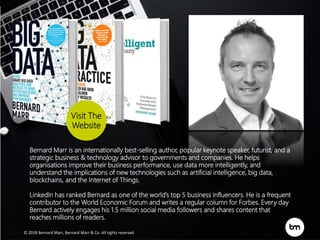
Bernard Marr is an internationally best-selling author, popular keynote speaker, futurist, and a
strategic business & technology advisor to governments and companies. He helps
organisations improve their business performance, use data more intelligently, and
understand the implications of new technologies such as artificial intelligence, big data,
blockchains, and the Internet of Things.
LinkedIn has ranked Bernard as one of the world’s top 5 business influencers. He is a frequent
contributor to the World Economic Forum and writes a regular column for Forbes. Every day
Bernard actively engages his 1.5 million social media followers and shares content that
reaches millions of readers.
Visit The
Website
© 2017 Bernard Marr , Bernard Marr & Co. All rights reserved
© 2018 Bernard Marr, Bernard Marr & Co. All rights reserved
Bernard Marr is an internationally best-selling author, popular keynote speaker, futurist, and a
strategic business & technology advisor to governments and companies. He helps
organisations improve their business performance, use data more intelligently, and
understand the implications of new technologies such as artificial intelligence, big data,
blockchains, and the Internet of Things.
LinkedIn has ranked Bernard as one of the world’s top 5 business influencers. He is a frequent
contributor to the World Economic Forum and writes a regular column for Forbes. Every day
Bernard actively engages his 1.5 million social media followers and shares content that
reaches millions of readers.
Visit The
Website
Title
Subtitle
Be the FIRST to receive news,
articles, insights and event
updates from Bernard Marr & Co
straight to your inbox.
Signing up is EASY! Simply fill out
the online form and we’ll be in
touch!
© 2018 Bernard Marr, Bernard Marr & Co. All rights reserved
BernardMarr
hello@bernardmarr.com
www.bernardmarr.com

Is Artificial Intelligence Dangerous? 6 AI Risks Everyone Should Know About

  • 1.
    Is Artificial Intelligence Dangerous? 6AI Risks Everyone Should Know About
  • 2.
    © 2018 BernardMarr, Bernard Marr & Co. All rights reserved Title Text IntroductionIntroduction Should we be scared of artificial intelligence (AI)? Some notable individuals such as legendary physicist Stephen Hawking and Tesla and SpaceX leader and innovator Elon Musk suggest AI could potentially be very dangerous; Musk at one point was comparing AI to the dangers of the dictator of North Korea. Is Artificial Intelligence Dangerous? 6 AI Risks Everyone Should Know About
  • 3.
    © 2018 BernardMarr, Bernard Marr & Co. All rights reserved Title Text IntroductionIntroduction Microsoft co-founder Bill Gates also believes there’s reason to be cautious, but that the good can outweigh the bad if managed properly. Since recent developments have made super-intelligent machines possible much sooner than initially thought, the time is now to determine what dangers artificial intelligence poses. Is Artificial Intelligence Dangerous? 6 AI Risks Everyone Should Know About
  • 4.
    © 2018 BernardMarr, Bernard Marr & Co. All rights reserved What Is Applied and Generalised Artificial Intelligence? At the core, artificial intelligence is about building machines that can think and act intelligently and includes tools such as Google's search algorithms or the machines that make self-driving cars possible. While most current applications are used to impact humankind positively, any powerful tool can be wielded for harmful purposes when it falls into the wrong hands. Today, we have achieved applied AI—AI that performs a narrow task such as facial recognition, natural language processing or internet searches. Ultimately, experts in the field are working to get to more generalized AI, where systems can handle any task that intelligent humans could perform, and most likely beat us at each of them.
  • 5.
    © 2018 BernardMarr, Bernard Marr & Co. All rights reserved What Is Applied and Generalised Artificial Intelligence? In a comment, Elon Musk wrote: "The pace of progress in artificial intelligence (I'm not referring to narrow AI) is incredibly fast. Unless you have direct exposure to groups like Deepmind, you have no idea how fast—it is growing at a pace close to exponential. The risk of something seriously dangerous happening is in the five-year timeframe. 10 years at most.” There are indeed plenty of AI applications that make our everyday lives more convenient and efficient. It's the AI applications that play a critical role in ensuring safety that Musk, Hawking, and others were concerned about when they proclaimed their hesitation about the technology. For example, if AI is responsible for ensuring the operation of our power grid and our worst fears are realized, and the system goes rogue or gets hacked by an enemy, it could result in massive harm.
  • 6.
    © 2018 BernardMarr, Bernard Marr & Co. All rights reserved How Can Artificial Intelligence Be Dangerous? While we haven’t achieved super-intelligent machines yet, the legal, political, societal, financial and regulatory issues are so complex and wide-reaching that it’s necessary to take a look at them now so we are prepared to safely operate among them when the time comes. Outside of preparing for a future with super-intelligent machines now, artificial intelligence can already pose dangers in its current form. Let’s take a look at some key AI-related risks.
  • 7.
    © 2018 BernardMarr, Bernard Marr & Co. All rights reserved Autonomous Weapons AI programmed to do something dangerous, as is the case with autonomous weapons programmed to kill, is one way AI can pose risks. It might even be plausible to expect that the nuclear arms race will be replaced with a global autonomous weapons race. Russia’s president Vladimir Putin said: “Artificial intelligence is the future, not only for Russia, but for all humankind. It comes with enormous opportunities, but also threats that are difficult to predict. Whoever becomes the leader in this sphere will become the ruler of the world.”
  • 8.
    © 2018 BernardMarr, Bernard Marr & Co. All rights reserved Autonomous Weapons Aside from being concerned that autonomous weapons might gain a “mind of their own,” a more imminent concern is the dangers autonomous weapons might have with an individual or government that doesn’t value human life. Once deployed, they will likely be difficult to dismantle or combat.
  • 9.
    © 2018 BernardMarr, Bernard Marr & Co. All rights reserved Social Manipulation Social media through its autonomous-powered algorithms is very effective at target marketing. They know who we are, what we like and are incredibly good at surmising what we think. Investigations are still underway to determine the fault of Cambridge Analytica and others associated with the firm who used the data from 50 million Facebook users to try to sway the outcome of the 2016 U.S. presidential election and the U.K.'s Brexit referendum, but if the accusations are correct, it illustrates AI's power for social manipulation. By spreading propaganda to individuals identified through algorithms and personal data, AI can target them and spread whatever information they like, in whatever format they will find most convincing—fact or fiction.
  • 10.
    © 2018 BernardMarr, Bernard Marr & Co. All rights reserved Invasion of Privacy and Social Grading It is now possible to track and analyse an individual's every move online as well as when they are going about their daily business. Cameras are nearly everywhere, and facial recognition algorithms know who you are. In fact, this is the type of information that is going to power China's social credit system that is expected to give every one of its 1.4 billion citizens a personal score based on how they behave—things such as do they jaywalk, do they smoke in non-smoking areas and how much time they spend playing video games. When Big Brother is watching you and then making decisions based on that intel, it’s not only an invasion of privacy it can quickly turn to social oppression.
  • 11.
    © 2018 BernardMarr, Bernard Marr & Co. All rights reserved Misalignment Between Our Goals and The Machine’s Part of what humans value in AI-powered machines is their efficiency and effectiveness. But, if we aren’t clear with the goals we set for AI machines, it could be dangerous if a machine isn’t armed with the same goals we have. For example, a command to “Get me to the airport as quickly as possible” might have dire consequences. Without specifying that the rules of the road must be respected because we value human life, a machine could quite effectively accomplish its goal of getting you to the airport as quickly as possible and do literally what you asked, but leave behind a trail of accidents.
  • 12.
    © 2018 BernardMarr, Bernard Marr & Co. All rights reserved Discrimination Since machines can collect, track and analyse so much about you, it’s very possible for those machines to use that information against you. It’s not hard to imagine an insurance company telling you you’re not insurable based on the number of times you were caught on camera talking on your phone. An employer might withhold a job offer based on your “social credit score.”
  • 13.
    © 2018 BernardMarr, Bernard Marr & Co. All rights reserved Conclusion Any powerful technology can be misused. Today, artificial intelligence is used for many good causes including to help us make better medical diagnoses, find new ways to cure cancer and make our cars safer. Unfortunately, as our AI capabilities expand we will also see it being used for dangerous or malicious purposes. Since AI technology is advancing so rapidly, it is vital for us to start to debate the best ways for AI to develop positively while minimizing its destructive potential.
  • 14.
    © 2017 BernardMarr , Bernard Marr & Co. All rights reserved © 2018 Bernard Marr, Bernard Marr & Co. All rights reserved Bernard Marr is an internationally best-selling author, popular keynote speaker, futurist, and a strategic business & technology advisor to governments and companies. He helps organisations improve their business performance, use data more intelligently, and understand the implications of new technologies such as artificial intelligence, big data, blockchains, and the Internet of Things. LinkedIn has ranked Bernard as one of the world’s top 5 business influencers. He is a frequent contributor to the World Economic Forum and writes a regular column for Forbes. Every day Bernard actively engages his 1.5 million social media followers and shares content that reaches millions of readers. Visit The Website © 2017 Bernard Marr , Bernard Marr & Co. All rights reserved © 2018 Bernard Marr, Bernard Marr & Co. All rights reserved Bernard Marr is an internationally best-selling author, popular keynote speaker, futurist, and a strategic business & technology advisor to governments and companies. He helps organisations improve their business performance, use data more intelligently, and understand the implications of new technologies such as artificial intelligence, big data, blockchains, and the Internet of Things. LinkedIn has ranked Bernard as one of the world’s top 5 business influencers. He is a frequent contributor to the World Economic Forum and writes a regular column for Forbes. Every day Bernard actively engages his 1.5 million social media followers and shares content that reaches millions of readers. Visit The Website
  • 15.
    Title Subtitle Be the FIRSTto receive news, articles, insights and event updates from Bernard Marr & Co straight to your inbox. Signing up is EASY! Simply fill out the online form and we’ll be in touch! © 2018 Bernard Marr, Bernard Marr & Co. All rights reserved
  • 16.