A Seminar on Artificial Intelligence
BY : BIJAY KUMAR NAYAK
‱ Introduction
‱ Branches
‱ Workflow
‱ Why AI
‱ Structural Design/Components
‱ Advantages & Disadvantages
‱ Applications
‱ Future Scope
‱ Conclusion
Contents
Artificial intelligence is a study that aims to create intelligent machines. It
has become an essential part of the technology industry.
Definition
What is an Intelligent machine
Machine Capable of learning and implementing itself.
Artificial Intelligence
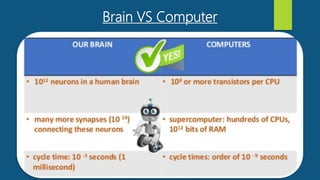
Brain VS Computer
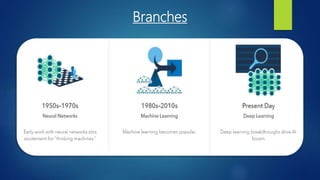
Branches
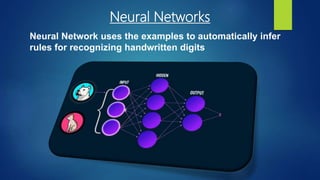
Neural Networks
Neural Network uses the examples to automatically infer
rules for recognizing handwritten digits
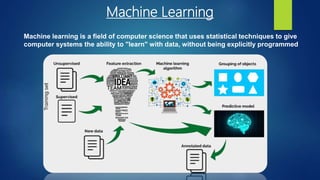
Machine Learning
Machine learning is a field of computer science that uses statistical techniques to give
computer systems the ability to "learn" with data, without being explicitly programmed
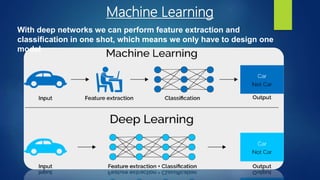
With deep networks we can perform feature extraction and
classification in one shot, which means we only have to design one
model
Machine Learning
‱Cognitive computing : is a subfield of AI that strives for a natural, human-like
interaction with machines. Using AI and cognitive computing, the ultimate goal is for a
machine to simulate human processes through the ability to interpret images and
speech – and then speak coherently in response.
‱Computer vision : relies on pattern recognition and deep learning to recognize what’s
in a picture or video. When machines can process, analyze and understand images,
they can capture images or videos in real time and interpret their surroundings.
‱Natural language processing (NLP) : is the ability of computers to analyze,
understand and generate human language, including speech. The next stage of NLP is
natural language interaction, which allows humans to communicate with computers
using normal, everyday language to perform tasks.
Cont.
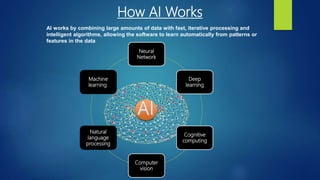
How AI Works
AI works by combining large amounts of data with fast, iterative processing and
intelligent algorithms, allowing the software to learn automatically from patterns or
features in the data
Neural
Network
Deep
learning
Cognitive
computing
Computer
vision
Natural
language
processing
Machine
learning
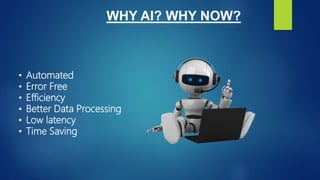
WHY AI? WHY NOW?
‱ Automated
‱ Error Free
‱ Efficiency
‱ Better Data Processing
‱ Low latency
‱ Time Saving
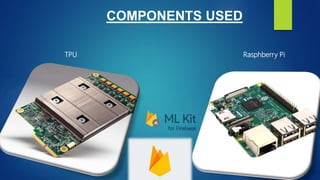
COMPONENTS USED
TPU Rasphberry Pi
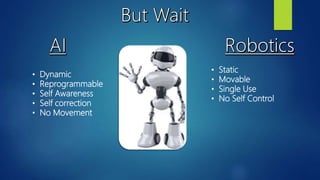
‱ Dynamic
‱ Reprogrammable
‱ Self Awareness
‱ Self correction
‱ No Movement
‱ Static
‱ Movable
‱ Single Use
‱ No Self Control
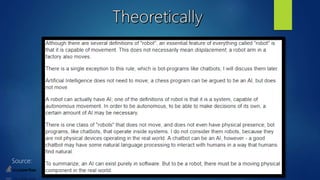
Source:
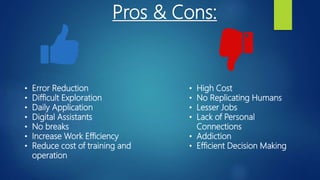
Pros & Cons:
‱ Error Reduction
‱ Difficult Exploration
‱ Daily Application
‱ Digital Assistants
‱ No breaks
‱ Increase Work Efficiency
‱ Reduce cost of training and
operation
‱ High Cost
‱ No Replicating Humans
‱ Lesser Jobs
‱ Lack of Personal
Connections
‱ Addiction
‱ Efficient Decision Making
Security Features
A.I is more secure with Banking level security uses 2014 bit encryption. So it will take
billions of year to decode a single letter with out actual key.
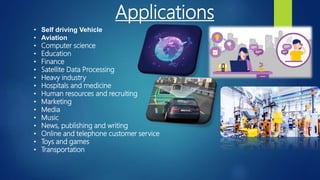
Applications
‱ Self driving Vehicle
‱ Aviation
‱ Computer science
‱ Education
‱ Finance
‱ Satellite Data Processing
‱ Heavy industry
‱ Hospitals and medicine
‱ Human resources and recruiting
‱ Marketing
‱ Media
‱ Music
‱ News, publishing and writing
‱ Online and telephone customer service
‱ Toys and games
‱ Transportation
A.I In Electrical Engineering
‱ Diagnosis of Electrical machines and drives
‱ Synchronous Control over electrical machine.
‱ Reduced Fault rate
Typical problems to which AI methods are
applied
‱ Optical character recognition
‱ Handwriting recognition
‱ Speech recognition
‱ Face recognition
‱ Artificial creativity
‱ Computer vision, Virtual reality, and Image
processing
‱ Photo and Video manipulation
‱ Diagnosis (artificial intelligence)
‱ Game theory and Strategic planning
‱ Game artificial intelligence and Computer
game bot
‱ Natural language processing, Translation and
Chatterbots
‱ Nonlinear control and Robotics
Other fields in which AI methods are implemented
‱ Artificial life
‱ Automated reasoning
‱ Automation
‱ Biologically inspired computing
‱ Concept mining
‱ Data mining
‱ Knowledge representation
‱ Semantic Web
‱ E-mail spam filtering
‱ Robotics
‱ Behavior-based robotics
‱ Cognitive
‱ Cybernetics
‱ Developmental robotics (Epigenetic)
‱ Evolutionary robotics
‱ Hybrid intelligent system
‱ Intelligent agent
‱ Intelligent control
‱ Litigation
Future Scope
‱ Soaring Demand for AI Professionals
‱ Novel Career Paths
‱ Earning Potential
‱ Cyber Security
Since Its started, Industries are switching over to AI based solution with every
small task to save time and engaged their engineers with AI features
development.
In future AI also can replace human in some common tasks with more security
and speed
1. https://ieeexplore.ieee.org/document/1201096/
2. https://ieeexplore.ieee.org/document/260875/
3. https://data-flair.training/blogs/artificial-intelligence-advantages-disadvantages/
4. https://www.pantechsolutions.net/blog/machine-learning-projects-and-ideas/
5. https://www.sas.com/en_us/insights/analytics/what-is-artificial-intelligence.html
6. http://www-formal.stanford.edu/jmc/whatisai/node3.html
7. https://en.wikipedia.org/wiki/Applications_of_artificial_intelligence
8. Artificial Intelligence: A Modern Approach by Peter Norvig and Stuart J. Russell
9. https://searchenterpriseai.techtarget.com/definition/AI-Artificial-Intelligence
10. https://ai.google/education/
References
Artificial Intelligence (A.I) and Its Application -Seminar

Artificial Intelligence (A.I) and Its Application -Seminar

  • 1.
    A Seminar onArtificial Intelligence BY : BIJAY KUMAR NAYAK
  • 2.
    ‱ Introduction ‱ Branches ‱Workflow ‱ Why AI ‱ Structural Design/Components ‱ Advantages & Disadvantages ‱ Applications ‱ Future Scope ‱ Conclusion Contents
  • 3.
    Artificial intelligence isa study that aims to create intelligent machines. It has become an essential part of the technology industry. Definition What is an Intelligent machine Machine Capable of learning and implementing itself. Artificial Intelligence
  • 4.
  • 5.
  • 6.
    Neural Networks Neural Networkuses the examples to automatically infer rules for recognizing handwritten digits
  • 7.
    Machine Learning Machine learningis a field of computer science that uses statistical techniques to give computer systems the ability to "learn" with data, without being explicitly programmed
  • 8.
    With deep networkswe can perform feature extraction and classification in one shot, which means we only have to design one model Machine Learning
  • 9.
    ‱Cognitive computing :is a subfield of AI that strives for a natural, human-like interaction with machines. Using AI and cognitive computing, the ultimate goal is for a machine to simulate human processes through the ability to interpret images and speech – and then speak coherently in response. ‱Computer vision : relies on pattern recognition and deep learning to recognize what’s in a picture or video. When machines can process, analyze and understand images, they can capture images or videos in real time and interpret their surroundings. ‱Natural language processing (NLP) : is the ability of computers to analyze, understand and generate human language, including speech. The next stage of NLP is natural language interaction, which allows humans to communicate with computers using normal, everyday language to perform tasks. Cont.
  • 10.
    How AI Works AIworks by combining large amounts of data with fast, iterative processing and intelligent algorithms, allowing the software to learn automatically from patterns or features in the data Neural Network Deep learning Cognitive computing Computer vision Natural language processing Machine learning
  • 11.
    WHY AI? WHYNOW? ‱ Automated ‱ Error Free ‱ Efficiency ‱ Better Data Processing ‱ Low latency ‱ Time Saving
  • 12.
  • 13.
    ‱ Dynamic ‱ Reprogrammable ‱Self Awareness ‱ Self correction ‱ No Movement ‱ Static ‱ Movable ‱ Single Use ‱ No Self Control
  • 14.
  • 16.
    Pros & Cons: ‱Error Reduction ‱ Difficult Exploration ‱ Daily Application ‱ Digital Assistants ‱ No breaks ‱ Increase Work Efficiency ‱ Reduce cost of training and operation ‱ High Cost ‱ No Replicating Humans ‱ Lesser Jobs ‱ Lack of Personal Connections ‱ Addiction ‱ Efficient Decision Making
  • 17.
    Security Features A.I ismore secure with Banking level security uses 2014 bit encryption. So it will take billions of year to decode a single letter with out actual key.
  • 18.
    Applications ‱ Self drivingVehicle ‱ Aviation ‱ Computer science ‱ Education ‱ Finance ‱ Satellite Data Processing ‱ Heavy industry ‱ Hospitals and medicine ‱ Human resources and recruiting ‱ Marketing ‱ Media ‱ Music ‱ News, publishing and writing ‱ Online and telephone customer service ‱ Toys and games ‱ Transportation
  • 19.
    A.I In ElectricalEngineering ‱ Diagnosis of Electrical machines and drives ‱ Synchronous Control over electrical machine. ‱ Reduced Fault rate
  • 20.
    Typical problems towhich AI methods are applied ‱ Optical character recognition ‱ Handwriting recognition ‱ Speech recognition ‱ Face recognition ‱ Artificial creativity ‱ Computer vision, Virtual reality, and Image processing ‱ Photo and Video manipulation ‱ Diagnosis (artificial intelligence) ‱ Game theory and Strategic planning ‱ Game artificial intelligence and Computer game bot ‱ Natural language processing, Translation and Chatterbots ‱ Nonlinear control and Robotics Other fields in which AI methods are implemented ‱ Artificial life ‱ Automated reasoning ‱ Automation ‱ Biologically inspired computing ‱ Concept mining ‱ Data mining ‱ Knowledge representation ‱ Semantic Web ‱ E-mail spam filtering ‱ Robotics ‱ Behavior-based robotics ‱ Cognitive ‱ Cybernetics ‱ Developmental robotics (Epigenetic) ‱ Evolutionary robotics ‱ Hybrid intelligent system ‱ Intelligent agent ‱ Intelligent control ‱ Litigation
  • 21.
    Future Scope ‱ SoaringDemand for AI Professionals ‱ Novel Career Paths ‱ Earning Potential ‱ Cyber Security Since Its started, Industries are switching over to AI based solution with every small task to save time and engaged their engineers with AI features development. In future AI also can replace human in some common tasks with more security and speed
  • 22.
    1. https://ieeexplore.ieee.org/document/1201096/ 2. https://ieeexplore.ieee.org/document/260875/ 3.https://data-flair.training/blogs/artificial-intelligence-advantages-disadvantages/ 4. https://www.pantechsolutions.net/blog/machine-learning-projects-and-ideas/ 5. https://www.sas.com/en_us/insights/analytics/what-is-artificial-intelligence.html 6. http://www-formal.stanford.edu/jmc/whatisai/node3.html 7. https://en.wikipedia.org/wiki/Applications_of_artificial_intelligence 8. Artificial Intelligence: A Modern Approach by Peter Norvig and Stuart J. Russell 9. https://searchenterpriseai.techtarget.com/definition/AI-Artificial-Intelligence 10. https://ai.google/education/ References