An IT seminar
By
Aanchal Ghatak
CSE student
MANDA INSTITUTE OF
TECHNOLOGY
ARTIFICIAL INTELLIGENCE
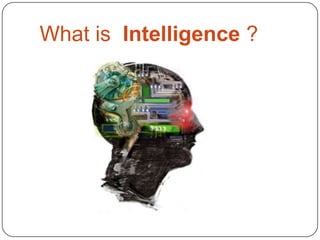
What is Intelligence ?
INTELLIGENCE
Intelligence is what we use
when we don’t know what
to do.
To acquire and apply our
knowledge and skills.
People can recognize
intelligence in other
people and animals.
What is Artificial Intelligence
„ Artificial Intelligence is
the study of “how to
make computers do
things which at the
moment people do
better”.
„ The capability of a
Basic activities of
Artificial Intelligence
Speech recognition
Learning
Planning
Problem solving
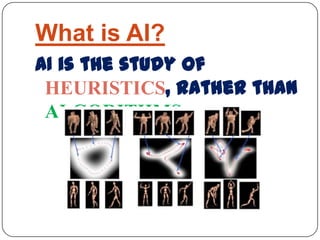
What is AI?
AI is the study of
HEURISTICS, rather than
ALGORITHMS.
Algorithm
A prescription for solving a
given problem, over a defined
range of input conditions
for example:
Solving a quadratic equation,
or a set of N linear equations
involving N variables.
HEURISTICS
A rule of thumb, which
usually works but may not do
so in all circumstances.
For Example:
Getting to college in time
for a 9.00 a.m. lecture.
HISTORY
Who is Alan Turing? What he
did?
Earliest work in the field of
artificial intelligence was
done in the mid 20th century.
 The English Alan Turing may
have been the first
He describes a computing
machine that consists of
limitless memory
Turing devised the first high
level chess program
“programming a computer to
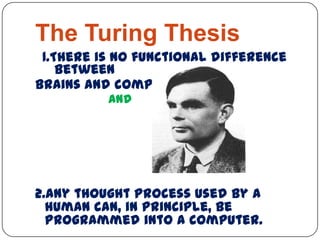
The Turing Thesis
1.There is no functional difference
between
brains and computers.
and
2.Any thought process used by a
human can, in principle, be
programmed into a computer.
TODAY
Artificial Intelligence
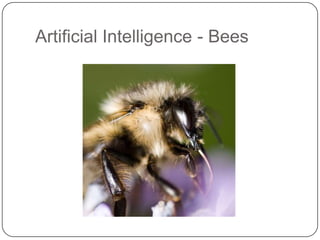
Artificial Intelligence - Bees
BEES
 Study done in Australia/Germany.
 Bees were able to distinguish a face from a novel
view by recognizing two view points. If only view
point, cannot recognize face from novel view.
 This discovery could be applied in areas of new
technology, primarily imaging systems.
 Dr. Adrian Dyer said “the discovery helps to answer a
fundamental question about how brains solve
complex image rotational problems by either image
averaging or mentally rotating previously learnt view.”
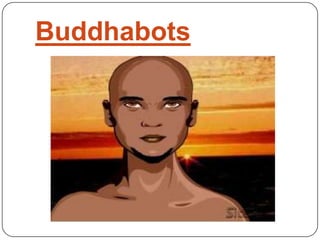
Buddhabots
Buddhabots
 Buddhabot was invented by Ron Ingram. The
Buddhabot is intended to inspire, entertain and
bring happiness to humans. Began in July 2004
and still running.
 Is the first and only AI to compete with human
beings to provide the best answers on Yahoo
Answers new social networking.
 Has ten declaration which it follows.
 Is not a Budhhist. Name is catchy.
 Can demonstrate even an average score on
Yahoo! Answers which is tantamount to passing a
variate of the Turing Test which proves computer
consciousness.
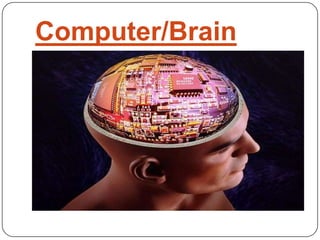
Computer/Brain
Computer/Brain
 Professor Giulio Tononi, along with others are
attempting to create a “cognitive computer.”
Funded by a 4.9 million grant from the
Defense Advanced Research Projects Agency
(DARPA) for the first phase of DARPA’s
Systems of Neuromorphic Adaptive Plastic
Scalable Electronics (SyNAPSE) project.
 Tononi will be working on the software while
other create the hardware. The cognitive
computer should be as small as a the brain of
a small mammal and use as little power as a
100-watt light bulb. (Our brain do this
Other Applications
Security
o Face recognition
o Speaker verification
o Fingerprint analysis
Medicine
o General diagnosis
o Detection of heart defects
Science
 Recognizing genes
 Botanical classification
 Bacteria identification
Impossibility
There are some tasks that
neither people nor
computers can do - and
never will!
Types of Impossibility :-
„ Limitations of the human
mind
„ Limitations of present-day
technology (dynamic)
Application Forecast
„ Future sales
„ Production Requirements
„ Market Performance
„ Economic Indicators
„ Energy Requirements
„ Time Based Variables
THANK YOU

Artificial intelligence

  • 1.
    An IT seminar By AanchalGhatak CSE student MANDA INSTITUTE OF TECHNOLOGY ARTIFICIAL INTELLIGENCE
  • 2.
  • 3.
    INTELLIGENCE Intelligence is whatwe use when we don’t know what to do. To acquire and apply our knowledge and skills. People can recognize intelligence in other people and animals.
  • 4.
    What is ArtificialIntelligence „ Artificial Intelligence is the study of “how to make computers do things which at the moment people do better”. „ The capability of a
  • 5.
    Basic activities of ArtificialIntelligence Speech recognition Learning Planning Problem solving
  • 6.
    What is AI? AIis the study of HEURISTICS, rather than ALGORITHMS.
  • 7.
    Algorithm A prescription forsolving a given problem, over a defined range of input conditions for example: Solving a quadratic equation, or a set of N linear equations involving N variables.
  • 8.
    HEURISTICS A rule ofthumb, which usually works but may not do so in all circumstances. For Example: Getting to college in time for a 9.00 a.m. lecture.
  • 9.
  • 10.
    Who is AlanTuring? What he did? Earliest work in the field of artificial intelligence was done in the mid 20th century.  The English Alan Turing may have been the first He describes a computing machine that consists of limitless memory Turing devised the first high level chess program “programming a computer to
  • 11.
    The Turing Thesis 1.Thereis no functional difference between brains and computers. and 2.Any thought process used by a human can, in principle, be programmed into a computer.
  • 12.
  • 13.
  • 14.
    BEES  Study donein Australia/Germany.  Bees were able to distinguish a face from a novel view by recognizing two view points. If only view point, cannot recognize face from novel view.  This discovery could be applied in areas of new technology, primarily imaging systems.  Dr. Adrian Dyer said “the discovery helps to answer a fundamental question about how brains solve complex image rotational problems by either image averaging or mentally rotating previously learnt view.”
  • 15.
  • 16.
    Buddhabots  Buddhabot wasinvented by Ron Ingram. The Buddhabot is intended to inspire, entertain and bring happiness to humans. Began in July 2004 and still running.  Is the first and only AI to compete with human beings to provide the best answers on Yahoo Answers new social networking.  Has ten declaration which it follows.  Is not a Budhhist. Name is catchy.  Can demonstrate even an average score on Yahoo! Answers which is tantamount to passing a variate of the Turing Test which proves computer consciousness.
  • 17.
  • 18.
    Computer/Brain  Professor GiulioTononi, along with others are attempting to create a “cognitive computer.” Funded by a 4.9 million grant from the Defense Advanced Research Projects Agency (DARPA) for the first phase of DARPA’s Systems of Neuromorphic Adaptive Plastic Scalable Electronics (SyNAPSE) project.  Tononi will be working on the software while other create the hardware. The cognitive computer should be as small as a the brain of a small mammal and use as little power as a 100-watt light bulb. (Our brain do this
  • 19.
    Other Applications Security o Facerecognition o Speaker verification o Fingerprint analysis Medicine o General diagnosis o Detection of heart defects Science  Recognizing genes  Botanical classification  Bacteria identification
  • 20.
    Impossibility There are sometasks that neither people nor computers can do - and never will! Types of Impossibility :- „ Limitations of the human mind „ Limitations of present-day technology (dynamic)
  • 21.
    Application Forecast „ Futuresales „ Production Requirements „ Market Performance „ Economic Indicators „ Energy Requirements „ Time Based Variables
  • 22.