Int 2 Accounting Mr Arthur
Aims of the Lesson Why do we create Accounts? What does Accounting Involve? Who is Interested in the Accounts of a Business? Financial V Management Accounting
Why do we Create Accounts?? To calculate profit or loss To try and cut expenses For the tax man!! To work out overall value of the business To work out partnership’s share To check if figures are correct Legal requirement To budget for future planning To attract shareholders To work out which areas are suffering and which are prospering
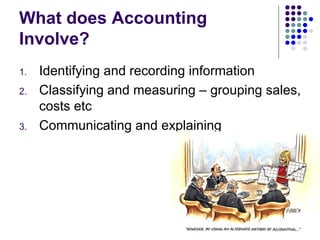
What does Accounting Involve? Identifying and recording information Classifying and measuring – grouping sales, costs etc Communicating and explaining
Who is Interested in Accounting Information?? Potential Investors Shareholders Bankers Owners Taxman Members Employees
Financial Accounting These accounts present a historical record of the company and are backward looking Trading Profit and Loss Balance Sheet Income and Expenditure Account Receipts and Payment Account Accounts are for external purposes – shareholders, employees etc Financial accounts are a legal requirement These accounts are unsuitable for planning, control and decision making
Management Accounting Management Accounts are not for publication Accounts provide recent, current and future estimates of performance Useful for Management to develop business strategies Not legally required
Aims of the Lesson Last Lesson Why do we create Accounts? What does Accounting Involve? Who is Interested in the Accounts of a Business? Financial V Management Accounting Today’s Lesson Documents of trade The document trail Research of accounting terms
Documents of Trade A business transaction occurs when goods or services are provided. Cash transaction  = goods are purchased and paid immediately Credit transaction  = goods are purchased and paid for at a later date
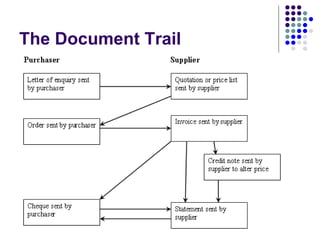
The Document Trail
Accounting Terms to Research Invoice Trade Discount Cash Discount Value Added Tax Credit Note Statement of Account Receipts Credit/Debit card Dishonoured Cheque Bad debt
Structure of the Course Role of Financial Accounting in business Introduction to accounting standards — SSAPs and FRSs Characteristics of business organisations Preparation of manufacturing accounts Features of ownership, funding, management, liability and control for an organisation Preparation of final accounts of business organisations; sole traders; partnerships and plcs Correction of errors and updating of final account figures Analysis and interpretation of accounting information Preparation of not-for profit final accounts
Final Accounts – Key Terms Prepayments An amount paid during this financial year for the next financial year, e.g. paying in advance  Accruals An expense which you have not managed to pay this financial year, which will spill into next year Depreciation This is the amount you are setting aside due to Assets reducing in value Bad Debts This is the amount of money you write of as you debtor is unable to pay you Provision for doubtful debts This is usually a percentage of your debtors for the year, Incase they cannot pay you back

Int 2 Accounting

  • 1.
  • 2.
    Aims of theLesson Why do we create Accounts? What does Accounting Involve? Who is Interested in the Accounts of a Business? Financial V Management Accounting
  • 3.
    Why do weCreate Accounts?? To calculate profit or loss To try and cut expenses For the tax man!! To work out overall value of the business To work out partnership’s share To check if figures are correct Legal requirement To budget for future planning To attract shareholders To work out which areas are suffering and which are prospering
  • 4.
    What does AccountingInvolve? Identifying and recording information Classifying and measuring – grouping sales, costs etc Communicating and explaining
  • 5.
    Who is Interestedin Accounting Information?? Potential Investors Shareholders Bankers Owners Taxman Members Employees
  • 6.
    Financial Accounting Theseaccounts present a historical record of the company and are backward looking Trading Profit and Loss Balance Sheet Income and Expenditure Account Receipts and Payment Account Accounts are for external purposes – shareholders, employees etc Financial accounts are a legal requirement These accounts are unsuitable for planning, control and decision making
  • 7.
    Management Accounting ManagementAccounts are not for publication Accounts provide recent, current and future estimates of performance Useful for Management to develop business strategies Not legally required
  • 8.
    Aims of theLesson Last Lesson Why do we create Accounts? What does Accounting Involve? Who is Interested in the Accounts of a Business? Financial V Management Accounting Today’s Lesson Documents of trade The document trail Research of accounting terms
  • 9.
    Documents of TradeA business transaction occurs when goods or services are provided. Cash transaction = goods are purchased and paid immediately Credit transaction = goods are purchased and paid for at a later date
  • 10.
  • 11.
    Accounting Terms toResearch Invoice Trade Discount Cash Discount Value Added Tax Credit Note Statement of Account Receipts Credit/Debit card Dishonoured Cheque Bad debt
  • 12.
    Structure of theCourse Role of Financial Accounting in business Introduction to accounting standards — SSAPs and FRSs Characteristics of business organisations Preparation of manufacturing accounts Features of ownership, funding, management, liability and control for an organisation Preparation of final accounts of business organisations; sole traders; partnerships and plcs Correction of errors and updating of final account figures Analysis and interpretation of accounting information Preparation of not-for profit final accounts
  • 13.
    Final Accounts –Key Terms Prepayments An amount paid during this financial year for the next financial year, e.g. paying in advance Accruals An expense which you have not managed to pay this financial year, which will spill into next year Depreciation This is the amount you are setting aside due to Assets reducing in value Bad Debts This is the amount of money you write of as you debtor is unable to pay you Provision for doubtful debts This is usually a percentage of your debtors for the year, Incase they cannot pay you back