ARTIFICIAL
INTELLIGENCE
content
Introductions
History of AI
 Applications
Future of AI
AI in daily life
conclusion
Introduction
What is a artificial intelligence or (A.I)?
 Artificial intelligence(AI) is intelligence
exhibited by machines . In computer science ,
an ideal “intelligent” machines is a flexible
rational agent that perceives its environment
and takes actions that maximize its chance of
success at same goal
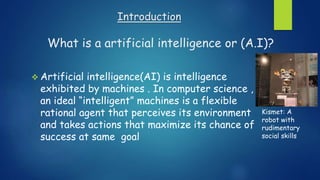
Kismet: A
robot with
rudimentary
social skills
History
 1943:McCullough and Pitts’ invented “artificial neurons”
 1950: inventions of Allan Turing’s “computing machinery and
intelligence
 1951: AI was using in games
 1956: Dartmouth conference; And the bird of AI
 1965: Robinson’s complete algorithm for logical reasoning
 1969-79: early development of knowledge based systems
took place
 1980-88: expert system industry booms
 1988-93:Expert system industry busts “ AI winter”
 1993-present: AI is now using rapidly in different technologies ; And is
achieving its goal
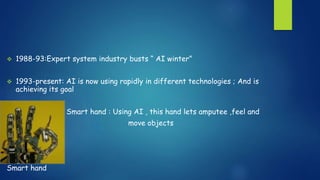
Smart hand : Using AI , this hand lets amputee ,feel and
move objects
Smart hand
Applications
 Expert system
 Natural language processing (NLP)
 Speech recognition
 Computer vision.
 Robotics
 Automatic programming
Expert system
 An Expert System is a computer program.
designed to act as an expert in a particular domain
(area of expertise). Domain of E.S. Knowledge
base Facts Heuristics Phases in Expert System.
Expert systems currently are designed to assist
experts, not to replace them, They have been
used in medical diagnosis, chemical analysis,
geological explorations etc.
Natural language processing (NLP)
 The goal of NLP is to enable people and
computers to LP communicate in a natural
(humanly) language(such as, English) rather
than in a computer language
Speech recognition
 The primary interactive method of communication
used by humans is not reading and writing, it is
speech. The goal of speech recognition research is
to allow computers to understand human speech.
So that they can hear our voices and recognize
the words we are speaking. It simplifies the
process of interactive communication between
people and computers, thus it advances the goal of
NLP.
Computer vision.
 People generally use vision as their primary means
of sensing their environment, we generally see
more than we hear, feel or smell or taste. The
goal of computer vision research is to give
computers this same powerful facility for
understanding their surrounding. Here A.I helps
computer to understand what they see through
attached cameras
Robotics
 A Robot is a electro-mechanical device that can by
programmed to perform manual tasks or a
reprogrammable multi functional manipulator
designed to move materials, parts, tools, or
specialized devices through variable programmed
motions for performance of variety of tasks. An
'intelligent' robot includes some kind of sensory
apparatus that allows it to respond to change in
it's environment.
Automatic programming
 Automatic programming is the generation of
programs by computer, usually based on
specifications that are higher-level and
easier for humans to specify than ordinary
programming languages. It's one of the
most important part of A.I.
Future of AI
 The future is really is UNKNOWN
Researches seem to disagree on a lot of the same issues.
With the rate at which technology is improving it is logical to believer AI
will continue to get more and more sophisticated.
But we can imagine two different kind of AI in
future
They are:
 Positive
 Negative
Positive
 Maybe, the day is not far when we will just sit
back in our cozy little beds and just command our
personal Robot's to entirely do our ruts. He will be
a perfect companion for us. Just enjoy the
Technology.
Negative
 It may end in other way too. Some day there will
be a knock at our door. As we open it, we'll see a
large number of Robots marching into our house
destroying everything we own and looting you. This
is because ever since there is an advantage in the
Technology, it attracts anti social elements. This
is true for Robots too. Because now they will have
full power to think as human, even as of anti-social
elements. So we should think trice before giving
them power of Cognition.
A.I in daily life
➤Virtual Personal Assistant
Siri, Google Now, and Cortana are all intelligent
digital personal assistants on various platforms(iOS,
Android, Windows) which are based on A.I.
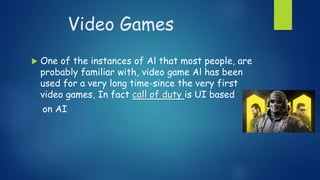
Video Games
 One of the instances of Al that most people, are
probably familiar with, video game Al has been
used for a very long time-since the very first
video games, In fact call of duty is UI based
on AI
Smart Cars
 Although we haven't seen smart cars on
street yet. But as the Artificial intelligence
is developing, that day is not so far when we
won't need a driver.
example : Tesla
Conclusion
 In it's short existence, Al has increased
understanding of the nature of intelligence and
provided an impressive array of application in a
wide range of areas. It has sharpened
understanding of human reasoning, and of the
nature of intelligence in general. At the same
time, it has revealed the complexity of modeling
human reasoning providing new areas and rich
challenges for the future.
BY
SWAPNIL SRIRAM
ARTIFICIAL.pptx

ARTIFICIAL.pptx

  • 1.
  • 2.
    content Introductions History of AI Applications Future of AI AI in daily life conclusion
  • 3.
    Introduction What is aartificial intelligence or (A.I)?  Artificial intelligence(AI) is intelligence exhibited by machines . In computer science , an ideal “intelligent” machines is a flexible rational agent that perceives its environment and takes actions that maximize its chance of success at same goal Kismet: A robot with rudimentary social skills
  • 4.
    History  1943:McCullough andPitts’ invented “artificial neurons”  1950: inventions of Allan Turing’s “computing machinery and intelligence  1951: AI was using in games  1956: Dartmouth conference; And the bird of AI  1965: Robinson’s complete algorithm for logical reasoning  1969-79: early development of knowledge based systems took place  1980-88: expert system industry booms
  • 5.
     1988-93:Expert systemindustry busts “ AI winter”  1993-present: AI is now using rapidly in different technologies ; And is achieving its goal Smart hand : Using AI , this hand lets amputee ,feel and move objects Smart hand
  • 6.
    Applications  Expert system Natural language processing (NLP)  Speech recognition  Computer vision.  Robotics  Automatic programming
  • 7.
    Expert system  AnExpert System is a computer program. designed to act as an expert in a particular domain (area of expertise). Domain of E.S. Knowledge base Facts Heuristics Phases in Expert System. Expert systems currently are designed to assist experts, not to replace them, They have been used in medical diagnosis, chemical analysis, geological explorations etc.
  • 8.
    Natural language processing(NLP)  The goal of NLP is to enable people and computers to LP communicate in a natural (humanly) language(such as, English) rather than in a computer language
  • 9.
    Speech recognition  Theprimary interactive method of communication used by humans is not reading and writing, it is speech. The goal of speech recognition research is to allow computers to understand human speech. So that they can hear our voices and recognize the words we are speaking. It simplifies the process of interactive communication between people and computers, thus it advances the goal of NLP.
  • 10.
    Computer vision.  Peoplegenerally use vision as their primary means of sensing their environment, we generally see more than we hear, feel or smell or taste. The goal of computer vision research is to give computers this same powerful facility for understanding their surrounding. Here A.I helps computer to understand what they see through attached cameras
  • 11.
    Robotics  A Robotis a electro-mechanical device that can by programmed to perform manual tasks or a reprogrammable multi functional manipulator designed to move materials, parts, tools, or specialized devices through variable programmed motions for performance of variety of tasks. An 'intelligent' robot includes some kind of sensory apparatus that allows it to respond to change in it's environment.
  • 12.
    Automatic programming  Automaticprogramming is the generation of programs by computer, usually based on specifications that are higher-level and easier for humans to specify than ordinary programming languages. It's one of the most important part of A.I.
  • 13.
    Future of AI The future is really is UNKNOWN Researches seem to disagree on a lot of the same issues. With the rate at which technology is improving it is logical to believer AI will continue to get more and more sophisticated.
  • 14.
    But we canimagine two different kind of AI in future They are:  Positive  Negative
  • 15.
    Positive  Maybe, theday is not far when we will just sit back in our cozy little beds and just command our personal Robot's to entirely do our ruts. He will be a perfect companion for us. Just enjoy the Technology.
  • 16.
    Negative  It mayend in other way too. Some day there will be a knock at our door. As we open it, we'll see a large number of Robots marching into our house destroying everything we own and looting you. This is because ever since there is an advantage in the Technology, it attracts anti social elements. This is true for Robots too. Because now they will have full power to think as human, even as of anti-social elements. So we should think trice before giving them power of Cognition.
  • 17.
    A.I in dailylife ➤Virtual Personal Assistant Siri, Google Now, and Cortana are all intelligent digital personal assistants on various platforms(iOS, Android, Windows) which are based on A.I.
  • 18.
    Video Games  Oneof the instances of Al that most people, are probably familiar with, video game Al has been used for a very long time-since the very first video games, In fact call of duty is UI based on AI
  • 19.
    Smart Cars  Althoughwe haven't seen smart cars on street yet. But as the Artificial intelligence is developing, that day is not so far when we won't need a driver. example : Tesla
  • 20.
    Conclusion  In it'sshort existence, Al has increased understanding of the nature of intelligence and provided an impressive array of application in a wide range of areas. It has sharpened understanding of human reasoning, and of the nature of intelligence in general. At the same time, it has revealed the complexity of modeling human reasoning providing new areas and rich challenges for the future.
  • 21.