WELCOME
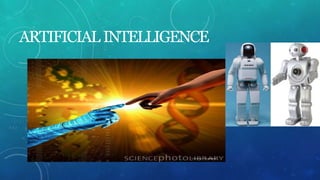
ARTIFICIAL INTELLIGENCE
Contents
Introduction
History of Artificial Intelligence
Why AI
Limitations of Human Mind
Applications
Advantages
Disadvantages
Future
Conclusion
Artificial Intelligence is composed of two words Artificial and Intelligence,
where Artificial defines "man-made," and intelligence defines "thinking power",
hence AI means "a man-made thinking power."
So, we can define AI as:
"It is a branch of computer science by which we can create intelligent machines
which can behave like a human, think like humans, and able to make
decisions."
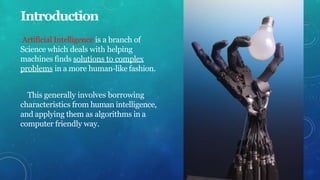
Introduction
Artificial Intelligence is a branch of
Science which deals with helping
machines finds solutions to complex
problems in a more human-like fashion.
This generally involves borrowing
characteristics from human intelligence,
and applying them as algorithms in a
computer friendly way.
Why Artificial Intelligence?
Before Learning about Artificial Intelligence, we should know that what is the
importance of AI and why should we learn it. Following are some main reasons to
learn about AI:
•With the help of AI, you can create such software or devices which can solve
real-world problems very easily and with accuracy such as health issues,
marketing, traffic issues, etc.
•With the help of AI, you can create your personal virtual Assistant, such as
Cortana, Google Assistant, Siri, etc.
•With the help of AI, you can build such Robots which can work in an environment
where survival of humans can be at risk.
•AI opens a path for other new technologies, new devices, and new
Opportunities.
BriefHistoryofAI
1941: Firstelectronic computer (technology finally available )
1956: Term Artificial Intelligence introduced
1960s: Checkers-playing program that was able to playgames
with opponents
1980s: Quality Control Systems
2000:First sophisticated walking robot
WHY AI?
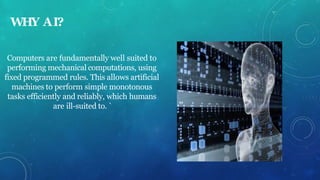
Computers are fundamentally well suited to
performing mechanical computations, using
fixed programmed rules. This allows artificial
machines to perform simple monotonous
tasks efficiently and reliably, which humans
are ill-suited to. `
LIMITATIONSOFHUMANMIND
Object recognition. People cannot properly explain
how they recognize objects.
Face recognition. Cannot be passed on to another
person by explanation.
Naming of colours. Based on learning, not on
absolute standards.
APPLICATIONS OF A I
Expert systems.
Natural Language Processing (NLP).
Speech recognition.
Computer vision.
Robotics.
EXPERT SYSTEMS
An Expert System is a computer program designed to act as
an expert in a particular domain (area of expertise).
PhasesinExpert System
Expert systems currently are designed to assist experts, not
to replace them, They have been used in medical diagnosis,
chemical analysis, geological explorations etc.
NaturalLanguage Processing
The goal of NLPis to enable people and computers to
communicate in a natural (humanly) language(such as, English)
rather than in a computer language.
The field of NLPis divided in 2categories—
Natural Language understanding.
Natural Language generation.
SpeechRecognition
The primary interactive method of communication used by
humans is not reading and writing, it is speech.
The goal of speech recognition research is to allow
computers to understand human speech. So that they can
hear our voices and recognize the words we arespeaking.
It simplifies the process of interactive communication
between people and computers, thus it advances the goalof
NLP.
ComputerVision
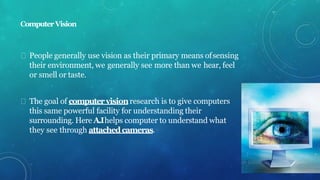
People generally use vision as their primary means ofsensing
their environment, we generally see more than we hear, feel
or smell or taste.
The goal of computervisionresearch is to give computers
this same powerful facility for understanding their
surrounding. Here A.Ihelps computer to understand what
they see through attachedcameras.
ROBOTICS
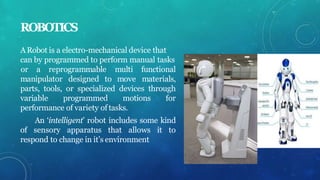
ARobot is a electro-mechanical device that
can by programmed to perform manual tasks
manipulator designed to move
or a reprogrammable multi functional
materials,
parts, tools, or specialized devices through
variable programmed motions for
performance of variety of tasks.
An ‘intelligent’ robot includes some kind
of sensory apparatus that allows it to
respond to change in it’s environment
Advantages
They will probably be increasingly used in the fieldof
medicine.
Aknowledge based expert system, which can cross-reference
symptoms and diseases will greatly improve the accuracy of
diagnostics.
Object recognition will also be a great aid todoctors.
Along with images from cats cans or X-raymachines, they
will be able to get preliminary analysis of thoseimages.
This of course will be possible only if people solve legal
questions that arise by giving power to a machine tocontrol
or influence the health of ahuman
Disadvantages
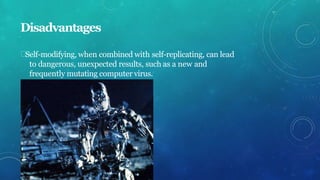
Self-modifying, when combined with self-replicating, can lead
to dangerous, unexpected results, such as a new and
frequently mutating computer virus.
FUTURE (+)
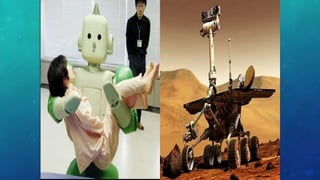
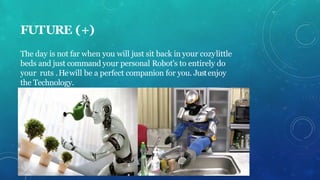
The day is not far when you will just sit back in your cozylittle
beds and just command your personal Robot's to entirely do
your ruts .Hewill be a perfect companion for you. Justenjoy
the Technology.
Future(-)
But wait, don’t be happy. .!
It may end in other way too. Some day there will be a knock
to your door. As you open it, you see a large number of
Robots marching into your house destroying everything
you own and looting you.
This is because ever since there is an advantage in the
Technology, it attracts anti-social elements. This is true for
Robots too. Because now they will have full power tothink
as human, even as of anti-social elements. So think trice
before giving them power ofCognition.
Conclusion
Init’s short existence, AIhas increased understanding of the
nature of intelligence and provided an impressive array of
application in a wide range of areas. It has sharpened
understanding of human reasoning, and of the nature of
intelligence in general. At the same time, it has revealed the
complexity of modeling human reasoning providing new areas
and rich challenges for the future.
Thank you

artifical intelligence.pptx

  • 1.
  • 2.
  • 3.
    Contents Introduction History of ArtificialIntelligence Why AI Limitations of Human Mind Applications Advantages Disadvantages Future Conclusion
  • 4.
    Artificial Intelligence iscomposed of two words Artificial and Intelligence, where Artificial defines "man-made," and intelligence defines "thinking power", hence AI means "a man-made thinking power." So, we can define AI as: "It is a branch of computer science by which we can create intelligent machines which can behave like a human, think like humans, and able to make decisions."
  • 5.
    Introduction Artificial Intelligence isa branch of Science which deals with helping machines finds solutions to complex problems in a more human-like fashion. This generally involves borrowing characteristics from human intelligence, and applying them as algorithms in a computer friendly way.
  • 6.
    Why Artificial Intelligence? BeforeLearning about Artificial Intelligence, we should know that what is the importance of AI and why should we learn it. Following are some main reasons to learn about AI: •With the help of AI, you can create such software or devices which can solve real-world problems very easily and with accuracy such as health issues, marketing, traffic issues, etc. •With the help of AI, you can create your personal virtual Assistant, such as Cortana, Google Assistant, Siri, etc. •With the help of AI, you can build such Robots which can work in an environment where survival of humans can be at risk. •AI opens a path for other new technologies, new devices, and new Opportunities.
  • 7.
    BriefHistoryofAI 1941: Firstelectronic computer(technology finally available ) 1956: Term Artificial Intelligence introduced 1960s: Checkers-playing program that was able to playgames with opponents 1980s: Quality Control Systems 2000:First sophisticated walking robot
  • 8.
    WHY AI? Computers arefundamentally well suited to performing mechanical computations, using fixed programmed rules. This allows artificial machines to perform simple monotonous tasks efficiently and reliably, which humans are ill-suited to. `
  • 9.
    LIMITATIONSOFHUMANMIND Object recognition. Peoplecannot properly explain how they recognize objects. Face recognition. Cannot be passed on to another person by explanation. Naming of colours. Based on learning, not on absolute standards.
  • 10.
    APPLICATIONS OF AI Expert systems. Natural Language Processing (NLP). Speech recognition. Computer vision. Robotics.
  • 11.
    EXPERT SYSTEMS An ExpertSystem is a computer program designed to act as an expert in a particular domain (area of expertise). PhasesinExpert System Expert systems currently are designed to assist experts, not to replace them, They have been used in medical diagnosis, chemical analysis, geological explorations etc.
  • 12.
    NaturalLanguage Processing The goalof NLPis to enable people and computers to communicate in a natural (humanly) language(such as, English) rather than in a computer language. The field of NLPis divided in 2categories— Natural Language understanding. Natural Language generation.
  • 13.
    SpeechRecognition The primary interactivemethod of communication used by humans is not reading and writing, it is speech. The goal of speech recognition research is to allow computers to understand human speech. So that they can hear our voices and recognize the words we arespeaking. It simplifies the process of interactive communication between people and computers, thus it advances the goalof NLP.
  • 14.
    ComputerVision People generally usevision as their primary means ofsensing their environment, we generally see more than we hear, feel or smell or taste. The goal of computervisionresearch is to give computers this same powerful facility for understanding their surrounding. Here A.Ihelps computer to understand what they see through attachedcameras.
  • 15.
    ROBOTICS ARobot is aelectro-mechanical device that can by programmed to perform manual tasks manipulator designed to move or a reprogrammable multi functional materials, parts, tools, or specialized devices through variable programmed motions for performance of variety of tasks. An ‘intelligent’ robot includes some kind of sensory apparatus that allows it to respond to change in it’s environment
  • 16.
    Advantages They will probablybe increasingly used in the fieldof medicine. Aknowledge based expert system, which can cross-reference symptoms and diseases will greatly improve the accuracy of diagnostics. Object recognition will also be a great aid todoctors. Along with images from cats cans or X-raymachines, they will be able to get preliminary analysis of thoseimages. This of course will be possible only if people solve legal questions that arise by giving power to a machine tocontrol or influence the health of ahuman
  • 18.
    Disadvantages Self-modifying, when combinedwith self-replicating, can lead to dangerous, unexpected results, such as a new and frequently mutating computer virus.
  • 19.
    FUTURE (+) The dayis not far when you will just sit back in your cozylittle beds and just command your personal Robot's to entirely do your ruts .Hewill be a perfect companion for you. Justenjoy the Technology.
  • 20.
    Future(-) But wait, don’tbe happy. .! It may end in other way too. Some day there will be a knock to your door. As you open it, you see a large number of Robots marching into your house destroying everything you own and looting you. This is because ever since there is an advantage in the Technology, it attracts anti-social elements. This is true for Robots too. Because now they will have full power tothink as human, even as of anti-social elements. So think trice before giving them power ofCognition.
  • 21.
    Conclusion Init’s short existence,AIhas increased understanding of the nature of intelligence and provided an impressive array of application in a wide range of areas. It has sharpened understanding of human reasoning, and of the nature of intelligence in general. At the same time, it has revealed the complexity of modeling human reasoning providing new areas and rich challenges for the future.
  • 22.