ARTIFICIAL INTELLIGENCE
Presentation By:
Ummiya Mohammedi
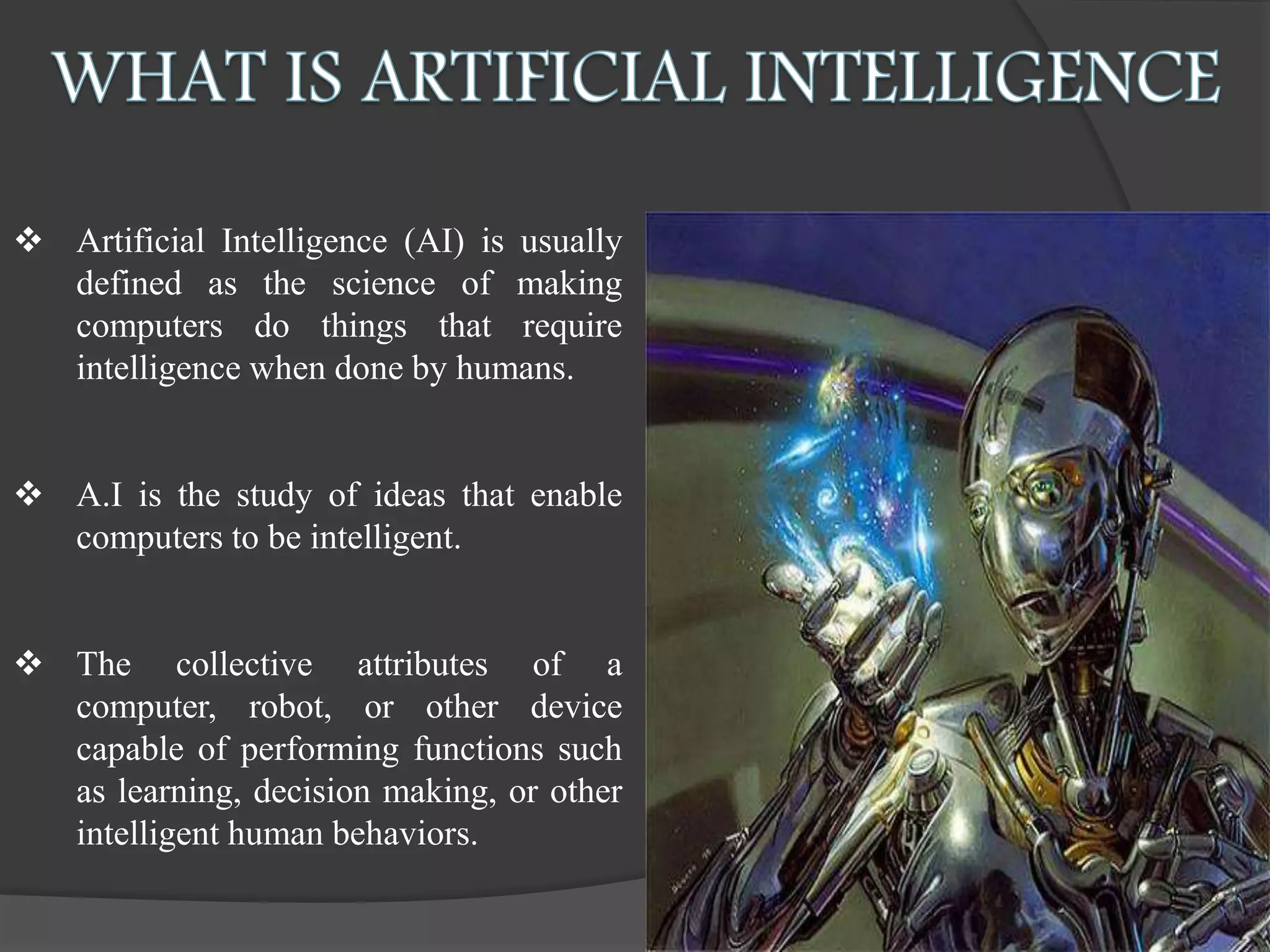
 Artificial Intelligence (AI) is usually
defined as the science of making
computers do things that require
intelligence when done by humans.
 A.I is the study of ideas that enable
computers to be intelligent.
 The collective attributes of a
computer, robot, or other device
capable of performing functions such
as learning, decision making, or other
intelligent human behaviors.
 The real emergence of AI (in computer technology) came during the years 1945-
1956.
 Marvin Minsky, John McCarthy, Allen Newell, Herbert Simon, and J.C. Shaw
were founders and pioneers of Artificial Intelligence.
 These innovators of AI broke away from conventional approaches and examined
how to implement human thought in computers.
The first term of Artificial Intelligence was first applied in 1956 by John McCarthy
during the Dartmouth Conference.
 The Dartmouth Conference was the first gathering of all researchers to develop
and focus on applying intelligence to computers.
 Logic Theorist was considered the first AI program. (In 1956)
• Although some all-purpose languages such as C, C++ and Java are used to create
intelligent software, two languages are specifically designed for AI: LISP and
PROLOG.
 LISP:
• LISP (LISt Programming) was invented by John McCarthy in 1958. As the name
implies, LISP is a programming language that manipulates lists.
 PROLOG:
• PROLOG (PROGRAMMING IN LOGIC) is a language that can build a database of
facts and a knowledge base of rules. A program in PROLOG can use logical
reasoning to answer questions that can be inferred from the knowledge base.
Artificial intelligence works with the help of
 Artificial Neurons (Artificial
Neural Network):
• Artificial neural networks are composed
of interconnecting artificial neurons
(programming constructs that mimic the
properties of biological neurons).
And
 Scientific theorems(If-Then
Statements, Logics)
 Human Intelligence  Artificial Intelligence
• Intuition, Common sense,
Judgement, Creativity, Beliefs
etc.
• The ability to demonstrate their
intelligence by communicating
effectively.
• Plausible Reasoning and Critical
thinking.
• Ability to simulate human
behavior and cognitive processes.
• Capture and preserve human
expertise.
• Raise legal and ethical concerns.
• Humans are fallible.
• They have limited knowledge
bases.
• Information processing of serial
nature proceed very slowly in the
brain as compared to computers.
• Humans are unable to retain large
amounts of data in memory.
• No “common sense”.
• Cannot readily deal with
“mixed” knowledge.
• May have high development
costs.
• Fast Response. The ability to
comprehend large amounts of
data quickly.
3 Main Components of A.I.:
•Speech Synthesis
•Speech Recognition
•Logical Reasoning
2 Main Software/Programming languages:
•Prolog
•Lisp
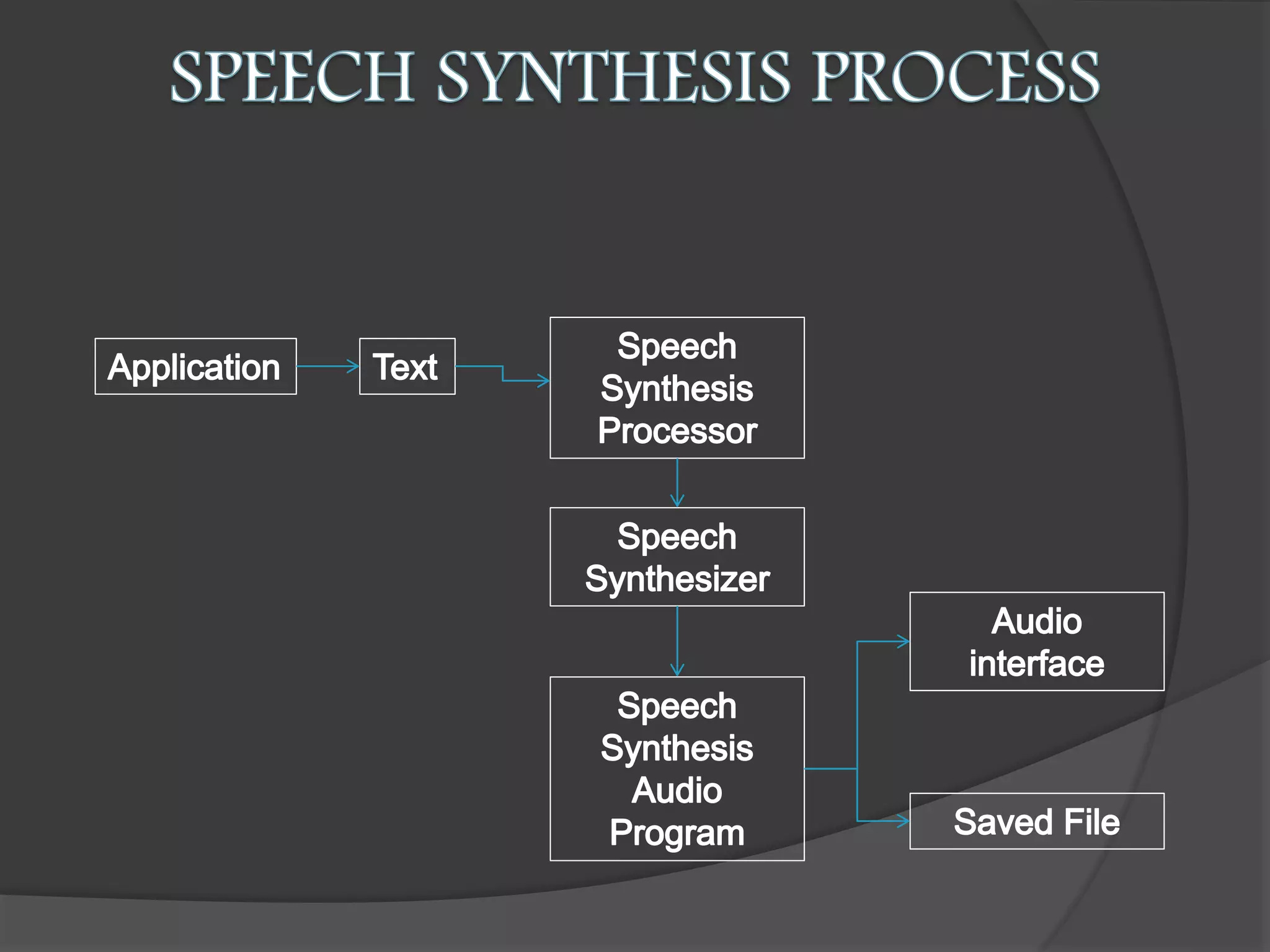
 The artificial creation of human speech through a speech synthesizer.
 It then uses a process called text-to-speech which changes the text into speech.
 The quality of speech synthesis is often judged by how well its understood, and
how well it resembles actual human speech.
 Speech synthesis is also used with speech recognition in other A.I. technologies.
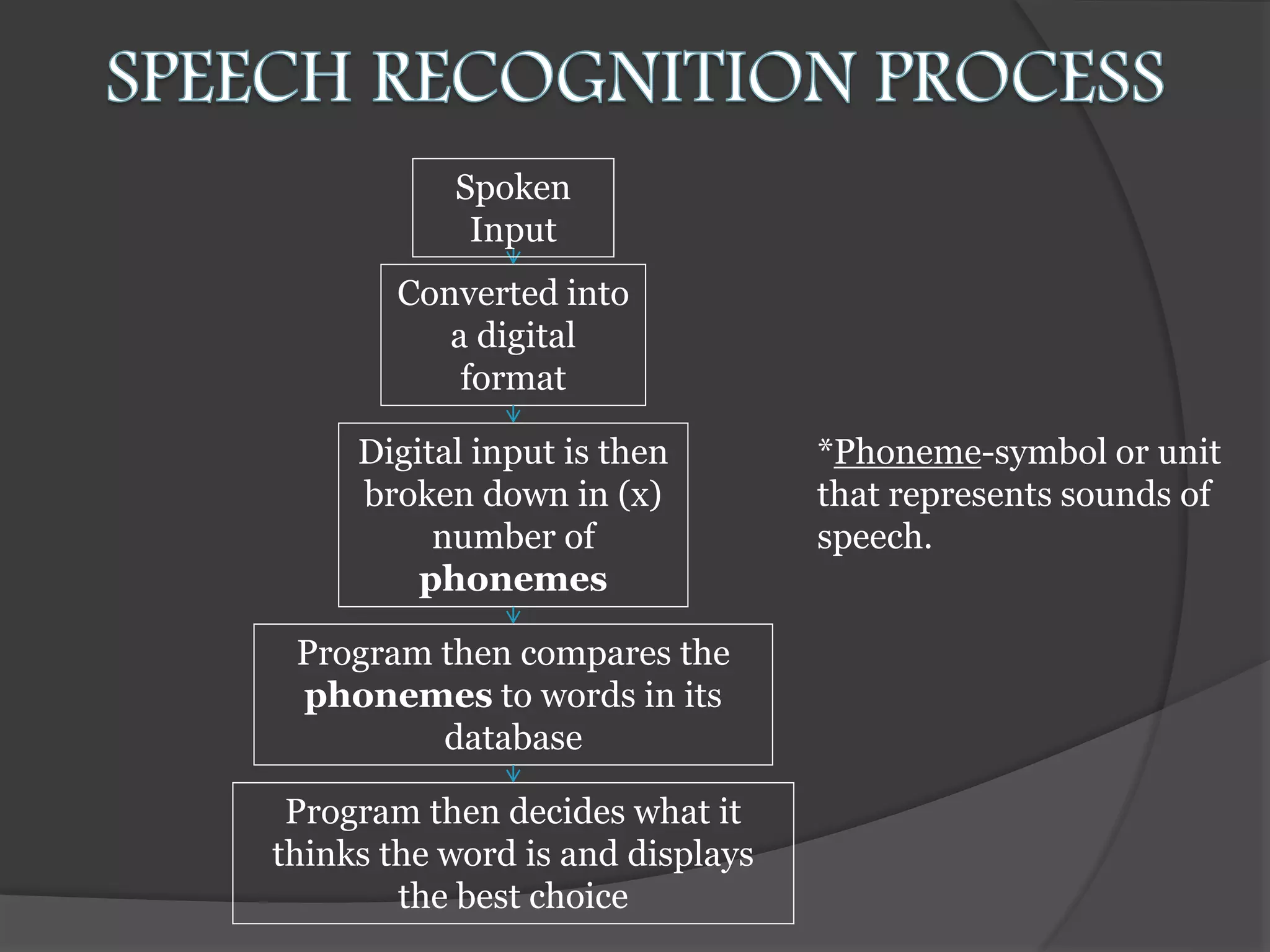
 Converts audio signals into text, or takes spoken input and changes it to written
output.
 It maps the audio signals to form an abstract meaning of the spoken input.
Converted into
a digital
format
Digital input is then
broken down in (x)
number of
phonemes
Program then compares the
phonemes to words in its
database
Program then decides what it
thinks the word is and displays
the best choice
Spoken
Input
*Phoneme-symbol or unit
that represents sounds of
speech.
 The logical reasoning process calculates results from specific variables in the
problem.
 More or less the variables have to be definite rather than a slight chance or good
chance of being accurate.
 The only results suitable are those that logically follow the inputted variables.
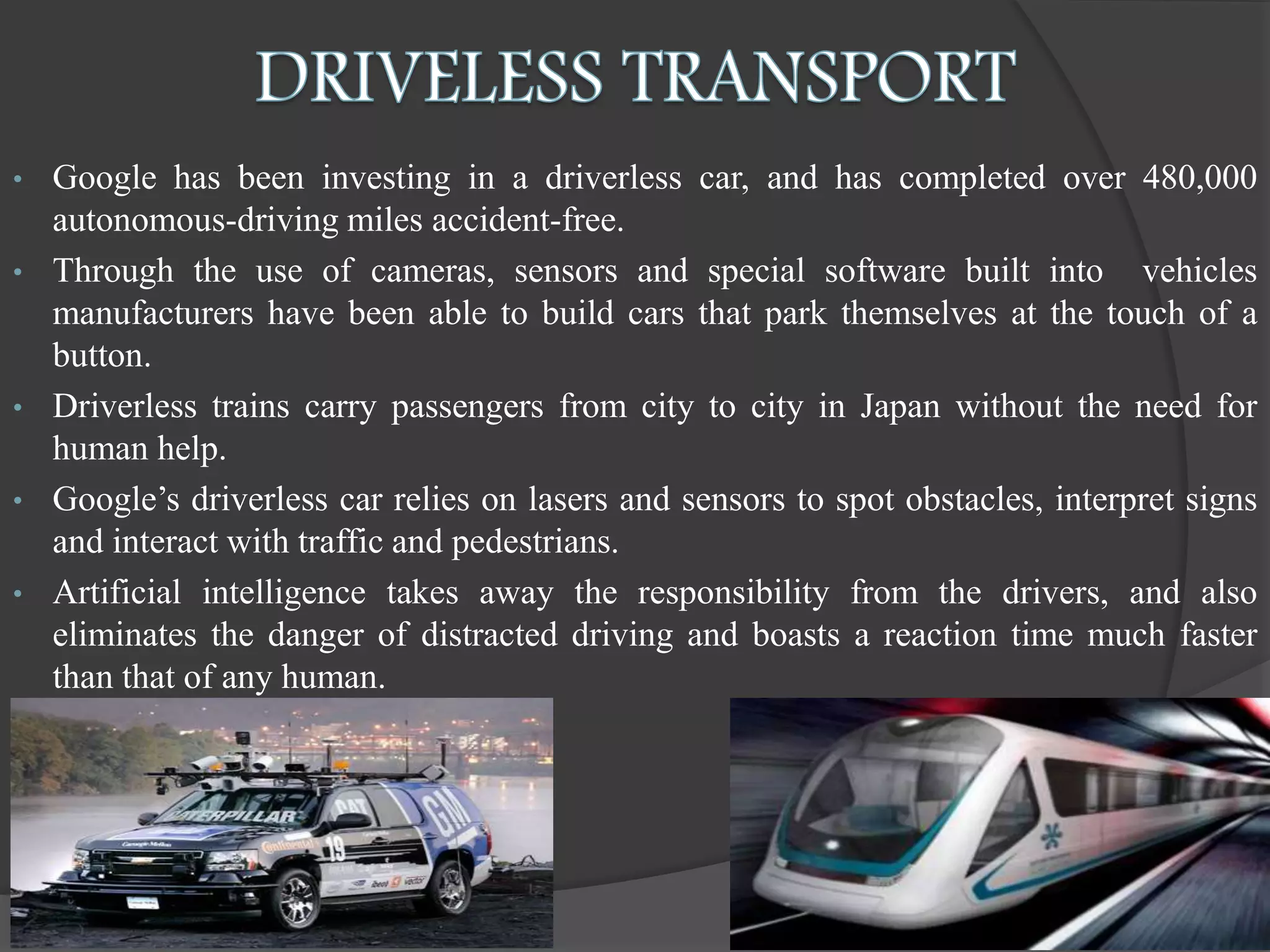
• Google has been investing in a driverless car, and has completed over 480,000
autonomous-driving miles accident-free.
• Through the use of cameras, sensors and special software built into vehicles
manufacturers have been able to build cars that park themselves at the touch of a
button.
• Driverless trains carry passengers from city to city in Japan without the need for
human help.
• Google’s driverless car relies on lasers and sensors to spot obstacles, interpret signs
and interact with traffic and pedestrians.
• Artificial intelligence takes away the responsibility from the drivers, and also
eliminates the danger of distracted driving and boasts a reaction time much faster
than that of any human.
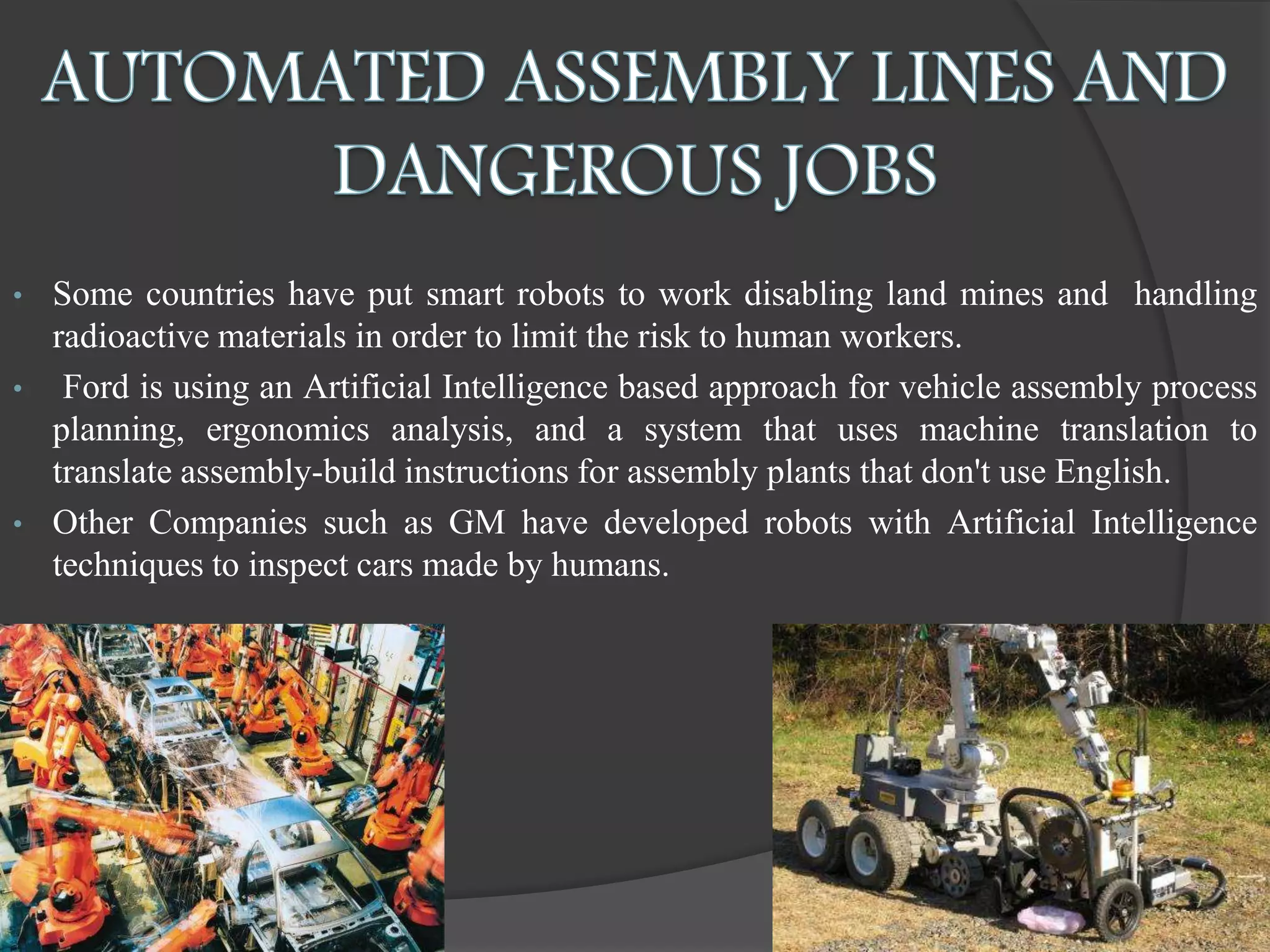
• Some countries have put smart robots to work disabling land mines and handling
radioactive materials in order to limit the risk to human workers.
• Ford is using an Artificial Intelligence based approach for vehicle assembly process
planning, ergonomics analysis, and a system that uses machine translation to
translate assembly-build instructions for assembly plants that don't use English.
• Other Companies such as GM have developed robots with Artificial Intelligence
techniques to inspect cars made by humans.
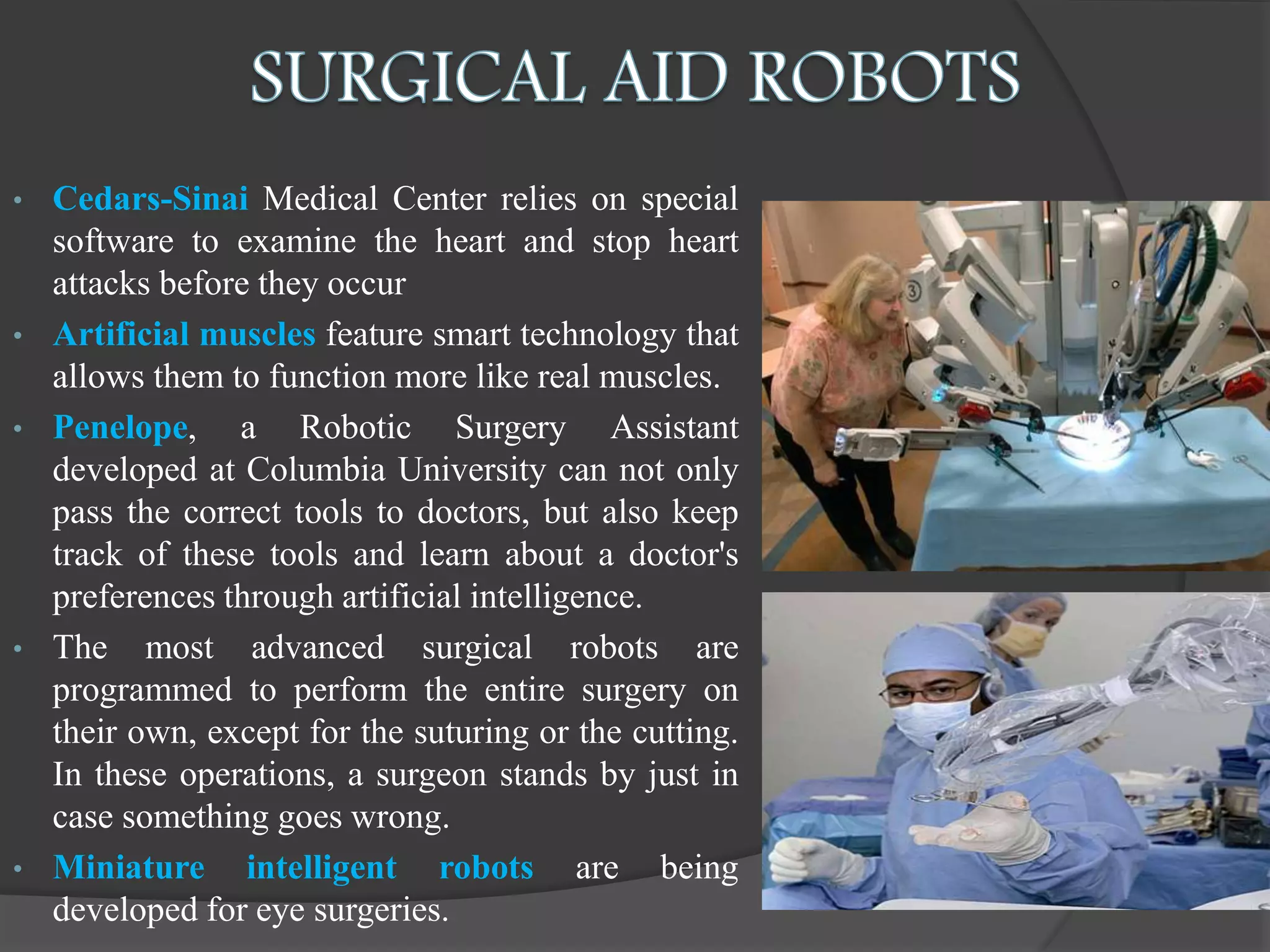
• Cedars-Sinai Medical Center relies on special
software to examine the heart and stop heart
attacks before they occur
• Artificial muscles feature smart technology that
allows them to function more like real muscles.
• Penelope, a Robotic Surgery Assistant
developed at Columbia University can not only
pass the correct tools to doctors, but also keep
track of these tools and learn about a doctor's
preferences through artificial intelligence.
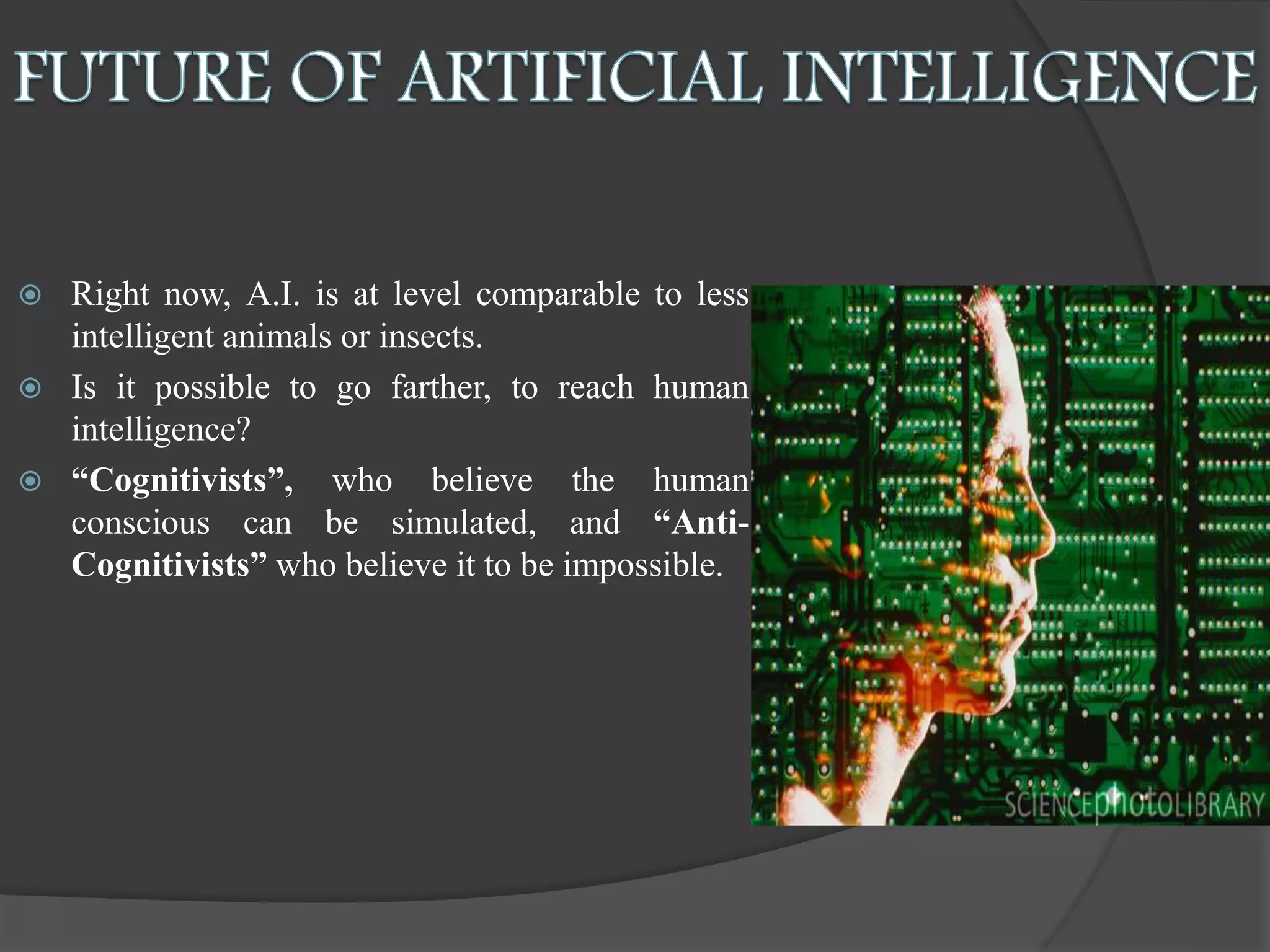
• The most advanced surgical robots are
programmed to perform the entire surgery on
their own, except for the suturing or the cutting.
In these operations, a surgeon stands by just in
case something goes wrong.
• Miniature intelligent robots are being
developed for eye surgeries.
 Right now, A.I. is at level comparable to less
intelligent animals or insects.
 Is it possible to go farther, to reach human
intelligence?
 “Cognitivists”, who believe the human
conscious can be simulated, and “Anti-
Cognitivists” who believe it to be impossible.
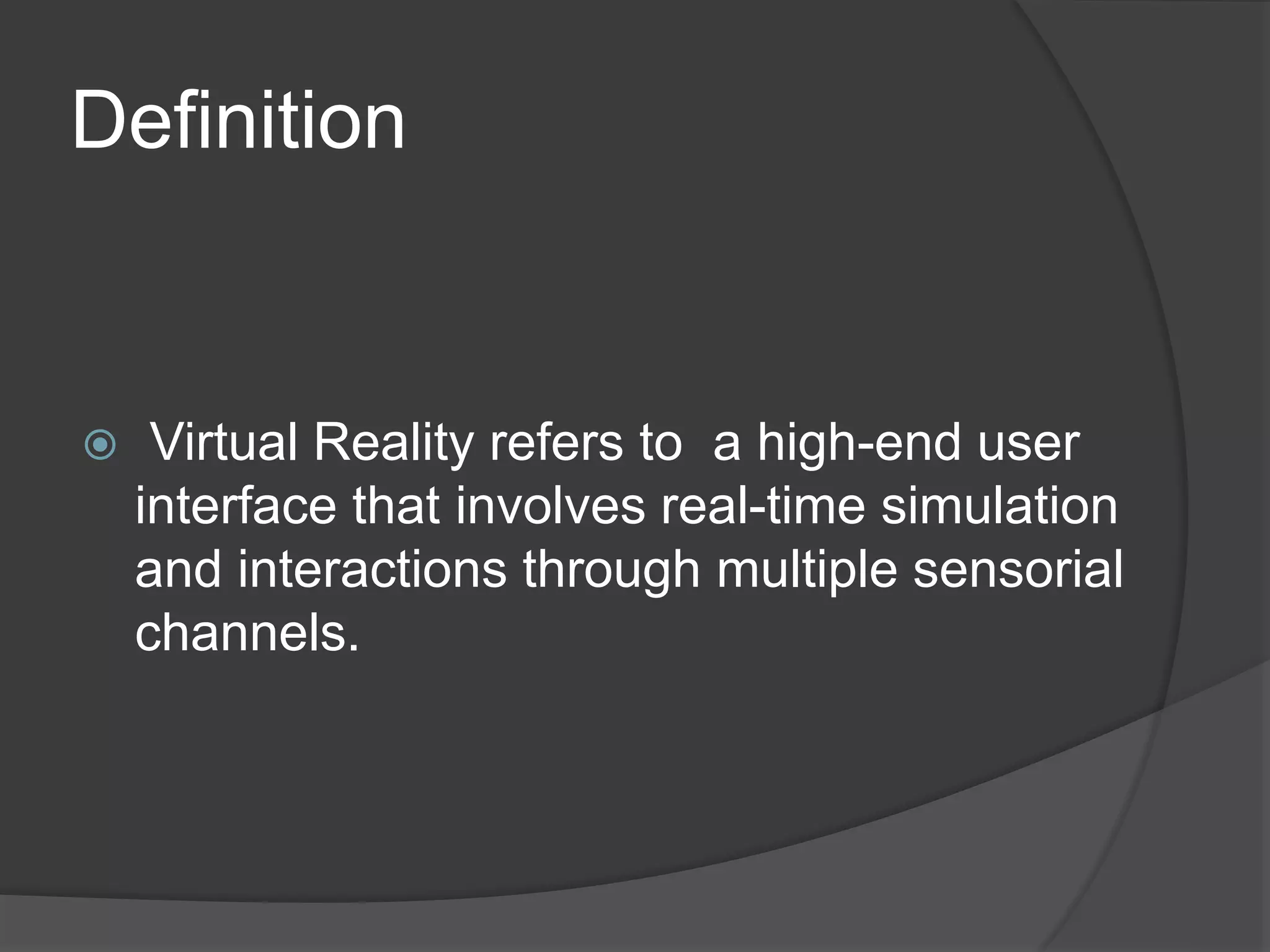
 2050: Estimated date of the emergence of the
Singularity, or greater-than-human super-
intelligence.
 At this point, it’s thought that certain machines
will exceed the human brain in terms of
intelligence
 It’s believed that this breakthrough will lead to a
rapid advancement in technology, as super
intelligent A.I. designs new computers and
machines at a rate no human could
Definition
 Virtual Reality refers to a high-end user
interface that involves real-time simulation
and interactions through multiple sensorial
channels.
INTRODUCTION
 Virtual reality must allow the user to
view the environment from any point
at any angle.
 VR should allow the user to interact
with the environment.
TYPES OF VIRTUAL
REALITY
 WINDOWS ON THE WORLD
 IMMERSIVE VIRTUAL REALITY
 TELEPRESENCE
 MIXED REALITY(AUGUMENTED VR)
WINDOW ON THE
WORLD
 Also known as desktop VR.
 Use of a monitor to display the visual
world.
 Does not require special hardware.
 Low Cost, Low Performance, Less
Immersion.
IMMERSIVE VIRTUAL
REALITY
 Use of Special Purpose Equipment.
 Feel of Presence.
TELEPRESENCE
 Real-time telepresence
Interactions are reflected to some real world
objects.
 Delayed telepresence
Interactions are recorded, and after
satisfaction is applied to the real-world object.
MIXED REALITY(AUGUMENTED
VR) Computer generated inputs
merged with the user’s view
of the real world
VR COMPONENTS
 VR Hardware
 VR Software
VR HARDWARE
 Primary user input interfaces
 Tracking interfaces
 Visual interfaces
 Auditory interfaces
 Haptic interfaces
 Olfactory interfaces
VR SOFTWARE
 Input Process
 Simulation Process
 Rendering Process
 World Database
Artificial Intellegence

Artificial Intellegence

  • 1.
  • 2.
     Artificial Intelligence(AI) is usually defined as the science of making computers do things that require intelligence when done by humans.  A.I is the study of ideas that enable computers to be intelligent.  The collective attributes of a computer, robot, or other device capable of performing functions such as learning, decision making, or other intelligent human behaviors.
  • 3.
     The realemergence of AI (in computer technology) came during the years 1945- 1956.  Marvin Minsky, John McCarthy, Allen Newell, Herbert Simon, and J.C. Shaw were founders and pioneers of Artificial Intelligence.  These innovators of AI broke away from conventional approaches and examined how to implement human thought in computers. The first term of Artificial Intelligence was first applied in 1956 by John McCarthy during the Dartmouth Conference.  The Dartmouth Conference was the first gathering of all researchers to develop and focus on applying intelligence to computers.  Logic Theorist was considered the first AI program. (In 1956)
  • 4.
    • Although someall-purpose languages such as C, C++ and Java are used to create intelligent software, two languages are specifically designed for AI: LISP and PROLOG.  LISP: • LISP (LISt Programming) was invented by John McCarthy in 1958. As the name implies, LISP is a programming language that manipulates lists.  PROLOG: • PROLOG (PROGRAMMING IN LOGIC) is a language that can build a database of facts and a knowledge base of rules. A program in PROLOG can use logical reasoning to answer questions that can be inferred from the knowledge base.
  • 5.
    Artificial intelligence workswith the help of  Artificial Neurons (Artificial Neural Network): • Artificial neural networks are composed of interconnecting artificial neurons (programming constructs that mimic the properties of biological neurons). And  Scientific theorems(If-Then Statements, Logics)
  • 7.
     Human Intelligence Artificial Intelligence • Intuition, Common sense, Judgement, Creativity, Beliefs etc. • The ability to demonstrate their intelligence by communicating effectively. • Plausible Reasoning and Critical thinking. • Ability to simulate human behavior and cognitive processes. • Capture and preserve human expertise. • Raise legal and ethical concerns.
  • 8.
    • Humans arefallible. • They have limited knowledge bases. • Information processing of serial nature proceed very slowly in the brain as compared to computers. • Humans are unable to retain large amounts of data in memory. • No “common sense”. • Cannot readily deal with “mixed” knowledge. • May have high development costs. • Fast Response. The ability to comprehend large amounts of data quickly.
  • 9.
    3 Main Componentsof A.I.: •Speech Synthesis •Speech Recognition •Logical Reasoning 2 Main Software/Programming languages: •Prolog •Lisp
  • 10.
     The artificialcreation of human speech through a speech synthesizer.  It then uses a process called text-to-speech which changes the text into speech.  The quality of speech synthesis is often judged by how well its understood, and how well it resembles actual human speech.  Speech synthesis is also used with speech recognition in other A.I. technologies.
  • 12.
     Converts audiosignals into text, or takes spoken input and changes it to written output.  It maps the audio signals to form an abstract meaning of the spoken input.
  • 13.
    Converted into a digital format Digitalinput is then broken down in (x) number of phonemes Program then compares the phonemes to words in its database Program then decides what it thinks the word is and displays the best choice Spoken Input *Phoneme-symbol or unit that represents sounds of speech.
  • 14.
     The logicalreasoning process calculates results from specific variables in the problem.  More or less the variables have to be definite rather than a slight chance or good chance of being accurate.  The only results suitable are those that logically follow the inputted variables.
  • 15.
    • Google hasbeen investing in a driverless car, and has completed over 480,000 autonomous-driving miles accident-free. • Through the use of cameras, sensors and special software built into vehicles manufacturers have been able to build cars that park themselves at the touch of a button. • Driverless trains carry passengers from city to city in Japan without the need for human help. • Google’s driverless car relies on lasers and sensors to spot obstacles, interpret signs and interact with traffic and pedestrians. • Artificial intelligence takes away the responsibility from the drivers, and also eliminates the danger of distracted driving and boasts a reaction time much faster than that of any human.
  • 16.
    • Some countrieshave put smart robots to work disabling land mines and handling radioactive materials in order to limit the risk to human workers. • Ford is using an Artificial Intelligence based approach for vehicle assembly process planning, ergonomics analysis, and a system that uses machine translation to translate assembly-build instructions for assembly plants that don't use English. • Other Companies such as GM have developed robots with Artificial Intelligence techniques to inspect cars made by humans.
  • 17.
    • Cedars-Sinai MedicalCenter relies on special software to examine the heart and stop heart attacks before they occur • Artificial muscles feature smart technology that allows them to function more like real muscles. • Penelope, a Robotic Surgery Assistant developed at Columbia University can not only pass the correct tools to doctors, but also keep track of these tools and learn about a doctor's preferences through artificial intelligence. • The most advanced surgical robots are programmed to perform the entire surgery on their own, except for the suturing or the cutting. In these operations, a surgeon stands by just in case something goes wrong. • Miniature intelligent robots are being developed for eye surgeries.
  • 18.
     Right now,A.I. is at level comparable to less intelligent animals or insects.  Is it possible to go farther, to reach human intelligence?  “Cognitivists”, who believe the human conscious can be simulated, and “Anti- Cognitivists” who believe it to be impossible.
  • 19.
     2050: Estimateddate of the emergence of the Singularity, or greater-than-human super- intelligence.  At this point, it’s thought that certain machines will exceed the human brain in terms of intelligence  It’s believed that this breakthrough will lead to a rapid advancement in technology, as super intelligent A.I. designs new computers and machines at a rate no human could
  • 21.
    Definition  Virtual Realityrefers to a high-end user interface that involves real-time simulation and interactions through multiple sensorial channels.
  • 22.
    INTRODUCTION  Virtual realitymust allow the user to view the environment from any point at any angle.  VR should allow the user to interact with the environment.
  • 23.
    TYPES OF VIRTUAL REALITY WINDOWS ON THE WORLD  IMMERSIVE VIRTUAL REALITY  TELEPRESENCE  MIXED REALITY(AUGUMENTED VR)
  • 24.
    WINDOW ON THE WORLD Also known as desktop VR.  Use of a monitor to display the visual world.  Does not require special hardware.  Low Cost, Low Performance, Less Immersion.
  • 25.
    IMMERSIVE VIRTUAL REALITY  Useof Special Purpose Equipment.  Feel of Presence.
  • 26.
    TELEPRESENCE  Real-time telepresence Interactionsare reflected to some real world objects.  Delayed telepresence Interactions are recorded, and after satisfaction is applied to the real-world object.
  • 27.
    MIXED REALITY(AUGUMENTED VR) Computergenerated inputs merged with the user’s view of the real world
  • 28.
    VR COMPONENTS  VRHardware  VR Software
  • 29.
    VR HARDWARE  Primaryuser input interfaces  Tracking interfaces  Visual interfaces  Auditory interfaces  Haptic interfaces  Olfactory interfaces
  • 30.
    VR SOFTWARE  InputProcess  Simulation Process  Rendering Process  World Database