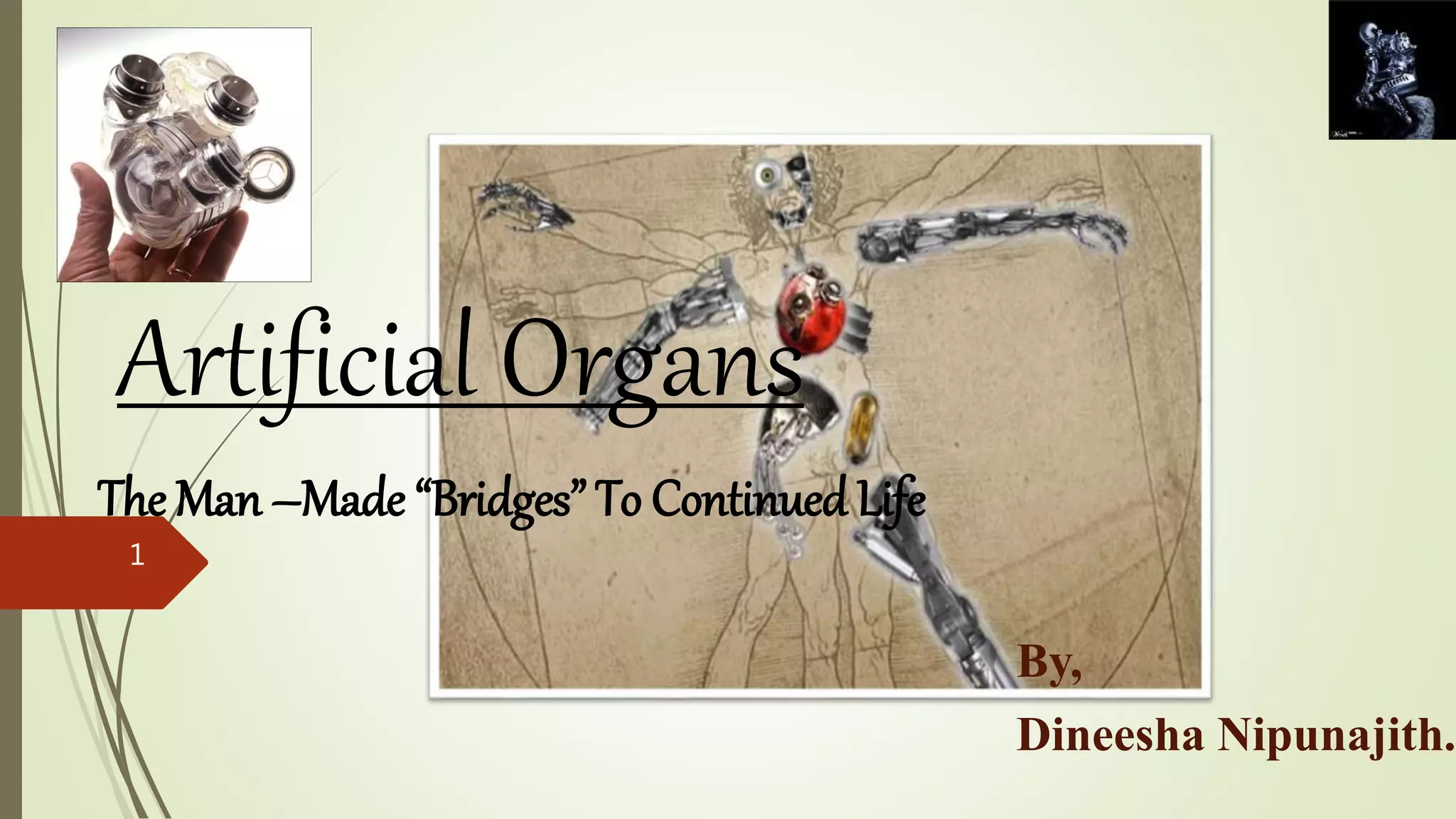
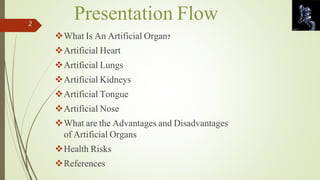
Artificial Organs 
By, 
Dineesha Nipunajith. 
The Man –Made “Bridges” To Continued Life 
1
Presentation Flow 
What Is An Artificial Organ? 
Artificial Heart 
Artificial Lungs 
Artificial Kidneys 
Artificial Tongue 
Artificial Nose 
What are the Advantages and Disadvantages 
of Artificial Organs 
Health Risks 
References 
2
What Is An Artificial Organ ? 
 An artificial organ is a man-made device that is implanted or 
integrated into a human to replace a natural organ, for the purpose of 
restoring a specific function or a group of related functions so the 
patient may return to a normal life as soon as possible. 
 Usually made out of stem cells from the patient. 
3
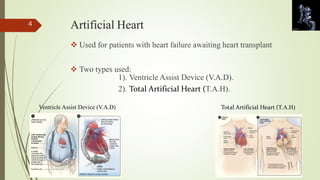
Artificial Heart 
 Used for patients with heart failure awaiting heart transplant 
 Two types used: 
1). Ventricle Assist Device (V.A.D). 
2). Total Artificial Heart (T.A.H). 
Ventricle Assist Device (V.A.D) Total Artificial Heart (T.A.H) 
4
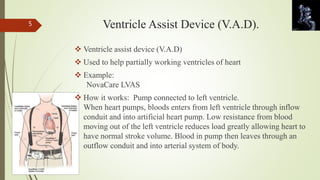
Ventricle Assist Device (V.A.D). 
 Ventricle assist device (V.A.D) 
 Used to help partially working ventricles of heart 
 Example: 
NovaCare LVAS 
 How it works: Pump connected to left ventricle. 
When heart pumps, bloods enters from left ventricle through inflow 
conduit and into artificial heart pump. Low resistance from blood 
moving out of the left ventricle reduces load greatly allowing heart to 
have normal stroke volume. Blood in pump then leaves through an 
outflow conduit and into arterial system of body. 
5
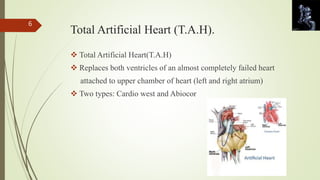
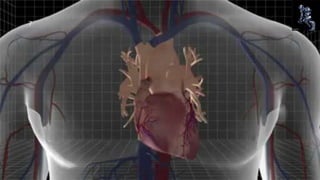
Total Artificial Heart (T.A.H). 
 Total Artificial Heart(T.A.H) 
 Replaces both ventricles of an almost completely failed heart 
attached to upper chamber of heart (left and right atrium) 
 Two types: Cardio west and Abiocor 
6
7
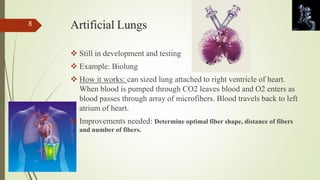
Artificial Lungs 
 Still in development and testing 
 Example: Biolung 
 How it works: can sized lung attached to right ventricle of heart. 
When blood is pumped through CO2 leaves blood and O2 enters as 
blood passes through array of microfibers. Blood travels back to left 
atrium of heart. 
 Improvements needed: Determine optimal fiber shape, distance of fibers 
and number of fibers. 
8
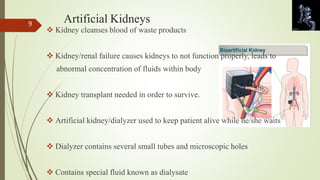
Artificial Kidneys 
 Kidney cleanses blood of waste products 
 Kidney/renal failure causes kidneys to not function properly, leads to 
abnormal concentration of fluids within body 
 Kidney transplant needed in order to survive. 
 Artificial kidney/dialyzer used to keep patient alive while he/she waits 
 Dialyzer contains several small tubes and microscopic holes 
 Contains special fluid known as dialysate 
9
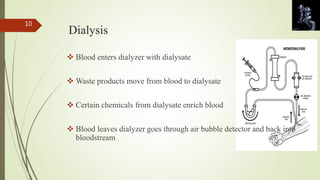
Dialysis 
 Blood enters dialyzer with dialysate 
Waste products move from blood to dialysate 
 Certain chemicals from dialysate enrich blood 
 Blood leaves dialyzer goes through air bubble detector and back into 
bloodstream 
10
Artificial Tongue / Electronic tongues 
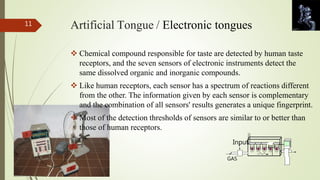
 Chemical compound responsible for taste are detected by human taste 
receptors, and the seven sensors of electronic instruments detect the 
same dissolved organic and inorganic compounds. 
 Like human receptors, each sensor has a spectrum of reactions different 
from the other. The information given by each sensor is complementary 
and the combination of all sensors' results generates a unique fingerprint. 
 Most of the detection thresholds of sensors are similar to or better than 
those of human receptors. 
Input 
GAS 
11
Applications 
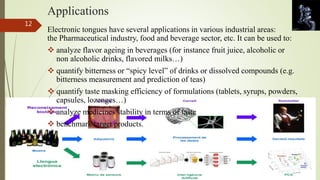
Electronic tongues have several applications in various industrial areas: 
the Pharmaceutical industry, food and beverage sector, etc. It can be used to: 
 analyze flavor ageing in beverages (for instance fruit juice, alcoholic or 
non alcoholic drinks, flavored milks…) 
 quantify bitterness or “spicy level” of drinks or dissolved compounds (e.g. 
bitterness measurement and prediction of teas) 
 quantify taste masking efficiency of formulations (tablets, syrups, powders, 
capsules, lozenges…) 
 analyze medicines stability in terms of taste 
 benchmark target products. 
12
Artificial Nose / Electronic Nose 
 An electronic nose is a device intended to detect odors or flavors. 
 Over the last decade, "electronic sensing" or "e-sensing" technologies have 
undergone important developments from a technical and commercial point of view. 
 The expression "electronic sensing" refers to the capability of reproducing human 
senses using sensor arrays and pattern recognition systems. 
 Since 1982, research has been conducted to develop technologies, commonly 
referred to as electronic noses, that could detect and recognize odors and flavors. 
 The stages of the recognition process are similar to human olfaction and are 
performed for identification, comparison, quantification and other applications, 
including data storage and retrieval. 
 However, hedonic evaluation is a specificity of the human nose given that it is 
related to subjective opinions. These devices have undergone much development 
and are now used to fulfill industrial needs. 
13
Applications 
 The fields of health and security 
- The detection of dangerous and harmful bacteria, such as software that has been specifically 
developed to recognize the smell of the MRSA (Methicillin-resistant Staphylococcus 
Aureus). 
 In quality control laboratories 
- Detection of contamination, spoilage, adulteration 
- Conformity of raw materials, intermediate and final products 
- Monitoring of storage conditions. 
 In process and production departments 
- Cleaning in place monitoring 
- Managing raw material variability 
 The field of crime prevention and security 
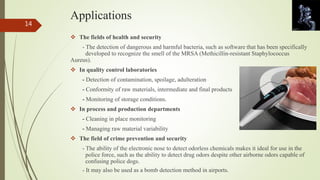
- The ability of the electronic nose to detect odorless chemicals makes it ideal for use in the 
police force, such as the ability to detect drug odors despite other airborne odors capable of 
confusing police dogs. 
- It may also be used as a bomb detection method in airports. 
14
15
What are the Advantages and Disadvantages of 
Artificial Organs ? 
 Only one major advantage, extends life increasing chance of 
receiving organ transplant. 
 Disadvantage: Cost, artificial heart costs between $100000 to 
$300000 
16
Health Risks 
 Bio artificial organs have a possible presence of disease if the tissue 
that was used to create the organ has been infected 
 Death, disabling injury, stroke, foreign body rejection, infection, 
device malfunction, cognitive impairment, and weakening over time 
are potential complications among completely artificial organs (heart 
mortality rate: 14-27%) 
 Artificial hearts are only able to sustain life for up to 18 months at a 
time 
17
References 
 http://www.kidney.org/patients/plu/plu_online_images/hemodiagram.jpg 
http://digitalmarsh.files.wordpress.com/2008/09/abiocor-heart.jpg 
http://www.jdrf.org/images/General_Images/Research/art_pancreas01.jpg 
 http://media.rd.com/rd/images/rdc/mag0803/medical-breakthrough-BioLung-af.jpg 
 http://www.medgadget.com/archives/img/131113.jpg 
 http://www.worldheart.com/images/product-vas.jpg 
 http://www.ideaconnection.com/images/inventions/lg_wearable-artificial-kidney.jpg 
 http://www.mc3corp.com/images/content/sidebar_images/Professional_BioLung_drawin.jpg 
 What Is a Total Artificial Heart? . Total Artificial Heart. Retrieved November 18, 2009, from 
http://www.nhlbi.nih.gov/health/dci/Diseases/tah/tah_what.html 
 Update on Work on Artificial Lung Prototypes - Regenerative Medicine at the McGowan Institute. Regenerative Medicine at the 
McGowan Institute. Retrieved November 19, 2009, from http://www.mirm.pitt.edu/news/article.asp?qEmpID=266 
 Type 1 Diabetes. University of Virginia Health System. Retrieved December 1, 2009, from 
http://www.healthsystem.virginia.edu/uvahealth/adult_diabetes/type1.cfm 
 People Like Us Live Web Series. (National Kidney Foundation. Retrieved December 1, 2009, from 
http://www.kidney.org/patients/plu/plu_hemo/pluo_3.cfm 
 MC3 Artificial Lung (Biolung). MC3 Artificial Lung (Biolung). Retrieved December 1, 2009, from 
:www.ele.uri.edu/courses/ele382/F07/Afeez_1.pdf 
 End Stage Renal Disease (ESRD). University of Virginia Health System. Retrieved December 1, 2009, from 
http://www.healthsystem.virginia.edu/UVAHealth/adult_urology/endstage.cfm 
 Artificial Pancreas - iVillage Your Total Health. iVillage Your Total Health Home - iVillage Your Total Health. Retrieved 
December 1, 2009, from http://lymphomafocus.org/artificial-pancreas.html?pageNum=3 
 Artificial Heart Program Technology - Pulsatile Systems - Regenerative Medicine at the McGowan Institute. (n.d.). Regenerative 
Medicine at the McGowan Institute. Retrieved December 1, 2009, from 
http://www.mirm.pitt.edu/programs/medical_devices/ahp_technology3.asp 
18
Thank You ! 
19

Applications of Bio systems Engineering (Artificial Organs)

  • 1.
    Artificial Organs By, Dineesha Nipunajith. The Man –Made “Bridges” To Continued Life 1
  • 2.
    Presentation Flow WhatIs An Artificial Organ? Artificial Heart Artificial Lungs Artificial Kidneys Artificial Tongue Artificial Nose What are the Advantages and Disadvantages of Artificial Organs Health Risks References 2
  • 3.
    What Is AnArtificial Organ ?  An artificial organ is a man-made device that is implanted or integrated into a human to replace a natural organ, for the purpose of restoring a specific function or a group of related functions so the patient may return to a normal life as soon as possible.  Usually made out of stem cells from the patient. 3
  • 4.
    Artificial Heart Used for patients with heart failure awaiting heart transplant  Two types used: 1). Ventricle Assist Device (V.A.D). 2). Total Artificial Heart (T.A.H). Ventricle Assist Device (V.A.D) Total Artificial Heart (T.A.H) 4
  • 5.
    Ventricle Assist Device(V.A.D).  Ventricle assist device (V.A.D)  Used to help partially working ventricles of heart  Example: NovaCare LVAS  How it works: Pump connected to left ventricle. When heart pumps, bloods enters from left ventricle through inflow conduit and into artificial heart pump. Low resistance from blood moving out of the left ventricle reduces load greatly allowing heart to have normal stroke volume. Blood in pump then leaves through an outflow conduit and into arterial system of body. 5
  • 6.
    Total Artificial Heart(T.A.H).  Total Artificial Heart(T.A.H)  Replaces both ventricles of an almost completely failed heart attached to upper chamber of heart (left and right atrium)  Two types: Cardio west and Abiocor 6
  • 7.
  • 8.
    Artificial Lungs Still in development and testing  Example: Biolung  How it works: can sized lung attached to right ventricle of heart. When blood is pumped through CO2 leaves blood and O2 enters as blood passes through array of microfibers. Blood travels back to left atrium of heart.  Improvements needed: Determine optimal fiber shape, distance of fibers and number of fibers. 8
  • 9.
    Artificial Kidneys Kidney cleanses blood of waste products  Kidney/renal failure causes kidneys to not function properly, leads to abnormal concentration of fluids within body  Kidney transplant needed in order to survive.  Artificial kidney/dialyzer used to keep patient alive while he/she waits  Dialyzer contains several small tubes and microscopic holes  Contains special fluid known as dialysate 9
  • 10.
    Dialysis  Bloodenters dialyzer with dialysate Waste products move from blood to dialysate  Certain chemicals from dialysate enrich blood  Blood leaves dialyzer goes through air bubble detector and back into bloodstream 10
  • 11.
    Artificial Tongue /Electronic tongues  Chemical compound responsible for taste are detected by human taste receptors, and the seven sensors of electronic instruments detect the same dissolved organic and inorganic compounds.  Like human receptors, each sensor has a spectrum of reactions different from the other. The information given by each sensor is complementary and the combination of all sensors' results generates a unique fingerprint.  Most of the detection thresholds of sensors are similar to or better than those of human receptors. Input GAS 11
  • 12.
    Applications Electronic tongueshave several applications in various industrial areas: the Pharmaceutical industry, food and beverage sector, etc. It can be used to:  analyze flavor ageing in beverages (for instance fruit juice, alcoholic or non alcoholic drinks, flavored milks…)  quantify bitterness or “spicy level” of drinks or dissolved compounds (e.g. bitterness measurement and prediction of teas)  quantify taste masking efficiency of formulations (tablets, syrups, powders, capsules, lozenges…)  analyze medicines stability in terms of taste  benchmark target products. 12
  • 13.
    Artificial Nose /Electronic Nose  An electronic nose is a device intended to detect odors or flavors.  Over the last decade, "electronic sensing" or "e-sensing" technologies have undergone important developments from a technical and commercial point of view.  The expression "electronic sensing" refers to the capability of reproducing human senses using sensor arrays and pattern recognition systems.  Since 1982, research has been conducted to develop technologies, commonly referred to as electronic noses, that could detect and recognize odors and flavors.  The stages of the recognition process are similar to human olfaction and are performed for identification, comparison, quantification and other applications, including data storage and retrieval.  However, hedonic evaluation is a specificity of the human nose given that it is related to subjective opinions. These devices have undergone much development and are now used to fulfill industrial needs. 13
  • 14.
    Applications  Thefields of health and security - The detection of dangerous and harmful bacteria, such as software that has been specifically developed to recognize the smell of the MRSA (Methicillin-resistant Staphylococcus Aureus).  In quality control laboratories - Detection of contamination, spoilage, adulteration - Conformity of raw materials, intermediate and final products - Monitoring of storage conditions.  In process and production departments - Cleaning in place monitoring - Managing raw material variability  The field of crime prevention and security - The ability of the electronic nose to detect odorless chemicals makes it ideal for use in the police force, such as the ability to detect drug odors despite other airborne odors capable of confusing police dogs. - It may also be used as a bomb detection method in airports. 14
  • 15.
  • 16.
    What are theAdvantages and Disadvantages of Artificial Organs ?  Only one major advantage, extends life increasing chance of receiving organ transplant.  Disadvantage: Cost, artificial heart costs between $100000 to $300000 16
  • 17.
    Health Risks Bio artificial organs have a possible presence of disease if the tissue that was used to create the organ has been infected  Death, disabling injury, stroke, foreign body rejection, infection, device malfunction, cognitive impairment, and weakening over time are potential complications among completely artificial organs (heart mortality rate: 14-27%)  Artificial hearts are only able to sustain life for up to 18 months at a time 17
  • 18.
    References  http://www.kidney.org/patients/plu/plu_online_images/hemodiagram.jpg http://digitalmarsh.files.wordpress.com/2008/09/abiocor-heart.jpg http://www.jdrf.org/images/General_Images/Research/art_pancreas01.jpg  http://media.rd.com/rd/images/rdc/mag0803/medical-breakthrough-BioLung-af.jpg  http://www.medgadget.com/archives/img/131113.jpg  http://www.worldheart.com/images/product-vas.jpg  http://www.ideaconnection.com/images/inventions/lg_wearable-artificial-kidney.jpg  http://www.mc3corp.com/images/content/sidebar_images/Professional_BioLung_drawin.jpg  What Is a Total Artificial Heart? . Total Artificial Heart. Retrieved November 18, 2009, from http://www.nhlbi.nih.gov/health/dci/Diseases/tah/tah_what.html  Update on Work on Artificial Lung Prototypes - Regenerative Medicine at the McGowan Institute. Regenerative Medicine at the McGowan Institute. Retrieved November 19, 2009, from http://www.mirm.pitt.edu/news/article.asp?qEmpID=266  Type 1 Diabetes. University of Virginia Health System. Retrieved December 1, 2009, from http://www.healthsystem.virginia.edu/uvahealth/adult_diabetes/type1.cfm  People Like Us Live Web Series. (National Kidney Foundation. Retrieved December 1, 2009, from http://www.kidney.org/patients/plu/plu_hemo/pluo_3.cfm  MC3 Artificial Lung (Biolung). MC3 Artificial Lung (Biolung). Retrieved December 1, 2009, from :www.ele.uri.edu/courses/ele382/F07/Afeez_1.pdf  End Stage Renal Disease (ESRD). University of Virginia Health System. Retrieved December 1, 2009, from http://www.healthsystem.virginia.edu/UVAHealth/adult_urology/endstage.cfm  Artificial Pancreas - iVillage Your Total Health. iVillage Your Total Health Home - iVillage Your Total Health. Retrieved December 1, 2009, from http://lymphomafocus.org/artificial-pancreas.html?pageNum=3  Artificial Heart Program Technology - Pulsatile Systems - Regenerative Medicine at the McGowan Institute. (n.d.). Regenerative Medicine at the McGowan Institute. Retrieved December 1, 2009, from http://www.mirm.pitt.edu/programs/medical_devices/ahp_technology3.asp 18
  • 19.