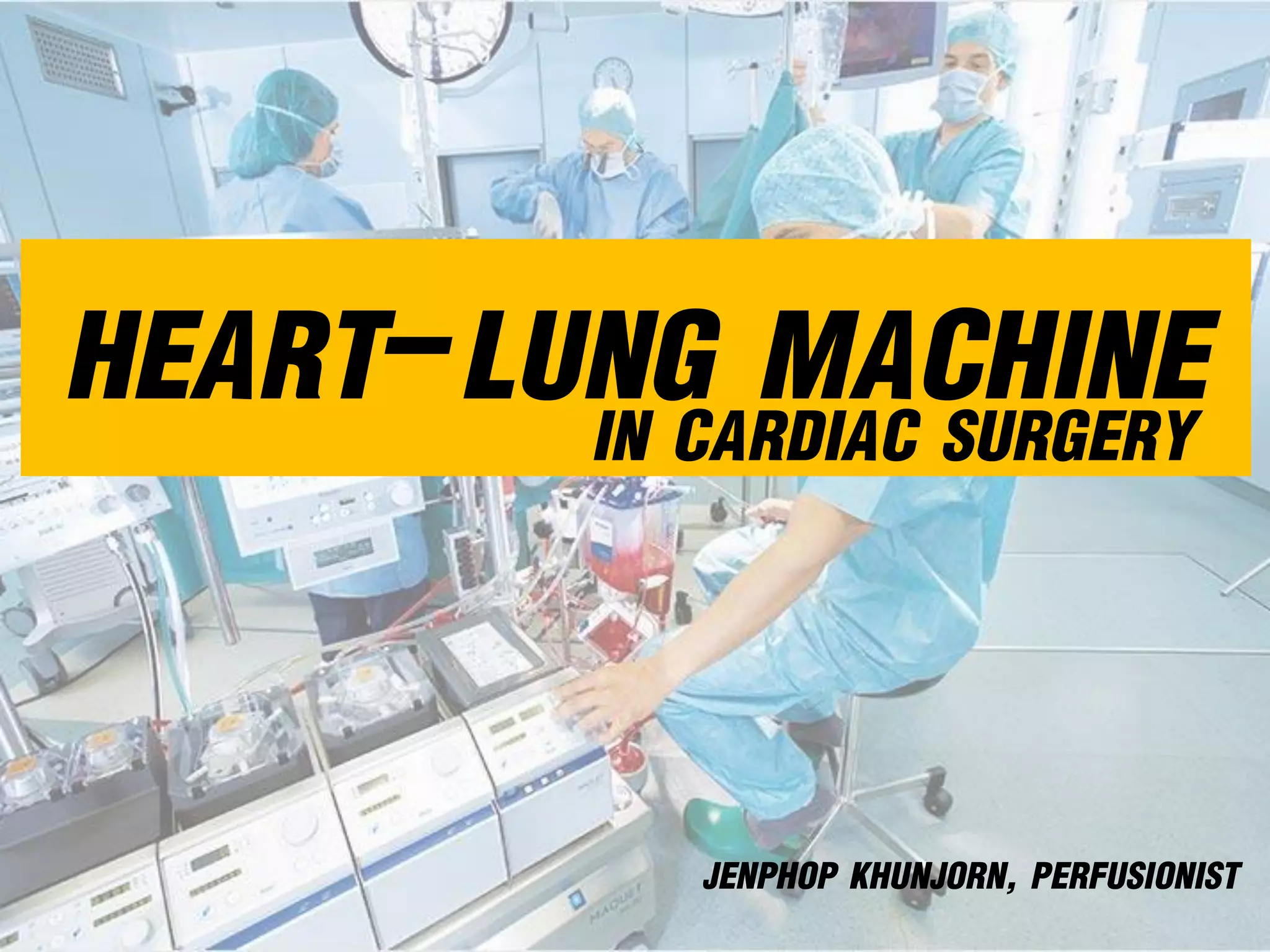
HEART-LUNG MACHINEIN CARDIAC SURGERY
JENPHOP KHUNJORN, PERFUSIONIST
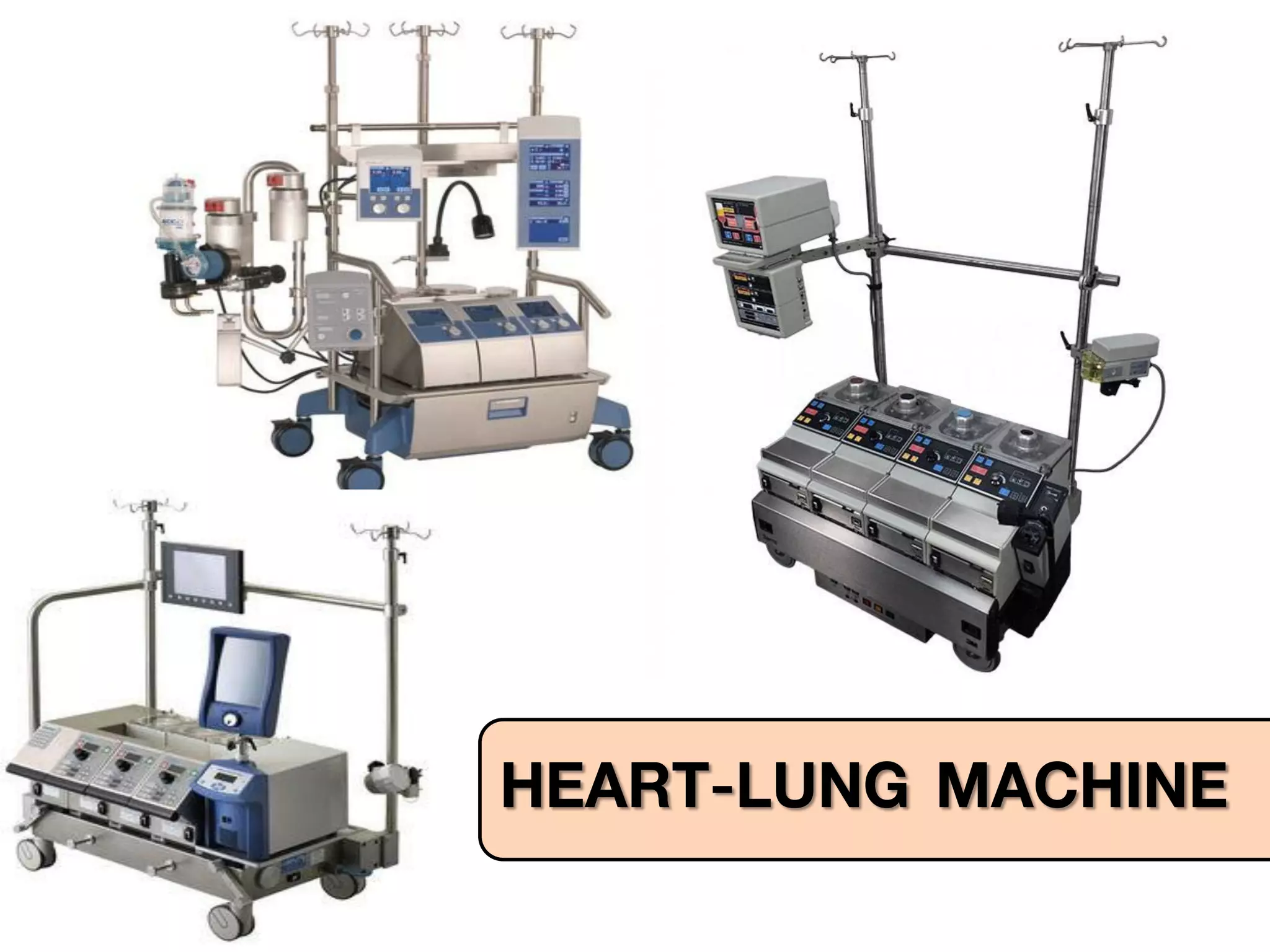
HEART-LUNG MACHINE
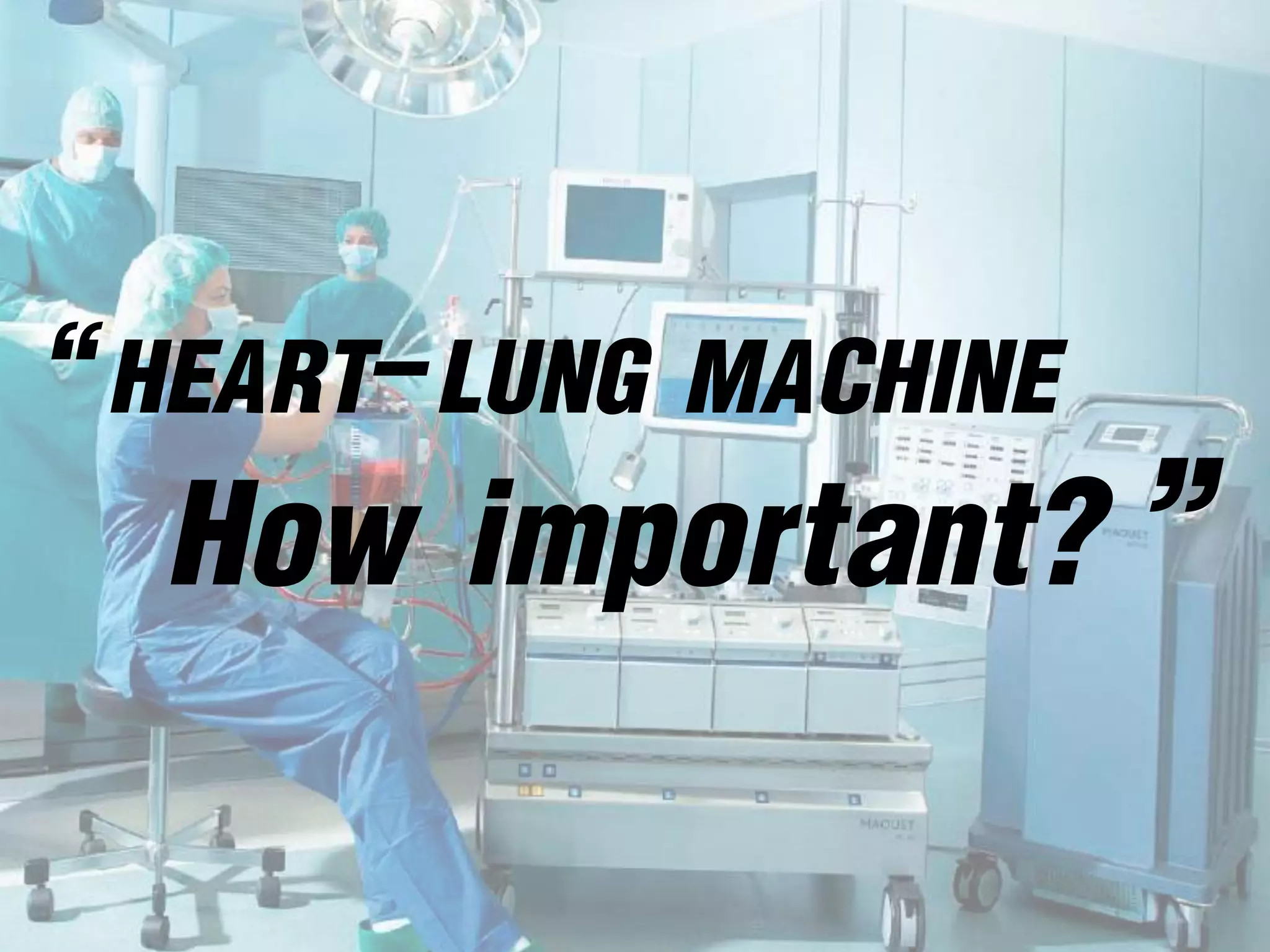
“HEART-LUNG MACHINE
How important? ”
• Machine for Cardiopulmonary bypass or Extracorporeal Circulation
system (ECC)
- For open cardiac surgery
- For supporting cardiac function, pulmonary function, or
cardiopulmonary function
• In the past >>> One unit
• Recently >>> Separate units
• Pump system (Heart)
• Oxygenator (Lung)
HEART-LUNG MACHINE
HEART-LUNG MACHINE
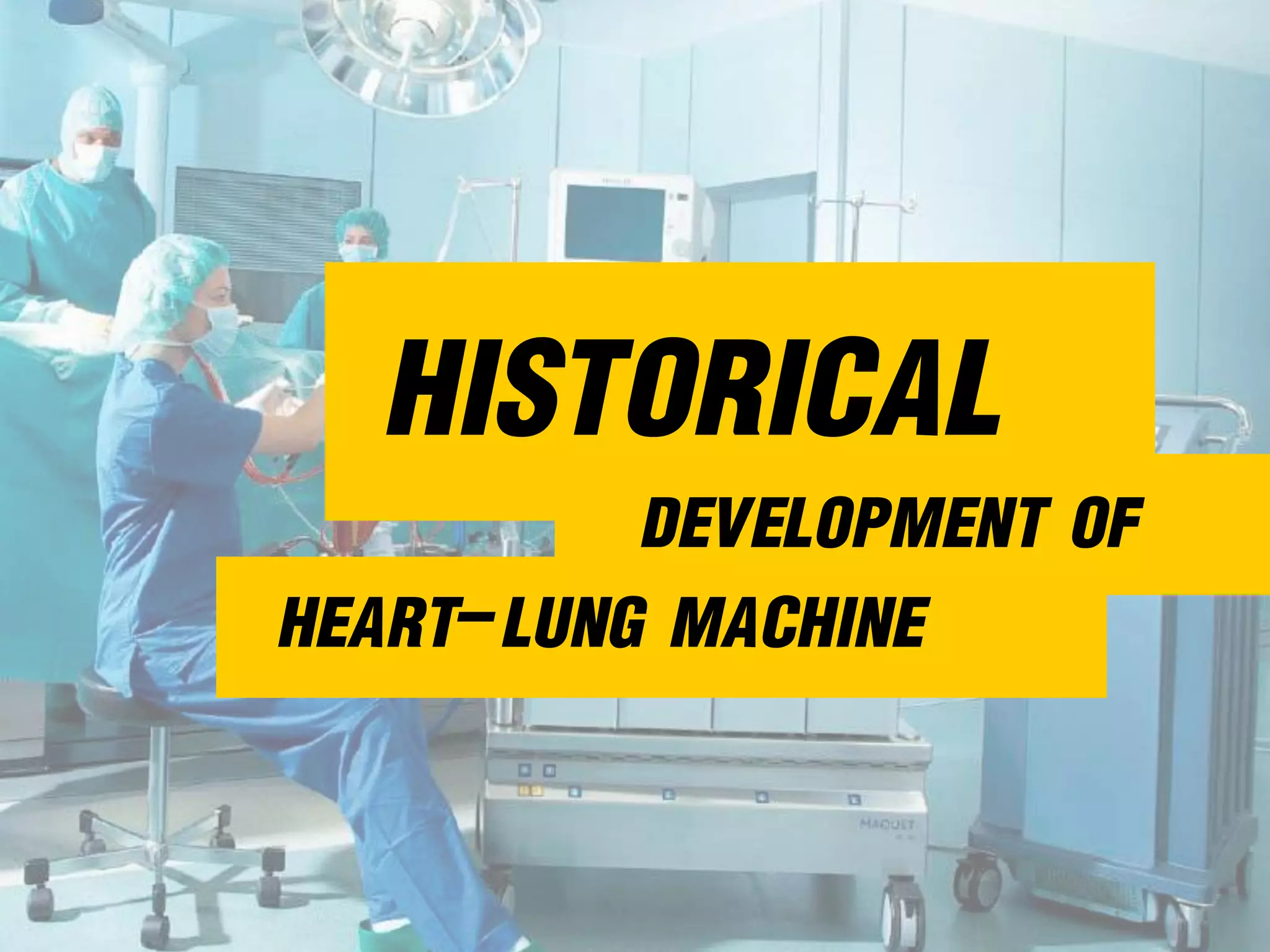
HISTORICAL
DEVELOPMENT OF
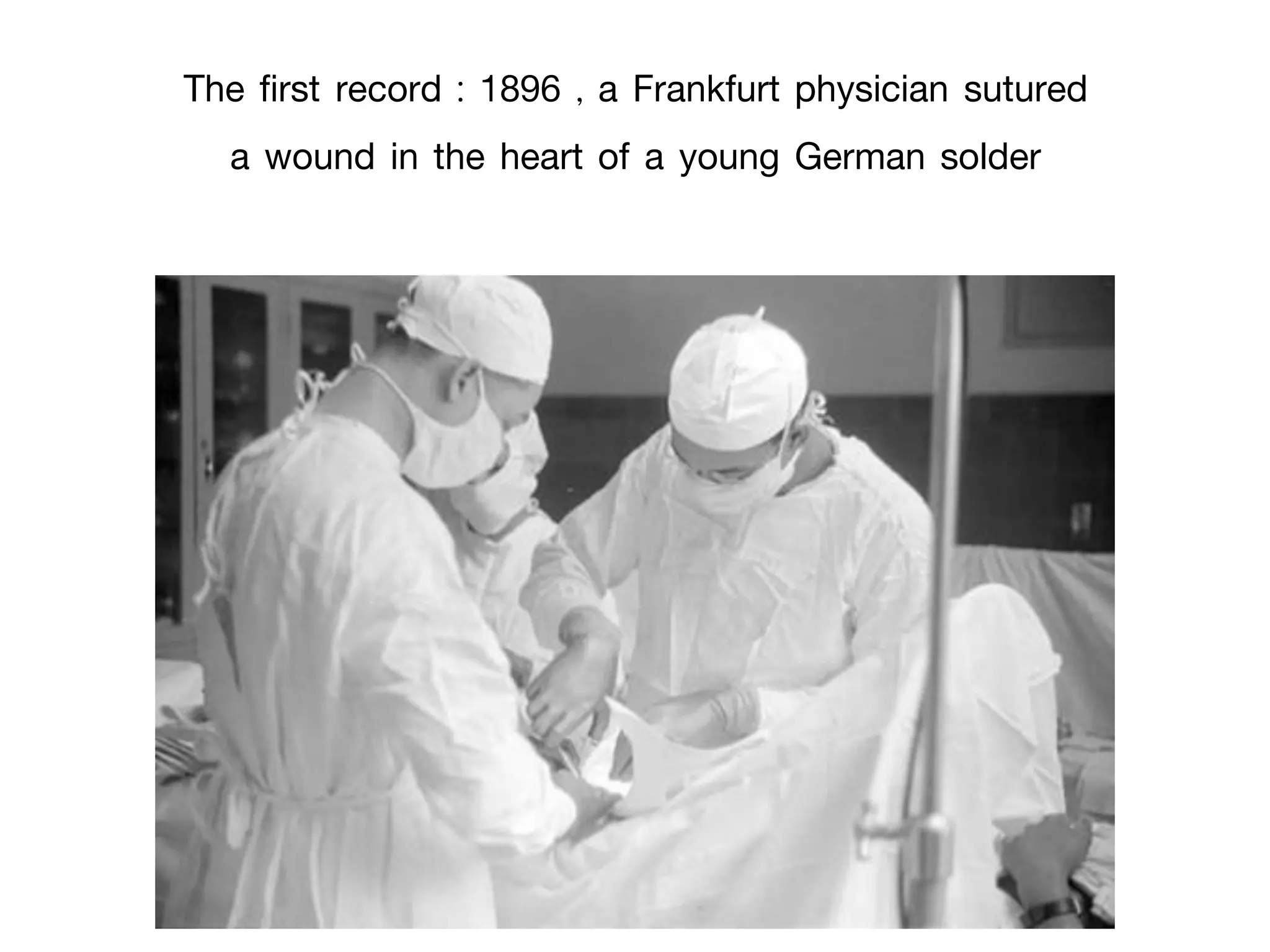
The first record : 1896 , a Frankfurt physician sutured
a wound in the heart of a young German solder
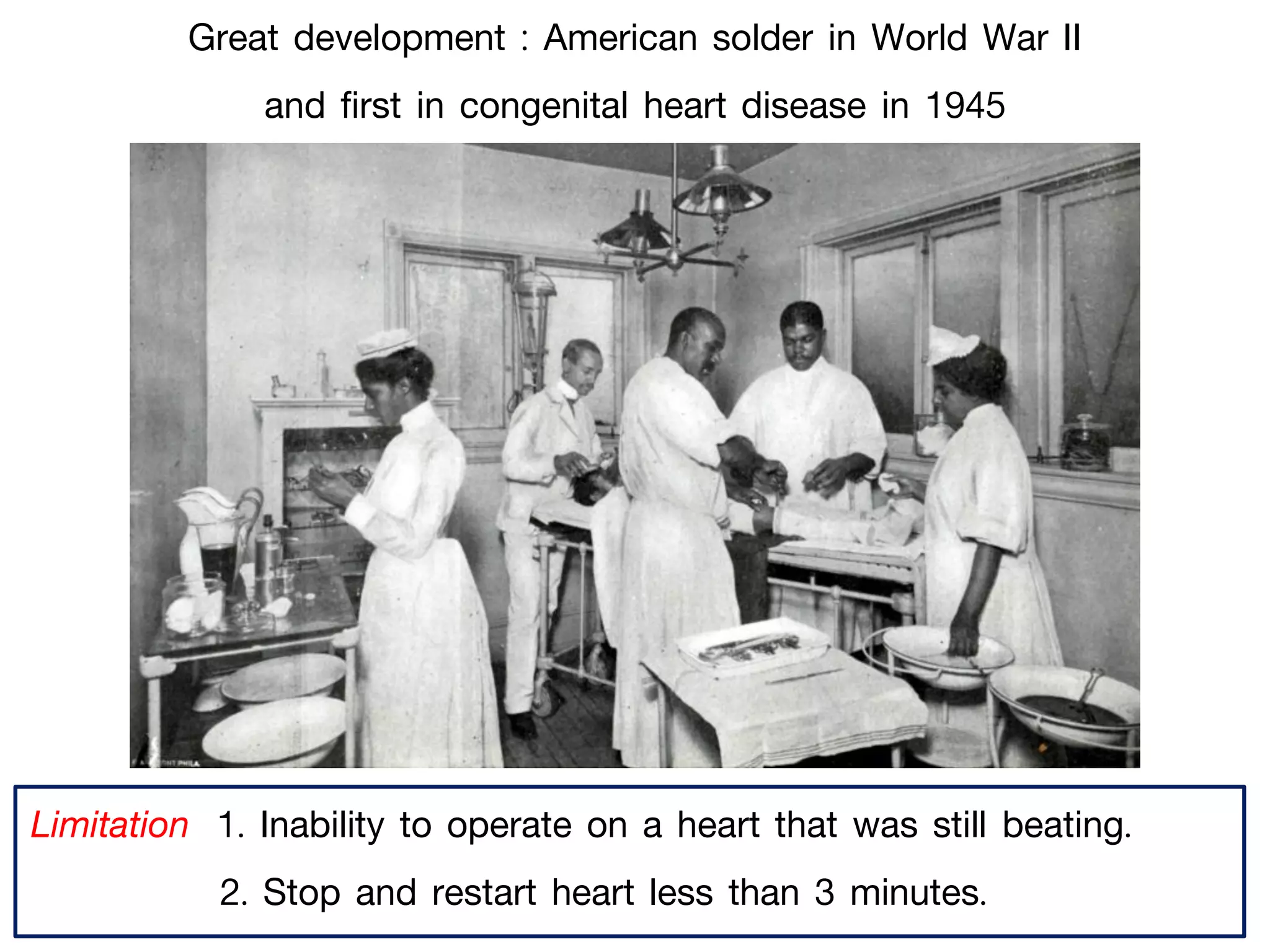
Limitation 1. Inability to operate on a heart that was still beating.
2. Stop and restart heart less than 3 minutes.
Great development : American solder in World War II
and first in congenital heart disease in 1945
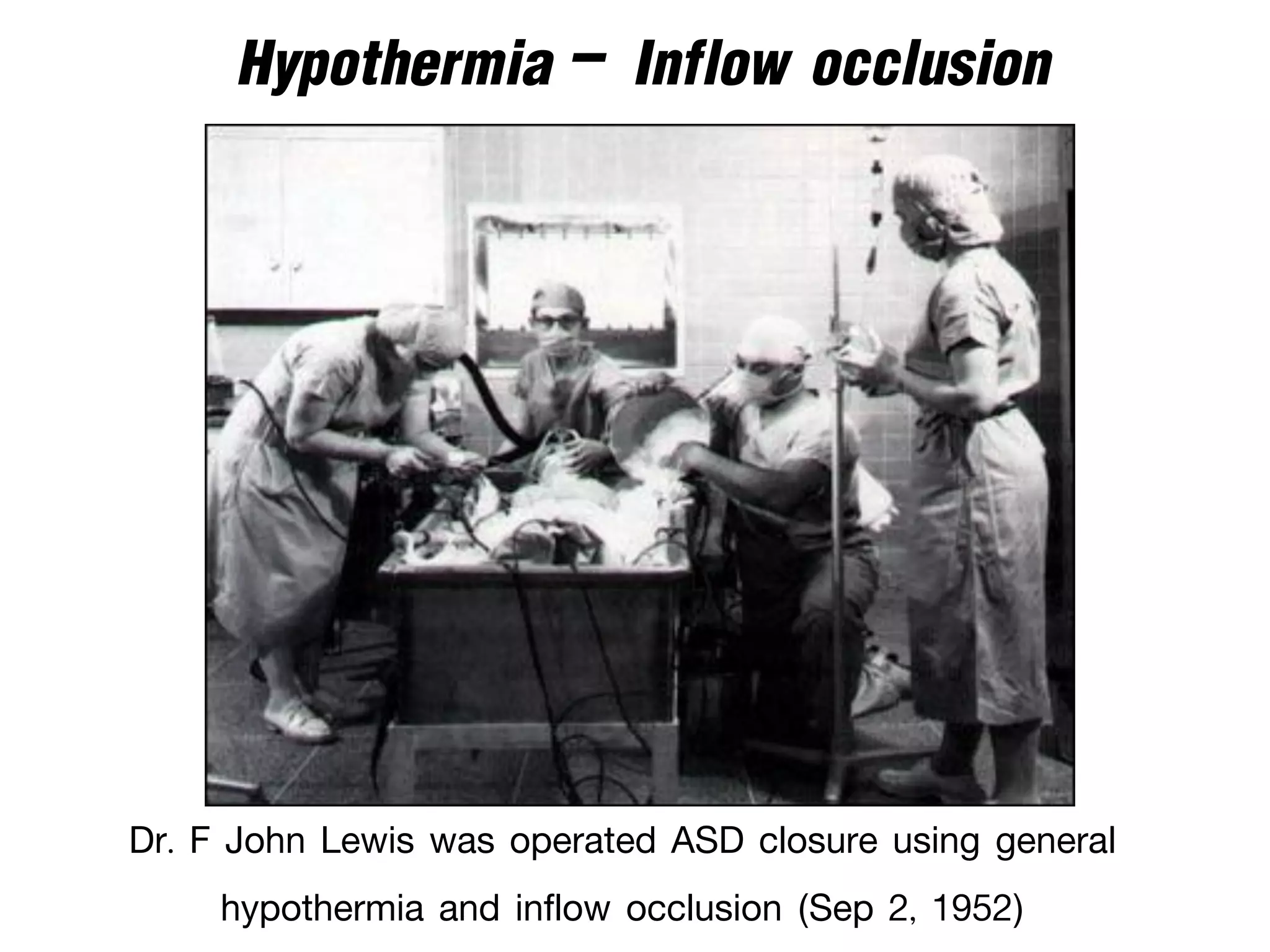
Hypothermia - Inflow occlusion
Dr. F John Lewis was operated ASD closure using general
hypothermia and inflow occlusion (Sep 2, 1952)
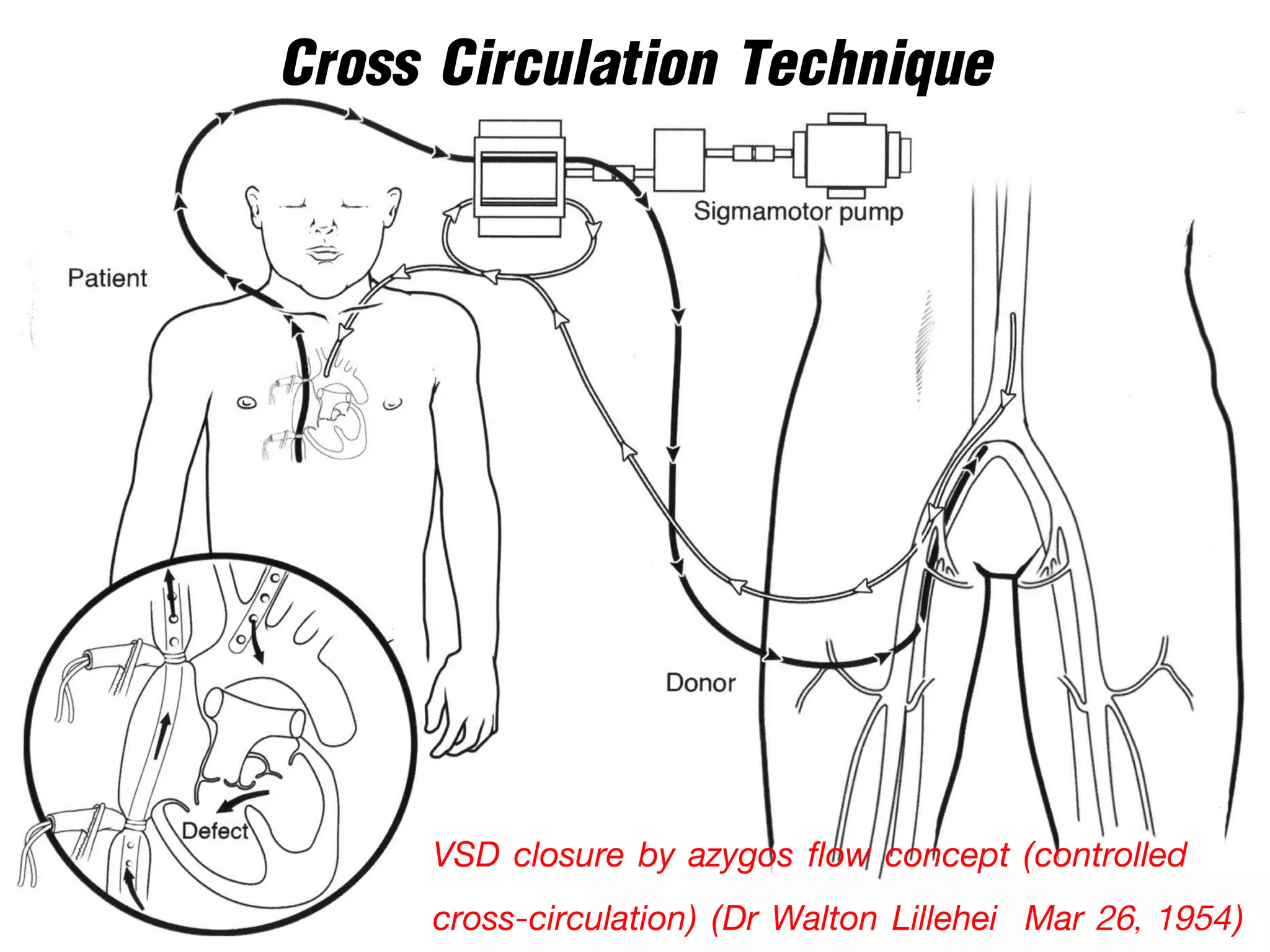
Cross Circulation Technique
VSD closure by azygos flow concept (controlled
cross-circulation) (Dr Walton Lillehei Mar 26, 1954)
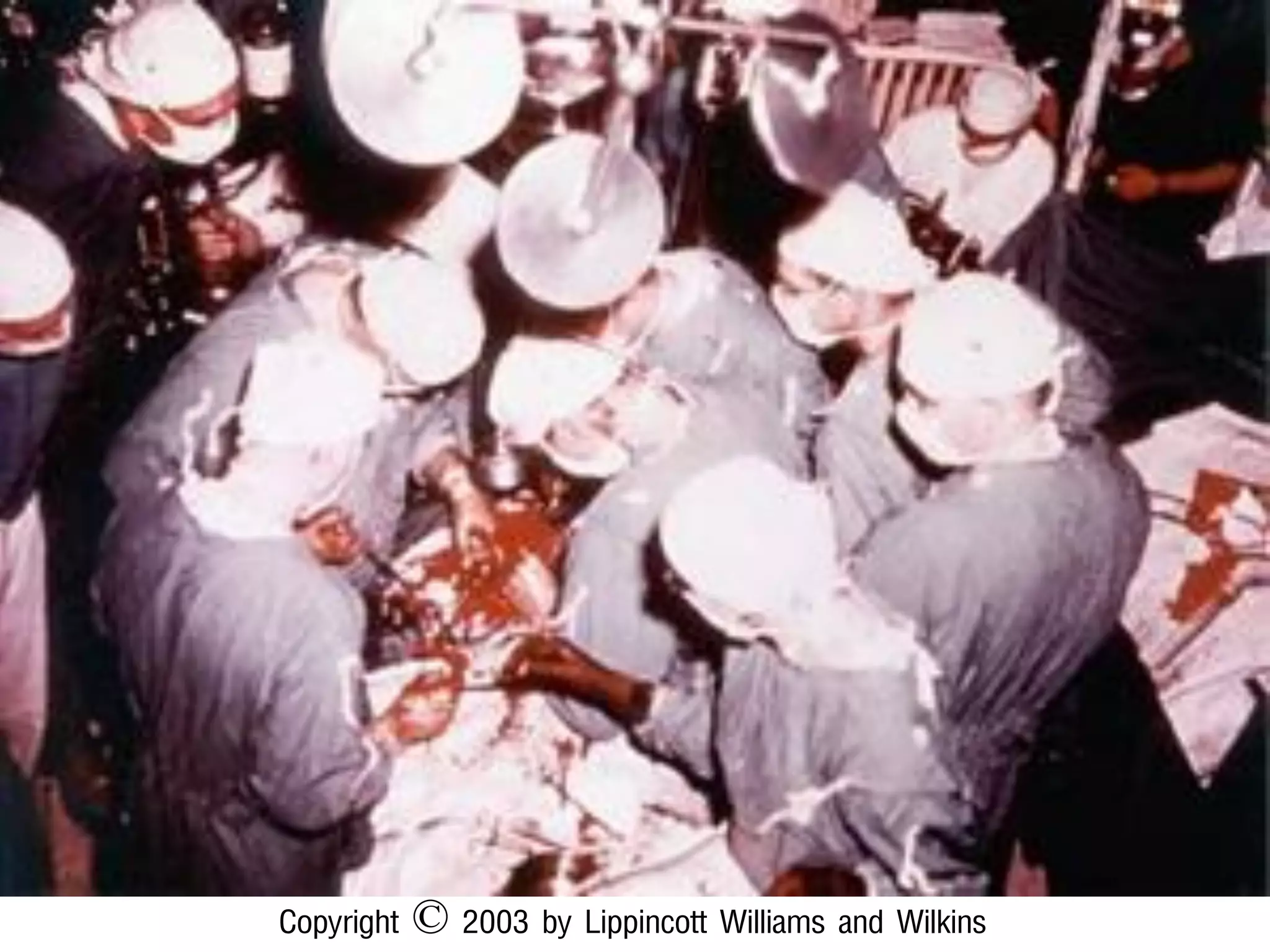
Copyright © 2003 by Lippincott Williams and Wilkins
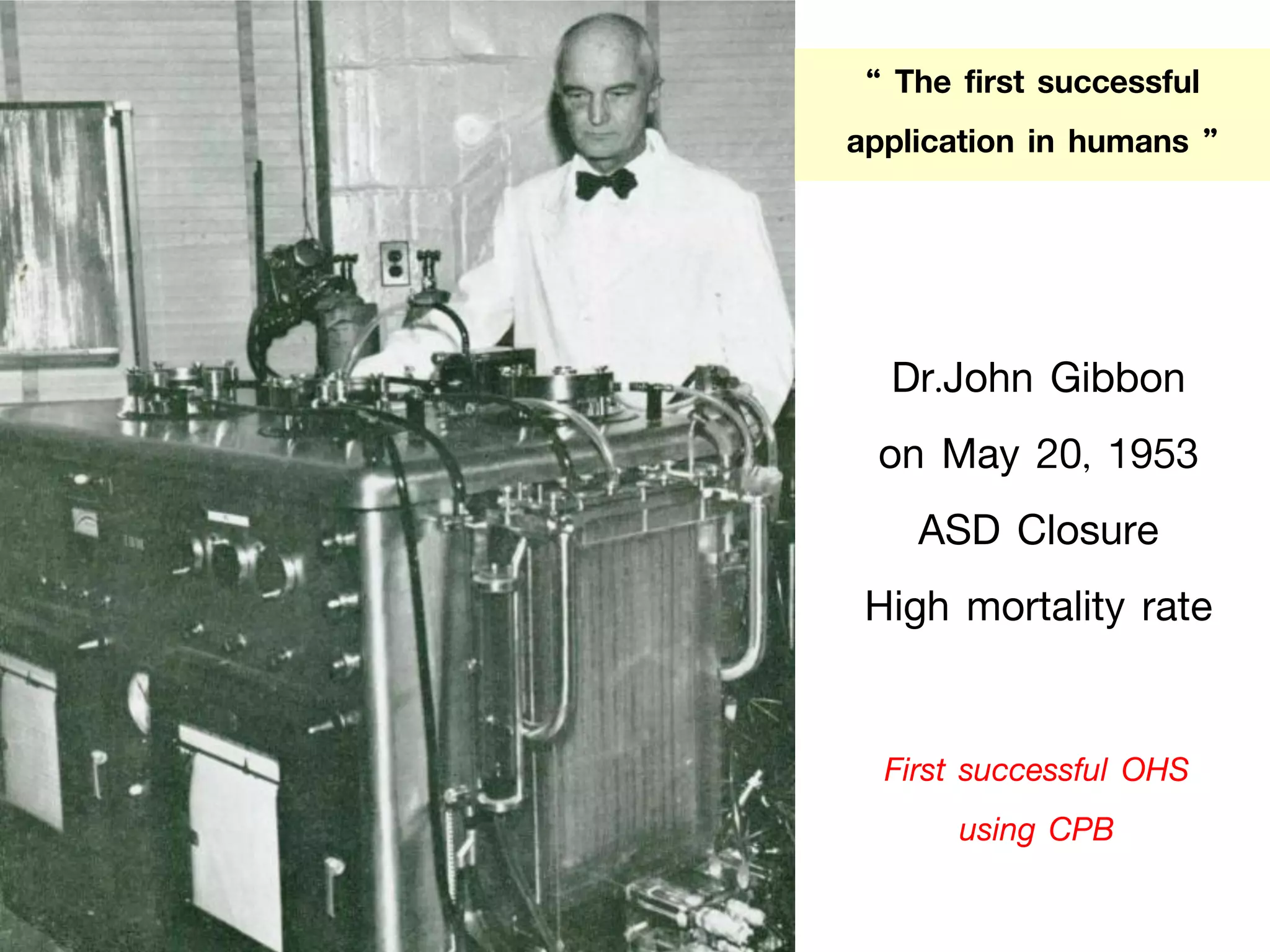
Dr.John Gibbon
on May 20, 1953
ASD Closure
High mortality rate
“ The first successful
application in humans ”
First successful OHS
using CPB
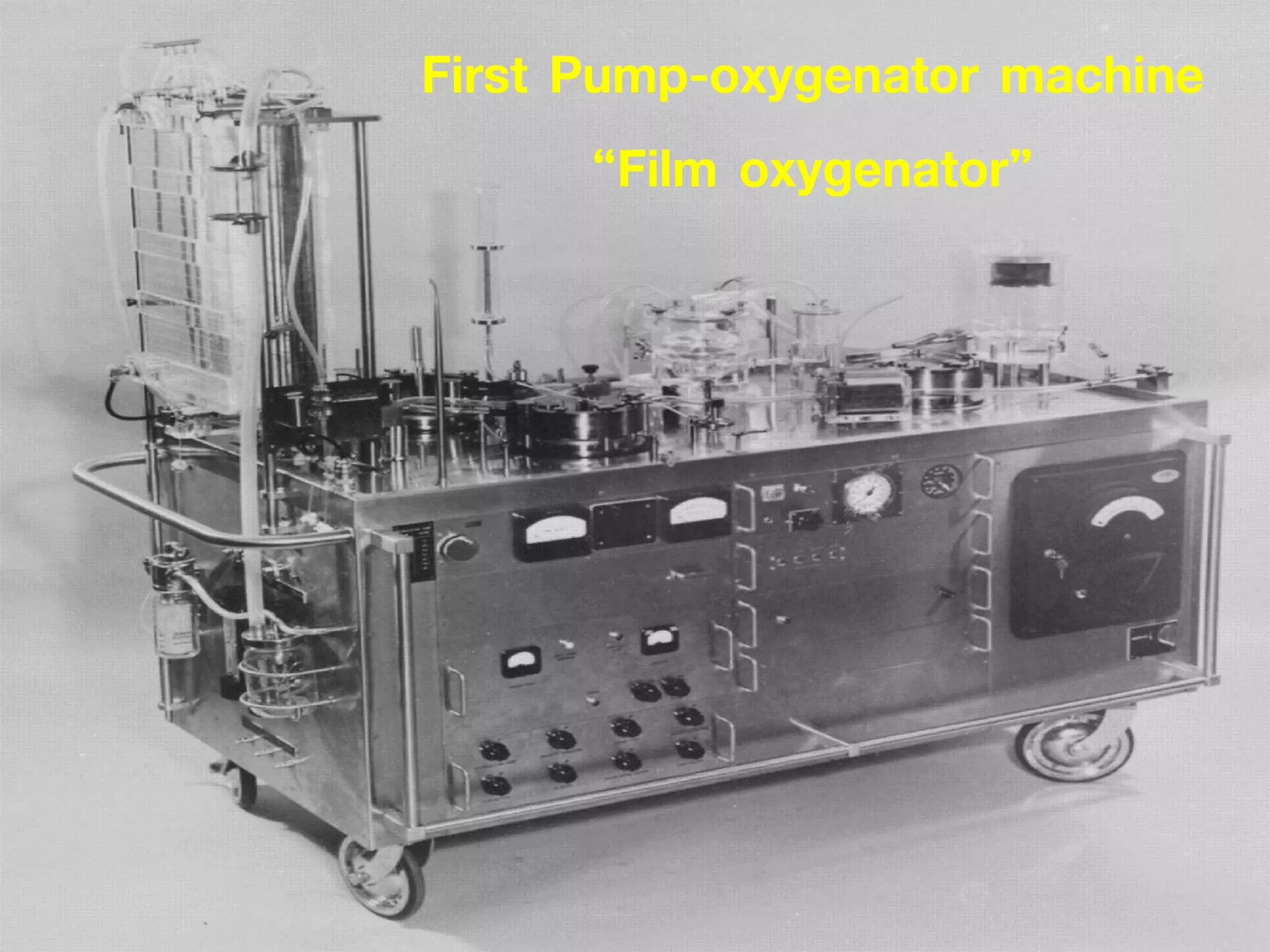
First Pump-oxygenator machine
“Film oxygenator”
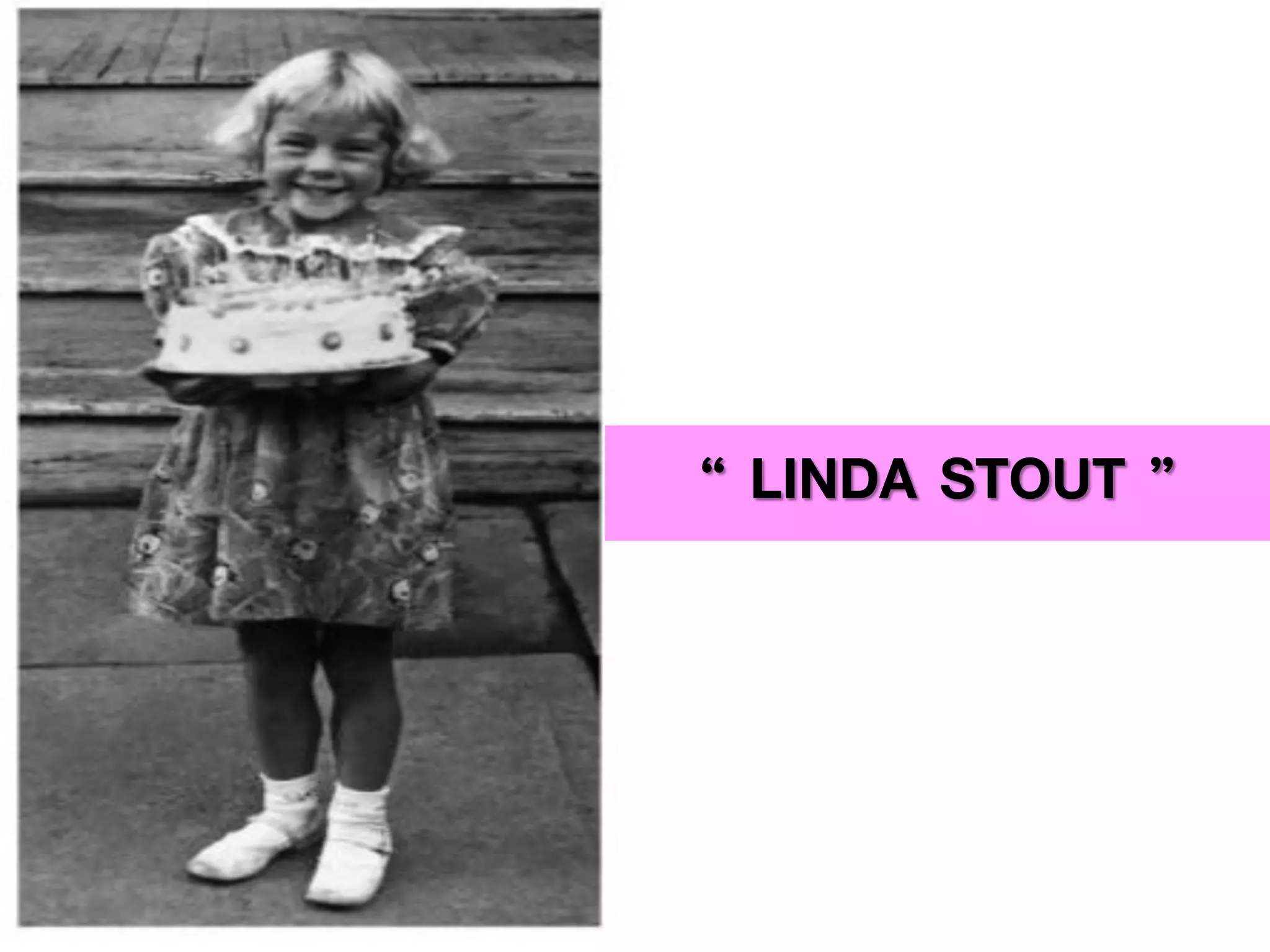
“ LINDA STOUT ”
SCIENTIFIC DISCOVERIES
AND TECHNIQUE OF TOTAL ECC
- Temporary interruption of venous return to heart
(inflow occlusion)
- Oxygenator and roller pump
- Correlation temperature and metabolic rate
- Discovery A, B, O blood group
- Anticoagulant (Heparin) / Antagonist (Protamine)
TECHNIQUES FACILITATING PROGRESS OF TOTAL ECC
- Cross Circulation
- Cardiac Catheterization
- Deep hypothermia
- Myocardial arrest and myocardial defibrillator
- External Pacemaker
- Hemodilution
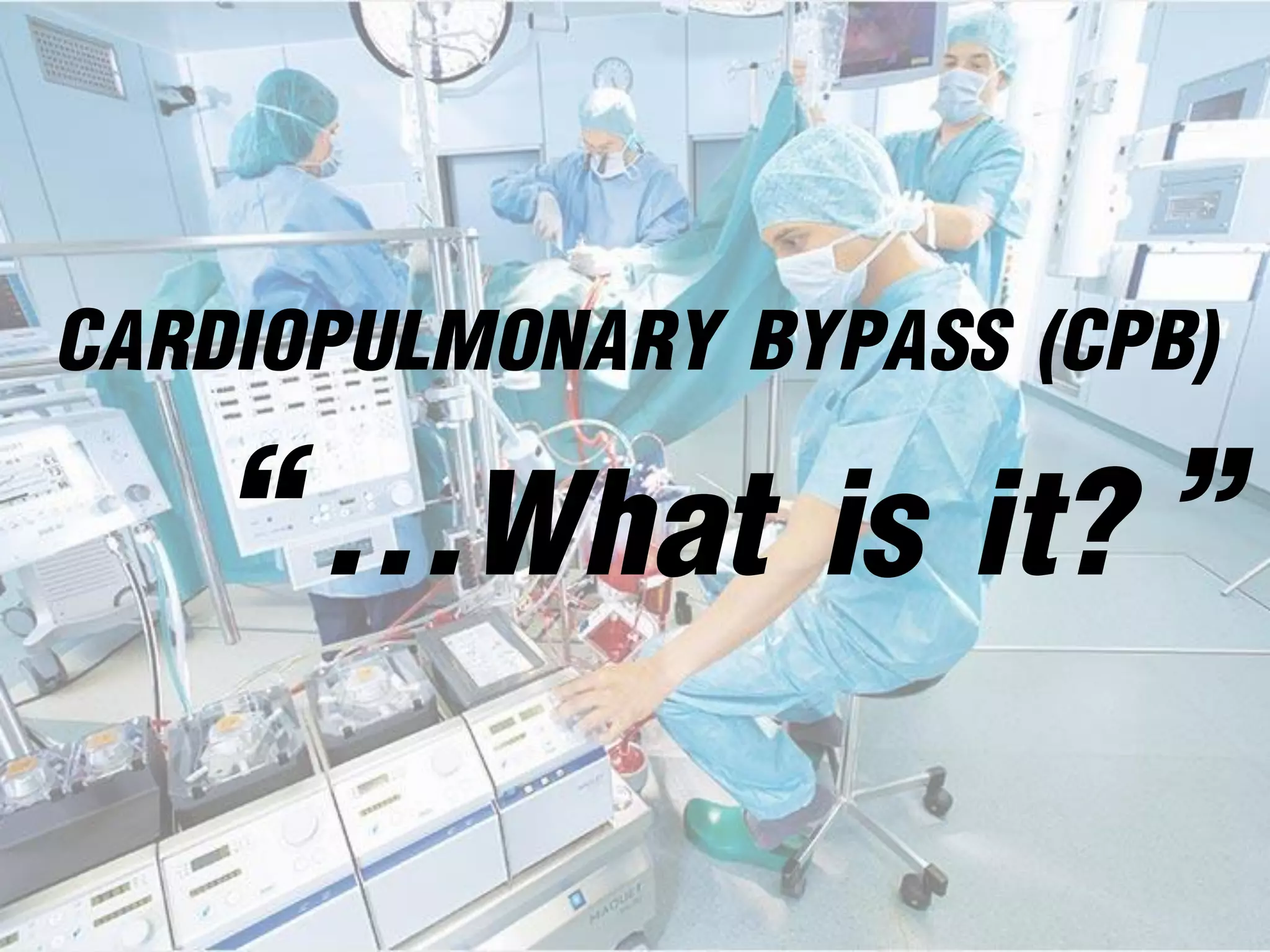
CARDIOPULMONARY BYPASS (CPB)
“...What is it? ”
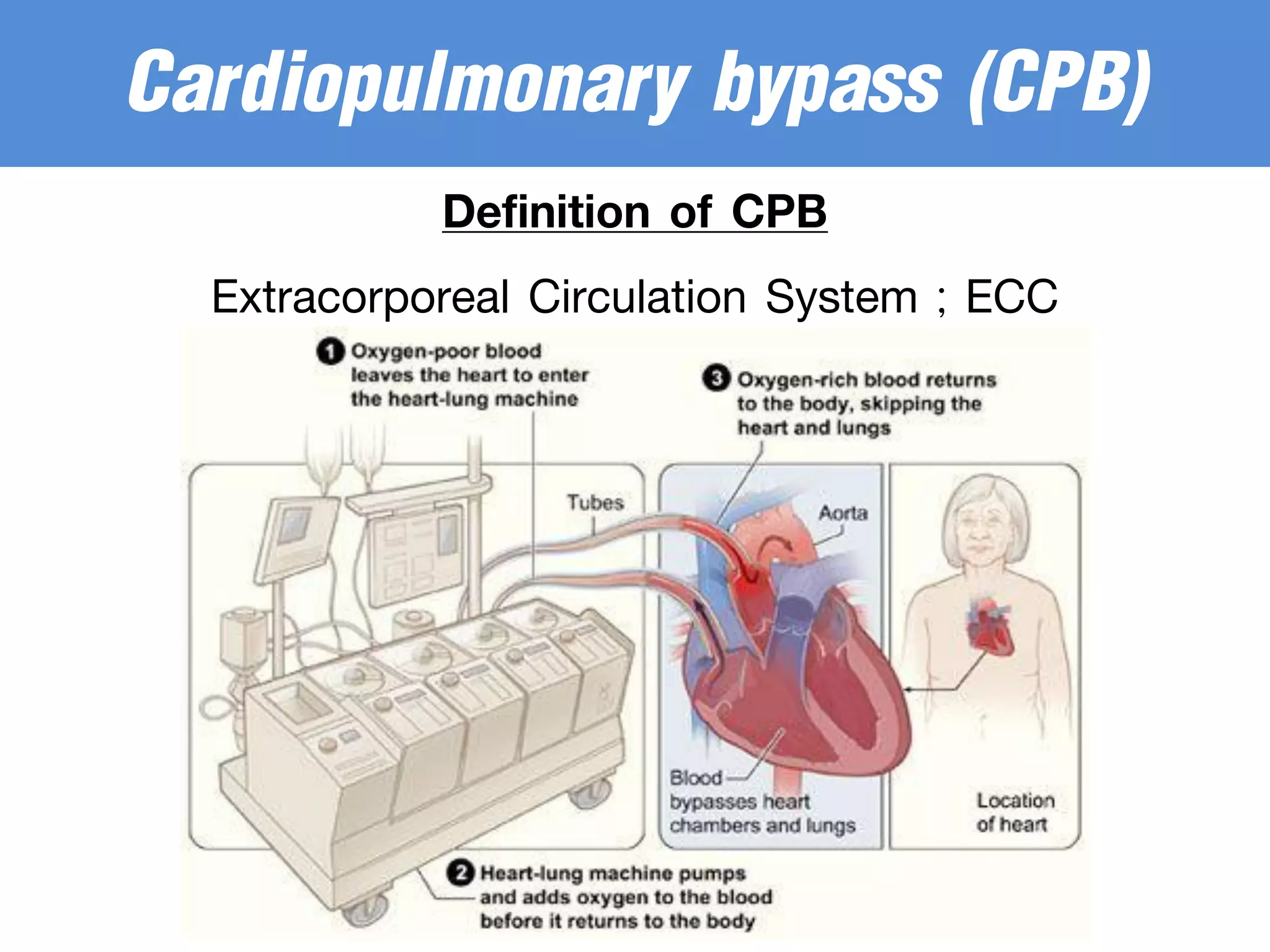
Definition of CPB
Extracorporeal Circulation System ; ECC
Cardiopulmonary bypass (CPB)
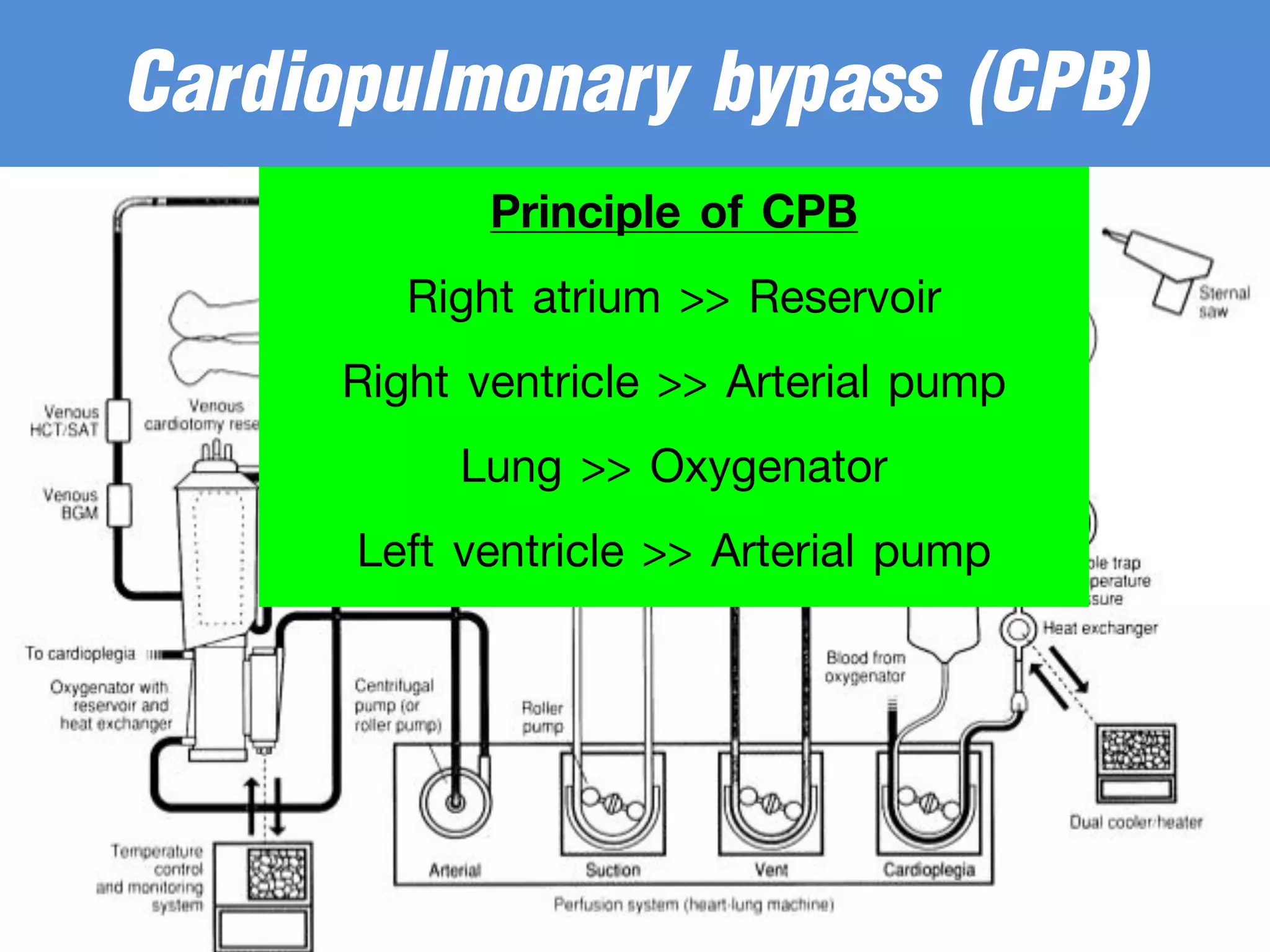
Principle of CPB
Right atrium >> Reservoir
Right ventricle >> Arterial pump
Lung >> Oxygenator
Left ventricle >> Arterial pump
Cardiopulmonary bypass (CPB)
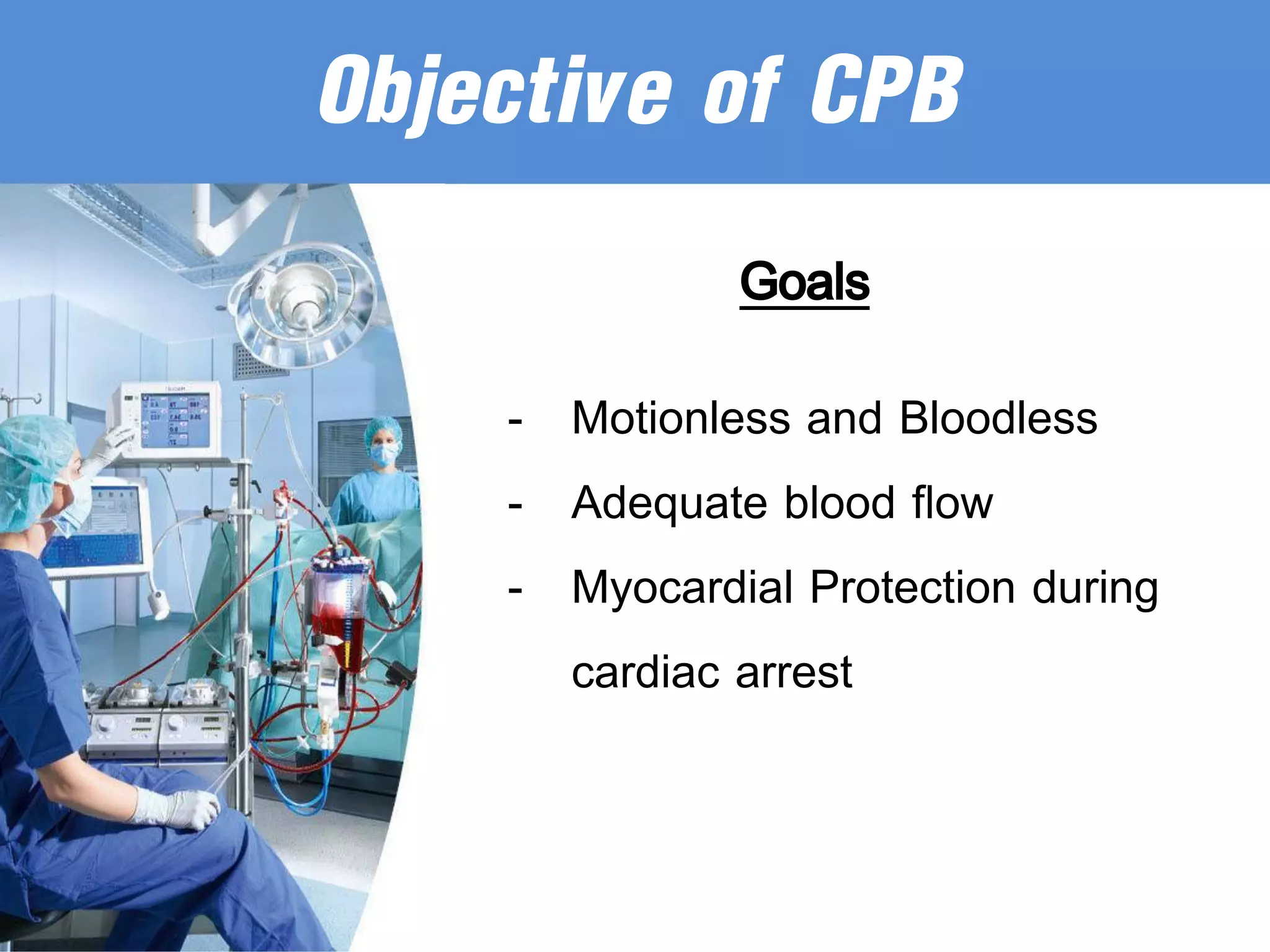
Objective of CPB
Goals
- Motionless and Bloodless
- Adequate blood flow
- Myocardial Protection during
cardiac arrest
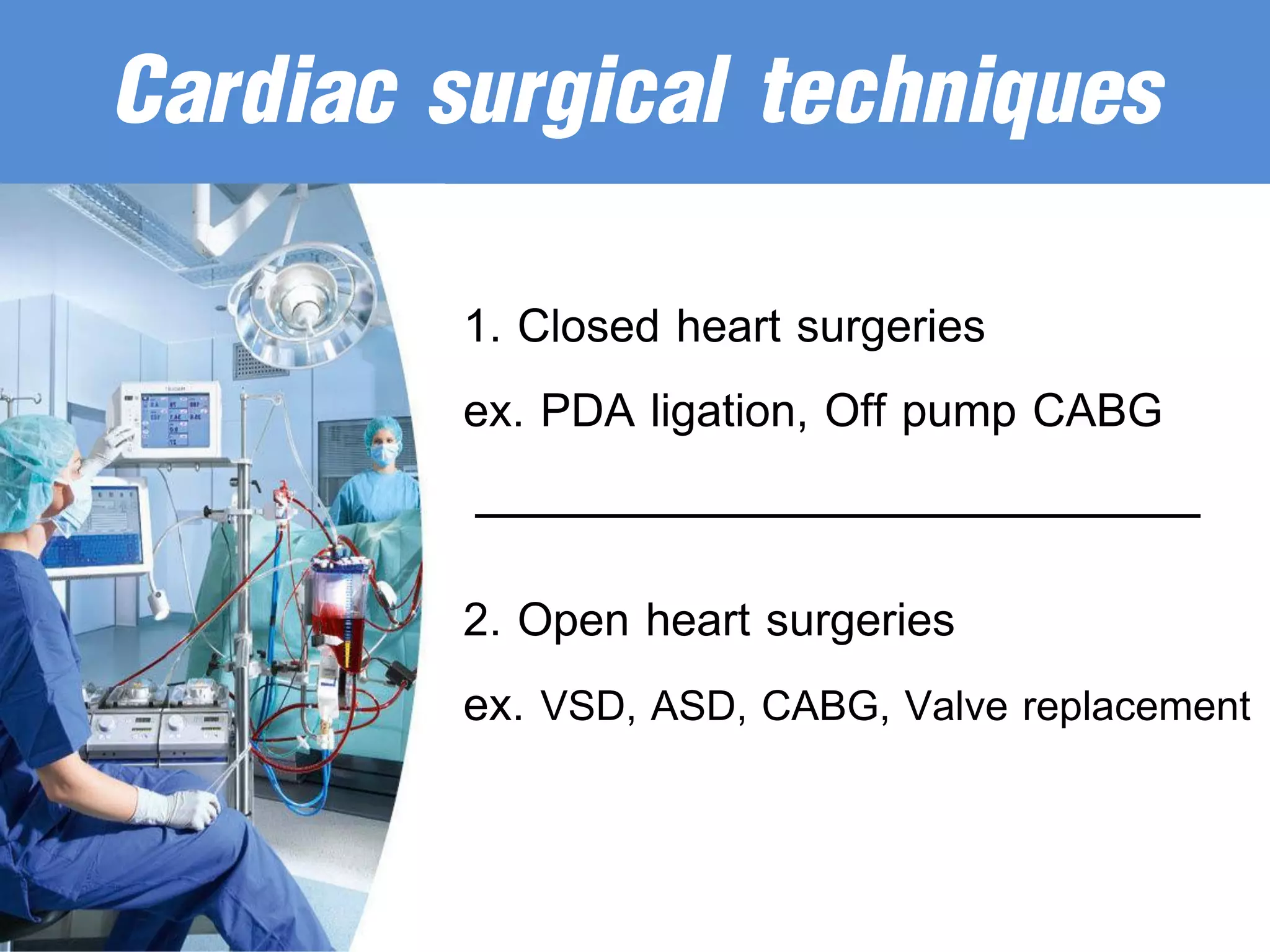
Cardiac surgical techniques
1. Closed heart surgeries
ex. PDA ligation, Off pump CABG
2. Open heart surgeries
ex. VSD, ASD, CABG, Valve replacement
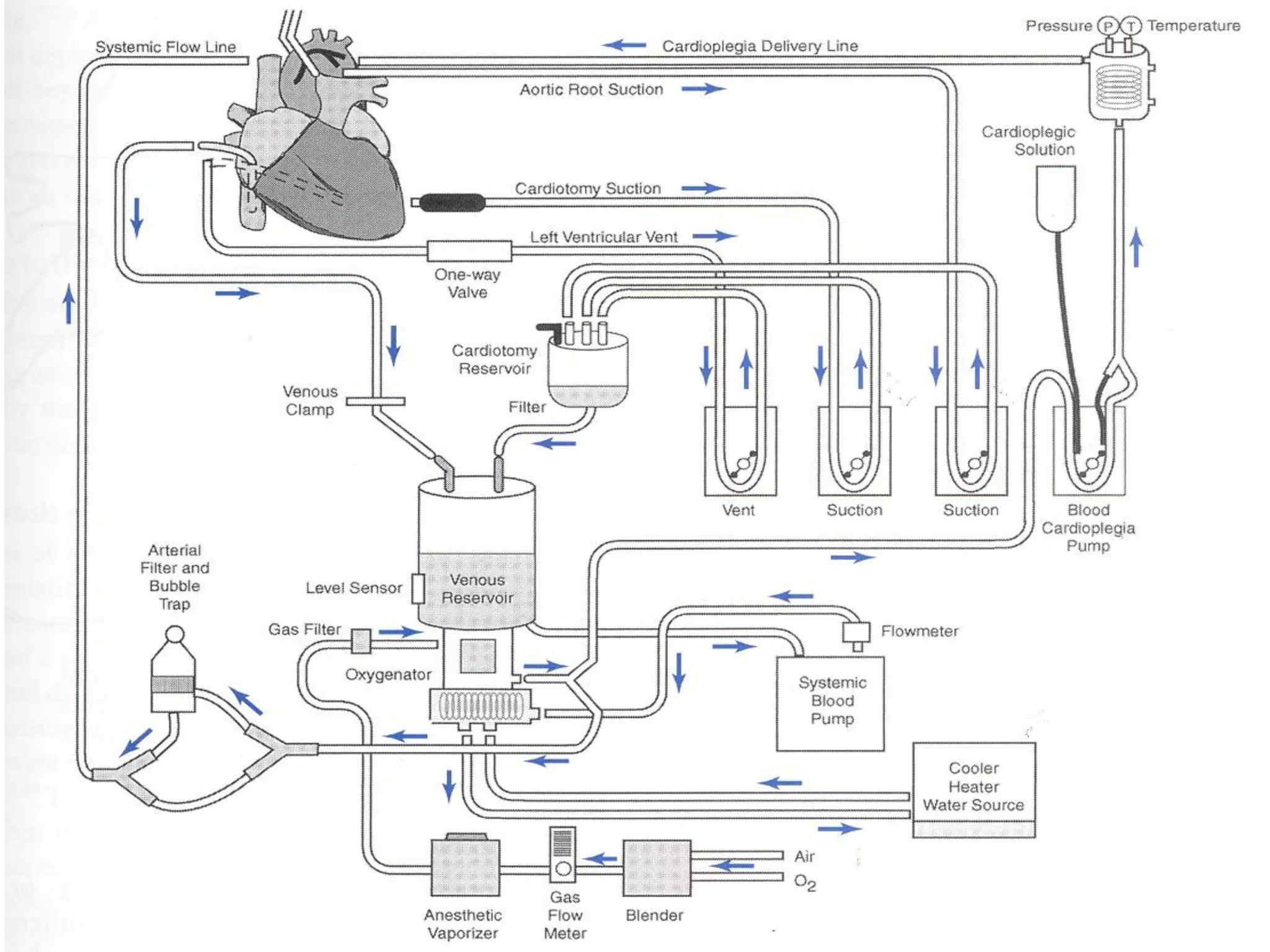
CPB Circuit
Table Set
Machine Set
Safe Sample Short
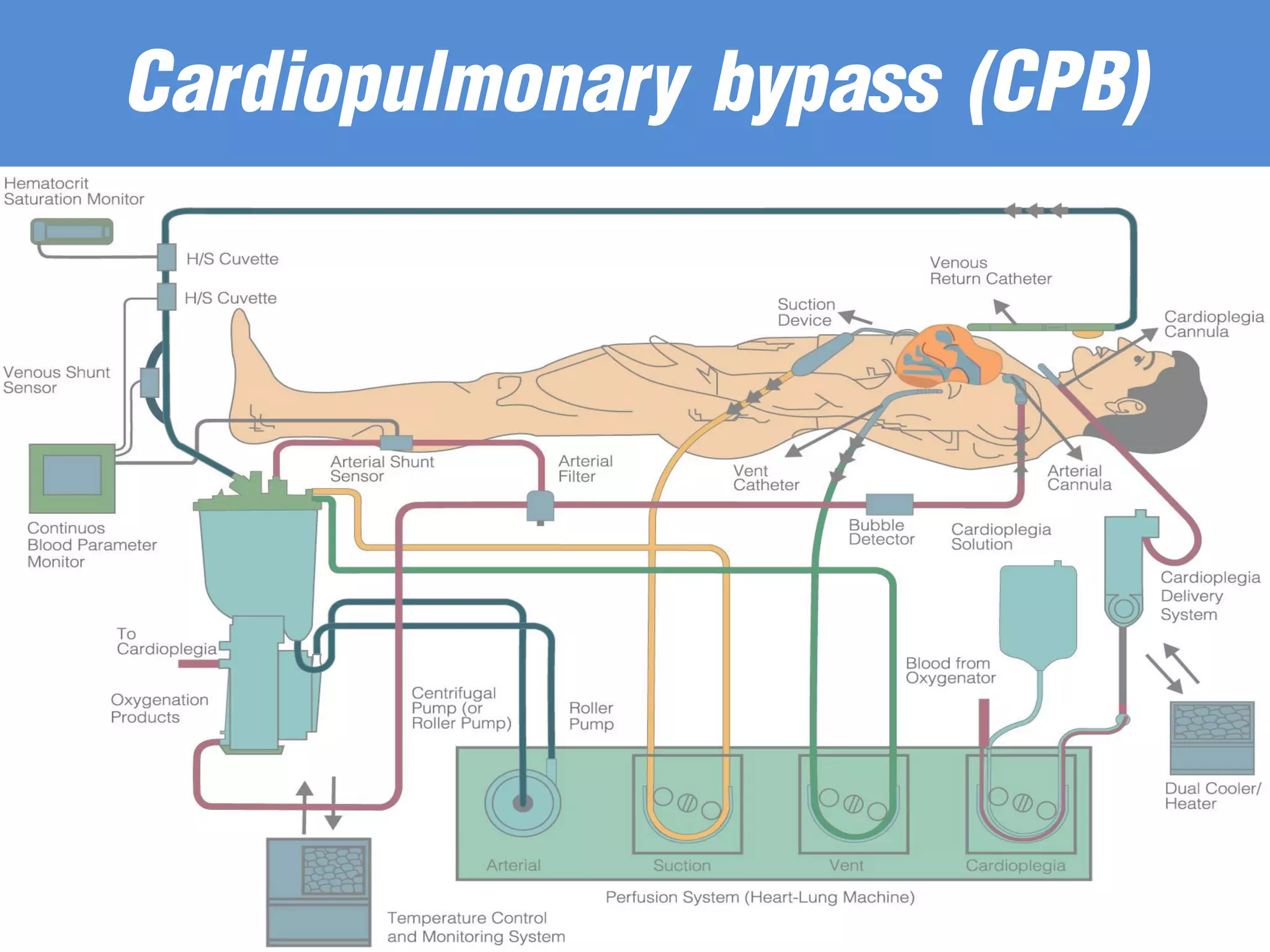
Components of CPB
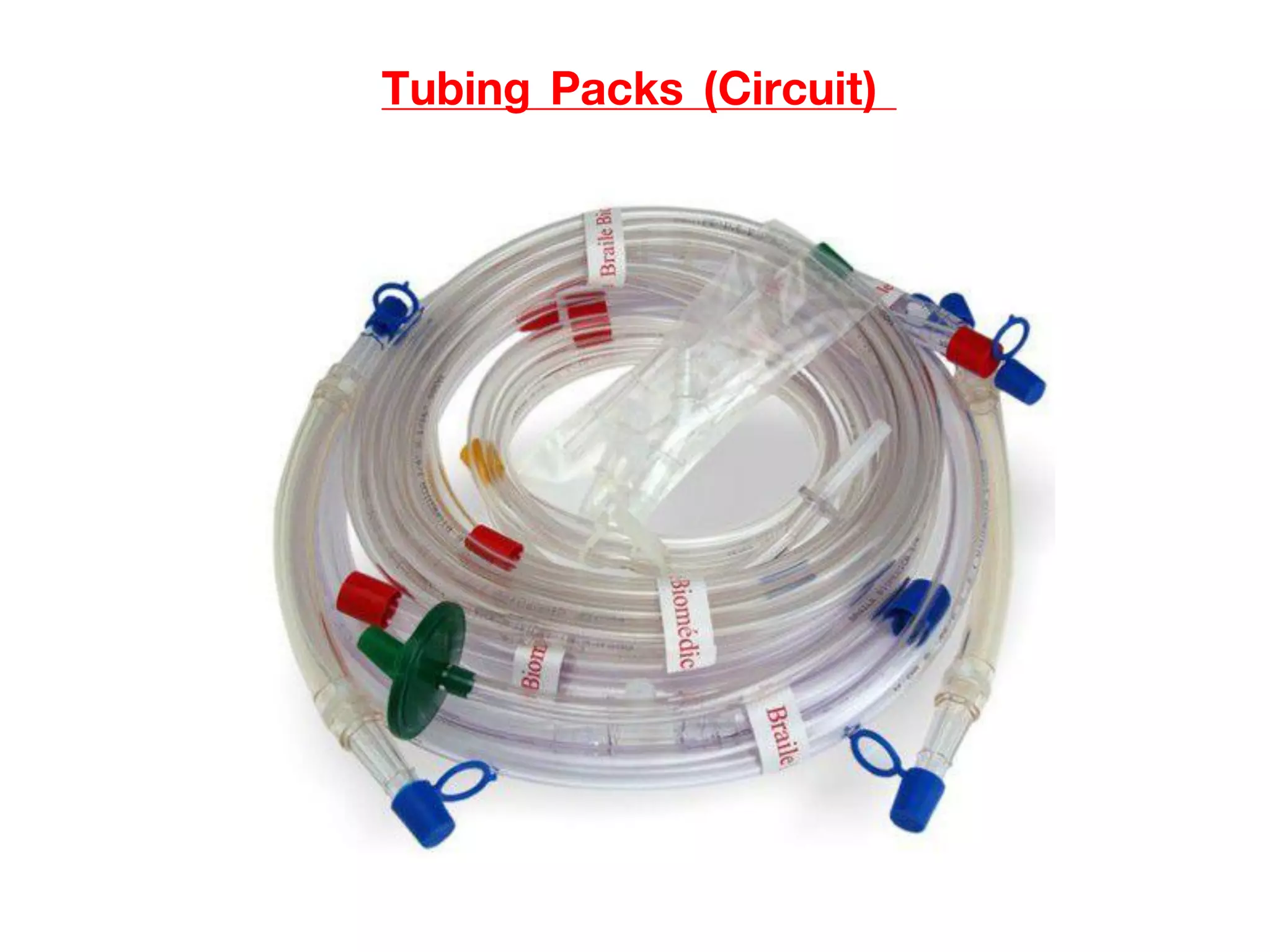
Tubing Packs (Circuit)
Arterial, Venous Cannula
Suckers and vents
Cardioplegia cannula
Oxygenator with reservoir
Arterial filter / Bubble trab
Blood, Suction, Vent, Cardioplegia Pump
Heat Exchanger / Heater-Cooler
Gas blender (Air-Oxygen mixer)
Anesthetic Gas Vaporizer
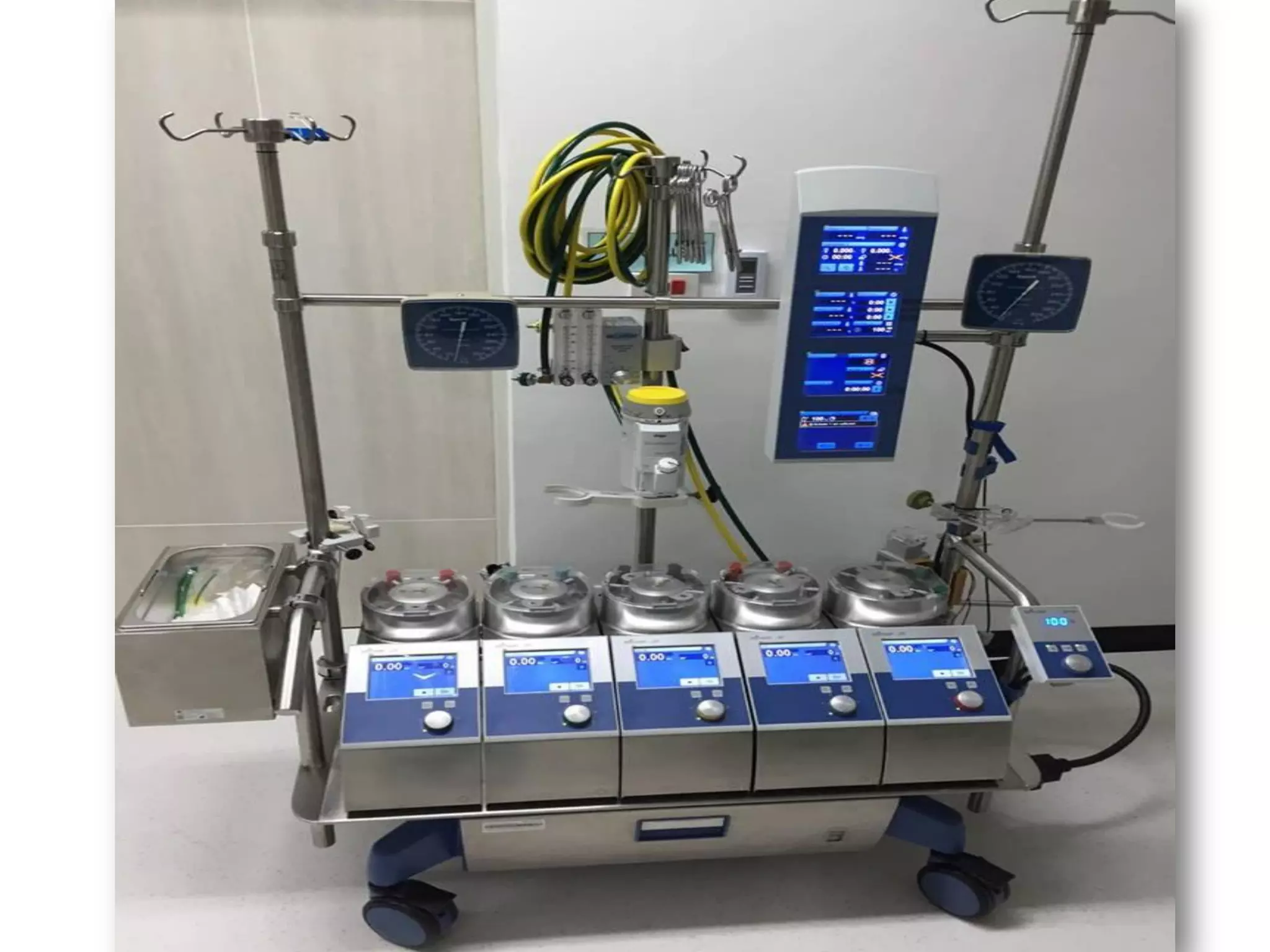
Heart-lung Machine
Tubing Packs (Circuit)
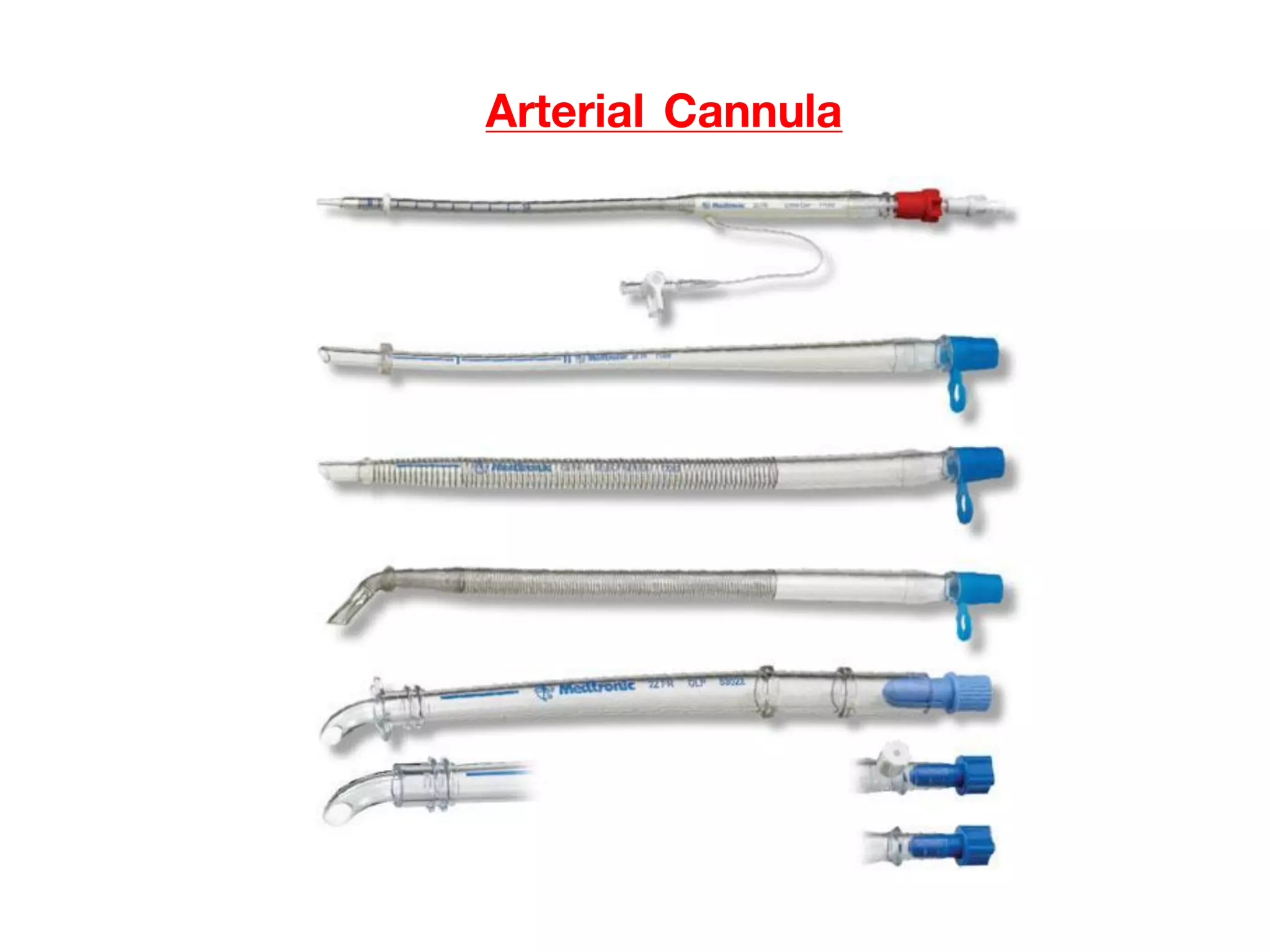
Arterial Cannula
Venous Cannula
Suckers and vents
Cardioplegia cannula
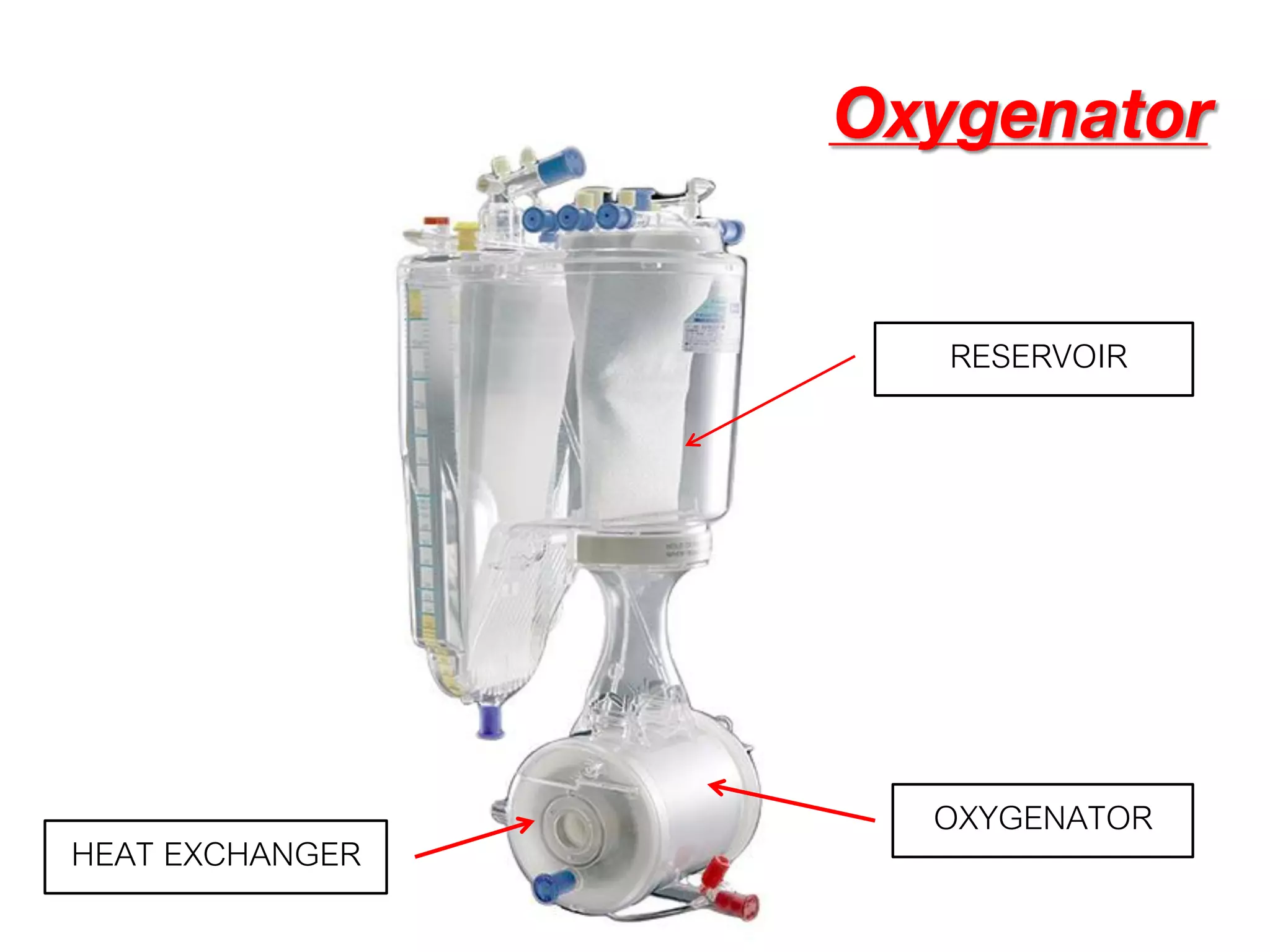
Oxygenator
RESERVOIR
HEAT EXCHANGER
OXYGENATOR
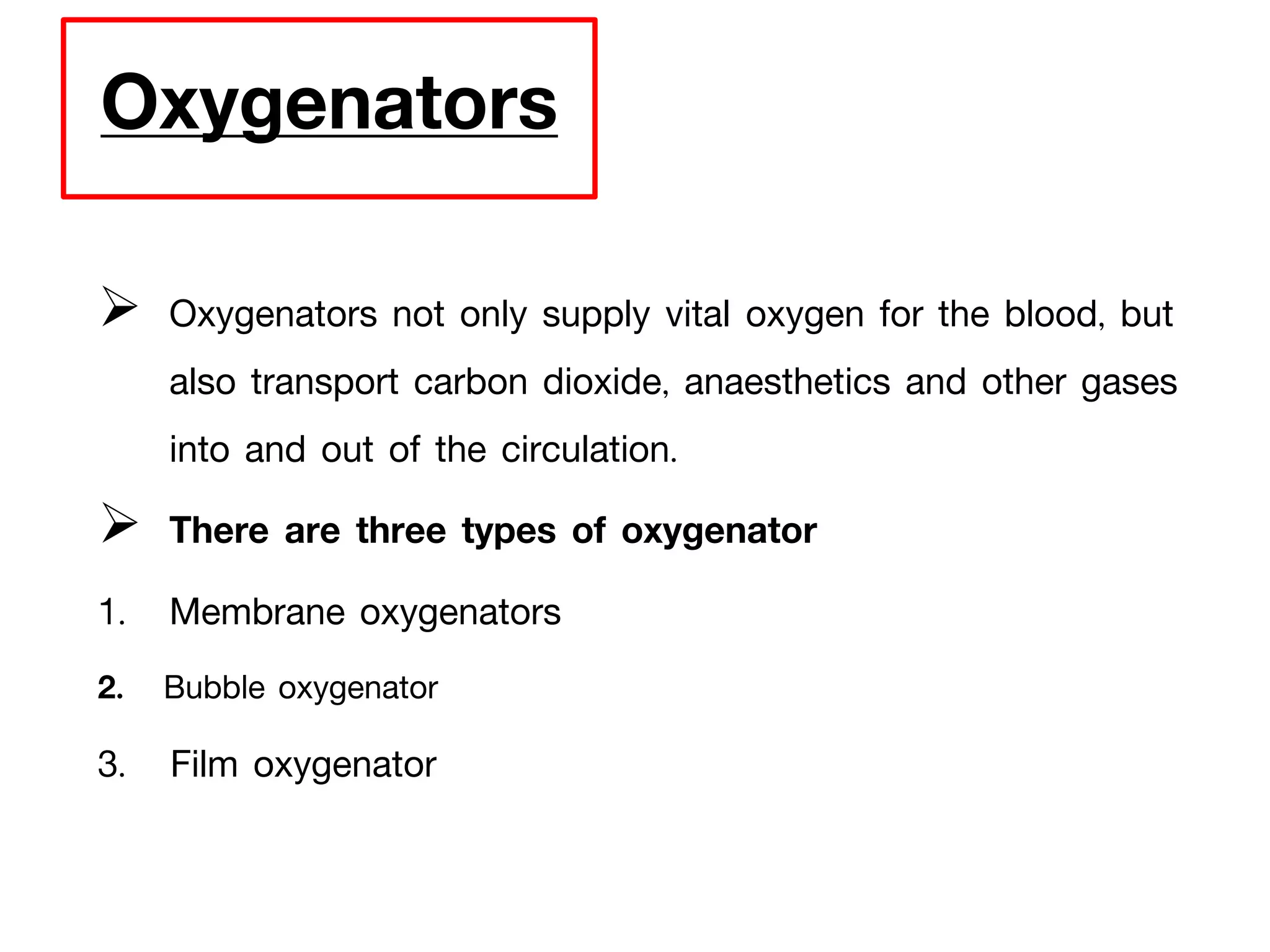
Oxygenators
 Oxygenators not only supply vital oxygen for the blood, but
also transport carbon dioxide, anaesthetics and other gases
into and out of the circulation.
 There are three types of oxygenator
1. Membrane oxygenators
2. Bubble oxygenator
3. Film oxygenator
Membrane oxygenators
Membrane oxygenators imitate the natural lung by a thin membrane of
either micro porous polypropylene or silicone rubber between the gas and blood
phases.
Diagram of a hollow fiber membrane oxygenator and heat exchanger unit. Oxygen enters
one end of the bundles of hollow fibers and exits at the opposite end. The hollow fiber
bundles are potted at each end to separate the blood and gas compartments. Oxygen
and carbon dioxide diffuse in opposite directions across the aggregate large surface of
the hollow fibers.
Heat Exchanger
Control body temperature by heating or cooling blood
passing through the perfusion circuit.
In heat exchanger, blood flows through spiralling coils
made of stainless steel. The inner walls of the coils are
coated with polymers to limit blood-surface interactions.
The circulating water is chilled to nearly 0 0C in an ice
bath and heated by an electric resistance coil to an
absolute maximum of 42 0C.
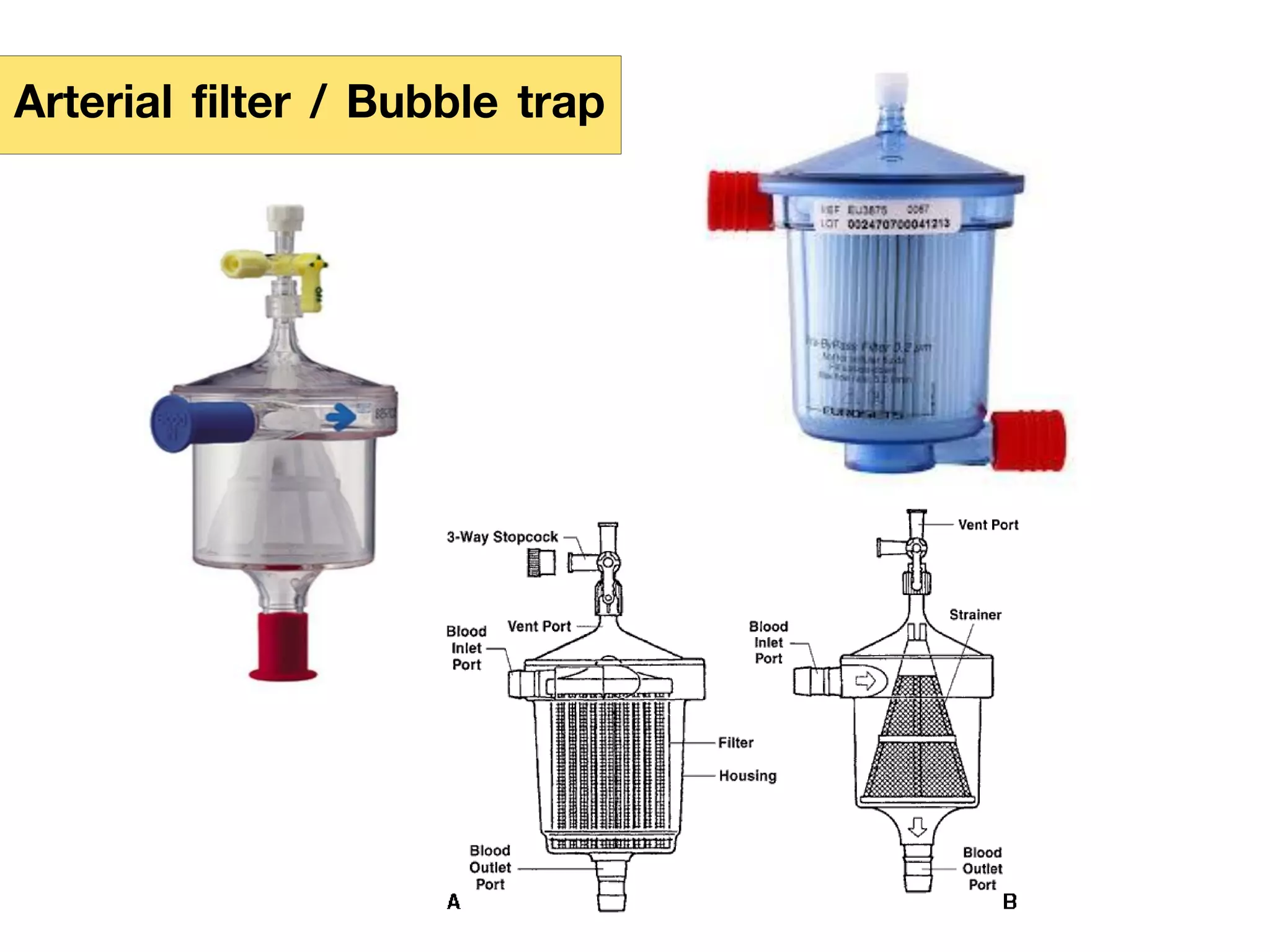
Arterial filter / Bubble trap
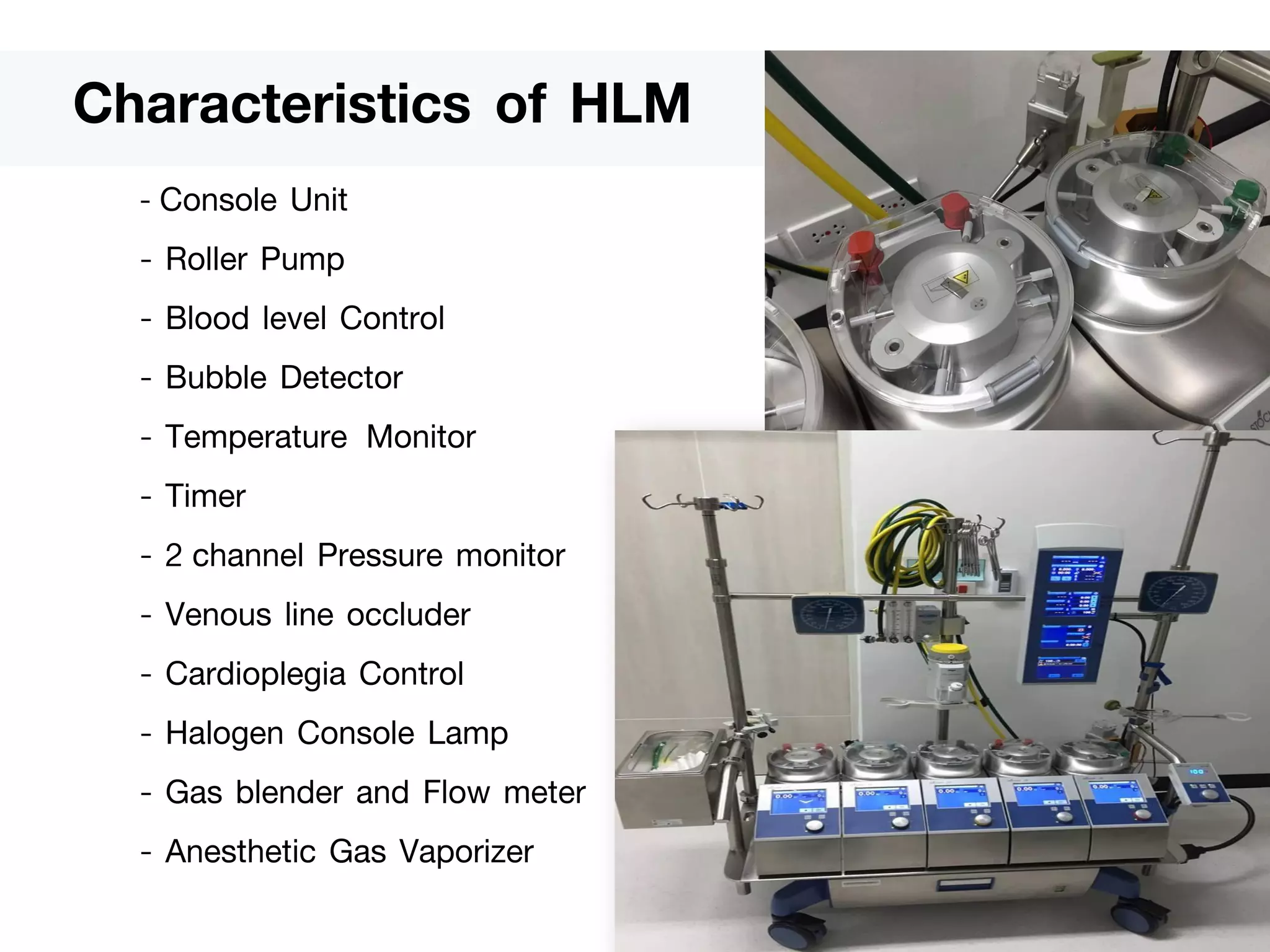
- Console Unit
- Roller Pump
- Blood level Control
- Bubble Detector
- Temperature Monitor
- Timer
- 2 channel Pressure monitor
- Venous line occluder
- Cardioplegia Control
- Halogen Console Lamp
- Gas blender and Flow meter
- Anesthetic Gas Vaporizer
Characteristics of HLM
Blood pump
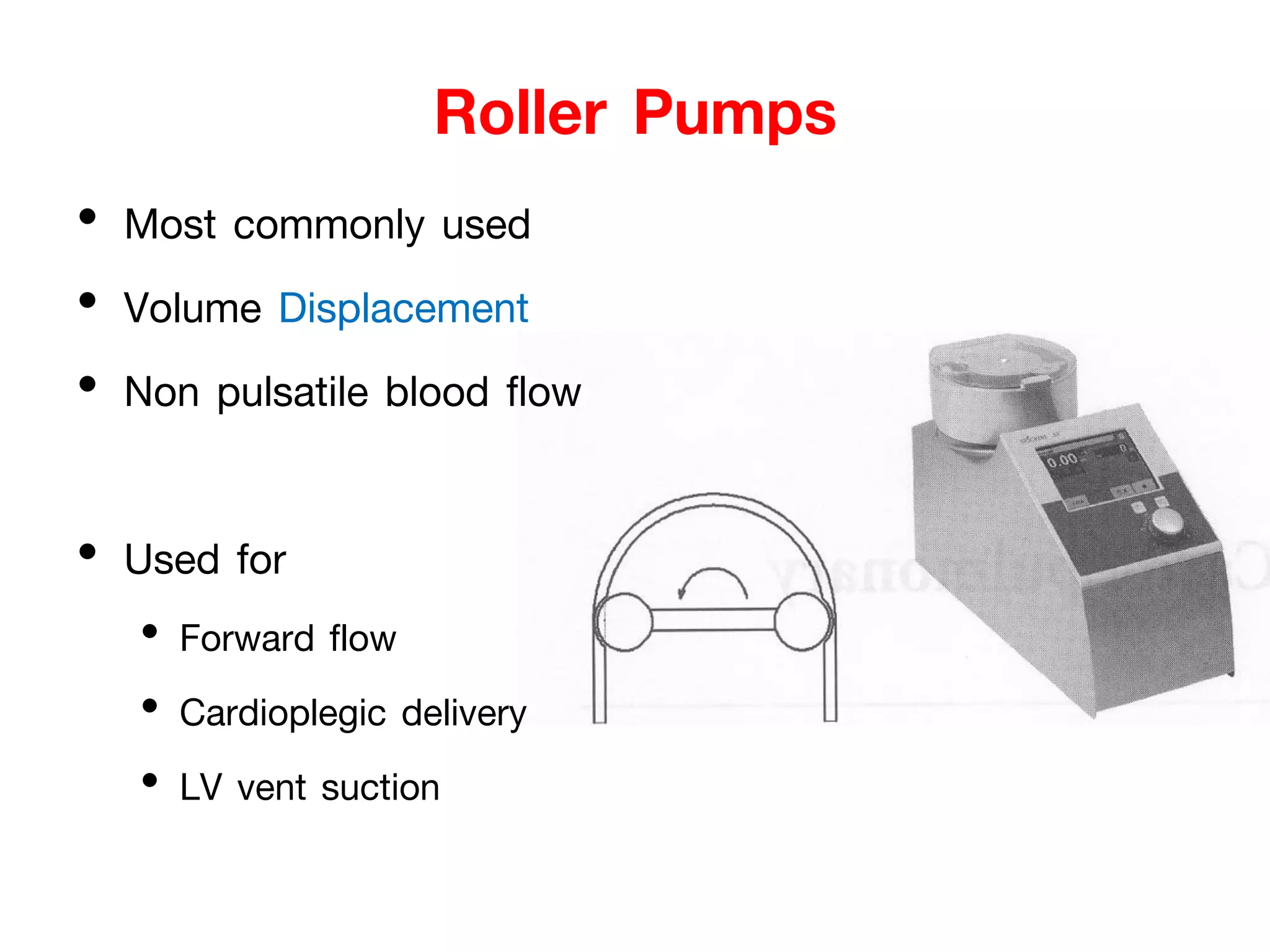
Roller Pumps
• Most commonly used
• Volume Displacement
• Non pulsatile blood flow
• Used for
• Forward flow
• Cardioplegic delivery
• LV vent suction
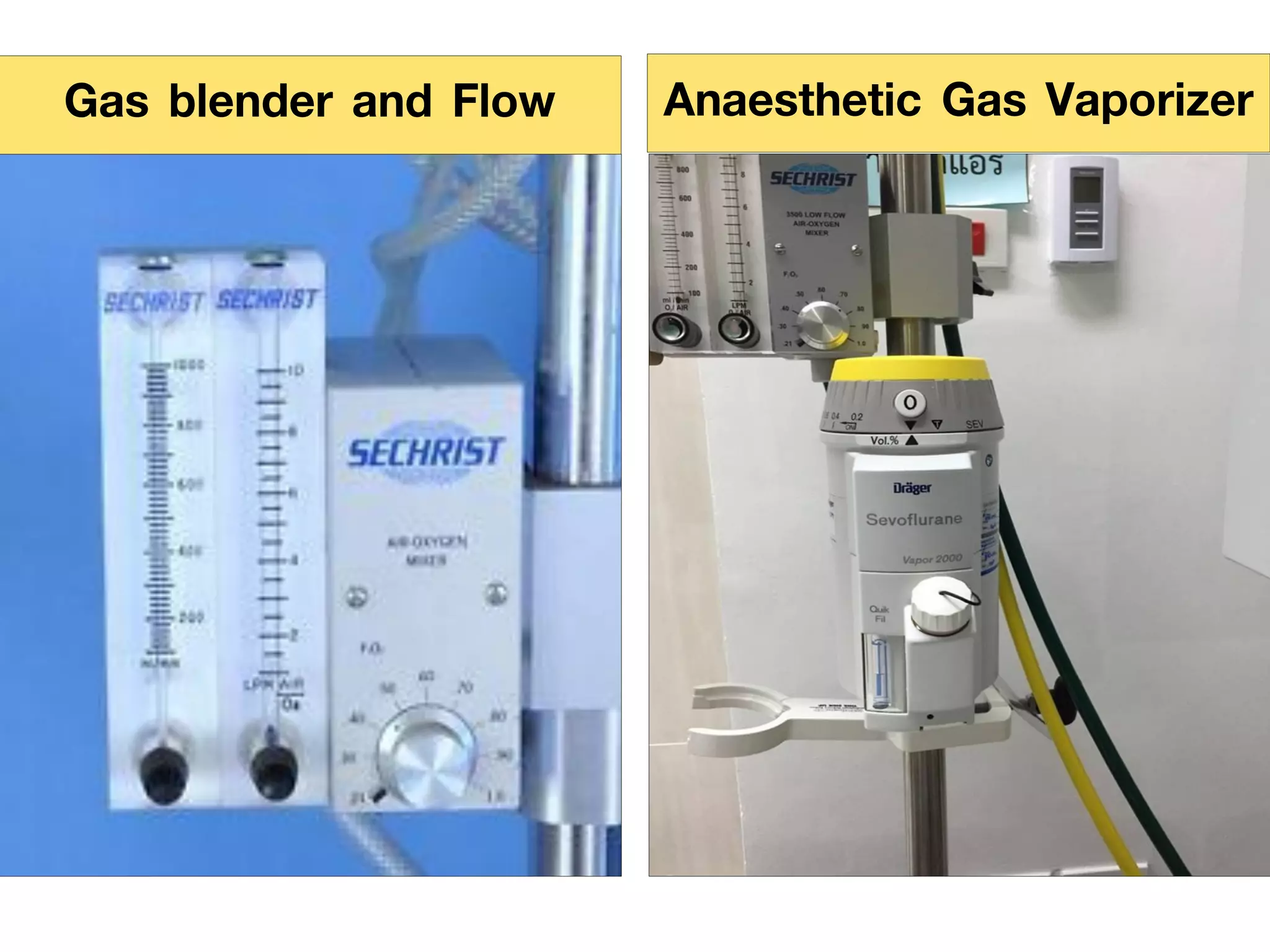
Gas blender and Flow
meter
Anaesthetic Gas Vaporizer
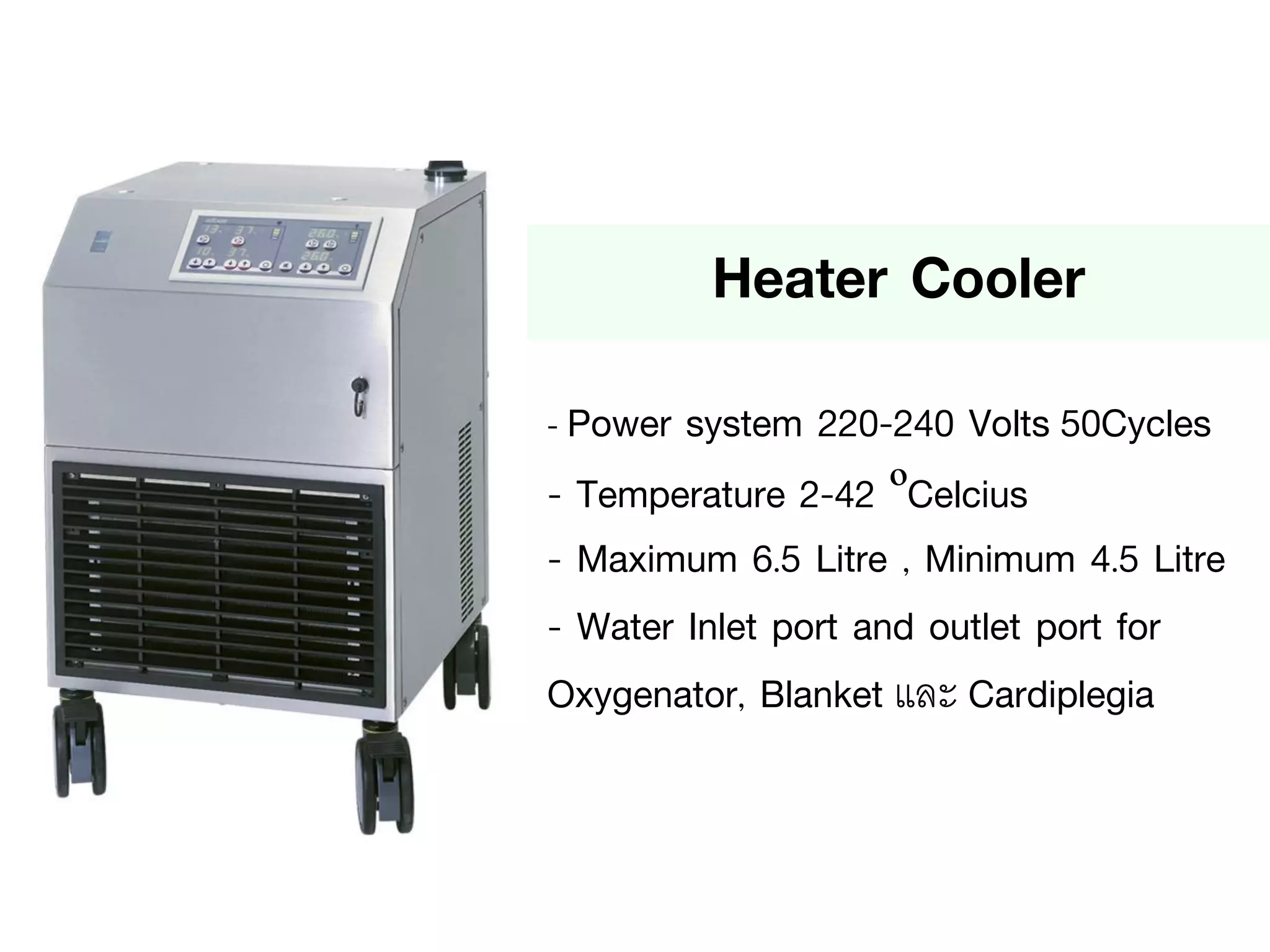
- Power system 220-240 Volts 50Cycles
- Temperature 2-42 ºCelcius
- Maximum 6.5 Litre , Minimum 4.5 Litre
- Water Inlet port and outlet port for
Oxygenator, Blanket และ Cardiplegia
Heater Cooler
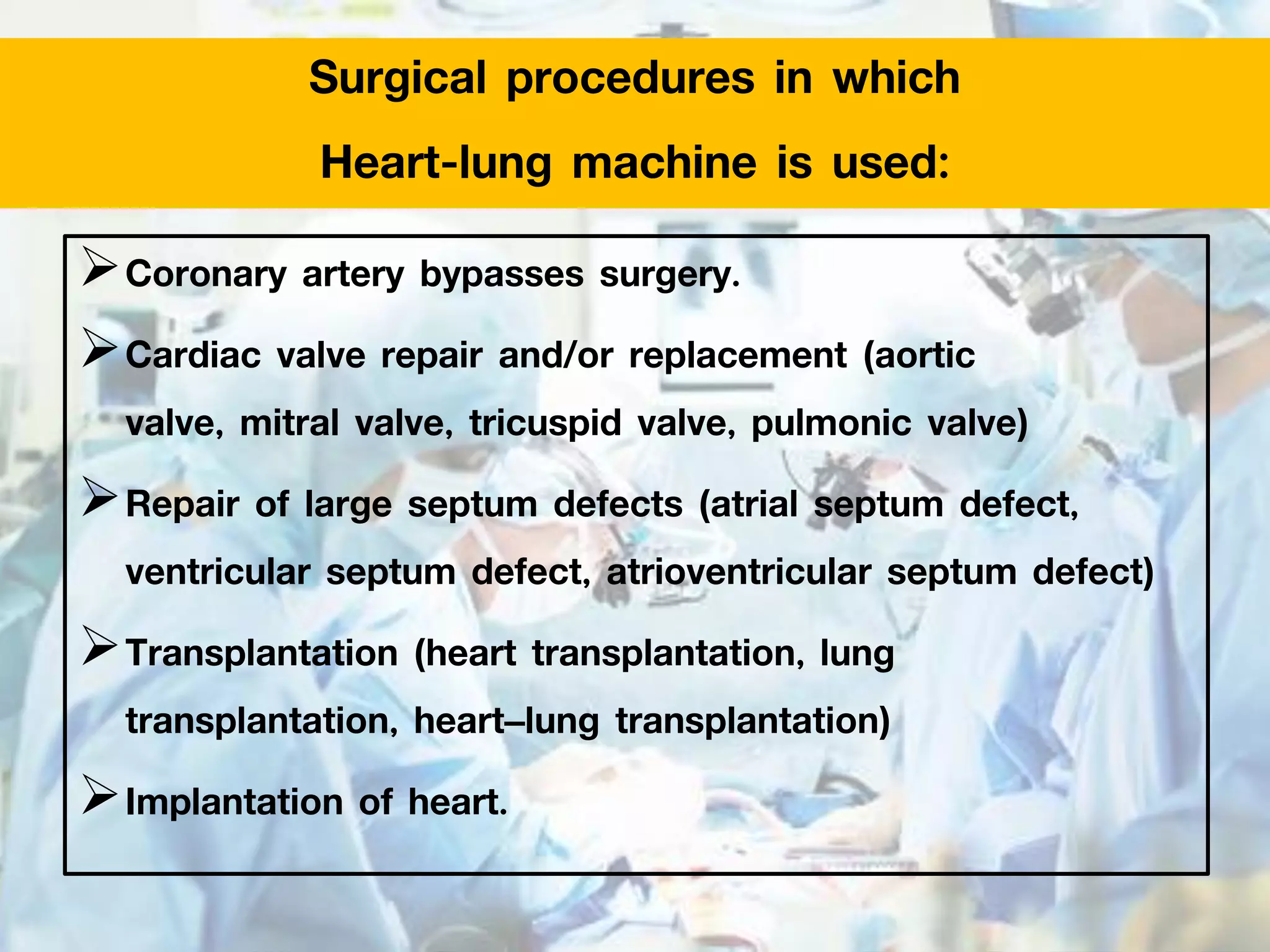
Surgical procedures in which
Heart-lung machine is used:
Coronary artery bypasses surgery.
Cardiac valve repair and/or replacement (aortic
valve, mitral valve, tricuspid valve, pulmonic valve)
Repair of large septum defects (atrial septum defect,
ventricular septum defect, atrioventricular septum defect)
Transplantation (heart transplantation, lung
transplantation, heart–lung transplantation)
Implantation of heart.
Complications
 Haemolysis
 Capillary leak syndrome
 Clotting of blood in the circuit – can block the circuit
or send a clot into the patient.
 Air embolism
 Leakage – lose blood perfusion of tissue if a line
becomes disconnected.
 1.5% of patients that undergo Heart-lung machine are
at risk of developing Acute Respiratory Distress
Syndrome.
THANK YOUFOR YOUR ATTENTION

Basic Heart-Lung Machine in Cardiac Surgery

  • 1.
    HEART-LUNG MACHINEIN CARDIACSURGERY JENPHOP KHUNJORN, PERFUSIONIST
  • 3.
  • 4.
  • 5.
    • Machine forCardiopulmonary bypass or Extracorporeal Circulation system (ECC) - For open cardiac surgery - For supporting cardiac function, pulmonary function, or cardiopulmonary function • In the past >>> One unit • Recently >>> Separate units • Pump system (Heart) • Oxygenator (Lung) HEART-LUNG MACHINE
  • 6.
  • 7.
    The first record: 1896 , a Frankfurt physician sutured a wound in the heart of a young German solder
  • 8.
    Limitation 1. Inabilityto operate on a heart that was still beating. 2. Stop and restart heart less than 3 minutes. Great development : American solder in World War II and first in congenital heart disease in 1945
  • 9.
    Hypothermia - Inflowocclusion Dr. F John Lewis was operated ASD closure using general hypothermia and inflow occlusion (Sep 2, 1952)
  • 10.
    Cross Circulation Technique VSDclosure by azygos flow concept (controlled cross-circulation) (Dr Walton Lillehei Mar 26, 1954)
  • 11.
    Copyright © 2003by Lippincott Williams and Wilkins
  • 12.
    Dr.John Gibbon on May20, 1953 ASD Closure High mortality rate “ The first successful application in humans ” First successful OHS using CPB
  • 13.
  • 14.
  • 15.
    SCIENTIFIC DISCOVERIES AND TECHNIQUEOF TOTAL ECC - Temporary interruption of venous return to heart (inflow occlusion) - Oxygenator and roller pump - Correlation temperature and metabolic rate - Discovery A, B, O blood group - Anticoagulant (Heparin) / Antagonist (Protamine)
  • 16.
    TECHNIQUES FACILITATING PROGRESSOF TOTAL ECC - Cross Circulation - Cardiac Catheterization - Deep hypothermia - Myocardial arrest and myocardial defibrillator - External Pacemaker - Hemodilution
  • 17.
  • 18.
    Definition of CPB ExtracorporealCirculation System ; ECC Cardiopulmonary bypass (CPB)
  • 19.
  • 20.
    Principle of CPB Rightatrium >> Reservoir Right ventricle >> Arterial pump Lung >> Oxygenator Left ventricle >> Arterial pump Cardiopulmonary bypass (CPB)
  • 21.
    Objective of CPB Goals -Motionless and Bloodless - Adequate blood flow - Myocardial Protection during cardiac arrest
  • 22.
    Cardiac surgical techniques 1.Closed heart surgeries ex. PDA ligation, Off pump CABG 2. Open heart surgeries ex. VSD, ASD, CABG, Valve replacement
  • 23.
    CPB Circuit Table Set MachineSet Safe Sample Short
  • 25.
    Components of CPB TubingPacks (Circuit) Arterial, Venous Cannula Suckers and vents Cardioplegia cannula Oxygenator with reservoir Arterial filter / Bubble trab Blood, Suction, Vent, Cardioplegia Pump Heat Exchanger / Heater-Cooler Gas blender (Air-Oxygen mixer) Anesthetic Gas Vaporizer Heart-lung Machine
  • 26.
  • 27.
  • 28.
  • 29.
  • 30.
  • 31.
  • 32.
    Oxygenators  Oxygenators notonly supply vital oxygen for the blood, but also transport carbon dioxide, anaesthetics and other gases into and out of the circulation.  There are three types of oxygenator 1. Membrane oxygenators 2. Bubble oxygenator 3. Film oxygenator
  • 33.
    Membrane oxygenators Membrane oxygenatorsimitate the natural lung by a thin membrane of either micro porous polypropylene or silicone rubber between the gas and blood phases. Diagram of a hollow fiber membrane oxygenator and heat exchanger unit. Oxygen enters one end of the bundles of hollow fibers and exits at the opposite end. The hollow fiber bundles are potted at each end to separate the blood and gas compartments. Oxygen and carbon dioxide diffuse in opposite directions across the aggregate large surface of the hollow fibers.
  • 34.
    Heat Exchanger Control bodytemperature by heating or cooling blood passing through the perfusion circuit. In heat exchanger, blood flows through spiralling coils made of stainless steel. The inner walls of the coils are coated with polymers to limit blood-surface interactions. The circulating water is chilled to nearly 0 0C in an ice bath and heated by an electric resistance coil to an absolute maximum of 42 0C.
  • 35.
    Arterial filter /Bubble trap
  • 36.
    - Console Unit -Roller Pump - Blood level Control - Bubble Detector - Temperature Monitor - Timer - 2 channel Pressure monitor - Venous line occluder - Cardioplegia Control - Halogen Console Lamp - Gas blender and Flow meter - Anesthetic Gas Vaporizer Characteristics of HLM
  • 37.
  • 38.
    Roller Pumps • Mostcommonly used • Volume Displacement • Non pulsatile blood flow • Used for • Forward flow • Cardioplegic delivery • LV vent suction
  • 39.
    Gas blender andFlow meter Anaesthetic Gas Vaporizer
  • 40.
    - Power system220-240 Volts 50Cycles - Temperature 2-42 ºCelcius - Maximum 6.5 Litre , Minimum 4.5 Litre - Water Inlet port and outlet port for Oxygenator, Blanket และ Cardiplegia Heater Cooler
  • 41.
    Surgical procedures inwhich Heart-lung machine is used: Coronary artery bypasses surgery. Cardiac valve repair and/or replacement (aortic valve, mitral valve, tricuspid valve, pulmonic valve) Repair of large septum defects (atrial septum defect, ventricular septum defect, atrioventricular septum defect) Transplantation (heart transplantation, lung transplantation, heart–lung transplantation) Implantation of heart.
  • 42.
    Complications  Haemolysis  Capillaryleak syndrome  Clotting of blood in the circuit – can block the circuit or send a clot into the patient.  Air embolism  Leakage – lose blood perfusion of tissue if a line becomes disconnected.  1.5% of patients that undergo Heart-lung machine are at risk of developing Acute Respiratory Distress Syndrome.
  • 43.