CONTENTS
INTRODUCTION
CENTRES OF PRODUCTION
THREADS USED
DYES USED
COLOUR USED
MOTIFS USED
DESIGNS OF BROCADES
TYPES OF BROCADES
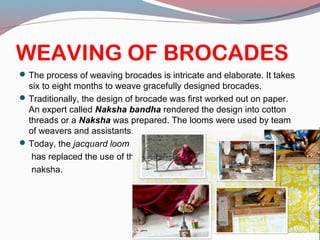
WEAVING OF BROCADES
REFERENCES
INTRODUCTION
India’s “Fabric of Dreams” is of course the
Banarasi brocade known as Kinkhab. Banaras
(Varanasi) is commonly known as Shivanagri
situated in U.P. Banaras is world famous centre
of handmade textiles.
With its interweaving of coloured silk and gold
threads, to form the most attractive floral
designs, the brocades are without doubt India’s
most gorgeous, most fascinating, of silken
fabrics.
The Indian kinkhab is literally a ‘cloth of gold’. In days
gone by, gold and silver wires of such extreme fineness
were drawn that the whole fabrics could be woven from
them, without any other kind of thread, literally glittering
with the metallic sheen.
The use of silk, or a mixture of cotton and silk, in the
weaving of the brocade seems to have been a fairly
recent innovation.
Delicate designs are created by the use of warp and
weft threads of different colours.
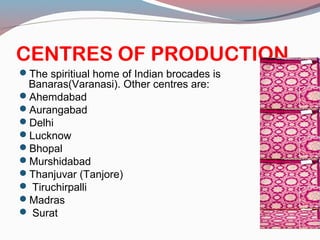
CENTRES OF PRODUCTION
The spiritiual home of Indian brocades is
Banaras(Varanasi). Other centres are:
Ahemdabad
Aurangabad
Delhi
Lucknow
Bhopal
Murshidabad
Thanjuvar (Tanjore)
 Tiruchirpalli
Madras
 Surat
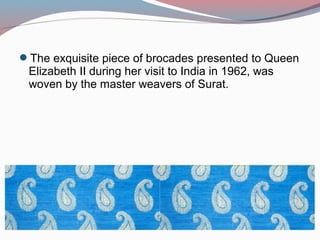
The exquisite piece of brocades presented to Queen
Elizabeth II during her visit to India in 1962, was
woven by the master weavers of Surat.
THREADS USED
Both silk and metallic threads are used in weaving of
brocades. The metallic threads are used to decorate and
silk yarns are used to provide body and colours to the
fabric.
The metallic threads used in brocades originally, known
as KALABATTU, was of pure gold and silver wire. But
nowadays artificial metallic thread “zari” is used.
There are two types of Kalabattu:
1.Sonari (sona): the base of thread is silver and at the end
gold was glided on it.
2.Ruperi (rupa) : it is made up of silver wire twisted around
the silk thread.
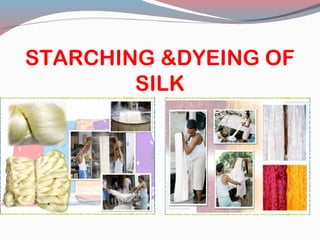
STARCHING &DYEING OF
SILK
DYES USED
In olden days dyes from vegetable origin were used
by Direct Dyeing Method, which produced fast
colours that lasted after years of wear. Also raw silk
was better adopted to natural dyes.
But with the introduction of chemical dyes, dyeing of
wide variety and unlimited shades of silk has
become possible.
COLOURS USED
Traditional Banaras saris usually have subtle colours
which may be quite pale. The colours used are :
English names Vernacular names
Red surkh
Blue asmani
Orange narangi
Green kahi
Mustard kafoori
Yellow zard
White safed
The colours used did not have any significance. But with
the introduction of synthetic dyes the colours and shades have
increased widely.
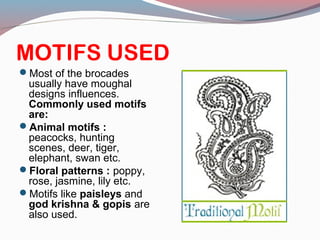
MOTIFS USED
Most of the brocades
usually have moughal
designs influences.
Commonly used motifs
are:
Animal motifs :
peacocks, hunting
scenes, deer, tiger,
elephant, swan etc.
Floral patterns : poppy,
rose, jasmine, lily etc.
Motifs like paisleys and
god krishna & gopis are
also used.
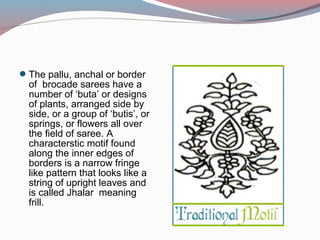
The pallu, anchal or border
of brocade sarees have a
number of ‘buta’ or designs
of plants, arranged side by
side, or a group of ‘butis’, or
springs, or flowers all over
the field of saree. A
characterstic motif found
along the inner edges of
borders is a narrow fringe
like pattern that looks like a
string of upright leaves and
is called Jhalar meaning
frill.
DESIGNS OF BROCADES
Shikarghar is one of the most popular designs of Indian
kinkhabs and has hunting scenes as the dominant motif.
Other designs are :
Buti : single flower or spray
Buta : large butis like pan(beetle), tara (star), asharfi
(coin), and kari (mango).
Phulwar : a floral pattern running all over the field.
Jali : scrolls or lines forming a network of sprays of
flowers.
Chand Tara: moon and stars
Dhup chaon: sunshine and shade.
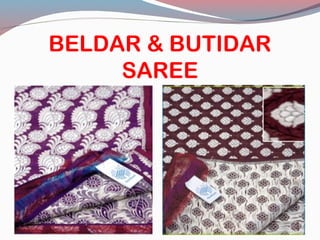
BELDAR & BUTIDAR
SAREE
Mor gala: peacocks neck.
Bulbul chasm: nightingale eyes
Doriya : longitudnal warp wise strips.
Salaidar : weft wise stripes.
Charkhana : stripes running both longitudinal &
across
Are-doriya : diagonal stripes
Bel : floral running scroll border.
Minatashi : the field is of gold or silver and the floral
design in coloured silks.
TYPES OF BROCADES
Generally speaking the kinkhabs can be of four
types:
1.OPAQUE ZARI BROCADE : there are many
variations of this brocades :
a) the pure ‘cloth of gold’ or ‘cloth of silver’.
b) brocades in which the gold and silver thread plays
the most important part, with coloured silks
interwoven here and there to emphasise the design.
These are the true kinkhabs of India perhaps too
heavy for making personal garments.
c) Baftas: also called Pot thans that are mostly of
closely woven coloured silks, with only selected
parts of the design in gold or silver threads.
2. Ab-e-rawan: these are lightese of brocades and are
transparent, made up of silk muslin or organza with
very little metallic threads.
3. Tissue brocades: It has very fine silk warp but the
weft thread of the ground is of zari, giving a cloth a
metallic sheen.
4. Amrus and Himrus
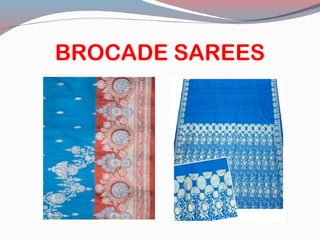
BROCADE SAREES
HIMRUSAn inferior type of brocades is the himru, a speciality of
Hyderabad and Aurangabad in which both silk and cotton
yarns are used to produce variety of designs and is
woven on the principle of extra weft figuring.
It is in popular demand because of its low price as
compared to pure silk brocades. Also it is soft to feel,and
is suitable as a fabric for personal wear than the true
brocades.
In the past, two varieties of himrus were best known,
Gulbadan and Shah Muhammad.
Today, the himrus are chiefly used for blouses and
cholies dress material for the Western fashion world, and
as furnishing fabrics for the home.
AMRUS
Amrus are the brocades in which the patterns are
created by supplementary weft in silk and not in zari.
 One distinctive type of Amru brocade is the Tanchoi. It is
believed that in last half of the 19th
century, 3 parsi
brothers called chhois learned the technique of weaving
these brocades in China and introduced it to indian
weavers in Surat. This art was then taken over by
varanasi weavers who started making less expensive
versions.
Tanchoi is a figured silk having complex weave as it has
one or two warp and two to five weft colours often is
same shed. It is densely patterned, heavy fabric.
WEAVING OF BROCADES
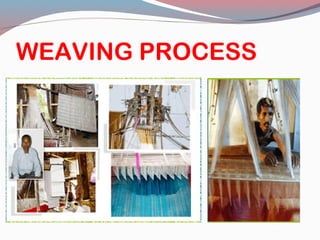
The process of weaving brocades is intricate and elaborate. It takes
six to eight months to weave gracefully designed brocades.
Traditionally, the design of brocade was first worked out on paper.
An expert called Naksha bandha rendered the design into cotton
threads or a Naksha was prepared. The looms were used by team
of weavers and assistants.
Today, the jacquard loom
has replaced the use of the
naksha.
WEAVING PROCESS
REFERENCES:
 Masterpieces of Indian Textiles – Rustam. G. Mehta
 Handicrafts of India – Kamladevi Chatopadhya
 The Sari – Linda Lynton/ Sanjay. K. Singh
Banaras Brocades- A Historical Perspective, An
Unpublished Dissertation – Geeta Mishra (1990)
 www.google.com/Brocades of Banaras.
Broadcloth - A plain weave tightly woven fabric that is usually made 
from 100%cotton or a cotton blend. Brocade - A heavy jacquard type 
fabric with an all over raised pattern or floral design. Brocatelle - A 
heavy fabric similar in appearance to a damask. The 
filler yarns (often linen) give it an embossed look

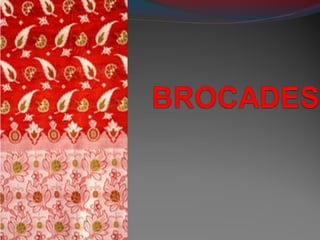
Brocades

  • 2.
    CONTENTS INTRODUCTION CENTRES OF PRODUCTION THREADSUSED DYES USED COLOUR USED MOTIFS USED DESIGNS OF BROCADES TYPES OF BROCADES WEAVING OF BROCADES REFERENCES
  • 3.
    INTRODUCTION India’s “Fabric ofDreams” is of course the Banarasi brocade known as Kinkhab. Banaras (Varanasi) is commonly known as Shivanagri situated in U.P. Banaras is world famous centre of handmade textiles. With its interweaving of coloured silk and gold threads, to form the most attractive floral designs, the brocades are without doubt India’s most gorgeous, most fascinating, of silken fabrics.
  • 4.
    The Indian kinkhabis literally a ‘cloth of gold’. In days gone by, gold and silver wires of such extreme fineness were drawn that the whole fabrics could be woven from them, without any other kind of thread, literally glittering with the metallic sheen. The use of silk, or a mixture of cotton and silk, in the weaving of the brocade seems to have been a fairly recent innovation. Delicate designs are created by the use of warp and weft threads of different colours.
  • 5.
    CENTRES OF PRODUCTION Thespiritiual home of Indian brocades is Banaras(Varanasi). Other centres are: Ahemdabad Aurangabad Delhi Lucknow Bhopal Murshidabad Thanjuvar (Tanjore)  Tiruchirpalli Madras  Surat
  • 6.
    The exquisite pieceof brocades presented to Queen Elizabeth II during her visit to India in 1962, was woven by the master weavers of Surat.
  • 7.
    THREADS USED Both silkand metallic threads are used in weaving of brocades. The metallic threads are used to decorate and silk yarns are used to provide body and colours to the fabric. The metallic threads used in brocades originally, known as KALABATTU, was of pure gold and silver wire. But nowadays artificial metallic thread “zari” is used. There are two types of Kalabattu: 1.Sonari (sona): the base of thread is silver and at the end gold was glided on it. 2.Ruperi (rupa) : it is made up of silver wire twisted around the silk thread.
  • 8.
  • 9.
    DYES USED In oldendays dyes from vegetable origin were used by Direct Dyeing Method, which produced fast colours that lasted after years of wear. Also raw silk was better adopted to natural dyes. But with the introduction of chemical dyes, dyeing of wide variety and unlimited shades of silk has become possible.
  • 10.
    COLOURS USED Traditional Banarassaris usually have subtle colours which may be quite pale. The colours used are : English names Vernacular names Red surkh Blue asmani Orange narangi Green kahi Mustard kafoori Yellow zard White safed The colours used did not have any significance. But with the introduction of synthetic dyes the colours and shades have increased widely.
  • 11.
    MOTIFS USED Most ofthe brocades usually have moughal designs influences. Commonly used motifs are: Animal motifs : peacocks, hunting scenes, deer, tiger, elephant, swan etc. Floral patterns : poppy, rose, jasmine, lily etc. Motifs like paisleys and god krishna & gopis are also used.
  • 12.
    The pallu, anchalor border of brocade sarees have a number of ‘buta’ or designs of plants, arranged side by side, or a group of ‘butis’, or springs, or flowers all over the field of saree. A characterstic motif found along the inner edges of borders is a narrow fringe like pattern that looks like a string of upright leaves and is called Jhalar meaning frill.
  • 13.
    DESIGNS OF BROCADES Shikargharis one of the most popular designs of Indian kinkhabs and has hunting scenes as the dominant motif. Other designs are : Buti : single flower or spray Buta : large butis like pan(beetle), tara (star), asharfi (coin), and kari (mango). Phulwar : a floral pattern running all over the field. Jali : scrolls or lines forming a network of sprays of flowers. Chand Tara: moon and stars Dhup chaon: sunshine and shade.
  • 14.
  • 15.
    Mor gala: peacocksneck. Bulbul chasm: nightingale eyes Doriya : longitudnal warp wise strips. Salaidar : weft wise stripes. Charkhana : stripes running both longitudinal & across Are-doriya : diagonal stripes Bel : floral running scroll border. Minatashi : the field is of gold or silver and the floral design in coloured silks.
  • 16.
    TYPES OF BROCADES Generallyspeaking the kinkhabs can be of four types: 1.OPAQUE ZARI BROCADE : there are many variations of this brocades : a) the pure ‘cloth of gold’ or ‘cloth of silver’. b) brocades in which the gold and silver thread plays the most important part, with coloured silks interwoven here and there to emphasise the design. These are the true kinkhabs of India perhaps too heavy for making personal garments.
  • 17.
    c) Baftas: alsocalled Pot thans that are mostly of closely woven coloured silks, with only selected parts of the design in gold or silver threads. 2. Ab-e-rawan: these are lightese of brocades and are transparent, made up of silk muslin or organza with very little metallic threads. 3. Tissue brocades: It has very fine silk warp but the weft thread of the ground is of zari, giving a cloth a metallic sheen. 4. Amrus and Himrus
  • 18.
  • 19.
    HIMRUSAn inferior typeof brocades is the himru, a speciality of Hyderabad and Aurangabad in which both silk and cotton yarns are used to produce variety of designs and is woven on the principle of extra weft figuring. It is in popular demand because of its low price as compared to pure silk brocades. Also it is soft to feel,and is suitable as a fabric for personal wear than the true brocades. In the past, two varieties of himrus were best known, Gulbadan and Shah Muhammad. Today, the himrus are chiefly used for blouses and cholies dress material for the Western fashion world, and as furnishing fabrics for the home.
  • 20.
    AMRUS Amrus are thebrocades in which the patterns are created by supplementary weft in silk and not in zari.  One distinctive type of Amru brocade is the Tanchoi. It is believed that in last half of the 19th century, 3 parsi brothers called chhois learned the technique of weaving these brocades in China and introduced it to indian weavers in Surat. This art was then taken over by varanasi weavers who started making less expensive versions. Tanchoi is a figured silk having complex weave as it has one or two warp and two to five weft colours often is same shed. It is densely patterned, heavy fabric.
  • 21.
    WEAVING OF BROCADES Theprocess of weaving brocades is intricate and elaborate. It takes six to eight months to weave gracefully designed brocades. Traditionally, the design of brocade was first worked out on paper. An expert called Naksha bandha rendered the design into cotton threads or a Naksha was prepared. The looms were used by team of weavers and assistants. Today, the jacquard loom has replaced the use of the naksha.
  • 22.
  • 23.
    REFERENCES:  Masterpieces ofIndian Textiles – Rustam. G. Mehta  Handicrafts of India – Kamladevi Chatopadhya  The Sari – Linda Lynton/ Sanjay. K. Singh Banaras Brocades- A Historical Perspective, An Unpublished Dissertation – Geeta Mishra (1990)  www.google.com/Brocades of Banaras.
  • 25.