SINGLE COMPLETE DENTURE : A
REVIEW
DR. SATVIKA PRASAD
MDS
DEPT. OF PROSTHODONTICS
MMCDSR
• Introduction
• Definition
• Indication
• Classification
• Maxillary single denture
• Mandibular single denture
• Combination syndrome
• Review
• Conclusion
CONTENTS
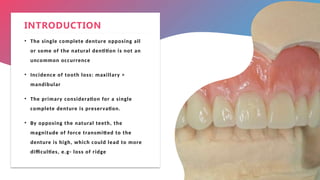
• The single complete denture opposing all
or some of the natural dentition is not an
uncommon occurrence
• Incidence of tooth loss: maxillary >
mandibular
• The primary consideration for a single
complete denture is preservation.
• By opposing the natural teeth, the
magnitude of force transmitted to the
denture is high, which could lead to more
difficulties, e.g- loss of ridge
INTRODUCTION
A single complete denture is a
complete denture that occludes
against some or all natural teeth, a
fixed restoration, or a previously
constructed removable partial denture
or a complete denture
DEFINITION
.
INDICATION
Opposing natural teeth
that are sufficient in
number and do not
necessitate a fixed or
removable partial denture
A partially edentulous
arch in which the missing
teeth have been or will be
replaced by the fixed /
removable partial denture
An existing complete
denture
Single complete denture may be desirable when it is to oppose -
DISADVANTAGES
• Heavy occlusal forces, due to opposing natural teeth. {3 times than that of conventional CD;
i.e 22lb}
• The high occlusal forces from the opposing natural teeth, which results in advanced bone loss
of ridges.
• Supra- eruption of the opposing natural teeth produces an inharmonious occlusal plane.
• Mesial drifting of the opposing natural teeth produce inharmonious occlusal plane.
• Midline fracture of the denture due to heavy forces.
• JR extremes which make it difficult to arrange artificial teeth for the denture along the line of
support.
• Excessively displaceable denture- bearing tissue (flabby ridges)
Carl F. Driscoll proposed a classification system that simplify
the identification & treatment of patients
Patient for whom minor or no tooth reduction is needed to obtain balance.
Patient for whom minor additions to the height of the teeth are needed to obtain balance.
Patient for whom both reduction and additions to the teeth are required to obtain
balance. t/t of these patient involves change in the VDO
Patient who presents with occlusal discrepancies that require addition to the width of the
occluding surface
Patient who presents with combination syndrome
Class
I
Class II
Class III
Class IV
Class
V
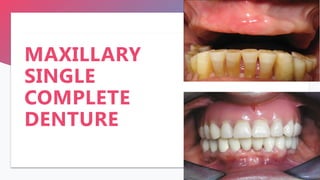
MAXILLARY
SINGLE
COMPLETE
DENTURE
Diagnosis & treatment planning
• Edentulous arch – evaluated similar to any complete edentulous situation
• Dentulous arch – teeth are evaluated for following
1. Number of teeth present
2. Position and condition of teeth to assess, endodontic, restorative and
periodontal condition
METHODS OF MOUTH PREPARATION
• Swenson’s technique
• Yurkstas technique
• Bruce technique
• Boucher’s technique
• Han Kuang Tan’s technique
SWENSON’S TECHNIQUE
• Upper and lower casts are mounted on the articulator.
• The upper denture is constructed. If the lower natural teeth interfere with the placement of
the denture teeth, they are adjusted on the cast and the area is marked with a pencil.
• The natural teeth are then modified using the marked diagnostic cast as a guide.
• This technique is simple but time consuming.
YURKASTA’S TECHNIQUE
• Use of a commercially available U shaped metal occlusal template that is slightly convex on the
lower surface, is placed on the occlusal surfaces of the remaining natural teeth and cusps to be
adjusted are identified
• Stone cast is modification to a more acceptable occlusal relationship and the modifications are
marked with a pencil and necessary alterations are done on natural teeth
• This template is often an aid in detecting minor deviations in the occlusal scheme
BRUCE’S TECHNIQUE
• Maxillary and mandibular casts are mounted at an acceptable VD with a CR
record.
• Necessary modifications are made on the stone cast.
• Acrylic resin template fabricated on the altered stone cast
• The natural teeth are modified accordingly till the template seats properly
BOUCHER’S TECHNIQUE
• Artificial teeth are arranged on the maxillary edentulous cast in CO establishing
occlusal plane, after maxillary and mandibular casts are mounted at an
acceptable VD with a CR record
• The porcelain teeth are moved over the mandibular teeth in stone and occlusal
interferences are ground by the porcelain teeth
• The ground areas are marked on the cast, and the natural teeth altered using this
as a guide
HAN KUANG TAN TECHNIQUE
• Make a vacuum formed clear template over the cast which is 2mm thick
• Mount the mandibular cast and arrange the maxillary teeth
• Grind both the denture teeth and natural stone teeth on the mandibular cast to
achieve best articulation possible.
• Voids are seen on the prepared areas of the template
• The template is cut over the prepared areas which will create openings in the
prepared areas, when it is seated in the patient’s mouth
• The natural teeth are grind using it as a template
IMPRESSIONS AND JAW RELATIONS
• For edentulous arch, the condition of the residual ridge and
philosophies of complete denture impression make dictate the
method to be used.
• For dentulous arch, irreversible hydrocolloid material is used,
following occlusal plane correction if needed.
• Jaw relations are recorded using the techniques, which is for
complete
TEETH SELECTION
• Various materials of tooth forms are available to oppose natural
teeth :-
1. PORCELAIN
2. ACRYLIC RESIN
3. GOLD OCCLUSALS
4. ACRYLIC RESIN WITH AMALGAM STOPS
5. INTERPENETRATING RESIN (IPN)
PORCELAIN
ADVANTAGES
• Wears very slowly
• Hence, maintains vertical
dimension
DISADVANTAGES
• Fracture, wearing and chipping
of natural teeth
• Difficult to equilibrate, since
their surfaces do not mark well
with the articulating paper
• Cannot be used when
interocclusal distance is less
• Contraindicated with acrylic
resin posteriors and bruxism
ACRYLIC RESIN
ADVANTAGES
• Does not wear
opposing natural
teeth
• Easy to equilibrate
DISADVANTAGES
• Loss of vertical
dimension
• Poor wear
resistance
GOLD OCCLUSALS
ADVANTAGES
• Best to oppose natural
teeth
DISADVANTAGES
• More time consuming
• Expensive
• Denture with acrylic resin teeth are worn out by patients
for few weeks.
• Occlusal index of the denture is made.
• Occlusal surface of posterior teeth reduced by 1 mm.
• Wax pattern is prepared and verified with the help of
occlusal index and casting is done.
ACRYLIC RESIN WITH AMALGAM STOPS
ADVANTAGES
• Better wear resistance than acrylic
• Simple
• Less time consuming
• Less expensive
• Recommended by WINKLER
• After the acrylic teeth have been balanced, occlusal preparations are
made in the acrylic teeth, extending to include as much of the
articulating paper tracing as possible.
• Amalgam is condensed into the preparations and eccentric
movements are made.
• Thus , centric holding area and some of the excrusions are recorded
in amalgam by the articulator
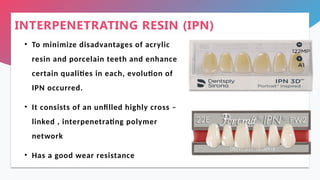
INTERPENETRATING RESIN (IPN)
• To minimize disadvantages of acrylic
resin and porcelain teeth and enhance
certain qualities in each, evolution of
IPN occurred.
• It consists of an unfilled highly cross –
linked , interpenetrating polymer
network
• Has a good wear resistance
Balanced setting
• The following methods are used to achieve eccentric balance
ARTICULATOR EQUILIBRATION METHOD
• Most commonly used as it is similar to obtaining balance with conventional complete dentures.
• Used when denture bases are not stable and neuro-muscular control of the patient is poor.
• After mounting the casts, teeth are arranged in centric occlusion. It has to be decided if the
lower buccal or lingual cusp is the centric holding cusp depending on the relationship of the
upper arch
• During try-in, eccentric records are obtained to adjust the condylar settings on the articulator
and teeth arranged in eccentric balance. The cusps are modified depending on the centric
holding cusp
FUNCTIONAL CHEW IN TECHNIQUE
• Most accurate method of recording occlusal patterns
• Record bases should have good stability
• Patient should have good neuromuscular control.
• Following techniques are suggested-
1. Stansbury’s technique
2. Vig’s technique
3. Sharry technique
4. Rudd’s technique
Stansbury’s technique
• This was the first functional chew-in technique Compound maxillary occlusal rim is trimmed buccally
and lingually so that occlusion is free in lateral excursions.
• Carding wax is added buccally and lingually and the patient is instructed to perform eccentric
chewing movements.
• Carding wax gets functionally moulded, whereas the compound rim in the central fossa maintains the
vertical dimension.
Vig’s technique
• It is similar to Stansbury's technique, except that a fin of
acrylic resin is maintained at the vertical dimension instead of
the compound rim
• Uses softened wax rim in increased vertical dimension.
• Eccentric chewing movements are made such that wax is
abraded generating the final paths of the lower cusps.
• It is continued until the correct vertical dimensions are
achieved
Sharry technique
Carding
wax
Rudd’s technique
• This technique is similar to Stansbury's technique
• Uses a combination of baseplate wax and red counter wax instead of carding wax to
make eccentric registration.
• But suggests using two maxillary bases, one for to recording the generated path and the
other for setting the teeth. It decreases the number of appointments.
MANDIBULAR SINGLE DENTURE
Causes
1. Irradiation therapy
2. Trauma
• Greater challenge than maxillary single denture due to the following
1. Difficult to stabilize lower denture
2. Mandible is the movable member
3. Proximity to tongue
4. More resorption than maxilla
5. Limited availability of good quality mucosa
• Osseointegrated implants supported prosthesis is best in this situation.
• If patient cannot afford, conventional single denture is made, where the procedure is
similar to that described for maxilla.
• Patient should be educated about the potential problems.
• Some clinicians recommend use of resilient liners in this situation to prevent soreness.
Complications of single complete denture:
1. Combination syndrome
2. Wear of natural teeth
3. Fracture of denture
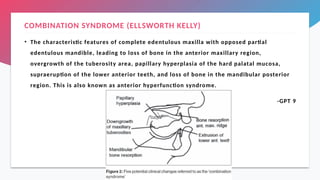
COMBINATION SYNDROME (ELLSWORTH KELLY)
• The characteristic features of complete edentulous maxilla with opposed partial
edentulous mandible, leading to loss of bone in the anterior maxillary region,
overgrowth of the tuberosity area, papillary hyperplasia of the hard palatal mucosa,
supraeruption of the lower anterior teeth, and loss of bone in the mandibular posterior
region. This is also known as anterior hyperfunction syndrome.
-GPT 9
Bone loss under the distal extension
removable prosthesis
Decreased occlusal load posteriorly
and increased occlusal load anteriorly
and resorption of bone in anterior
maxilla
Fulcrum of rotation in the cuspid-
bicuspid region
Change in occlusal plane-negative
pressure in the PPS, so there
will be fibrous growth of tuberosity
and papillary hyperplasia of the
palate
Loss of stability
Resorption in the anterior maxilla
causes labial flange to irritate the
labial mucosa - produces epulis
fissuratum
Lower anterior supraerupts and poor
oral hygiene contributes to
periodontal problem
SEQUENCE OF
COMBINATION
SYNDROME
TREATMENT PLANNING
Systemic factors
• Systemic factors like diabetes and osteoporosis increase the rate of resorption of the bone
Dental factors
• In case of class 3 relationship, there will be increased pressure in the anterior maxilla
• When lower anterior are retained for a long time, the patient is accustomed to biting in the anterior
region
• Presence of Para functional habits increases bone resorption
• Type of occlusal scheme also has direct effect on the development of the syndrome
Systemic and dental considerations
PREVENTION
RATIONALE
• Prevention of rapid resorption of bone under the removable prosthesis
• Prevention of excessive load in the anterior region
• Providing stable occlusion
• Allowing anterior teeth only for phonetics and aesthetics
• Education of the patient
• Retain weaker posterior teeth by using combined endodontic and periodontic
techniques
• Endosseous endodontic implants are used in the posterior mandibular region
• An overlay denture on the lower may avoid the combination syndrome
Management
• Kelly advocated surgical excision of the maxillary tuberosity fibrous growth to
establish proper occlusion
• Frequent recalls visits with frequent relining to compensate for the resorption
especially in the lower distal extension prosthesis.
• Educating the patient about the possible outcome of the treatment and better
understanding of the syndrome
• Schumitt advocated construction of lower removable partial denture first and then
to construct the upper complete denture
CASE
REPORTS
Management of Syndrome Case with Metal Reinforced
Maxillary Complete Denture and Mandibular Teeth
supported Overdenture
• Buzayan MM, Sivakumar I, Choudhary S, Tawfiq O, Mahdey HM, Mahmood WA. iMedPub Journals.
• A 73 years old woman reported to the Department of prosthodontics, requested for new upper and lower
prostheses. She had a history of very loose upper and lower dentures
• Intraoral examination showed that she was completely edentulous on the upper arch, with moderate bone
resorptio The maxillary tuberosities were both enlarged, and she was partially dentate on the lower arch
n ͘
with spacing and over erupted remaining anterior teeth
• The treatment plan was decided to fabricate a metal
reinforced maxillary complete denture and metal
reinforced mandibular overdenture utilizing 32, 31, 41,
and 42 as long coping (thimble) abutments
• Primary impressions of the maxillary and mandibular
arches were taken with alginate impression material.
• The lower anterior teeth were prepared on the cast to
simulate the assumed size.
• After confirming that there would be enough space for
the planned type of the overdenture abutments, teeth
preparations of 42, 41, 31 and 32 was carried out to
receive metal coping, providing more reduction on the
labial surface of the teeth.
• secondary impression was made using silicon medium
body
Construction of an interim overdenture using the existing lower prosthesis:
• The current lower removable partial denture was picked up with an alginate impression
(Figure 5), and poured in stone, to modify it into interim overdenture by adding artificial
acrylic teeth to it.
• And it was issued to the patient on the same day of the teeth preparation
Cementation of the long metal copings:
• The metal coping was tried on the teeth and cemented permanently using Poly F cement.
Subsequently, the intaglio surface of the interim overdenture was adjusted to remove
any interference with the cemented copings (Figure 6).
• Using a spaced custom tray, new secondary impressions were made for the lower and
upper arches using addition silicone medium body
Issuing the final prosthesis
• The conventional way of the metal reinforced removable prostheses construction and
fabrication was followed. At insertion stage, the intaglio surface of the mandibular
overdenture around the abutments was relined using side-chair hard relining material to
increase the intimate contact between the prostheses and the abutments (Figures 7 and
8).
Discussion
• Using this approach in the management of the combination syndrome, will
increase the stability, retention and will provide better support for the
prostheses, this, in turn, will interfere with the combination syndrome
mechanism and prevent further destructive changes from occurring
• For the maxillary arch, these prosthetic managements can be followed by either;
1. Implant-supported fixed denture prosthesis,
2. Implant supported over dentures, or
3. Metal reinforced maxillary complete denture
The Single Complete Denture – A Case Report
• Radke UM, Gundawar SM, Banarjee RS, Paldiwal AS. The Single Complete Denture–A Case Report.
International Journal of Clinical Dental Science. 2012 Jan 7;3(1).
• A 70 year old female patient reported to the Department of Prosthetic Dentistry
of V.S.P.M.’s Dental College And Research Centre, Nagpur with the chief
complaint of repeated fracture of maxillary denture and for replacing the missing
lower anterior teeth
Irreversible
hydrocolloid
Impression
compound
To check inter-arch distance
• Master cast was duplicated.
• On the working cast of maxillary
edentulous arch, the pattern of the metal
frame work was adapted.
• The pattern of the metal base was kept
short of posterior palatal seal area for ease
to relieve the area if required
• The lower natural teeth impression was
made in an irreversible hydrocolloid
impression material.
• On this impression the vacuum-formed
clear template (Biostar) with 0.02 inch thick
was adapted.
• Template was removed from the cast.
• The maxillary and mandibular casts were
mounted in centric relation
• Maxillary teeth were arranged according to the
contour of the maxillary occlusion rim and
aligned the occlusal surface, in a compensating
curve to facilitate the development of occlusal
balance
• In the course of arranging teeth, the denture
teeth were grinded judiciously to achieve the
best possible articulation with the natural stone
teeth on mandibular cast.
• tooth preparation was done for 33 and 44. (Fig.10)
• The impressions of prepared tooth was made in
elastomeric impression material putty and light body
impression material and poured in die stone
• The provisionals were fabricated and cemented with
temporary zinc oxide non-eugenol cement
• For the fabrication of metal
occlusal the posterior teeth
were removed from the
teeth arrangement and putty
index of the teeth was made
1. The occlusal third of the putty index was filled with inlay wax.
2. The patterns were removed and custom made hooks were
incorporated onto the waxed occlusals for retention of metal
with the heat cure resin
3. These patterns were invested, casted, finished and polished
4. The metal occlusals were again placed in the putty index and
modeling wax was poured into it till the cervical portion.
5. The wax was allowed to set and solidify following to which the
metal occlusals with the attached wax patterns were retrieved
from the putty index and were flasked for incorporating tooth
colored material.
6. The regular procedure of dewaxing, followed by packing of heat
cure tooth colored material and curing was done
7. The custom made teeth with metal occlusals were then again
placed in the jaw relation
Try in was carried out and denture was processed in
usual manner
DISCUSSION
Advantages:
1. Very rigid.
2. High thermal conductivity.
3. Very stable form.
4. High abrasion resistance.
5. Less porous than acrylic and therefore easier to
clean.
Disadvantages
1. More difficult to adjust tissue surface
2. More difficult to reline the metal tissue surface.
3. Metal not esthetic.
4. Possibility of allergy
5. Weight
• Many patients become edentulous in one arch while retaining some or all of
their natural teeth, in the opposing arch.
• Several difficulties are encountered in providing a successful, single
complete denture treatment.
• Metal bases for complete dentures have been used successfully and provide
many advantages over the more commonly used acrylic resin
Fabrication of maxillary single complete denture
in a patient with deranged mandibular occlusal
plane:A case report
• Foong KW, Patil PG. Fabrication of maxillary single complete denture in a patient with deranged
mandibular occlusal plane: A case report. The Saudi dental journal. 2019 Jan 1;31(1):148-54.
Pravinkumar G. Patil
• A 73-year-old female patient presented in March 2017 with a concern of missing upper teeth
and reduced height of lower teeth
Technique to fabricate the OPT
(Occlusal Plane Template)
• A volleyball with a circumference of 65–67 cm and diameter of
approximately 20.7 cm (8.1 in.) was procured.
• These dimensions were closely matching to the Monson’s sphere
which has a diameter of 8”
• A single thickness modelling wax sheet was made into a circle to
prepare a wax-box of approximately 10 cm in diameter and type
III gypsum dental stone was poured into it
• The concave stone-form was then trimmed to appropriate size to
ensure that it fits easily into the vacuum former machine
• A 1.5 mm thick, hard, thermoplastic sheet was used to adapt onto
the stone-form in the machine to fabricate the OPT
• After cooling, the occlusal template was removed from the
vacuum former and trimmed into a horseshoe shape of suitable
size to fit the average dental arch
Use of OPT
• To evaluate and correct the occlusal plane with composite
restorations, the OPT was placed on the primary cast and
interfering cusps and amount of reduction required were
identified
• Since the amount of reduction needed was minimal and within
the enamel, selective grinding procedure was carried out.
• Before the mock-grinding procedure, the 4 points were
identified namely disto-buccal cusp-tips of 36 and 46 and the
cusp-tips of 33 and 43.
• A thin layer of a quick setting adhesive glue was applied on
these 4 cusps to protect them from accidental wearing off
during grinding procedure as these 4 points were the part of
the Monson’s sphere.
• The step by step mock grinding was performed on the primary
cast with the help of the OPT
Refinement of occlusion
• Since the mandibular anterior teeth were
severely attrited, they needed to be built up
with composite resin to maintain the normal
occlusal plane
• Putty impression of the wax-up was taken and
cusps which require selective grinding were
marked on the cast
• Putty guide was placed lingually
• Teeth to be restored with the composite were
beveled to allow more surface area for
bonding and for better aesthetics
• The OPT was placed intra-orally and any interfering
cusps or incisal edges were visualized and trimmed
accordingly
• All restored teeth were occlusally refined
using fine grit diamond point inclined lingually
until the OPT touches to almost all cusp tips
and incisal edges
Fabrication of maxillary denture
• Maxillary primary impression, final
impression, maxillamandibular relationship
records (Fig. 6), teeth arrangement and try
in was carried out in a conventional manner.
• Denture was then processed, finished and
polished.
• Occlusal refinement of denture was again
carried out on the articulator before the
denture issue appointment
• A harmonious balanced occlusion was
achieved (Fig. 7).
• The maxillary complete denture was then
issued and patient is recalled at suitable
time for review. (Fig. 8A,8B)
Discussion
• The use of OPT aids the clinician in the development of a
harmonious occlusal plane from a deranged one.
• The OPT can be used during pre-treatment and planning stages
on a stone-cast as well as used during treatment directly intra-
orally
SINGLE COMPLETE DENTURE IN MANDIBULAR ARCH
OPPOSING NATURAL DENTITION – A CASE REPORT
• Kaira LS, Singh R. Single complete denture in mandibular arch opposing Natural dentition–a case report.
Journal of Health and Allied Sciences NU. 2013 Mar;3(01):72-5.
• A 43 year old male reported to the Department of Prosthetic Dentistry with a chief
complaint of completely edentulous mandibular arch
• Impression of the upper natural teeth was made with a irreversible hydrocolloid
impression material.
• Preliminary impressions of the edentulous mandible was made with a viscous mixture of
two varieties of softened impression compound (3 parts impression compound + 7 parts
greenstick compound) [McCord's Technique]
• Border moulding was done and secondary impression was made with medium body
• The jaw relations were recorded. Face Bow transfer and jaw relations were then verified
and secured in a semi adjustable articulator for teeth arrangement
• A trial of waxed up mandibular denture was made followed by acrylization of the
complete denture with heat polymerizing acrylic resin
Discussion
• Mandibular denture bases may encounter tissue changes of the residual ridge followed by
discomfort, occlusal problems and fracture of denture base
• The midline fracture in a denture is often a result of flexural fatigue. Though Poly Methyl
Metha Acrylate denture bases have good mechanical, biological and esthetic properties, the
impact and fatigue strength of PMMA are not entirely satisfactory ,thus may fail when there is
excessive parafunctional and / or functional forces .
• Cobalt chromium bases in mandibular denture reduces functional deformation and thrust to
the supporting tissues occurring in the anterior part of mandible . Besides rigidity and
fracture resistance these metal bases have several other advantages like excellent strength to
volume ratio, good adaptation to the supporting tissues, enhanced plaque control, high
thermal conductivity, very little dimensional changes in time through fluid absorption
Problems of single denture:
• Greater magnitude of forces, lead to change in the underlying bone, the denture will
compromised.
• Occlusal form of the remaining natural teeth, this occlusal form dictates occlusal form of the
denture teeth which might be un suitable for denture.
• Occlusal scheme causing more horizontal forces.
• These factors causes occurrence of:
1. Single denture syndrome.
2. Damage of mucosa.
3. Ridge resorption.
Conclusion
• The single complete denture opposing natural or restored arches is a greater
challenge than conventional complete denture for the clinician.
• This is mainly due to the difference in support mechanisms of the natural and
artificial teeth.
• The problems must be recognized and appropriate treatment should be provided
to ensure a stable and comfortable prosthesis, which will preserve the
supporting tissues.
• The patient should also be educated regarding the uniqueness of this treatment
modality.
References
• Hobrink J, Zarb GA, Bolender CL, Eckert S, Jacob R, Fenton A, Mericske-Stern R. Prosthodontic treatment
for edentulous patients: complete dentures and implant-supported prostheses. Elsevier Health Sciences;
2003 Sep 17.
• Buzayan MM, Sivakumar I, Choudhary S, Tawfiq O, Mahdey HM, Mahmood WA. iMedPub Journals
• Foong KW, Patil PG. Fabrication of maxillary single complete denture in a patient with deranged mandibular
occlusal plane: A case report. The Saudi dental journal. 2019 Jan 1;31(1):148-54. Pravinkumar G. Patil
• Radke UM, Gundawar SM, Banarjee RS, Paldiwal AS. The Single Complete Denture–A Case Report.
International Journal of Clinical Dental Science. 2012 Jan 7;3(1).
• Kaira LS, Singh R. Single complete denture in mandibular arch opposing Natural dentition–a case report.
Journal of Health and Allied Sciences NU. 2013 Mar;3(01):72-5.
• Driscoll CF, Masri RM. Single maxillary complete denture. Dental Clinics. 2004 Jul 1;48(3):567-83.

SINGLE COMPLETE DENTURE .pptx

  • 1.
    SINGLE COMPLETE DENTURE: A REVIEW DR. SATVIKA PRASAD MDS DEPT. OF PROSTHODONTICS MMCDSR
  • 2.
    • Introduction • Definition •Indication • Classification • Maxillary single denture • Mandibular single denture • Combination syndrome • Review • Conclusion CONTENTS
  • 3.
    • The singlecomplete denture opposing all or some of the natural dentition is not an uncommon occurrence • Incidence of tooth loss: maxillary > mandibular • The primary consideration for a single complete denture is preservation. • By opposing the natural teeth, the magnitude of force transmitted to the denture is high, which could lead to more difficulties, e.g- loss of ridge INTRODUCTION
  • 4.
    A single completedenture is a complete denture that occludes against some or all natural teeth, a fixed restoration, or a previously constructed removable partial denture or a complete denture DEFINITION .
  • 5.
    INDICATION Opposing natural teeth thatare sufficient in number and do not necessitate a fixed or removable partial denture A partially edentulous arch in which the missing teeth have been or will be replaced by the fixed / removable partial denture An existing complete denture Single complete denture may be desirable when it is to oppose -
  • 6.
    DISADVANTAGES • Heavy occlusalforces, due to opposing natural teeth. {3 times than that of conventional CD; i.e 22lb} • The high occlusal forces from the opposing natural teeth, which results in advanced bone loss of ridges. • Supra- eruption of the opposing natural teeth produces an inharmonious occlusal plane. • Mesial drifting of the opposing natural teeth produce inharmonious occlusal plane. • Midline fracture of the denture due to heavy forces. • JR extremes which make it difficult to arrange artificial teeth for the denture along the line of support. • Excessively displaceable denture- bearing tissue (flabby ridges)
  • 7.
    Carl F. Driscollproposed a classification system that simplify the identification & treatment of patients Patient for whom minor or no tooth reduction is needed to obtain balance. Patient for whom minor additions to the height of the teeth are needed to obtain balance. Patient for whom both reduction and additions to the teeth are required to obtain balance. t/t of these patient involves change in the VDO Patient who presents with occlusal discrepancies that require addition to the width of the occluding surface Patient who presents with combination syndrome Class I Class II Class III Class IV Class V
  • 8.
  • 9.
    Diagnosis & treatmentplanning • Edentulous arch – evaluated similar to any complete edentulous situation • Dentulous arch – teeth are evaluated for following 1. Number of teeth present 2. Position and condition of teeth to assess, endodontic, restorative and periodontal condition
  • 10.
    METHODS OF MOUTHPREPARATION • Swenson’s technique • Yurkstas technique • Bruce technique • Boucher’s technique • Han Kuang Tan’s technique
  • 11.
    SWENSON’S TECHNIQUE • Upperand lower casts are mounted on the articulator. • The upper denture is constructed. If the lower natural teeth interfere with the placement of the denture teeth, they are adjusted on the cast and the area is marked with a pencil. • The natural teeth are then modified using the marked diagnostic cast as a guide. • This technique is simple but time consuming.
  • 12.
    YURKASTA’S TECHNIQUE • Useof a commercially available U shaped metal occlusal template that is slightly convex on the lower surface, is placed on the occlusal surfaces of the remaining natural teeth and cusps to be adjusted are identified • Stone cast is modification to a more acceptable occlusal relationship and the modifications are marked with a pencil and necessary alterations are done on natural teeth • This template is often an aid in detecting minor deviations in the occlusal scheme
  • 13.
    BRUCE’S TECHNIQUE • Maxillaryand mandibular casts are mounted at an acceptable VD with a CR record. • Necessary modifications are made on the stone cast. • Acrylic resin template fabricated on the altered stone cast • The natural teeth are modified accordingly till the template seats properly
  • 14.
    BOUCHER’S TECHNIQUE • Artificialteeth are arranged on the maxillary edentulous cast in CO establishing occlusal plane, after maxillary and mandibular casts are mounted at an acceptable VD with a CR record • The porcelain teeth are moved over the mandibular teeth in stone and occlusal interferences are ground by the porcelain teeth • The ground areas are marked on the cast, and the natural teeth altered using this as a guide
  • 15.
    HAN KUANG TANTECHNIQUE • Make a vacuum formed clear template over the cast which is 2mm thick • Mount the mandibular cast and arrange the maxillary teeth • Grind both the denture teeth and natural stone teeth on the mandibular cast to achieve best articulation possible. • Voids are seen on the prepared areas of the template • The template is cut over the prepared areas which will create openings in the prepared areas, when it is seated in the patient’s mouth • The natural teeth are grind using it as a template
  • 17.
    IMPRESSIONS AND JAWRELATIONS • For edentulous arch, the condition of the residual ridge and philosophies of complete denture impression make dictate the method to be used. • For dentulous arch, irreversible hydrocolloid material is used, following occlusal plane correction if needed. • Jaw relations are recorded using the techniques, which is for complete
  • 18.
    TEETH SELECTION • Variousmaterials of tooth forms are available to oppose natural teeth :- 1. PORCELAIN 2. ACRYLIC RESIN 3. GOLD OCCLUSALS 4. ACRYLIC RESIN WITH AMALGAM STOPS 5. INTERPENETRATING RESIN (IPN)
  • 19.
    PORCELAIN ADVANTAGES • Wears veryslowly • Hence, maintains vertical dimension DISADVANTAGES • Fracture, wearing and chipping of natural teeth • Difficult to equilibrate, since their surfaces do not mark well with the articulating paper • Cannot be used when interocclusal distance is less • Contraindicated with acrylic resin posteriors and bruxism
  • 20.
    ACRYLIC RESIN ADVANTAGES • Doesnot wear opposing natural teeth • Easy to equilibrate DISADVANTAGES • Loss of vertical dimension • Poor wear resistance
  • 21.
    GOLD OCCLUSALS ADVANTAGES • Bestto oppose natural teeth DISADVANTAGES • More time consuming • Expensive • Denture with acrylic resin teeth are worn out by patients for few weeks. • Occlusal index of the denture is made. • Occlusal surface of posterior teeth reduced by 1 mm. • Wax pattern is prepared and verified with the help of occlusal index and casting is done.
  • 22.
    ACRYLIC RESIN WITHAMALGAM STOPS ADVANTAGES • Better wear resistance than acrylic • Simple • Less time consuming • Less expensive • Recommended by WINKLER • After the acrylic teeth have been balanced, occlusal preparations are made in the acrylic teeth, extending to include as much of the articulating paper tracing as possible. • Amalgam is condensed into the preparations and eccentric movements are made. • Thus , centric holding area and some of the excrusions are recorded in amalgam by the articulator
  • 23.
    INTERPENETRATING RESIN (IPN) •To minimize disadvantages of acrylic resin and porcelain teeth and enhance certain qualities in each, evolution of IPN occurred. • It consists of an unfilled highly cross – linked , interpenetrating polymer network • Has a good wear resistance
  • 24.
    Balanced setting • Thefollowing methods are used to achieve eccentric balance ARTICULATOR EQUILIBRATION METHOD • Most commonly used as it is similar to obtaining balance with conventional complete dentures. • Used when denture bases are not stable and neuro-muscular control of the patient is poor. • After mounting the casts, teeth are arranged in centric occlusion. It has to be decided if the lower buccal or lingual cusp is the centric holding cusp depending on the relationship of the upper arch • During try-in, eccentric records are obtained to adjust the condylar settings on the articulator and teeth arranged in eccentric balance. The cusps are modified depending on the centric holding cusp
  • 25.
    FUNCTIONAL CHEW INTECHNIQUE • Most accurate method of recording occlusal patterns • Record bases should have good stability • Patient should have good neuromuscular control. • Following techniques are suggested- 1. Stansbury’s technique 2. Vig’s technique 3. Sharry technique 4. Rudd’s technique
  • 26.
    Stansbury’s technique • Thiswas the first functional chew-in technique Compound maxillary occlusal rim is trimmed buccally and lingually so that occlusion is free in lateral excursions. • Carding wax is added buccally and lingually and the patient is instructed to perform eccentric chewing movements. • Carding wax gets functionally moulded, whereas the compound rim in the central fossa maintains the vertical dimension.
  • 27.
    Vig’s technique • Itis similar to Stansbury's technique, except that a fin of acrylic resin is maintained at the vertical dimension instead of the compound rim • Uses softened wax rim in increased vertical dimension. • Eccentric chewing movements are made such that wax is abraded generating the final paths of the lower cusps. • It is continued until the correct vertical dimensions are achieved Sharry technique Carding wax
  • 28.
    Rudd’s technique • Thistechnique is similar to Stansbury's technique • Uses a combination of baseplate wax and red counter wax instead of carding wax to make eccentric registration. • But suggests using two maxillary bases, one for to recording the generated path and the other for setting the teeth. It decreases the number of appointments.
  • 29.
  • 30.
    Causes 1. Irradiation therapy 2.Trauma • Greater challenge than maxillary single denture due to the following 1. Difficult to stabilize lower denture 2. Mandible is the movable member 3. Proximity to tongue 4. More resorption than maxilla 5. Limited availability of good quality mucosa
  • 31.
    • Osseointegrated implantssupported prosthesis is best in this situation. • If patient cannot afford, conventional single denture is made, where the procedure is similar to that described for maxilla. • Patient should be educated about the potential problems. • Some clinicians recommend use of resilient liners in this situation to prevent soreness. Complications of single complete denture: 1. Combination syndrome 2. Wear of natural teeth 3. Fracture of denture
  • 32.
    COMBINATION SYNDROME (ELLSWORTHKELLY) • The characteristic features of complete edentulous maxilla with opposed partial edentulous mandible, leading to loss of bone in the anterior maxillary region, overgrowth of the tuberosity area, papillary hyperplasia of the hard palatal mucosa, supraeruption of the lower anterior teeth, and loss of bone in the mandibular posterior region. This is also known as anterior hyperfunction syndrome. -GPT 9
  • 34.
    Bone loss underthe distal extension removable prosthesis Decreased occlusal load posteriorly and increased occlusal load anteriorly and resorption of bone in anterior maxilla Fulcrum of rotation in the cuspid- bicuspid region Change in occlusal plane-negative pressure in the PPS, so there will be fibrous growth of tuberosity and papillary hyperplasia of the palate Loss of stability Resorption in the anterior maxilla causes labial flange to irritate the labial mucosa - produces epulis fissuratum Lower anterior supraerupts and poor oral hygiene contributes to periodontal problem SEQUENCE OF COMBINATION SYNDROME
  • 35.
    TREATMENT PLANNING Systemic factors •Systemic factors like diabetes and osteoporosis increase the rate of resorption of the bone Dental factors • In case of class 3 relationship, there will be increased pressure in the anterior maxilla • When lower anterior are retained for a long time, the patient is accustomed to biting in the anterior region • Presence of Para functional habits increases bone resorption • Type of occlusal scheme also has direct effect on the development of the syndrome Systemic and dental considerations
  • 36.
    PREVENTION RATIONALE • Prevention ofrapid resorption of bone under the removable prosthesis • Prevention of excessive load in the anterior region • Providing stable occlusion • Allowing anterior teeth only for phonetics and aesthetics • Education of the patient • Retain weaker posterior teeth by using combined endodontic and periodontic techniques • Endosseous endodontic implants are used in the posterior mandibular region • An overlay denture on the lower may avoid the combination syndrome
  • 37.
    Management • Kelly advocatedsurgical excision of the maxillary tuberosity fibrous growth to establish proper occlusion • Frequent recalls visits with frequent relining to compensate for the resorption especially in the lower distal extension prosthesis. • Educating the patient about the possible outcome of the treatment and better understanding of the syndrome • Schumitt advocated construction of lower removable partial denture first and then to construct the upper complete denture
  • 38.
  • 39.
    Management of SyndromeCase with Metal Reinforced Maxillary Complete Denture and Mandibular Teeth supported Overdenture • Buzayan MM, Sivakumar I, Choudhary S, Tawfiq O, Mahdey HM, Mahmood WA. iMedPub Journals.
  • 40.
    • A 73years old woman reported to the Department of prosthodontics, requested for new upper and lower prostheses. She had a history of very loose upper and lower dentures • Intraoral examination showed that she was completely edentulous on the upper arch, with moderate bone resorptio The maxillary tuberosities were both enlarged, and she was partially dentate on the lower arch n ͘ with spacing and over erupted remaining anterior teeth
  • 41.
    • The treatmentplan was decided to fabricate a metal reinforced maxillary complete denture and metal reinforced mandibular overdenture utilizing 32, 31, 41, and 42 as long coping (thimble) abutments • Primary impressions of the maxillary and mandibular arches were taken with alginate impression material. • The lower anterior teeth were prepared on the cast to simulate the assumed size. • After confirming that there would be enough space for the planned type of the overdenture abutments, teeth preparations of 42, 41, 31 and 32 was carried out to receive metal coping, providing more reduction on the labial surface of the teeth. • secondary impression was made using silicon medium body
  • 42.
    Construction of aninterim overdenture using the existing lower prosthesis: • The current lower removable partial denture was picked up with an alginate impression (Figure 5), and poured in stone, to modify it into interim overdenture by adding artificial acrylic teeth to it. • And it was issued to the patient on the same day of the teeth preparation
  • 43.
    Cementation of thelong metal copings: • The metal coping was tried on the teeth and cemented permanently using Poly F cement. Subsequently, the intaglio surface of the interim overdenture was adjusted to remove any interference with the cemented copings (Figure 6). • Using a spaced custom tray, new secondary impressions were made for the lower and upper arches using addition silicone medium body
  • 44.
    Issuing the finalprosthesis • The conventional way of the metal reinforced removable prostheses construction and fabrication was followed. At insertion stage, the intaglio surface of the mandibular overdenture around the abutments was relined using side-chair hard relining material to increase the intimate contact between the prostheses and the abutments (Figures 7 and 8).
  • 45.
    Discussion • Using thisapproach in the management of the combination syndrome, will increase the stability, retention and will provide better support for the prostheses, this, in turn, will interfere with the combination syndrome mechanism and prevent further destructive changes from occurring • For the maxillary arch, these prosthetic managements can be followed by either; 1. Implant-supported fixed denture prosthesis, 2. Implant supported over dentures, or 3. Metal reinforced maxillary complete denture
  • 46.
    The Single CompleteDenture – A Case Report • Radke UM, Gundawar SM, Banarjee RS, Paldiwal AS. The Single Complete Denture–A Case Report. International Journal of Clinical Dental Science. 2012 Jan 7;3(1).
  • 47.
    • A 70year old female patient reported to the Department of Prosthetic Dentistry of V.S.P.M.’s Dental College And Research Centre, Nagpur with the chief complaint of repeated fracture of maxillary denture and for replacing the missing lower anterior teeth
  • 48.
  • 49.
    • Master castwas duplicated. • On the working cast of maxillary edentulous arch, the pattern of the metal frame work was adapted. • The pattern of the metal base was kept short of posterior palatal seal area for ease to relieve the area if required
  • 50.
    • The lowernatural teeth impression was made in an irreversible hydrocolloid impression material. • On this impression the vacuum-formed clear template (Biostar) with 0.02 inch thick was adapted. • Template was removed from the cast. • The maxillary and mandibular casts were mounted in centric relation • Maxillary teeth were arranged according to the contour of the maxillary occlusion rim and aligned the occlusal surface, in a compensating curve to facilitate the development of occlusal balance • In the course of arranging teeth, the denture teeth were grinded judiciously to achieve the best possible articulation with the natural stone teeth on mandibular cast.
  • 51.
    • tooth preparationwas done for 33 and 44. (Fig.10) • The impressions of prepared tooth was made in elastomeric impression material putty and light body impression material and poured in die stone • The provisionals were fabricated and cemented with temporary zinc oxide non-eugenol cement • For the fabrication of metal occlusal the posterior teeth were removed from the teeth arrangement and putty index of the teeth was made
  • 52.
    1. The occlusalthird of the putty index was filled with inlay wax. 2. The patterns were removed and custom made hooks were incorporated onto the waxed occlusals for retention of metal with the heat cure resin 3. These patterns were invested, casted, finished and polished 4. The metal occlusals were again placed in the putty index and modeling wax was poured into it till the cervical portion. 5. The wax was allowed to set and solidify following to which the metal occlusals with the attached wax patterns were retrieved from the putty index and were flasked for incorporating tooth colored material. 6. The regular procedure of dewaxing, followed by packing of heat cure tooth colored material and curing was done 7. The custom made teeth with metal occlusals were then again placed in the jaw relation
  • 53.
    Try in wascarried out and denture was processed in usual manner
  • 54.
    DISCUSSION Advantages: 1. Very rigid. 2.High thermal conductivity. 3. Very stable form. 4. High abrasion resistance. 5. Less porous than acrylic and therefore easier to clean. Disadvantages 1. More difficult to adjust tissue surface 2. More difficult to reline the metal tissue surface. 3. Metal not esthetic. 4. Possibility of allergy 5. Weight • Many patients become edentulous in one arch while retaining some or all of their natural teeth, in the opposing arch. • Several difficulties are encountered in providing a successful, single complete denture treatment. • Metal bases for complete dentures have been used successfully and provide many advantages over the more commonly used acrylic resin
  • 55.
    Fabrication of maxillarysingle complete denture in a patient with deranged mandibular occlusal plane:A case report • Foong KW, Patil PG. Fabrication of maxillary single complete denture in a patient with deranged mandibular occlusal plane: A case report. The Saudi dental journal. 2019 Jan 1;31(1):148-54. Pravinkumar G. Patil
  • 56.
    • A 73-year-oldfemale patient presented in March 2017 with a concern of missing upper teeth and reduced height of lower teeth
  • 57.
    Technique to fabricatethe OPT (Occlusal Plane Template) • A volleyball with a circumference of 65–67 cm and diameter of approximately 20.7 cm (8.1 in.) was procured. • These dimensions were closely matching to the Monson’s sphere which has a diameter of 8” • A single thickness modelling wax sheet was made into a circle to prepare a wax-box of approximately 10 cm in diameter and type III gypsum dental stone was poured into it • The concave stone-form was then trimmed to appropriate size to ensure that it fits easily into the vacuum former machine • A 1.5 mm thick, hard, thermoplastic sheet was used to adapt onto the stone-form in the machine to fabricate the OPT • After cooling, the occlusal template was removed from the vacuum former and trimmed into a horseshoe shape of suitable size to fit the average dental arch
  • 58.
    Use of OPT •To evaluate and correct the occlusal plane with composite restorations, the OPT was placed on the primary cast and interfering cusps and amount of reduction required were identified • Since the amount of reduction needed was minimal and within the enamel, selective grinding procedure was carried out. • Before the mock-grinding procedure, the 4 points were identified namely disto-buccal cusp-tips of 36 and 46 and the cusp-tips of 33 and 43. • A thin layer of a quick setting adhesive glue was applied on these 4 cusps to protect them from accidental wearing off during grinding procedure as these 4 points were the part of the Monson’s sphere. • The step by step mock grinding was performed on the primary cast with the help of the OPT
  • 59.
    Refinement of occlusion •Since the mandibular anterior teeth were severely attrited, they needed to be built up with composite resin to maintain the normal occlusal plane • Putty impression of the wax-up was taken and cusps which require selective grinding were marked on the cast • Putty guide was placed lingually • Teeth to be restored with the composite were beveled to allow more surface area for bonding and for better aesthetics
  • 60.
    • The OPTwas placed intra-orally and any interfering cusps or incisal edges were visualized and trimmed accordingly • All restored teeth were occlusally refined using fine grit diamond point inclined lingually until the OPT touches to almost all cusp tips and incisal edges
  • 61.
    Fabrication of maxillarydenture • Maxillary primary impression, final impression, maxillamandibular relationship records (Fig. 6), teeth arrangement and try in was carried out in a conventional manner. • Denture was then processed, finished and polished. • Occlusal refinement of denture was again carried out on the articulator before the denture issue appointment • A harmonious balanced occlusion was achieved (Fig. 7). • The maxillary complete denture was then issued and patient is recalled at suitable time for review. (Fig. 8A,8B)
  • 62.
    Discussion • The useof OPT aids the clinician in the development of a harmonious occlusal plane from a deranged one. • The OPT can be used during pre-treatment and planning stages on a stone-cast as well as used during treatment directly intra- orally
  • 63.
    SINGLE COMPLETE DENTUREIN MANDIBULAR ARCH OPPOSING NATURAL DENTITION – A CASE REPORT • Kaira LS, Singh R. Single complete denture in mandibular arch opposing Natural dentition–a case report. Journal of Health and Allied Sciences NU. 2013 Mar;3(01):72-5.
  • 64.
    • A 43year old male reported to the Department of Prosthetic Dentistry with a chief complaint of completely edentulous mandibular arch
  • 65.
    • Impression ofthe upper natural teeth was made with a irreversible hydrocolloid impression material. • Preliminary impressions of the edentulous mandible was made with a viscous mixture of two varieties of softened impression compound (3 parts impression compound + 7 parts greenstick compound) [McCord's Technique] • Border moulding was done and secondary impression was made with medium body • The jaw relations were recorded. Face Bow transfer and jaw relations were then verified and secured in a semi adjustable articulator for teeth arrangement • A trial of waxed up mandibular denture was made followed by acrylization of the complete denture with heat polymerizing acrylic resin
  • 67.
    Discussion • Mandibular denturebases may encounter tissue changes of the residual ridge followed by discomfort, occlusal problems and fracture of denture base • The midline fracture in a denture is often a result of flexural fatigue. Though Poly Methyl Metha Acrylate denture bases have good mechanical, biological and esthetic properties, the impact and fatigue strength of PMMA are not entirely satisfactory ,thus may fail when there is excessive parafunctional and / or functional forces . • Cobalt chromium bases in mandibular denture reduces functional deformation and thrust to the supporting tissues occurring in the anterior part of mandible . Besides rigidity and fracture resistance these metal bases have several other advantages like excellent strength to volume ratio, good adaptation to the supporting tissues, enhanced plaque control, high thermal conductivity, very little dimensional changes in time through fluid absorption
  • 68.
    Problems of singledenture: • Greater magnitude of forces, lead to change in the underlying bone, the denture will compromised. • Occlusal form of the remaining natural teeth, this occlusal form dictates occlusal form of the denture teeth which might be un suitable for denture. • Occlusal scheme causing more horizontal forces. • These factors causes occurrence of: 1. Single denture syndrome. 2. Damage of mucosa. 3. Ridge resorption.
  • 69.
    Conclusion • The singlecomplete denture opposing natural or restored arches is a greater challenge than conventional complete denture for the clinician. • This is mainly due to the difference in support mechanisms of the natural and artificial teeth. • The problems must be recognized and appropriate treatment should be provided to ensure a stable and comfortable prosthesis, which will preserve the supporting tissues. • The patient should also be educated regarding the uniqueness of this treatment modality.
  • 70.
    References • Hobrink J,Zarb GA, Bolender CL, Eckert S, Jacob R, Fenton A, Mericske-Stern R. Prosthodontic treatment for edentulous patients: complete dentures and implant-supported prostheses. Elsevier Health Sciences; 2003 Sep 17. • Buzayan MM, Sivakumar I, Choudhary S, Tawfiq O, Mahdey HM, Mahmood WA. iMedPub Journals • Foong KW, Patil PG. Fabrication of maxillary single complete denture in a patient with deranged mandibular occlusal plane: A case report. The Saudi dental journal. 2019 Jan 1;31(1):148-54. Pravinkumar G. Patil • Radke UM, Gundawar SM, Banarjee RS, Paldiwal AS. The Single Complete Denture–A Case Report. International Journal of Clinical Dental Science. 2012 Jan 7;3(1). • Kaira LS, Singh R. Single complete denture in mandibular arch opposing Natural dentition–a case report. Journal of Health and Allied Sciences NU. 2013 Mar;3(01):72-5. • Driscoll CF, Masri RM. Single maxillary complete denture. Dental Clinics. 2004 Jul 1;48(3):567-83.

Editor's Notes

  • #13 Add pic from rangarajan
  • #14 Add pic from book