Entry Requirements 
Recent developments in cell transfection and molecular delivery technologies 
By Nicholette Zeliadt | September 1, 2014 
© DESIGN36/SHUTTERSTOCK 
Cell biologists have a variety of tricks up their sleeves when it comes to loading up cells with exogenous 
molecules, such as plasmid DNA or small interfering RNA (siRNA). The most popular options include 
chemical transfection reagents that ferry molecules into the cells using lipids or polymers; devices that 
use electricity to make cell membranes transiently porous; and viral delivery systems. 
Choosing a delivery method typically boils down to a combination of the cell type being targeted, the 
class of molecule being delivered, and the transfection efficiency needed to answer the 
particularresearch question. “The method that people gravitate to the most is the simplest method, 
which is chemical transfection,” says Josh Snow, technical services manager at Wisconsin-based Mirus 
Bio, which sells a variety of transfection products. 
By and large, conventional chemical and physical approaches to transfection cover the needs of most 
researchers using easy-to-transfect and easy-to-grow cell lines. But they’re often toxic, and chemical 
methods can have low transfection efficiency with primary cells, stem cells, or other difficult-to-transfect 
cell types. Viral approaches tend to provide very high transfection efficiency in a wide variety 
of cell types, but are labor-intensive to develop and require special precautions for the personnel using 
them. 
Fortunately, transfection companies have taken notice and have begun developing products that 
canmore efficiently transfect sensitive and finicky cells. For instance, this past January, California-based 
Life Technologies released a lipid nanoparticle product called Lipofectamine 3000, which was designed 
to target “hard-to-transfect and primary cells,” says Xavier de Mollerat du Jeu, senior staffscientist at 
Life Technologies. Other companies, such as Mirus Bio, have developed transfection reagents optimized 
for specific hard-to-transfect cell types, such as skin cells, neural cells, breastcancer lines, or blood cell 
lines.
Still others are working on completely new approaches for delivering not only nucleic acids but also 
additional types of materials such as small molecules and proteins. Here, The Scientist brings you the 
lowdown on some of the newest transfection and molecular-delivery products and methods. 
Exo-Fect 
System Biosciences 
systembio.com 
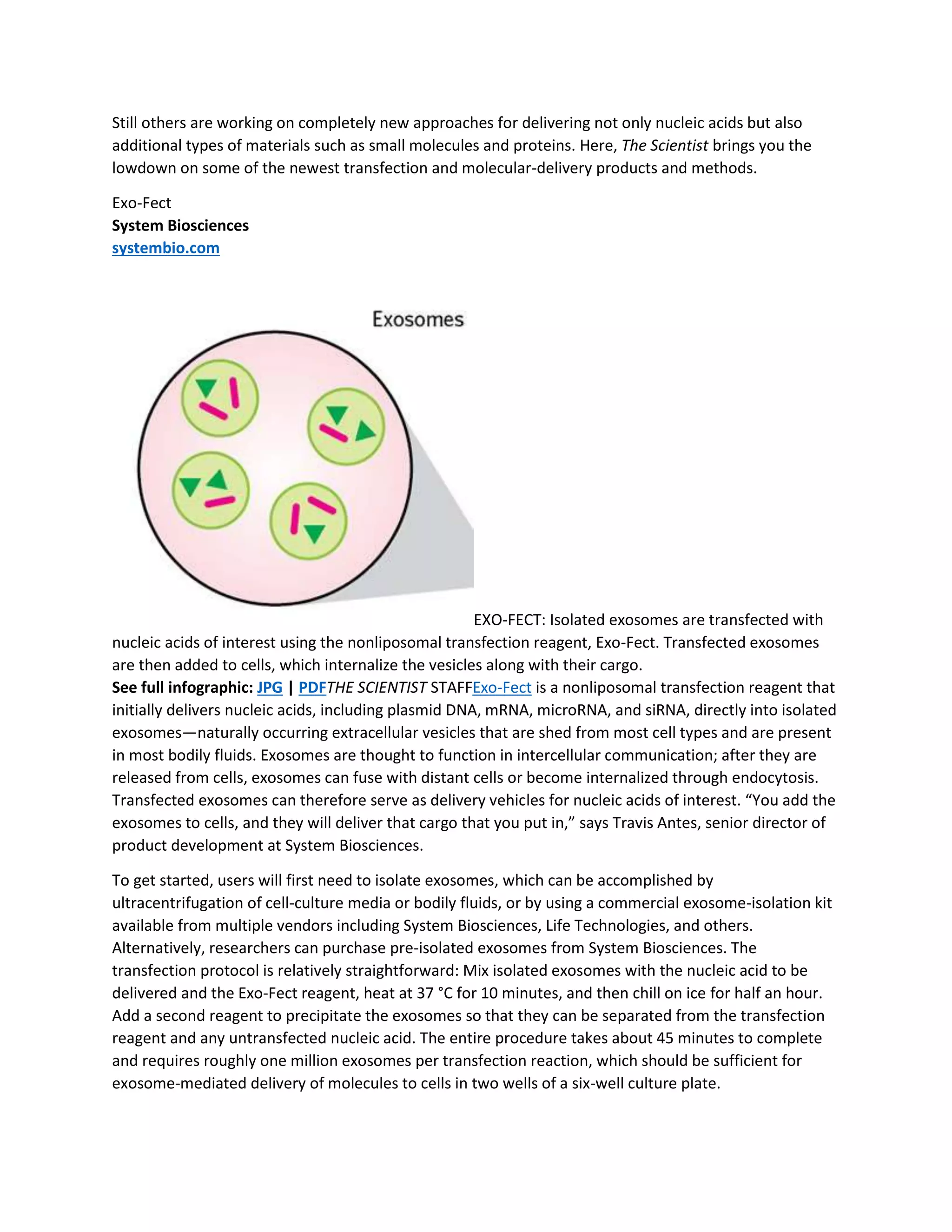
EXO-FECT: Isolated exosomes are transfected with 
nucleic acids of interest using the nonliposomal transfection reagent, Exo-Fect. Transfected exosomes 
are then added to cells, which internalize the vesicles along with their cargo. 
See full infographic: JPG | PDFTHE SCIENTIST STAFFExo-Fect is a nonliposomal transfection reagent that 
initially delivers nucleic acids, including plasmid DNA, mRNA, microRNA, and siRNA, directly into isolated 
exosomes—naturally occurring extracellular vesicles that are shed from most cell types and are present 
in most bodily fluids. Exosomes are thought to function in intercellular communication; after they are 
released from cells, exosomes can fuse with distant cells or become internalized through endocytosis. 
Transfected exosomes can therefore serve as delivery vehicles for nucleic acids of interest. “You add the 
exosomes to cells, and they will deliver that cargo that you put in,” says Travis Antes, senior director of 
product development at System Biosciences. 
To get started, users will first need to isolate exosomes, which can be accomplished by 
ultracentrifugation of cell-culture media or bodily fluids, or by using a commercial exosome-isolation kit 
available from multiple vendors including System Biosciences, Life Technologies, and others. 
Alternatively, researchers can purchase pre-isolated exosomes from System Biosciences. The 
transfection protocol is relatively straightforward: Mix isolated exosomes with the nucleic acid to be 
delivered and the Exo-Fect reagent, heat at 37 °C for 10 minutes, and then chill on ice for half an hour. 
Add a second reagent to precipitate the exosomes so that they can be separated from the transfection 
reagent and any untransfected nucleic acid. The entire procedure takes about 45 minutes to complete 
and requires roughly one million exosomes per transfection reaction, which should be sufficient for 
exosome-mediated delivery of molecules to cells in two wells of a six-well culture plate.
Benefits 
 Exosome-mediated delivery is nontoxic, Antes says. “Once we add the exosomes onto cells, 
there’s zero [cell] death.” 
 Can be used to deliver mixtures of different nucleic acid types 
 The Exo-Fect transfection kit comes with a fluorescently labeled nontargeting siRNA that can be 
used to monitor the effectiveness of a transfection and subsequent delivery into cells. 
Challenges 
 Depending on the method used, exosome isolation can be time-consuming and labor-intensive. 
 The product was only released in April 2014, so it remains relatively untested by researchers. 
 The fetal bovine serum (FBS) that is typically added to cell culture media is chock-full of cow 
exosomes that can interfere with exosome-mediated delivery. The company recommends users 
grow their cells in media with exosome-depleted FBS. 
Cost 
Kit costs range from $195 for 10 transfection reactions to $350 for 20 reactions. Exosome isolation kits 
start at $288, and a 50 mL bottle of exosome-depleted FBS sells for $153. The company also provides 
pre-isolated exosomes from a variety of sources starting at about $350 for a vial containing roughly one 
million exosomes. 
CellSqueeze 
SQZ Biotechnologies 
sqzbiotech.com 
CELLSQUEEZE: The rectangular microfluidic chip 
contains a series of parallel channels, each with at least one narrow constriction designed to be smaller
than the diameter of a cell. As the cells squeeze through the constrictions, pores form transiently in the 
plasma membrane, allowing extracellular molecules to enter the cytoplasm by diffusion. The cell 
membrane then reseals within minutes. 
See full infographic: JPG | PDFREDRAWN FROM "NARROW STRAIGHTS," THE SCIENTIST, JULY 
2013CellSqueeze is a microfluidic system released to the MARKET in 2013 that can deliver a variety of 
materials, including siRNA, drugs, proteins, or nanoparticles, into virtually any cell type. (See “Narrow 
Straits,” The Scientist, July 2013.) The system uses a rectangular microfluidic chip containing a series of 
75 parallel channels, each of which is 30 microns in diameter and contains at least one narrow 
constriction designed to be smaller than the diameter of a cell. 
As the cells squeeze through the constrictions, transient pores form in the plasma membrane, allowing 
extracellular molecules to enter the cytoplasm by diffusion. The cell membrane then reseals within 
minutes. Disrupting the cell membrane in this way “doesn’t seem to have any long-term side effects on 
the cells,” says Armon Sharei, a postdoctoral fellow at HarvardMedical School who cofounded SQZ 
Biotechnologies with Robert Langer and Klavs Jensen of MIT. “So it looks like we just open up their 
membrane and they repair it after the stuff is in, and they don’t think anything of it,” adds Sharei. 
The system has a pressure regulator that allows control of the speed with which the cells flow through 
the channels, and a pair of reservoirs that sit atop the chip and interface with its inlet and outlet holes. 
Users simply add their material to be transfected to a sample of cells in solution, deposit the mixture 
into the one of the interchangeable reservoirs, and apply pressure to begin pumping the sample through 
the device. Cells that have passed through the chip collect in the opposite reservoir, where they can be 
retrieved. It only takes about 5 seconds for a sample to flow through the system, Sharei says. 
Benefits 
 Easy to use and very fast, says user Morgane Griesbeck of the Ragon Institute of Massachusetts 
General Hospital, MIT, and Harvard who used the system to introduce a recombinant protein 
into a rare subset of human primary blood cells, “without stressing them too much, which is 
something very difficult,” she adds. 
 Simple process that works well with a variety of cell types, including established cell lines, 
primary immune cells, and embryonic stem cells 
 Can deliver a medley of materials simultaneously 
 The company OFFERS 16 different chip designs in which the length, width, and number of 
constrictions per channel vary, so researchers can tweak a variety of parameters to try to get 
the delivery that they desire. 
 Can reliably deliver molecules up to 2 MDa in size. “Bigger things probably get in too, but that’s 
the biggest we’ve tested,” Sharei says. 
 Unlike conventional delivery strategies, the process doesn’t involve proprietary buffers or 
delivery vectors that might be toxic to cells. 
Challenges
 The system is not currently suitable for delivering DNA and mRNA. “We know the mRNA and 
DNA get inside cells, but once they’re inside, something prevents them from getting expressed,” 
Sharei says. “We think we know what that is, and initial tests show that we may be able to get 
around it.” 
 The reservoirs hold a maximum volume of 250 μL. Larger volumes can be processed in small 
batches sequentially. 
 Requires two to three training sessions to learn how to use 
 The holder that clamps the reservoirs onto the chip will need to be replaced periodically 
because it tends to loosen over time, causing leaks that can ruin experiments, Griesbeck says. 
Cost 
 Chips sell for $50 apiece. A starter kit consisting of the pressure system plus two holder sets is 
available for $3,000. Onsite training will set new users back about $800 to $1,000. The system is 
commercially available only to “approved partners,” Sharei says. Prospective users will need to 
consult with the company’s scientific team before they can gain access to the technology. 
GOLD nanoparticle–mediated laser transfection (GNOME) 
Leibniz University Hannover, Germany 
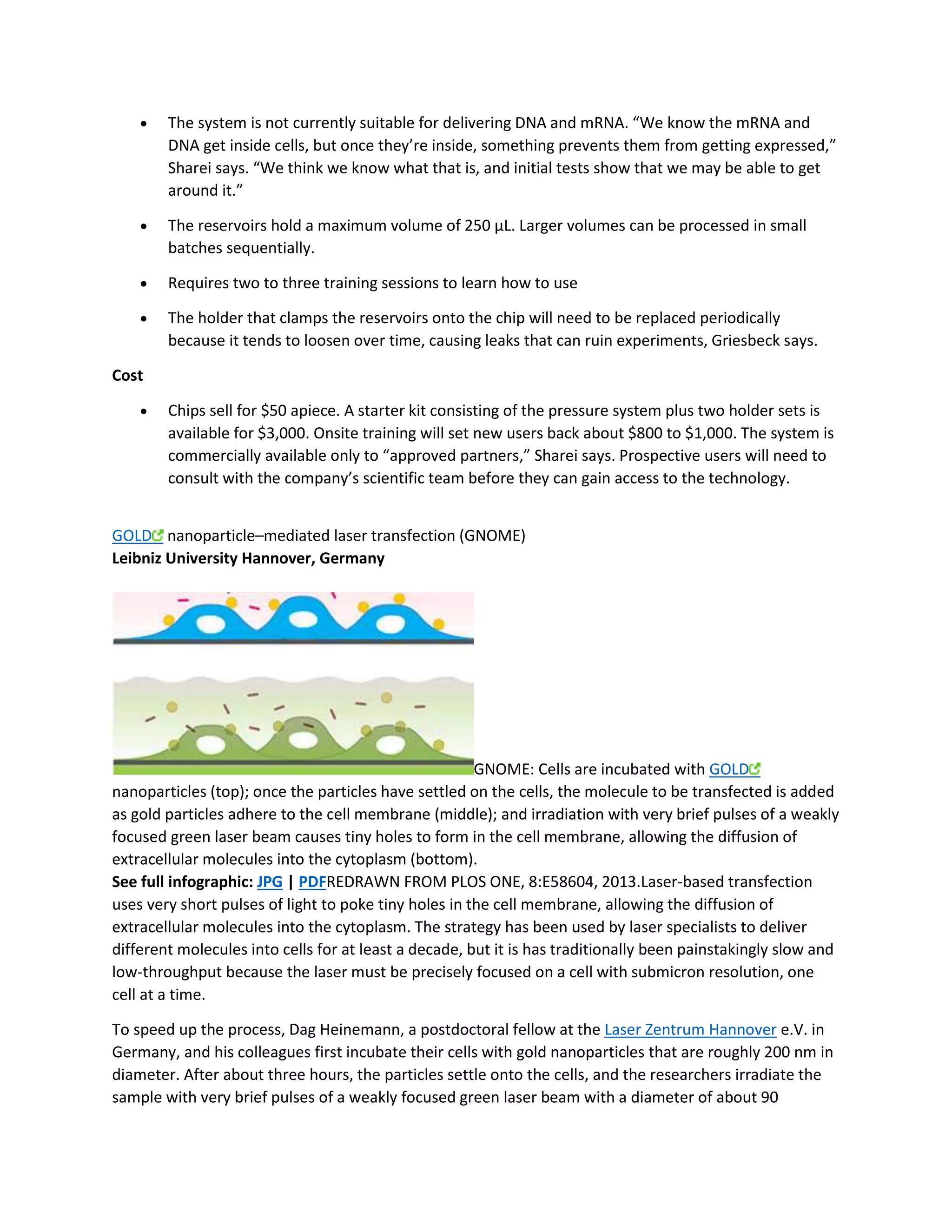
GNOME: Cells are incubated with GOLD 
nanoparticles (top); once the particles have settled on the cells, the molecule to be transfected is added 
as gold particles adhere to the cell membrane (middle); and irradiation with very brief pulses of a weakly 
focused green laser beam causes tiny holes to form in the cell membrane, allowing the diffusion of 
extracellular molecules into the cytoplasm (bottom). 
See full infographic: JPG | PDFREDRAWN FROM PLOS ONE, 8:E58604, 2013.Laser-based transfection 
uses very short pulses of light to poke tiny holes in the cell membrane, allowing the diffusion of 
extracellular molecules into the cytoplasm. The strategy has been used by laser specialists to deliver 
different molecules into cells for at least a decade, but it is has traditionally been painstakingly slow and 
low-throughput because the laser must be precisely focused on a cell with submicron resolution, one 
cell at a time. 
To speed up the process, Dag Heinemann, a postdoctoral fellow at the Laser Zentrum Hannover e.V. in 
Germany, and his colleagues first incubate their cells with gold nanoparticles that are roughly 200 nm in 
diameter. After about three hours, the particles settle onto the cells, and the researchers irradiate the 
sample with very brief pulses of a weakly focused green laser beam with a diameter of about 90
microns. The irradiation is performed in an automated device that the researchers developed in-house, 
complete with a microscope stage and software that automatically moves the culture plate around to 
quickly irradiate all or parts of the sample. 
Upon absorbing the light, electrons in the gold particles oscillate rapidly and heat up. What happens 
next is not well understood, Heinemann says, but the end result is that the cells’ membranes become 
perforated. Using the technique, Heinemann’s team delivered siRNA and effectively knocked down a 
gene in a canine cancer cell line (PLoS One, 8:e58604, 2013). The team estimated that nearly 90 percent 
of the cells were transfected, and more than 80 percent of the cells remained viable after the treatment. 
Benefits 
 Very gentle. “We can achieve very high cell viabilities, which are typically above 90 percent even 
with a sensitive cell type,” Heinemann says. 
 High-throughput. Heinemann says that an entire 96-well plate of cells can be processed in about 
4–5 minutes. 
 Compatible with a variety of cell types and highly reproducible, “because the physical 
mechanism stays the same and the cell itself is not actively involved in the mechanism,” 
Heinemann says. Working in collaboration with researchers at the Hannover Medical School, 
Heinemann says he has successfully transfected several different cell lines as well as primary 
neurons, cardiomyocytes, and stem cells, which tend to be difficult to transfect using 
established methods. 
 In addition to delivering siRNA, Heinemann has also used the method to deliver proteins, small 
molecules, and synthetic oligonucleotides called morpholinos. 
Challenges 
 Doesn’t work very well with plasmid DNA or other relatively large molecules. “We think the 
plasmid is quite large for the type of openings we introduce with the particles,” Heinemann 
says. 
 The GOLD particles eventually enter the cells in the process and could potentially alter cell 
behavior. “But as much as we know, [the particles] are completely biologically inert and they do 
not affect the cell afterward,” Heinemann says. 
 It’s still in the experimental stage at this point. Heinemann says he’s currently developing a user-friendly 
prototype device that could be operated in a typical cell biology lab with a simple press 
of a button. He says he hopes to have the system ready within a year. 
Cost 
None available. But Heinemann expects that his device will be competitive with sophisticated 
electroporation systems, which typically retail for about $10,000 or more. 
Tags 
transfection, techniques, siRNA, nanoparticle, microfluidics, exosomes and cell & molecular biology

Articles 1

  • 1.
    Entry Requirements Recentdevelopments in cell transfection and molecular delivery technologies By Nicholette Zeliadt | September 1, 2014 © DESIGN36/SHUTTERSTOCK Cell biologists have a variety of tricks up their sleeves when it comes to loading up cells with exogenous molecules, such as plasmid DNA or small interfering RNA (siRNA). The most popular options include chemical transfection reagents that ferry molecules into the cells using lipids or polymers; devices that use electricity to make cell membranes transiently porous; and viral delivery systems. Choosing a delivery method typically boils down to a combination of the cell type being targeted, the class of molecule being delivered, and the transfection efficiency needed to answer the particularresearch question. “The method that people gravitate to the most is the simplest method, which is chemical transfection,” says Josh Snow, technical services manager at Wisconsin-based Mirus Bio, which sells a variety of transfection products. By and large, conventional chemical and physical approaches to transfection cover the needs of most researchers using easy-to-transfect and easy-to-grow cell lines. But they’re often toxic, and chemical methods can have low transfection efficiency with primary cells, stem cells, or other difficult-to-transfect cell types. Viral approaches tend to provide very high transfection efficiency in a wide variety of cell types, but are labor-intensive to develop and require special precautions for the personnel using them. Fortunately, transfection companies have taken notice and have begun developing products that canmore efficiently transfect sensitive and finicky cells. For instance, this past January, California-based Life Technologies released a lipid nanoparticle product called Lipofectamine 3000, which was designed to target “hard-to-transfect and primary cells,” says Xavier de Mollerat du Jeu, senior staffscientist at Life Technologies. Other companies, such as Mirus Bio, have developed transfection reagents optimized for specific hard-to-transfect cell types, such as skin cells, neural cells, breastcancer lines, or blood cell lines.
  • 2.
    Still others areworking on completely new approaches for delivering not only nucleic acids but also additional types of materials such as small molecules and proteins. Here, The Scientist brings you the lowdown on some of the newest transfection and molecular-delivery products and methods. Exo-Fect System Biosciences systembio.com EXO-FECT: Isolated exosomes are transfected with nucleic acids of interest using the nonliposomal transfection reagent, Exo-Fect. Transfected exosomes are then added to cells, which internalize the vesicles along with their cargo. See full infographic: JPG | PDFTHE SCIENTIST STAFFExo-Fect is a nonliposomal transfection reagent that initially delivers nucleic acids, including plasmid DNA, mRNA, microRNA, and siRNA, directly into isolated exosomes—naturally occurring extracellular vesicles that are shed from most cell types and are present in most bodily fluids. Exosomes are thought to function in intercellular communication; after they are released from cells, exosomes can fuse with distant cells or become internalized through endocytosis. Transfected exosomes can therefore serve as delivery vehicles for nucleic acids of interest. “You add the exosomes to cells, and they will deliver that cargo that you put in,” says Travis Antes, senior director of product development at System Biosciences. To get started, users will first need to isolate exosomes, which can be accomplished by ultracentrifugation of cell-culture media or bodily fluids, or by using a commercial exosome-isolation kit available from multiple vendors including System Biosciences, Life Technologies, and others. Alternatively, researchers can purchase pre-isolated exosomes from System Biosciences. The transfection protocol is relatively straightforward: Mix isolated exosomes with the nucleic acid to be delivered and the Exo-Fect reagent, heat at 37 °C for 10 minutes, and then chill on ice for half an hour. Add a second reagent to precipitate the exosomes so that they can be separated from the transfection reagent and any untransfected nucleic acid. The entire procedure takes about 45 minutes to complete and requires roughly one million exosomes per transfection reaction, which should be sufficient for exosome-mediated delivery of molecules to cells in two wells of a six-well culture plate.
  • 3.
    Benefits  Exosome-mediateddelivery is nontoxic, Antes says. “Once we add the exosomes onto cells, there’s zero [cell] death.”  Can be used to deliver mixtures of different nucleic acid types  The Exo-Fect transfection kit comes with a fluorescently labeled nontargeting siRNA that can be used to monitor the effectiveness of a transfection and subsequent delivery into cells. Challenges  Depending on the method used, exosome isolation can be time-consuming and labor-intensive.  The product was only released in April 2014, so it remains relatively untested by researchers.  The fetal bovine serum (FBS) that is typically added to cell culture media is chock-full of cow exosomes that can interfere with exosome-mediated delivery. The company recommends users grow their cells in media with exosome-depleted FBS. Cost Kit costs range from $195 for 10 transfection reactions to $350 for 20 reactions. Exosome isolation kits start at $288, and a 50 mL bottle of exosome-depleted FBS sells for $153. The company also provides pre-isolated exosomes from a variety of sources starting at about $350 for a vial containing roughly one million exosomes. CellSqueeze SQZ Biotechnologies sqzbiotech.com CELLSQUEEZE: The rectangular microfluidic chip contains a series of parallel channels, each with at least one narrow constriction designed to be smaller
  • 4.
    than the diameterof a cell. As the cells squeeze through the constrictions, pores form transiently in the plasma membrane, allowing extracellular molecules to enter the cytoplasm by diffusion. The cell membrane then reseals within minutes. See full infographic: JPG | PDFREDRAWN FROM "NARROW STRAIGHTS," THE SCIENTIST, JULY 2013CellSqueeze is a microfluidic system released to the MARKET in 2013 that can deliver a variety of materials, including siRNA, drugs, proteins, or nanoparticles, into virtually any cell type. (See “Narrow Straits,” The Scientist, July 2013.) The system uses a rectangular microfluidic chip containing a series of 75 parallel channels, each of which is 30 microns in diameter and contains at least one narrow constriction designed to be smaller than the diameter of a cell. As the cells squeeze through the constrictions, transient pores form in the plasma membrane, allowing extracellular molecules to enter the cytoplasm by diffusion. The cell membrane then reseals within minutes. Disrupting the cell membrane in this way “doesn’t seem to have any long-term side effects on the cells,” says Armon Sharei, a postdoctoral fellow at HarvardMedical School who cofounded SQZ Biotechnologies with Robert Langer and Klavs Jensen of MIT. “So it looks like we just open up their membrane and they repair it after the stuff is in, and they don’t think anything of it,” adds Sharei. The system has a pressure regulator that allows control of the speed with which the cells flow through the channels, and a pair of reservoirs that sit atop the chip and interface with its inlet and outlet holes. Users simply add their material to be transfected to a sample of cells in solution, deposit the mixture into the one of the interchangeable reservoirs, and apply pressure to begin pumping the sample through the device. Cells that have passed through the chip collect in the opposite reservoir, where they can be retrieved. It only takes about 5 seconds for a sample to flow through the system, Sharei says. Benefits  Easy to use and very fast, says user Morgane Griesbeck of the Ragon Institute of Massachusetts General Hospital, MIT, and Harvard who used the system to introduce a recombinant protein into a rare subset of human primary blood cells, “without stressing them too much, which is something very difficult,” she adds.  Simple process that works well with a variety of cell types, including established cell lines, primary immune cells, and embryonic stem cells  Can deliver a medley of materials simultaneously  The company OFFERS 16 different chip designs in which the length, width, and number of constrictions per channel vary, so researchers can tweak a variety of parameters to try to get the delivery that they desire.  Can reliably deliver molecules up to 2 MDa in size. “Bigger things probably get in too, but that’s the biggest we’ve tested,” Sharei says.  Unlike conventional delivery strategies, the process doesn’t involve proprietary buffers or delivery vectors that might be toxic to cells. Challenges
  • 5.
     The systemis not currently suitable for delivering DNA and mRNA. “We know the mRNA and DNA get inside cells, but once they’re inside, something prevents them from getting expressed,” Sharei says. “We think we know what that is, and initial tests show that we may be able to get around it.”  The reservoirs hold a maximum volume of 250 μL. Larger volumes can be processed in small batches sequentially.  Requires two to three training sessions to learn how to use  The holder that clamps the reservoirs onto the chip will need to be replaced periodically because it tends to loosen over time, causing leaks that can ruin experiments, Griesbeck says. Cost  Chips sell for $50 apiece. A starter kit consisting of the pressure system plus two holder sets is available for $3,000. Onsite training will set new users back about $800 to $1,000. The system is commercially available only to “approved partners,” Sharei says. Prospective users will need to consult with the company’s scientific team before they can gain access to the technology. GOLD nanoparticle–mediated laser transfection (GNOME) Leibniz University Hannover, Germany GNOME: Cells are incubated with GOLD nanoparticles (top); once the particles have settled on the cells, the molecule to be transfected is added as gold particles adhere to the cell membrane (middle); and irradiation with very brief pulses of a weakly focused green laser beam causes tiny holes to form in the cell membrane, allowing the diffusion of extracellular molecules into the cytoplasm (bottom). See full infographic: JPG | PDFREDRAWN FROM PLOS ONE, 8:E58604, 2013.Laser-based transfection uses very short pulses of light to poke tiny holes in the cell membrane, allowing the diffusion of extracellular molecules into the cytoplasm. The strategy has been used by laser specialists to deliver different molecules into cells for at least a decade, but it is has traditionally been painstakingly slow and low-throughput because the laser must be precisely focused on a cell with submicron resolution, one cell at a time. To speed up the process, Dag Heinemann, a postdoctoral fellow at the Laser Zentrum Hannover e.V. in Germany, and his colleagues first incubate their cells with gold nanoparticles that are roughly 200 nm in diameter. After about three hours, the particles settle onto the cells, and the researchers irradiate the sample with very brief pulses of a weakly focused green laser beam with a diameter of about 90
  • 6.
    microns. The irradiationis performed in an automated device that the researchers developed in-house, complete with a microscope stage and software that automatically moves the culture plate around to quickly irradiate all or parts of the sample. Upon absorbing the light, electrons in the gold particles oscillate rapidly and heat up. What happens next is not well understood, Heinemann says, but the end result is that the cells’ membranes become perforated. Using the technique, Heinemann’s team delivered siRNA and effectively knocked down a gene in a canine cancer cell line (PLoS One, 8:e58604, 2013). The team estimated that nearly 90 percent of the cells were transfected, and more than 80 percent of the cells remained viable after the treatment. Benefits  Very gentle. “We can achieve very high cell viabilities, which are typically above 90 percent even with a sensitive cell type,” Heinemann says.  High-throughput. Heinemann says that an entire 96-well plate of cells can be processed in about 4–5 minutes.  Compatible with a variety of cell types and highly reproducible, “because the physical mechanism stays the same and the cell itself is not actively involved in the mechanism,” Heinemann says. Working in collaboration with researchers at the Hannover Medical School, Heinemann says he has successfully transfected several different cell lines as well as primary neurons, cardiomyocytes, and stem cells, which tend to be difficult to transfect using established methods.  In addition to delivering siRNA, Heinemann has also used the method to deliver proteins, small molecules, and synthetic oligonucleotides called morpholinos. Challenges  Doesn’t work very well with plasmid DNA or other relatively large molecules. “We think the plasmid is quite large for the type of openings we introduce with the particles,” Heinemann says.  The GOLD particles eventually enter the cells in the process and could potentially alter cell behavior. “But as much as we know, [the particles] are completely biologically inert and they do not affect the cell afterward,” Heinemann says.  It’s still in the experimental stage at this point. Heinemann says he’s currently developing a user-friendly prototype device that could be operated in a typical cell biology lab with a simple press of a button. He says he hopes to have the system ready within a year. Cost None available. But Heinemann expects that his device will be competitive with sophisticated electroporation systems, which typically retail for about $10,000 or more. Tags transfection, techniques, siRNA, nanoparticle, microfluidics, exosomes and cell & molecular biology