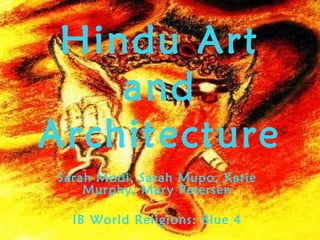
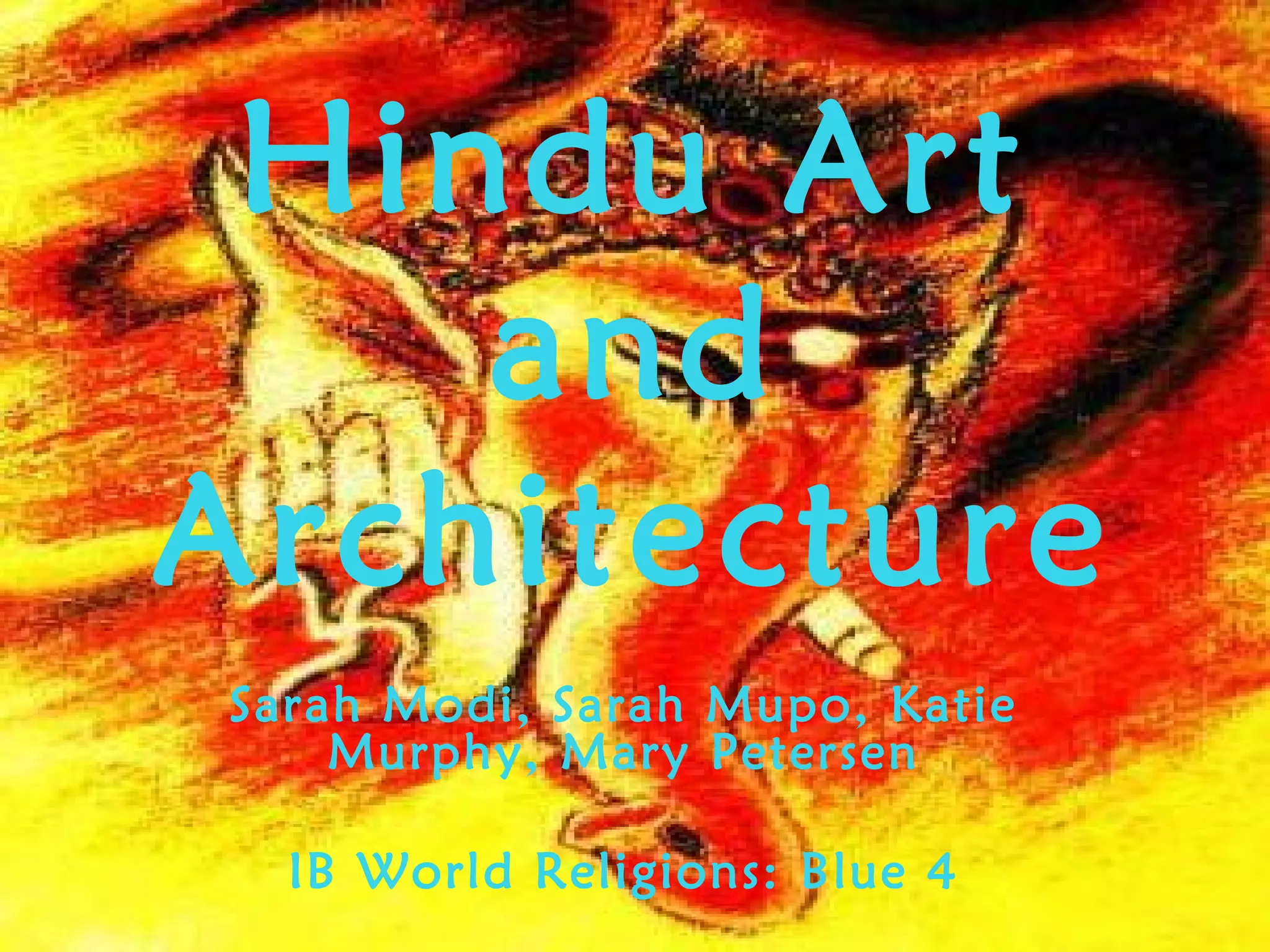
Hindu Art
and
Architecture
Sarah Modi, Sarah Mupo, Katie
Murphy, Mary Petersen
IB World Religions: Blue 4
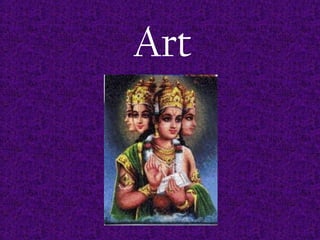
Art
“The man who knows nothing of
music, literature, or art is no
better than a beast.”
•Warning of ancient Hindu wisdom
•Hindus think highly of art
•Art = the key to salvation of the ultimate
release sought by all good Hindus
•Art is a unity of many forms and artistic
experiences very holistic
Yoga
•Indian art in its purest form
•A disciplined style of self-restraint and worship
•India’s oldest indigenous “science”
•spiritual exercise leading to the beatific vision
-also a psychological process of drawing
oneself into the dynamics which control the
universe
-and to ready oneself for all kinds of mental
and physical activity
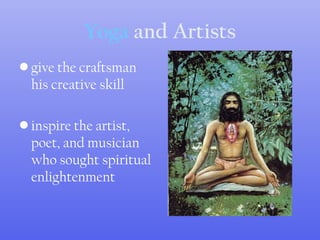
Yoga and Artists
• give the craftsman
his creative skill
• inspire the artist,
poet, and musician
who sought spiritual
enlightenment
The Art
• Hindu/ Indian artists have celebrated/ immortalized
the beauty of human bodies in bronze and stone for
more than 5,000 yrs
• Art is most often associated with Hindu religion and
philosophy
-difficult to appreciate fully unless one has
knowledge of Hindu ideals
-religious urge, a looking beyond
-attempt to bring down the beauty of the things
above
Art Con’t
• Art is essentially idealistic, mystic, symbolic,
and transcendental
- Mere bodily strength and mundane
perfections of form are never glorified in
Indian art.
• Artist is both priest and poet
• Only by meditating on the Ultimate Perfection
could the artist perceive the beauty of the
Godhead
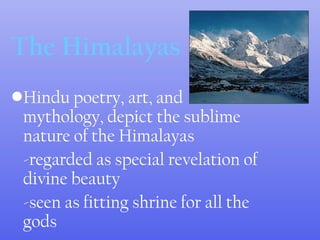
•Hindu poetry, art, and
mythology, depict the sublime
nature of the Himalayas
-regarded as special revelation of
divine beauty
-seen as fitting shrine for all the
gods
The Himalayas
•Hindu philosophy recognizes the
impossibility of human art capturing the
form of God
•Creates in Indian painting and sculpture a
symbolical representation of milder,
humanized (but still superhuman), divine
appearances which mortal eyes can bear
Philosophy of Art
Purpose of Art
• To suggest divine attributes to Indian people
is the purpose of Hindu art
• True Indian art is stripped of the superfluities
and vulgarities which delight the uneducated
eye
- believe that Hindu art requires a
higher degree of artistic understanding
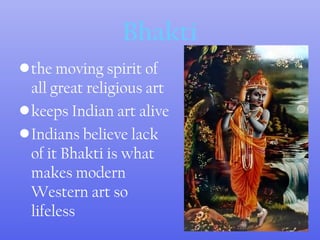
Bhakti
•the moving spirit of
all great religious art
•keeps Indian art alive
•Indians believe lack
of it Bhakti is what
makes modern
Western art so
lifeless
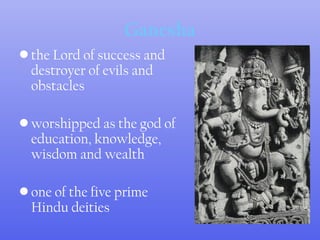
Ganesha
• the Lord of success and
destroyer of evils and
obstacles
• worshipped as the god of
education, knowledge,
wisdom and wealth
• one of the five prime
Hindu deities
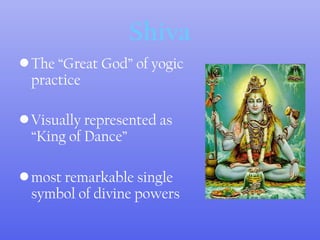
Shiva
•The “Great God” of yogic
practice
•Visually represented as
“King of Dance”
•most remarkable single
symbol of divine powers
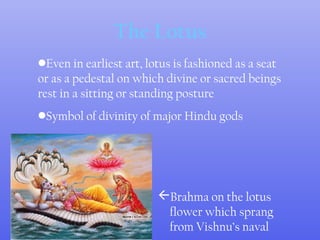
The Lotus
Brahma on the lotus
flower which sprang
from Vishnu’s naval
•Even in earliest art, lotus is fashioned as a seat
or as a pedestal on which divine or sacred beings
rest in a sitting or standing posture
•Symbol of divinity of major Hindu gods
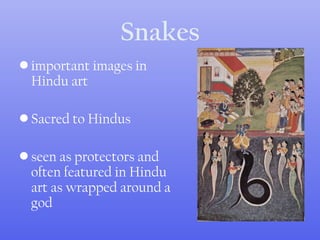
Snakes
• important images in
Hindu art
• Sacred to Hindus
• seen as protectors and
often featured in Hindu
art as wrapped around a
god
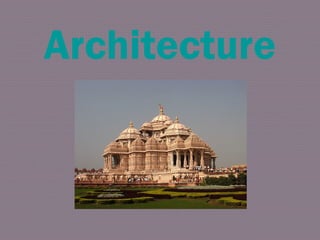
Architecture
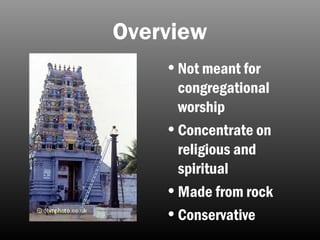
Overview
•Not meant for
congregational
worship
•Concentrate on
religious and
spiritual
•Made from rock
•Conservative
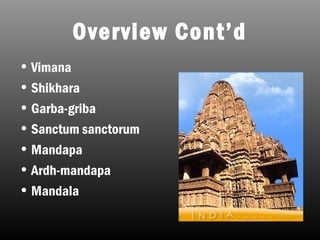
Overview Cont’d
• Vimana
• Shikhara
• Garba-griba
• Sanctum sanctorum
• Mandapa
• Ardh-mandapa
• Mandala
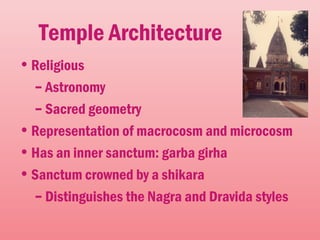
Temple Architecture
•Religious
– Astronomy
– Sacred geometry
•Representation of macrocosm and microcosm
•Has an inner sanctum: garba girha
•Sanctum crowned by a shikara
– Distinguishes the Nagra and Dravida styles
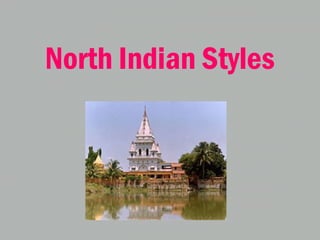
North Indian Styles
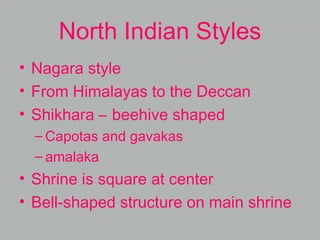
North Indian Styles
• Nagara style
• From Himalayas to the Deccan
• Shikhara – beehive shaped
– Capotas and gavakas
– amalaka
• Shrine is square at center
• Bell-shaped structure on main shrine
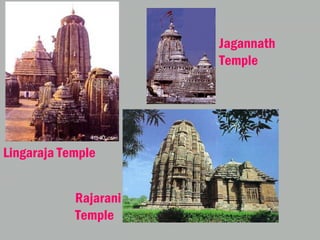
Lingaraja Temple
Rajarani
Temple
Jagannath
Temple
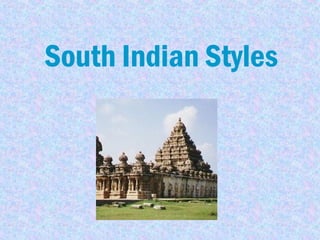
South Indian Styles
South Indian Style
•Dravida Style
•Shikhara – pyramid shaped
•Have different: ground plan; position of
stone deities; decorative elements
•Walls around whole building
•Different types: Pallava, Chola, Pandya,
Vijayanagar, Nayak
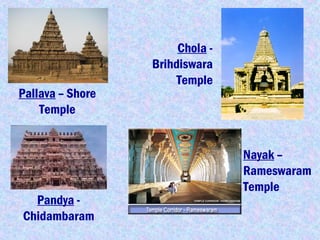
Pallava – Shore
Temple
Chola -
Brihdiswara
Temple
Pandya -
Chidambaram
Nayak –
Rameswaram
Temple
Historical Development
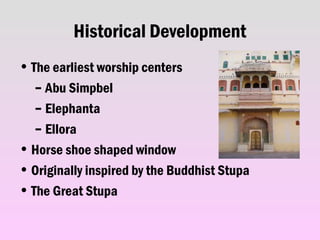
• The earliest worship centers
– Abu Simpbel
– Elephanta
– Ellora
• Horse shoe shaped window
• Originally inspired by the Buddhist Stupa
• The Great Stupa
Historical Development cont’d
• The Stupa
– Addition to the temple from Buddism
• Shilpa Shastra
– Point of reference
for architects
• Hindu temples
– Large temples vs.
mandirs:
Historical Development cont’d
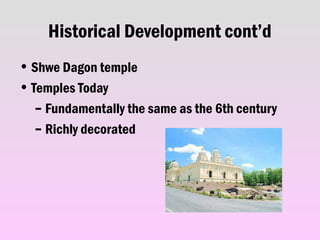
• Shwe Dagon temple
• Temples Today
– Fundamentally the same as the 6th century
– Richly decorated
Works Cited
"Art and Architecture" http://hinduism.iskcon.com/index.htm. The Heart of
Hinduism Project. 2004. 1 section. 3 Nov 2006. ISKCON Educational
Services <http://hinduism.iskcon.com/lifestyle/805.htm>
"Architectural Mosaic" http://www.hinduonline.com/. The Hindu. 12 May
2002. 5 sections. 2002 1 Nov 2006 <
http://www.hinduonnet.com/thehindu/mag/2002/05/12/stories/200205120045
>
Batchelor, Anthony. “Indian Temple Architecture.” TempleNet. 13 Nov.
2006. <http://www.indiantemples.com/temparc.html>
“Ganesha: The Elephant God.” About. 13 November 2006.
<http://hinduism.about.com/library/weekly/aa083000a.htm>.
Havell, Ernest Binfield. The Art heritage of India. Dutton, 1911.
Hindu Architecture. Indiasite.com. 10 November 2006.
<http://www.indiasite.com/architecture/hindu.html>.
Works Cited Con’t
"Hindu Architecture" 10 Aug 2004, 7 paragraphs. Project India. 11 Nov 2006 <
http://www.scholars.nus.edu.sg/student_work/global_programme/indiaweb/PI2/hindu
>.
Hindu Art. 15 August 2006. Hindu Wisdom. 13 November 2006.
<http://www.hinduwisdom.info/Hindu_Art.htm#h%20i%20n%20d%20u
%20%20%20%20a%20r%20t>.
Hindu Temple Architecture. Answers Corporation. 15 November 2006.
<http://www.answers.com/topic/hindu-temple-architecture>.
Kumar, Nitin. “The Hindu Temple: Where Man Becomes God.” May 2006. Exotic
India. 12 Nov. 2006. <http://www.exoticindiaart.com/read/hindu_temple.htm>.
Nangia, Ashish. “Poetry in Stone: Crystallization of the Hindu Temple.” 15 Nov.
2001. Boloji.com. 13 Nov. 2006.
<http://www.boloji.com/architecture/00006.htm>.
Temples. Indian Heritage. 10 Nov. 2006.
<http://www.saigan.com/heritage/tindex.html>.

India art and architecture ppt(1)

  • 1.
    Hindu Art and Architecture Sarah Modi,Sarah Mupo, Katie Murphy, Mary Petersen IB World Religions: Blue 4
  • 2.
  • 3.
    “The man whoknows nothing of music, literature, or art is no better than a beast.” •Warning of ancient Hindu wisdom •Hindus think highly of art •Art = the key to salvation of the ultimate release sought by all good Hindus •Art is a unity of many forms and artistic experiences very holistic
  • 4.
    Yoga •Indian art inits purest form •A disciplined style of self-restraint and worship •India’s oldest indigenous “science” •spiritual exercise leading to the beatific vision -also a psychological process of drawing oneself into the dynamics which control the universe -and to ready oneself for all kinds of mental and physical activity
  • 5.
    Yoga and Artists •give the craftsman his creative skill • inspire the artist, poet, and musician who sought spiritual enlightenment
  • 6.
    The Art • Hindu/Indian artists have celebrated/ immortalized the beauty of human bodies in bronze and stone for more than 5,000 yrs • Art is most often associated with Hindu religion and philosophy -difficult to appreciate fully unless one has knowledge of Hindu ideals -religious urge, a looking beyond -attempt to bring down the beauty of the things above
  • 7.
    Art Con’t • Artis essentially idealistic, mystic, symbolic, and transcendental - Mere bodily strength and mundane perfections of form are never glorified in Indian art. • Artist is both priest and poet • Only by meditating on the Ultimate Perfection could the artist perceive the beauty of the Godhead
  • 8.
    •Hindu poetry, art,and mythology, depict the sublime nature of the Himalayas -regarded as special revelation of divine beauty -seen as fitting shrine for all the gods The Himalayas
  • 9.
    •Hindu philosophy recognizesthe impossibility of human art capturing the form of God •Creates in Indian painting and sculpture a symbolical representation of milder, humanized (but still superhuman), divine appearances which mortal eyes can bear Philosophy of Art
  • 10.
    Purpose of Art •To suggest divine attributes to Indian people is the purpose of Hindu art • True Indian art is stripped of the superfluities and vulgarities which delight the uneducated eye - believe that Hindu art requires a higher degree of artistic understanding
  • 11.
    Bhakti •the moving spiritof all great religious art •keeps Indian art alive •Indians believe lack of it Bhakti is what makes modern Western art so lifeless
  • 13.
    Ganesha • the Lordof success and destroyer of evils and obstacles • worshipped as the god of education, knowledge, wisdom and wealth • one of the five prime Hindu deities
  • 14.
    Shiva •The “Great God”of yogic practice •Visually represented as “King of Dance” •most remarkable single symbol of divine powers
  • 15.
    The Lotus Brahma onthe lotus flower which sprang from Vishnu’s naval •Even in earliest art, lotus is fashioned as a seat or as a pedestal on which divine or sacred beings rest in a sitting or standing posture •Symbol of divinity of major Hindu gods
  • 16.
    Snakes • important imagesin Hindu art • Sacred to Hindus • seen as protectors and often featured in Hindu art as wrapped around a god
  • 17.
  • 18.
    Overview •Not meant for congregational worship •Concentrateon religious and spiritual •Made from rock •Conservative
  • 19.
    Overview Cont’d • Vimana •Shikhara • Garba-griba • Sanctum sanctorum • Mandapa • Ardh-mandapa • Mandala
  • 20.
    Temple Architecture •Religious – Astronomy –Sacred geometry •Representation of macrocosm and microcosm •Has an inner sanctum: garba girha •Sanctum crowned by a shikara – Distinguishes the Nagra and Dravida styles
  • 21.
  • 22.
    North Indian Styles •Nagara style • From Himalayas to the Deccan • Shikhara – beehive shaped – Capotas and gavakas – amalaka • Shrine is square at center • Bell-shaped structure on main shrine
  • 23.
  • 24.
  • 25.
    South Indian Style •DravidaStyle •Shikhara – pyramid shaped •Have different: ground plan; position of stone deities; decorative elements •Walls around whole building •Different types: Pallava, Chola, Pandya, Vijayanagar, Nayak
  • 26.
    Pallava – Shore Temple Chola- Brihdiswara Temple Pandya - Chidambaram Nayak – Rameswaram Temple
  • 27.
    Historical Development • Theearliest worship centers – Abu Simpbel – Elephanta – Ellora • Horse shoe shaped window • Originally inspired by the Buddhist Stupa • The Great Stupa
  • 28.
    Historical Development cont’d •The Stupa – Addition to the temple from Buddism • Shilpa Shastra – Point of reference for architects • Hindu temples – Large temples vs. mandirs:
  • 29.
    Historical Development cont’d •Shwe Dagon temple • Temples Today – Fundamentally the same as the 6th century – Richly decorated
  • 30.
    Works Cited "Art andArchitecture" http://hinduism.iskcon.com/index.htm. The Heart of Hinduism Project. 2004. 1 section. 3 Nov 2006. ISKCON Educational Services <http://hinduism.iskcon.com/lifestyle/805.htm> "Architectural Mosaic" http://www.hinduonline.com/. The Hindu. 12 May 2002. 5 sections. 2002 1 Nov 2006 < http://www.hinduonnet.com/thehindu/mag/2002/05/12/stories/200205120045 > Batchelor, Anthony. “Indian Temple Architecture.” TempleNet. 13 Nov. 2006. <http://www.indiantemples.com/temparc.html> “Ganesha: The Elephant God.” About. 13 November 2006. <http://hinduism.about.com/library/weekly/aa083000a.htm>. Havell, Ernest Binfield. The Art heritage of India. Dutton, 1911. Hindu Architecture. Indiasite.com. 10 November 2006. <http://www.indiasite.com/architecture/hindu.html>.
  • 31.
    Works Cited Con’t "HinduArchitecture" 10 Aug 2004, 7 paragraphs. Project India. 11 Nov 2006 < http://www.scholars.nus.edu.sg/student_work/global_programme/indiaweb/PI2/hindu >. Hindu Art. 15 August 2006. Hindu Wisdom. 13 November 2006. <http://www.hinduwisdom.info/Hindu_Art.htm#h%20i%20n%20d%20u %20%20%20%20a%20r%20t>. Hindu Temple Architecture. Answers Corporation. 15 November 2006. <http://www.answers.com/topic/hindu-temple-architecture>. Kumar, Nitin. “The Hindu Temple: Where Man Becomes God.” May 2006. Exotic India. 12 Nov. 2006. <http://www.exoticindiaart.com/read/hindu_temple.htm>. Nangia, Ashish. “Poetry in Stone: Crystallization of the Hindu Temple.” 15 Nov. 2001. Boloji.com. 13 Nov. 2006. <http://www.boloji.com/architecture/00006.htm>. Temples. Indian Heritage. 10 Nov. 2006. <http://www.saigan.com/heritage/tindex.html>.