THEORY:
Sources of abnormal
sensory re-weighting in
fall-prone older adults
Gloria Ammons
Leslie K. Allison, PhD, PT
September 11, 2008
Postural Control
 Peripheral sensory inputs:
 Vision
 Somatosensation
 Vestibular
 Central processing
 sensory interpretation
 central integration
 map appropriate response
 activate muscular system
Deficient Sensory Processing
 Attributed to falls in the elderly
 Sources:
1. Peripheral sensory
 E.g. Bilateral vestibular loss
2. Central sensory integration
 E.g. “Pusher syndrome”
(Karnath 2003)
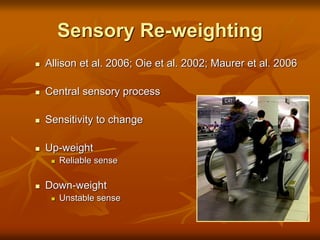
Sensory Re-weighting
 Allison et al. 2006; Oie et al. 2002; Maurer et al. 2006
 Central sensory process
 Sensitivity to change
 Up-weight
 Reliable sense
 Down-weight
 Unstable sense
Theory 1
 Allison et al. 2006
 Older adults vs. young adults
 Both able to “re-weight” senses accurately
to changing stimuli as long as older adults
are given enough time to adapt
 “weight” is measured by gain
Gain = peak response amplitude
peak stimulus amplitude
Allison et al. 2006: Fig 1
 Normal re-weighting:
 INTER-modality dependence
  visual display amplitude,  gain to vision stimulus motion
 INTRA-modality dependence
  visual display amplitude,  gain to somatosensory motion
Allison et al. 2006: Fig 4
Theory 2
 Peterka 2002
 Persons with known bilateral vestibular loss “weight”
vision & proprioceptive cues more highly than individuals
with intact vestibular function
Peterka 2002: Fig 3
 Despite screening for
peripheral sensory loss,
older adults “weighted”
vision & somatosensory
information more highly
than young adults
 Increased body sway 
higher gains
 Problem: inadequate
screening for vestibular
sensory loss?
Theory 3
 Allison et al. 2006; Borger 1999; Simoneau 1999
Allison et al. 2006: Fig 2
Purpose
 To determine if the source of abnormal sensory
re-weighting in fall-prone older adults is due to
peripheral vestibular loss or due to a central
processing deficit.
Hypothesis
 Fall-prone older adults with and without known peripheral
vestibular loss will both demonstrate sensory re-
weighting as measured by altered gain responses to
amplitude changes in visual and somatosensory motion
stimuli.
 Fall-prone older adults with intact vestibular function will
also demonstrate heightened sensitivity to vision and
somatosensory motion, indicating a central sensory
processing deficiency.
Importance
 Fall-risk increases with age
 15.9% of people  65 yrs reported falling at least once in 3 mo period
(CDC 2007)
 Falls & “fear of falling” are associated with activity avoidance, which
threaten independence among elderly (Stevens 2008; Bertera 2008)
 Exercise reduces risk for falls
 Current study will help:
 Promote EBP & future research
 Understand source of sensory processing deficits
 Develop effective fall prevention programs (Allison 2006)
References
1. Allison LK (2006) The dynamics of multi-sensory re-weighting in healthy and
fall-prone older adults. (Doctoral dissertation, University of Maryland, 2006).
Dissertation Abstracts International, 67 (6). (UMI No. 3222601)
2. Allison LK, Kiemel T, Jeka JJ (2006) Multisensory re-weighting of vision and
touch is intact in healthy and fall-prone older adults. Exp Brain Res 175:342-
352
3. Bertera EM, Bertera RL (2008) Fear of falling and activity avoidance in a
national sample of older adults in the United States. Health Soc Work 33:54-
62
4. Borger LL, Whitney SL, Redfern MS, Furman JM (1999) The influence of
dynamic visual environments on postural sway in the elderly. J Vestibl Res
9:197-205
5. Centers for Disease Control and Prevention [CDC] 2007 Web-based injury
statistics query and reporting system. National Center for Injury Prevention
and Control, Centers for Disease Control and Prevention. Accessed
September 10, 2008 from: www.cdc.gov/ncipc/wisqars
6. Jeka JJ, Allison LK, Saffer M, Zhang Y, Carver S, Kiemel T (2006) Sensory
re-weighting with translational visual stimuli in young and elderly adults: the
role of state-dependent noise. Exp Brain Res 174:517-527
7. Karnath H, Broetz D (2003) Understanding and treating “pusher syndrome.”
Phys Ther 83:1119-1125
References
8. Maurer C, Mergner T, Peterka, RJ (2006) Multisensory control of
human upright stance. Exp Brain Res 171:231-250
9. Oie KS, Kiemel T, Jeka JJ (2002) Multisensory fusion: simultaneous
re-weighting of vision and touch for the control of human posture.
Cogn Brain Res 14:164-176
10. Peterka RJ (2002). Sensorimotor integration in human postural
control. J Neurophysiol 88:1097-1118
11. Simoneau M, Teasdale N, Bourdin C, Bard C, Fleury M, Nougier V
(1999) Aging and postural control: postural perturbations caused by
changing the visual anchor. J Am Geriatr Soc 47:235-239
12. Speers RA, Kuo AD, Horak FB (2002) Contributions of altered
sensation and feedback responses to changes in coordination of
postural control due to aging. Gait Posture 16:20-30
13. Stevens JA, Mack KA, Paulozzi LJ, Ballesteros MF (2008) Self-
reported falls and fall-related injuries among persons aged  65
years – United States, 2006. Journal of Safety Research 39:345-349
METHODS:
Sources of abnormal
sensory re-weighting in
fall-prone older adults
Gloria Ammons
Leslie K. Allison, PhD, PT
October 7, 2008
THEORY
 Postural control is influenced by peripheral sensory inputs & central
sensory processing
 Both peripheral & central sensory deficits are associated with falls in
the elderly
 Normal sensory reweighting (SRW) is characterized by a pattern of
absolute gain responses to changes in environmental stimuli
 Increases in vision gain as visual input becomes more reliable;
 Decrease in somatosensory gain as vision becomes more reliable
THEORY
 No differences in pattern of gain response in young (HY), healthy
older (HO), & fall-prone older adults (FP) if given enough time to
adapt to changing stimulus
 People with known bilateral vestibular function loss (VFL) have
heightened sensitivity to changes in vision & proprioceptive cues
compared to people with intact vestibular function (VFI)
 FP also have heightened sensitivity to changes in vision &
somatosensation stimuli compared to HO & HY
PURPOSE
 To determine if the source of SRW in FP is due to:
 Peripheral vestibular loss or
 Central processing deficiency
HYPOTHESES
 Both HO & FP will demonstrate SRW as measured by altered gain
responses to amplitude changes in visual and somatosensory (SS)
stimuli
 All older adults with VFL will demonstrate heightened sensitivity to
vision & SS motion as measured by greater absolute gain responses
to the same stimulus.
 HO with VFI will not show heightened sensitivity to vision & SS
motion
 peripheral loss
 central impairment
 FP with VFI will show heightened sensitivity to vision & SS
 peripheral loss
 central impairment
METHODS
Subjects
 Sample
 3 groups of 30 each (total 90 expected)
 Healthy young (HY)
 age 18-30
 Healthy older (HO)
 age  70
 Fall-prone older (FP)
 age  70
 Selection
 Flyer
 Advertisements
 Personal contact
 Community
 ECU students
 Informed consent of experimental procedures
 Approved by University Institutional Review Board
Volunteers Needed
For Balance Study
If you are 70 years of age or older & have had
falls,
near falls,
or become much less steady than you were a year ago,
Please join the East Carolina University
Balance Study this summer/fall.
You will receive
FREE specialized balance testing
Up to $45.00 compensation for your participation
For more information, please call
Gloria Ammons at 252-327-9631
Leslie Allison at 252-744-6236
This study is funded by East Carolina University.
Subjects
 Exclusion Criteria
 Hx of psychological,
neurological, or
orthopedic disability;
 Consuming
medications that
impair balance
 Inclusion Criteria
 HY: Normal strength & ROM;
vision corrected to 20/20
 HO: No hx of falls; no reported
symptoms of imbalance; No AD;
have high physical activity level
 FP: Hx of falls or have high risk of
falls; reported incidence of
multiple near falls; reduced
functional activity level 2
imbalance; with/without AD
Experimental Apparatus
 Visual Display
 Rear-projected random star
field pattern
 Translucent 4m x 3m screen
 Software: Microsoft Visual
Studio 2005
 Central ellipse w/o stars
(Dijkstra et al. 1994)
 Refresh rate: 60 Hz
Experimental Apparatus
 Surface Motion
 NeuroCom v1.2.0
 Dynamic Dual Force Plate
 Raised platform
 A-P translation
 Measure GRF, estimated
COM
 Collected at 200 Hz
Experimental Apparatus
 Kinematics
 EVaRT v5.0.4 motion analysis
 6 cameras
 Infrared emitting diode markers
 3 head
 Bilateral acromioclavicular,
greater trochanters, lat.
femoral-tibial, lat. malleoli,
distal 5th metatarsals
 Calculate estimated COM
 Signals collected at 120 Hz
Experimental Protocol
 3 separate testing sessions for older adults
 Clinical screening session (2 hrs)
 Performed by PT & GA’s
 1st session to establish eligibility
 Tests:
 Visual Acuity - Snellen eye chart
 Mini-mental Exam
 Dynamic Handicap Inventory
 Berg Balance Scale
 1 Minute STS
 TUG
 LE strength screening
 LE somatosensation
 Touch - Semmes-Winstein
monofilaments
 Vibration - 128 Hz tuning fork
 Proprioception - PROM 1st ray & ankle
Experimental Protocol
 Vestibular Diagnostic Testing (3 hrs)
 Performed by audiologist & GA’s
 Tests:
 Hearing
 Videonystagmography
 Dynamic Visual Acuity Test
 Vestibular Evoked Myogenic Potentials (VEMP)
 Rotary Chair:
 Visual-Vestibular interaction
 Subjective visual vertical
 Multisensory Reweighting Experiment (3 hrs)
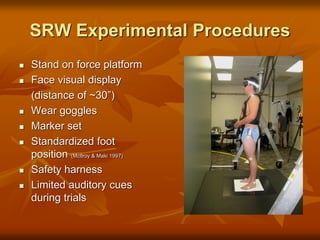
SRW Experimental Procedures
 Stand on force platform
 Face visual display
(distance of ~30”)
 Wear goggles
 Marker set
 Standardized foot
position (McIlroy & Maki 1997)
 Safety harness
 Limited auditory cues
during trials
Experimental Procedures
 Baseline data:
 Room lit
 Subject instruction
 Silent sync trigger
 Activates Neurocom &
EVaRT
 Collect:
 Standing calibration
 Static postural sway
 30 sec
 Dynamic LOS
 60 sec
 SRW data:
 Room darkened
 Subject instruction
 Silent sync trigger
 Activates Neurom, EVaRT,
& Visual
 Two stimuli - vision, &
somatosensation
 Stimuli have constant
frequency, varying amplitude
 Ten – 3 min trials
 Randomized conditions
 2’ seated rests between trials
Randomized
Conditions
Visual
stimulus
(ƒ = .28 Hz)
Somatosensory
stimulus
(ƒ = .20 Hz)
1 High amplitude
(8 mm)
Low amplitude
(2 mm)
2 Low amplitude
(2 mm)
High amplitude
(8 mm)
Data Analysis
Dependent Variables:
Gain
(amplitude)
Phase
(timing)
Independent
Variables:
Fall status HO
FP
Vestibular
function
Intact
(VFI)
Loss
(VFL)
Amplitude = peak COM displacement
Gain = peak response amplitude
peak stimulus amplitude
Gain
Allison et al 2006
INTER-modality dependence
INTRA-modality dependence
Phase
Allison et al 2006
Data Analysis
 P  0.05
 MANOVA
 Repeated measures
 2 x 2 Factorial design
References
 Dijkstra TMH, Schoner G, Giese MA, Gielen CCAM (1994)
Temporal stability of the action-perception cycle for postural control
in a moving visual observed with human stationary stance. Exp
Brain Res 97:477-486
 Hair JF, Anderson RE, Tatham RL, Black WC (1998) Multivariate
Data Analysis (5th ed). Prentice Hall
 McIlroy WE, Maki BE (1997) Preferred placement of the feet during
quiet stance: development of a standardized foot placement for
balance testing. Clin Biomech 12:66-70
 Allison LK, Kiemel T, Jeka JJ (2006) Multisensory re-weighting of
vision and touch is intact in healthy and fall-prone older adults. Exp
Brain Res 175:342-352
RESULTS:
Sources of abnormal
sensory re-weighting in
fall-prone older adults
Gloria Ammons
Leslie K. Allison, PhD, PT
December 2, 2008
Purpose / Hypotheses
 Purpose: to determine if the source of SRW in fall prone older adults is due
to peripheral vestibular loss or central processing deficiency
 Hypotheses:
1. Both young & older adults will demonstrate SRW as measured by
altered gain responses to amplitude changes in visual &
somatosensory (SS) stimuli
2. All older adults with vestibular function loss will demonstrate
heightened sensitivity to vision & SS motion as measured by greater
absolute gain responses to the same stimulus.
3. Fall prone older adults with intact vestibular function will also
demonstrate heightened sensitivity to vision & SS motion.
Experimental Methods
 3 groups of 30 each
 Healthy young (HY)
 age 18-30
 Healthy older (HO)
 age  70
 Fall-prone older (FP)
 age  70
 Experimental Apparatus
 Visual Display
 NeuroCom Surface Motion
 EVaRT Motion Analysis
 Protocol
 Clinical Screening Test
 Vestibular Testing
 MSWR Study
 MSWR Procedures
 Room lit for baseline data
 Static: postural sway
 Dynamic: limits of stability
 Room darkened for 10 trials (3 minutes each)
 Surface motion 0.28 Hz
 Visual motion 0.20 Hz
 5 conditions Hi to Lo amplitude (.8, .2)
 5 conditions Lo to Hi amplitude (.2, .8)
 Divided data into 4 segments: Hi pre, Lo post, Lo pre, Hi post
Experimental Design
 Independent variables
 Age
 Fall status
 Vestibular function
 Dependent variables
 Gain
 Phase
 P  0.05
 One way ANOVA
 Age (HY, HO, FP)
 vs. Gain
 vs. Phase
 Two way ANOVA
 Fall status, vestibular function
 vs. Gain
 vs. Phase
Actual Methods
 Pilot subjects: HY (2)
 MSRW
 NeuroCom – collect data points @ 200 Hz
 Calculate COM, gain, phase
Amplitude
Gain = COM response amplitude @ 0.2 Hz
stimulus amplitude @ 0.2 Hz
Phase = time difference between cycles
(position in degrees)
 Use a frequency response function to convert time data into
frequency data to understand the relationship between the input
stimulus (surface motion) and the output (postural sway)
Data Analysis
 N = 8
 Independent t test
 Condition (Hi, Lo)
 Vs. Gain
 Not significant
 Identified 2 outliers
 Ran Independent t test
 Significant p = 0.008 (df = 6)
Pilot 5: Hi pre (0.24), Lo post (2.36)
Pilot 3: Lo pre (10), Hi post (0.43)
Pilot Data Summary
 There was a significant difference between conditions Hi & Lo
amplitude and gain without outliers.
 Both subjects demonstrated SRW: Lower gain values in Hi condition
versus Lo condition.
Questions?
SRW Theory_Methods_Results

SRW Theory_Methods_Results

  • 1.
    THEORY: Sources of abnormal sensoryre-weighting in fall-prone older adults Gloria Ammons Leslie K. Allison, PhD, PT September 11, 2008
  • 2.
    Postural Control  Peripheralsensory inputs:  Vision  Somatosensation  Vestibular  Central processing  sensory interpretation  central integration  map appropriate response  activate muscular system
  • 3.
    Deficient Sensory Processing Attributed to falls in the elderly  Sources: 1. Peripheral sensory  E.g. Bilateral vestibular loss 2. Central sensory integration  E.g. “Pusher syndrome” (Karnath 2003)
  • 4.
    Sensory Re-weighting  Allisonet al. 2006; Oie et al. 2002; Maurer et al. 2006  Central sensory process  Sensitivity to change  Up-weight  Reliable sense  Down-weight  Unstable sense
  • 5.
    Theory 1  Allisonet al. 2006  Older adults vs. young adults  Both able to “re-weight” senses accurately to changing stimuli as long as older adults are given enough time to adapt  “weight” is measured by gain Gain = peak response amplitude peak stimulus amplitude Allison et al. 2006: Fig 1
  • 6.
     Normal re-weighting: INTER-modality dependence   visual display amplitude,  gain to vision stimulus motion  INTRA-modality dependence   visual display amplitude,  gain to somatosensory motion Allison et al. 2006: Fig 4
  • 7.
    Theory 2  Peterka2002  Persons with known bilateral vestibular loss “weight” vision & proprioceptive cues more highly than individuals with intact vestibular function Peterka 2002: Fig 3
  • 8.
     Despite screeningfor peripheral sensory loss, older adults “weighted” vision & somatosensory information more highly than young adults  Increased body sway  higher gains  Problem: inadequate screening for vestibular sensory loss? Theory 3  Allison et al. 2006; Borger 1999; Simoneau 1999 Allison et al. 2006: Fig 2
  • 9.
    Purpose  To determineif the source of abnormal sensory re-weighting in fall-prone older adults is due to peripheral vestibular loss or due to a central processing deficit.
  • 10.
    Hypothesis  Fall-prone olderadults with and without known peripheral vestibular loss will both demonstrate sensory re- weighting as measured by altered gain responses to amplitude changes in visual and somatosensory motion stimuli.  Fall-prone older adults with intact vestibular function will also demonstrate heightened sensitivity to vision and somatosensory motion, indicating a central sensory processing deficiency.
  • 11.
    Importance  Fall-risk increaseswith age  15.9% of people  65 yrs reported falling at least once in 3 mo period (CDC 2007)  Falls & “fear of falling” are associated with activity avoidance, which threaten independence among elderly (Stevens 2008; Bertera 2008)  Exercise reduces risk for falls  Current study will help:  Promote EBP & future research  Understand source of sensory processing deficits  Develop effective fall prevention programs (Allison 2006)
  • 12.
    References 1. Allison LK(2006) The dynamics of multi-sensory re-weighting in healthy and fall-prone older adults. (Doctoral dissertation, University of Maryland, 2006). Dissertation Abstracts International, 67 (6). (UMI No. 3222601) 2. Allison LK, Kiemel T, Jeka JJ (2006) Multisensory re-weighting of vision and touch is intact in healthy and fall-prone older adults. Exp Brain Res 175:342- 352 3. Bertera EM, Bertera RL (2008) Fear of falling and activity avoidance in a national sample of older adults in the United States. Health Soc Work 33:54- 62 4. Borger LL, Whitney SL, Redfern MS, Furman JM (1999) The influence of dynamic visual environments on postural sway in the elderly. J Vestibl Res 9:197-205 5. Centers for Disease Control and Prevention [CDC] 2007 Web-based injury statistics query and reporting system. National Center for Injury Prevention and Control, Centers for Disease Control and Prevention. Accessed September 10, 2008 from: www.cdc.gov/ncipc/wisqars 6. Jeka JJ, Allison LK, Saffer M, Zhang Y, Carver S, Kiemel T (2006) Sensory re-weighting with translational visual stimuli in young and elderly adults: the role of state-dependent noise. Exp Brain Res 174:517-527 7. Karnath H, Broetz D (2003) Understanding and treating “pusher syndrome.” Phys Ther 83:1119-1125
  • 13.
    References 8. Maurer C,Mergner T, Peterka, RJ (2006) Multisensory control of human upright stance. Exp Brain Res 171:231-250 9. Oie KS, Kiemel T, Jeka JJ (2002) Multisensory fusion: simultaneous re-weighting of vision and touch for the control of human posture. Cogn Brain Res 14:164-176 10. Peterka RJ (2002). Sensorimotor integration in human postural control. J Neurophysiol 88:1097-1118 11. Simoneau M, Teasdale N, Bourdin C, Bard C, Fleury M, Nougier V (1999) Aging and postural control: postural perturbations caused by changing the visual anchor. J Am Geriatr Soc 47:235-239 12. Speers RA, Kuo AD, Horak FB (2002) Contributions of altered sensation and feedback responses to changes in coordination of postural control due to aging. Gait Posture 16:20-30 13. Stevens JA, Mack KA, Paulozzi LJ, Ballesteros MF (2008) Self- reported falls and fall-related injuries among persons aged  65 years – United States, 2006. Journal of Safety Research 39:345-349
  • 15.
    METHODS: Sources of abnormal sensoryre-weighting in fall-prone older adults Gloria Ammons Leslie K. Allison, PhD, PT October 7, 2008
  • 16.
    THEORY  Postural controlis influenced by peripheral sensory inputs & central sensory processing  Both peripheral & central sensory deficits are associated with falls in the elderly  Normal sensory reweighting (SRW) is characterized by a pattern of absolute gain responses to changes in environmental stimuli  Increases in vision gain as visual input becomes more reliable;  Decrease in somatosensory gain as vision becomes more reliable
  • 17.
    THEORY  No differencesin pattern of gain response in young (HY), healthy older (HO), & fall-prone older adults (FP) if given enough time to adapt to changing stimulus  People with known bilateral vestibular function loss (VFL) have heightened sensitivity to changes in vision & proprioceptive cues compared to people with intact vestibular function (VFI)  FP also have heightened sensitivity to changes in vision & somatosensation stimuli compared to HO & HY
  • 18.
    PURPOSE  To determineif the source of SRW in FP is due to:  Peripheral vestibular loss or  Central processing deficiency
  • 19.
    HYPOTHESES  Both HO& FP will demonstrate SRW as measured by altered gain responses to amplitude changes in visual and somatosensory (SS) stimuli  All older adults with VFL will demonstrate heightened sensitivity to vision & SS motion as measured by greater absolute gain responses to the same stimulus.  HO with VFI will not show heightened sensitivity to vision & SS motion  peripheral loss  central impairment  FP with VFI will show heightened sensitivity to vision & SS  peripheral loss  central impairment
  • 20.
  • 21.
    Subjects  Sample  3groups of 30 each (total 90 expected)  Healthy young (HY)  age 18-30  Healthy older (HO)  age  70  Fall-prone older (FP)  age  70  Selection  Flyer  Advertisements  Personal contact  Community  ECU students  Informed consent of experimental procedures  Approved by University Institutional Review Board Volunteers Needed For Balance Study If you are 70 years of age or older & have had falls, near falls, or become much less steady than you were a year ago, Please join the East Carolina University Balance Study this summer/fall. You will receive FREE specialized balance testing Up to $45.00 compensation for your participation For more information, please call Gloria Ammons at 252-327-9631 Leslie Allison at 252-744-6236 This study is funded by East Carolina University.
  • 22.
    Subjects  Exclusion Criteria Hx of psychological, neurological, or orthopedic disability;  Consuming medications that impair balance  Inclusion Criteria  HY: Normal strength & ROM; vision corrected to 20/20  HO: No hx of falls; no reported symptoms of imbalance; No AD; have high physical activity level  FP: Hx of falls or have high risk of falls; reported incidence of multiple near falls; reduced functional activity level 2 imbalance; with/without AD
  • 23.
    Experimental Apparatus  VisualDisplay  Rear-projected random star field pattern  Translucent 4m x 3m screen  Software: Microsoft Visual Studio 2005  Central ellipse w/o stars (Dijkstra et al. 1994)  Refresh rate: 60 Hz
  • 24.
    Experimental Apparatus  SurfaceMotion  NeuroCom v1.2.0  Dynamic Dual Force Plate  Raised platform  A-P translation  Measure GRF, estimated COM  Collected at 200 Hz
  • 25.
    Experimental Apparatus  Kinematics EVaRT v5.0.4 motion analysis  6 cameras  Infrared emitting diode markers  3 head  Bilateral acromioclavicular, greater trochanters, lat. femoral-tibial, lat. malleoli, distal 5th metatarsals  Calculate estimated COM  Signals collected at 120 Hz
  • 26.
    Experimental Protocol  3separate testing sessions for older adults  Clinical screening session (2 hrs)  Performed by PT & GA’s  1st session to establish eligibility  Tests:  Visual Acuity - Snellen eye chart  Mini-mental Exam  Dynamic Handicap Inventory  Berg Balance Scale  1 Minute STS  TUG  LE strength screening  LE somatosensation  Touch - Semmes-Winstein monofilaments  Vibration - 128 Hz tuning fork  Proprioception - PROM 1st ray & ankle
  • 27.
    Experimental Protocol  VestibularDiagnostic Testing (3 hrs)  Performed by audiologist & GA’s  Tests:  Hearing  Videonystagmography  Dynamic Visual Acuity Test  Vestibular Evoked Myogenic Potentials (VEMP)  Rotary Chair:  Visual-Vestibular interaction  Subjective visual vertical  Multisensory Reweighting Experiment (3 hrs)
  • 28.
    SRW Experimental Procedures Stand on force platform  Face visual display (distance of ~30”)  Wear goggles  Marker set  Standardized foot position (McIlroy & Maki 1997)  Safety harness  Limited auditory cues during trials
  • 29.
    Experimental Procedures  Baselinedata:  Room lit  Subject instruction  Silent sync trigger  Activates Neurocom & EVaRT  Collect:  Standing calibration  Static postural sway  30 sec  Dynamic LOS  60 sec  SRW data:  Room darkened  Subject instruction  Silent sync trigger  Activates Neurom, EVaRT, & Visual  Two stimuli - vision, & somatosensation  Stimuli have constant frequency, varying amplitude  Ten – 3 min trials  Randomized conditions  2’ seated rests between trials
  • 30.
    Randomized Conditions Visual stimulus (ƒ = .28Hz) Somatosensory stimulus (ƒ = .20 Hz) 1 High amplitude (8 mm) Low amplitude (2 mm) 2 Low amplitude (2 mm) High amplitude (8 mm)
  • 31.
  • 32.
    Amplitude = peakCOM displacement Gain = peak response amplitude peak stimulus amplitude
  • 33.
    Gain Allison et al2006 INTER-modality dependence INTRA-modality dependence
  • 34.
  • 35.
    Data Analysis  P 0.05  MANOVA  Repeated measures  2 x 2 Factorial design
  • 36.
    References  Dijkstra TMH,Schoner G, Giese MA, Gielen CCAM (1994) Temporal stability of the action-perception cycle for postural control in a moving visual observed with human stationary stance. Exp Brain Res 97:477-486  Hair JF, Anderson RE, Tatham RL, Black WC (1998) Multivariate Data Analysis (5th ed). Prentice Hall  McIlroy WE, Maki BE (1997) Preferred placement of the feet during quiet stance: development of a standardized foot placement for balance testing. Clin Biomech 12:66-70  Allison LK, Kiemel T, Jeka JJ (2006) Multisensory re-weighting of vision and touch is intact in healthy and fall-prone older adults. Exp Brain Res 175:342-352
  • 38.
    RESULTS: Sources of abnormal sensoryre-weighting in fall-prone older adults Gloria Ammons Leslie K. Allison, PhD, PT December 2, 2008
  • 39.
    Purpose / Hypotheses Purpose: to determine if the source of SRW in fall prone older adults is due to peripheral vestibular loss or central processing deficiency  Hypotheses: 1. Both young & older adults will demonstrate SRW as measured by altered gain responses to amplitude changes in visual & somatosensory (SS) stimuli 2. All older adults with vestibular function loss will demonstrate heightened sensitivity to vision & SS motion as measured by greater absolute gain responses to the same stimulus. 3. Fall prone older adults with intact vestibular function will also demonstrate heightened sensitivity to vision & SS motion.
  • 40.
    Experimental Methods  3groups of 30 each  Healthy young (HY)  age 18-30  Healthy older (HO)  age  70  Fall-prone older (FP)  age  70  Experimental Apparatus  Visual Display  NeuroCom Surface Motion  EVaRT Motion Analysis  Protocol  Clinical Screening Test  Vestibular Testing  MSWR Study
  • 41.
     MSWR Procedures Room lit for baseline data  Static: postural sway  Dynamic: limits of stability  Room darkened for 10 trials (3 minutes each)  Surface motion 0.28 Hz  Visual motion 0.20 Hz  5 conditions Hi to Lo amplitude (.8, .2)  5 conditions Lo to Hi amplitude (.2, .8)  Divided data into 4 segments: Hi pre, Lo post, Lo pre, Hi post
  • 42.
    Experimental Design  Independentvariables  Age  Fall status  Vestibular function  Dependent variables  Gain  Phase  P  0.05  One way ANOVA  Age (HY, HO, FP)  vs. Gain  vs. Phase  Two way ANOVA  Fall status, vestibular function  vs. Gain  vs. Phase
  • 43.
    Actual Methods  Pilotsubjects: HY (2)  MSRW  NeuroCom – collect data points @ 200 Hz  Calculate COM, gain, phase Amplitude Gain = COM response amplitude @ 0.2 Hz stimulus amplitude @ 0.2 Hz Phase = time difference between cycles (position in degrees)
  • 44.
     Use afrequency response function to convert time data into frequency data to understand the relationship between the input stimulus (surface motion) and the output (postural sway)
  • 45.
    Data Analysis  N= 8  Independent t test  Condition (Hi, Lo)  Vs. Gain  Not significant  Identified 2 outliers  Ran Independent t test  Significant p = 0.008 (df = 6)
  • 46.
    Pilot 5: Hipre (0.24), Lo post (2.36)
  • 47.
    Pilot 3: Lopre (10), Hi post (0.43)
  • 48.
    Pilot Data Summary There was a significant difference between conditions Hi & Lo amplitude and gain without outliers.  Both subjects demonstrated SRW: Lower gain values in Hi condition versus Lo condition. Questions?