Neurologic Disorders
- Assessment and
Treatment of
Balance – Part I
Ana Souto, Physiotherapist
Clinical Practice Specialist
November 2023
Neurologic
Disorders -
Assessment and
Treatment of
Balance – Part I
Ana Souto, Physiotherapist
November 2023
Today you'll explore:
1️⃣ The Balance Control System and sensory systems interaction 👀 👂
🤾‍♂️
2️⃣ Balance Control Disturbances in Neurologic Disorders
3️⃣ Balance Assessment using Posturography: Center of pressure and
related parameters
4️⃣ Posturography's Role in Neurologic Disorders: Key insights
5️⃣ Limits of Stability Protocol, Romberg Test, and Sit to Stand Protocol
for balance assessment in Neurologic Disorders
Balance Control Impairment
• Fall Risk
• Limited activity capacity
• Restriction in participation in daily
life situations
• Social isolation
• Physical Inactivity
Contextualizing – Neurologic Disorders
Gaze Stabilization
• Visual System
• Vestibular System
Postural Orientation
• Somatosensory system – Proprioception
70%
• Visual System – Visual cues of our
surroundings 10%
• Vestibular system – Spatial orientation,
linear and rotation movement 20%
Balance Control
Balance Control System
Gaze Stabilization
• Visual System;
• Vestibular System
Postural Stabilization
• Proprioception
Integration and
organizarion of sensory
input
Neural Comand Motor output
When Balance Gets Though
Postural Imbalance:
• Increased body sway during quiet stance
• Asymmetrical lower limb weight distribution
• Decreased Limits of Stability
• Excessive reliance on Visual input
• Impaired anticipatory postural adjustments.
• Proprioception
• Muscle tonus
• Muscle strength
• Reflexes
• Motor Control
When Balance Gets Though – Stroke
• Proprioception
• Axial muscle tone
• Postural Reflexes
• Impaired Cognition
• Visual stimuli perception
• Narrow Stance
Postural Imbalance
• Displacement of center of mass over the base
of support;
• Increased Body Sway
• High body Sway velocity
When Balance Gets Though – Parkinson's Disease
Acute Neurological Disorder
Balance Dysfunction:
• Dizziness
• Unsteadiness
• Decrease in one´s limits of stability
• Decreased speed of information processing;
• Difficulties in Sensory integration and
organization, involving the use of visual,
proprioceptive and/or Vestibular inputs
• Vestibular System Disruption
When Balance Gets Though – Concussions
• Weakness
• Spasticity
• Fatigue
• Proprioceptive Deficit
• Coordination Deficit
• Vision alterations
• Cognitive alterations
Postural Imbalance
Gait dysfunction
High Fall Risk
When Balance Gets Though – Multiple Sclerosis
Balance Assessment
Is there a problem?
What is the problem?
What is causing the problem?
How much of a problem is it?
Objective and quantitative measurements
Simple but vital information
Diagnosis and treatment planning
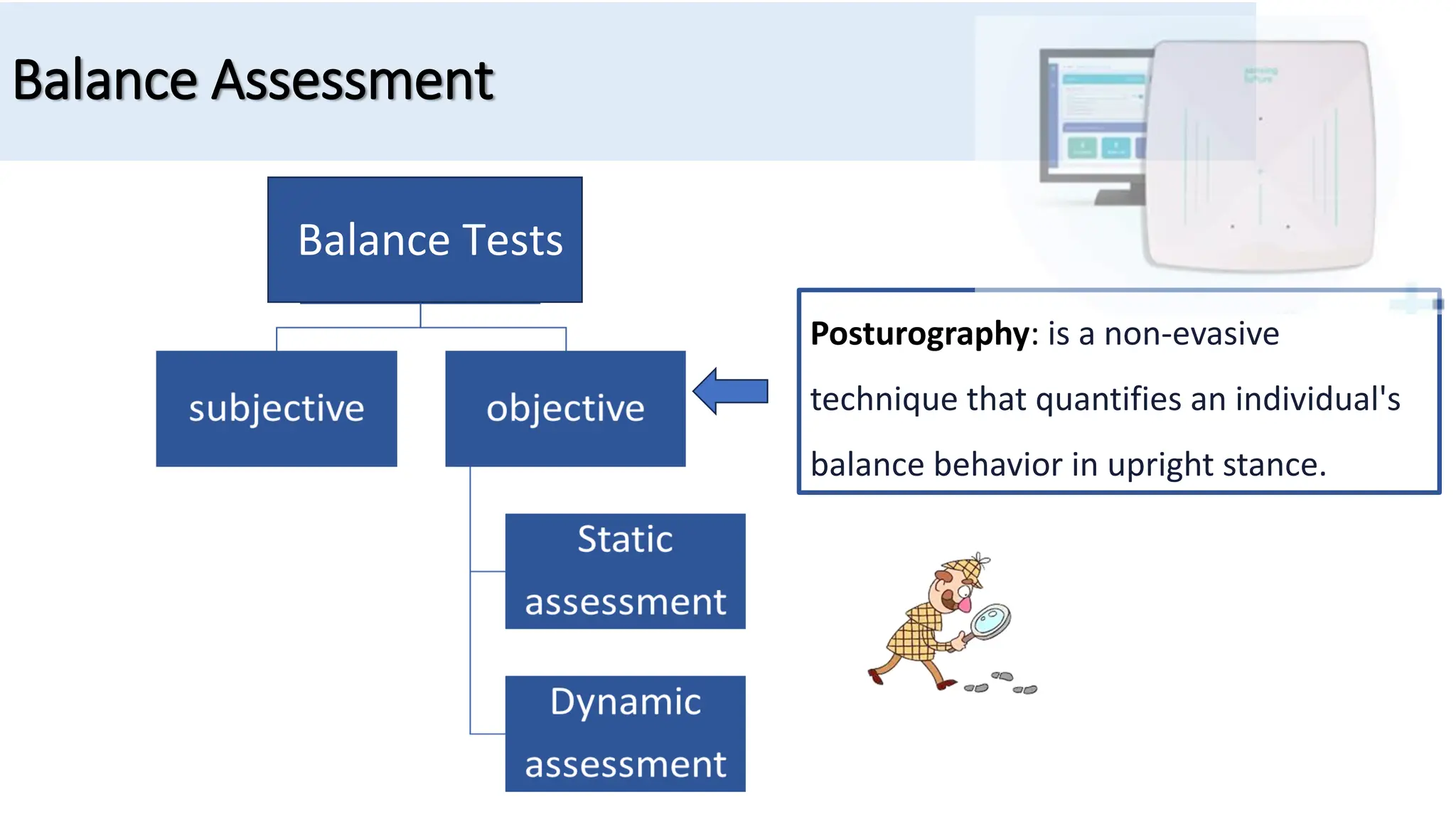
Balance Tests
Posturography: is a non-evasive
technique that quantifies an individual's
balance behavior in upright stance.
Balance Assessment
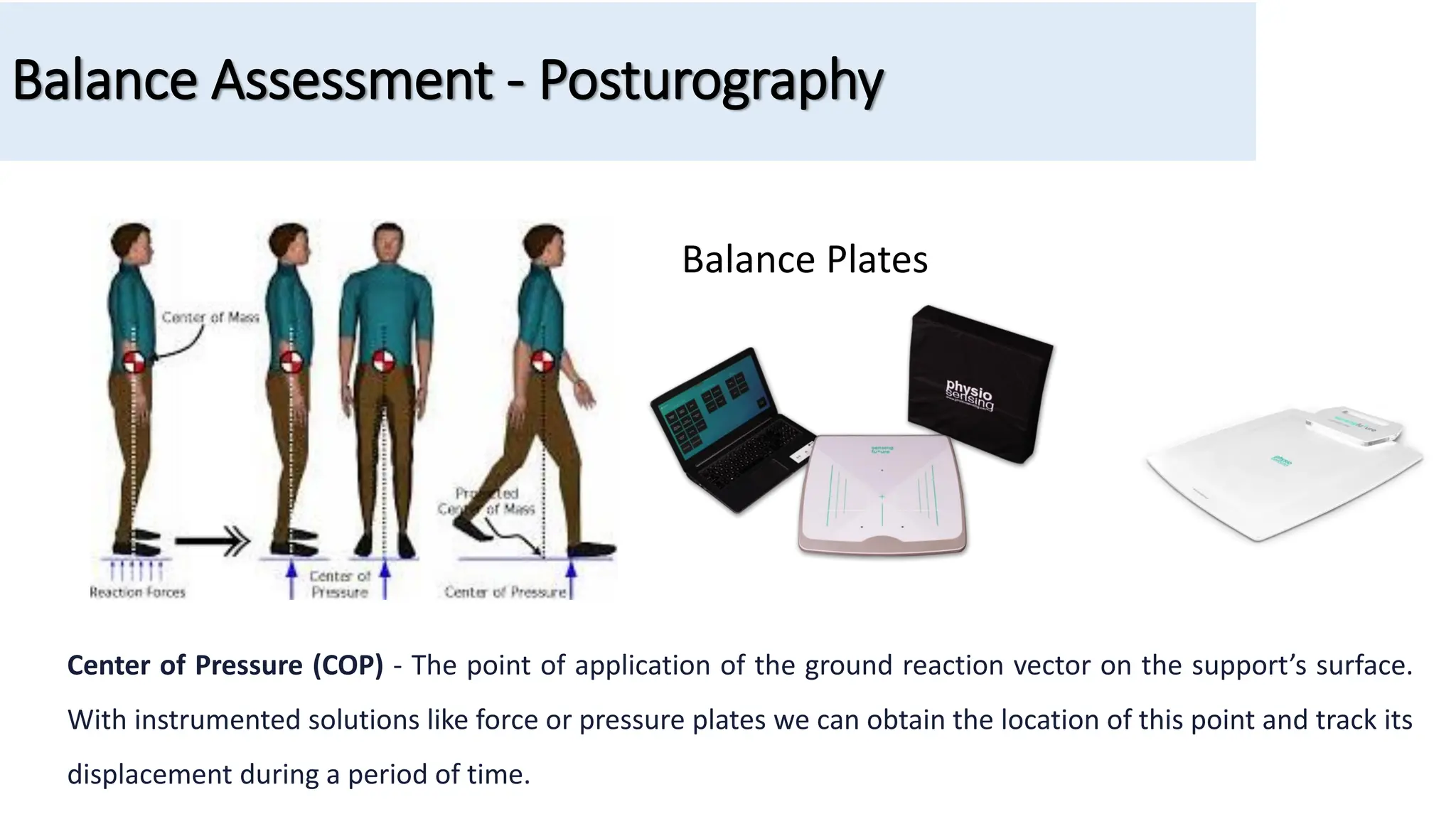
Center of Pressure (COP) - The point of application of the ground reaction vector on the support’s surface.
With instrumented solutions like force or pressure plates we can obtain the location of this point and track its
displacement during a period of time.
Balance Assessment - Posturography
Balance Plates
CoG
CoG
Mediolateral Anteroposterior
ML displacement
(right)
AP displacement
(front)
ML
Stabilogram
AP
Stabilogram
Stabilograms
What does a balance platform measures?
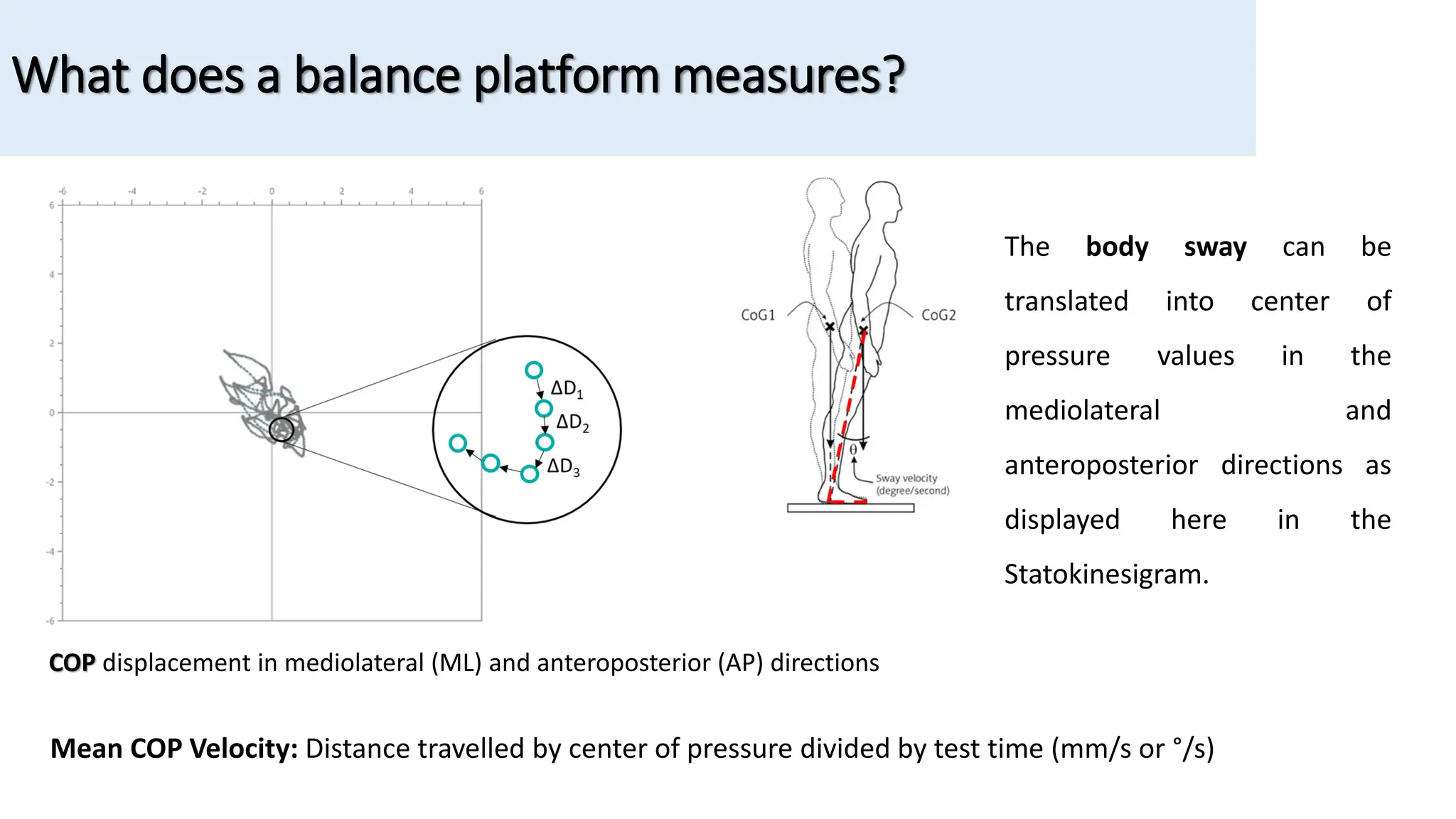
During an upright body position, it is possible to quantify the small corrections that are performed to oppose the
destabilizing effect of gravity. This stabilization of the body is visible in the center of pressure trajectory. As
illustrated here in this image. With force or pressure plates we can obtain the sway displacement during a period of
time in mediolateral and anteroposterior directions.
COP displacement in mediolateral (ML) and anteroposterior (AP) directions
What does a balance platform measures?
The body sway can be
translated into center of
pressure values in the
mediolateral and
anteroposterior directions as
displayed here in the
Statokinesigram.
Mean COP Velocity: Distance travelled by center of pressure divided by test time (mm/s or °/s)
Examples of parameters calculated in Posturography are:
COP Displacement or Length: total length of the center of
pressure path. The COP path is the series of data points
traced out by the movement of the COP.
AP and ML Range: Distance between maximum and minimum COP values in the anteroposterior and mediolateral direction
(mm).
COP Ellipse Area: Area of the prediction ellipse with 95% of the COP values (mm²).
Balance Assessment - Posturography
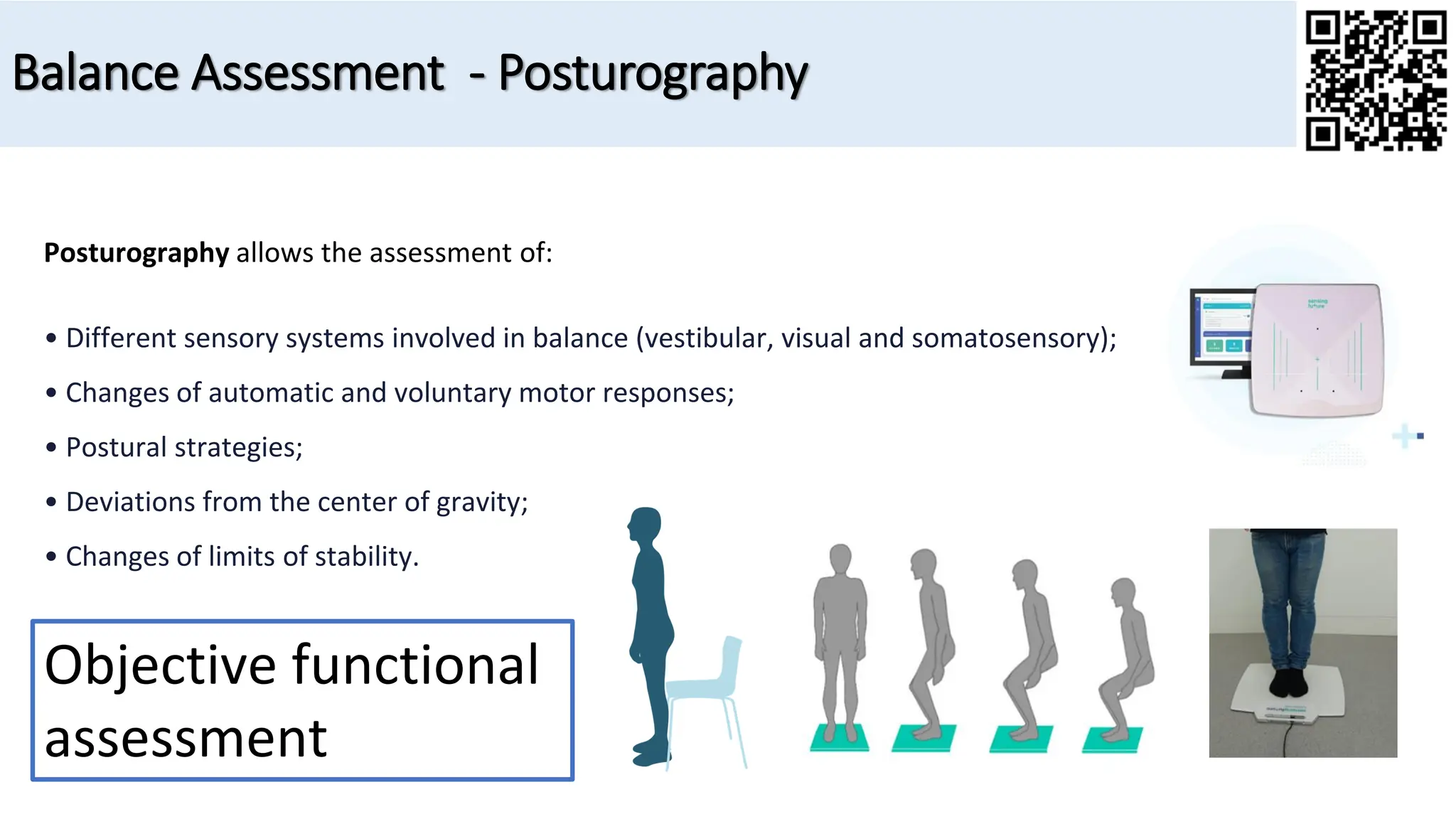
Posturography allows the assessment of:
• Different sensory systems involved in balance (vestibular, visual and somatosensory);
• Changes of automatic and voluntary motor responses;
• Postural strategies;
• Deviations from the center of gravity;
• Changes of limits of stability.
Objective functional
assessment
Balance Assessment - Posturography
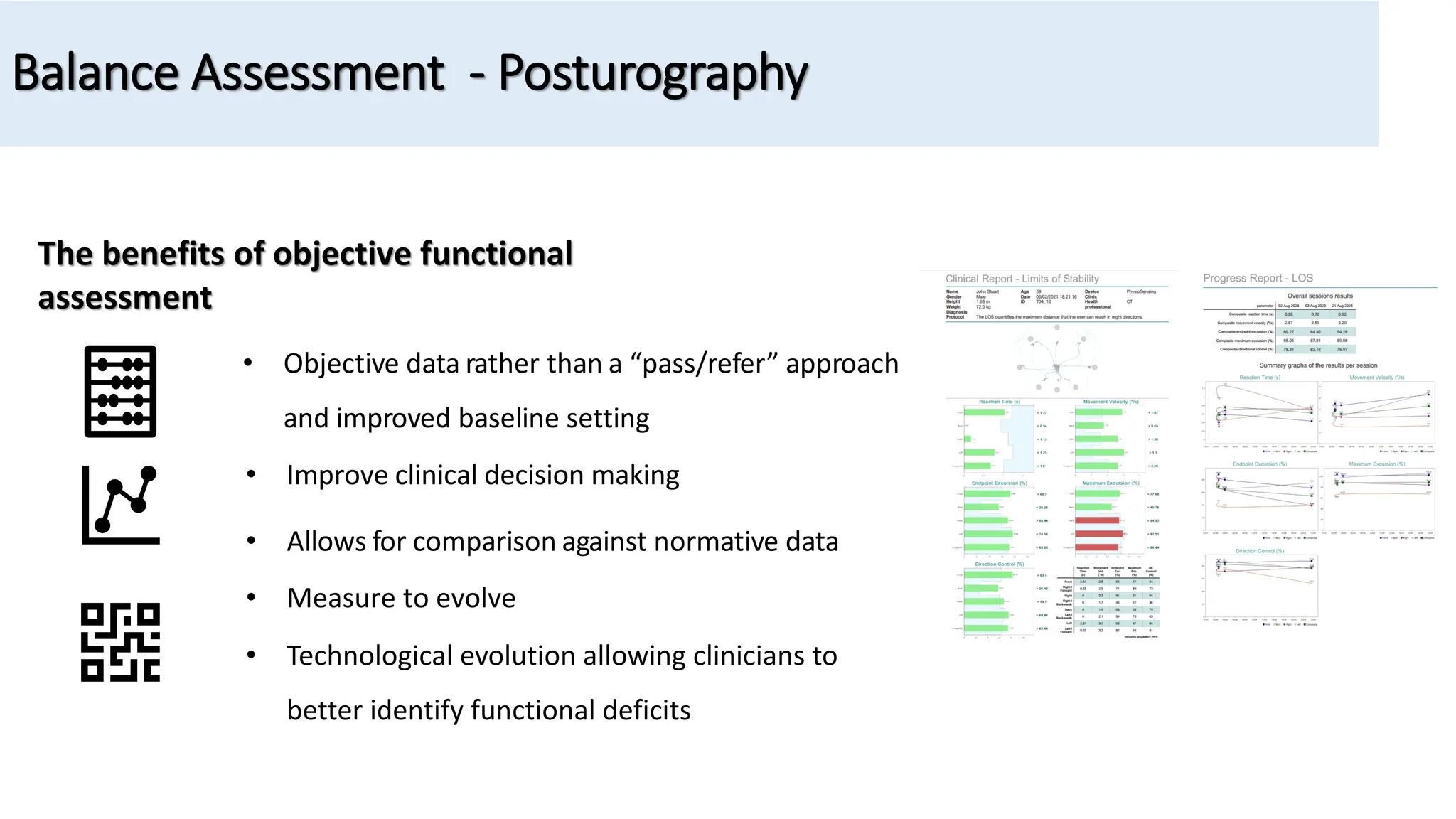
The benefits of objective functional
assessment
• Objective data rather than a “pass/refer” approach
and improved baseline setting
• Allows for comparison against normative data
• Technological evolution allowing clinicians to
better identify functional deficits
Balance Assessment - Posturography
• Improve clinical decision making
• Measure to evolve
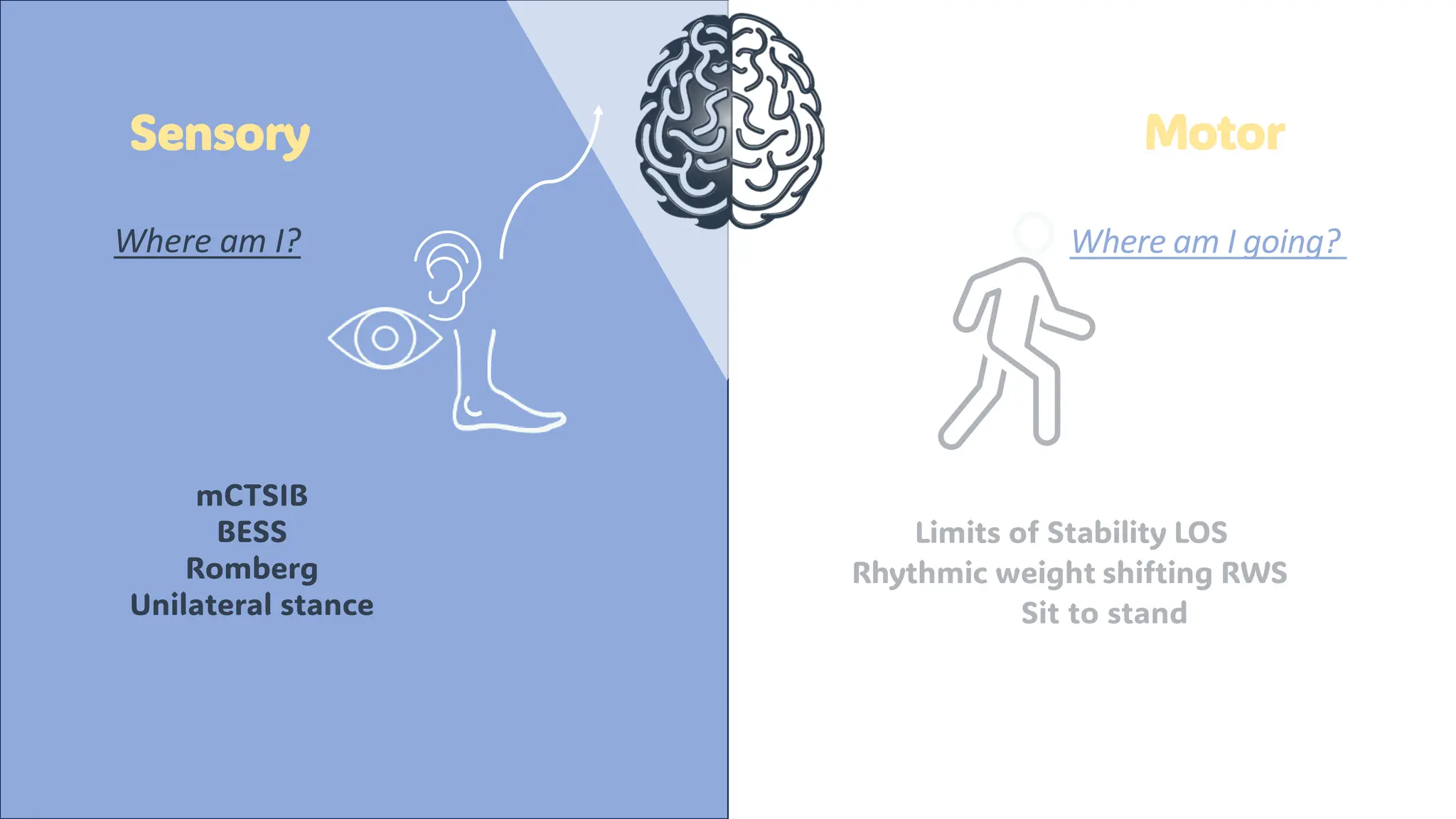
Sensory
Where am I?
Motor
Where am I going?
mCTSIB
BESS
Romberg
Unilateral stance
Limits of Stability LOS
Rhythmic weight shifting RWS
Sit to stand
➢ Balance alterations detected with static posturography
before being perceivable by the physician.
Ellipse Area Average sway speed
➢ Healthy subjects vs. Multiple Sclerosis Patients (with normal Romberg Test)
Posturography in Multiple Sclerosis
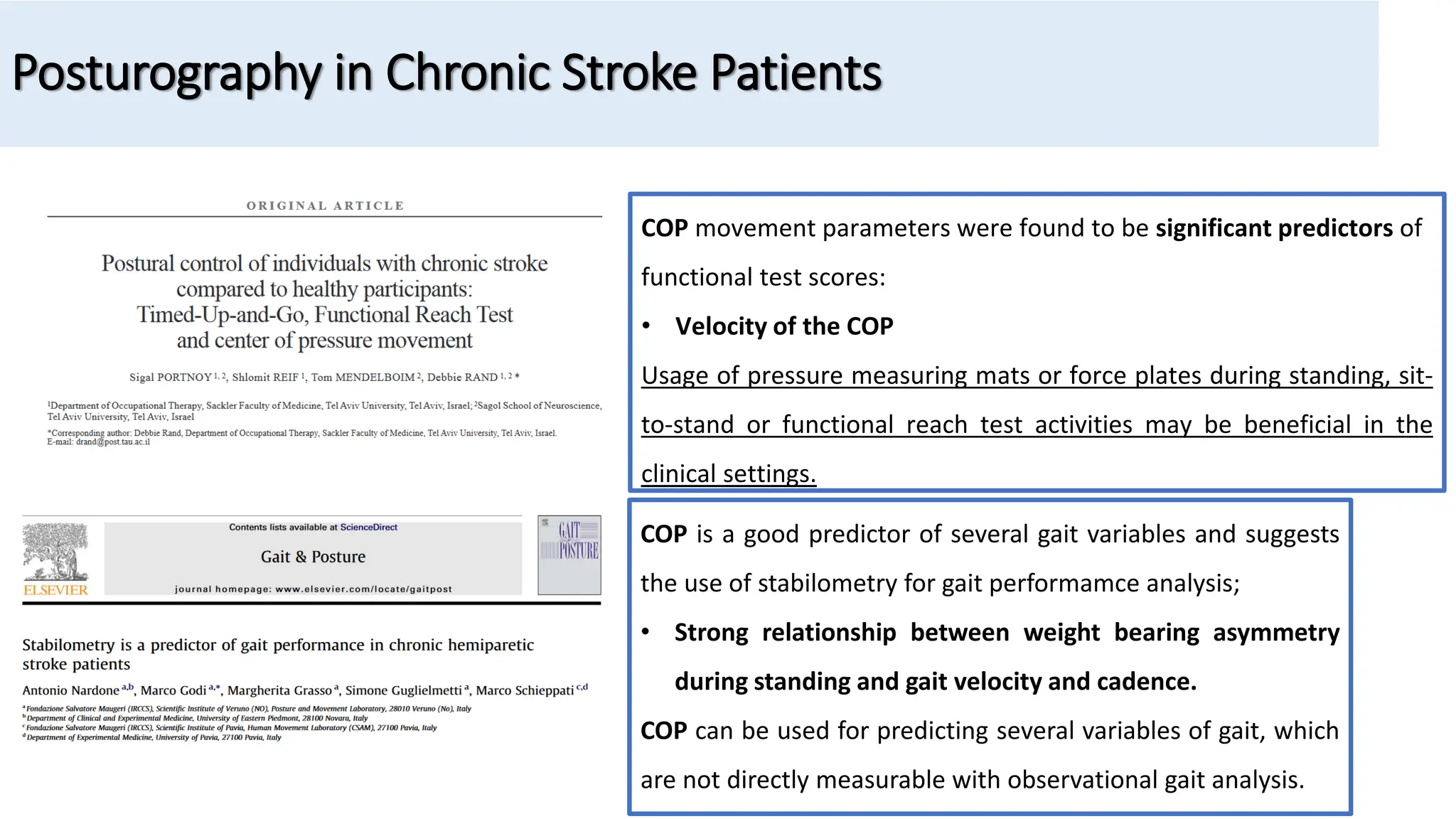
COP movement parameters were found to be significant predictors of
functional test scores:
• Velocity of the COP
Usage of pressure measuring mats or force plates during standing, sit-
to-stand or functional reach test activities may be beneficial in the
clinical settings.
COP is a good predictor of several gait variables and suggests
the use of stabilometry for gait performamce analysis;
• Strong relationship between weight bearing asymmetry
during standing and gait velocity and cadence.
COP can be used for predicting several variables of gait, which
are not directly measurable with observational gait analysis.
Posturography in Chronic Stroke Patients
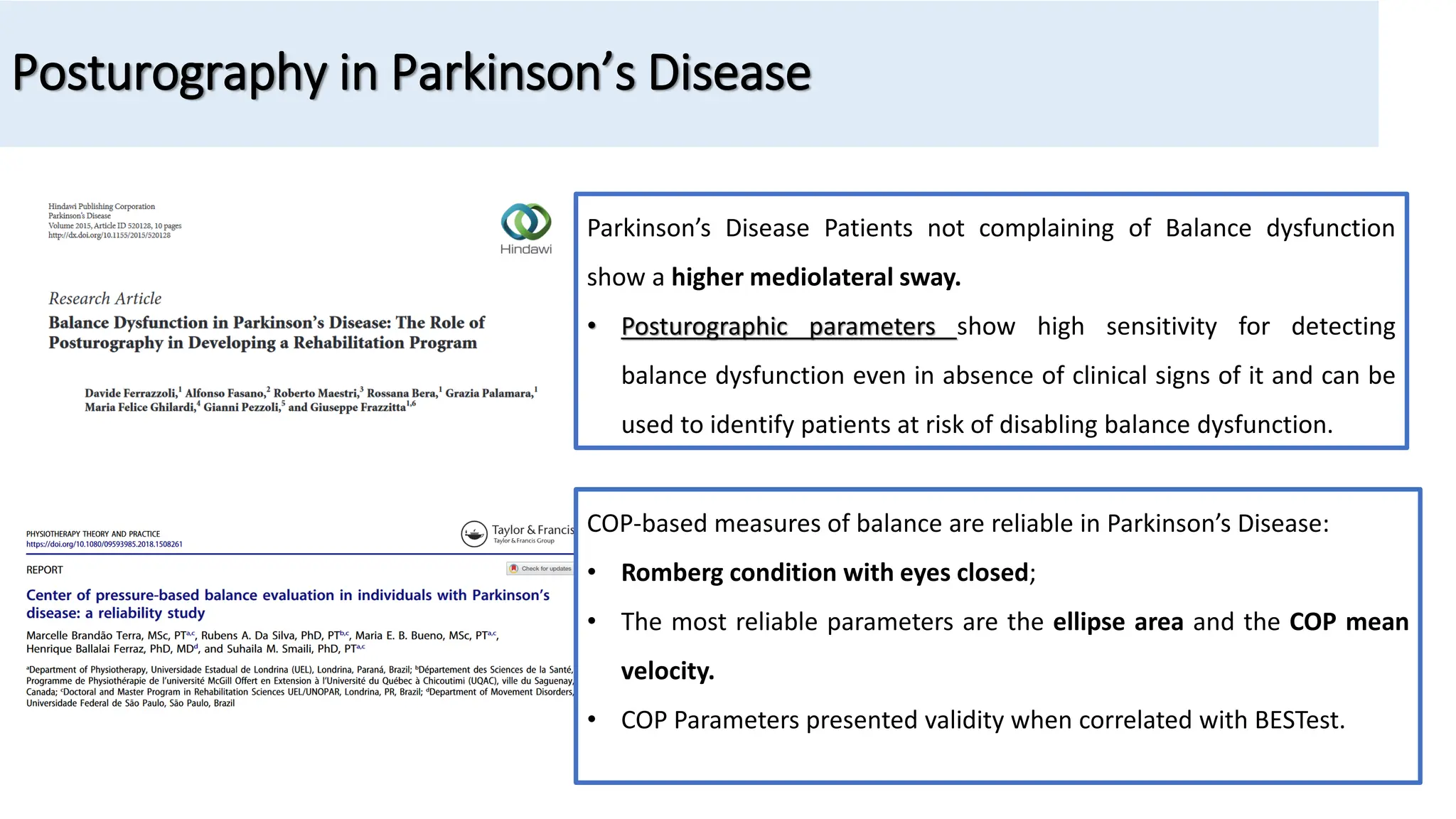
Parkinson’s Disease Patients not complaining of Balance dysfunction
show a higher mediolateral sway.
• Posturographic parameters show high sensitivity for detecting
balance dysfunction even in absence of clinical signs of it and can be
used to identify patients at risk of disabling balance dysfunction.
COP-based measures of balance are reliable in Parkinson’s Disease:
• Romberg condition with eyes closed;
• The most reliable parameters are the ellipse area and the COP mean
velocity.
• COP Parameters presented validity when correlated with BESTest.
Posturography in Parkinson’s Disease
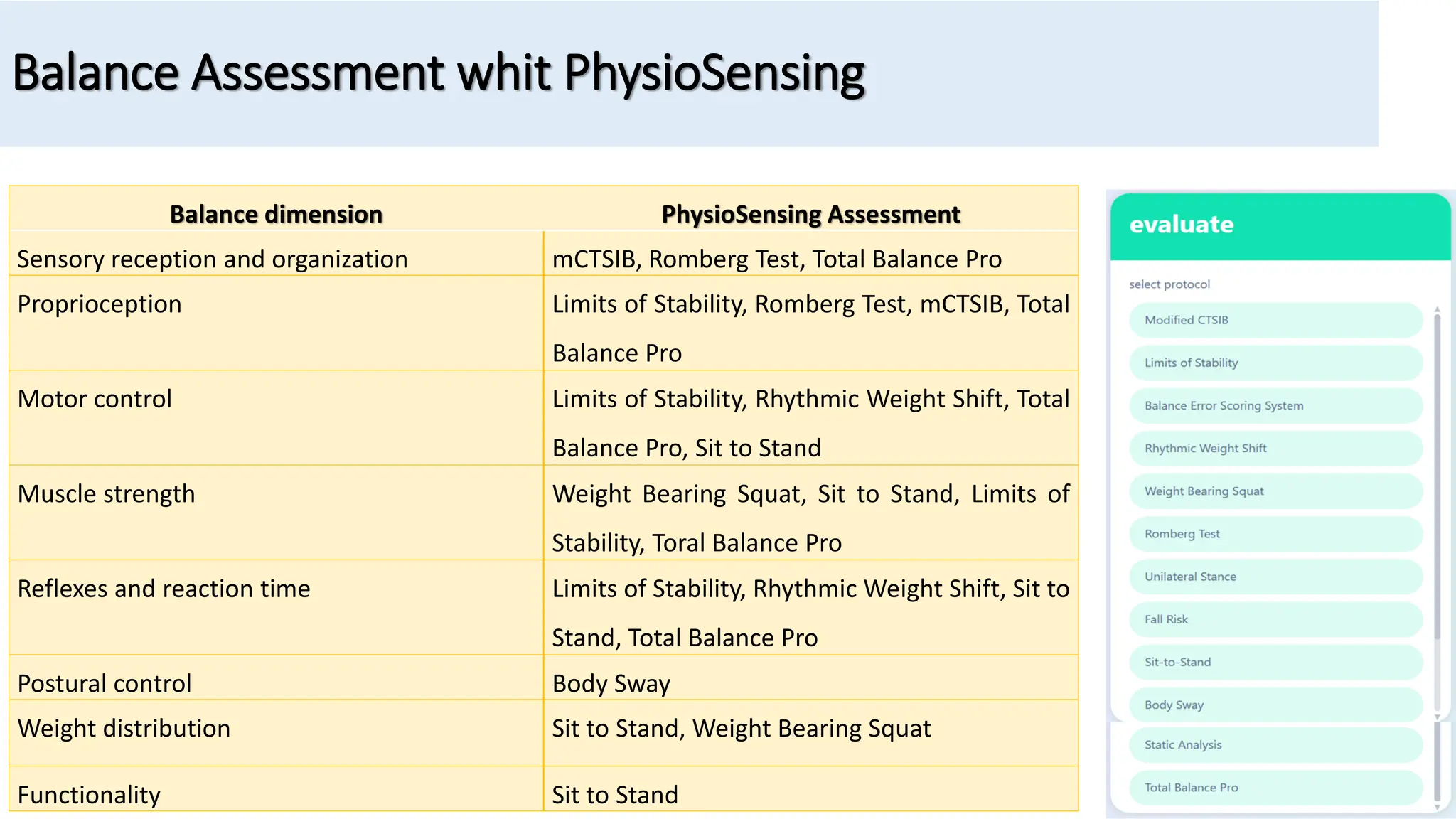
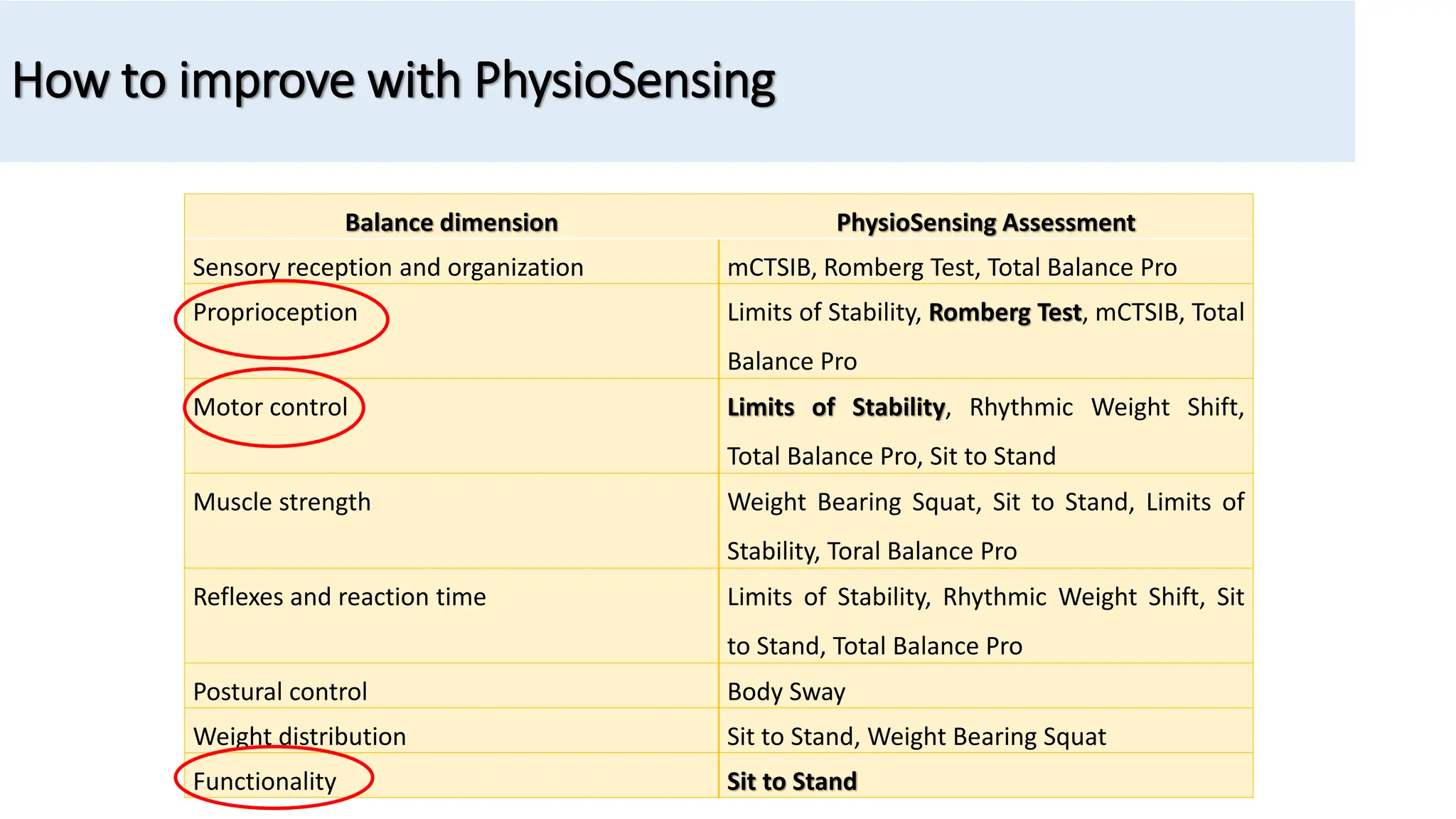
Balance dimension PhysioSensing Assessment
Sensory reception and organization mCTSIB, Romberg Test, Total Balance Pro
Proprioception Limits of Stability, Romberg Test, mCTSIB, Total
Balance Pro
Motor control Limits of Stability, Rhythmic Weight Shift, Total
Balance Pro, Sit to Stand
Muscle strength Weight Bearing Squat, Sit to Stand, Limits of
Stability, Toral Balance Pro
Reflexes and reaction time Limits of Stability, Rhythmic Weight Shift, Sit to
Stand, Total Balance Pro
Postural control Body Sway
Weight distribution Sit to Stand, Weight Bearing Squat
Functionality Sit to Stand
Balance Assessment whit PhysioSensing
Balance dimension PhysioSensing Assessment
Sensory reception and organization mCTSIB, Romberg Test, Total Balance Pro
Proprioception Limits of Stability, Romberg Test, mCTSIB,
Total Balance Pro
Motor control Limits of Stability, Rhythmic Weight Shift,
Total Balance Pro, Sit to Stand
Muscle strength Weight Bearing Squat, Sit to Stand, Limits of
Stability, Toral Balance Pro
Reflexes and reaction time Limits of Stability, Rhythmic Weight Shift, Sit
to Stand, Total Balance Pro
Postural control Body Sway
Weight distribution Sit to Stand, Weight Bearing Squat
Functionality Sit to Stand
Balance Assessment whit PhysioSensing
➢ If you have any questions
regarding this subject, you can
book a 15-minute meeting
with me by scanning this QR
CODE
Balance dimension PhysioSensing Assessment
Sensory reception and organization mCTSIB, Romberg Test, Total Balance Pro
Proprioception Limits of Stability, Romberg Test, mCTSIB, Total
Balance Pro
Motor control Limits of Stability, Rhythmic Weight Shift,
Total Balance Pro, Sit to Stand
Muscle strength Weight Bearing Squat, Sit to Stand, Limits of
Stability, Toral Balance Pro
Reflexes and reaction time Limits of Stability, Rhythmic Weight Shift, Sit
to Stand, Total Balance Pro
Postural control Body Sway
Weight distribution Sit to Stand, Weight Bearing Squat
Functionality Sit to Stand
How to improve with PhysioSensing
Goal:
The goal is to determine the maximum distance that the patient is able to displace his/her center of
pressure from the primary vertical position in different directions without losing balance taking a step.
Protocol:
This assessment requires the patient to lean at the ankles (not bend at the
waist or knees) forward, backward, and side to side. A healthy individual
can lean 6.25 –8 degrees to the front, 4.5 degrees to the back, and 8 degrees
to either side.
LOS determined by height of patient.
8
6,25-8
8
4,5
Assessing the limits of the patient’s stability in two keyways:
1.Bio-mechanic -how fast and far can the patient physically move?
2. Psychological – how fast and far is the patient psychologically willing to move?
Limits of stability
Possible causes of LOS impairment
1. Impaired cognitive processing: (most often due to aging)
2. Neuromuscular impairments: Conditions such as bradykinesia, ataxia, tremor etc
3. Musculoskeletal impairments: Weakness, limited range of motion (ROM), pain, lower limb pathology
4. Emotional Overlay: fear or anxiety
5. Imbalance due to vestibular causes
Limits of stability
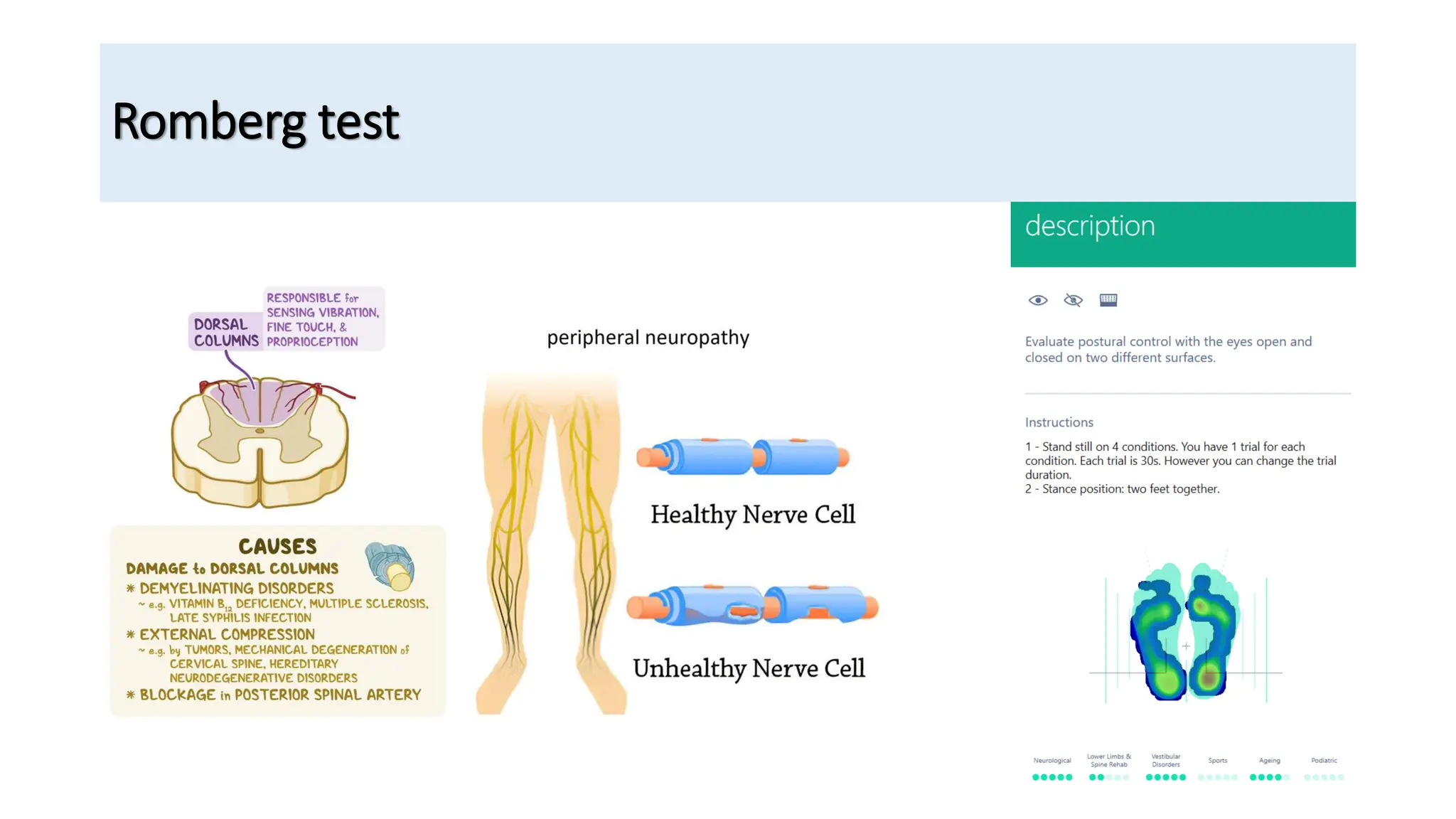
Romberg test
Romberg test
Somatosensory (Proprioception)
System
Vestibular System
Sit to Stand
In the next webinar we will talk about:
• How to perform a balance assessment and how to
plan a rehabilitation session with PhysioSensing.
How to Improve with PhysioSensing
28th November 2023
www.physiosensing.net
anasouto@sensingfuture.pt
www.physiosensing.net
anasouto@sensingfuture.pt
References
Bonan, I. V., Colle, F. M., Guichard, J. P., Vicaut, E., Eisenfisz, M., Tran Ba Huy, P., & Yelnik, A. P. (2004). Reliance on visual information after stroke. Part I: Balance on dynamic posturography.
Archives of Physical Medicine and Rehabilitation, 85(2), 268–273. https://doi.org/10.1016/j.apmr.2003.06.017
Cameron, M. H., & Nilsagard, Y. (2018). Balance, gait, and falls in multiple sclerosis. In Handbook of Clinical Neurology (Vol. 159, pp. 237–250). Elsevier. https://doi.org/10.1016/B978-0-444-
63916-5.00015-X
Chen, T., Fan, Y., Zhuang, X., Feng, D., Chen, Y., Chan, P., & Du, Y. (2018). Postural sway in patients with early Parkinson’s disease performing cognitive tasks while standing. Neurological
Research, 40(6), 491–498. https://doi.org/10.1080/01616412.2018.1451017
De Nunzio, A. M., Zucchella, C., Spicciato, F., Tortola, P., Vecchione, C., Pierelli, F., & Bartolo, M. (2014). Biofeedback rehabilitation of posture and weightbearing distribution in stroke: A
center of foot pressure analysis. Functional Neurology, 29(2), 127–134.
Duarte, M., & Freitas, S. M. S. F. (2010). Revision of posturography based on force plate for balance evaluation. Revista Brasileira De Fisioterapia (Sao Carlos (Sao Paulo, Brazil)), 14(3), 183–
192.
Elzière, M., Devèze, A., Bartoli, C., & Levy, G. (2017). Post-traumatic balance disorder. European Annals of Otorhinolaryngology, Head and Neck Diseases, 134(3), 171–175.
https://doi.org/10.1016/j.anorl.2016.10.005
Ferrazzoli, D., Fasano, A., Maestri, R., Bera, R., Palamara, G., Ghilardi, M. F., Pezzoli, G., & Frazzitta, G. (2015). Balance Dysfunction in Parkinson’s Disease: The Role of Posturography in
Developing a Rehabilitation Program. Parkinson’s Disease, 2015, 1–10. https://doi.org/10.1155/2015/520128
Forbes, P. A., Chen, A., & Blouin, J.-S. (2018). Sensorimotor control of standing balance. In Handbook of Clinical Neurology (Vol. 159, pp. 61–83). Elsevier. https://doi.org/10.1016/B978-0-
444-63916-5.00004-5
GBD 2016 Neurology Collaborators. (2019). Global, regional, and national burden of neurological disorders, 1990-2016: A systematic analysis for the Global Burden of Disease Study 2016.
The Lancet. Neurology, 18(5), 459–480. https://doi.org/10.1016/S1474-4422(18)30499-X
Guskiewicz, K. M., Ross, S. E., & Marshall, S. W. (2001). Postural Stability and Neuropsychological Deficits After Concussion in Collegiate Athletes. Journal of Athletic Training, 36(3), 263–273.
Halabchi, F., Alizadeh, Z., Sahraian, M. A., & Abolhasani, M. (2017). Exercise prescription for patients with multiple sclerosis; potential benefits and practical recommendations. BMC
Neurology, 17(1), 185. https://doi.org/10.1186/s12883-017-0960-9
References
Hugues, A., Di Marco, J., Janiaud, P., Xue, Y., Pires, J., Khademi, H., Cucherat, M., Bonan, I., Gueyffier, F., & Rode, G. (2017). Efficiency of physical therapy on postural imbalance after stroke: Study
protocol for a systematic review and meta-analysis. BMJ Open, 7(1), e013348. https://doi.org/10.1136/bmjopen-2016-013348
Hupfeld, K., McGregor, H., Hass, C., Pasternak, O., & Seidler, R. (2022). Sensory system-specific associations between brain structure and balance [Preprint]. Neuroscience.
https://doi.org/10.1101/2022.01.17.476654
Inojosa, H., Schriefer, D., Klöditz, A., Trentzsch, K., & Ziemssen, T. (2020). Balance Testing in Multiple Sclerosis-Improving Neurological Assessment With Static Posturography? Frontiers in Neurology,
11, 135. https://doi.org/10.3389/fneur.2020.00135
Kwakkel, G., Stinear, C., Essers, B., Munoz-Novoa, M., Branscheidt, M., Cabanas-Valdés, R., Lakičević, S., Lampropoulou, S., Luft, A. R., Marque, P., Moore, S. A., Solomon, J. M., Swinnen, E., Turolla,
A., Alt Murphy, M., & Verheyden, G. (2023). Motor rehabilitation after stroke: European Stroke Organisation (ESO) consensus-based definition and guiding framework. European Stroke Journal,
23969873231191304. https://doi.org/10.1177/23969873231191304
Lee, M. Y., Wong, M. K., Tang, F. T., Cheng, P. T., & Lin, P. S. (1997). Comparison of balance responses and motor patterns during sit-to-stand task with functional mobility in stroke patients. American
Journal of Physical Medicine & Rehabilitation, 76(5), 401–410. https://doi.org/10.1097/00002060-199709000-00011
Mancini, M., Carlson-Kuhta, P., Zampieri, C., Nutt, J. G., Chiari, L., & Horak, F. B. (2012). Postural sway as a marker of progression in Parkinson’s disease: A pilot longitudinal study. Gait & Posture,
36(3), 471–476. https://doi.org/10.1016/j.gaitpost.2012.04.010
Mancini, M., & Horak, F. B. (2010). The relevance of clinical balance assessment tools to differentiate balance deficits. European Journal of Physical and Rehabilitation Medicine, 46(2), 239–248.
Mansfield, A., Danells, C. J., Zettel, J. L., Black, S. E., & McIlroy, W. E. (2013). Determinants and consequences for standing balance of spontaneous weight-bearing on the paretic side among
individuals with chronic stroke. Gait & Posture, 38(3), 428–432. https://doi.org/10.1016/j.gaitpost.2013.01.005
Nardone, A., Godi, M., Grasso, M., Guglielmetti, S., & Schieppati, M. (2009). Stabilometry is a predictor of gait performance in chronic hemiparetic stroke patients. Gait & Posture, 30(1), 5–10.
https://doi.org/10.1016/j.gaitpost.2009.02.006
Nonnekes, J., Goselink, R. J. M., Růžička, E., Fasano, A., Nutt, J. G., & Bloem, B. R. (2018). Neurological disorders of gait, balance and posture: A sign-based approach. Nature Reviews Neurology,
14(3), 183–189. https://doi.org/10.1038/nrneurol.2017.178
Opara, J., Małecki, A., Małecka, E., & Socha, T. (2017). Motor assessment in Parkinson`s disease. Annals of Agricultural and Environmental Medicine, 24(3), 411–415.
https://doi.org/10.5604/12321966.1232774
References
References
Peterson, C. L., Ferrara, M. S., Mrazik, M., Piland, S., & Elliott, R. (2003). Evaluation of Neuropsychological Domain Scores and Postural Stability Following Cerebral Concussion in Sports:
Clinical Journal of Sport Medicine, 13(4), 230–237. https://doi.org/10.1097/00042752-200307000-00006
Portnoy, S., Reif, S., Mendelboim, T., & Rand, D. (2017). Postural control of individuals with chronic stroke compared to healthy participants: Timed-Up-and-Go, Functional Reach Test and
center of pressure movement. European Journal of Physical and Rehabilitation Medicine, 53(5). https://doi.org/10.23736/S1973-9087.17.04522-1
Row, J., Chan, L., Damiano, D., Shenouda, C., Collins, J., & Zampieri, C. (2019). Balance Assessment in Traumatic Brain Injury: A Comparison of the Sensory Organization and Limits of
Stability Tests. Journal of Neurotrauma, 36(16), 2435–2442. https://doi.org/10.1089/neu.2018.5755
Schröder, J., Saeys, W., Yperzeele, L., Kwakkel, G., & Truijen, S. (2022). Time Course and Mechanisms Underlying Standing Balance Recovery Early After Stroke: Design of a Prospective
Cohort Study With Repeated Measurements. Frontiers in Neurology, 13, 781416. https://doi.org/10.3389/fneur.2022.781416
Silsby, M., Yiannikas, C., Ng, K., Kiernan, M. C., Fung, V. S. C., & Vucic, S. (2022). Posturography as a biomarker of intravenous immunoglobulin efficacy in chronic inflammatory
demyelinating polyradiculoneuropathy. Muscle & Nerve, 65(1), 43–50. https://doi.org/10.1002/mus.27398
Takakusaki, K., Takahashi, M., Obara, K., & Chiba, R. (2017). Neural substrates involved in the control of posture. Advanced Robotics, 31(1–2), 2–23.
https://doi.org/10.1080/01691864.2016.1252690
Terra, M. B., Da Silva, R. A., Bueno, M. E. B., Ferraz, H. B., & Smaili, S. M. (2020). Center of pressure-based balance evaluation in individuals with Parkinson’s disease: A reliability study.
Physiotherapy Theory and Practice, 36(7), 826–833. https://doi.org/10.1080/09593985.2018.1508261
Valovich McLeod, T. C., & Hale, T. D. (2015). Vestibular and balance issues following sport-related concussion. Brain Injury, 29(2), 175–184.
https://doi.org/10.3109/02699052.2014.965206
Visser, J. E., Carpenter, M. G., Van Der Kooij, H., & Bloem, B. R. (2008). The clinical utility of posturography. Clinical Neurophysiology, 119(11), 2424–2436.
https://doi.org/10.1016/j.clinph.2008.07.220
References

Posturography in Neurological Disorders - How to assess and treat balance with PhysioSensing?

  • 1.
    Neurologic Disorders - Assessmentand Treatment of Balance – Part I Ana Souto, Physiotherapist Clinical Practice Specialist November 2023
  • 2.
    Neurologic Disorders - Assessment and Treatmentof Balance – Part I Ana Souto, Physiotherapist November 2023 Today you'll explore: 1️⃣ The Balance Control System and sensory systems interaction 👀 👂 🤾‍♂️ 2️⃣ Balance Control Disturbances in Neurologic Disorders 3️⃣ Balance Assessment using Posturography: Center of pressure and related parameters 4️⃣ Posturography's Role in Neurologic Disorders: Key insights 5️⃣ Limits of Stability Protocol, Romberg Test, and Sit to Stand Protocol for balance assessment in Neurologic Disorders
  • 3.
    Balance Control Impairment •Fall Risk • Limited activity capacity • Restriction in participation in daily life situations • Social isolation • Physical Inactivity Contextualizing – Neurologic Disorders
  • 4.
    Gaze Stabilization • VisualSystem • Vestibular System Postural Orientation • Somatosensory system – Proprioception 70% • Visual System – Visual cues of our surroundings 10% • Vestibular system – Spatial orientation, linear and rotation movement 20% Balance Control Balance Control System
  • 5.
  • 6.
    Gaze Stabilization • VisualSystem; • Vestibular System Postural Stabilization • Proprioception Integration and organizarion of sensory input Neural Comand Motor output When Balance Gets Though
  • 7.
    Postural Imbalance: • Increasedbody sway during quiet stance • Asymmetrical lower limb weight distribution • Decreased Limits of Stability • Excessive reliance on Visual input • Impaired anticipatory postural adjustments. • Proprioception • Muscle tonus • Muscle strength • Reflexes • Motor Control When Balance Gets Though – Stroke
  • 8.
    • Proprioception • Axialmuscle tone • Postural Reflexes • Impaired Cognition • Visual stimuli perception • Narrow Stance Postural Imbalance • Displacement of center of mass over the base of support; • Increased Body Sway • High body Sway velocity When Balance Gets Though – Parkinson's Disease
  • 9.
    Acute Neurological Disorder BalanceDysfunction: • Dizziness • Unsteadiness • Decrease in one´s limits of stability • Decreased speed of information processing; • Difficulties in Sensory integration and organization, involving the use of visual, proprioceptive and/or Vestibular inputs • Vestibular System Disruption When Balance Gets Though – Concussions
  • 10.
    • Weakness • Spasticity •Fatigue • Proprioceptive Deficit • Coordination Deficit • Vision alterations • Cognitive alterations Postural Imbalance Gait dysfunction High Fall Risk When Balance Gets Though – Multiple Sclerosis
  • 11.
    Balance Assessment Is therea problem? What is the problem? What is causing the problem? How much of a problem is it? Objective and quantitative measurements Simple but vital information Diagnosis and treatment planning
  • 12.
    Balance Tests Posturography: isa non-evasive technique that quantifies an individual's balance behavior in upright stance. Balance Assessment
  • 13.
    Center of Pressure(COP) - The point of application of the ground reaction vector on the support’s surface. With instrumented solutions like force or pressure plates we can obtain the location of this point and track its displacement during a period of time. Balance Assessment - Posturography Balance Plates
  • 14.
    CoG CoG Mediolateral Anteroposterior ML displacement (right) APdisplacement (front) ML Stabilogram AP Stabilogram Stabilograms What does a balance platform measures? During an upright body position, it is possible to quantify the small corrections that are performed to oppose the destabilizing effect of gravity. This stabilization of the body is visible in the center of pressure trajectory. As illustrated here in this image. With force or pressure plates we can obtain the sway displacement during a period of time in mediolateral and anteroposterior directions.
  • 15.
    COP displacement inmediolateral (ML) and anteroposterior (AP) directions What does a balance platform measures? The body sway can be translated into center of pressure values in the mediolateral and anteroposterior directions as displayed here in the Statokinesigram. Mean COP Velocity: Distance travelled by center of pressure divided by test time (mm/s or °/s)
  • 16.
    Examples of parameterscalculated in Posturography are: COP Displacement or Length: total length of the center of pressure path. The COP path is the series of data points traced out by the movement of the COP. AP and ML Range: Distance between maximum and minimum COP values in the anteroposterior and mediolateral direction (mm). COP Ellipse Area: Area of the prediction ellipse with 95% of the COP values (mm²). Balance Assessment - Posturography
  • 17.
    Posturography allows theassessment of: • Different sensory systems involved in balance (vestibular, visual and somatosensory); • Changes of automatic and voluntary motor responses; • Postural strategies; • Deviations from the center of gravity; • Changes of limits of stability. Objective functional assessment Balance Assessment - Posturography
  • 18.
    The benefits ofobjective functional assessment • Objective data rather than a “pass/refer” approach and improved baseline setting • Allows for comparison against normative data • Technological evolution allowing clinicians to better identify functional deficits Balance Assessment - Posturography • Improve clinical decision making • Measure to evolve
  • 19.
    Sensory Where am I? Motor Wheream I going? mCTSIB BESS Romberg Unilateral stance Limits of Stability LOS Rhythmic weight shifting RWS Sit to stand
  • 20.
    ➢ Balance alterationsdetected with static posturography before being perceivable by the physician. Ellipse Area Average sway speed ➢ Healthy subjects vs. Multiple Sclerosis Patients (with normal Romberg Test) Posturography in Multiple Sclerosis
  • 21.
    COP movement parameterswere found to be significant predictors of functional test scores: • Velocity of the COP Usage of pressure measuring mats or force plates during standing, sit- to-stand or functional reach test activities may be beneficial in the clinical settings. COP is a good predictor of several gait variables and suggests the use of stabilometry for gait performamce analysis; • Strong relationship between weight bearing asymmetry during standing and gait velocity and cadence. COP can be used for predicting several variables of gait, which are not directly measurable with observational gait analysis. Posturography in Chronic Stroke Patients
  • 22.
    Parkinson’s Disease Patientsnot complaining of Balance dysfunction show a higher mediolateral sway. • Posturographic parameters show high sensitivity for detecting balance dysfunction even in absence of clinical signs of it and can be used to identify patients at risk of disabling balance dysfunction. COP-based measures of balance are reliable in Parkinson’s Disease: • Romberg condition with eyes closed; • The most reliable parameters are the ellipse area and the COP mean velocity. • COP Parameters presented validity when correlated with BESTest. Posturography in Parkinson’s Disease
  • 23.
    Balance dimension PhysioSensingAssessment Sensory reception and organization mCTSIB, Romberg Test, Total Balance Pro Proprioception Limits of Stability, Romberg Test, mCTSIB, Total Balance Pro Motor control Limits of Stability, Rhythmic Weight Shift, Total Balance Pro, Sit to Stand Muscle strength Weight Bearing Squat, Sit to Stand, Limits of Stability, Toral Balance Pro Reflexes and reaction time Limits of Stability, Rhythmic Weight Shift, Sit to Stand, Total Balance Pro Postural control Body Sway Weight distribution Sit to Stand, Weight Bearing Squat Functionality Sit to Stand Balance Assessment whit PhysioSensing
  • 24.
    Balance dimension PhysioSensingAssessment Sensory reception and organization mCTSIB, Romberg Test, Total Balance Pro Proprioception Limits of Stability, Romberg Test, mCTSIB, Total Balance Pro Motor control Limits of Stability, Rhythmic Weight Shift, Total Balance Pro, Sit to Stand Muscle strength Weight Bearing Squat, Sit to Stand, Limits of Stability, Toral Balance Pro Reflexes and reaction time Limits of Stability, Rhythmic Weight Shift, Sit to Stand, Total Balance Pro Postural control Body Sway Weight distribution Sit to Stand, Weight Bearing Squat Functionality Sit to Stand Balance Assessment whit PhysioSensing ➢ If you have any questions regarding this subject, you can book a 15-minute meeting with me by scanning this QR CODE
  • 25.
    Balance dimension PhysioSensingAssessment Sensory reception and organization mCTSIB, Romberg Test, Total Balance Pro Proprioception Limits of Stability, Romberg Test, mCTSIB, Total Balance Pro Motor control Limits of Stability, Rhythmic Weight Shift, Total Balance Pro, Sit to Stand Muscle strength Weight Bearing Squat, Sit to Stand, Limits of Stability, Toral Balance Pro Reflexes and reaction time Limits of Stability, Rhythmic Weight Shift, Sit to Stand, Total Balance Pro Postural control Body Sway Weight distribution Sit to Stand, Weight Bearing Squat Functionality Sit to Stand How to improve with PhysioSensing
  • 26.
    Goal: The goal isto determine the maximum distance that the patient is able to displace his/her center of pressure from the primary vertical position in different directions without losing balance taking a step. Protocol: This assessment requires the patient to lean at the ankles (not bend at the waist or knees) forward, backward, and side to side. A healthy individual can lean 6.25 –8 degrees to the front, 4.5 degrees to the back, and 8 degrees to either side. LOS determined by height of patient. 8 6,25-8 8 4,5 Assessing the limits of the patient’s stability in two keyways: 1.Bio-mechanic -how fast and far can the patient physically move? 2. Psychological – how fast and far is the patient psychologically willing to move? Limits of stability
  • 27.
    Possible causes ofLOS impairment 1. Impaired cognitive processing: (most often due to aging) 2. Neuromuscular impairments: Conditions such as bradykinesia, ataxia, tremor etc 3. Musculoskeletal impairments: Weakness, limited range of motion (ROM), pain, lower limb pathology 4. Emotional Overlay: fear or anxiety 5. Imbalance due to vestibular causes Limits of stability
  • 28.
  • 29.
  • 30.
  • 31.
    In the nextwebinar we will talk about: • How to perform a balance assessment and how to plan a rehabilitation session with PhysioSensing. How to Improve with PhysioSensing 28th November 2023
  • 32.
  • 34.
  • 35.
    References Bonan, I. V.,Colle, F. M., Guichard, J. P., Vicaut, E., Eisenfisz, M., Tran Ba Huy, P., & Yelnik, A. P. (2004). Reliance on visual information after stroke. Part I: Balance on dynamic posturography. Archives of Physical Medicine and Rehabilitation, 85(2), 268–273. https://doi.org/10.1016/j.apmr.2003.06.017 Cameron, M. H., & Nilsagard, Y. (2018). Balance, gait, and falls in multiple sclerosis. In Handbook of Clinical Neurology (Vol. 159, pp. 237–250). Elsevier. https://doi.org/10.1016/B978-0-444- 63916-5.00015-X Chen, T., Fan, Y., Zhuang, X., Feng, D., Chen, Y., Chan, P., & Du, Y. (2018). Postural sway in patients with early Parkinson’s disease performing cognitive tasks while standing. Neurological Research, 40(6), 491–498. https://doi.org/10.1080/01616412.2018.1451017 De Nunzio, A. M., Zucchella, C., Spicciato, F., Tortola, P., Vecchione, C., Pierelli, F., & Bartolo, M. (2014). Biofeedback rehabilitation of posture and weightbearing distribution in stroke: A center of foot pressure analysis. Functional Neurology, 29(2), 127–134. Duarte, M., & Freitas, S. M. S. F. (2010). Revision of posturography based on force plate for balance evaluation. Revista Brasileira De Fisioterapia (Sao Carlos (Sao Paulo, Brazil)), 14(3), 183– 192. Elzière, M., Devèze, A., Bartoli, C., & Levy, G. (2017). Post-traumatic balance disorder. European Annals of Otorhinolaryngology, Head and Neck Diseases, 134(3), 171–175. https://doi.org/10.1016/j.anorl.2016.10.005 Ferrazzoli, D., Fasano, A., Maestri, R., Bera, R., Palamara, G., Ghilardi, M. F., Pezzoli, G., & Frazzitta, G. (2015). Balance Dysfunction in Parkinson’s Disease: The Role of Posturography in Developing a Rehabilitation Program. Parkinson’s Disease, 2015, 1–10. https://doi.org/10.1155/2015/520128 Forbes, P. A., Chen, A., & Blouin, J.-S. (2018). Sensorimotor control of standing balance. In Handbook of Clinical Neurology (Vol. 159, pp. 61–83). Elsevier. https://doi.org/10.1016/B978-0- 444-63916-5.00004-5 GBD 2016 Neurology Collaborators. (2019). Global, regional, and national burden of neurological disorders, 1990-2016: A systematic analysis for the Global Burden of Disease Study 2016. The Lancet. Neurology, 18(5), 459–480. https://doi.org/10.1016/S1474-4422(18)30499-X Guskiewicz, K. M., Ross, S. E., & Marshall, S. W. (2001). Postural Stability and Neuropsychological Deficits After Concussion in Collegiate Athletes. Journal of Athletic Training, 36(3), 263–273. Halabchi, F., Alizadeh, Z., Sahraian, M. A., & Abolhasani, M. (2017). Exercise prescription for patients with multiple sclerosis; potential benefits and practical recommendations. BMC Neurology, 17(1), 185. https://doi.org/10.1186/s12883-017-0960-9 References
  • 36.
    Hugues, A., DiMarco, J., Janiaud, P., Xue, Y., Pires, J., Khademi, H., Cucherat, M., Bonan, I., Gueyffier, F., & Rode, G. (2017). Efficiency of physical therapy on postural imbalance after stroke: Study protocol for a systematic review and meta-analysis. BMJ Open, 7(1), e013348. https://doi.org/10.1136/bmjopen-2016-013348 Hupfeld, K., McGregor, H., Hass, C., Pasternak, O., & Seidler, R. (2022). Sensory system-specific associations between brain structure and balance [Preprint]. Neuroscience. https://doi.org/10.1101/2022.01.17.476654 Inojosa, H., Schriefer, D., Klöditz, A., Trentzsch, K., & Ziemssen, T. (2020). Balance Testing in Multiple Sclerosis-Improving Neurological Assessment With Static Posturography? Frontiers in Neurology, 11, 135. https://doi.org/10.3389/fneur.2020.00135 Kwakkel, G., Stinear, C., Essers, B., Munoz-Novoa, M., Branscheidt, M., Cabanas-Valdés, R., Lakičević, S., Lampropoulou, S., Luft, A. R., Marque, P., Moore, S. A., Solomon, J. M., Swinnen, E., Turolla, A., Alt Murphy, M., & Verheyden, G. (2023). Motor rehabilitation after stroke: European Stroke Organisation (ESO) consensus-based definition and guiding framework. European Stroke Journal, 23969873231191304. https://doi.org/10.1177/23969873231191304 Lee, M. Y., Wong, M. K., Tang, F. T., Cheng, P. T., & Lin, P. S. (1997). Comparison of balance responses and motor patterns during sit-to-stand task with functional mobility in stroke patients. American Journal of Physical Medicine & Rehabilitation, 76(5), 401–410. https://doi.org/10.1097/00002060-199709000-00011 Mancini, M., Carlson-Kuhta, P., Zampieri, C., Nutt, J. G., Chiari, L., & Horak, F. B. (2012). Postural sway as a marker of progression in Parkinson’s disease: A pilot longitudinal study. Gait & Posture, 36(3), 471–476. https://doi.org/10.1016/j.gaitpost.2012.04.010 Mancini, M., & Horak, F. B. (2010). The relevance of clinical balance assessment tools to differentiate balance deficits. European Journal of Physical and Rehabilitation Medicine, 46(2), 239–248. Mansfield, A., Danells, C. J., Zettel, J. L., Black, S. E., & McIlroy, W. E. (2013). Determinants and consequences for standing balance of spontaneous weight-bearing on the paretic side among individuals with chronic stroke. Gait & Posture, 38(3), 428–432. https://doi.org/10.1016/j.gaitpost.2013.01.005 Nardone, A., Godi, M., Grasso, M., Guglielmetti, S., & Schieppati, M. (2009). Stabilometry is a predictor of gait performance in chronic hemiparetic stroke patients. Gait & Posture, 30(1), 5–10. https://doi.org/10.1016/j.gaitpost.2009.02.006 Nonnekes, J., Goselink, R. J. M., Růžička, E., Fasano, A., Nutt, J. G., & Bloem, B. R. (2018). Neurological disorders of gait, balance and posture: A sign-based approach. Nature Reviews Neurology, 14(3), 183–189. https://doi.org/10.1038/nrneurol.2017.178 Opara, J., Małecki, A., Małecka, E., & Socha, T. (2017). Motor assessment in Parkinson`s disease. Annals of Agricultural and Environmental Medicine, 24(3), 411–415. https://doi.org/10.5604/12321966.1232774 References
  • 37.
    References Peterson, C. L.,Ferrara, M. S., Mrazik, M., Piland, S., & Elliott, R. (2003). Evaluation of Neuropsychological Domain Scores and Postural Stability Following Cerebral Concussion in Sports: Clinical Journal of Sport Medicine, 13(4), 230–237. https://doi.org/10.1097/00042752-200307000-00006 Portnoy, S., Reif, S., Mendelboim, T., & Rand, D. (2017). Postural control of individuals with chronic stroke compared to healthy participants: Timed-Up-and-Go, Functional Reach Test and center of pressure movement. European Journal of Physical and Rehabilitation Medicine, 53(5). https://doi.org/10.23736/S1973-9087.17.04522-1 Row, J., Chan, L., Damiano, D., Shenouda, C., Collins, J., & Zampieri, C. (2019). Balance Assessment in Traumatic Brain Injury: A Comparison of the Sensory Organization and Limits of Stability Tests. Journal of Neurotrauma, 36(16), 2435–2442. https://doi.org/10.1089/neu.2018.5755 Schröder, J., Saeys, W., Yperzeele, L., Kwakkel, G., & Truijen, S. (2022). Time Course and Mechanisms Underlying Standing Balance Recovery Early After Stroke: Design of a Prospective Cohort Study With Repeated Measurements. Frontiers in Neurology, 13, 781416. https://doi.org/10.3389/fneur.2022.781416 Silsby, M., Yiannikas, C., Ng, K., Kiernan, M. C., Fung, V. S. C., & Vucic, S. (2022). Posturography as a biomarker of intravenous immunoglobulin efficacy in chronic inflammatory demyelinating polyradiculoneuropathy. Muscle & Nerve, 65(1), 43–50. https://doi.org/10.1002/mus.27398 Takakusaki, K., Takahashi, M., Obara, K., & Chiba, R. (2017). Neural substrates involved in the control of posture. Advanced Robotics, 31(1–2), 2–23. https://doi.org/10.1080/01691864.2016.1252690 Terra, M. B., Da Silva, R. A., Bueno, M. E. B., Ferraz, H. B., & Smaili, S. M. (2020). Center of pressure-based balance evaluation in individuals with Parkinson’s disease: A reliability study. Physiotherapy Theory and Practice, 36(7), 826–833. https://doi.org/10.1080/09593985.2018.1508261 Valovich McLeod, T. C., & Hale, T. D. (2015). Vestibular and balance issues following sport-related concussion. Brain Injury, 29(2), 175–184. https://doi.org/10.3109/02699052.2014.965206 Visser, J. E., Carpenter, M. G., Van Der Kooij, H., & Bloem, B. R. (2008). The clinical utility of posturography. Clinical Neurophysiology, 119(11), 2424–2436. https://doi.org/10.1016/j.clinph.2008.07.220 References