COMPUTER ARCHITECTURE
UNIT – II ARITHMETIC OPERATIONS
CA PPT5 ARITHMETIC, ALU
1
ALU - Addition and subtraction – Multiplication – Division – Floating
Point operations – Subword parallelism
Arithmetic for Computers
 ALU - Arithmetic & Logic Unit
 Responsible for performing arithmetic operations such as addition,
subtraction, division and multiplication and logical operations such
as AND, OR and their inversion etc.,
 Arithmetic operations are performed on data type
Fixed point numbers
Floating point numbers
 Representing number in such data type is known as
Fixed point representation
Floating point representation
CA PPT5 ARITHMETIC, ALU
2
Fixed point representation
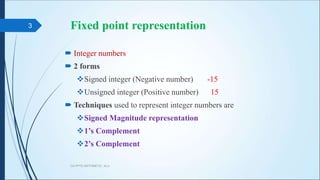
 Integer numbers
 2 forms
Signed integer (Negative number) -15
Unsigned integer (Positive number) 15
 Techniques used to represent integer numbers are
Signed Magnitude representation
1’s Complement
2’s Complement
CA PPT5 ARITHMETIC, ALU
3
Signed Magnitude representation
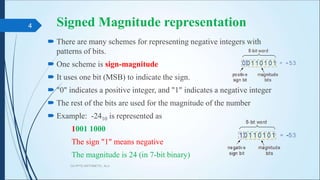
 There are many schemes for representing negative integers with
patterns of bits.
 One scheme is sign-magnitude
 It uses one bit (MSB) to indicate the sign.
 "0" indicates a positive integer, and "1" indicates a negative integer
 The rest of the bits are used for the magnitude of the number
 Example: -2410 is represented as
1001 1000
The sign "1" means negative
The magnitude is 24 (in 7-bit binary)
CA PPT5 ARITHMETIC, ALU
4
Example
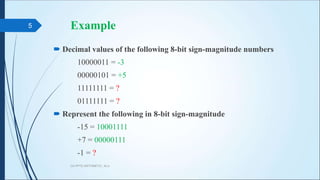
 Decimal values of the following 8-bit sign-magnitude numbers
10000011 = -3
00000101 = +5
11111111 = ?
01111111 = ?
 Represent the following in 8-bit sign-magnitude
-15 = 10001111
+7 = 00000111
-1 = ?
CA PPT5 ARITHMETIC, ALU
5
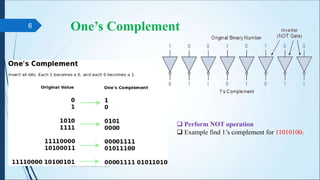
One’s Complement
CA PPT5 ARITHMETIC, ALU
6
 Perform NOT operation
 Example find 1’s complement for 110101002
Two’s Complement
CA PPT5 ARITHMETIC, ALU
7
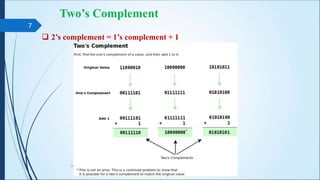
 2’s complement = 1’s complement + 1
Two’s Complement
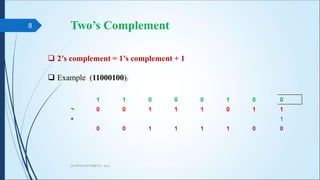
1 1 0 0 0 1 0 0
¬ 0 0 1 1 1 0 1 1
+ 1
0 0 1 1 1 1 0 0
CA PPT5 ARITHMETIC, ALU
8
 2’s complement = 1’s complement + 1
 Example (11000100)2
Addition & Subtraction
Addition
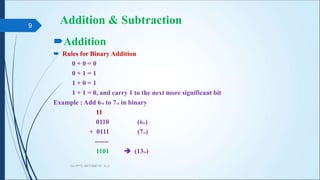
 Rules for Binary Addition
0 + 0 = 0
0 + 1 = 1
1 + 0 = 1
1 + 1 = 0, and carry 1 to the next more significant bit
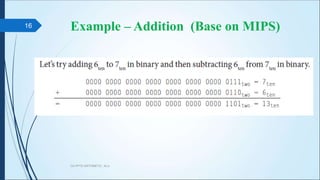
Example : Add 610 to 710 in binary
11
0110 (610)
+ 0111 (710)
------
1101  (1310)
CA PPT5 ARITHMETIC, ALU
9
Addition
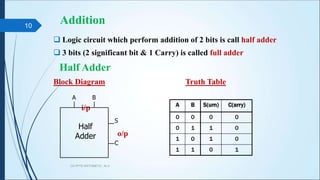
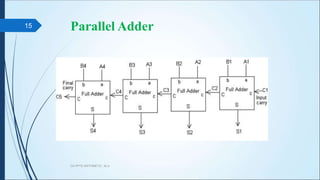
 Logic circuit which perform addition of 2 bits is call half adder
 3 bits (2 significant bit & 1 Carry) is called full adder
Half Adder
Block Diagram Truth Table
i/p
o/p
CA PPT5 ARITHMETIC, ALU
10
Half
Adder
A B
S
C
A B S(um) C(arry)
0 0 0 0
0 1 1 0
1 0 1 0
1 1 0 1
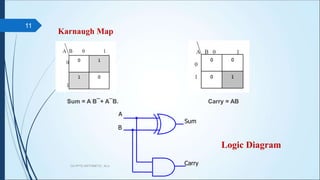
Karnaugh Map
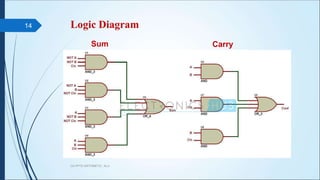
Sum = A B ̅ + A ̅ B. Carry = AB
CA PPT5 ARITHMETIC, ALU
11
A
B
Sum
Carry
Logic Diagram
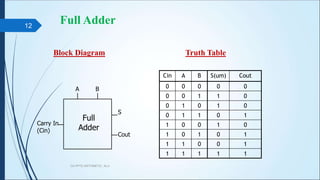
Full Adder
Block Diagram Truth Table
CA PPT5 ARITHMETIC, ALU
12
Full
Adder
A B
S
Cout
Carry In
(Cin)
Cin A B S(um) Cout
0 0 0 0 0
0 0 1 1 0
0 1 0 1 0
0 1 1 0 1
1 0 0 1 0
1 0 1 0 1
1 1 0 0 1
1 1 1 1 1
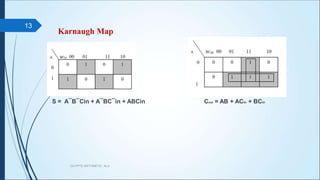
Karnaugh Map
S = A ̅ B ̅ Cin + A ̅ BC ̅ in + ABCin Cout = AB + ACin + BCin
CA PPT5 ARITHMETIC, ALU
13
Logic Diagram
CA PPT5 ARITHMETIC, ALU
14
Carry
Sum
Parallel Adder
CA PPT5 ARITHMETIC, ALU
15
Example – Addition (Base on MIPS)
CA PPT5 ARITHMETIC, ALU
16
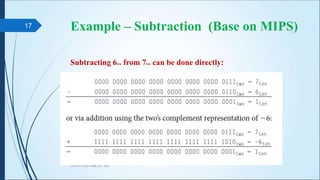
Example – Subtraction (Base on MIPS)
CA PPT5 ARITHMETIC, ALU
17
Subtracting 6ten from 7ten can be done directly:
Binary Subtraction
 Suppose we want to perform A-B
 Steps:
 Take 2’s Complement of B
 Result  A + 2’s Complement of B
 If Carry is generated  Result is Positive (Ignore Carry)
 If no Carry  Result is Negative & in the 2’s Complement form
 Example : Perform (28)10 – (15)10 using 6 bit 2’s Complement
representation
CA PPT5 ARITHMETIC, ALU
18
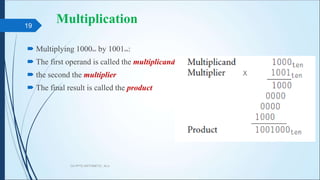
Multiplication
 Multiplying 1000ten by 1001ten:
 The first operand is called the multiplicand
 the second the multiplier
 The final result is called the product
CA PPT5 ARITHMETIC, ALU
19
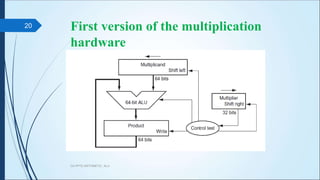
First version of the multiplication
hardware
CA PPT5 ARITHMETIC, ALU
20
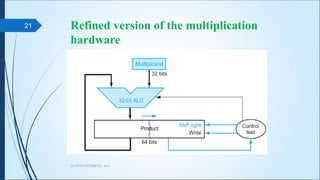
Refined version of the multiplication
hardware
CA PPT5 ARITHMETIC, ALU
21
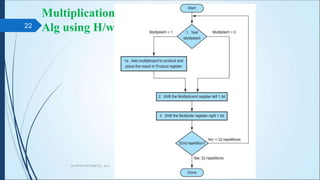
Multiplication
Alg using H/w
CA PPT5 ARITHMETIC, ALU
22
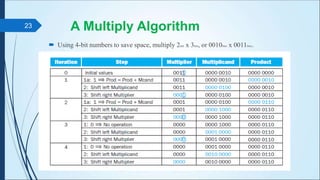
A Multiply Algorithm
 Using 4-bit numbers to save space, multiply 2ten x 3ten, or 0010two x 0011two.
CA PPT5 ARITHMETIC, ALU
23
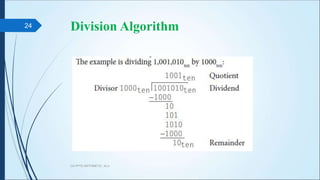
Division Algorithm
CA PPT5 ARITHMETIC, ALU
24
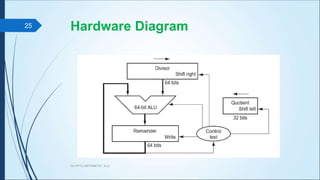
Hardware Diagram
CA PPT5 ARITHMETIC, ALU
25
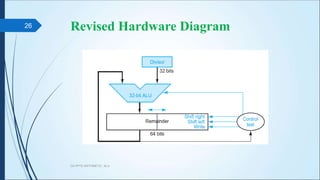
Revised Hardware Diagram
CA PPT5 ARITHMETIC, ALU
26
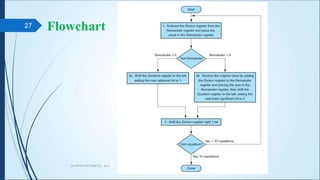
Flowchart
CA PPT5 ARITHMETIC, ALU
27
Example: Using a 4 bit version of the Algorithm
Divide 710 by 210 [0000 0111(2) by 0010(2)]
CA PPT5 ARITHMETIC, ALU
28

ARITHMETIC LOGIC UNIT.ppt

  • 1.
    COMPUTER ARCHITECTURE UNIT –II ARITHMETIC OPERATIONS CA PPT5 ARITHMETIC, ALU 1 ALU - Addition and subtraction – Multiplication – Division – Floating Point operations – Subword parallelism
  • 2.
    Arithmetic for Computers ALU - Arithmetic & Logic Unit  Responsible for performing arithmetic operations such as addition, subtraction, division and multiplication and logical operations such as AND, OR and their inversion etc.,  Arithmetic operations are performed on data type Fixed point numbers Floating point numbers  Representing number in such data type is known as Fixed point representation Floating point representation CA PPT5 ARITHMETIC, ALU 2
  • 3.
    Fixed point representation Integer numbers  2 forms Signed integer (Negative number) -15 Unsigned integer (Positive number) 15  Techniques used to represent integer numbers are Signed Magnitude representation 1’s Complement 2’s Complement CA PPT5 ARITHMETIC, ALU 3
  • 4.
    Signed Magnitude representation There are many schemes for representing negative integers with patterns of bits.  One scheme is sign-magnitude  It uses one bit (MSB) to indicate the sign.  "0" indicates a positive integer, and "1" indicates a negative integer  The rest of the bits are used for the magnitude of the number  Example: -2410 is represented as 1001 1000 The sign "1" means negative The magnitude is 24 (in 7-bit binary) CA PPT5 ARITHMETIC, ALU 4
  • 5.
    Example  Decimal valuesof the following 8-bit sign-magnitude numbers 10000011 = -3 00000101 = +5 11111111 = ? 01111111 = ?  Represent the following in 8-bit sign-magnitude -15 = 10001111 +7 = 00000111 -1 = ? CA PPT5 ARITHMETIC, ALU 5
  • 6.
    One’s Complement CA PPT5ARITHMETIC, ALU 6  Perform NOT operation  Example find 1’s complement for 110101002
  • 7.
    Two’s Complement CA PPT5ARITHMETIC, ALU 7  2’s complement = 1’s complement + 1
  • 8.
    Two’s Complement 1 10 0 0 1 0 0 ¬ 0 0 1 1 1 0 1 1 + 1 0 0 1 1 1 1 0 0 CA PPT5 ARITHMETIC, ALU 8  2’s complement = 1’s complement + 1  Example (11000100)2
  • 9.
    Addition & Subtraction Addition Rules for Binary Addition 0 + 0 = 0 0 + 1 = 1 1 + 0 = 1 1 + 1 = 0, and carry 1 to the next more significant bit Example : Add 610 to 710 in binary 11 0110 (610) + 0111 (710) ------ 1101  (1310) CA PPT5 ARITHMETIC, ALU 9
  • 10.
    Addition  Logic circuitwhich perform addition of 2 bits is call half adder  3 bits (2 significant bit & 1 Carry) is called full adder Half Adder Block Diagram Truth Table i/p o/p CA PPT5 ARITHMETIC, ALU 10 Half Adder A B S C A B S(um) C(arry) 0 0 0 0 0 1 1 0 1 0 1 0 1 1 0 1
  • 11.
    Karnaugh Map Sum =A B ̅ + A ̅ B. Carry = AB CA PPT5 ARITHMETIC, ALU 11 A B Sum Carry Logic Diagram
  • 12.
    Full Adder Block DiagramTruth Table CA PPT5 ARITHMETIC, ALU 12 Full Adder A B S Cout Carry In (Cin) Cin A B S(um) Cout 0 0 0 0 0 0 0 1 1 0 0 1 0 1 0 0 1 1 0 1 1 0 0 1 0 1 0 1 0 1 1 1 0 0 1 1 1 1 1 1
  • 13.
    Karnaugh Map S =A ̅ B ̅ Cin + A ̅ BC ̅ in + ABCin Cout = AB + ACin + BCin CA PPT5 ARITHMETIC, ALU 13
  • 14.
    Logic Diagram CA PPT5ARITHMETIC, ALU 14 Carry Sum
  • 15.
    Parallel Adder CA PPT5ARITHMETIC, ALU 15
  • 16.
    Example – Addition(Base on MIPS) CA PPT5 ARITHMETIC, ALU 16
  • 17.
    Example – Subtraction(Base on MIPS) CA PPT5 ARITHMETIC, ALU 17 Subtracting 6ten from 7ten can be done directly:
  • 18.
    Binary Subtraction  Supposewe want to perform A-B  Steps:  Take 2’s Complement of B  Result  A + 2’s Complement of B  If Carry is generated  Result is Positive (Ignore Carry)  If no Carry  Result is Negative & in the 2’s Complement form  Example : Perform (28)10 – (15)10 using 6 bit 2’s Complement representation CA PPT5 ARITHMETIC, ALU 18
  • 19.
    Multiplication  Multiplying 1000tenby 1001ten:  The first operand is called the multiplicand  the second the multiplier  The final result is called the product CA PPT5 ARITHMETIC, ALU 19
  • 20.
    First version ofthe multiplication hardware CA PPT5 ARITHMETIC, ALU 20
  • 21.
    Refined version ofthe multiplication hardware CA PPT5 ARITHMETIC, ALU 21
  • 22.
    Multiplication Alg using H/w CAPPT5 ARITHMETIC, ALU 22
  • 23.
    A Multiply Algorithm Using 4-bit numbers to save space, multiply 2ten x 3ten, or 0010two x 0011two. CA PPT5 ARITHMETIC, ALU 23
  • 24.
    Division Algorithm CA PPT5ARITHMETIC, ALU 24
  • 25.
    Hardware Diagram CA PPT5ARITHMETIC, ALU 25
  • 26.
    Revised Hardware Diagram CAPPT5 ARITHMETIC, ALU 26
  • 27.
  • 28.
    Example: Using a4 bit version of the Algorithm Divide 710 by 210 [0000 0111(2) by 0010(2)] CA PPT5 ARITHMETIC, ALU 28