Euclid's algorithm is an efficient method for computing the greatest common divisor (GCD) of two numbers. It works by repeatedly finding the remainder of dividing the larger number by the smaller number, and then setting the larger number equal to the smaller number and the smaller number equal to the remainder, until the smaller number is zero. The last non-zero remainder is the GCD. The time complexity of Euclid's algorithm is O(log n) where n is the smaller of the two input numbers. Algorithm analysis techniques such as worst-case, best-case, average-case analysis and asymptotic notations can be used to formally analyze the efficiency of algorithms.


![Other methods for gcd(m,n) [cont.]
Middle-school procedure
Step 1 Find the prime factorization of m
Step 2 Find the prime factorization of n
Step 3 Find all the common prime factors
Step 4 Compute the product of all the common prime factors
and return it as gcd(m,n)
Eg. m=36 n=48 find gcd(m,n)
m=2*2*3*3
n=2*2*2*2*3
Common factors are 2,2,3.
Gcd=2*2*3=12](https://image.slidesharecdn.com/daa1ppt-230822054116-9e359cbf/75/DAA-1-ppt-pptx-6-2048.jpg)


![Space complexity
1. Algorithm Sum(a[], n)
2. {
3. s:= 0.0;
4. for i = 1 to n do
5. s := s + a[i];
6. return s;
7. }
Every instance needs to store array a[] & n.
– Space needed to store n = 1 word.
– Space needed to store a[ ] = n floating point
words (or at least n words)
– Space needed to store i and s = 2 words
• Hence S(P) = (n + 3).(i.e 1+n+2=n+3)](https://image.slidesharecdn.com/daa1ppt-230822054116-9e359cbf/75/DAA-1-ppt-pptx-21-2048.jpg)


![Time complexity
Matrix addition
For(i=0;i<n;i++)
{
For(j=0;j<n;j++)
{
C[i][j]=a[i][j]+b[i][j]
}
• Frequency count(FC) can be computed as follows
For(i=0;i<n;i++)
• i=0 executes once . Fc=1
• i<n executes for n+1 times
• i++ executes for n times
For(j=0;j<n;j++)
• j=0 executes n*1=n times
• j<n executes n*(n+1) times= n2+n times
• j++ executes n*n= n2 times
• C[i][j]=a[i][j]+b[i][j] executes n*n= n2 times
Totally 3n2+4n+2](https://image.slidesharecdn.com/daa1ppt-230822054116-9e359cbf/75/DAA-1-ppt-pptx-24-2048.jpg)


![Mathematical Analysis for Recursive and Non-Recursive
Algorithms (Cont..)
EXAMPLE 1 Consider the problem of finding the value of the largest
element
in a list of n numbers. For simplicity, we assume that the list is implemented as
an array. The following is pseudocode of a standard algorithm for solving the
problem.
ALGORITHM MaxElement(A[0..n − 1])
//Determines the value of the largest element in a given array
//Input: An array A[0..n − 1] of real numbers
//Output: The value of the largest element in A
maxval ←A[0]
for i ←1 to n − 1 do
if A[i]>maxval
maxval←A[i] //if any value large//searching the maximum element from
an arrayr than current_maxvalue then set new
maxvalue by obtained larger value
return maxval](https://image.slidesharecdn.com/daa1ppt-230822054116-9e359cbf/75/DAA-1-ppt-pptx-44-2048.jpg)
![Mathematical Analysis for Recursive and Non-Recursive Algorithms (Cont..)
• measure of an input’s size here is the number of elements in the array,
i.e., n.
• There are two operations in the loop’s body:
• the comparison A[i]> maxval and
• the assignment maxval←A[i].
• Which of these two operations should we consider basic?
• Since the comparison is executed on each repetition of the loop
• and the assignment is not
• we should consider the comparison to be the algorithm’s basic
operation.
• Note:The comparisons is made for each value of n there is no need to
find worst, average, and best cases analysis here.
• C(n) the number of times this comparison is executed
• The algorithm makes one comparison on each execution of the loop,
which is repeated for each value of the loop’s variable i within the
bounds 1 and n − 1, inclusive.](https://image.slidesharecdn.com/daa1ppt-230822054116-9e359cbf/75/DAA-1-ppt-pptx-45-2048.jpg)

![Mathematical Analysis for Recursive and Non-Recursive
Algorithms (Cont..)
EXAMPLE 2 Consider the element uniqueness problem: check
whether all the elements in a given array of n elements are distinct.
This problem can be solved by the following straightforward
algorithm.
ALGORITHM UniqueElements(A[0..n − 1])
//Determines whether all the elements in a given array are distinct
//Input: An array A[0..n − 1]
//Output: Returns “true” if all the elements in A are distinct
// and “false” otherwise
for i ←0 to n − 2 do
for j ←i + 1 to n − 1 do
if A[i]= A[j ] return false //if any two elmts in the array are similar then
return false indicating that the array elmts are not distinct
return true](https://image.slidesharecdn.com/daa1ppt-230822054116-9e359cbf/75/DAA-1-ppt-pptx-47-2048.jpg)


![Mathematical Analysis for Recursive and Non-Recursive Algorithms
(Cont..)
ALGORITHM MatrixMultiplication(A[0..n − 1, 0..n − 1],
B[0..n − 1, 0..n − 1])
//Multiplies two square matrices of order n by the definition-
based algorithm
//Input: Two n × n matrices A and B
//Output: Matrix C = AB
for i ←0 to n − 1 do
for j ←0 to n − 1 do
C[i, j ]←0.0
for k←0 to n − 1 do
C[i, j ]←C[i, j ]+ A[i, k] ∗ B[k, j]
return C](https://image.slidesharecdn.com/daa1ppt-230822054116-9e359cbf/75/DAA-1-ppt-pptx-50-2048.jpg)
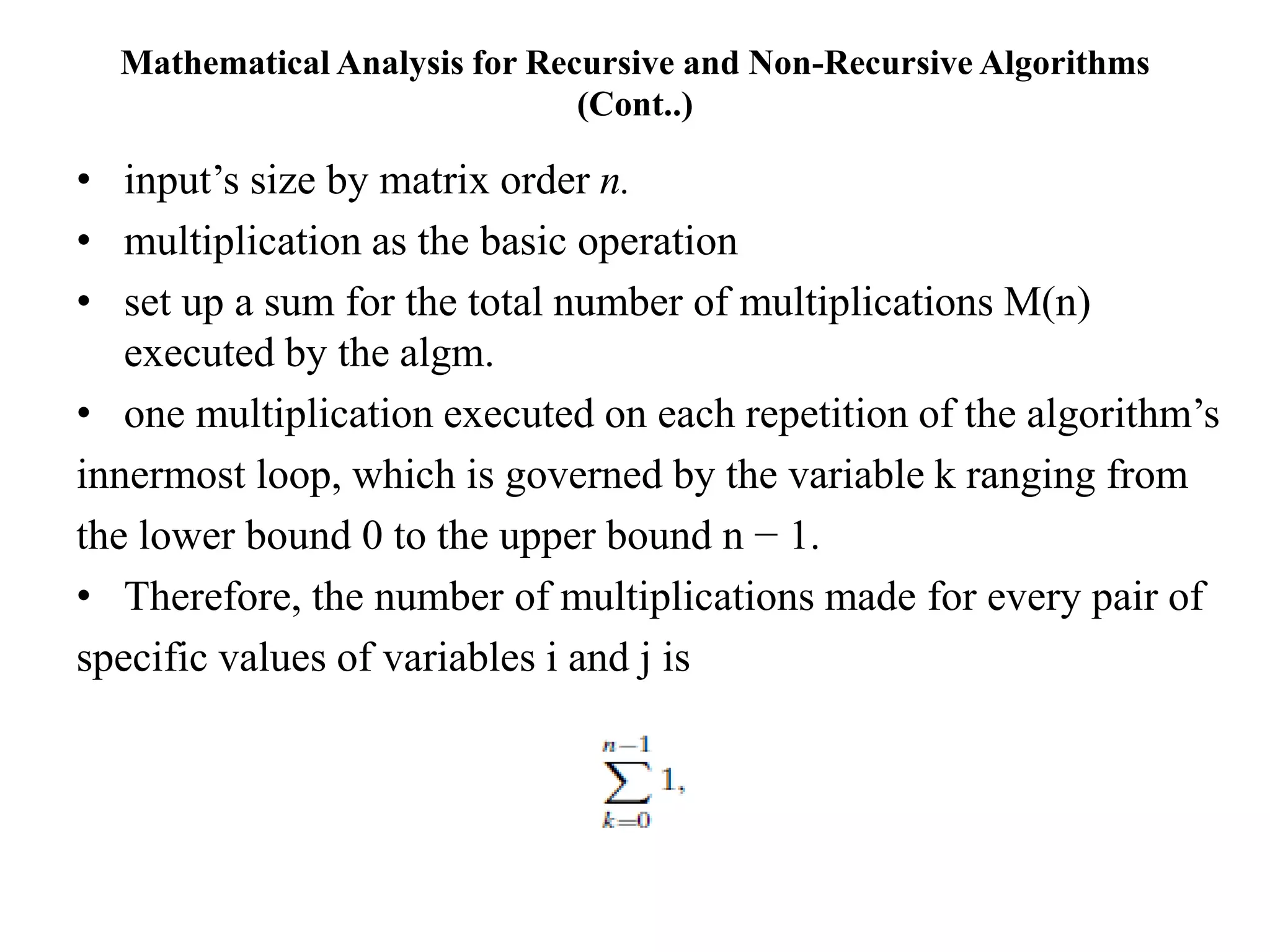
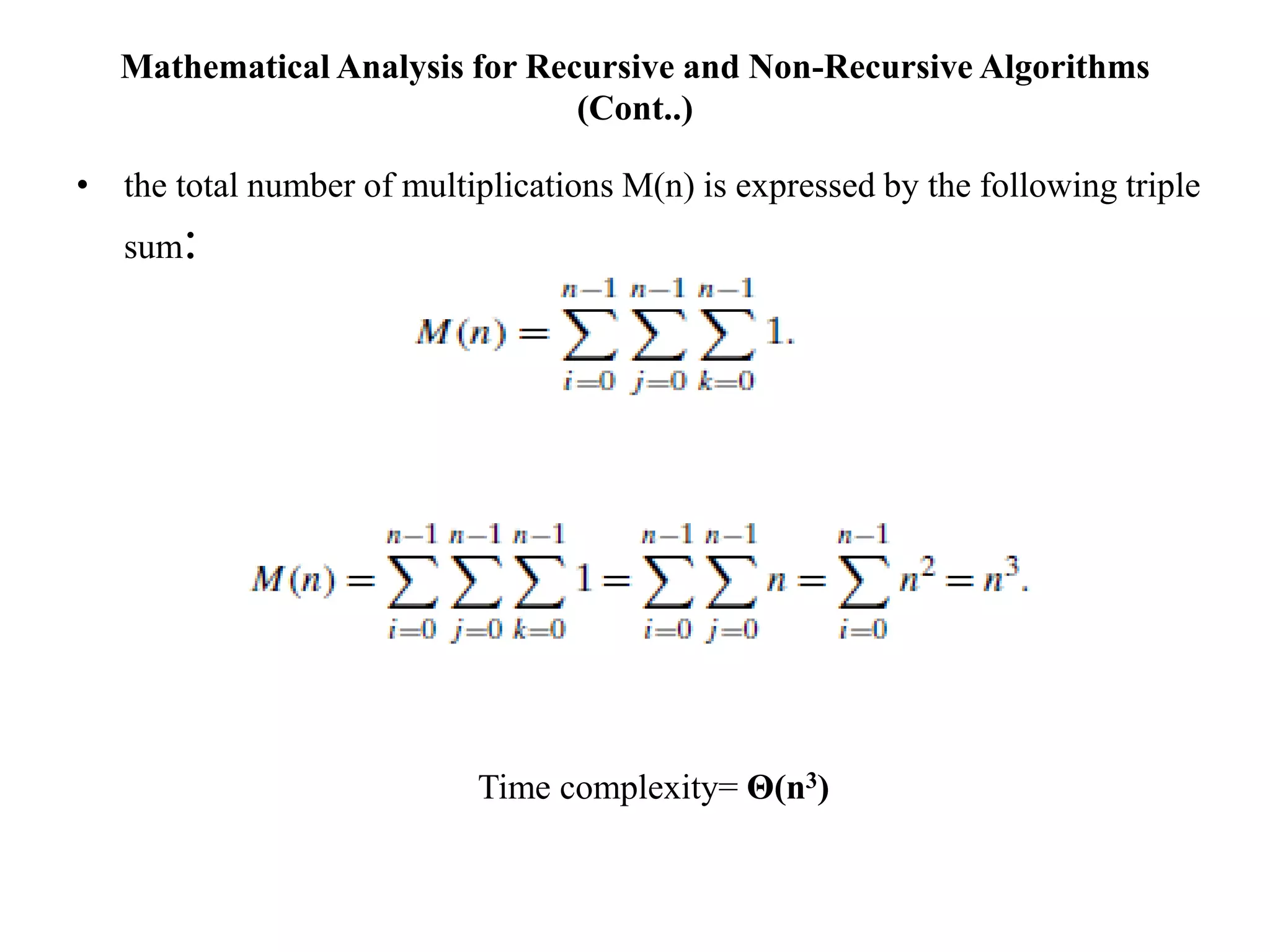


![Mathematical Analysis of Recursive Algorithms
• M(n − 1) multiplications are spent to compute F(n − 1).
eg .n=55-1=4!0!*1*2*3*4--n-1 multiplications.
• one more multiplication is needed to multiply the result by n.(0!*1*2*3*4) * 5
• if n = 0 return 1. when n = 0, the algorithm performs no multiplications. Therefore, the
initial condition M(0) =0.
• M(0) ---the calls stop when n = 0 0---no multiplications when n = 0
• the recurrence relation and initial condition for the algorithm’s number of multiplications
M(n) = M(n − 1) + 1 for n > 0, M(0) = 0.
backward substitutions:
• M(n) = M(n − 1) + 1 (substitute M(n − 1) = M(n − 2) + 1)
= [M(n − 2) + 1]+ 1= M(n − 2) + 2 (substitute M(n − 2) = M(n− 3) + 1)
= [M(n − 3) + 1]+ 2 = M(n − 3) + 3.
General formula for the pattern:
M(n) = M(n − i) + i.
• substitute i = n in the pattern’s formula to get the ultimate result of our backward
substitutions:
• M(n) = M(n − 1) + 1= . . . = M(n − i) + i = . . . = M(n − n) + n = n.](https://image.slidesharecdn.com/daa1ppt-230822054116-9e359cbf/75/DAA-1-ppt-pptx-57-2048.jpg)


![Binary Search
• A binary search looks for an item in a list using a divide-and
conquer strategy.
• Very efficient algorithm for searching in sorted array:
• Binary search algorithm assumes that the items in the array being searched are
sorted
– The algorithm begins at the middle of the array in a binary search
– If the item for which we are searching is less than the item in the middle,
we know that the item won’t be in the second half of the array
– Once again we examine the “middle” element
– The process continues with each comparison cutting in half the portion of
the array where the item might be
• Binary Search: middle element.
• An element which is to be searched from the list of elements sorted in array
A[0…n-1] is called KEY element.
mid =
left + right
2](https://image.slidesharecdn.com/daa1ppt-230822054116-9e359cbf/75/DAA-1-ppt-pptx-68-2048.jpg)


![Analysis
• The Basic operation in binary search is comparison of search key (i.e.
KEY) with the array elements.
• To analyze the efficiency of binary search we must count the number of
times the search keys compared with the array elements.
• The comparison is also called a three way comparison because algorithm
makes the comparison to determine whether KEY is smaller, equal to or
greater than A[m].
• In this algorithm after one comparison the list of n elements is divided into
n/2 sub lists.](https://image.slidesharecdn.com/daa1ppt-230822054116-9e359cbf/75/DAA-1-ppt-pptx-73-2048.jpg)


![Average Case
• To obtain average case efficiency of binary search, consider some samples of
input n.
• Again A[2]=33 and 33<44 we divide list. In right sub list A[4]=44 and key is 44.
thus total 3 comparisons are made to search 44.](https://image.slidesharecdn.com/daa1ppt-230822054116-9e359cbf/75/DAA-1-ppt-pptx-78-2048.jpg)


![Eg. An array A[5]={64,25,12,22,11}
0 , 1 , 2, 3, 4
PASS 1:
i=0 // range of i={0,1,2,3} // for i=0 to n-2
min0 //min=i
j1 //range of j={1,2,3,4} //for j=i+1 to n-1
25< 64 min1 //if A[j]<A[min] minj
j 2 , 12<25 min2
j 3 , 22<12
j 4 , 11<12 //end of j
Swap 64 and 11 // swap A[i] and A[min]
// Now list becomes 11,25,12,22,64
// Now list is 11,25,12,22,64
PASS 2:
i=1 min1
j2 12< 25 min2
j 3 , 22<12](https://image.slidesharecdn.com/daa1ppt-230822054116-9e359cbf/75/DAA-1-ppt-pptx-106-2048.jpg)
![j 4 , 64<12 //end of j
Swap 25 and 12
// Now list becomes 11,12,25,22,64
PASS 3:
i=2 min2
j 3 , 22<25 min3
j 4 , 64<22 //end of j
Swap 25 and 22
// Now list becomes 11,12,22,25,64
// Now list is 11,12,22,25,64
PASS 4:
i=3 min3
j 4 , 64<25 //end of j
Swap 25 and 64
// Now list becomes 11,12,22,25,64
Output array A[5]={11,12,22,25,64}](https://image.slidesharecdn.com/daa1ppt-230822054116-9e359cbf/75/DAA-1-ppt-pptx-107-2048.jpg)
![Analysis
The input size is given by the number of elements n.
basic operation is the key comparison A[j ]<A[min].
The number of times it is executed depends only on the array size and is given
by the following sum:
Thus, selection sort is a (n2) algorithm on all inputs.](https://image.slidesharecdn.com/daa1ppt-230822054116-9e359cbf/75/DAA-1-ppt-pptx-108-2048.jpg)

![Eg.an array A[5]={5,1,4,2,8}
0,1,2,3,4
PASS 1:
i=0 //range of i={0,1,2,3} //for i=0 to n-2
j=0 //range of j={0,1,2,3} //for j=0 to n-2-i
1<5 //A[j+1]<A[j]
Swap 1 and 5, //swap A[j] and A[j+1]
//List becomes 1,5,4,2,8
j=1 , 4<5 ,swap 4 and 5 // list becomes 1,4,5,2,8
j=2 , 2<5 ,swap 2 and 5 // list becomes 1,4,2,5,8
j=3, 8<5 // list remains 1,4,2,5,8](https://image.slidesharecdn.com/daa1ppt-230822054116-9e359cbf/75/DAA-1-ppt-pptx-110-2048.jpg)
![Now the list is 1,4,2,5,8
PASS 2:
i=1
j=0 //range of j={0,1,2} //for j=0 to n-2-i
4<1 //A[j+1]<A[j]
//List remains 1,4,2,5,8
j=1 , 2<4 , swap 2 and 4 // list becomes 1,2,4,5,8
j=2 , 5<4 // list remains 1,2,4,5,8
PASS 3:
Now the list is1,2,4,5,8
i=2
j=0 //range of j={0,1} //for j=0 to n-2-i
2<1 // list remains 1,2,4,5,8
j=1 , 4<2 // list remains 1,2,4,5,8](https://image.slidesharecdn.com/daa1ppt-230822054116-9e359cbf/75/DAA-1-ppt-pptx-111-2048.jpg)
![PASS 4:
Now the list is1,2,4,5,8
i=3
j=0 //range of j={0} //for j=0 to n-2-i
2<1 // list remains 1,2,4,5,8
Output array A[5]={1,2,4,5,8}
Analysis:
• The number of key comparisons for the bubble-sort is the same for all
arrays of size n;
• it is obtained by a sum that is almost identical to the sum for selection sort:](https://image.slidesharecdn.com/daa1ppt-230822054116-9e359cbf/75/DAA-1-ppt-pptx-112-2048.jpg)


![Quick Sort
• Select a pivot (partitioning element) – here, the first element
• Rearrange the list so that all the elements in the first s
positions are smaller than or equal to the pivot and all the
elements in the remaining n-s positions are larger than or
equal to the pivot (see next slide for an algorithm)
• Exchange the pivot with the last element in the first (i.e., )
subarray — the pivot is now in its final position
• Sort the two subarrays recursively.
p
A[i]p A[i]p](https://image.slidesharecdn.com/daa1ppt-230822054116-9e359cbf/75/DAA-1-ppt-pptx-117-2048.jpg)
![Quick Sort
• Algorithm Quick(A[0……n-1],low,high)
• Pblm: sorting of array A[0…n-1]
• i/p: An array A[0….n-1]in which unsorted elmts are
given.low indicates leftmost elmt in the list and high
indicates the rightmost elmt in the list.
• o/p: sorted in ascending order.
• If(low<high)then
• //split the array into two sub arrays
• m partition(A[low…high])//m is mid of the array.
• Quick(A[low…m-1])
• Quick(A[mid+1….high])](https://image.slidesharecdn.com/daa1ppt-230822054116-9e359cbf/75/DAA-1-ppt-pptx-118-2048.jpg)
![Quick Sort
• Algorithm partition(A[low…high])
• Pblm: partition the subarray using the first element as
pivot element.
• i/p:subarray A with low as lower most index of the
array and high as higher most index of the array.
• o/p: partitioning of array A is done and pivot
occupies its proper position. And the rightmost index
of the list is returned.
pivotA[low]
ilow
jhigh+1](https://image.slidesharecdn.com/daa1ppt-230822054116-9e359cbf/75/DAA-1-ppt-pptx-119-2048.jpg)
![While(i<=j)do
{
While(A[i]<=pivot) do
ii+1
While(A[j]>=pivot) do
jj-1
If(i<=j)then
Swap(A[i],A[j]) / /swap A[i] and A[j]
}
Swap(A[low],A[j] ) //when i crosses j swap A[low] and
A[j]
Return j //rightmost index of the list](https://image.slidesharecdn.com/daa1ppt-230822054116-9e359cbf/75/DAA-1-ppt-pptx-120-2048.jpg)


![• In the worst case, one of the two subarrays will
be empty arrays, i.e., for inputs for which the
problem is already solved
• if A[0..n − 1] is a strictly increasing array and we
use A[0] as the pivot, the left-to-right scan will
stop on A[1] while the right-to-left scan will go all
the way to reach A[0], indicating the split at
position 0.
• So, after making n + 1 comparisons to get to this
partition and exchanging the pivot A[0] with
itself, the algorithm will be left with the strictly
increasing array A[1..n − 1] to sort.](https://image.slidesharecdn.com/daa1ppt-230822054116-9e359cbf/75/DAA-1-ppt-pptx-125-2048.jpg)


![Knapsack Problem and Memory
Functions
Steps to select actual knapsack item:
Let i = n and k = W then
while (i>0 and k>0)
{
if(table [i,k] table[i-1,k]) then
mark ith item as in knapsack](https://image.slidesharecdn.com/daa1ppt-230822054116-9e359cbf/75/DAA-1-ppt-pptx-139-2048.jpg)


![Dijkstra’s Algorithm
• Dijkstra’s algorithm is used to find shortest path. This algorithm is
also known as single source shortest path algorithm. In this
algorithm, for a given vertex called source the shortest path to all
other vertices is obtained.
• In this algorithm the main focus is not to find only one single path
but to find the shortest paths from any vertex to all other remaining
vertices. This algorithm is applicable to graphs with non-negative
weights only.
Algorithm DagShortestPaths (G, s)
//Solves the single-source shortest paths problem for a dag
//Input: A weighted dag G = [V,E] and its vertex s
//Output: The length dv of a shortest path from s to v and
// its ultimate vertex pv for every vertex v in V topologically sort the
vertices of G](https://image.slidesharecdn.com/daa1ppt-230822054116-9e359cbf/75/DAA-1-ppt-pptx-145-2048.jpg)


![a b c d e
LB = [(1+ 3) + (3 + 6) + (1+ 2) + (3 + 4) + (2 + 3)]/2
= 28/2=14.(this is the root of the state space tree)
• Compute the distances at level 1a-b,a-c,a-d,a-e.
• Compute the distances at level 2a-b-c,a-b-d,
a-b-e.
• Compute the distances at level 3a-b-c-d,a-b-c-e
and a-b-d-c,a-b-d-e.
• Thus the state space tree can be](https://image.slidesharecdn.com/daa1ppt-230822054116-9e359cbf/75/DAA-1-ppt-pptx-165-2048.jpg)

![LB = [(1+ 3) + (3 + 6) + (1+ 2) + (3 + 4) + (2 + 3)]/2
= 28/2=14.(this is the root of the state space tree)
Node 1:consider distance a-b in computation of the
corresponding vertices along with 1 minimum
distance. Find 2 least cost edges adjacent to V/2.
a=a-b + a-c=3+1=4 (consider a-b here)
b=a-b+b-c=3+6=9 (consider a-b here)
c=a-c+c-e=1+2=3 LB=4+9+3+7+5=28/2=14
d=d-e+c-d=3+4=7
e=c-e+d-e=2+3=5](https://image.slidesharecdn.com/daa1ppt-230822054116-9e359cbf/75/DAA-1-ppt-pptx-167-2048.jpg)


