Francis Petrarch
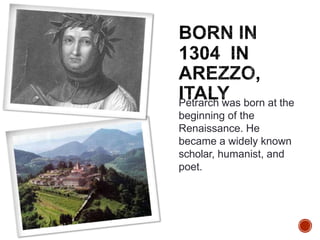
Petrarch was born at the
beginning of the
Renaissance. He
became a widely known
scholar, humanist, and
poet.
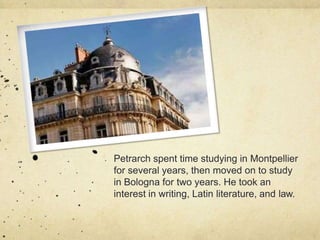
Petrarch spent time studying in Montpellier
for several years, then moved on to study
in Bologna for two years. He took an
interest in writing, Latin literature, and law.
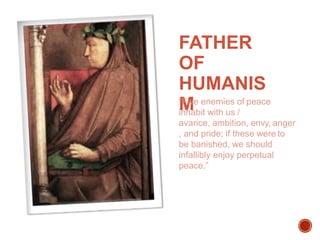
FATHER
OF
HUMANIS
M“Five enemies of peace
inhabit with us /
avarice, ambition, envy, anger
, and pride; if these were to
be banished, we should
infallibly enjoy perpetual
peace.”
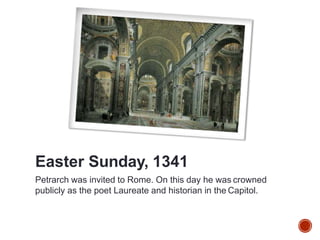
Easter Sunday, 1341
Petrarch was invited to Rome. On this day he was crowned
publicly as the poet Laureate and historian in the Capitol.
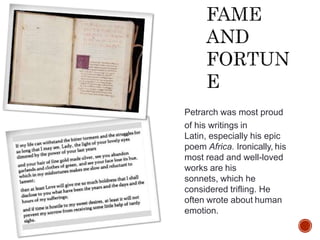
Petrarch was most proud
of his writings in
Latin, especially his epic
poem Africa. Ironically, his
most read and well-loved
works are his
sonnets, which he
considered trifling. He
often wrote about human
emotion.
Petrarch wrote sonnets, essays, and poems by the
hundreds, but two of his most famous are the
“Trionfi” and the “Canzoniere.”
The “Trionfi” is a moral allegory, featuring six
figures: Love, Chastity, Death, Fame, Time, and
Divinity; the former being ultimately triumphant.
The “Conzoniere” is a compilation of sonnets with
themes of love and patriotism.
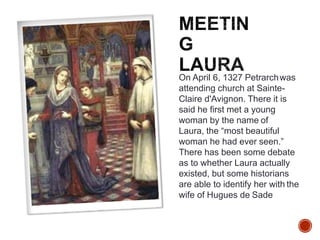
On April 6, 1327 Petrarchwas
attending church at Sainte-
Claire d'Avignon. There it is
said he first met a young
woman by the name of
Laura, the “most beautiful
woman he had ever seen.”
There has been some debate
as to whether Laura actually
existed, but some historians
are able to identify her with the
wife of Hugues de Sade
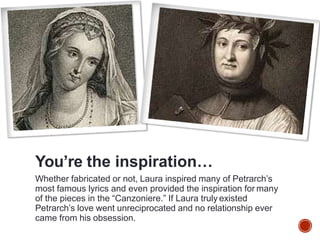
You’re the inspiration…
Whether fabricated or not, Laura inspired many of Petrarch’s
most famous lyrics and even provided the inspiration for many
of the pieces in the “Canzoniere.” If Laura truly existed
Petrarch’s love went unreciprocated and no relationship ever
came from his obsession.
From the Italian sonetto, which means “a little sound or
song," the sonnet is a popular classical form that has
compelled poets for centuries.
Traditionally, the sonnet is a fourteen-line poem written in
iambic pentameter, which employ one of several rhyme
schemes and adhere to a tightly structured thematic
organization.
Two sonnet forms provide the models from which all other
sonnets are formed: the Petrarchan and the
Shakespearean.
Two Types of Sonnets
The first and most common sonnet is the Petrarchan,
or Italian.
Named after one of its greatest practitioners, the
Italian poet Petrarch, the Petrarchan sonnet is divided
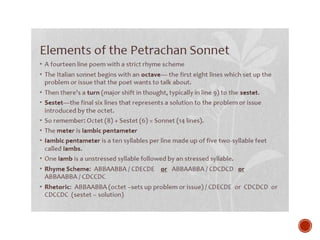
into 2 stanzas, the octave (the first eight lines)
followed by the answering sestet (the final six lines).
The Petrarchan rhyme scheme is abba, abba, cdecde
or cdcdcd.
These letters refer to the last word in each line of the
poem and the sound of the word. If “bed” is “a” then
“red” would also be “a” in this rhyme scheme.
Example of a rhyme scheme:
Roses are red (a)
Violets are blue (b)
Sugar is sweet (c)
And so are you (b)
Since the Petrarchan presents an argument,
observation, question, or some other answerable
charge in the octave, a turn, or volta, occurs
between the eighth and ninth lines.
This turn marks a shift in the direction of the
foregoing argument or narrative, turning the
sestet into the vehicle for the counterargument,
clarification, or whatever answer the octave
demands.
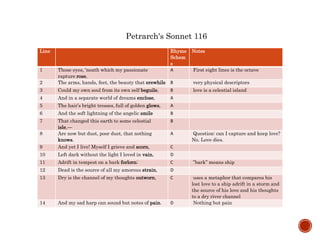
Line Rhyme
Schem
e
Notes
1 Those eyes, ’neath which my passionate
rapture rose,
A First eight lines is the octave
2 The arms, hands, feet, the beauty that erewhile B very physical descriptors
3 Could my own soul from its own self beguile, B love is a celestial island
4 And in a separate world of dreams enclose, A
5 The hair’s bright tresses, full of golden glows, A
6 And the soft lightning of the angelic smile B
7 That changed this earth to some celestial
isle,—
B
8 Are now but dust, poor dust, that nothing
knows.
A Question: can I capture and keep love?
No. Love dies.
9 And yet I live! Myself I grieve and scorn, C
10 Left dark without the light I loved in vain, D
11 Adrift in tempest on a bark forlorn; C ”bark” means ship
12 Dead is the source of all my amorous strain, D
13 Dry is the channel of my thoughts outworn, C uses a metaphor that compares his
lost love to a ship adrift in a storm and
the source of his love and his thoughts
to a dry river channel
14 And my sad harp can sound but notes of pain. D Nothing but pain
Petrarch's Sonnet 116
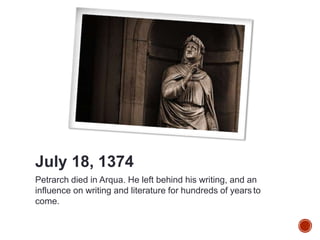
July 18, 1374
Petrarch died in Arqua. He left behind his writing, and an
influence on writing and literature for hundreds of years to
come.

Introduction to Petrarch

  • 1.
  • 2.
    Petrarch was bornat the beginning of the Renaissance. He became a widely known scholar, humanist, and poet.
  • 3.
    Petrarch spent timestudying in Montpellier for several years, then moved on to study in Bologna for two years. He took an interest in writing, Latin literature, and law.
  • 4.
    FATHER OF HUMANIS M“Five enemies ofpeace inhabit with us / avarice, ambition, envy, anger , and pride; if these were to be banished, we should infallibly enjoy perpetual peace.”
  • 5.
    Easter Sunday, 1341 Petrarchwas invited to Rome. On this day he was crowned publicly as the poet Laureate and historian in the Capitol.
  • 6.
    Petrarch was mostproud of his writings in Latin, especially his epic poem Africa. Ironically, his most read and well-loved works are his sonnets, which he considered trifling. He often wrote about human emotion.
  • 7.
    Petrarch wrote sonnets,essays, and poems by the hundreds, but two of his most famous are the “Trionfi” and the “Canzoniere.” The “Trionfi” is a moral allegory, featuring six figures: Love, Chastity, Death, Fame, Time, and Divinity; the former being ultimately triumphant. The “Conzoniere” is a compilation of sonnets with themes of love and patriotism.
  • 8.
    On April 6,1327 Petrarchwas attending church at Sainte- Claire d'Avignon. There it is said he first met a young woman by the name of Laura, the “most beautiful woman he had ever seen.” There has been some debate as to whether Laura actually existed, but some historians are able to identify her with the wife of Hugues de Sade
  • 9.
    You’re the inspiration… Whetherfabricated or not, Laura inspired many of Petrarch’s most famous lyrics and even provided the inspiration for many of the pieces in the “Canzoniere.” If Laura truly existed Petrarch’s love went unreciprocated and no relationship ever came from his obsession.
  • 10.
    From the Italiansonetto, which means “a little sound or song," the sonnet is a popular classical form that has compelled poets for centuries. Traditionally, the sonnet is a fourteen-line poem written in iambic pentameter, which employ one of several rhyme schemes and adhere to a tightly structured thematic organization. Two sonnet forms provide the models from which all other sonnets are formed: the Petrarchan and the Shakespearean. Two Types of Sonnets
  • 11.
    The first andmost common sonnet is the Petrarchan, or Italian. Named after one of its greatest practitioners, the Italian poet Petrarch, the Petrarchan sonnet is divided into 2 stanzas, the octave (the first eight lines) followed by the answering sestet (the final six lines). The Petrarchan rhyme scheme is abba, abba, cdecde or cdcdcd. These letters refer to the last word in each line of the poem and the sound of the word. If “bed” is “a” then “red” would also be “a” in this rhyme scheme. Example of a rhyme scheme: Roses are red (a) Violets are blue (b) Sugar is sweet (c) And so are you (b)
  • 12.
    Since the Petrarchanpresents an argument, observation, question, or some other answerable charge in the octave, a turn, or volta, occurs between the eighth and ninth lines. This turn marks a shift in the direction of the foregoing argument or narrative, turning the sestet into the vehicle for the counterargument, clarification, or whatever answer the octave demands.
  • 14.
    Line Rhyme Schem e Notes 1 Thoseeyes, ’neath which my passionate rapture rose, A First eight lines is the octave 2 The arms, hands, feet, the beauty that erewhile B very physical descriptors 3 Could my own soul from its own self beguile, B love is a celestial island 4 And in a separate world of dreams enclose, A 5 The hair’s bright tresses, full of golden glows, A 6 And the soft lightning of the angelic smile B 7 That changed this earth to some celestial isle,— B 8 Are now but dust, poor dust, that nothing knows. A Question: can I capture and keep love? No. Love dies. 9 And yet I live! Myself I grieve and scorn, C 10 Left dark without the light I loved in vain, D 11 Adrift in tempest on a bark forlorn; C ”bark” means ship 12 Dead is the source of all my amorous strain, D 13 Dry is the channel of my thoughts outworn, C uses a metaphor that compares his lost love to a ship adrift in a storm and the source of his love and his thoughts to a dry river channel 14 And my sad harp can sound but notes of pain. D Nothing but pain Petrarch's Sonnet 116
  • 15.
    July 18, 1374 Petrarchdied in Arqua. He left behind his writing, and an influence on writing and literature for hundreds of years to come.