Vincent W. Wedelich P.E. (Texas) January 2008 Burns & McDonnellVincent W. Wedelich P.E. (Texas) January 2008 Burns & McDonnell Presentation Area ClassificationPresentation Area Classification
Electrical AreaElectrical Area
Classification TrainingClassification Training
Presented by:Presented by:
Vincent W. Wedelich P.E.Vincent W. Wedelich P.E.
January 8, 2008January 8, 2008
Vincent W. Wedelich P.E. (Texas) January 2008 Burns & McDonnellVincent W. Wedelich P.E. (Texas) January 2008 Burns & McDonnell Presentation Area ClassificationPresentation Area Classification
What will be covered in this course.What will be covered in this course.
Introduction to area classification terminologyIntroduction to area classification terminology
and standards.and standards.
Identifying electrical equipment that can be usedIdentifying electrical equipment that can be used
in different hazardous areas.in different hazardous areas.
Introduction to PIP ELEHA01 SpecificationIntroduction to PIP ELEHA01 Specification
Introduction to PIP ELEHA01 Form No. 1Introduction to PIP ELEHA01 Form No. 1
Flammable Combustible.Flammable Combustible.
Introduction to PIP ELEHA01 Form No. 2Introduction to PIP ELEHA01 Form No. 2
Sources of Release.Sources of Release.
Vincent W. Wedelich P.E. (Texas) January 2008 Burns & McDonnellVincent W. Wedelich P.E. (Texas) January 2008 Burns & McDonnell Presentation Area ClassificationPresentation Area Classification
Introduction to area classificationIntroduction to area classification
terminology and standards.terminology and standards.
Standards WorldwideStandards Worldwide
National Electric Code N.E.C.National Electric Code N.E.C.
Class LocationsClass Locations
LocationsLocations
GroupsGroups
Explosion elementsExplosion elements
Vincent W. Wedelich P.E. (Texas) January 2008 Burns & McDonnellVincent W. Wedelich P.E. (Texas) January 2008 Burns & McDonnell Presentation Area ClassificationPresentation Area Classification
Notable Standards For AreaNotable Standards For Area
ClassificationClassification
lEC60079 Part 10 for the UK and Europe.lEC60079 Part 10 for the UK and Europe.
BS5345 Part 2 for UK only.BS5345 Part 2 for UK only.
API 500 A for USA.API 500 A for USA.
Vincent W. Wedelich P.E. (Texas) January 2008 Burns & McDonnellVincent W. Wedelich P.E. (Texas) January 2008 Burns & McDonnell Presentation Area ClassificationPresentation Area Classification
Explosion elementsExplosion elements
Vincent W. Wedelich P.E. (Texas) January 2008 Burns & McDonnellVincent W. Wedelich P.E. (Texas) January 2008 Burns & McDonnell Presentation Area ClassificationPresentation Area Classification
N.E.C. Article 500 Code SectionsN.E.C. Article 500 Code Sections
Article 500 Hazardous LocationsArticle 500 Hazardous Locations
Article 501 Class I LocationsArticle 501 Class I Locations
Article 502 Class II LocationsArticle 502 Class II Locations
Article 503 Class III LocationsArticle 503 Class III Locations
Article 504 Intrinsically Safe SystemsArticle 504 Intrinsically Safe Systems
Article 505 Class 1, Zone 0, 1, and 2Article 505 Class 1, Zone 0, 1, and 2
LocationsLocations
Article 510 Hazardous LocationArticle 510 Hazardous Location --SpecificSpecific
Article 511 Commercial GaragesArticle 511 Commercial Garages
Article 513 Aircraft HangarsArticle 513 Aircraft Hangars
Article 514 Gasoline Service StationsArticle 514 Gasoline Service Stations
Article 515 Bulk Storage PlantsArticle 515 Bulk Storage Plants
Article 516 Paint Spray ApplicationArticle 516 Paint Spray Application
Vincent W. Wedelich P.E. (Texas) January 2008 Burns & McDonnellVincent W. Wedelich P.E. (Texas) January 2008 Burns & McDonnell Presentation Area ClassificationPresentation Area Classification
Class LocationsClass Locations
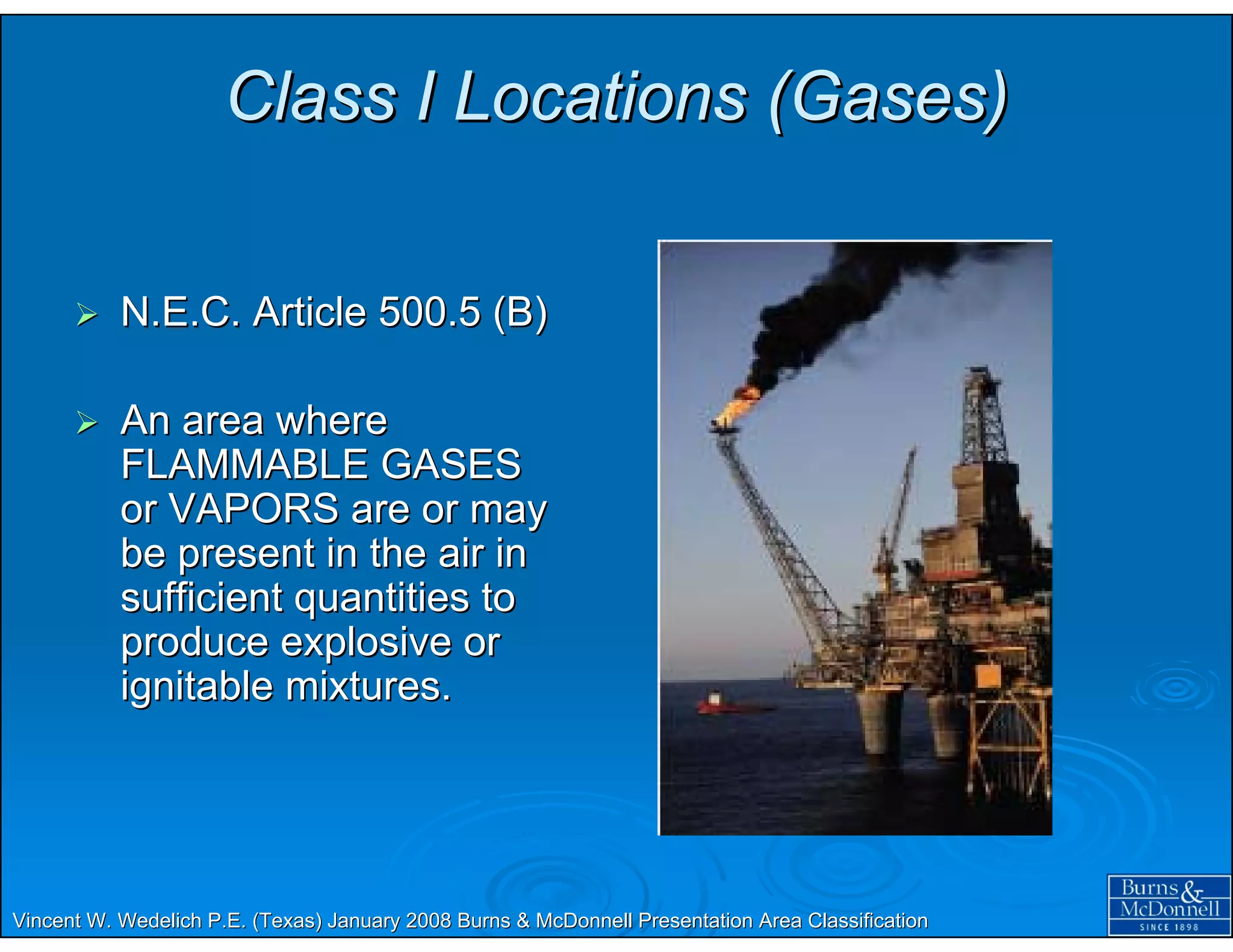
N.E.C. Article 500.5 (B)N.E.C. Article 500.5 (B)
An area whereAn area where
FLAMMABLE GASESFLAMMABLE GASES
or VAPORS are or mayor VAPORS are or may
be present in the air inbe present in the air in
sufficient quantities tosufficient quantities to
produce explosive orproduce explosive or
ignitable mixtures.ignitable mixtures.
Vincent W. Wedelich P.E. (Texas) January 2008 Burns & McDonnellVincent W. Wedelich P.E. (Texas) January 2008 Burns & McDonnell Presentation Area ClassificationPresentation Area Classification
Class I Locations (Gases)Class I Locations (Gases)
N.E.C. Article 500.5 (B)N.E.C. Article 500.5 (B)
An area whereAn area where
FLAMMABLE GASESFLAMMABLE GASES
or VAPORS are or mayor VAPORS are or may
be present in the air inbe present in the air in
sufficient quantities tosufficient quantities to
produce explosive orproduce explosive or
ignitable mixtures.ignitable mixtures.
Vincent W. Wedelich P.E. (Texas) January 2008 Burns & McDonnellVincent W. Wedelich P.E. (Texas) January 2008 Burns & McDonnell Presentation Area ClassificationPresentation Area Classification
Class I Locations (Gases)Class I Locations (Gases)
7FA GE Turbine Installation7FA GE Turbine Installation
Vincent W. Wedelich P.E. (Texas) January 2008 Burns & McDonnellVincent W. Wedelich P.E. (Texas) January 2008 Burns & McDonnell Presentation Area ClassificationPresentation Area Classification
Class I Locations (Gases)Class I Locations (Gases)
7FA GE Turbine Installation7FA GE Turbine Installation
Vincent W. Wedelich P.E. (Texas) January 2008 Burns & McDonnellVincent W. Wedelich P.E. (Texas) January 2008 Burns & McDonnell Presentation Area ClassificationPresentation Area Classification
Class I Locations (Gases)Class I Locations (Gases)
CLASS I INDUSTRIES AND APPLICATIONSCLASS I INDUSTRIES AND APPLICATIONS
Natural or liquefied gas storage facilitiesNatural or liquefied gas storage facilities
Chemical plantsChemical plants
Petroleum refineriesPetroleum refineries
Bulk handling or storage facilities for gasolineBulk handling or storage facilities for gasoline
Dip tanksDip tanks
Storage tanks for flammable liquids or gasStorage tanks for flammable liquids or gas
Spraying areas for paints or plasticsSpraying areas for paints or plastics
Aircraft fuel servicing areas or hangersAircraft fuel servicing areas or hangers
Well drilling (oil and gas), offshore or onWell drilling (oil and gas), offshore or on
Pipeline pumping areasPipeline pumping areas
Printing machine areasPrinting machine areas
Vincent W. Wedelich P.E. (Texas) January 2008 Burns & McDonnellVincent W. Wedelich P.E. (Texas) January 2008 Burns & McDonnell Presentation Area ClassificationPresentation Area Classification
Class II Locations (Dust)Class II Locations (Dust)
N.E.C. Article 500.5 (C)N.E.C. Article 500.5 (C)
An area where presenceAn area where presence
of COMBUSTIBLEof COMBUSTIBLE
DUST presents a fire orDUST presents a fire or
explosion hazard.explosion hazard.
Vincent W. Wedelich P.E. (Texas) January 2008 Burns & McDonnellVincent W. Wedelich P.E. (Texas) January 2008 Burns & McDonnell Presentation Area ClassificationPresentation Area Classification
Class II Locations (Dust)Class II Locations (Dust)
CLASS II INDUSTRIES AND APPLICATIONSCLASS II INDUSTRIES AND APPLICATIONS
Grain storage, handling or processing plantsGrain storage, handling or processing plants
Coal storage, handling or processing facilitiesCoal storage, handling or processing facilities
Metal grinding or metal powder producingMetal grinding or metal powder producing
facilitiesfacilities
Gunpowder or explosive (fireworks) plantsGunpowder or explosive (fireworks) plants
Sugar, cocoa, spice or starch production orSugar, cocoa, spice or starch production or
handling facilitieshandling facilities
Vincent W. Wedelich P.E. (Texas) January 2008 Burns & McDonnellVincent W. Wedelich P.E. (Texas) January 2008 Burns & McDonnell Presentation Area ClassificationPresentation Area Classification
Class III Locations (Fibers)Class III Locations (Fibers)
NEC Article 500.5 (D)NEC Article 500.5 (D)
An area made hazardousAn area made hazardous
because of the presence ofbecause of the presence of
easily ignitable FIBERS oreasily ignitable FIBERS or
FLYINGS, but in which suchFLYINGS, but in which such
fibers or flying's are not likelyfibers or flying's are not likely
to be in suspension in the airto be in suspension in the air
in quantities sufficient toin quantities sufficient to
produce ignitable mixtures.produce ignitable mixtures.
Vincent W. Wedelich P.E. (Texas) January 2008 Burns & McDonnellVincent W. Wedelich P.E. (Texas) January 2008 Burns & McDonnell Presentation Area ClassificationPresentation Area Classification
Class III Locations (Fibers)Class III Locations (Fibers)
CLASS III INDUSTRIES ANDCLASS III INDUSTRIES AND
APPLICATIONSAPPLICATIONS
Cotton, textile or flax producing orCotton, textile or flax producing or
handling facilitieshandling facilities
Wood cutting, pulverizing or shapingWood cutting, pulverizing or shaping
plantsplants
Clothing manufacturing facilitiesClothing manufacturing facilities
Vincent W. Wedelich P.E. (Texas) January 2008 Burns & McDonnellVincent W. Wedelich P.E. (Texas) January 2008 Burns & McDonnell Presentation Area ClassificationPresentation Area Classification
LocationsLocations
Division 1Division 1
Division 2Division 2
Vincent W. Wedelich P.E. (Texas) January 2008 Burns & McDonnellVincent W. Wedelich P.E. (Texas) January 2008 Burns & McDonnell Presentation Area ClassificationPresentation Area Classification
Division 1 LocationDivision 1 Location
NEC Articles 500.5(B)(1),NEC Articles 500.5(B)(1),
500.5(C)(1) and 500.5(D)(1)500.5(C)(1) and 500.5(D)(1)
An area where the HAZARDAn area where the HAZARD
EXIST UNDEREXIST UNDER
NORMALOPERATINGNORMALOPERATING
CONDITIONS. This alsoCONDITIONS. This also
includes locations where theincludes locations where the
hazard is caused byhazard is caused by
frequent maintenance orfrequent maintenance or
repair work or frequentrepair work or frequent
equipment failure.equipment failure.
Vincent W. Wedelich P.E. (Texas) January 2008 Burns & McDonnellVincent W. Wedelich P.E. (Texas) January 2008 Burns & McDonnell Presentation Area ClassificationPresentation Area Classification
Division 1 LocationDivision 1 Location
Consider that there are 8,760 hours in a year. It isConsider that there are 8,760 hours in a year. It is
proposed that a Division I location would be oneproposed that a Division I location would be one
that is within the flammable range more than 0.1%that is within the flammable range more than 0.1%
of the time, that is more than 8.76 hrs/yr.of the time, that is more than 8.76 hrs/yr.
From a practical viewpoint on this basis, we wouldFrom a practical viewpoint on this basis, we would
suggest that any area in the flammable range 10suggest that any area in the flammable range 10
hrs/yr. or more should be classified as Division 1.hrs/yr. or more should be classified as Division 1.
Vincent W. Wedelich P.E. (Texas) January 2008 Burns & McDonnellVincent W. Wedelich P.E. (Texas) January 2008 Burns & McDonnell Presentation Area ClassificationPresentation Area Classification
Division 2 LocationDivision 2 Location
NEC Articles 500.5(B)(2) ,NEC Articles 500.5(B)(2) ,
500.5(C)(2), and 500.5(D)(2)500.5(C)(2), and 500.5(D)(2)
An area where ignitable gases,An area where ignitable gases,
vapors, dust, or fibers arevapors, dust, or fibers are
handled, processed, or used,handled, processed, or used,
but which EXIST ONLY UNDERbut which EXIST ONLY UNDER
ABNORMAL CONDITIONS,ABNORMAL CONDITIONS,
such as containers or closedsuch as containers or closed
systems from which they cansystems from which they can
only escape through accidentalonly escape through accidental
rupture or breakdown.rupture or breakdown.
Note: No electrically conductiveNote: No electrically conductive
dust are included in Class II,dust are included in Class II,
Division 2 atmospheres.Division 2 atmospheres.
Vincent W. Wedelich P.E. (Texas) January 2008 Burns & McDonnellVincent W. Wedelich P.E. (Texas) January 2008 Burns & McDonnell Presentation Area ClassificationPresentation Area Classification
Division 2 LocationDivision 2 Location
A Division 2 location would be one that isA Division 2 location would be one that is
within the range more than 0.01% and upwithin the range more than 0.01% and up
to 0.1 % of the time (0.876 hours to 8.76to 0.1 % of the time (0.876 hours to 8.76
hours).hours).
From a practical viewpoint on this basis,From a practical viewpoint on this basis,
we would suggest that any area in thewe would suggest that any area in the
flammable range classified as Division 2,flammable range classified as Division 2,
would be in the range between 1would be in the range between 1--10 hrs/yr.10 hrs/yr.
Vincent W. Wedelich P.E. (Texas) January 2008 Burns & McDonnellVincent W. Wedelich P.E. (Texas) January 2008 Burns & McDonnell Presentation Area ClassificationPresentation Area Classification
Comparison of Div 1 and Div 2 forComparison of Div 1 and Div 2 for
GasesGases
Vincent W. Wedelich P.E. (Texas) January 2008 Burns & McDonnellVincent W. Wedelich P.E. (Texas) January 2008 Burns & McDonnell Presentation Area ClassificationPresentation Area Classification
Groups A, B, C, and D (Gases)Groups A, B, C, and D (Gases)
NEC Article 500.6(A)NEC Article 500.6(A)
Groups indicates the DEGREE OF THE HAZARD.Groups indicates the DEGREE OF THE HAZARD.
GROUPS A, B, C and D are classified by chemicalGROUPS A, B, C and D are classified by chemical
families as shown in NFPA 497Mfamilies as shown in NFPA 497M--1986 and 325M1986 and 325M--
1984.1984.
The important factor in classifying a gas or vapor byThe important factor in classifying a gas or vapor by
Group is how much PRESSURE is created during anGroup is how much PRESSURE is created during an
explosion. Group A (Acetylene) creates the mostexplosion. Group A (Acetylene) creates the most
pressure, with Group B (Hydrogen) next.pressure, with Group B (Hydrogen) next.
Vincent W. Wedelich P.E. (Texas) January 2008 Burns & McDonnellVincent W. Wedelich P.E. (Texas) January 2008 Burns & McDonnell Presentation Area ClassificationPresentation Area Classification
Groups A, B, C, and D (Gases)Groups A, B, C, and D (Gases)
Vincent W. Wedelich P.E. (Texas) January 2008 Burns & McDonnellVincent W. Wedelich P.E. (Texas) January 2008 Burns & McDonnell Presentation Area ClassificationPresentation Area Classification
Groups A, B, C, and D (Gases)Groups A, B, C, and D (Gases)
Relative speed and maximum pressure of five test
gases: acetylene, hydrogen, ethylene, propane, and methane.
Vincent W. Wedelich P.E. (Texas) January 2008 Burns & McDonnellVincent W. Wedelich P.E. (Texas) January 2008 Burns & McDonnell Presentation Area ClassificationPresentation Area Classification
Groups E, F and G (Dust)Groups E, F and G (Dust)
NEC Article 500.6(B)NEC Article 500.6(B)
Groups indicates the DEGREE OF THEGroups indicates the DEGREE OF THE
HAZARD, based on Electrical ResistivityHAZARD, based on Electrical Resistivity
from Table on right (Source: ANSI/ISAfrom Table on right (Source: ANSI/ISA--
S12.10S12.10--1988)1988)
GROUP EGROUP E --Atmospheres containingAtmospheres containing
combustible METAL DUST.combustible METAL DUST.
GROUP FGROUP F --Atmospheres containingAtmospheres containing
CARBON BLACK, CHARCOAL, COAL,CARBON BLACK, CHARCOAL, COAL,
or COKE DUST.or COKE DUST.
GROUP GGROUP G --Atmospheres containingAtmospheres containing
AGRICULTURAL and other dustsAGRICULTURAL and other dusts
Vincent W. Wedelich P.E. (Texas) January 2008 Burns & McDonnellVincent W. Wedelich P.E. (Texas) January 2008 Burns & McDonnell Presentation Area ClassificationPresentation Area Classification
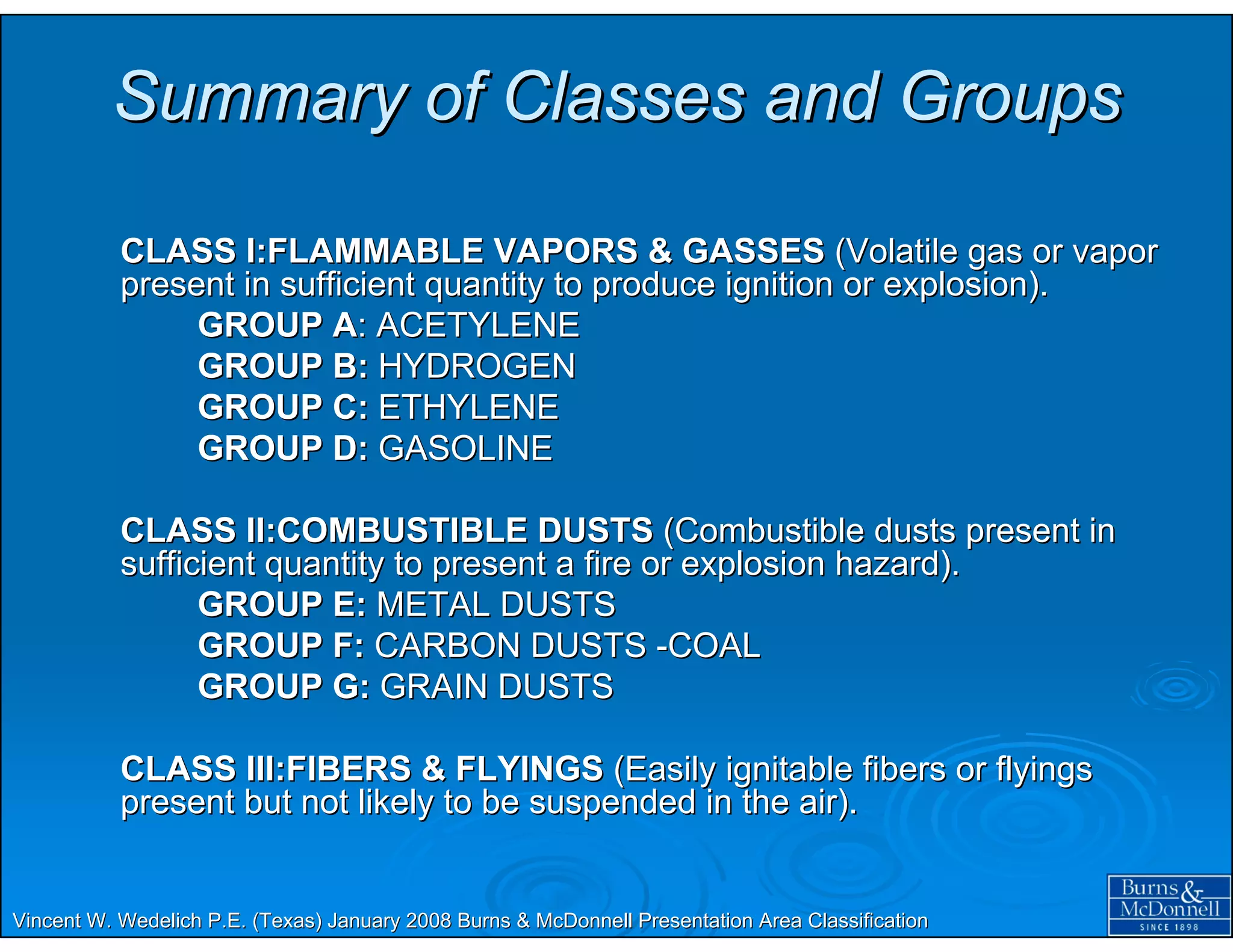
Summary of Classes and GroupsSummary of Classes and Groups
CLASS I:FLAMMABLE VAPORS & GASSESCLASS I:FLAMMABLE VAPORS & GASSES (Volatile gas or vapor(Volatile gas or vapor
present in sufficient quantity to produce ignition or explosion)present in sufficient quantity to produce ignition or explosion)..
GROUP AGROUP A: ACETYLENE: ACETYLENE
GROUP B:GROUP B: HYDROGENHYDROGEN
GROUP C:GROUP C: ETHYLENEETHYLENE
GROUP D:GROUP D: GASOLINEGASOLINE
CLASS II:COMBUSTIBLE DUSTSCLASS II:COMBUSTIBLE DUSTS (Combustible dusts present in(Combustible dusts present in
sufficient quantity to present a fire or explosion hazard).sufficient quantity to present a fire or explosion hazard).
GROUP E:GROUP E: METAL DUSTSMETAL DUSTS
GROUP F:GROUP F: CARBON DUSTSCARBON DUSTS --COALCOAL
GROUP G:GROUP G: GRAIN DUSTSGRAIN DUSTS
CLASS III:FIBERS & FLYINGSCLASS III:FIBERS & FLYINGS (Easily ignitable fibers or flyings(Easily ignitable fibers or flyings
present but not likely to be suspended in the air).present but not likely to be suspended in the air).
Vincent W. Wedelich P.E. (Texas) January 2008 Burns & McDonnellVincent W. Wedelich P.E. (Texas) January 2008 Burns & McDonnell Presentation Area ClassificationPresentation Area Classification
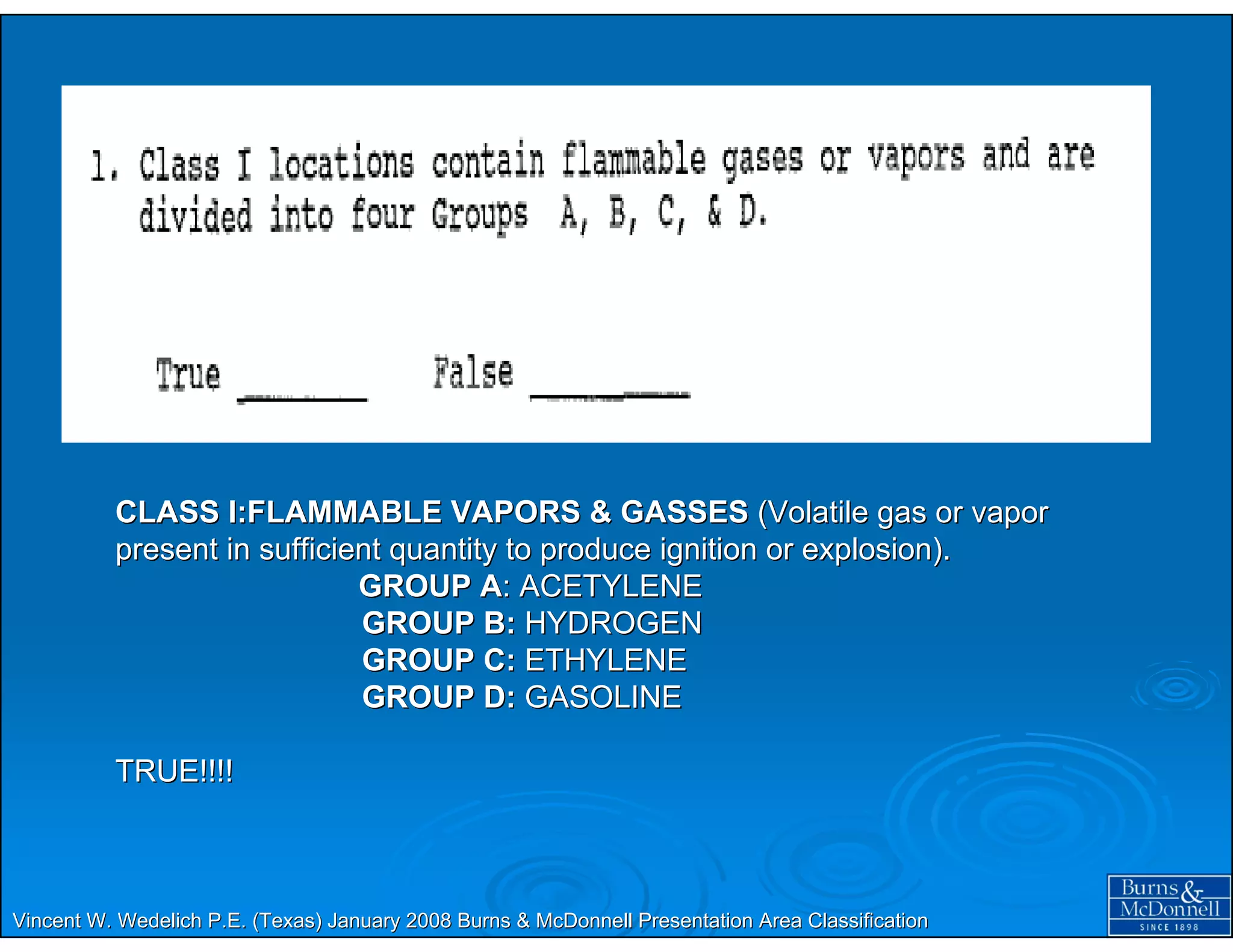
CLASS I:FLAMMABLE VAPORS & GASSESCLASS I:FLAMMABLE VAPORS & GASSES (Volatile gas or vapor(Volatile gas or vapor
present in sufficient quantity to produce ignition or explosion)present in sufficient quantity to produce ignition or explosion)..
GROUP AGROUP A: ACETYLENE: ACETYLENE
GROUP B:GROUP B: HYDROGENHYDROGEN
GROUP C:GROUP C: ETHYLENEETHYLENE
GROUP D:GROUP D: GASOLINEGASOLINE
TRUE!!!!TRUE!!!!
Vincent W. Wedelich P.E. (Texas) January 2008 Burns & McDonnellVincent W. Wedelich P.E. (Texas) January 2008 Burns & McDonnell Presentation Area ClassificationPresentation Area Classification
Identifying electrical equipment that can be used inIdentifying electrical equipment that can be used in
different hazardous areas.different hazardous areas.
UL Explosion proof Apparatus Definition NEMAUL Explosion proof Apparatus Definition NEMA
7 Enclosures.7 Enclosures.
Purging/Pressurization Systems.Purging/Pressurization Systems.
Intrinsically Safe Equipment.Intrinsically Safe Equipment.
Vincent W. Wedelich P.E. (Texas) January 2008 Burns & McDonnellVincent W. Wedelich P.E. (Texas) January 2008 Burns & McDonnell Presentation Area ClassificationPresentation Area Classification
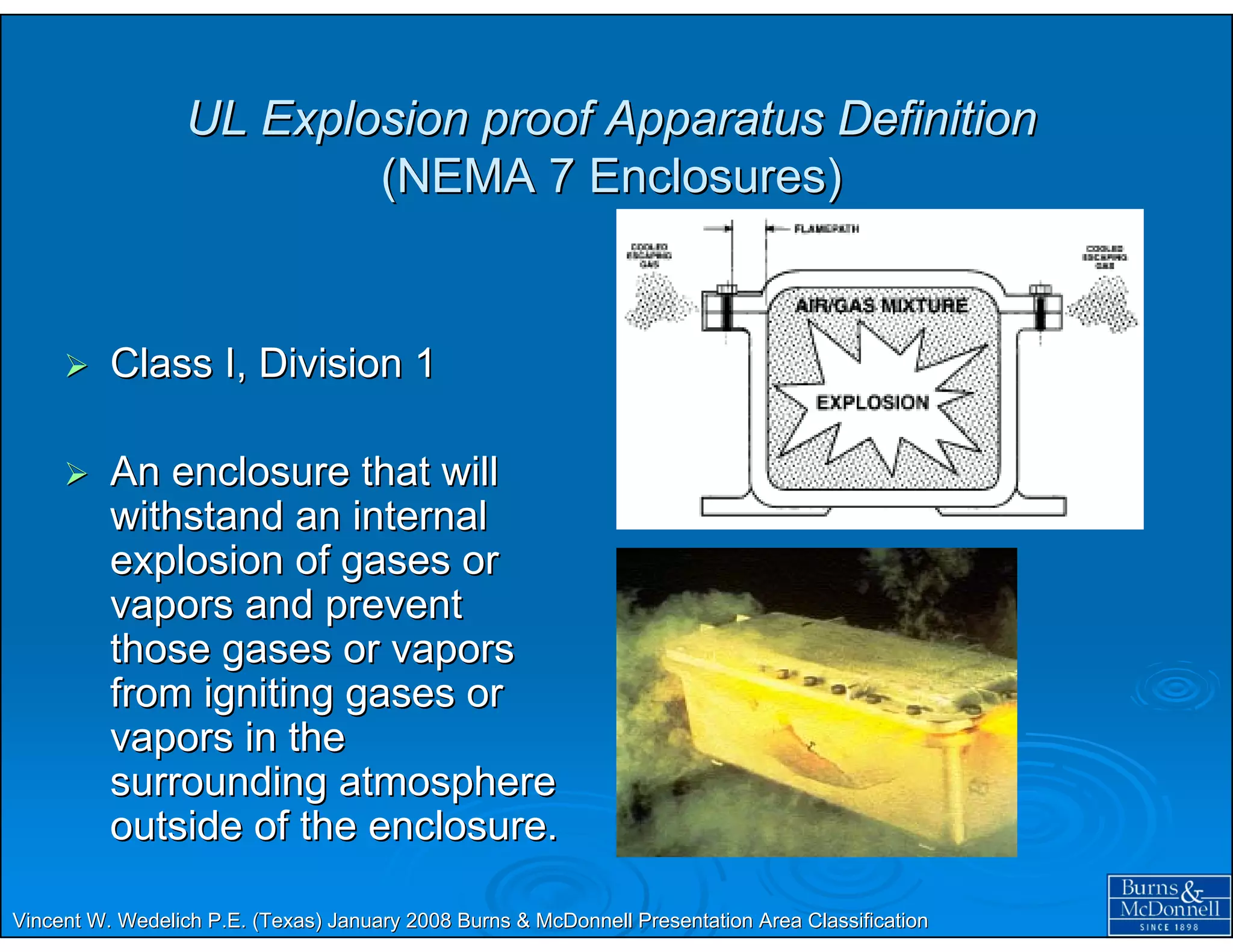
UL Explosion proof Apparatus DefinitionUL Explosion proof Apparatus Definition
(NEMA 7 Enclosures)(NEMA 7 Enclosures)
Class I, Division 1Class I, Division 1
An enclosure that willAn enclosure that will
withstand an internalwithstand an internal
explosion of gases orexplosion of gases or
vapors and preventvapors and prevent
those gases or vaporsthose gases or vapors
from igniting gases orfrom igniting gases or
vapors in thevapors in the
surrounding atmospheresurrounding atmosphere
outside of the enclosure.outside of the enclosure.
Vincent W. Wedelich P.E. (Texas) January 2008 Burns & McDonnellVincent W. Wedelich P.E. (Texas) January 2008 Burns & McDonnell Presentation Area ClassificationPresentation Area Classification
Explosion proof EquipmentExplosion proof Equipment --JointsJoints
Vincent W. Wedelich P.E. (Texas) January 2008 Burns & McDonnellVincent W. Wedelich P.E. (Texas) January 2008 Burns & McDonnell Presentation Area ClassificationPresentation Area Classification
Explosion proof EquipmentExplosion proof Equipment --JointsJoints
Vincent W. Wedelich P.E. (Texas) January 2008 Burns & McDonnellVincent W. Wedelich P.E. (Texas) January 2008 Burns & McDonnell Presentation Area ClassificationPresentation Area Classification
NEMA 7 DesignsNEMA 7 Designs
AdvantagesAdvantages
Explosion ContainmentExplosion Containment
No ElectronicsNo Electronics
Low MaintenanceLow Maintenance
No Moving PartsNo Moving Parts
HighHigh--Powered EquipmentPowered Equipment
DisadvantagesDisadvantages
No warning mechanism for containment failureNo warning mechanism for containment failure
Danger to Equipment After ExplosionsDanger to Equipment After Explosions
Possibility of Installation/Maintenance ErrorsPossibility of Installation/Maintenance Errors
Cost of Protection per ft3 Increases With Enclosure SizeCost of Protection per ft3 Increases With Enclosure Size
Windows are LimitedWindows are Limited
Condensation buildup is commonCondensation buildup is common
Few sizes to choose fromFew sizes to choose from
Cumbersome, Limited AccessCumbersome, Limited Access
Bulky DesignsBulky Designs
Causes Harmful Heat Build upCauses Harmful Heat Build up
Excessive WeightExcessive Weight
Vincent W. Wedelich P.E. (Texas) January 2008 Burns & McDonnellVincent W. Wedelich P.E. (Texas) January 2008 Burns & McDonnell Presentation Area ClassificationPresentation Area Classification
Purpose of the Conduit SealsPurpose of the Conduit Seals
Vincent W. Wedelich P.E. (Texas) January 2008 Burns & McDonnellVincent W. Wedelich P.E. (Texas) January 2008 Burns & McDonnell Presentation Area ClassificationPresentation Area Classification
Conduit Seal FittingsConduit Seal Fittings
Vincent W. Wedelich P.E. (Texas) January 2008 Burns & McDonnellVincent W. Wedelich P.E. (Texas) January 2008 Burns & McDonnell Presentation Area ClassificationPresentation Area Classification
Conduit Seal FittingsConduit Seal Fittings
Vincent W. Wedelich P.E. (Texas) January 2008 Burns & McDonnellVincent W. Wedelich P.E. (Texas) January 2008 Burns & McDonnell Presentation Area ClassificationPresentation Area Classification
Conduit Seals Class I, Division 1
Vincent W. Wedelich P.E. (Texas) January 2008 Burns & McDonnellVincent W. Wedelich P.E. (Texas) January 2008 Burns & McDonnell Presentation Area ClassificationPresentation Area Classification
Conduit Seals Class I, Division 1
Vincent W. Wedelich P.E. (Texas) January 2008 Burns & McDonnellVincent W. Wedelich P.E. (Texas) January 2008 Burns & McDonnell Presentation Area ClassificationPresentation Area Classification
Conduit Seals Class I, Division 1
Vincent W. Wedelich P.E. (Texas) January 2008 Burns & McDonnellVincent W. Wedelich P.E. (Texas) January 2008 Burns & McDonnell Presentation Area ClassificationPresentation Area Classification
Conduit Seals Class I, Division 2
Vincent W. Wedelich P.E. (Texas) January 2008 Burns & McDonnellVincent W. Wedelich P.E. (Texas) January 2008 Burns & McDonnell Presentation Area ClassificationPresentation Area Classification
Wiring Methods
Vincent W. Wedelich P.E. (Texas) January 2008 Burns & McDonnellVincent W. Wedelich P.E. (Texas) January 2008 Burns & McDonnell Presentation Area ClassificationPresentation Area Classification
Cable Seals Class I, Division 1
Vincent W. Wedelich P.E. (Texas) January 2008 Burns & McDonnellVincent W. Wedelich P.E. (Texas) January 2008 Burns & McDonnell Presentation Area ClassificationPresentation Area Classification
Cable Seals Class I, Division 1
Vincent W. Wedelich P.E. (Texas) January 2008 Burns & McDonnellVincent W. Wedelich P.E. (Texas) January 2008 Burns & McDonnell Presentation Area ClassificationPresentation Area Classification
Cable Seals Class I, Division 2
Vincent W. Wedelich P.E. (Texas) January 2008 Burns & McDonnellVincent W. Wedelich P.E. (Texas) January 2008 Burns & McDonnell Presentation Area ClassificationPresentation Area Classification
Hazardous Lighting -T Rating
Vincent W. Wedelich P.E. (Texas) January 2008 Burns & McDonnellVincent W. Wedelich P.E. (Texas) January 2008 Burns & McDonnell Presentation Area ClassificationPresentation Area Classification
UL Temperature Test
Class I, Division 1 Lighting
Vincent W. Wedelich P.E. (Texas) January 2008 Burns & McDonnellVincent W. Wedelich P.E. (Texas) January 2008 Burns & McDonnell Presentation Area ClassificationPresentation Area Classification
What is the max. surface temperature of theWhat is the max. surface temperature of the
VMVCVMVC--100100--S712?S712?
Vincent W. Wedelich P.E. (Texas) January 2008 Burns & McDonnellVincent W. Wedelich P.E. (Texas) January 2008 Burns & McDonnell Presentation Area ClassificationPresentation Area Classification
http://www.bebcoeps.com/pdf/purge_tech_review.pdf
Vincent W. Wedelich P.E. (Texas) January 2008 Burns & McDonnellVincent W. Wedelich P.E. (Texas) January 2008 Burns & McDonnell Presentation Area ClassificationPresentation Area Classification
Purge DesignsPurge Designs
AdvantagesAdvantages
Reduces Heat Build upReduces Heat Build up
Inhibits Metal CorrosionInhibits Metal Corrosion
Low MaintenanceLow Maintenance
Increases Equipment LongevityIncreases Equipment Longevity
No Special Enclosures RequiredNo Special Enclosures Required
Allows Fast Access to EquipmentAllows Fast Access to Equipment
Reduces Moisture & Dust Build upReduces Moisture & Dust Build up
Reduces Classification Within the EnclosureReduces Classification Within the Enclosure
Continuous System Status IndicationContinuous System Status Indication
Protects Enclosures up to 450 ft3Protects Enclosures up to 450 ft3
Allows use of any Enclosure ShapeAllows use of any Enclosure Shape
Cost of Protection per ft3 Decreases With Enclosure SizeCost of Protection per ft3 Decreases With Enclosure Size
No immediate danger if system failure occursNo immediate danger if system failure occurs
DisadvantagesDisadvantages
Contains Moving PartsContains Moving Parts
Requires Instrument Air SupplyRequires Instrument Air Supply
Some Systems Require ElectronicsSome Systems Require Electronics
Hot Permits RequiredHot Permits Required
Vincent W. Wedelich P.E. (Texas) January 2008 Burns & McDonnellVincent W. Wedelich P.E. (Texas) January 2008 Burns & McDonnell Presentation Area ClassificationPresentation Area Classification
Intrinsically Safe CircuitsIntrinsically Safe Circuits
AdvantagesAdvantages
The Only Protection Allowed for Zone 0The Only Protection Allowed for Zone 0
Eliminates Possibility of ExplosionEliminates Possibility of Explosion
No Hot PermitsNo Hot Permits
Low MaintenanceLow Maintenance
No Special CablesNo Special Cables
Ideal for LowIdeal for Low--Power DevicesPower Devices
Limits Energy to the DeviceLimits Energy to the Device
DisadvantagesDisadvantages
Requires Documentation of I.S. Circuits and InstallationRequires Documentation of I.S. Circuits and Installation
Can be Used Only With LowCan be Used Only With Low--Power DevicesPower Devices
Vincent W. Wedelich P.E. (Texas) January 2008 Burns & McDonnellVincent W. Wedelich P.E. (Texas) January 2008 Burns & McDonnell Presentation Area ClassificationPresentation Area Classification
Electrical Area Classification StudyElectrical Area Classification Study
quick review.quick review.
1.1. Selection of Project Specific ReferenceSelection of Project Specific Reference
Material (in our case it is the PIP ELEHA01Material (in our case it is the PIP ELEHA01
2.2. Data Requirements ( conduct a site surveyData Requirements ( conduct a site survey
determine if the area is hazardous)determine if the area is hazardous)
3.3. Material and Properties (fill in PIP ELEHA01Material and Properties (fill in PIP ELEHA01
Form 1.Form 1.
4.4. Release Sources (fill in PIP ELEHA01 Form 2)Release Sources (fill in PIP ELEHA01 Form 2)
5.5. Create a Classification Document (a drawingCreate a Classification Document (a drawing
showing the different areas and theirshowing the different areas and their
hazardous classifications).hazardous classifications).
Vincent W. Wedelich P.E. (Texas) January 2008 Burns & McDonnellVincent W. Wedelich P.E. (Texas) January 2008 Burns & McDonnell Presentation Area ClassificationPresentation Area Classification
Introduction to PIP ELEHA01Introduction to PIP ELEHA01
SpecificationSpecification
Vincent W. Wedelich P.E. (Texas) January 2008 Burns & McDonnellVincent W. Wedelich P.E. (Texas) January 2008 Burns & McDonnell Presentation Area ClassificationPresentation Area Classification
Introduction to PIP ELEHA01 Form No. 1Introduction to PIP ELEHA01 Form No. 1
Flammable Combustible.Flammable Combustible.
Vincent W. Wedelich P.E. (Texas) January 2008 Burns & McDonnellVincent W. Wedelich P.E. (Texas) January 2008 Burns & McDonnell Presentation Area ClassificationPresentation Area Classification
Introduction to PIP ELEHA01 Form No. 2 Sources of Release.Introduction to PIP ELEHA01 Form No. 2 Sources of Release.
Vincent W. Wedelich P.E. (Texas) January 2008 Burns & McDonnellVincent W. Wedelich P.E. (Texas) January 2008 Burns & McDonnell Presentation Area ClassificationPresentation Area Classification
Introduction to PIP ELEHA01 Form No. 2 Sources of Release.Introduction to PIP ELEHA01 Form No. 2 Sources of Release.
Vincent W. Wedelich P.E. (Texas) January 2008 Burns & McDonnellVincent W. Wedelich P.E. (Texas) January 2008 Burns & McDonnell Presentation Area ClassificationPresentation Area Classification
Questions?Questions?
References:References:
NFPA, IEC, IEEE, Appleton EGS, PIP, GE,NFPA, IEC, IEEE, Appleton EGS, PIP, GE,
Bebco, Crouse Hinds, CEAG.Bebco, Crouse Hinds, CEAG.
Vincent W. Wedelich P.E. (Texas)Vincent W. Wedelich P.E. (Texas)
vwedelich@burnsmcd.comvwedelich@burnsmcd.com
832832--214214--2804 office phone2804 office phone

Area classification

  • 1.
    Vincent W. WedelichP.E. (Texas) January 2008 Burns & McDonnellVincent W. Wedelich P.E. (Texas) January 2008 Burns & McDonnell Presentation Area ClassificationPresentation Area Classification Electrical AreaElectrical Area Classification TrainingClassification Training Presented by:Presented by: Vincent W. Wedelich P.E.Vincent W. Wedelich P.E. January 8, 2008January 8, 2008
  • 2.
    Vincent W. WedelichP.E. (Texas) January 2008 Burns & McDonnellVincent W. Wedelich P.E. (Texas) January 2008 Burns & McDonnell Presentation Area ClassificationPresentation Area Classification What will be covered in this course.What will be covered in this course. Introduction to area classification terminologyIntroduction to area classification terminology and standards.and standards. Identifying electrical equipment that can be usedIdentifying electrical equipment that can be used in different hazardous areas.in different hazardous areas. Introduction to PIP ELEHA01 SpecificationIntroduction to PIP ELEHA01 Specification Introduction to PIP ELEHA01 Form No. 1Introduction to PIP ELEHA01 Form No. 1 Flammable Combustible.Flammable Combustible. Introduction to PIP ELEHA01 Form No. 2Introduction to PIP ELEHA01 Form No. 2 Sources of Release.Sources of Release.
  • 3.
    Vincent W. WedelichP.E. (Texas) January 2008 Burns & McDonnellVincent W. Wedelich P.E. (Texas) January 2008 Burns & McDonnell Presentation Area ClassificationPresentation Area Classification Introduction to area classificationIntroduction to area classification terminology and standards.terminology and standards. Standards WorldwideStandards Worldwide National Electric Code N.E.C.National Electric Code N.E.C. Class LocationsClass Locations LocationsLocations GroupsGroups Explosion elementsExplosion elements
  • 4.
    Vincent W. WedelichP.E. (Texas) January 2008 Burns & McDonnellVincent W. Wedelich P.E. (Texas) January 2008 Burns & McDonnell Presentation Area ClassificationPresentation Area Classification
  • 5.
    Vincent W. WedelichP.E. (Texas) January 2008 Burns & McDonnellVincent W. Wedelich P.E. (Texas) January 2008 Burns & McDonnell Presentation Area ClassificationPresentation Area Classification Notable Standards For AreaNotable Standards For Area ClassificationClassification lEC60079 Part 10 for the UK and Europe.lEC60079 Part 10 for the UK and Europe. BS5345 Part 2 for UK only.BS5345 Part 2 for UK only. API 500 A for USA.API 500 A for USA.
  • 6.
    Vincent W. WedelichP.E. (Texas) January 2008 Burns & McDonnellVincent W. Wedelich P.E. (Texas) January 2008 Burns & McDonnell Presentation Area ClassificationPresentation Area Classification
  • 7.
    Vincent W. WedelichP.E. (Texas) January 2008 Burns & McDonnellVincent W. Wedelich P.E. (Texas) January 2008 Burns & McDonnell Presentation Area ClassificationPresentation Area Classification Explosion elementsExplosion elements
  • 8.
    Vincent W. WedelichP.E. (Texas) January 2008 Burns & McDonnellVincent W. Wedelich P.E. (Texas) January 2008 Burns & McDonnell Presentation Area ClassificationPresentation Area Classification N.E.C. Article 500 Code SectionsN.E.C. Article 500 Code Sections Article 500 Hazardous LocationsArticle 500 Hazardous Locations Article 501 Class I LocationsArticle 501 Class I Locations Article 502 Class II LocationsArticle 502 Class II Locations Article 503 Class III LocationsArticle 503 Class III Locations Article 504 Intrinsically Safe SystemsArticle 504 Intrinsically Safe Systems Article 505 Class 1, Zone 0, 1, and 2Article 505 Class 1, Zone 0, 1, and 2 LocationsLocations Article 510 Hazardous LocationArticle 510 Hazardous Location --SpecificSpecific Article 511 Commercial GaragesArticle 511 Commercial Garages Article 513 Aircraft HangarsArticle 513 Aircraft Hangars Article 514 Gasoline Service StationsArticle 514 Gasoline Service Stations Article 515 Bulk Storage PlantsArticle 515 Bulk Storage Plants Article 516 Paint Spray ApplicationArticle 516 Paint Spray Application
  • 9.
    Vincent W. WedelichP.E. (Texas) January 2008 Burns & McDonnellVincent W. Wedelich P.E. (Texas) January 2008 Burns & McDonnell Presentation Area ClassificationPresentation Area Classification Class LocationsClass Locations N.E.C. Article 500.5 (B)N.E.C. Article 500.5 (B) An area whereAn area where FLAMMABLE GASESFLAMMABLE GASES or VAPORS are or mayor VAPORS are or may be present in the air inbe present in the air in sufficient quantities tosufficient quantities to produce explosive orproduce explosive or ignitable mixtures.ignitable mixtures.
  • 10.
    Vincent W. WedelichP.E. (Texas) January 2008 Burns & McDonnellVincent W. Wedelich P.E. (Texas) January 2008 Burns & McDonnell Presentation Area ClassificationPresentation Area Classification Class I Locations (Gases)Class I Locations (Gases) N.E.C. Article 500.5 (B)N.E.C. Article 500.5 (B) An area whereAn area where FLAMMABLE GASESFLAMMABLE GASES or VAPORS are or mayor VAPORS are or may be present in the air inbe present in the air in sufficient quantities tosufficient quantities to produce explosive orproduce explosive or ignitable mixtures.ignitable mixtures.
  • 11.
    Vincent W. WedelichP.E. (Texas) January 2008 Burns & McDonnellVincent W. Wedelich P.E. (Texas) January 2008 Burns & McDonnell Presentation Area ClassificationPresentation Area Classification Class I Locations (Gases)Class I Locations (Gases) 7FA GE Turbine Installation7FA GE Turbine Installation
  • 12.
    Vincent W. WedelichP.E. (Texas) January 2008 Burns & McDonnellVincent W. Wedelich P.E. (Texas) January 2008 Burns & McDonnell Presentation Area ClassificationPresentation Area Classification Class I Locations (Gases)Class I Locations (Gases) 7FA GE Turbine Installation7FA GE Turbine Installation
  • 13.
    Vincent W. WedelichP.E. (Texas) January 2008 Burns & McDonnellVincent W. Wedelich P.E. (Texas) January 2008 Burns & McDonnell Presentation Area ClassificationPresentation Area Classification Class I Locations (Gases)Class I Locations (Gases) CLASS I INDUSTRIES AND APPLICATIONSCLASS I INDUSTRIES AND APPLICATIONS Natural or liquefied gas storage facilitiesNatural or liquefied gas storage facilities Chemical plantsChemical plants Petroleum refineriesPetroleum refineries Bulk handling or storage facilities for gasolineBulk handling or storage facilities for gasoline Dip tanksDip tanks Storage tanks for flammable liquids or gasStorage tanks for flammable liquids or gas Spraying areas for paints or plasticsSpraying areas for paints or plastics Aircraft fuel servicing areas or hangersAircraft fuel servicing areas or hangers Well drilling (oil and gas), offshore or onWell drilling (oil and gas), offshore or on Pipeline pumping areasPipeline pumping areas Printing machine areasPrinting machine areas
  • 14.
    Vincent W. WedelichP.E. (Texas) January 2008 Burns & McDonnellVincent W. Wedelich P.E. (Texas) January 2008 Burns & McDonnell Presentation Area ClassificationPresentation Area Classification Class II Locations (Dust)Class II Locations (Dust) N.E.C. Article 500.5 (C)N.E.C. Article 500.5 (C) An area where presenceAn area where presence of COMBUSTIBLEof COMBUSTIBLE DUST presents a fire orDUST presents a fire or explosion hazard.explosion hazard.
  • 15.
    Vincent W. WedelichP.E. (Texas) January 2008 Burns & McDonnellVincent W. Wedelich P.E. (Texas) January 2008 Burns & McDonnell Presentation Area ClassificationPresentation Area Classification Class II Locations (Dust)Class II Locations (Dust) CLASS II INDUSTRIES AND APPLICATIONSCLASS II INDUSTRIES AND APPLICATIONS Grain storage, handling or processing plantsGrain storage, handling or processing plants Coal storage, handling or processing facilitiesCoal storage, handling or processing facilities Metal grinding or metal powder producingMetal grinding or metal powder producing facilitiesfacilities Gunpowder or explosive (fireworks) plantsGunpowder or explosive (fireworks) plants Sugar, cocoa, spice or starch production orSugar, cocoa, spice or starch production or handling facilitieshandling facilities
  • 16.
    Vincent W. WedelichP.E. (Texas) January 2008 Burns & McDonnellVincent W. Wedelich P.E. (Texas) January 2008 Burns & McDonnell Presentation Area ClassificationPresentation Area Classification Class III Locations (Fibers)Class III Locations (Fibers) NEC Article 500.5 (D)NEC Article 500.5 (D) An area made hazardousAn area made hazardous because of the presence ofbecause of the presence of easily ignitable FIBERS oreasily ignitable FIBERS or FLYINGS, but in which suchFLYINGS, but in which such fibers or flying's are not likelyfibers or flying's are not likely to be in suspension in the airto be in suspension in the air in quantities sufficient toin quantities sufficient to produce ignitable mixtures.produce ignitable mixtures.
  • 17.
    Vincent W. WedelichP.E. (Texas) January 2008 Burns & McDonnellVincent W. Wedelich P.E. (Texas) January 2008 Burns & McDonnell Presentation Area ClassificationPresentation Area Classification Class III Locations (Fibers)Class III Locations (Fibers) CLASS III INDUSTRIES ANDCLASS III INDUSTRIES AND APPLICATIONSAPPLICATIONS Cotton, textile or flax producing orCotton, textile or flax producing or handling facilitieshandling facilities Wood cutting, pulverizing or shapingWood cutting, pulverizing or shaping plantsplants Clothing manufacturing facilitiesClothing manufacturing facilities
  • 18.
    Vincent W. WedelichP.E. (Texas) January 2008 Burns & McDonnellVincent W. Wedelich P.E. (Texas) January 2008 Burns & McDonnell Presentation Area ClassificationPresentation Area Classification LocationsLocations Division 1Division 1 Division 2Division 2
  • 19.
    Vincent W. WedelichP.E. (Texas) January 2008 Burns & McDonnellVincent W. Wedelich P.E. (Texas) January 2008 Burns & McDonnell Presentation Area ClassificationPresentation Area Classification Division 1 LocationDivision 1 Location NEC Articles 500.5(B)(1),NEC Articles 500.5(B)(1), 500.5(C)(1) and 500.5(D)(1)500.5(C)(1) and 500.5(D)(1) An area where the HAZARDAn area where the HAZARD EXIST UNDEREXIST UNDER NORMALOPERATINGNORMALOPERATING CONDITIONS. This alsoCONDITIONS. This also includes locations where theincludes locations where the hazard is caused byhazard is caused by frequent maintenance orfrequent maintenance or repair work or frequentrepair work or frequent equipment failure.equipment failure.
  • 20.
    Vincent W. WedelichP.E. (Texas) January 2008 Burns & McDonnellVincent W. Wedelich P.E. (Texas) January 2008 Burns & McDonnell Presentation Area ClassificationPresentation Area Classification Division 1 LocationDivision 1 Location Consider that there are 8,760 hours in a year. It isConsider that there are 8,760 hours in a year. It is proposed that a Division I location would be oneproposed that a Division I location would be one that is within the flammable range more than 0.1%that is within the flammable range more than 0.1% of the time, that is more than 8.76 hrs/yr.of the time, that is more than 8.76 hrs/yr. From a practical viewpoint on this basis, we wouldFrom a practical viewpoint on this basis, we would suggest that any area in the flammable range 10suggest that any area in the flammable range 10 hrs/yr. or more should be classified as Division 1.hrs/yr. or more should be classified as Division 1.
  • 21.
    Vincent W. WedelichP.E. (Texas) January 2008 Burns & McDonnellVincent W. Wedelich P.E. (Texas) January 2008 Burns & McDonnell Presentation Area ClassificationPresentation Area Classification Division 2 LocationDivision 2 Location NEC Articles 500.5(B)(2) ,NEC Articles 500.5(B)(2) , 500.5(C)(2), and 500.5(D)(2)500.5(C)(2), and 500.5(D)(2) An area where ignitable gases,An area where ignitable gases, vapors, dust, or fibers arevapors, dust, or fibers are handled, processed, or used,handled, processed, or used, but which EXIST ONLY UNDERbut which EXIST ONLY UNDER ABNORMAL CONDITIONS,ABNORMAL CONDITIONS, such as containers or closedsuch as containers or closed systems from which they cansystems from which they can only escape through accidentalonly escape through accidental rupture or breakdown.rupture or breakdown. Note: No electrically conductiveNote: No electrically conductive dust are included in Class II,dust are included in Class II, Division 2 atmospheres.Division 2 atmospheres.
  • 22.
    Vincent W. WedelichP.E. (Texas) January 2008 Burns & McDonnellVincent W. Wedelich P.E. (Texas) January 2008 Burns & McDonnell Presentation Area ClassificationPresentation Area Classification Division 2 LocationDivision 2 Location A Division 2 location would be one that isA Division 2 location would be one that is within the range more than 0.01% and upwithin the range more than 0.01% and up to 0.1 % of the time (0.876 hours to 8.76to 0.1 % of the time (0.876 hours to 8.76 hours).hours). From a practical viewpoint on this basis,From a practical viewpoint on this basis, we would suggest that any area in thewe would suggest that any area in the flammable range classified as Division 2,flammable range classified as Division 2, would be in the range between 1would be in the range between 1--10 hrs/yr.10 hrs/yr.
  • 23.
    Vincent W. WedelichP.E. (Texas) January 2008 Burns & McDonnellVincent W. Wedelich P.E. (Texas) January 2008 Burns & McDonnell Presentation Area ClassificationPresentation Area Classification Comparison of Div 1 and Div 2 forComparison of Div 1 and Div 2 for GasesGases
  • 24.
    Vincent W. WedelichP.E. (Texas) January 2008 Burns & McDonnellVincent W. Wedelich P.E. (Texas) January 2008 Burns & McDonnell Presentation Area ClassificationPresentation Area Classification Groups A, B, C, and D (Gases)Groups A, B, C, and D (Gases) NEC Article 500.6(A)NEC Article 500.6(A) Groups indicates the DEGREE OF THE HAZARD.Groups indicates the DEGREE OF THE HAZARD. GROUPS A, B, C and D are classified by chemicalGROUPS A, B, C and D are classified by chemical families as shown in NFPA 497Mfamilies as shown in NFPA 497M--1986 and 325M1986 and 325M-- 1984.1984. The important factor in classifying a gas or vapor byThe important factor in classifying a gas or vapor by Group is how much PRESSURE is created during anGroup is how much PRESSURE is created during an explosion. Group A (Acetylene) creates the mostexplosion. Group A (Acetylene) creates the most pressure, with Group B (Hydrogen) next.pressure, with Group B (Hydrogen) next.
  • 25.
    Vincent W. WedelichP.E. (Texas) January 2008 Burns & McDonnellVincent W. Wedelich P.E. (Texas) January 2008 Burns & McDonnell Presentation Area ClassificationPresentation Area Classification Groups A, B, C, and D (Gases)Groups A, B, C, and D (Gases)
  • 26.
    Vincent W. WedelichP.E. (Texas) January 2008 Burns & McDonnellVincent W. Wedelich P.E. (Texas) January 2008 Burns & McDonnell Presentation Area ClassificationPresentation Area Classification Groups A, B, C, and D (Gases)Groups A, B, C, and D (Gases) Relative speed and maximum pressure of five test gases: acetylene, hydrogen, ethylene, propane, and methane.
  • 27.
    Vincent W. WedelichP.E. (Texas) January 2008 Burns & McDonnellVincent W. Wedelich P.E. (Texas) January 2008 Burns & McDonnell Presentation Area ClassificationPresentation Area Classification Groups E, F and G (Dust)Groups E, F and G (Dust) NEC Article 500.6(B)NEC Article 500.6(B) Groups indicates the DEGREE OF THEGroups indicates the DEGREE OF THE HAZARD, based on Electrical ResistivityHAZARD, based on Electrical Resistivity from Table on right (Source: ANSI/ISAfrom Table on right (Source: ANSI/ISA-- S12.10S12.10--1988)1988) GROUP EGROUP E --Atmospheres containingAtmospheres containing combustible METAL DUST.combustible METAL DUST. GROUP FGROUP F --Atmospheres containingAtmospheres containing CARBON BLACK, CHARCOAL, COAL,CARBON BLACK, CHARCOAL, COAL, or COKE DUST.or COKE DUST. GROUP GGROUP G --Atmospheres containingAtmospheres containing AGRICULTURAL and other dustsAGRICULTURAL and other dusts
  • 28.
    Vincent W. WedelichP.E. (Texas) January 2008 Burns & McDonnellVincent W. Wedelich P.E. (Texas) January 2008 Burns & McDonnell Presentation Area ClassificationPresentation Area Classification Summary of Classes and GroupsSummary of Classes and Groups CLASS I:FLAMMABLE VAPORS & GASSESCLASS I:FLAMMABLE VAPORS & GASSES (Volatile gas or vapor(Volatile gas or vapor present in sufficient quantity to produce ignition or explosion)present in sufficient quantity to produce ignition or explosion).. GROUP AGROUP A: ACETYLENE: ACETYLENE GROUP B:GROUP B: HYDROGENHYDROGEN GROUP C:GROUP C: ETHYLENEETHYLENE GROUP D:GROUP D: GASOLINEGASOLINE CLASS II:COMBUSTIBLE DUSTSCLASS II:COMBUSTIBLE DUSTS (Combustible dusts present in(Combustible dusts present in sufficient quantity to present a fire or explosion hazard).sufficient quantity to present a fire or explosion hazard). GROUP E:GROUP E: METAL DUSTSMETAL DUSTS GROUP F:GROUP F: CARBON DUSTSCARBON DUSTS --COALCOAL GROUP G:GROUP G: GRAIN DUSTSGRAIN DUSTS CLASS III:FIBERS & FLYINGSCLASS III:FIBERS & FLYINGS (Easily ignitable fibers or flyings(Easily ignitable fibers or flyings present but not likely to be suspended in the air).present but not likely to be suspended in the air).
  • 29.
    Vincent W. WedelichP.E. (Texas) January 2008 Burns & McDonnellVincent W. Wedelich P.E. (Texas) January 2008 Burns & McDonnell Presentation Area ClassificationPresentation Area Classification
  • 30.
    Vincent W. WedelichP.E. (Texas) January 2008 Burns & McDonnellVincent W. Wedelich P.E. (Texas) January 2008 Burns & McDonnell Presentation Area ClassificationPresentation Area Classification CLASS I:FLAMMABLE VAPORS & GASSESCLASS I:FLAMMABLE VAPORS & GASSES (Volatile gas or vapor(Volatile gas or vapor present in sufficient quantity to produce ignition or explosion)present in sufficient quantity to produce ignition or explosion).. GROUP AGROUP A: ACETYLENE: ACETYLENE GROUP B:GROUP B: HYDROGENHYDROGEN GROUP C:GROUP C: ETHYLENEETHYLENE GROUP D:GROUP D: GASOLINEGASOLINE TRUE!!!!TRUE!!!!
  • 31.
    Vincent W. WedelichP.E. (Texas) January 2008 Burns & McDonnellVincent W. Wedelich P.E. (Texas) January 2008 Burns & McDonnell Presentation Area ClassificationPresentation Area Classification
  • 32.
    Vincent W. WedelichP.E. (Texas) January 2008 Burns & McDonnellVincent W. Wedelich P.E. (Texas) January 2008 Burns & McDonnell Presentation Area ClassificationPresentation Area Classification
  • 33.
    Vincent W. WedelichP.E. (Texas) January 2008 Burns & McDonnellVincent W. Wedelich P.E. (Texas) January 2008 Burns & McDonnell Presentation Area ClassificationPresentation Area Classification Identifying electrical equipment that can be used inIdentifying electrical equipment that can be used in different hazardous areas.different hazardous areas. UL Explosion proof Apparatus Definition NEMAUL Explosion proof Apparatus Definition NEMA 7 Enclosures.7 Enclosures. Purging/Pressurization Systems.Purging/Pressurization Systems. Intrinsically Safe Equipment.Intrinsically Safe Equipment.
  • 34.
    Vincent W. WedelichP.E. (Texas) January 2008 Burns & McDonnellVincent W. Wedelich P.E. (Texas) January 2008 Burns & McDonnell Presentation Area ClassificationPresentation Area Classification
  • 35.
    Vincent W. WedelichP.E. (Texas) January 2008 Burns & McDonnellVincent W. Wedelich P.E. (Texas) January 2008 Burns & McDonnell Presentation Area ClassificationPresentation Area Classification UL Explosion proof Apparatus DefinitionUL Explosion proof Apparatus Definition (NEMA 7 Enclosures)(NEMA 7 Enclosures) Class I, Division 1Class I, Division 1 An enclosure that willAn enclosure that will withstand an internalwithstand an internal explosion of gases orexplosion of gases or vapors and preventvapors and prevent those gases or vaporsthose gases or vapors from igniting gases orfrom igniting gases or vapors in thevapors in the surrounding atmospheresurrounding atmosphere outside of the enclosure.outside of the enclosure.
  • 36.
    Vincent W. WedelichP.E. (Texas) January 2008 Burns & McDonnellVincent W. Wedelich P.E. (Texas) January 2008 Burns & McDonnell Presentation Area ClassificationPresentation Area Classification
  • 37.
    Vincent W. WedelichP.E. (Texas) January 2008 Burns & McDonnellVincent W. Wedelich P.E. (Texas) January 2008 Burns & McDonnell Presentation Area ClassificationPresentation Area Classification Explosion proof EquipmentExplosion proof Equipment --JointsJoints
  • 38.
    Vincent W. WedelichP.E. (Texas) January 2008 Burns & McDonnellVincent W. Wedelich P.E. (Texas) January 2008 Burns & McDonnell Presentation Area ClassificationPresentation Area Classification Explosion proof EquipmentExplosion proof Equipment --JointsJoints
  • 39.
    Vincent W. WedelichP.E. (Texas) January 2008 Burns & McDonnellVincent W. Wedelich P.E. (Texas) January 2008 Burns & McDonnell Presentation Area ClassificationPresentation Area Classification
  • 40.
    Vincent W. WedelichP.E. (Texas) January 2008 Burns & McDonnellVincent W. Wedelich P.E. (Texas) January 2008 Burns & McDonnell Presentation Area ClassificationPresentation Area Classification
  • 41.
    Vincent W. WedelichP.E. (Texas) January 2008 Burns & McDonnellVincent W. Wedelich P.E. (Texas) January 2008 Burns & McDonnell Presentation Area ClassificationPresentation Area Classification
  • 42.
    Vincent W. WedelichP.E. (Texas) January 2008 Burns & McDonnellVincent W. Wedelich P.E. (Texas) January 2008 Burns & McDonnell Presentation Area ClassificationPresentation Area Classification
  • 43.
    Vincent W. WedelichP.E. (Texas) January 2008 Burns & McDonnellVincent W. Wedelich P.E. (Texas) January 2008 Burns & McDonnell Presentation Area ClassificationPresentation Area Classification
  • 44.
    Vincent W. WedelichP.E. (Texas) January 2008 Burns & McDonnellVincent W. Wedelich P.E. (Texas) January 2008 Burns & McDonnell Presentation Area ClassificationPresentation Area Classification
  • 45.
    Vincent W. WedelichP.E. (Texas) January 2008 Burns & McDonnellVincent W. Wedelich P.E. (Texas) January 2008 Burns & McDonnell Presentation Area ClassificationPresentation Area Classification
  • 46.
    Vincent W. WedelichP.E. (Texas) January 2008 Burns & McDonnellVincent W. Wedelich P.E. (Texas) January 2008 Burns & McDonnell Presentation Area ClassificationPresentation Area Classification NEMA 7 DesignsNEMA 7 Designs AdvantagesAdvantages Explosion ContainmentExplosion Containment No ElectronicsNo Electronics Low MaintenanceLow Maintenance No Moving PartsNo Moving Parts HighHigh--Powered EquipmentPowered Equipment DisadvantagesDisadvantages No warning mechanism for containment failureNo warning mechanism for containment failure Danger to Equipment After ExplosionsDanger to Equipment After Explosions Possibility of Installation/Maintenance ErrorsPossibility of Installation/Maintenance Errors Cost of Protection per ft3 Increases With Enclosure SizeCost of Protection per ft3 Increases With Enclosure Size Windows are LimitedWindows are Limited Condensation buildup is commonCondensation buildup is common Few sizes to choose fromFew sizes to choose from Cumbersome, Limited AccessCumbersome, Limited Access Bulky DesignsBulky Designs Causes Harmful Heat Build upCauses Harmful Heat Build up Excessive WeightExcessive Weight
  • 47.
    Vincent W. WedelichP.E. (Texas) January 2008 Burns & McDonnellVincent W. Wedelich P.E. (Texas) January 2008 Burns & McDonnell Presentation Area ClassificationPresentation Area Classification Purpose of the Conduit SealsPurpose of the Conduit Seals
  • 48.
    Vincent W. WedelichP.E. (Texas) January 2008 Burns & McDonnellVincent W. Wedelich P.E. (Texas) January 2008 Burns & McDonnell Presentation Area ClassificationPresentation Area Classification Conduit Seal FittingsConduit Seal Fittings
  • 49.
    Vincent W. WedelichP.E. (Texas) January 2008 Burns & McDonnellVincent W. Wedelich P.E. (Texas) January 2008 Burns & McDonnell Presentation Area ClassificationPresentation Area Classification Conduit Seal FittingsConduit Seal Fittings
  • 50.
    Vincent W. WedelichP.E. (Texas) January 2008 Burns & McDonnellVincent W. Wedelich P.E. (Texas) January 2008 Burns & McDonnell Presentation Area ClassificationPresentation Area Classification
  • 51.
    Vincent W. WedelichP.E. (Texas) January 2008 Burns & McDonnellVincent W. Wedelich P.E. (Texas) January 2008 Burns & McDonnell Presentation Area ClassificationPresentation Area Classification
  • 52.
    Vincent W. WedelichP.E. (Texas) January 2008 Burns & McDonnellVincent W. Wedelich P.E. (Texas) January 2008 Burns & McDonnell Presentation Area ClassificationPresentation Area Classification
  • 53.
    Vincent W. WedelichP.E. (Texas) January 2008 Burns & McDonnellVincent W. Wedelich P.E. (Texas) January 2008 Burns & McDonnell Presentation Area ClassificationPresentation Area Classification
  • 54.
    Vincent W. WedelichP.E. (Texas) January 2008 Burns & McDonnellVincent W. Wedelich P.E. (Texas) January 2008 Burns & McDonnell Presentation Area ClassificationPresentation Area Classification
  • 55.
    Vincent W. WedelichP.E. (Texas) January 2008 Burns & McDonnellVincent W. Wedelich P.E. (Texas) January 2008 Burns & McDonnell Presentation Area ClassificationPresentation Area Classification
  • 56.
    Vincent W. WedelichP.E. (Texas) January 2008 Burns & McDonnellVincent W. Wedelich P.E. (Texas) January 2008 Burns & McDonnell Presentation Area ClassificationPresentation Area Classification
  • 57.
    Vincent W. WedelichP.E. (Texas) January 2008 Burns & McDonnellVincent W. Wedelich P.E. (Texas) January 2008 Burns & McDonnell Presentation Area ClassificationPresentation Area Classification
  • 58.
    Vincent W. WedelichP.E. (Texas) January 2008 Burns & McDonnellVincent W. Wedelich P.E. (Texas) January 2008 Burns & McDonnell Presentation Area ClassificationPresentation Area Classification Conduit Seals Class I, Division 1
  • 59.
    Vincent W. WedelichP.E. (Texas) January 2008 Burns & McDonnellVincent W. Wedelich P.E. (Texas) January 2008 Burns & McDonnell Presentation Area ClassificationPresentation Area Classification Conduit Seals Class I, Division 1
  • 60.
    Vincent W. WedelichP.E. (Texas) January 2008 Burns & McDonnellVincent W. Wedelich P.E. (Texas) January 2008 Burns & McDonnell Presentation Area ClassificationPresentation Area Classification Conduit Seals Class I, Division 1
  • 61.
    Vincent W. WedelichP.E. (Texas) January 2008 Burns & McDonnellVincent W. Wedelich P.E. (Texas) January 2008 Burns & McDonnell Presentation Area ClassificationPresentation Area Classification Conduit Seals Class I, Division 2
  • 62.
    Vincent W. WedelichP.E. (Texas) January 2008 Burns & McDonnellVincent W. Wedelich P.E. (Texas) January 2008 Burns & McDonnell Presentation Area ClassificationPresentation Area Classification
  • 63.
    Vincent W. WedelichP.E. (Texas) January 2008 Burns & McDonnellVincent W. Wedelich P.E. (Texas) January 2008 Burns & McDonnell Presentation Area ClassificationPresentation Area Classification Wiring Methods
  • 64.
    Vincent W. WedelichP.E. (Texas) January 2008 Burns & McDonnellVincent W. Wedelich P.E. (Texas) January 2008 Burns & McDonnell Presentation Area ClassificationPresentation Area Classification Cable Seals Class I, Division 1
  • 65.
    Vincent W. WedelichP.E. (Texas) January 2008 Burns & McDonnellVincent W. Wedelich P.E. (Texas) January 2008 Burns & McDonnell Presentation Area ClassificationPresentation Area Classification Cable Seals Class I, Division 1
  • 66.
    Vincent W. WedelichP.E. (Texas) January 2008 Burns & McDonnellVincent W. Wedelich P.E. (Texas) January 2008 Burns & McDonnell Presentation Area ClassificationPresentation Area Classification Cable Seals Class I, Division 2
  • 67.
    Vincent W. WedelichP.E. (Texas) January 2008 Burns & McDonnellVincent W. Wedelich P.E. (Texas) January 2008 Burns & McDonnell Presentation Area ClassificationPresentation Area Classification
  • 68.
    Vincent W. WedelichP.E. (Texas) January 2008 Burns & McDonnellVincent W. Wedelich P.E. (Texas) January 2008 Burns & McDonnell Presentation Area ClassificationPresentation Area Classification
  • 69.
    Vincent W. WedelichP.E. (Texas) January 2008 Burns & McDonnellVincent W. Wedelich P.E. (Texas) January 2008 Burns & McDonnell Presentation Area ClassificationPresentation Area Classification
  • 70.
    Vincent W. WedelichP.E. (Texas) January 2008 Burns & McDonnellVincent W. Wedelich P.E. (Texas) January 2008 Burns & McDonnell Presentation Area ClassificationPresentation Area Classification
  • 71.
    Vincent W. WedelichP.E. (Texas) January 2008 Burns & McDonnellVincent W. Wedelich P.E. (Texas) January 2008 Burns & McDonnell Presentation Area ClassificationPresentation Area Classification Hazardous Lighting -T Rating
  • 72.
    Vincent W. WedelichP.E. (Texas) January 2008 Burns & McDonnellVincent W. Wedelich P.E. (Texas) January 2008 Burns & McDonnell Presentation Area ClassificationPresentation Area Classification UL Temperature Test Class I, Division 1 Lighting
  • 73.
    Vincent W. WedelichP.E. (Texas) January 2008 Burns & McDonnellVincent W. Wedelich P.E. (Texas) January 2008 Burns & McDonnell Presentation Area ClassificationPresentation Area Classification What is the max. surface temperature of theWhat is the max. surface temperature of the VMVCVMVC--100100--S712?S712?
  • 74.
    Vincent W. WedelichP.E. (Texas) January 2008 Burns & McDonnellVincent W. Wedelich P.E. (Texas) January 2008 Burns & McDonnell Presentation Area ClassificationPresentation Area Classification
  • 75.
    Vincent W. WedelichP.E. (Texas) January 2008 Burns & McDonnellVincent W. Wedelich P.E. (Texas) January 2008 Burns & McDonnell Presentation Area ClassificationPresentation Area Classification
  • 76.
    Vincent W. WedelichP.E. (Texas) January 2008 Burns & McDonnellVincent W. Wedelich P.E. (Texas) January 2008 Burns & McDonnell Presentation Area ClassificationPresentation Area Classification
  • 77.
    Vincent W. WedelichP.E. (Texas) January 2008 Burns & McDonnellVincent W. Wedelich P.E. (Texas) January 2008 Burns & McDonnell Presentation Area ClassificationPresentation Area Classification
  • 78.
    Vincent W. WedelichP.E. (Texas) January 2008 Burns & McDonnellVincent W. Wedelich P.E. (Texas) January 2008 Burns & McDonnell Presentation Area ClassificationPresentation Area Classification
  • 79.
    Vincent W. WedelichP.E. (Texas) January 2008 Burns & McDonnellVincent W. Wedelich P.E. (Texas) January 2008 Burns & McDonnell Presentation Area ClassificationPresentation Area Classification http://www.bebcoeps.com/pdf/purge_tech_review.pdf
  • 80.
    Vincent W. WedelichP.E. (Texas) January 2008 Burns & McDonnellVincent W. Wedelich P.E. (Texas) January 2008 Burns & McDonnell Presentation Area ClassificationPresentation Area Classification Purge DesignsPurge Designs AdvantagesAdvantages Reduces Heat Build upReduces Heat Build up Inhibits Metal CorrosionInhibits Metal Corrosion Low MaintenanceLow Maintenance Increases Equipment LongevityIncreases Equipment Longevity No Special Enclosures RequiredNo Special Enclosures Required Allows Fast Access to EquipmentAllows Fast Access to Equipment Reduces Moisture & Dust Build upReduces Moisture & Dust Build up Reduces Classification Within the EnclosureReduces Classification Within the Enclosure Continuous System Status IndicationContinuous System Status Indication Protects Enclosures up to 450 ft3Protects Enclosures up to 450 ft3 Allows use of any Enclosure ShapeAllows use of any Enclosure Shape Cost of Protection per ft3 Decreases With Enclosure SizeCost of Protection per ft3 Decreases With Enclosure Size No immediate danger if system failure occursNo immediate danger if system failure occurs DisadvantagesDisadvantages Contains Moving PartsContains Moving Parts Requires Instrument Air SupplyRequires Instrument Air Supply Some Systems Require ElectronicsSome Systems Require Electronics Hot Permits RequiredHot Permits Required
  • 81.
    Vincent W. WedelichP.E. (Texas) January 2008 Burns & McDonnellVincent W. Wedelich P.E. (Texas) January 2008 Burns & McDonnell Presentation Area ClassificationPresentation Area Classification
  • 82.
    Vincent W. WedelichP.E. (Texas) January 2008 Burns & McDonnellVincent W. Wedelich P.E. (Texas) January 2008 Burns & McDonnell Presentation Area ClassificationPresentation Area Classification
  • 83.
    Vincent W. WedelichP.E. (Texas) January 2008 Burns & McDonnellVincent W. Wedelich P.E. (Texas) January 2008 Burns & McDonnell Presentation Area ClassificationPresentation Area Classification Intrinsically Safe CircuitsIntrinsically Safe Circuits AdvantagesAdvantages The Only Protection Allowed for Zone 0The Only Protection Allowed for Zone 0 Eliminates Possibility of ExplosionEliminates Possibility of Explosion No Hot PermitsNo Hot Permits Low MaintenanceLow Maintenance No Special CablesNo Special Cables Ideal for LowIdeal for Low--Power DevicesPower Devices Limits Energy to the DeviceLimits Energy to the Device DisadvantagesDisadvantages Requires Documentation of I.S. Circuits and InstallationRequires Documentation of I.S. Circuits and Installation Can be Used Only With LowCan be Used Only With Low--Power DevicesPower Devices
  • 84.
    Vincent W. WedelichP.E. (Texas) January 2008 Burns & McDonnellVincent W. Wedelich P.E. (Texas) January 2008 Burns & McDonnell Presentation Area ClassificationPresentation Area Classification
  • 85.
    Vincent W. WedelichP.E. (Texas) January 2008 Burns & McDonnellVincent W. Wedelich P.E. (Texas) January 2008 Burns & McDonnell Presentation Area ClassificationPresentation Area Classification
  • 86.
    Vincent W. WedelichP.E. (Texas) January 2008 Burns & McDonnellVincent W. Wedelich P.E. (Texas) January 2008 Burns & McDonnell Presentation Area ClassificationPresentation Area Classification
  • 87.
    Vincent W. WedelichP.E. (Texas) January 2008 Burns & McDonnellVincent W. Wedelich P.E. (Texas) January 2008 Burns & McDonnell Presentation Area ClassificationPresentation Area Classification
  • 88.
    Vincent W. WedelichP.E. (Texas) January 2008 Burns & McDonnellVincent W. Wedelich P.E. (Texas) January 2008 Burns & McDonnell Presentation Area ClassificationPresentation Area Classification
  • 89.
    Vincent W. WedelichP.E. (Texas) January 2008 Burns & McDonnellVincent W. Wedelich P.E. (Texas) January 2008 Burns & McDonnell Presentation Area ClassificationPresentation Area Classification
  • 90.
    Vincent W. WedelichP.E. (Texas) January 2008 Burns & McDonnellVincent W. Wedelich P.E. (Texas) January 2008 Burns & McDonnell Presentation Area ClassificationPresentation Area Classification
  • 91.
    Vincent W. WedelichP.E. (Texas) January 2008 Burns & McDonnellVincent W. Wedelich P.E. (Texas) January 2008 Burns & McDonnell Presentation Area ClassificationPresentation Area Classification
  • 92.
    Vincent W. WedelichP.E. (Texas) January 2008 Burns & McDonnellVincent W. Wedelich P.E. (Texas) January 2008 Burns & McDonnell Presentation Area ClassificationPresentation Area Classification
  • 93.
    Vincent W. WedelichP.E. (Texas) January 2008 Burns & McDonnellVincent W. Wedelich P.E. (Texas) January 2008 Burns & McDonnell Presentation Area ClassificationPresentation Area Classification
  • 94.
    Vincent W. WedelichP.E. (Texas) January 2008 Burns & McDonnellVincent W. Wedelich P.E. (Texas) January 2008 Burns & McDonnell Presentation Area ClassificationPresentation Area Classification
  • 95.
    Vincent W. WedelichP.E. (Texas) January 2008 Burns & McDonnellVincent W. Wedelich P.E. (Texas) January 2008 Burns & McDonnell Presentation Area ClassificationPresentation Area Classification
  • 96.
    Vincent W. WedelichP.E. (Texas) January 2008 Burns & McDonnellVincent W. Wedelich P.E. (Texas) January 2008 Burns & McDonnell Presentation Area ClassificationPresentation Area Classification
  • 97.
    Vincent W. WedelichP.E. (Texas) January 2008 Burns & McDonnellVincent W. Wedelich P.E. (Texas) January 2008 Burns & McDonnell Presentation Area ClassificationPresentation Area Classification
  • 98.
    Vincent W. WedelichP.E. (Texas) January 2008 Burns & McDonnellVincent W. Wedelich P.E. (Texas) January 2008 Burns & McDonnell Presentation Area ClassificationPresentation Area Classification
  • 99.
    Vincent W. WedelichP.E. (Texas) January 2008 Burns & McDonnellVincent W. Wedelich P.E. (Texas) January 2008 Burns & McDonnell Presentation Area ClassificationPresentation Area Classification
  • 100.
    Vincent W. WedelichP.E. (Texas) January 2008 Burns & McDonnellVincent W. Wedelich P.E. (Texas) January 2008 Burns & McDonnell Presentation Area ClassificationPresentation Area Classification
  • 101.
    Vincent W. WedelichP.E. (Texas) January 2008 Burns & McDonnellVincent W. Wedelich P.E. (Texas) January 2008 Burns & McDonnell Presentation Area ClassificationPresentation Area Classification
  • 102.
    Vincent W. WedelichP.E. (Texas) January 2008 Burns & McDonnellVincent W. Wedelich P.E. (Texas) January 2008 Burns & McDonnell Presentation Area ClassificationPresentation Area Classification
  • 103.
    Vincent W. WedelichP.E. (Texas) January 2008 Burns & McDonnellVincent W. Wedelich P.E. (Texas) January 2008 Burns & McDonnell Presentation Area ClassificationPresentation Area Classification
  • 104.
    Vincent W. WedelichP.E. (Texas) January 2008 Burns & McDonnellVincent W. Wedelich P.E. (Texas) January 2008 Burns & McDonnell Presentation Area ClassificationPresentation Area Classification Electrical Area Classification StudyElectrical Area Classification Study quick review.quick review. 1.1. Selection of Project Specific ReferenceSelection of Project Specific Reference Material (in our case it is the PIP ELEHA01Material (in our case it is the PIP ELEHA01 2.2. Data Requirements ( conduct a site surveyData Requirements ( conduct a site survey determine if the area is hazardous)determine if the area is hazardous) 3.3. Material and Properties (fill in PIP ELEHA01Material and Properties (fill in PIP ELEHA01 Form 1.Form 1. 4.4. Release Sources (fill in PIP ELEHA01 Form 2)Release Sources (fill in PIP ELEHA01 Form 2) 5.5. Create a Classification Document (a drawingCreate a Classification Document (a drawing showing the different areas and theirshowing the different areas and their hazardous classifications).hazardous classifications).
  • 105.
    Vincent W. WedelichP.E. (Texas) January 2008 Burns & McDonnellVincent W. Wedelich P.E. (Texas) January 2008 Burns & McDonnell Presentation Area ClassificationPresentation Area Classification Introduction to PIP ELEHA01Introduction to PIP ELEHA01 SpecificationSpecification
  • 106.
    Vincent W. WedelichP.E. (Texas) January 2008 Burns & McDonnellVincent W. Wedelich P.E. (Texas) January 2008 Burns & McDonnell Presentation Area ClassificationPresentation Area Classification
  • 107.
    Vincent W. WedelichP.E. (Texas) January 2008 Burns & McDonnellVincent W. Wedelich P.E. (Texas) January 2008 Burns & McDonnell Presentation Area ClassificationPresentation Area Classification
  • 108.
    Vincent W. WedelichP.E. (Texas) January 2008 Burns & McDonnellVincent W. Wedelich P.E. (Texas) January 2008 Burns & McDonnell Presentation Area ClassificationPresentation Area Classification
  • 109.
    Vincent W. WedelichP.E. (Texas) January 2008 Burns & McDonnellVincent W. Wedelich P.E. (Texas) January 2008 Burns & McDonnell Presentation Area ClassificationPresentation Area Classification
  • 110.
    Vincent W. WedelichP.E. (Texas) January 2008 Burns & McDonnellVincent W. Wedelich P.E. (Texas) January 2008 Burns & McDonnell Presentation Area ClassificationPresentation Area Classification
  • 111.
    Vincent W. WedelichP.E. (Texas) January 2008 Burns & McDonnellVincent W. Wedelich P.E. (Texas) January 2008 Burns & McDonnell Presentation Area ClassificationPresentation Area Classification
  • 112.
    Vincent W. WedelichP.E. (Texas) January 2008 Burns & McDonnellVincent W. Wedelich P.E. (Texas) January 2008 Burns & McDonnell Presentation Area ClassificationPresentation Area Classification Introduction to PIP ELEHA01 Form No. 1Introduction to PIP ELEHA01 Form No. 1 Flammable Combustible.Flammable Combustible.
  • 113.
    Vincent W. WedelichP.E. (Texas) January 2008 Burns & McDonnellVincent W. Wedelich P.E. (Texas) January 2008 Burns & McDonnell Presentation Area ClassificationPresentation Area Classification Introduction to PIP ELEHA01 Form No. 2 Sources of Release.Introduction to PIP ELEHA01 Form No. 2 Sources of Release.
  • 114.
    Vincent W. WedelichP.E. (Texas) January 2008 Burns & McDonnellVincent W. Wedelich P.E. (Texas) January 2008 Burns & McDonnell Presentation Area ClassificationPresentation Area Classification Introduction to PIP ELEHA01 Form No. 2 Sources of Release.Introduction to PIP ELEHA01 Form No. 2 Sources of Release.
  • 115.
    Vincent W. WedelichP.E. (Texas) January 2008 Burns & McDonnellVincent W. Wedelich P.E. (Texas) January 2008 Burns & McDonnell Presentation Area ClassificationPresentation Area Classification
  • 116.
    Vincent W. WedelichP.E. (Texas) January 2008 Burns & McDonnellVincent W. Wedelich P.E. (Texas) January 2008 Burns & McDonnell Presentation Area ClassificationPresentation Area Classification
  • 117.
    Vincent W. WedelichP.E. (Texas) January 2008 Burns & McDonnellVincent W. Wedelich P.E. (Texas) January 2008 Burns & McDonnell Presentation Area ClassificationPresentation Area Classification
  • 118.
    Vincent W. WedelichP.E. (Texas) January 2008 Burns & McDonnellVincent W. Wedelich P.E. (Texas) January 2008 Burns & McDonnell Presentation Area ClassificationPresentation Area Classification
  • 119.
    Vincent W. WedelichP.E. (Texas) January 2008 Burns & McDonnellVincent W. Wedelich P.E. (Texas) January 2008 Burns & McDonnell Presentation Area ClassificationPresentation Area Classification
  • 120.
    Vincent W. WedelichP.E. (Texas) January 2008 Burns & McDonnellVincent W. Wedelich P.E. (Texas) January 2008 Burns & McDonnell Presentation Area ClassificationPresentation Area Classification Questions?Questions? References:References: NFPA, IEC, IEEE, Appleton EGS, PIP, GE,NFPA, IEC, IEEE, Appleton EGS, PIP, GE, Bebco, Crouse Hinds, CEAG.Bebco, Crouse Hinds, CEAG. Vincent W. Wedelich P.E. (Texas)Vincent W. Wedelich P.E. (Texas) vwedelich@burnsmcd.comvwedelich@burnsmcd.com 832832--214214--2804 office phone2804 office phone