The Profit Chain
Attaining Total Customer
Satisfaction: Doing Things
Right the Second Time
Student: Vincent W. Wedelich
Professor: Phaedon P. Papadopoulos, Ph. D.
Overview
 Doing It Right the First and Second Time
 Getting Customers to Complain
 External and Internal Service Contracting
 Service Guarantees
 Service Recovery
 Questions for Management
 End with Questions??
Doing It Right the First and Second
Time
 “do it right the first time.” Motorola
 Six sigma; zero defects.
 Doing it right the second time may actually
produce higher levels of satisfaction than
doing it right the first time.
 Must exceed the customers expectations the
second time.
Doing It Right the First and Second
Time
 UPS is an example of doing it right the first
time.
 But if they did not do it right; and had to try
and figure out what happened; they did not
have the ability to resolve where the package
was.
 FEDEX had this ability to track packages.
Next Topic
 Doing It Right the First and Second Time
 Getting Customers to Complain
 External and Internal Service Contracting
 Service Guarantees
 Service Recovery
 Questions for Management
 End with Questions??
Getting Customers to Complain
 The British Airways Experience
 The Problem
 Some Responses
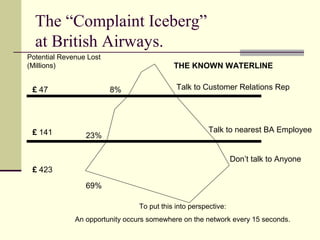
The “Complaint Iceberg”
at British Airways.
8%
23%
69%
Don’t talk to Anyone
Talk to nearest BA Employee
Talk to Customer Relations Rep
THE KNOWN WATERLINE
To put this into perspective:
An opportunity occurs somewhere on the network every 15 seconds.
Potential Revenue Lost
(Millions)
£ 47
£ 141
£ 423
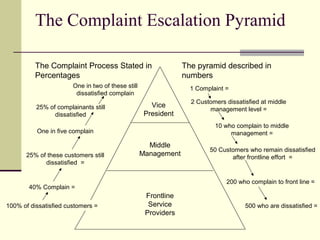
The Complaint Escalation Pyramid
The pyramid described in
numbers
The Complaint Process Stated in
Percentages
Vice
President
Middle
Management
Frontline
Service
Providers
1 Complaint =
2 Customers dissatisfied at middle
management level =
10 who complain to middle
management =
50 Customers who remain dissatisfied
after frontline effort =
200 who complain to front line =
500 who are dissatisfied =
One in two of these still
dissatisfied complain
25% of complainants still
dissatisfied
One in five complain
25% of these customers still
dissatisfied =
40% Complain =
100% of dissatisfied customers =
Next Topic
 Doing It Right the First and Second Time
 Getting Customers to Complain
 External and Internal Service Contracting
 Service Guarantees
 Service Recovery
 Questions for Management
 End with Questions??
External and Internal Service
Contracting
 Customer Service Contracting
 Internal Service Contracting
 Supplier Service Contracting
External and Internal Service
Contracting
 Customer Service Contracting
 Serve as a device for:
 Improving customer satisfaction
 Internal operations
 Supplier performance
External and Internal Service
Contracting
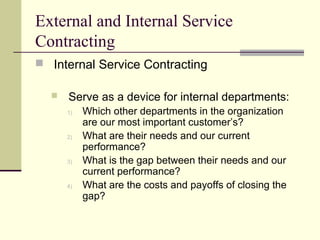
 Internal Service Contracting
 Serve as a device for internal departments:
1) Which other departments in the organization
are our most important customer’s?
2) What are their needs and our current
performance?
3) What is the gap between their needs and our
current performance?
4) What are the costs and payoffs of closing the
gap?
External and Internal Service
Contracting
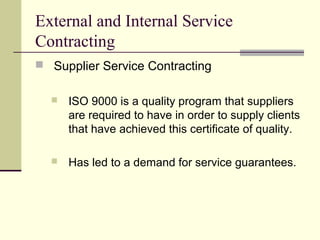
 Supplier Service Contracting
 ISO 9000 is a quality program that suppliers
are required to have in order to supply clients
that have achieved this certificate of quality.
 Has led to a demand for service guarantees.
Next Topic
 Doing It Right the First and Second Time
 Getting Customers to Complain
 External and Internal Service Contracting
 Service Guarantees
 Service Recovery
 Questions for Management
 End with Questions??
Service Guarantees
 Questions in Guarantee Design
 What’s the Primary Purpose
 Internal Guarantees
 Impact on Suppliers
 The Economic of Service Guarantees
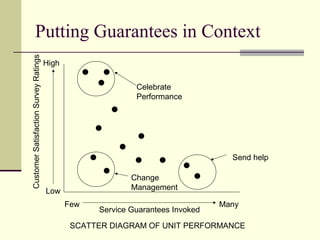
 Putting Guarantees in Context
Putting Guarantees in ContextCustomerSatisfactionSurveyRatings
Service Guarantees Invoked
Few Many
Low
High
Celebrate
Performance
Send help
Change
Management
SCATTER DIAGRAM OF UNIT PERFORMANCE
Next Topic
 Doing It Right the First and Second Time
 Getting Customers to Complain
 External and Internal Service Contracting
 Service Guarantees
 Service Recovery
 Questions for Management
 End with Questions??
Service Recovery
 A Case for Capability
 The service recovery needs to take place at
the frontline.
 Fast
 Customized
 Personalized
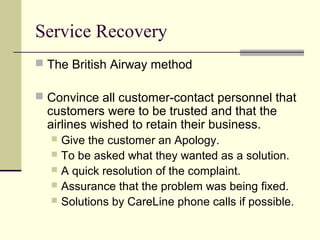
Service Recovery
 The British Airway method
 Convince all customer-contact personnel that
customers were to be trusted and that the
airlines wished to retain their business.
 Give the customer an Apology.
 To be asked what they wanted as a solution.
 A quick resolution of the complaint.
 Assurance that the problem was being fixed.
 Solutions by CareLine phone calls if possible.
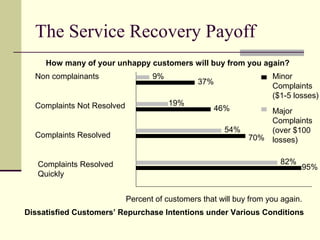
The Service Recovery Payoff
Non complainants
Complaints Not Resolved
Complaints Resolved
Complaints Resolved
Quickly
How many of your unhappy customers will buy from you again?
Minor
Complaints
($1-5 losses)
Major
Complaints
(over $100
losses)
Percent of customers that will buy from you again.
9%
37%
19%
46%
54%
70%
82%
95%
Dissatisfied Customers’ Repurchase Intentions under Various Conditions
Next Topic
 Doing It Right the First and Second Time
 Getting Customers to Complain
 External and Internal Service Contracting
 Service Guarantees
 Service Recovery
 Questions for Management
 End with Questions??
Questions for Management
 What is the rate at which dissatisfied
customers complain about your products or
services? How do you know?
 How are complaints encouraged by your
organization? What kind of incentives are
provided to customers to complain?
Questions for Management
 Are a majority of customer complaints made
to representatives of the organization who
can do something about them? If not, what
has to be done to insure that this is the case?
 Are the reactions of dissatisfied customers
assembled in one data base (a consolidated
“listening post”) for management information,
planning, and longer term action?
Questions for Management
 Based on information from dissatisfied
customers, what is the potential for
renegotiating agreements both across
relevant departments of your organization
and with “supply chain” partners?
 What does fast, personalized, customized
recovery mean in your business? What has
to be done to achieve it in your organization?
Questions for Management
 To what extent has service contracting been
employed within the organization and with
other organizations in the supply chain?
 How would a service guarantee help your
organization elicit complaints, provide an
incentive for effective service recovery, and
service as a vehicle for improving service
operations?
Questions??
 References:
 James L. Heskett, W. Earl Sasser Jr, Leonard
A. Schlesinger, The Service Profit Chain, pp.
175 -197 (The Free Press) ,

THE PROFIT CHAIN

  • 1.
    The Profit Chain AttainingTotal Customer Satisfaction: Doing Things Right the Second Time Student: Vincent W. Wedelich Professor: Phaedon P. Papadopoulos, Ph. D.
  • 2.
    Overview  Doing ItRight the First and Second Time  Getting Customers to Complain  External and Internal Service Contracting  Service Guarantees  Service Recovery  Questions for Management  End with Questions??
  • 3.
    Doing It Rightthe First and Second Time  “do it right the first time.” Motorola  Six sigma; zero defects.  Doing it right the second time may actually produce higher levels of satisfaction than doing it right the first time.  Must exceed the customers expectations the second time.
  • 4.
    Doing It Rightthe First and Second Time  UPS is an example of doing it right the first time.  But if they did not do it right; and had to try and figure out what happened; they did not have the ability to resolve where the package was.  FEDEX had this ability to track packages.
  • 5.
    Next Topic  DoingIt Right the First and Second Time  Getting Customers to Complain  External and Internal Service Contracting  Service Guarantees  Service Recovery  Questions for Management  End with Questions??
  • 6.
    Getting Customers toComplain  The British Airways Experience  The Problem  Some Responses
  • 7.
    The “Complaint Iceberg” atBritish Airways. 8% 23% 69% Don’t talk to Anyone Talk to nearest BA Employee Talk to Customer Relations Rep THE KNOWN WATERLINE To put this into perspective: An opportunity occurs somewhere on the network every 15 seconds. Potential Revenue Lost (Millions) £ 47 £ 141 £ 423
  • 8.
    The Complaint EscalationPyramid The pyramid described in numbers The Complaint Process Stated in Percentages Vice President Middle Management Frontline Service Providers 1 Complaint = 2 Customers dissatisfied at middle management level = 10 who complain to middle management = 50 Customers who remain dissatisfied after frontline effort = 200 who complain to front line = 500 who are dissatisfied = One in two of these still dissatisfied complain 25% of complainants still dissatisfied One in five complain 25% of these customers still dissatisfied = 40% Complain = 100% of dissatisfied customers =
  • 9.
    Next Topic  DoingIt Right the First and Second Time  Getting Customers to Complain  External and Internal Service Contracting  Service Guarantees  Service Recovery  Questions for Management  End with Questions??
  • 10.
    External and InternalService Contracting  Customer Service Contracting  Internal Service Contracting  Supplier Service Contracting
  • 11.
    External and InternalService Contracting  Customer Service Contracting  Serve as a device for:  Improving customer satisfaction  Internal operations  Supplier performance
  • 12.
    External and InternalService Contracting  Internal Service Contracting  Serve as a device for internal departments: 1) Which other departments in the organization are our most important customer’s? 2) What are their needs and our current performance? 3) What is the gap between their needs and our current performance? 4) What are the costs and payoffs of closing the gap?
  • 13.
    External and InternalService Contracting  Supplier Service Contracting  ISO 9000 is a quality program that suppliers are required to have in order to supply clients that have achieved this certificate of quality.  Has led to a demand for service guarantees.
  • 14.
    Next Topic  DoingIt Right the First and Second Time  Getting Customers to Complain  External and Internal Service Contracting  Service Guarantees  Service Recovery  Questions for Management  End with Questions??
  • 15.
    Service Guarantees  Questionsin Guarantee Design  What’s the Primary Purpose  Internal Guarantees  Impact on Suppliers  The Economic of Service Guarantees  Putting Guarantees in Context
  • 16.
    Putting Guarantees inContextCustomerSatisfactionSurveyRatings Service Guarantees Invoked Few Many Low High Celebrate Performance Send help Change Management SCATTER DIAGRAM OF UNIT PERFORMANCE
  • 17.
    Next Topic  DoingIt Right the First and Second Time  Getting Customers to Complain  External and Internal Service Contracting  Service Guarantees  Service Recovery  Questions for Management  End with Questions??
  • 18.
    Service Recovery  ACase for Capability  The service recovery needs to take place at the frontline.  Fast  Customized  Personalized
  • 19.
    Service Recovery  TheBritish Airway method  Convince all customer-contact personnel that customers were to be trusted and that the airlines wished to retain their business.  Give the customer an Apology.  To be asked what they wanted as a solution.  A quick resolution of the complaint.  Assurance that the problem was being fixed.  Solutions by CareLine phone calls if possible.
  • 20.
    The Service RecoveryPayoff Non complainants Complaints Not Resolved Complaints Resolved Complaints Resolved Quickly How many of your unhappy customers will buy from you again? Minor Complaints ($1-5 losses) Major Complaints (over $100 losses) Percent of customers that will buy from you again. 9% 37% 19% 46% 54% 70% 82% 95% Dissatisfied Customers’ Repurchase Intentions under Various Conditions
  • 21.
    Next Topic  DoingIt Right the First and Second Time  Getting Customers to Complain  External and Internal Service Contracting  Service Guarantees  Service Recovery  Questions for Management  End with Questions??
  • 22.
    Questions for Management What is the rate at which dissatisfied customers complain about your products or services? How do you know?  How are complaints encouraged by your organization? What kind of incentives are provided to customers to complain?
  • 23.
    Questions for Management Are a majority of customer complaints made to representatives of the organization who can do something about them? If not, what has to be done to insure that this is the case?  Are the reactions of dissatisfied customers assembled in one data base (a consolidated “listening post”) for management information, planning, and longer term action?
  • 24.
    Questions for Management Based on information from dissatisfied customers, what is the potential for renegotiating agreements both across relevant departments of your organization and with “supply chain” partners?  What does fast, personalized, customized recovery mean in your business? What has to be done to achieve it in your organization?
  • 25.
    Questions for Management To what extent has service contracting been employed within the organization and with other organizations in the supply chain?  How would a service guarantee help your organization elicit complaints, provide an incentive for effective service recovery, and service as a vehicle for improving service operations?
  • 26.
    Questions??  References:  JamesL. Heskett, W. Earl Sasser Jr, Leonard A. Schlesinger, The Service Profit Chain, pp. 175 -197 (The Free Press) ,

Editor's Notes

  • #4 The problem is many companies when given the opportunity to do it right the second time drop the ball. The customer expects it to be done right the first time. But if it is not done right and a company goes a little above and beyond to correct the mistake you may win a customer for life. In my opinion, it is better to do it right the first time, and then contact the customer with an email making sure that they are 100% satisfied; knowing full well that you have exceeded their expectations. Promise something and deliver 10 time more. Another thing is the employees need to act like owners; if they do not have “skin in the game”, then there is no incentive for them to take the extra steps to make sure the clients are happy.
  • #5 UPS and FEDEX are fortunate in one way. If the customer does not get the package; the customer complains. At least they have an alert to do it right the second time. When a firm does not get a complaint; they do not know why the client left them, they have no way of doing it right the second time. They just think the client does not need the service at this time; when in reality they have moved to another vendor.
  • #7 Getting customers to complain is a tool that can be used to help the company do it right the second time. The problem: eliciting customers to complain.
  • #8 For every 1% of customer that BA could get to complain; meant an increase in 200,000 to 400,000 pounds sterling in revenue from the potential defectors. They had to melt the iceberg and get the customers to complain. Customers typically do not register their complaints because it takes to much time and there is to little potential payoff. It is simply easier to just switch airline carriers.
  • #9 Some Responses: British Airways in order to encourage a higher proportion of dissatisfied travelers to complain; implemented listening posts. The Care-Line phone connection; Global Free Post Comment Cards; Informal Chat Groups; Highly valued customers were invited to fly BA’s customer airline experimented with video booths where deplaned passengers could register their reactions to a flight moments after completing it. Newer Boeing 767 and 777 aircraft could register complaints from their seats. The Maine Savings Bank offered one dollar for every complaint letter written suggesting ways to improve services.
  • #11 Service contracts can serve as a device for improving customers satisfaction, internal operations, and even supplier performance.
  • #13 Example: Insurance company: the field reps were complaining that it took to long to approve an application; the customers prone to having second thoughts were cancelling the “apps” with increasing frequency. In response the internal underwriters allowed the field reps the ability to complete and approve small policies. This fulfilled the speed the field reps desired and allowed the underwriters to devote their time to larger policies.
  • #21 The faster the response time, the lower the monetary rewards that were required to satisfy customer’s. As CareLine customers satisfaction indicators rose into the mid 90 percent range, the staff were actually awarding 8 percent less in customer compensation. For every pound spent on customer retention efforts, the airline was retaining tow pounds in revenue that it would have lost.