DATA COLLECTION
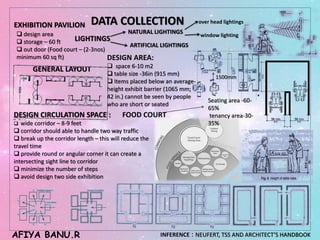
EXHIBITION PAVILION
 design area
 storage – 60 ft
 out door (Food court – (2-3nos)
minimum 60 sq ft)
GENERAL LAYOUT
DESIGN CIRCULATION SPACE :
 wide corridor – 8-9 feet
 corridor should able to handle two way traffic
 break up the corridor length – this will reduce the
travel time
 provide round or angular corner it can create a
intersecting sight line to corridor
 minimize the number of steps
 avoid design two side exhibition
LIGHTINGS
NATURAL LIGHTINGS
ARTIFICIAL LIGHTINGS
over head lightings
window lighting
DESIGN AREA:
 space 6-10 m2
 table size -36in (915 mm)
 Items placed below an average-
height exhibit barrier (1065 mm;
42 in.) cannot be seen by people
who are short or seated
FOOD COURT
Seating area -60-
65%
tenancy area-30-
35%
1500mm
INFERENCE : NEUFERT, TSS AND ARCHITECT’S HANDBOOK
AFIYA BANU.R
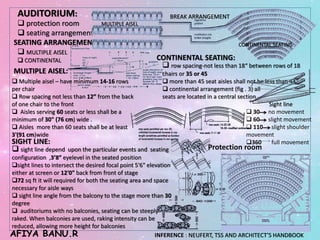
AUDITORIUM:
 protection room
 seating arrangement
SEATING ARRANGEMENTS:
 MULTIPLE AISEL
 CONTINENTAL
MULTIPLE AISEL:
 Multiple aisel – have minimum 14-16 rows
per chair
 Row spacing not less than 12” from the back
of one chair to the front
 Aisles serving 60 seats or less shall be a
minimum of 30" (76 cm) wide .
 Aisles more than 60 seats shall be at least
3'(91 cm)wide
CONTINENTAL SEATING:
 row spacing-not less than 18“ between rows of 18
chairs or 35 or 45
 more than 45 seat aisles shall not be less than 44“
 continental arrangement (fig . 3) all
seats are located in a central section .
MULTIPLE AISEL
CONTINENTAL SEATING
SIGHT LINE:
 sight line depend upon the particular events and seating
configuration ,3’8” eyelevel in the seated position
sight lines to intersect the desired focal point 5'6" elevation
either at screen or 12'0" back from front of stage
72 sq ft it will required for both the seating area and space
necessary for aisle ways
 sight line angle from the balcony to the stage more than 30
degree
 auditoriums with no balconies, seating can be steeply
raked. When balconies are used, raking intensity can be
reduced, allowing more height for balconies
Sight line
 30 no movement
 60 slight movement
 110 slight shoulder
movement
360 full movement
BREAK ARRANGEMENT
Protection room
AFIYA BANU.R INFERENCE : NEUFERT, TSS AND ARCHITECT’S HANDBOOK
ADMINISTRATION AREA
 reception – 80sq ft
 executive director -200 sq ft
 toilet – 50sq ft
 work room – 180 sq ft
 small meeting – 100 sq ft
 storage – 80 sq ft
RECEPTION AREA
EXECUTIVE DIRECTOR
SMALL MEETING
 formal meeting 100-150sqft(2-3hr
meeting)
 formal layout : audio visual , good
ventilation
TOILET
 toilet attached with executive
officer room
WORK ROOM
 work room – office space –open
space all people can access
 desk ,storage ,wide circulation
zone
STORAGE
AFIYA BANU.R INFERENCE : NEUFERT, TSS AND ARCHITECT’S HANDBOOK
CONFERENCE HALL
 The Conference space types are
areas used for formal
meeting, training, and teleconference
activities
 special equipment such as rear
projection screens; special electronics
control and audiovisual recording ,
and computer-assisted meetings
 Conference reception -80SQ FT
 seating places-800SQFT
 Toilets (Male) -60SQFT
Toilets (Female)-60 SQ FT
 large conference ,presentation , lecture and
training session
 provide tv system , projector , audio visual ,
space for seating
 The Conference is typically designed to
accommodate a variety of audiovisual
equipment, with special attention to acoustical
separation from surrounding spaces.
FOOD COURT
DESIGN GUILDLINES
 The Food Court shall be located adjacent to
the auditorium
 All the Food Tenancies should have a
service corridor , atleast 1500mm wide
 Various types of seating including chairs,
banquet and booth types.
 Terraces are welcomed as part of the Food
Court layout
 Cafeteria- commercial . . . . . . . 16-18 sq ft
10 nos -5000sq ft
AFIYA BANU.R INFERENCE : NEUFERT, TSS AND ARCHITECT’S HANDBOOK
FIRE PRECAUTIONS
 alternative exit route must be provided
 travel distance of exit , flame resistance
materials , fire and smoke compartment
SECURITY
 FIREDETECTION SYSTEM
ALARM
SEVICES
 height of ceiling 3.6-institutional building
 kitchen height not less than 2.75m
 height of bathroom not less than 2.1m
 area of bath room not less than 1.8m2
,minimum width 1.2m
 mezzanine floor minimum height -2.2m
FIRE ESCAPES OR EXTERNAL STAIR CASES
 All fire escapes shall be directly connected to the
ground
 Entrance to the fire escape shall be separate and
remote from internal staircase
 The route to fire escape shall be free of obstructions at
all times except the
doorway leading to the fire escape which shall have the
required fire resistance.
 Fire escape shall be constructed of non-combustible
materials.
 Fire escape stairs shall have straight flight not less than
125 cm wide with 25 cm treads and risers not more than
19 cm.
 Handrails shall be at a height not less than 100 cm
 Provision of the lifts shall be made for all multi-storye
building having a height of 15.0 m. and above.
.
FIRE PROTECTION SYSTEM
 To prevent spread of fire
 classified into two system 1.active fire
protection 2.passive fire protection
 Active fire protection-fire alarm
system (single and two stages)
 single stage -activated the alarm
signal immediately transmitted
throughout the buildings to warm the
occupants
 two stage –signal alert the people
Passive fire protection –integral
components of fire protection
 Minimum tread
The minimum width of tread without nosing shall be 250
mm for residential buildings.
The minimum width of tread for other buildings shall be
300 mm.
Maximum rise
The maximum height of riser shall be 190 mm for
residential buildings and 150 mm
for other buildings and these shall be limited to 12 per
flight.
The minimum head-room in a passage under the
landing of a staircase shall be 2.2
m. The minimum clear head-room in any staircase shall be
2.2 m.
Exit Requirements
All aspects of exit
requirements for corridors,
doors, stair cases, ramps, etc in
respect of widths
AFIYA BANU.R INFERENCE : NEUFERT, TSS AND ARCHITECT’S HANDBOOK
PARKING:
 the parking spaces acts as a place for the
ceremonies of arrival & departure.
 parking can be done in various ways:
inclined with various angles or perpendicular.
parking can also be done in basement or on
surface outside the complex.
 surface parking requires less space than the
basement parking due to absence of columns.
 In case of basement parking, a relatively
narrow column grid pattern can be used, with
careful planning and design
DESIGN CONSIDERATION
CAR ORIENTATION
Ramps for Basement
Parking:
For each car ramp, the
run must be more than
5m long, with ramps that
can be up to 12%
gradient.
AFIYA BANU.R INFERENCE : NEUFERT, TSS AND ARCHITECT’S HANDBOOK
PUBLIC REST ROOM
Plumbing Fixture and Accessory Heights
 provides specific vertical dimensions
of both plumbing fixtures and accessories
 Mounting heights or vertical dimensions are always taken
from the finished floor. When installing accessories on tile walls,
the tile module and dimensions should be taken into
consideration
Men’s toilet layout
women’s toilet layout
AFIYA BANU.R INFERENCE : NEUFERT, TSS AND ARCHITECT’S HANDBOOK

ARCHITECTURAL LITERATURE STUDY.pdf

  • 1.
    DATA COLLECTION EXHIBITION PAVILION design area  storage – 60 ft  out door (Food court – (2-3nos) minimum 60 sq ft) GENERAL LAYOUT DESIGN CIRCULATION SPACE :  wide corridor – 8-9 feet  corridor should able to handle two way traffic  break up the corridor length – this will reduce the travel time  provide round or angular corner it can create a intersecting sight line to corridor  minimize the number of steps  avoid design two side exhibition LIGHTINGS NATURAL LIGHTINGS ARTIFICIAL LIGHTINGS over head lightings window lighting DESIGN AREA:  space 6-10 m2  table size -36in (915 mm)  Items placed below an average- height exhibit barrier (1065 mm; 42 in.) cannot be seen by people who are short or seated FOOD COURT Seating area -60- 65% tenancy area-30- 35% 1500mm INFERENCE : NEUFERT, TSS AND ARCHITECT’S HANDBOOK AFIYA BANU.R
  • 2.
    AUDITORIUM:  protection room seating arrangement SEATING ARRANGEMENTS:  MULTIPLE AISEL  CONTINENTAL MULTIPLE AISEL:  Multiple aisel – have minimum 14-16 rows per chair  Row spacing not less than 12” from the back of one chair to the front  Aisles serving 60 seats or less shall be a minimum of 30" (76 cm) wide .  Aisles more than 60 seats shall be at least 3'(91 cm)wide CONTINENTAL SEATING:  row spacing-not less than 18“ between rows of 18 chairs or 35 or 45  more than 45 seat aisles shall not be less than 44“  continental arrangement (fig . 3) all seats are located in a central section . MULTIPLE AISEL CONTINENTAL SEATING SIGHT LINE:  sight line depend upon the particular events and seating configuration ,3’8” eyelevel in the seated position sight lines to intersect the desired focal point 5'6" elevation either at screen or 12'0" back from front of stage 72 sq ft it will required for both the seating area and space necessary for aisle ways  sight line angle from the balcony to the stage more than 30 degree  auditoriums with no balconies, seating can be steeply raked. When balconies are used, raking intensity can be reduced, allowing more height for balconies Sight line  30 no movement  60 slight movement  110 slight shoulder movement 360 full movement BREAK ARRANGEMENT Protection room AFIYA BANU.R INFERENCE : NEUFERT, TSS AND ARCHITECT’S HANDBOOK
  • 3.
    ADMINISTRATION AREA  reception– 80sq ft  executive director -200 sq ft  toilet – 50sq ft  work room – 180 sq ft  small meeting – 100 sq ft  storage – 80 sq ft RECEPTION AREA EXECUTIVE DIRECTOR SMALL MEETING  formal meeting 100-150sqft(2-3hr meeting)  formal layout : audio visual , good ventilation TOILET  toilet attached with executive officer room WORK ROOM  work room – office space –open space all people can access  desk ,storage ,wide circulation zone STORAGE AFIYA BANU.R INFERENCE : NEUFERT, TSS AND ARCHITECT’S HANDBOOK
  • 4.
    CONFERENCE HALL  TheConference space types are areas used for formal meeting, training, and teleconference activities  special equipment such as rear projection screens; special electronics control and audiovisual recording , and computer-assisted meetings  Conference reception -80SQ FT  seating places-800SQFT  Toilets (Male) -60SQFT Toilets (Female)-60 SQ FT  large conference ,presentation , lecture and training session  provide tv system , projector , audio visual , space for seating  The Conference is typically designed to accommodate a variety of audiovisual equipment, with special attention to acoustical separation from surrounding spaces. FOOD COURT DESIGN GUILDLINES  The Food Court shall be located adjacent to the auditorium  All the Food Tenancies should have a service corridor , atleast 1500mm wide  Various types of seating including chairs, banquet and booth types.  Terraces are welcomed as part of the Food Court layout  Cafeteria- commercial . . . . . . . 16-18 sq ft 10 nos -5000sq ft AFIYA BANU.R INFERENCE : NEUFERT, TSS AND ARCHITECT’S HANDBOOK FIRE PRECAUTIONS  alternative exit route must be provided  travel distance of exit , flame resistance materials , fire and smoke compartment
  • 5.
    SECURITY  FIREDETECTION SYSTEM ALARM SEVICES height of ceiling 3.6-institutional building  kitchen height not less than 2.75m  height of bathroom not less than 2.1m  area of bath room not less than 1.8m2 ,minimum width 1.2m  mezzanine floor minimum height -2.2m FIRE ESCAPES OR EXTERNAL STAIR CASES  All fire escapes shall be directly connected to the ground  Entrance to the fire escape shall be separate and remote from internal staircase  The route to fire escape shall be free of obstructions at all times except the doorway leading to the fire escape which shall have the required fire resistance.  Fire escape shall be constructed of non-combustible materials.  Fire escape stairs shall have straight flight not less than 125 cm wide with 25 cm treads and risers not more than 19 cm.  Handrails shall be at a height not less than 100 cm  Provision of the lifts shall be made for all multi-storye building having a height of 15.0 m. and above. . FIRE PROTECTION SYSTEM  To prevent spread of fire  classified into two system 1.active fire protection 2.passive fire protection  Active fire protection-fire alarm system (single and two stages)  single stage -activated the alarm signal immediately transmitted throughout the buildings to warm the occupants  two stage –signal alert the people Passive fire protection –integral components of fire protection  Minimum tread The minimum width of tread without nosing shall be 250 mm for residential buildings. The minimum width of tread for other buildings shall be 300 mm. Maximum rise The maximum height of riser shall be 190 mm for residential buildings and 150 mm for other buildings and these shall be limited to 12 per flight. The minimum head-room in a passage under the landing of a staircase shall be 2.2 m. The minimum clear head-room in any staircase shall be 2.2 m. Exit Requirements All aspects of exit requirements for corridors, doors, stair cases, ramps, etc in respect of widths AFIYA BANU.R INFERENCE : NEUFERT, TSS AND ARCHITECT’S HANDBOOK
  • 6.
    PARKING:  the parkingspaces acts as a place for the ceremonies of arrival & departure.  parking can be done in various ways: inclined with various angles or perpendicular. parking can also be done in basement or on surface outside the complex.  surface parking requires less space than the basement parking due to absence of columns.  In case of basement parking, a relatively narrow column grid pattern can be used, with careful planning and design DESIGN CONSIDERATION CAR ORIENTATION Ramps for Basement Parking: For each car ramp, the run must be more than 5m long, with ramps that can be up to 12% gradient. AFIYA BANU.R INFERENCE : NEUFERT, TSS AND ARCHITECT’S HANDBOOK
  • 7.
    PUBLIC REST ROOM PlumbingFixture and Accessory Heights  provides specific vertical dimensions of both plumbing fixtures and accessories  Mounting heights or vertical dimensions are always taken from the finished floor. When installing accessories on tile walls, the tile module and dimensions should be taken into consideration Men’s toilet layout women’s toilet layout AFIYA BANU.R INFERENCE : NEUFERT, TSS AND ARCHITECT’S HANDBOOK