WORKSHOP
BASIC DESIGN 1ST YEAR
MEASUREMENT DRAWING
Presented By- Rohan Dutta & Kumar Satyam | M.Plan 2nd Year | GCAP |
INTRODUCTION
Dimensions
A dimension is for size and position (of the designed/modeled shape).
The purpose of dimensioning is to provide a clear and complete description of an object.
To show dimensions of all parts of drawing is mandatory in Architecture.
Scale
Usually the word scale is used for an instrument used for drawing straight lines.
But actually in Architectural language scale means the proportion or ratio between the
dimensions adopted for the drawing and the corresponding dimensions of the object.
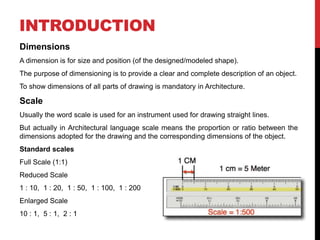
Standard scales
Full Scale (1:1)
Reduced Scale
1 : 10, 1 : 20, 1 : 50, 1 : 100, 1 : 200
Enlarged Scale
10 : 1, 5 : 1, 2 : 1
INTRODUCTION
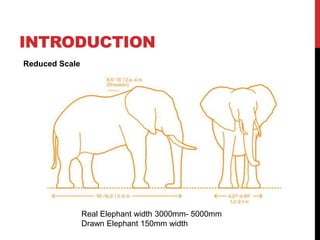
Real Elephant width 3000mm- 5000mm
Drawn Elephant 150mm width
Reduced Scale
INTRODUCTION
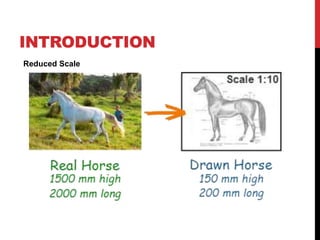
Reduced Scale
INTRODUCTION
Enlarged Scale
REPRESENTATIVE FRACTION (R.F.)
The ratio of the size of the element in the drawing to the size of the same element in the
object is called the Representative Fraction (R.F.)
R.F.= Length of the object in the drawing / Actual length of the object
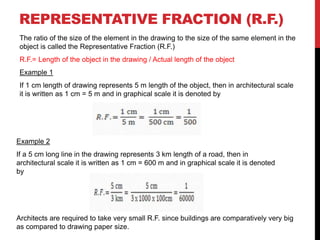
Example 1
If 1 cm length of drawing represents 5 m length of the object, then in architectural scale
it is written as 1 cm = 5 m and in graphical scale it is denoted by
Example 2
If a 5 cm long line in the drawing represents 3 km length of a road, then in
architectural scale it is written as 1 cm = 600 m and in graphical scale it is denoted
by
Architects are required to take very small R.F. since buildings are comparatively very big
as compared to drawing paper size.
PLAIN SCALES
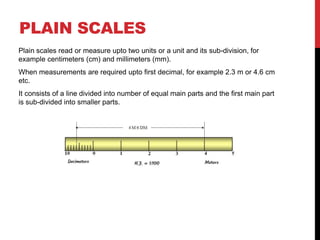
Plain scales read or measure upto two units or a unit and its sub-division, for
example centimeters (cm) and millimeters (mm).
When measurements are required upto first decimal, for example 2.3 m or 4.6 cm
etc.
It consists of a line divided into number of equal main parts and the first main part
is sub-divided into smaller parts.
THANK YOU

Workshop basic measurement drawing .pptx

  • 1.
    WORKSHOP BASIC DESIGN 1STYEAR MEASUREMENT DRAWING Presented By- Rohan Dutta & Kumar Satyam | M.Plan 2nd Year | GCAP |
  • 2.
    INTRODUCTION Dimensions A dimension isfor size and position (of the designed/modeled shape). The purpose of dimensioning is to provide a clear and complete description of an object. To show dimensions of all parts of drawing is mandatory in Architecture. Scale Usually the word scale is used for an instrument used for drawing straight lines. But actually in Architectural language scale means the proportion or ratio between the dimensions adopted for the drawing and the corresponding dimensions of the object. Standard scales Full Scale (1:1) Reduced Scale 1 : 10, 1 : 20, 1 : 50, 1 : 100, 1 : 200 Enlarged Scale 10 : 1, 5 : 1, 2 : 1
  • 3.
    INTRODUCTION Real Elephant width3000mm- 5000mm Drawn Elephant 150mm width Reduced Scale
  • 4.
  • 5.
  • 6.
    REPRESENTATIVE FRACTION (R.F.) Theratio of the size of the element in the drawing to the size of the same element in the object is called the Representative Fraction (R.F.) R.F.= Length of the object in the drawing / Actual length of the object Example 1 If 1 cm length of drawing represents 5 m length of the object, then in architectural scale it is written as 1 cm = 5 m and in graphical scale it is denoted by Example 2 If a 5 cm long line in the drawing represents 3 km length of a road, then in architectural scale it is written as 1 cm = 600 m and in graphical scale it is denoted by Architects are required to take very small R.F. since buildings are comparatively very big as compared to drawing paper size.
  • 7.
    PLAIN SCALES Plain scalesread or measure upto two units or a unit and its sub-division, for example centimeters (cm) and millimeters (mm). When measurements are required upto first decimal, for example 2.3 m or 4.6 cm etc. It consists of a line divided into number of equal main parts and the first main part is sub-divided into smaller parts.
  • 8.