What is archaeology?
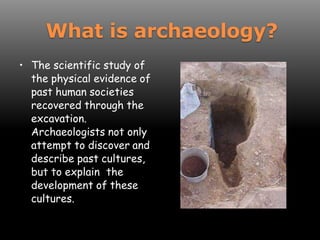
• The scientific study of
the physical evidence of
past human societies
recovered through the
excavation.
Archaeologists not only
attempt to discover and
describe past cultures,
but to explain the
development of these
cultures.
How is a site chosen?
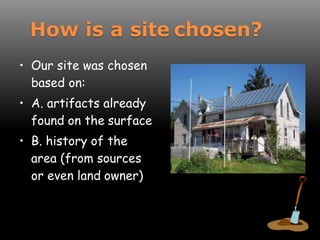
• Our site was chosen
based on:
• A. artifacts already
found on the surface
• B. history of the
area (from sources
or even land owner)
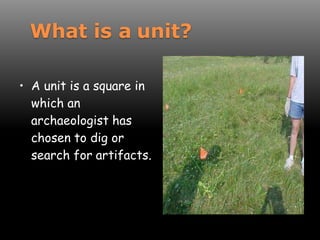
What is a unit?
• A unit is a square in
which an
archaeologist has
chosen to dig or
search for artifacts.
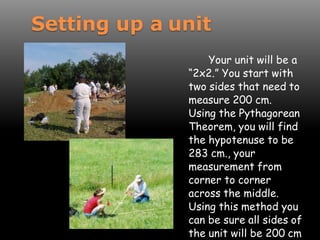
Setting up a unit
Your unit will be a
“2x2.” You start with
two sides that need to
measure 200 cm.
Using the Pythagorean
Theorem, you will find
the hypotenuse to be
283 cm., your
measurement from
corner to corner
across the middle.
Using this method you
can be sure all sides of
the unit will be 200 cm
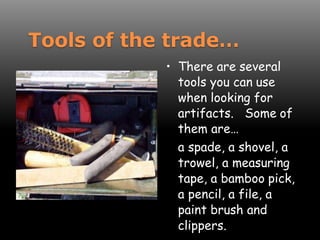
Tools of the trade…
• There are several
tools you can use
when looking for
artifacts. Some of
them are…
a spade, a shovel, a
trowel, a measuring
tape, a bamboo pick,
a pencil, a file, a
paint brush and
clippers.
AND don’t
forget the
sunscreen
and bug
spray!!!!
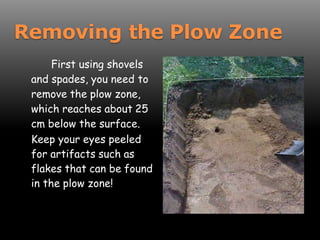
First using shovels
and spades, you need to
remove the plow zone,
which reaches about 25
cm below the surface.
Keep your eyes peeled
for artifacts such as
flakes that can be found
in the plow zone!
Removing the Plow Zone
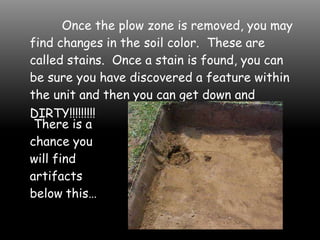
Once the plow zone is removed, you may
find changes in the soil color. These are
called stains. Once a stain is found, you can
be sure you have discovered a feature within
the unit and then you can get down and
DIRTY!!!!!!!!!
There is a
chance you
will find
artifacts
below this…
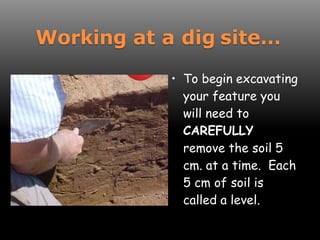
Working at a dig site…
• To begin excavating
your feature you
will need to
CAREFULLY
remove the soil 5
cm. at a time. Each
5 cm of soil is
called a level.
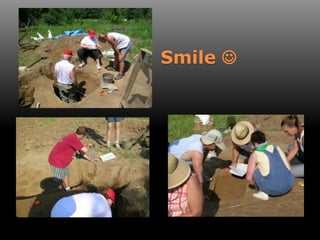
Smile 
Archaeology sources and materials

Archaeology sources and materials

  • 2.
    What is archaeology? •The scientific study of the physical evidence of past human societies recovered through the excavation. Archaeologists not only attempt to discover and describe past cultures, but to explain the development of these cultures.
  • 3.
    How is asite chosen? • Our site was chosen based on: • A. artifacts already found on the surface • B. history of the area (from sources or even land owner)
  • 4.
    What is aunit? • A unit is a square in which an archaeologist has chosen to dig or search for artifacts.
  • 5.
    Setting up aunit Your unit will be a “2x2.” You start with two sides that need to measure 200 cm. Using the Pythagorean Theorem, you will find the hypotenuse to be 283 cm., your measurement from corner to corner across the middle. Using this method you can be sure all sides of the unit will be 200 cm
  • 6.
    Tools of thetrade… • There are several tools you can use when looking for artifacts. Some of them are… a spade, a shovel, a trowel, a measuring tape, a bamboo pick, a pencil, a file, a paint brush and clippers.
  • 7.
  • 8.
    First using shovels andspades, you need to remove the plow zone, which reaches about 25 cm below the surface. Keep your eyes peeled for artifacts such as flakes that can be found in the plow zone! Removing the Plow Zone
  • 9.
    Once the plowzone is removed, you may find changes in the soil color. These are called stains. Once a stain is found, you can be sure you have discovered a feature within the unit and then you can get down and DIRTY!!!!!!!!! There is a chance you will find artifacts below this…
  • 10.
    Working at adig site… • To begin excavating your feature you will need to CAREFULLY remove the soil 5 cm. at a time. Each 5 cm of soil is called a level.
  • 11.