What is Archaeology?
Presented by Sarah, Shennel & Janvi
Fossils/Artifacts
An archaeologist is someone who
tries to figure out what life was like
in the ancient past by looking at the
remains of ancient people – their
fossils and their artifacts. An
archaeologist must know the
difference between an artifact and a
fossil.
1. Fossils are remains of living things (plants, animals,
   people), not of things that were made.
2. Artifacts are remains of things that were made, not
   the remains of living things.
What is a site?
                  A "site" is a place
                  archaeologists wish to
                  explore.

                  At the site, archaeologists
                  literally dig, looking for the
                  remains of ancient
                  civilizations. That is why
                  they call the site at which
                  they are working a “dig”.
Finding a site
How do archaeologists find sites to explore?

1. They think about what people
need to stay alive. Some of
those things include
access to clean drinking
water, a protected place
to live, and easy access
to trade routes. With this
in mind, archaeologists look
for remains of civilizations along
the banks of rivers and streams.
Finding a site
2. They check out reports of artifacts that have been
discovered. Artifacts have been discovered by farmers
and construction companies while working at their jobs.

                              3. They check the land from
                              the air, looking for large
                              depressions that could be
                              the ruins of an ancient living
                              area.

                              4. They use scientific
                              instruments like radar and
                              sonar to look for ruins.
Permission to Dig
An archaeologist must receive
permission to explore a site. The owner
of the land must grant sometimes
permission. Sometimes the government
of a country must issue permits.

Once permission is received,
archaeologists work in teams with other
archaeologists. A team begins to explore
the area. They look for evidence that
people once lived in the area.
Evidence includes fossils and artifacts.
Grids & Labeling
Before they begin digging, archaeologists design a grid
on the ground using rope and string.
                         Each square in the grid must be
                         carefully searched. A record
                         must be kept of anything found,
                                   including what was
                                   found next to it.
Tools of the Trade
The tools they use are
sometimes very simple. Tools
include trowels, brushes, spoons,
dental picks, sieves, saws,
dustpans, and wheelbarrows.

They search each grid very
carefully. Digging at a site
is slow and careful work.
Back in the Lab
Once objects are labeled and removed from a site, they
are taken to a lab, relabeled, and placed into a database.
Archaeologists use this information to put together pieces
of the past.

It takes a great deal of
education, training,
patience, and attention
to detail to work
as an
archaeologist.
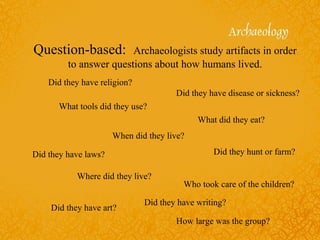
Question-based:         Archaeologists study artifacts in order
         to answer questions about how humans lived.
    Did they have religion?
                                      Did they have disease or sickness?
      What tools did they use?
                                            What did they eat?
                      When did they live?

Did they have laws?                             Did they hunt or farm?

           Where did they live?
                                        Who took care of the children?

                              Did they have writing?
    Did they have art?
                                      How large was the group?
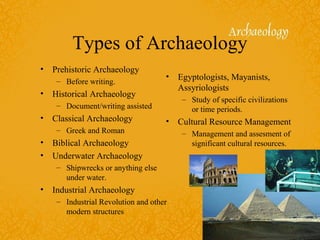
Types of Archaeology
•   Prehistoric Archaeology
     – Before writing.
                                     •   Egyptologists, Mayanists,
                                         Assyriologists
•   Historical Archaeology
                                          – Study of specific civilizations
     – Document/writing assisted            or time periods.
•   Classical Archaeology            •   Cultural Resource Management
     – Greek and Roman                    – Management and assesment of
•   Biblical Archaeology                    significant cultural resources.
•   Underwater Archaeology
     – Shipwrecks or anything else
       under water.
•   Industrial Archaeology
     – Industrial Revolution and other
       modern structures
What is it?
The job of an archaeologist is a great deal like the job of
a detective. Here are some puzzles for you to solve.

1. While planting my garden, I
   found a three-foot long bone.
    Did I find a fossil or an
   artifact?

2. While exploring in the woods
   near my house, I found an
   old arrowhead. Did I find a
   fossil or an artifact?

Archaeology presntation

  • 1.
    What is Archaeology? Presentedby Sarah, Shennel & Janvi
  • 2.
    Fossils/Artifacts An archaeologist issomeone who tries to figure out what life was like in the ancient past by looking at the remains of ancient people – their fossils and their artifacts. An archaeologist must know the difference between an artifact and a fossil. 1. Fossils are remains of living things (plants, animals, people), not of things that were made. 2. Artifacts are remains of things that were made, not the remains of living things.
  • 3.
    What is asite? A "site" is a place archaeologists wish to explore. At the site, archaeologists literally dig, looking for the remains of ancient civilizations. That is why they call the site at which they are working a “dig”.
  • 4.
    Finding a site Howdo archaeologists find sites to explore? 1. They think about what people need to stay alive. Some of those things include access to clean drinking water, a protected place to live, and easy access to trade routes. With this in mind, archaeologists look for remains of civilizations along the banks of rivers and streams.
  • 5.
    Finding a site 2.They check out reports of artifacts that have been discovered. Artifacts have been discovered by farmers and construction companies while working at their jobs. 3. They check the land from the air, looking for large depressions that could be the ruins of an ancient living area. 4. They use scientific instruments like radar and sonar to look for ruins.
  • 6.
    Permission to Dig Anarchaeologist must receive permission to explore a site. The owner of the land must grant sometimes permission. Sometimes the government of a country must issue permits. Once permission is received, archaeologists work in teams with other archaeologists. A team begins to explore the area. They look for evidence that people once lived in the area. Evidence includes fossils and artifacts.
  • 7.
    Grids & Labeling Beforethey begin digging, archaeologists design a grid on the ground using rope and string. Each square in the grid must be carefully searched. A record must be kept of anything found, including what was found next to it.
  • 8.
    Tools of theTrade The tools they use are sometimes very simple. Tools include trowels, brushes, spoons, dental picks, sieves, saws, dustpans, and wheelbarrows. They search each grid very carefully. Digging at a site is slow and careful work.
  • 9.
    Back in theLab Once objects are labeled and removed from a site, they are taken to a lab, relabeled, and placed into a database. Archaeologists use this information to put together pieces of the past. It takes a great deal of education, training, patience, and attention to detail to work as an archaeologist.
  • 10.
    Question-based: Archaeologists study artifacts in order to answer questions about how humans lived. Did they have religion? Did they have disease or sickness? What tools did they use? What did they eat? When did they live? Did they have laws? Did they hunt or farm? Where did they live? Who took care of the children? Did they have writing? Did they have art? How large was the group?
  • 11.
    Types of Archaeology • Prehistoric Archaeology – Before writing. • Egyptologists, Mayanists, Assyriologists • Historical Archaeology – Study of specific civilizations – Document/writing assisted or time periods. • Classical Archaeology • Cultural Resource Management – Greek and Roman – Management and assesment of • Biblical Archaeology significant cultural resources. • Underwater Archaeology – Shipwrecks or anything else under water. • Industrial Archaeology – Industrial Revolution and other modern structures
  • 12.
    What is it? Thejob of an archaeologist is a great deal like the job of a detective. Here are some puzzles for you to solve. 1. While planting my garden, I found a three-foot long bone. Did I find a fossil or an artifact? 2. While exploring in the woods near my house, I found an old arrowhead. Did I find a fossil or an artifact?

Editor's Notes

  • #11 Archeology is a question-based science. Archeologists always develop a question they want answered before they do anything else. These are some of the questions they may ask and try to find the answer to.
  • #12 Many archeologists go on in their training to specialize in specific times, places, or environments. The ones listed above are the few of many special interests. Prehistoric archaeologists study cultures with no writing. Historic archaeologists use written documents and photographs to help them with their work. Classical Archaeology is the study of the ancient Greeks and Romans. Biblical archaeologist try to prove or disprove places and events described in the bible. Underwater Archaeologists wear scuba gear and use the same methods as other archaeologists to study archaeological remains. They mostly look at shipwrecks. Because things in water are always cold and wet they don’t rot very fast. Archaeologists can find an entire ship in one piece because of the constant environment. Industrial Archaeology is the study of the Industrial Revolution and other modern structures. The study of Egypt, the Mayans, and ancient Assyria (Babylon) Cultural Resource Management is the management and assessment of cultural resources. That means whenever something new is built an archaeologist must come in and make sure that there are no artifacts being lost or destroyed. We also keep track of places we know have artifacts and make sure they aren’t being damaged or stolen from. Cultural Resource Management is also used to teach others about archaeology.
  • #13 Answers: A fossil An artifact