


www.luxetvitan.com
By Anbr Cama
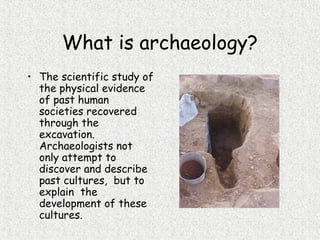
What is archaeology?
• The scientific study of
the physical evidence
of past human
societies recovered
through the
excavation.
Archaeologists not
only attempt to
discover and describe
past cultures, but to
explain the
development of these
cultures.
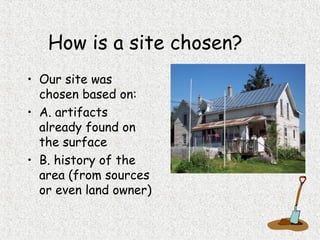
How is a site chosen?
• Our site was
chosen based on:
• A. artifacts
already found on
the surface
• B. history of the
area (from sources
or even land owner)
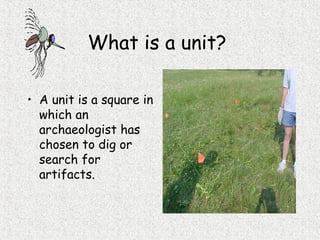
What is a unit?
• A unit is a square in
which an
archaeologist has
chosen to dig or
search for
artifacts.
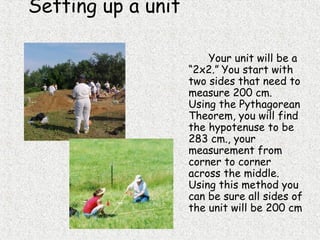
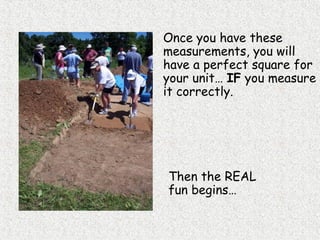
Setting up a unit
Your unit will be a
“2x2.” You start with
two sides that need to
measure 200 cm.
Using the Pythagorean
Theorem, you will find
the hypotenuse to be
283 cm., your
measurement from
corner to corner
across the middle.
Using this method you
can be sure all sides of
the unit will be 200 cm
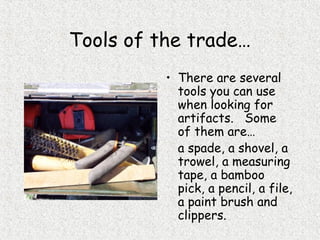
Once you have these
measurements, you will
have a perfect square for
your unit… IF you measure
it correctly.
Then the REAL
fun begins…
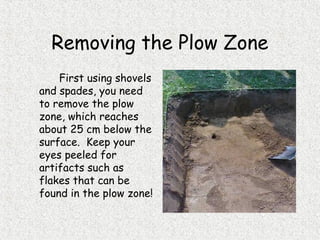
Tools of the trade…
• There are several
tools you can use
when looking for
artifacts. Some
of them are…
a spade, a shovel, a
trowel, a measuring
tape, a bamboo
pick, a pencil, a file,
a paint brush and
clippers.
AND don’t forget
the sunscreen
and bug spray!!!!
First using shovels
and spades, you need
to remove the plow
zone, which reaches
about 25 cm below the
surface. Keep your
eyes peeled for
artifacts such as
flakes that can be
found in the plow zone!
Removing the Plow Zone
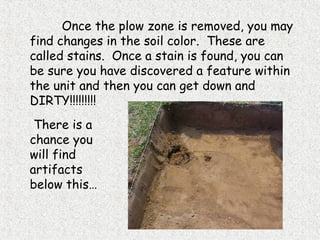
Once the plow zone is removed, you may
find changes in the soil color. These are
called stains. Once a stain is found, you can
be sure you have discovered a feature within
the unit and then you can get down and
DIRTY!!!!!!!!!
There is a
chance you
will find
artifacts
below this…
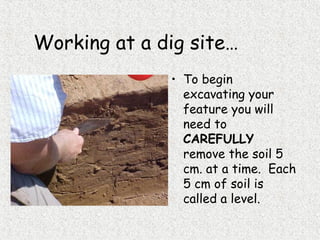
Working at a dig site…
• To begin
excavating your
feature you will
need to
CAREFULLY
remove the soil 5
cm. at a time. Each
5 cm of soil is
called a level.
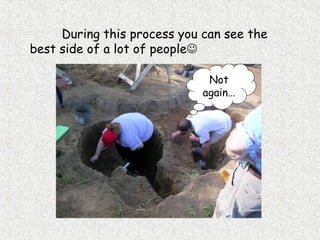
During this process you can see the
best side of a lot of people
Not
again…
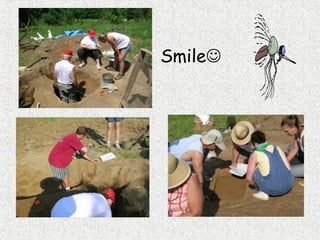
Smile
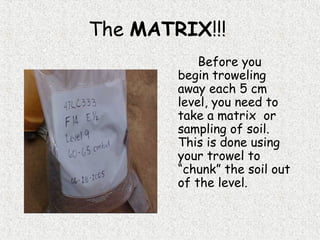
The MATRIX!!!
Before you
begin troweling
away each 5 cm
level, you need to
take a matrix or
sampling of soil.
This is done using
your trowel to
“chunk” the soil out
of the level.
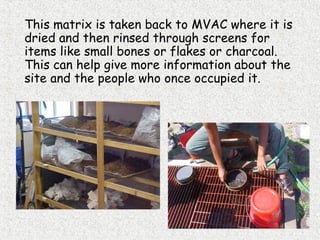
This matrix is taken back to MVAC where it is
dried and then rinsed through screens for
items like small bones or flakes or charcoal.
This can help give more information about the
site and the people who once occupied it.
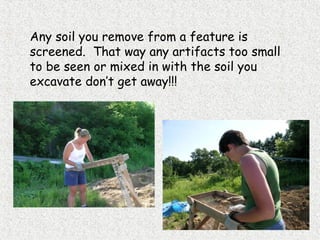
Any soil you remove from a feature is
screened. That way any artifacts too small
to be seen or mixed in with the soil you
excavate don’t get away!!!
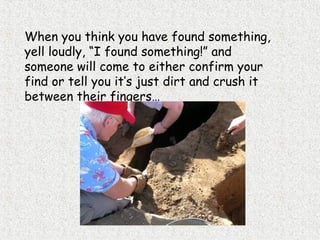
When you think you have found something,
yell loudly, “I found something!” and
someone will come to either confirm your
find or tell you it’s just dirt and crush it
between their fingers…
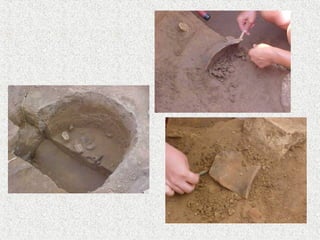
Certain artifacts will need to be left “in situ”
as they may continue into the next level.
Some you may need to pedestal or leave dirt
underneath it and then map it. Then you will
need to use your handy bamboo pick and
paintbrush to remove the dirt. Even though
you may be tempted to just “yank that puppy
out of there” – DON’T DO IT!!!!!!!!!! Removal
of an artifact needs to be done very
carefully!!!!!!
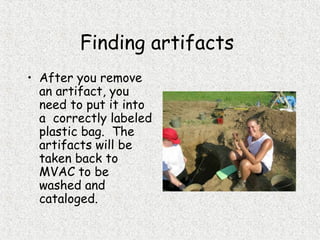
Finding artifacts
• After you remove
an artifact, you
need to put it into
a correctly labeled
plastic bag. The
artifacts will be
taken back to
MVAC to be
washed and
cataloged.
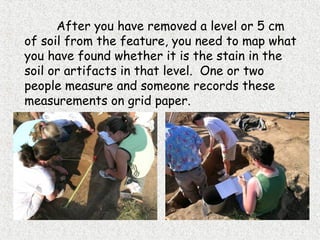
After you have removed a level or 5 cm
of soil from the feature, you need to map what
you have found whether it is the stain in the
soil or artifacts in that level. One or two
people measure and someone records these
measurements on grid paper.
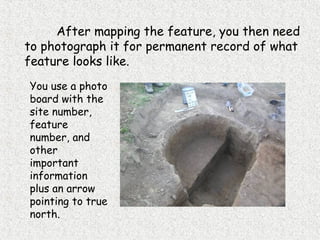
After mapping the feature, you then need
to photograph it for permanent record of what
feature looks like.
You use a photo
board with the
site number,
feature
number, and
other
important
information
plus an arrow
pointing to true
north.
Then you can start the
whole process all over
again…
Until you reach
sterile soil…
or China…
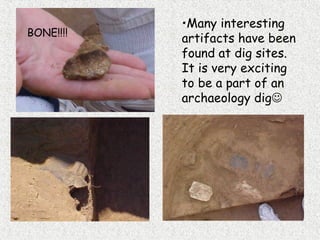
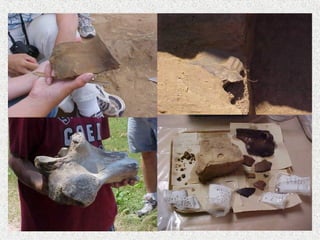
•Many interesting
artifacts have been
found at dig sites.
It is very exciting
to be a part of an
archaeology dig
BONE!!!!
www.luxetvitan.com

Archaeology

  • 1.
  • 2.
  • 3.
    What is archaeology? •The scientific study of the physical evidence of past human societies recovered through the excavation. Archaeologists not only attempt to discover and describe past cultures, but to explain the development of these cultures.
  • 4.
    How is asite chosen? • Our site was chosen based on: • A. artifacts already found on the surface • B. history of the area (from sources or even land owner)
  • 5.
    What is aunit? • A unit is a square in which an archaeologist has chosen to dig or search for artifacts.
  • 6.
    Setting up aunit Your unit will be a “2x2.” You start with two sides that need to measure 200 cm. Using the Pythagorean Theorem, you will find the hypotenuse to be 283 cm., your measurement from corner to corner across the middle. Using this method you can be sure all sides of the unit will be 200 cm
  • 7.
    Once you havethese measurements, you will have a perfect square for your unit… IF you measure it correctly. Then the REAL fun begins…
  • 8.
    Tools of thetrade… • There are several tools you can use when looking for artifacts. Some of them are… a spade, a shovel, a trowel, a measuring tape, a bamboo pick, a pencil, a file, a paint brush and clippers.
  • 9.
    AND don’t forget thesunscreen and bug spray!!!!
  • 10.
    First using shovels andspades, you need to remove the plow zone, which reaches about 25 cm below the surface. Keep your eyes peeled for artifacts such as flakes that can be found in the plow zone! Removing the Plow Zone
  • 11.
    Once the plowzone is removed, you may find changes in the soil color. These are called stains. Once a stain is found, you can be sure you have discovered a feature within the unit and then you can get down and DIRTY!!!!!!!!! There is a chance you will find artifacts below this…
  • 12.
    Working at adig site… • To begin excavating your feature you will need to CAREFULLY remove the soil 5 cm. at a time. Each 5 cm of soil is called a level.
  • 13.
    During this processyou can see the best side of a lot of people Not again…
  • 14.
  • 15.
    The MATRIX!!! Before you begintroweling away each 5 cm level, you need to take a matrix or sampling of soil. This is done using your trowel to “chunk” the soil out of the level.
  • 16.
    This matrix istaken back to MVAC where it is dried and then rinsed through screens for items like small bones or flakes or charcoal. This can help give more information about the site and the people who once occupied it.
  • 17.
    Any soil youremove from a feature is screened. That way any artifacts too small to be seen or mixed in with the soil you excavate don’t get away!!!
  • 18.
    When you thinkyou have found something, yell loudly, “I found something!” and someone will come to either confirm your find or tell you it’s just dirt and crush it between their fingers…
  • 19.
    Certain artifacts willneed to be left “in situ” as they may continue into the next level. Some you may need to pedestal or leave dirt underneath it and then map it. Then you will need to use your handy bamboo pick and paintbrush to remove the dirt. Even though you may be tempted to just “yank that puppy out of there” – DON’T DO IT!!!!!!!!!! Removal of an artifact needs to be done very carefully!!!!!!
  • 21.
    Finding artifacts • Afteryou remove an artifact, you need to put it into a correctly labeled plastic bag. The artifacts will be taken back to MVAC to be washed and cataloged.
  • 22.
    After you haveremoved a level or 5 cm of soil from the feature, you need to map what you have found whether it is the stain in the soil or artifacts in that level. One or two people measure and someone records these measurements on grid paper.
  • 23.
    After mapping thefeature, you then need to photograph it for permanent record of what feature looks like. You use a photo board with the site number, feature number, and other important information plus an arrow pointing to true north.
  • 24.
    Then you canstart the whole process all over again… Until you reach sterile soil… or China…
  • 25.
    •Many interesting artifacts havebeen found at dig sites. It is very exciting to be a part of an archaeology dig BONE!!!!
  • 29.