© IEA, Inc. 2008 USING SIX SIGMA TOOLS TO IMPROVE SAFETY PROCESSES
Agenda FMEA C &E
Overview of Six Sigma
Overview of Six Sigma To be successful a Six Sigma, approach needs: Management Commitment Employee Participation Planning Involve all Aspects of the Organization Based on Continuous Improvement Same basic principles as ANSI Z10 –  Occupational Health and Safety Management Systems
Continuous Improvement
Define
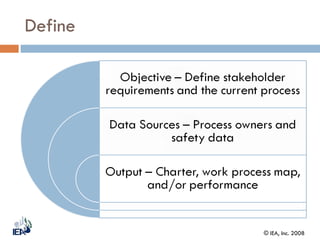
Define – Case Study Objective – Improve overall safety performance. Recordable rate average 4.5 to 5  Annual workers compensation $2.5 million (average) Data Sources – Plant statistics, incident reports, workers compensation reports. Output – Team charter, EHS incident data by location
Safety Performance – Flat Line
Measure
Measure – Case Study
Measure – Key Thoughts
Analyze - Objectives
Pareto Charts – Other Examples Shift Injury Type Injury Cause Body Part Length of Employment Day of Week Tools Used Product Made Supervisor Plant/Work Cell Location Vehicle Type Task/Work Activity Worker Type
Analyze – Case Study First level pareto
Analyze – Case Study First level pareto Second level pareto
Analyze – Case Study Third Level Pareto defines the C&E. 2 nd  Level – use the C&E subtitles: Man – Materials – Machines – Methods – Measurements - Environment
Paretos
C&E Diagram - Fishbone 5 Why’s
C&E Diagram
C&E – Case Study Man Training provided? Use of PPE? Use of knives? Machines Types of knives used? Other options? PPE requirements? Core Slabbers not used? Methods Cutting away from body? Why cutting plastics? Measurements What measurements impact the use of knives? Environment Heat play a role?
C&E Feeds FMEA Example
FMEA
FMEA Outcomes – Case Study Standardized utility knives – Martor Megasafe Standardized “J” knives Eliminated manual core slabbing Purchased core slabbing equipment Established Policies
Improve Objective Prioritize, plan, and test corrective actions. Eliminate defects through process/product redesign. Deploy effective corrective actions. Output Redesigned process. Collect date/measurements on effectiveness.
Improve – Case Study Tested variety of knives. ROI projections on core slabbing equipment. Implemented policies on core slabbing, knife usage, and PPE requirements.
Control Plan Sets in place – rules for future practices. Often impacts many areas of the organization: Operations, Purchasing, EHS Guidelines for each of these areas to follow Identifies measurements to determine if the control plan is successful or needs to be revisited. Sets accountabilities and timelines. Becomes policy or procedure.
Control Plan  (continued) Policies on standardized knives. Purchasing not allowed to purchase alternatives. Policy on knife usage – disciplinary action for improper use. All old knives removed and discarded by a given date. Incident statistics used a measurement – knife related incidents went from 40 injuries per year to less than 5!
Continuous Improvement
Key Lessons/Best Practices Go through the steps – don’t let personal influences bias the process. Use a team approach to the tools. Establish assumptions up front as an organization. Cost Avoidance credit? ROI Criteria Solid Incident Investigations are critical. Follow-up and Review. Use the data to drive the process.
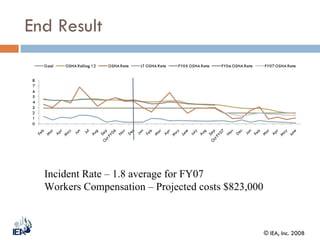
End Result Incident Rate – 1.8 average for FY07 Workers Compensation – Projected costs $823,000
Questions
Contact Info Email:  [email_address] Phone: 507-281-6661 Cell: 507-884-6691 LinkedIn  http://www.linkedin.com/in/timpuyleart

Six Sigma Asse

  • 1.
    © IEA, Inc.2008 USING SIX SIGMA TOOLS TO IMPROVE SAFETY PROCESSES
  • 2.
  • 3.
  • 4.
    Overview of SixSigma To be successful a Six Sigma, approach needs: Management Commitment Employee Participation Planning Involve all Aspects of the Organization Based on Continuous Improvement Same basic principles as ANSI Z10 – Occupational Health and Safety Management Systems
  • 5.
  • 6.
  • 7.
    Define – CaseStudy Objective – Improve overall safety performance. Recordable rate average 4.5 to 5 Annual workers compensation $2.5 million (average) Data Sources – Plant statistics, incident reports, workers compensation reports. Output – Team charter, EHS incident data by location
  • 8.
  • 9.
  • 10.
  • 11.
  • 12.
  • 13.
    Pareto Charts –Other Examples Shift Injury Type Injury Cause Body Part Length of Employment Day of Week Tools Used Product Made Supervisor Plant/Work Cell Location Vehicle Type Task/Work Activity Worker Type
  • 14.
    Analyze – CaseStudy First level pareto
  • 15.
    Analyze – CaseStudy First level pareto Second level pareto
  • 16.
    Analyze – CaseStudy Third Level Pareto defines the C&E. 2 nd Level – use the C&E subtitles: Man – Materials – Machines – Methods – Measurements - Environment
  • 17.
  • 18.
    C&E Diagram -Fishbone 5 Why’s
  • 19.
  • 20.
    C&E – CaseStudy Man Training provided? Use of PPE? Use of knives? Machines Types of knives used? Other options? PPE requirements? Core Slabbers not used? Methods Cutting away from body? Why cutting plastics? Measurements What measurements impact the use of knives? Environment Heat play a role?
  • 21.
  • 22.
  • 23.
    FMEA Outcomes –Case Study Standardized utility knives – Martor Megasafe Standardized “J” knives Eliminated manual core slabbing Purchased core slabbing equipment Established Policies
  • 24.
    Improve Objective Prioritize,plan, and test corrective actions. Eliminate defects through process/product redesign. Deploy effective corrective actions. Output Redesigned process. Collect date/measurements on effectiveness.
  • 25.
    Improve – CaseStudy Tested variety of knives. ROI projections on core slabbing equipment. Implemented policies on core slabbing, knife usage, and PPE requirements.
  • 26.
    Control Plan Setsin place – rules for future practices. Often impacts many areas of the organization: Operations, Purchasing, EHS Guidelines for each of these areas to follow Identifies measurements to determine if the control plan is successful or needs to be revisited. Sets accountabilities and timelines. Becomes policy or procedure.
  • 27.
    Control Plan (continued) Policies on standardized knives. Purchasing not allowed to purchase alternatives. Policy on knife usage – disciplinary action for improper use. All old knives removed and discarded by a given date. Incident statistics used a measurement – knife related incidents went from 40 injuries per year to less than 5!
  • 28.
  • 29.
    Key Lessons/Best PracticesGo through the steps – don’t let personal influences bias the process. Use a team approach to the tools. Establish assumptions up front as an organization. Cost Avoidance credit? ROI Criteria Solid Incident Investigations are critical. Follow-up and Review. Use the data to drive the process.
  • 30.
    End Result IncidentRate – 1.8 average for FY07 Workers Compensation – Projected costs $823,000
  • 31.
  • 32.
    Contact Info Email: [email_address] Phone: 507-281-6661 Cell: 507-884-6691 LinkedIn http://www.linkedin.com/in/timpuyleart