Arc Welding Patrick V. Bebout BCN5737-8384 Advanced Construction Safety Spring, 2009
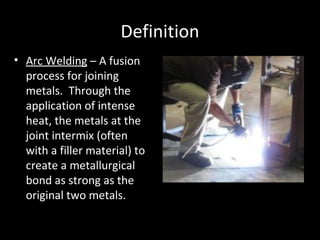
Definition Arc Welding  – A fusion process for joining metals.  Through the application of intense heat, the metals at the joint intermix (often with a filler material) to create a metallurgical bond as strong as the original two metals.
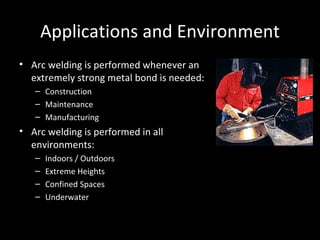
Applications and Environment Arc welding is performed whenever an extremely strong metal bond is needed: Construction Maintenance Manufacturing Arc welding is performed in all environments: Indoors / Outdoors Extreme Heights Confined Spaces Underwater
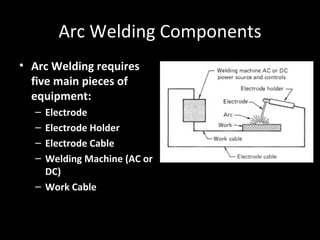
Arc Welding Components Arc Welding requires five main pieces of equipment: Electrode   Electrode Holder   Electrode Cable Welding Machine (AC or DC) Work Cable
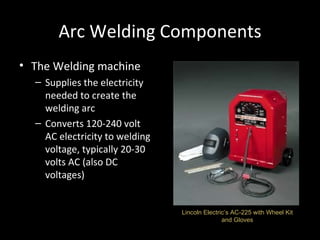
Arc Welding Components The Welding machine Supplies the electricity needed to create the welding arc Converts 120-240 volt AC electricity to welding voltage, typically 20-30 volts AC (also DC voltages) Lincoln Electric’s AC-225 with Wheel Kit and Gloves
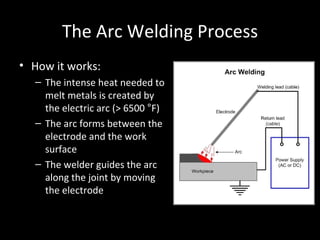
The Arc Welding Process How it works: The intense heat needed to melt metals is created by the electric arc (> 6500  ° F) The arc forms between the electrode and the work surface The welder guides the arc along the joint by moving the electrode
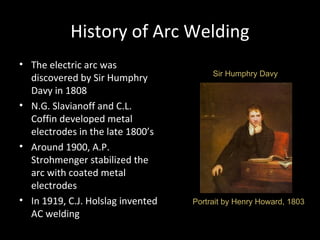
History of Arc Welding The electric arc was discovered by Sir Humphry Davy in 1808 N.G. Slavianoff and C.L. Coffin developed metal electrodes in the late 1800’s Around 1900, A.P. Strohmenger stabilized the arc with coated metal electrodes In 1919, C.J. Holslag invented AC welding Portrait by Henry Howard, 1803 Sir Humphry Davy
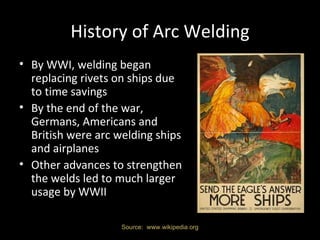
History of Arc Welding By WWI, welding began replacing rivets on ships due to time savings By the end of the war, Germans, Americans and British were arc welding ships and airplanes Other advances to strengthen the welds led to much larger usage by WWII Source:  www.wikipedia.org
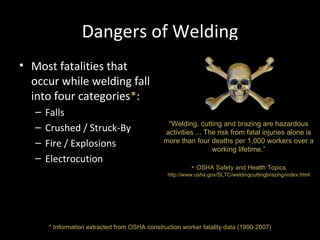
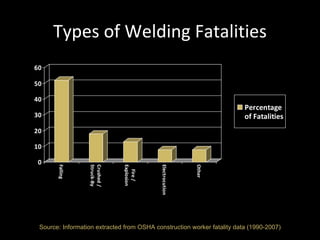
Dangers of Welding Most fatalities that occur while welding fall into four categories * : Falls Crushed / Struck-By Fire / Explosions Electrocution “ Welding, cutting and brazing are hazardous activities ... The risk from fatal injuries alone is more than four deaths per 1,000 workers over a working lifetime.” OSHA Safety and Health Topics http://www.osha.gov/SLTC/weldingcuttingbrazing/index.html * Information extracted from OSHA construction worker fatality data (1990-2007)
Types of Welding Fatalities Source: Information extracted from OSHA construction worker fatality data (1990-2007)
Example Fatality Fall: Employee #1 was walking along the edge of a roof to conduct some welding on an airport expansion project Decking along the edge became loose  The employee fell 51 feet to the compacted soil He died several hours later of internal bleeding and asphyxia Source: OSHA construction worker fatality data (1990-2007)
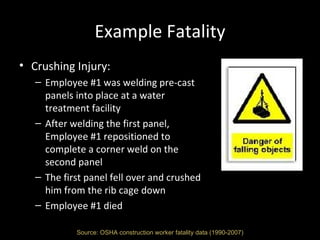
Example Fatality Crushing Injury: Employee #1 was welding pre-cast panels into place at a water treatment facility After welding the first panel, Employee #1 repositioned to complete a corner weld on the second panel The first panel fell over and crushed him from the rib cage down Employee #1 died Source: OSHA construction worker fatality data (1990-2007)
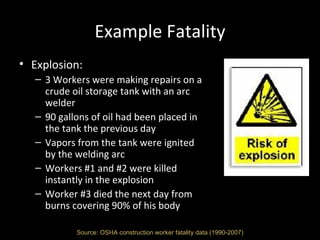
Example Fatality Explosion: 3 Workers were making repairs on a crude oil storage tank with an arc welder 90 gallons of oil had been placed in the tank the previous day Vapors from the tank were ignited by the welding arc Workers #1 and #2 were killed instantly in the explosion Worker #3 died the next day from burns covering 90% of his body Source: OSHA construction worker fatality data (1990-2007)
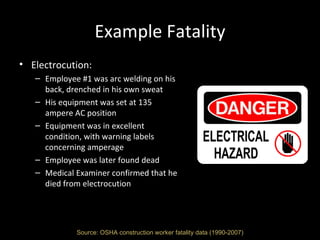
Example Fatality Electrocution: Employee #1 was arc welding on his back, drenched in his own sweat His equipment was set at 135 ampere AC position Equipment was in excellent condition, with warning labels concerning amperage Employee was later found dead Medical Examiner confirmed that he died from electrocution Source: OSHA construction worker fatality data (1990-2007)
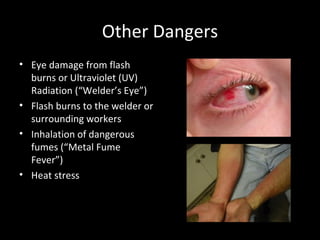
Other Dangers Eye damage from flash burns or Ultraviolet (UV) Radiation (“Welder’s Eye”) Flash burns to the welder or surrounding workers Inhalation of dangerous fumes (“Metal Fume Fever”) Heat stress
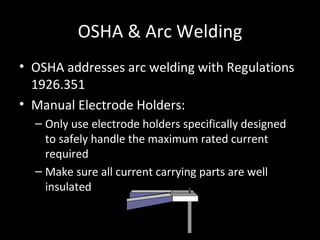
OSHA & Arc Welding OSHA addresses arc welding with Regulations 1926.351  Manual Electrode Holders: Only use electrode holders specifically designed to safely handle the maximum rated current required Make sure all current carrying parts are well insulated
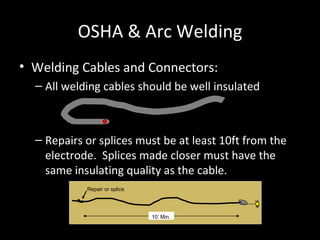
OSHA & Arc Welding Welding Cables and Connectors: All welding cables should be well insulated Repairs or splices must be at least 10ft from the electrode.  Splices made closer must have the same insulating quality as the cable. 10’ Min. Repair or splice
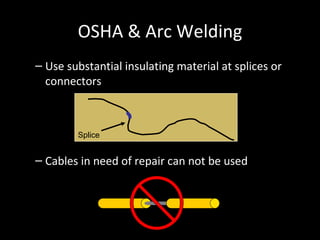
OSHA & Arc Welding Use substantial insulating material at splices or connectors Cables in need of repair can not be used Splice
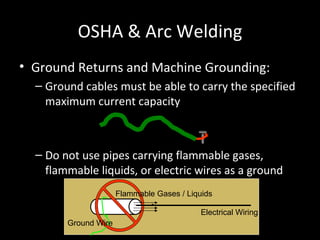
OSHA & Arc Welding Ground Returns and Machine Grounding: Ground cables must be able to carry the specified maximum current capacity Do not use pipes carrying flammable gases, flammable liquids, or electric wires as a ground Ground Wire Flammable Gases / Liquids Electrical Wiring
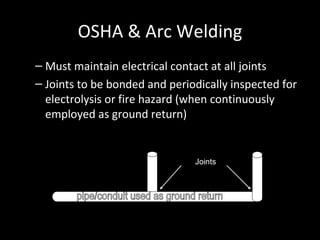
OSHA & Arc Welding Must maintain electrical contact at all joints Joints to be bonded and periodically inspected for electrolysis or fire hazard (when continuously employed as ground return) Joints pipe/conduit used as ground return
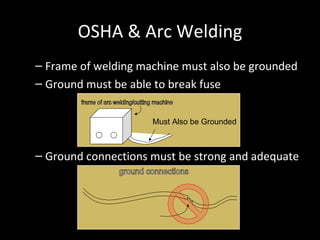
OSHA & Arc Welding Frame of welding machine must also be grounded Ground must be able to break fuse Ground connections must be strong and adequate Must Also be Grounded frame of arc welding/cutting machine ground connections
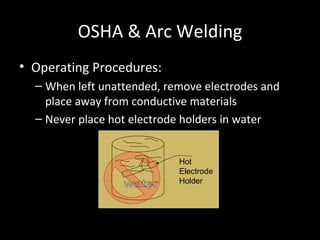
OSHA & Arc Welding Operating Procedures: When left unattended, remove electrodes and place away from conductive materials  Never place hot electrode holders in water Hot Electrode Holder water
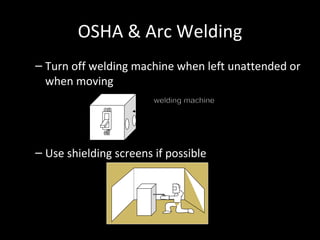
OSHA & Arc Welding Turn off welding machine when left unattended or when moving Use shielding screens if possible on off welding machine
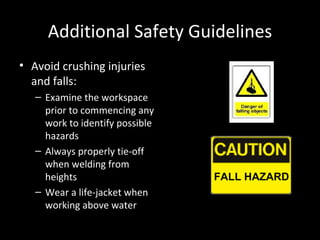
Additional Safety Guidelines Avoid crushing injuries and falls: Examine the workspace prior to commencing any work to identify possible hazards Always properly tie-off when welding from heights Wear a life-jacket when working above water FALL HAZARD
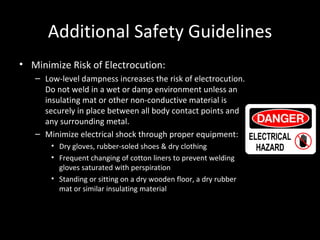
Additional Safety Guidelines Minimize Risk of Electrocution: Low-level dampness increases the risk of electrocution.  Do not weld in a wet or damp environment unless an insulating mat or other non-conductive material is securely in place between all body contact points and any surrounding metal. Minimize electrical shock through proper equipment: Dry gloves, rubber-soled shoes & dry clothing Frequent changing of cotton liners to prevent welding gloves saturated with perspiration Standing or sitting on a dry wooden floor, a dry rubber mat or similar insulating material
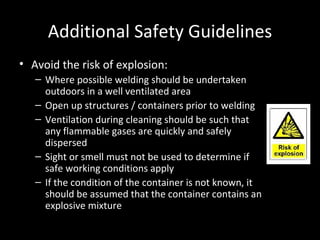
Additional Safety Guidelines Avoid the risk of explosion: Where possible welding should be undertaken outdoors in a well ventilated area Open up structures / containers prior to welding Ventilation during cleaning should be such that any flammable gases are quickly and safely dispersed Sight or smell must not be used to determine if safe working conditions apply If the condition of the container is not known, it should be assumed that the container contains an explosive mixture
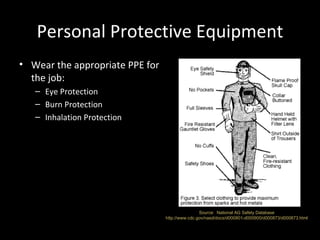
Personal Protective Equipment Source:  National AG Safety Database http://www.cdc.gov/nasd/docs/d000801-d000900/d000873/d000873.html Wear the appropriate PPE for the job: Eye Protection Burn Protection Inhalation Protection
Conclusions Welding should only be carried out by experienced welders directly supervised by a person who fully understands the hazards involved Always properly maintain equipment Wear appropriate personal protective equipment Perform a hazard identification and risk assessment of any workplace prior to commencement of any work
 

Arc welding & safty

  • 1.
    Arc Welding PatrickV. Bebout BCN5737-8384 Advanced Construction Safety Spring, 2009
  • 2.
    Definition Arc Welding – A fusion process for joining metals. Through the application of intense heat, the metals at the joint intermix (often with a filler material) to create a metallurgical bond as strong as the original two metals.
  • 3.
    Applications and EnvironmentArc welding is performed whenever an extremely strong metal bond is needed: Construction Maintenance Manufacturing Arc welding is performed in all environments: Indoors / Outdoors Extreme Heights Confined Spaces Underwater
  • 4.
    Arc Welding ComponentsArc Welding requires five main pieces of equipment: Electrode Electrode Holder Electrode Cable Welding Machine (AC or DC) Work Cable
  • 5.
    Arc Welding ComponentsThe Welding machine Supplies the electricity needed to create the welding arc Converts 120-240 volt AC electricity to welding voltage, typically 20-30 volts AC (also DC voltages) Lincoln Electric’s AC-225 with Wheel Kit and Gloves
  • 6.
    The Arc WeldingProcess How it works: The intense heat needed to melt metals is created by the electric arc (> 6500 ° F) The arc forms between the electrode and the work surface The welder guides the arc along the joint by moving the electrode
  • 7.
    History of ArcWelding The electric arc was discovered by Sir Humphry Davy in 1808 N.G. Slavianoff and C.L. Coffin developed metal electrodes in the late 1800’s Around 1900, A.P. Strohmenger stabilized the arc with coated metal electrodes In 1919, C.J. Holslag invented AC welding Portrait by Henry Howard, 1803 Sir Humphry Davy
  • 8.
    History of ArcWelding By WWI, welding began replacing rivets on ships due to time savings By the end of the war, Germans, Americans and British were arc welding ships and airplanes Other advances to strengthen the welds led to much larger usage by WWII Source: www.wikipedia.org
  • 9.
    Dangers of WeldingMost fatalities that occur while welding fall into four categories * : Falls Crushed / Struck-By Fire / Explosions Electrocution “ Welding, cutting and brazing are hazardous activities ... The risk from fatal injuries alone is more than four deaths per 1,000 workers over a working lifetime.” OSHA Safety and Health Topics http://www.osha.gov/SLTC/weldingcuttingbrazing/index.html * Information extracted from OSHA construction worker fatality data (1990-2007)
  • 10.
    Types of WeldingFatalities Source: Information extracted from OSHA construction worker fatality data (1990-2007)
  • 11.
    Example Fatality Fall:Employee #1 was walking along the edge of a roof to conduct some welding on an airport expansion project Decking along the edge became loose The employee fell 51 feet to the compacted soil He died several hours later of internal bleeding and asphyxia Source: OSHA construction worker fatality data (1990-2007)
  • 12.
    Example Fatality CrushingInjury: Employee #1 was welding pre-cast panels into place at a water treatment facility After welding the first panel, Employee #1 repositioned to complete a corner weld on the second panel The first panel fell over and crushed him from the rib cage down Employee #1 died Source: OSHA construction worker fatality data (1990-2007)
  • 13.
    Example Fatality Explosion:3 Workers were making repairs on a crude oil storage tank with an arc welder 90 gallons of oil had been placed in the tank the previous day Vapors from the tank were ignited by the welding arc Workers #1 and #2 were killed instantly in the explosion Worker #3 died the next day from burns covering 90% of his body Source: OSHA construction worker fatality data (1990-2007)
  • 14.
    Example Fatality Electrocution:Employee #1 was arc welding on his back, drenched in his own sweat His equipment was set at 135 ampere AC position Equipment was in excellent condition, with warning labels concerning amperage Employee was later found dead Medical Examiner confirmed that he died from electrocution Source: OSHA construction worker fatality data (1990-2007)
  • 15.
    Other Dangers Eyedamage from flash burns or Ultraviolet (UV) Radiation (“Welder’s Eye”) Flash burns to the welder or surrounding workers Inhalation of dangerous fumes (“Metal Fume Fever”) Heat stress
  • 16.
    OSHA & ArcWelding OSHA addresses arc welding with Regulations 1926.351 Manual Electrode Holders: Only use electrode holders specifically designed to safely handle the maximum rated current required Make sure all current carrying parts are well insulated
  • 17.
    OSHA & ArcWelding Welding Cables and Connectors: All welding cables should be well insulated Repairs or splices must be at least 10ft from the electrode. Splices made closer must have the same insulating quality as the cable. 10’ Min. Repair or splice
  • 18.
    OSHA & ArcWelding Use substantial insulating material at splices or connectors Cables in need of repair can not be used Splice
  • 19.
    OSHA & ArcWelding Ground Returns and Machine Grounding: Ground cables must be able to carry the specified maximum current capacity Do not use pipes carrying flammable gases, flammable liquids, or electric wires as a ground Ground Wire Flammable Gases / Liquids Electrical Wiring
  • 20.
    OSHA & ArcWelding Must maintain electrical contact at all joints Joints to be bonded and periodically inspected for electrolysis or fire hazard (when continuously employed as ground return) Joints pipe/conduit used as ground return
  • 21.
    OSHA & ArcWelding Frame of welding machine must also be grounded Ground must be able to break fuse Ground connections must be strong and adequate Must Also be Grounded frame of arc welding/cutting machine ground connections
  • 22.
    OSHA & ArcWelding Operating Procedures: When left unattended, remove electrodes and place away from conductive materials Never place hot electrode holders in water Hot Electrode Holder water
  • 23.
    OSHA & ArcWelding Turn off welding machine when left unattended or when moving Use shielding screens if possible on off welding machine
  • 24.
    Additional Safety GuidelinesAvoid crushing injuries and falls: Examine the workspace prior to commencing any work to identify possible hazards Always properly tie-off when welding from heights Wear a life-jacket when working above water FALL HAZARD
  • 25.
    Additional Safety GuidelinesMinimize Risk of Electrocution: Low-level dampness increases the risk of electrocution. Do not weld in a wet or damp environment unless an insulating mat or other non-conductive material is securely in place between all body contact points and any surrounding metal. Minimize electrical shock through proper equipment: Dry gloves, rubber-soled shoes & dry clothing Frequent changing of cotton liners to prevent welding gloves saturated with perspiration Standing or sitting on a dry wooden floor, a dry rubber mat or similar insulating material
  • 26.
    Additional Safety GuidelinesAvoid the risk of explosion: Where possible welding should be undertaken outdoors in a well ventilated area Open up structures / containers prior to welding Ventilation during cleaning should be such that any flammable gases are quickly and safely dispersed Sight or smell must not be used to determine if safe working conditions apply If the condition of the container is not known, it should be assumed that the container contains an explosive mixture
  • 27.
    Personal Protective EquipmentSource: National AG Safety Database http://www.cdc.gov/nasd/docs/d000801-d000900/d000873/d000873.html Wear the appropriate PPE for the job: Eye Protection Burn Protection Inhalation Protection
  • 28.
    Conclusions Welding shouldonly be carried out by experienced welders directly supervised by a person who fully understands the hazards involved Always properly maintain equipment Wear appropriate personal protective equipment Perform a hazard identification and risk assessment of any workplace prior to commencement of any work
  • 29.