Robotics
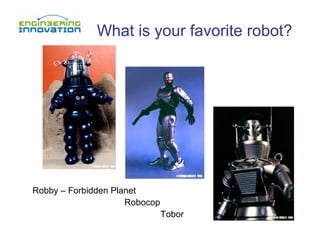
What is your favorite robot?
Robby – Forbidden Planet
Robocop
Tobor
Find some good robotics videos.
 Swimming fish:
 http://privatewww.essex.ac.uk/~jliua/videogal.htm
 Robot wars:
 http://robogames.net/videos.php
 http://www.metalmunchingmaniacs.com/combat-robot-
videos.t
 Japanese robots:
 http://www.ecst.csuchico.edu/~renner/Teaching/Roboti
cs/videos.html
 http://www.plyojump.com/qrio.html
 Miscellaneous robots:
 http://www.roboticsonline.com/public/articles/articles.cf
m?cat=298
“A robot is a reprogrammable, multifunctional
manipulator designed to move material, parts, tools,
or specialized devices through variable programmed
motions for the performance of a variety of tasks.”
(Robot Institute of America)
Definition:
Alternate definition:
“A robot is a one-armed, blind idiot with limited
memory and which cannot speak, see, or hear.”
What is a robot?
What are robots good at?
 What is hard for humans is easy for robots.
 Repetitive tasks.
 Continuous operation.
 Do complicated calculations.
 Refer to huge data bases.
 What is easy for a human is hard for robots.
 Reasoning.
 Adapting to new situations.
 Flexible to changing requirements.
 Integrating multiple sensors.
 Resolving conflicting data.
 Synthesizing unrelated information.
 Creativity.
What tasks would you give
robots?
 Dangerous
 Space exploration
 chemical spill cleanup
 disarming bombs
 disaster cleanup
 Boring and/or repetitive
 Welding car frames
 part pick and place
 manufacturing parts.
 High precision or high speed
 Electronics testing
 Surgery
 precision machining.
What does building robots
teach us about humans?
 How do our sensors work?
 eyes
 brain
 How do we integrate sensors?
 How does our muscular-skeletal
system work?
 How do we grab and hold an
object?
 How does our brain process
information?
 What is nature of intelligence?
 How do we make decisions?
What subsystems make up a
robot?
 Action
 Stationary base
 Mobile
 Sensors
 Control
 Power supply
Robert Stengel, Princeton Univ.
Action – do some function.
 Actuators
 pneumatic
 hydraulic
 electric solenoid
 Motors
 Analog (continuous)
 Stepping (discrete increments)
 Gears, belts, screws, levers
 Manipulations
Three types of robot actions.
 Pick and place
 Moves items between points.
 Continuous path control
 Moves along a programmable
path
 Sensory
 Employs sensors for feedback
 Simple joints (2D)
 Prismatic — sliding along one axis
• square cylinder in square tube
 Revolute — rotating about one axis
 Compound joints (3D)
 ball and socket = 3 revolute joints
 round cylinder in tube = 1 prismatic, 1 revolute
 Degrees of freedom = Number of independent
motions
 3 degrees of freedom: 2 translation, 1 rotation
 6 degrees of freedom: 3 translation, 3 rotation
How do robots move?
Mobility
 Legs
 Wheels
 Tracks
 Crawls
 Role
What sensors might robots
have?
 Optical
 Laser / radar
 3D
 Color spectrum
 Pressure
 Temperature
 Chemical
 Motion & Accelerometer
 Acoustic
 Ultrasonic
What use are sensors?
 Uses sensors for feedback
 Closed-loop robots use sensors in
conjunction with actuators to gain
higher accuracy – servo motors.
 Uses include mobile robotics,
telepresence, search and rescue,
pick and place with machine vision.
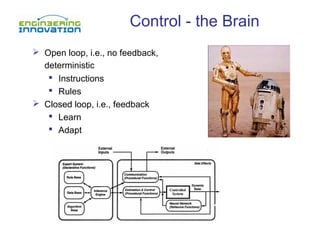
Control - the Brain
 Open loop, i.e., no feedback,
deterministic
 Instructions
 Rules
 Closed loop, i.e., feedback
 Learn
 Adapt

robot

  • 1.
  • 2.
    What is yourfavorite robot? Robby – Forbidden Planet Robocop Tobor
  • 3.
    Find some goodrobotics videos.  Swimming fish:  http://privatewww.essex.ac.uk/~jliua/videogal.htm  Robot wars:  http://robogames.net/videos.php  http://www.metalmunchingmaniacs.com/combat-robot- videos.t  Japanese robots:  http://www.ecst.csuchico.edu/~renner/Teaching/Roboti cs/videos.html  http://www.plyojump.com/qrio.html  Miscellaneous robots:  http://www.roboticsonline.com/public/articles/articles.cf m?cat=298
  • 4.
    “A robot isa reprogrammable, multifunctional manipulator designed to move material, parts, tools, or specialized devices through variable programmed motions for the performance of a variety of tasks.” (Robot Institute of America) Definition: Alternate definition: “A robot is a one-armed, blind idiot with limited memory and which cannot speak, see, or hear.” What is a robot?
  • 5.
    What are robotsgood at?  What is hard for humans is easy for robots.  Repetitive tasks.  Continuous operation.  Do complicated calculations.  Refer to huge data bases.  What is easy for a human is hard for robots.  Reasoning.  Adapting to new situations.  Flexible to changing requirements.  Integrating multiple sensors.  Resolving conflicting data.  Synthesizing unrelated information.  Creativity.
  • 6.
    What tasks wouldyou give robots?  Dangerous  Space exploration  chemical spill cleanup  disarming bombs  disaster cleanup  Boring and/or repetitive  Welding car frames  part pick and place  manufacturing parts.  High precision or high speed  Electronics testing  Surgery  precision machining.
  • 7.
    What does buildingrobots teach us about humans?  How do our sensors work?  eyes  brain  How do we integrate sensors?  How does our muscular-skeletal system work?  How do we grab and hold an object?  How does our brain process information?  What is nature of intelligence?  How do we make decisions?
  • 8.
    What subsystems makeup a robot?  Action  Stationary base  Mobile  Sensors  Control  Power supply Robert Stengel, Princeton Univ.
  • 9.
    Action – dosome function.  Actuators  pneumatic  hydraulic  electric solenoid  Motors  Analog (continuous)  Stepping (discrete increments)  Gears, belts, screws, levers  Manipulations
  • 10.
    Three types ofrobot actions.  Pick and place  Moves items between points.  Continuous path control  Moves along a programmable path  Sensory  Employs sensors for feedback
  • 11.
     Simple joints(2D)  Prismatic — sliding along one axis • square cylinder in square tube  Revolute — rotating about one axis  Compound joints (3D)  ball and socket = 3 revolute joints  round cylinder in tube = 1 prismatic, 1 revolute  Degrees of freedom = Number of independent motions  3 degrees of freedom: 2 translation, 1 rotation  6 degrees of freedom: 3 translation, 3 rotation How do robots move?
  • 12.
    Mobility  Legs  Wheels Tracks  Crawls  Role
  • 13.
    What sensors mightrobots have?  Optical  Laser / radar  3D  Color spectrum  Pressure  Temperature  Chemical  Motion & Accelerometer  Acoustic  Ultrasonic
  • 14.
    What use aresensors?  Uses sensors for feedback  Closed-loop robots use sensors in conjunction with actuators to gain higher accuracy – servo motors.  Uses include mobile robotics, telepresence, search and rescue, pick and place with machine vision.
  • 15.
    Control - theBrain  Open loop, i.e., no feedback, deterministic  Instructions  Rules  Closed loop, i.e., feedback  Learn  Adapt