The World After the Cold War Russian Break Up Colonies around the World  Formation of Israel
Review Questions Who was Khrushchev? What were some problems faced in African independent movement? What were some problems faced by Southeast Asian independence? List at least three things you know about the creation of Israel and its relationship with Palestinians today.
Palestine and Israel  3,000 years of conflict over the area of the world that is now Israel  What is the definition of Zionist? People who favor a Jewish national homeland in Palestine  Britain asked to watch over Palestine after WWI to get it ready for independence
British Uneasiness The Palestinians fear the growing number of Jewish individuals living in the area  The Jewish people ask for their own nation in the same territory  Britain does not believe the two groups can live together peacefully and do not want to lose support of either side  Britain calls for a partition of the country to ensure peace
United Nations Gets Involved After WWII Britain turns over the issue to the United Nations  The United Nations recommends partition on the state  Jewish State and Palestinian State Jerusalem to be an international city owned by both  All Arab States vote against the proposal but still passes the UN General Assembly Israel officially created on May 14, 1948
Conflicts in the Middle East From the beginning the nation of Israel has been faced with conflicts with its Arab neighbors  Day after its creation Egypt, Iraq, Jordan, Lebanon, Saudi Arabia, and Syria invade the country  Strong American support allows Israel to win within months
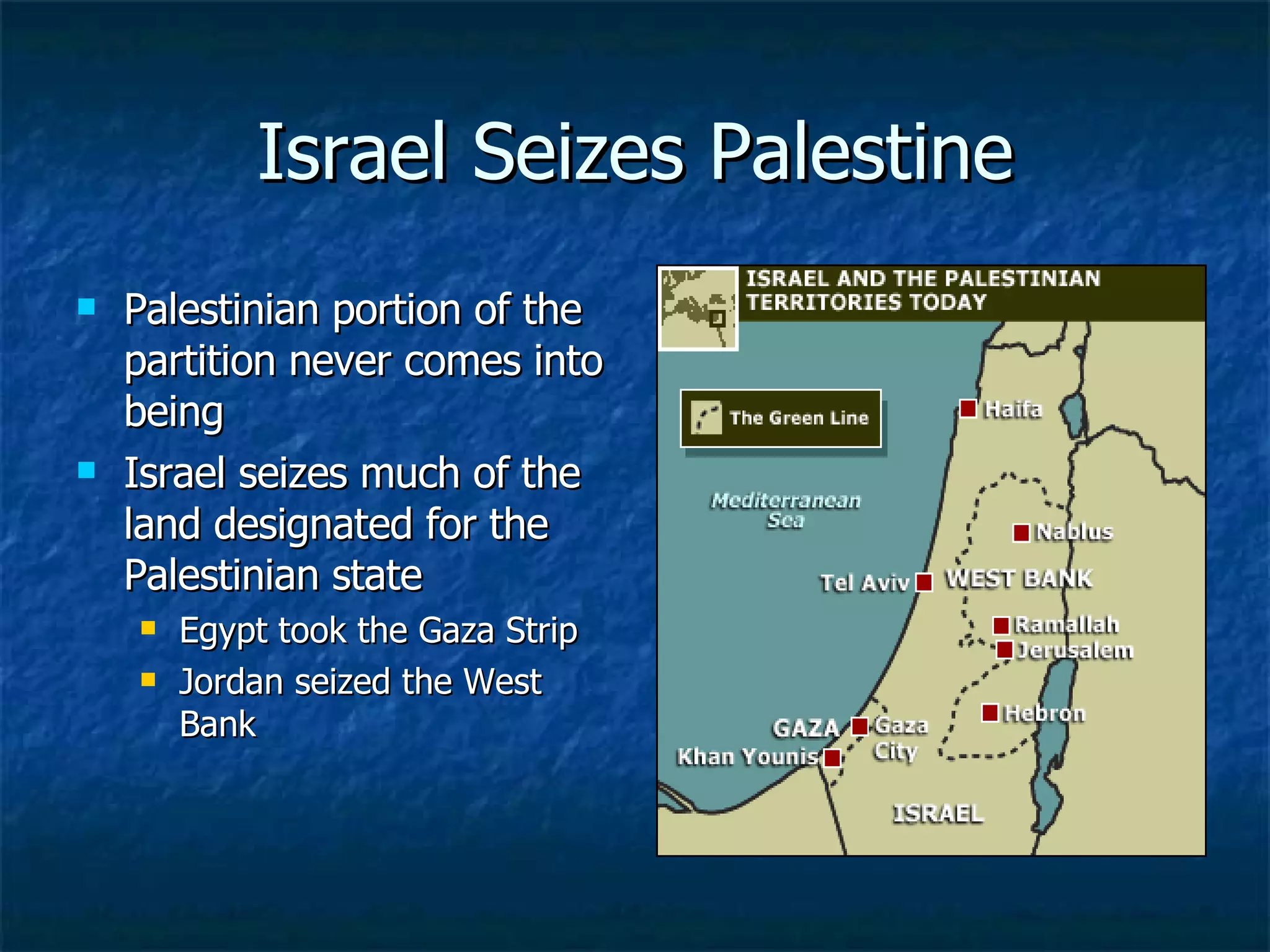
Israel Seizes Palestine Palestinian portion of the partition never comes into being  Israel seizes much of the land designated for the Palestinian state Egypt took the Gaza Strip Jordan seized the West Bank
Continued Conflict  1956 Suez Crisis  Egypt seizes the Suez Canal in 1956 which was ordered by President Nasser  US and British agree to provide air support to the Israelis who march on the Canal and quickly defeated the Egyptians  International community forces Israel and the
Continued Conflict Six-Day War Nasser threatens Israel in a speech  Israel strikes at the air bases of Egypt, Syria, Iran, and Jordan  Ground invasion success  Lost 800 troops to the Arabs 15,000  Took the old city of Jerusalem, Sinai Peninsula, The Golan Heights, and the West Bank  Buffer zones for the Israelis
Continued Conflict  1973 War or the Yom Kippur war Anwar Sadat now the president of Egypt  Israel caught by surprise and initially suffers loss of land and casualties  Counter-attack launched where Israel regains most of the land  Cease Fire signed after several weeks of fighting but not a peace agreement
The Olive Branch  1977 Sadat offers peace to Israel if Israel would agree to give up the lands it took in 1967 from Egypt, Jordan, and Syria Jimmy Carter jumps at the opportunity to gain some stability in the region  Camp David Accords  Egypt recognizes Israelis right to exist and Israel returns the Sinai Peninsula
Palestinian Demands for Statehood  Originally the Palestinians were promised a state by the UN as well which never materialized and Israel occupied their land  Israel begins to establish settlements in Palestinian lands in the Gaza Strip and the West Bank
Palestinian Liberation Organization (PLO) Led by Yasar Arafat Military wing of PLO conducts armed resistance operations against the Israelis  Israel begins bombing any suspected PLO stronghold in towns  Invades Lebanon in 1982 to knock out strongholds
Peace Talks Finally in 1991 the two sides meet face to face for a series of peace talks  International opinion swayed by civil disobedience and NOT the military operations of the PLO An agreement for Israeli withdraw and Palestinian rule of the Gaza Strip and West Bank was signed in 1993 between Sharon and Rabin Rabin Assassinated in 1995  Withdrawal process slow and complicated by Israeli Prime Ministers who were against the plan
Activity  Read Chapter 19 Section 1 and answer the following questions  What were the steps towards democracy that each country took? Who were the important leaders? What kind of obstacles did the countries face on their road towards democracy?
Russia and the Unholy Trinity
Collapse of the Soviet Union  Politburo- ruling committee of the communist party  Who were the two leaders of USSR since Stalin’s death? Mikhail Gorbachev placed in power  The Politburo looking for mild reform  Gorbachev had not lived through the Stalin Era and was open to new ideas
Collapse of the Soviet Union What is Glasnost? Openness  Encouraged soviets to discuss how to improve their society  Churches open  Released political dissidents  Unbanned books  Open press investigates and criticizes government
Collapse of the Soviet Union What is Perestroika? Economic restructuring  Allowed for local managers of farms and small private businesses (restored profit motive)
Collapse of the Soviet Union What is Democratization? Gorbachev introduces plan to slowly open the political system  Elections of a new legislative body  Lists of candidates for each office which led to part bosses losing elections and reformists gaining political power
Collapse of the Soviet Union  Escape from East Germany… vacationers paradise  No reforms in Eastern Germany  1989 Hungary who was well on its own way to democracy allowed vacationing East Germans to enter into Austria  Freedom for those who could afford the trip  East Germany closes its borders entirely to try and stop the flood of emigrants
Collapse of the Soviet Union  Fall of the Wall (1989) Huge protests break out all over the country  Police refuse to break up the protests  Leader forced to resign power  Egon Krenz new leader of Eastern Germany and believes he can restore order by allowing people to leave Eastern Germany
Germany Reunified  Within months the Communist Party in Eastern Germany ceased to exist as corruption and scandal were discovered New leadership moves towards democracy and reunification of the country  Process begins in 1994  Economy serious obstacle  Unified and back on track as of today

The World After The Cold War

  • 1.
    The World Afterthe Cold War Russian Break Up Colonies around the World Formation of Israel
  • 2.
    Review Questions Whowas Khrushchev? What were some problems faced in African independent movement? What were some problems faced by Southeast Asian independence? List at least three things you know about the creation of Israel and its relationship with Palestinians today.
  • 3.
    Palestine and Israel 3,000 years of conflict over the area of the world that is now Israel What is the definition of Zionist? People who favor a Jewish national homeland in Palestine Britain asked to watch over Palestine after WWI to get it ready for independence
  • 4.
    British Uneasiness ThePalestinians fear the growing number of Jewish individuals living in the area The Jewish people ask for their own nation in the same territory Britain does not believe the two groups can live together peacefully and do not want to lose support of either side Britain calls for a partition of the country to ensure peace
  • 5.
    United Nations GetsInvolved After WWII Britain turns over the issue to the United Nations The United Nations recommends partition on the state Jewish State and Palestinian State Jerusalem to be an international city owned by both All Arab States vote against the proposal but still passes the UN General Assembly Israel officially created on May 14, 1948
  • 6.
    Conflicts in theMiddle East From the beginning the nation of Israel has been faced with conflicts with its Arab neighbors Day after its creation Egypt, Iraq, Jordan, Lebanon, Saudi Arabia, and Syria invade the country Strong American support allows Israel to win within months
  • 7.
    Israel Seizes PalestinePalestinian portion of the partition never comes into being Israel seizes much of the land designated for the Palestinian state Egypt took the Gaza Strip Jordan seized the West Bank
  • 8.
    Continued Conflict 1956 Suez Crisis Egypt seizes the Suez Canal in 1956 which was ordered by President Nasser US and British agree to provide air support to the Israelis who march on the Canal and quickly defeated the Egyptians International community forces Israel and the
  • 9.
    Continued Conflict Six-DayWar Nasser threatens Israel in a speech Israel strikes at the air bases of Egypt, Syria, Iran, and Jordan Ground invasion success Lost 800 troops to the Arabs 15,000 Took the old city of Jerusalem, Sinai Peninsula, The Golan Heights, and the West Bank Buffer zones for the Israelis
  • 10.
    Continued Conflict 1973 War or the Yom Kippur war Anwar Sadat now the president of Egypt Israel caught by surprise and initially suffers loss of land and casualties Counter-attack launched where Israel regains most of the land Cease Fire signed after several weeks of fighting but not a peace agreement
  • 11.
    The Olive Branch 1977 Sadat offers peace to Israel if Israel would agree to give up the lands it took in 1967 from Egypt, Jordan, and Syria Jimmy Carter jumps at the opportunity to gain some stability in the region Camp David Accords Egypt recognizes Israelis right to exist and Israel returns the Sinai Peninsula
  • 12.
    Palestinian Demands forStatehood Originally the Palestinians were promised a state by the UN as well which never materialized and Israel occupied their land Israel begins to establish settlements in Palestinian lands in the Gaza Strip and the West Bank
  • 13.
    Palestinian Liberation Organization(PLO) Led by Yasar Arafat Military wing of PLO conducts armed resistance operations against the Israelis Israel begins bombing any suspected PLO stronghold in towns Invades Lebanon in 1982 to knock out strongholds
  • 14.
    Peace Talks Finallyin 1991 the two sides meet face to face for a series of peace talks International opinion swayed by civil disobedience and NOT the military operations of the PLO An agreement for Israeli withdraw and Palestinian rule of the Gaza Strip and West Bank was signed in 1993 between Sharon and Rabin Rabin Assassinated in 1995 Withdrawal process slow and complicated by Israeli Prime Ministers who were against the plan
  • 15.
    Activity ReadChapter 19 Section 1 and answer the following questions What were the steps towards democracy that each country took? Who were the important leaders? What kind of obstacles did the countries face on their road towards democracy?
  • 16.
    Russia and theUnholy Trinity
  • 17.
    Collapse of theSoviet Union Politburo- ruling committee of the communist party Who were the two leaders of USSR since Stalin’s death? Mikhail Gorbachev placed in power The Politburo looking for mild reform Gorbachev had not lived through the Stalin Era and was open to new ideas
  • 18.
    Collapse of theSoviet Union What is Glasnost? Openness Encouraged soviets to discuss how to improve their society Churches open Released political dissidents Unbanned books Open press investigates and criticizes government
  • 19.
    Collapse of theSoviet Union What is Perestroika? Economic restructuring Allowed for local managers of farms and small private businesses (restored profit motive)
  • 20.
    Collapse of theSoviet Union What is Democratization? Gorbachev introduces plan to slowly open the political system Elections of a new legislative body Lists of candidates for each office which led to part bosses losing elections and reformists gaining political power
  • 21.
    Collapse of theSoviet Union Escape from East Germany… vacationers paradise No reforms in Eastern Germany 1989 Hungary who was well on its own way to democracy allowed vacationing East Germans to enter into Austria Freedom for those who could afford the trip East Germany closes its borders entirely to try and stop the flood of emigrants
  • 22.
    Collapse of theSoviet Union Fall of the Wall (1989) Huge protests break out all over the country Police refuse to break up the protests Leader forced to resign power Egon Krenz new leader of Eastern Germany and believes he can restore order by allowing people to leave Eastern Germany
  • 23.
    Germany Reunified Within months the Communist Party in Eastern Germany ceased to exist as corruption and scandal were discovered New leadership moves towards democracy and reunification of the country Process begins in 1994 Economy serious obstacle Unified and back on track as of today