The Jewish connection with Israel goes
back 4,000 years.
According to Jewish and Christian
sacred text, God commands Abraham to
leave his land in Mesopotamia and go to
the land that he will be shown.
That land is the present-day nation of
Israel.
Seven times God promised Abraham the
land and repeated that promise to Isaac
and Jacob, descendants of Abraham.
Jews believe if any nation on earth has a
right to any land -- a right based on
history, attachment, long association --
then the Jewish people have a right to
Israel.
Jews argue that they never left Israel
voluntarily.
They were forced out through persecution, but
they never gave up their rights to the land.
Jews argue the idea that Jews came to Israel as
outsiders or imperialists is absurd.
They say Jews were the land's original
inhabitants. They have the same relationship to
the land as native Americans to America and
aborigines to Australia.
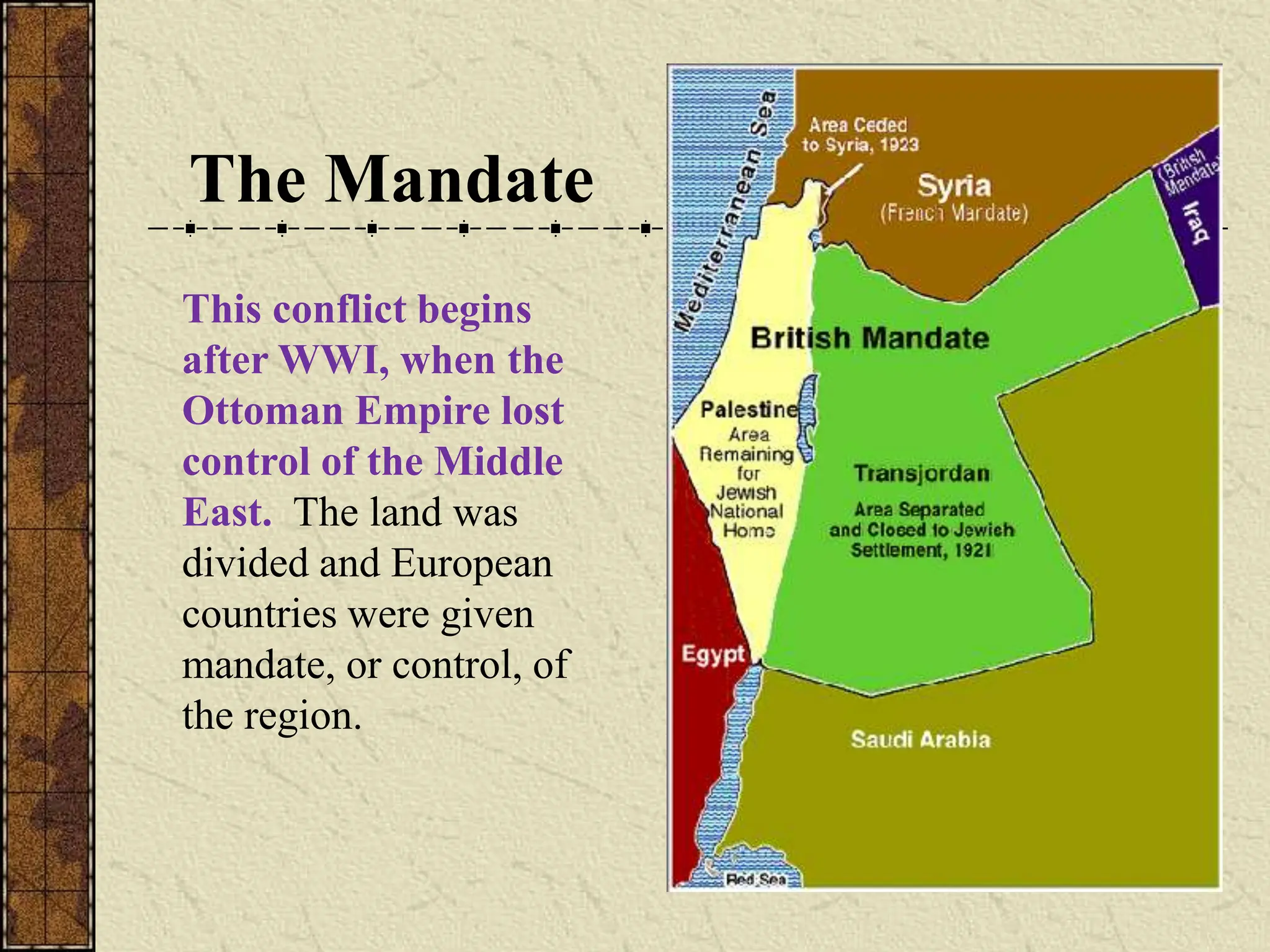
This conflict begins
after WWI, when the
Ottoman Empire lost
control of the Middle
East. The land was
divided and European
countries were given
mandate, or control, of
the region.
The Mandate
The British Mandate (1917-48)
The Balfour Declaration of 1917 pledged
Britain’s support for “the establishment in
Palestine of a national home for the Jewish
people” and paid lip service to safeguarding the
civil and political rights of the non-Jewish
communities in Palestine
Successive waves of migrations increased Jewish
population in Palestine from less than 6% in
1903 to 31% in 1945
In 1947, the United Nations
announced a plan to divide
Palestine into an Arab and
Jewish state. Jews agreed,
but Arabs vowed to do
anything needed to prevent
the U.N. plan from being
carried out.
The Partition
The Jews were
outnumbered in Palestine,
but their armies were
much more advanced
because of involvement in
WWII. Despite the
bloodshed, the State of
Israel was created on May
14, 1948.
The State of Israel
David Ben-Gurion: leader of
Zionism movement and first
prime minister of Israel
That night, a combined Arab
force of Egyptians, Iraqis,
Jordanians, Syrians, Lebanese,
Saudi, and Yemeni troops
attacked. The Arab-Israeli War
or Israeli War for Independence
lasted for 8 months, during
which time the Jews not only
defended their land, but
expanded the territory to
include most of the lands the
Palestinians had been offered
and rejected.
Arab-Israeli War of Independence
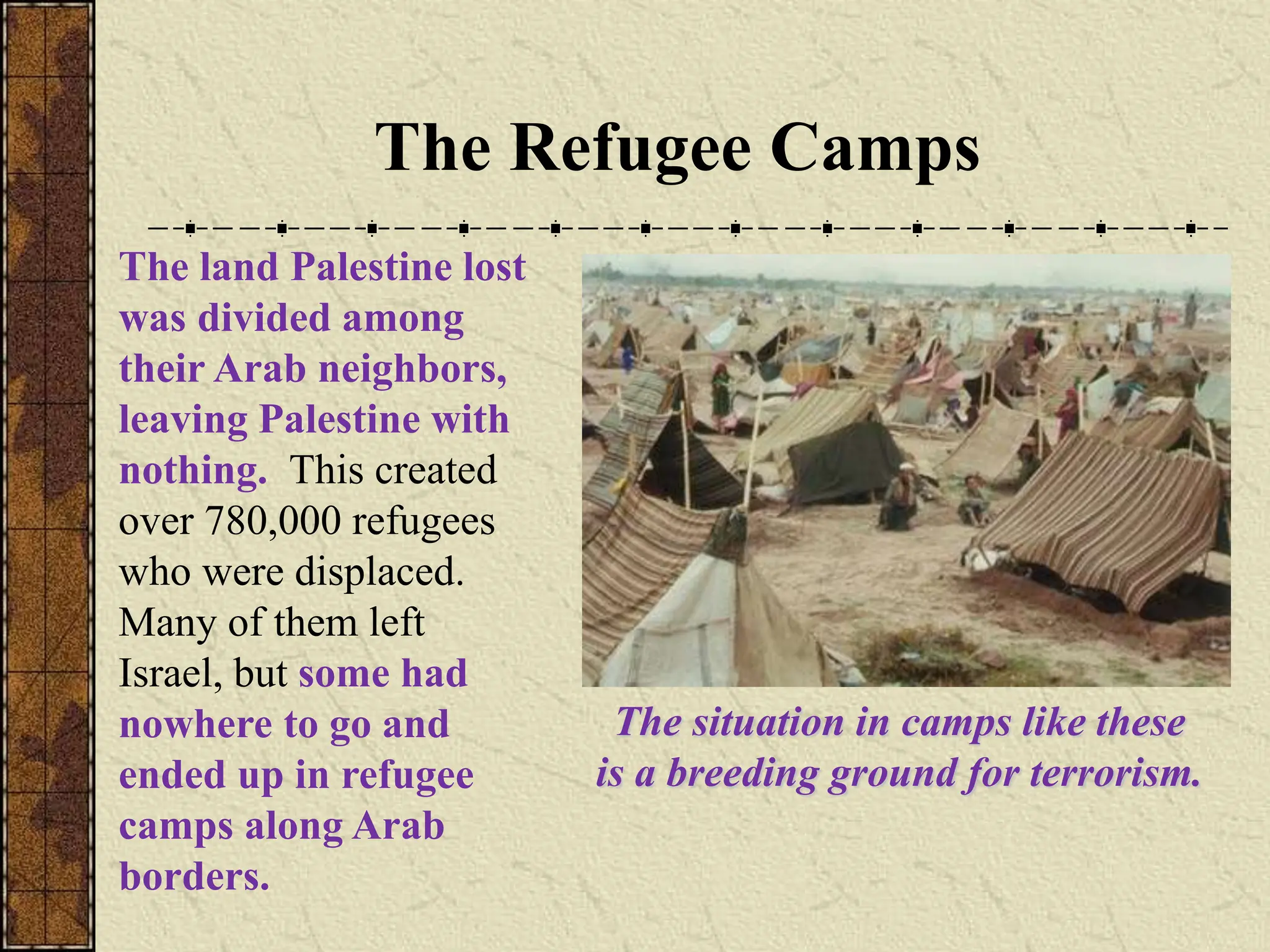
The land Palestine lost
was divided among
their Arab neighbors,
leaving Palestine with
nothing. This created
over 780,000 refugees
who were displaced.
Many of them left
Israel, but some had
nowhere to go and
ended up in refugee
camps along Arab
borders.
The Refugee Camps
The situation in camps like these
is a breeding ground for terrorism.
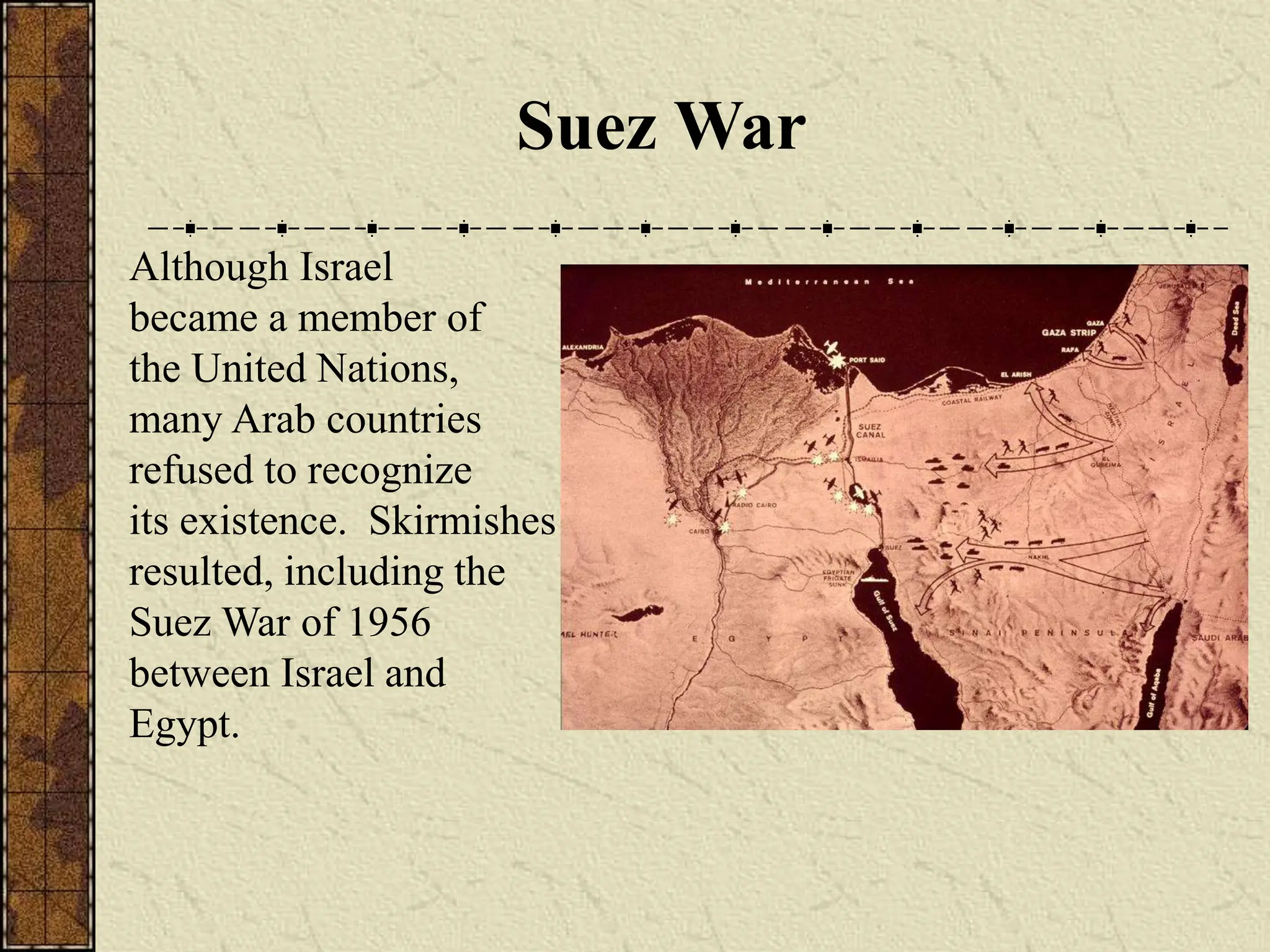
Although Israel
became a member of
the United Nations,
many Arab countries
refused to recognize
its existence. Skirmishes
resulted, including the
Suez War of 1956
between Israel and
Egypt.
Suez War
The Conflict Continues
 In 1964, the Palestinian Liberation Organization (PLO)
was formed.
 The PLO was made up of several Palestinian political groups
in different countries.
 Their goal was to take Palestine back from the Israelis.
The Conflict
Continues
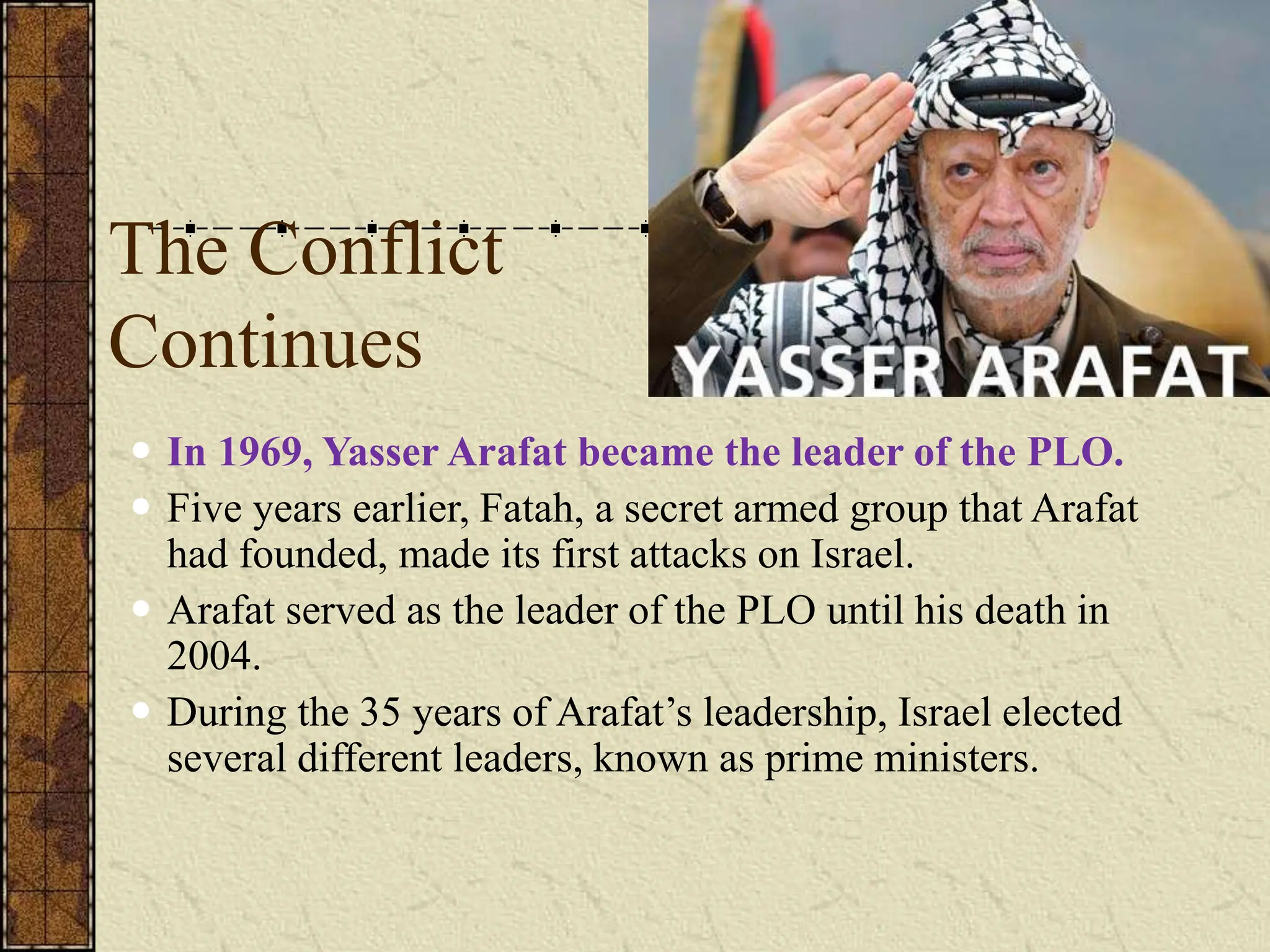
 In 1969, Yasser Arafat became the leader of the PLO.
 Five years earlier, Fatah, a secret armed group that Arafat
had founded, made its first attacks on Israel.
 Arafat served as the leader of the PLO until his death in
2004.
 During the 35 years of Arafat’s leadership, Israel elected
several different leaders, known as prime ministers.
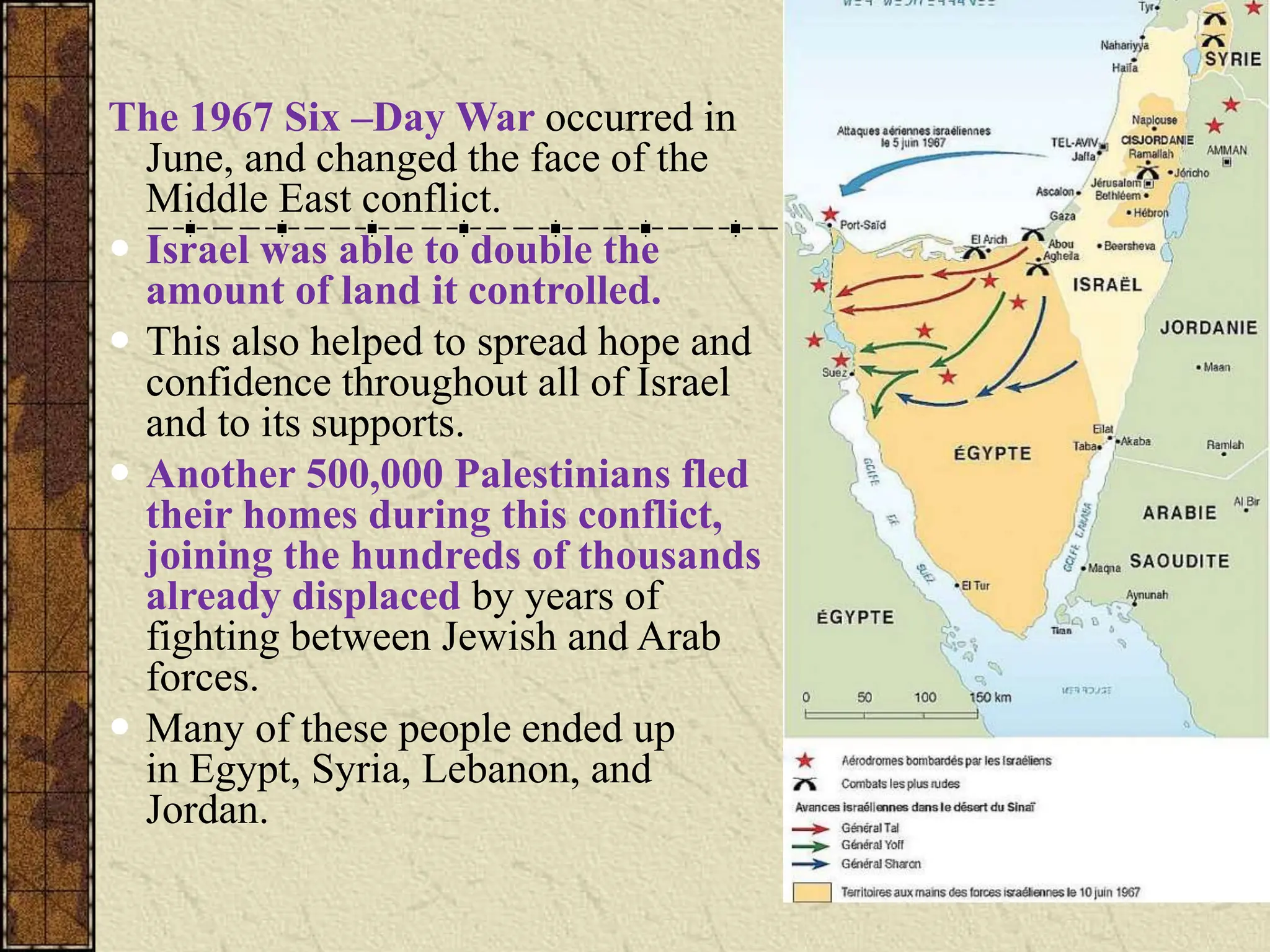
The 1967 Six –Day War occurred in
June, and changed the face of the
Middle East conflict.
 Israel was able to double the
amount of land it controlled.
 This also helped to spread hope and
confidence throughout all of Israel
and to its supports.
 Another 500,000 Palestinians fled
their homes during this conflict,
joining the hundreds of thousands
already displaced by years of
fighting between Jewish and Arab
forces.
 Many of these people ended up
in Egypt, Syria, Lebanon, and
Jordan.
The Six Day War of
1967 was a sweeping
victory for the Israelis.
They overran the
enemies, gaining
control of the Sinai
Peninsula and the City
of Jerusalem, which is
sacred to both
Muslims and Jews.
Six Day War
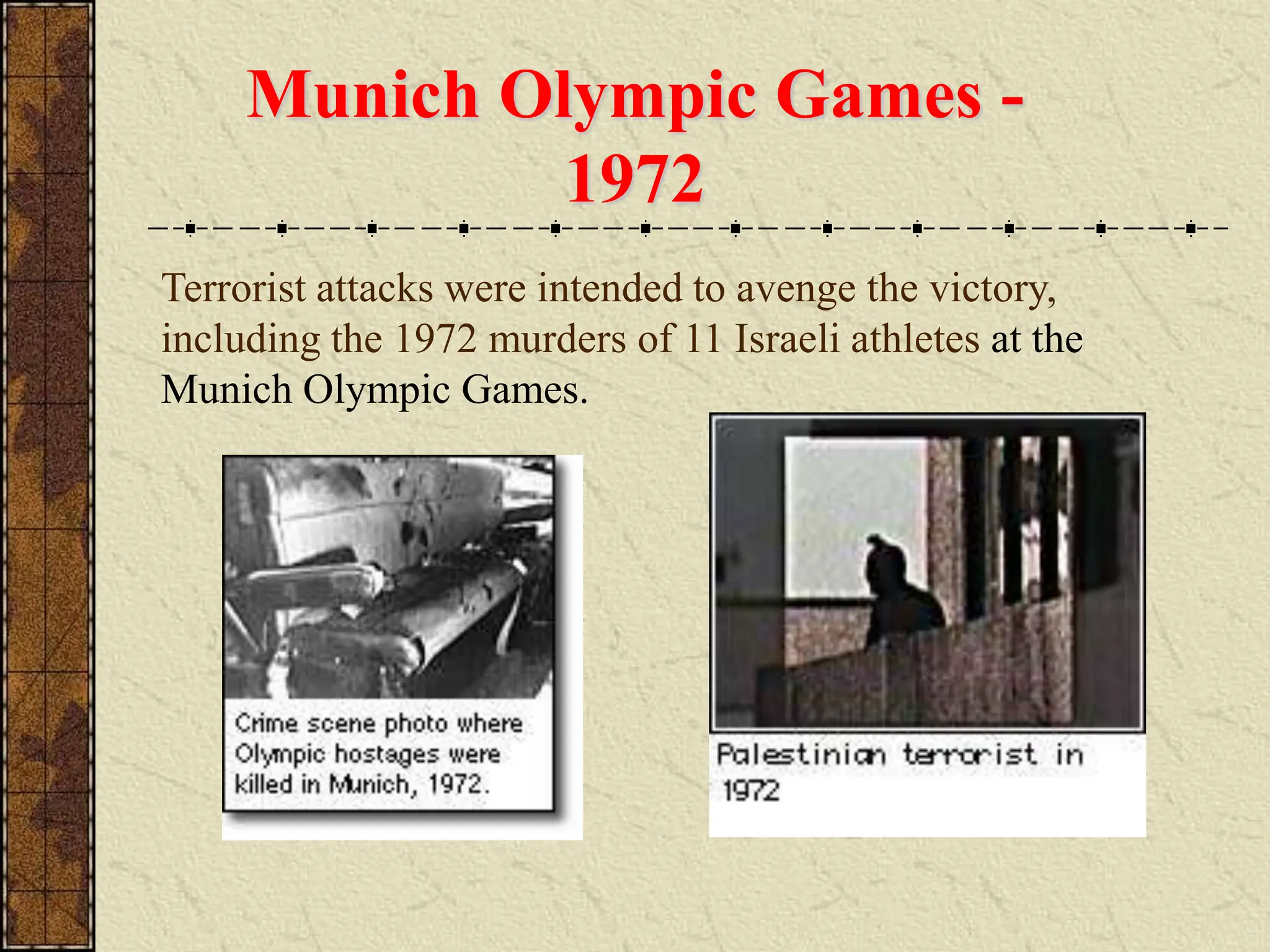
Terrorist attacks were intended to avenge the victory,
including the 1972 murders of 11 Israeli athletes at the
Munich Olympic Games.
Munich Olympic Games -
1972
In 1973, Egypt and Syria carried out
an attack on Israel during Yom
Kippur, the holiest day in the Jewish
calendar. This time, the Arabs
were better prepared with
weapons from the Soviet Union.
The Israelis were able to hold off
the Arabs, but the Yom Kippur War
was an important step to the peace
process.
Yom Kippur War - 1973
Attempts at Peace
 Menachem Begin became prime minister of Israel in
1977, during the US presidency of Jimmy Carter.
 President Carter helped Prime Minster Begin and
Egyptian President Anwar Sadat work out an
agreement.
 This agreement was called the Camp David Accord.
 The three leaders met at Camp
David in the US
 Begin agreed to remove all Israeli
troops from the Sinai Peninsula
and return the land to Egypt.
 Other Arab countries were not
happy about this agreement.
 In 1981, Sadat was assassinated by
troops in the Egyptian army.
 Hezbollah and Hamas are two important Arab groups
that were founded in the mid-1980’s.
 Hezbollah is from Lebanon.
 Hamas is based in the West Bank and the Gaza Strip.
 Both groups are supported by Syria and Iran and are made
up of Muslims.
 Over the last 25 years, both groups have each led
attacks on Israel.
 These attacks have often been very violent and have
killed many civilians.
 The late 1980’s and the 1990’s saw continued fighting
between Israelis and Arabs.
 Often civilians were involved, and thousands have been
killed.
 There have been treaties and agreements that
unfortunately, have not led to peace in the region.
In the 1980’s Palestinians began the Intifada, or
war of sticks and stones. Israeli soldiers did not
know how to react to the Palestinian civilians without
looking like bullies.
Intifada – “Uprising”
The 1990’s showed little improvement to the situation. Israeli
extremists were responsible for the Hebron Massacre where
29 Palestinians were killed at a mosque. Another Jewish
extremist, angered by peace efforts, assassinated Prime
Minister Yitzak Rabin. Palestinian terrorism is also common.
Suicide bombings by Palestinian groups attack both civilian
and military targets.
Death…A Part of Life?
 In 2004, Arafat died and was succeeded byMahmoud
Abbas.
 In 2005, President Abbas (of the Palestinian
Authority) successfully convinced Hamas and other
groups to temporarily and unofficially stop their
attacks on Israelis.
 President Abbas and Israeli Prime Minister Ariel
Sharon agreed to a ceasefire, which is when fighting
stops between two groups.
 Sharon agreed to withdraw Israeli forces and settlers
from a contested region of land called the Gaza strip.
By early September of 2005, the Israelis had
left, and Palestinians took control of the
Gaza Strip.
Since then there have been multiple attacks
and cease fire agreements from each side.
The latest coming in June 2008 but was
almost interrupted by an attack which left
six Palestinians dead.
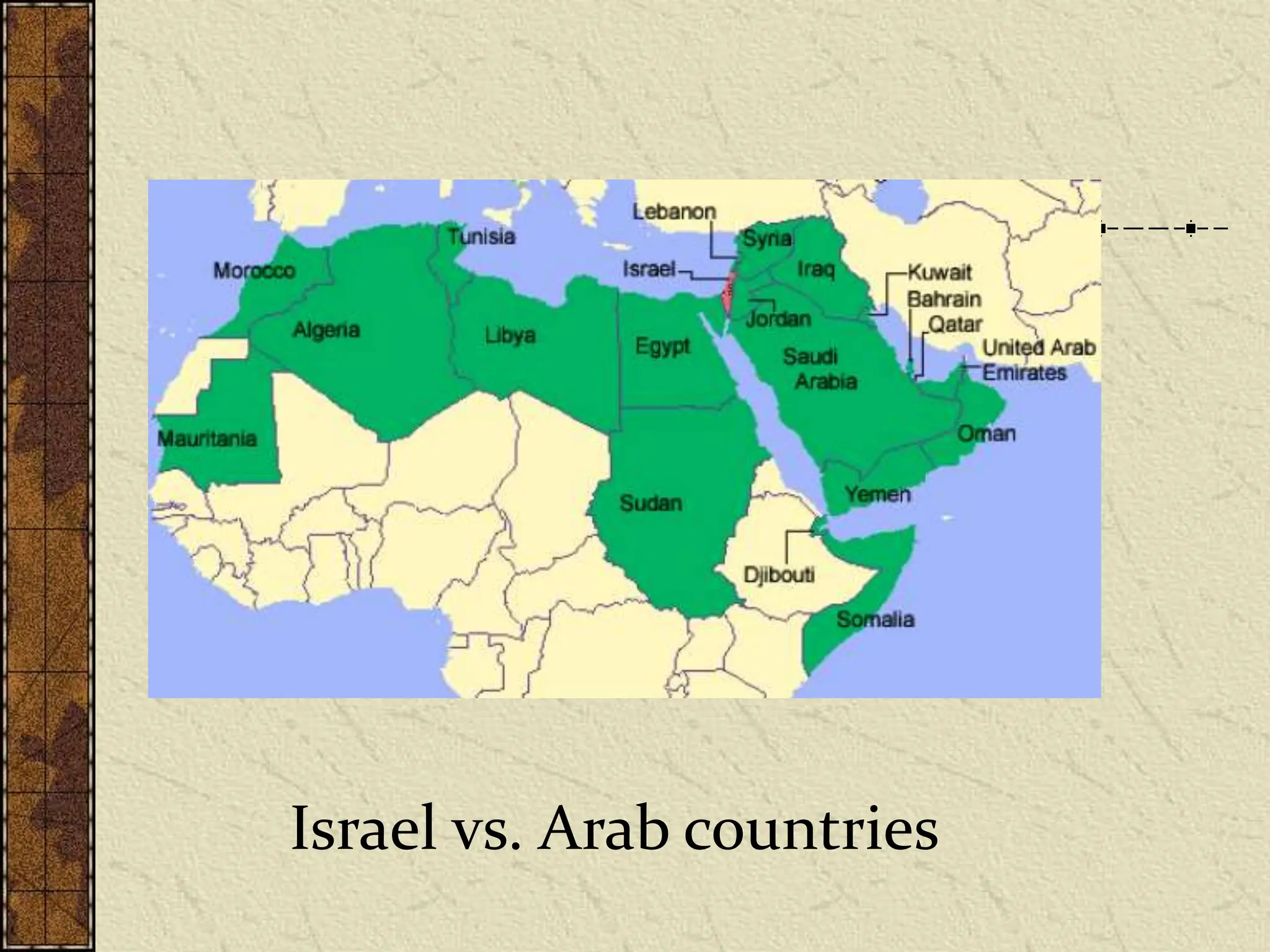
Israel vs. Arab countries
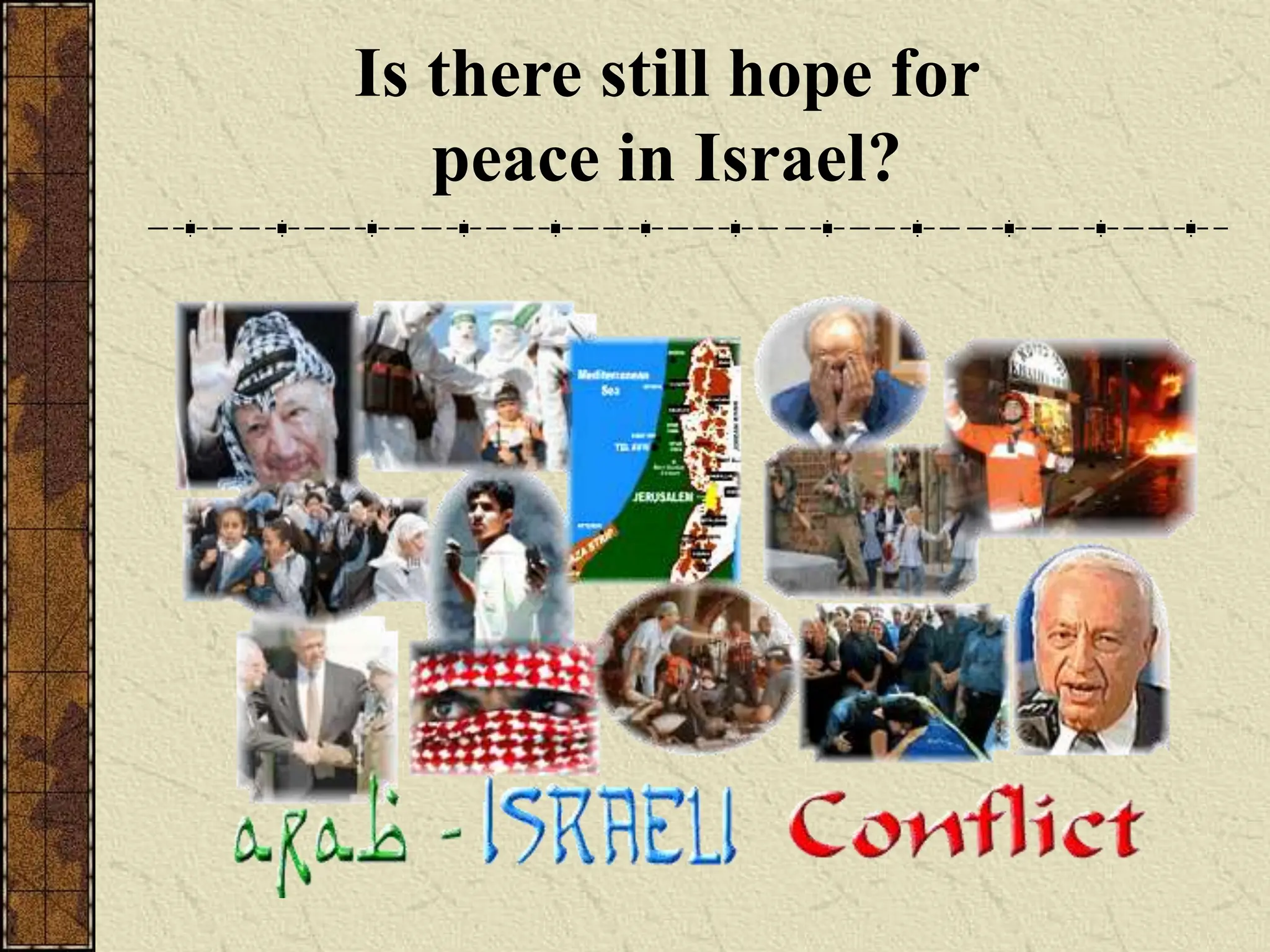
Is there still hope for
peace in Israel?

arab-israeli_conflict- its background.ppt

  • 2.
    The Jewish connectionwith Israel goes back 4,000 years. According to Jewish and Christian sacred text, God commands Abraham to leave his land in Mesopotamia and go to the land that he will be shown.
  • 3.
    That land isthe present-day nation of Israel. Seven times God promised Abraham the land and repeated that promise to Isaac and Jacob, descendants of Abraham. Jews believe if any nation on earth has a right to any land -- a right based on history, attachment, long association -- then the Jewish people have a right to Israel.
  • 4.
    Jews argue thatthey never left Israel voluntarily. They were forced out through persecution, but they never gave up their rights to the land.
  • 5.
    Jews argue theidea that Jews came to Israel as outsiders or imperialists is absurd. They say Jews were the land's original inhabitants. They have the same relationship to the land as native Americans to America and aborigines to Australia.
  • 6.
    This conflict begins afterWWI, when the Ottoman Empire lost control of the Middle East. The land was divided and European countries were given mandate, or control, of the region. The Mandate
  • 7.
    The British Mandate(1917-48) The Balfour Declaration of 1917 pledged Britain’s support for “the establishment in Palestine of a national home for the Jewish people” and paid lip service to safeguarding the civil and political rights of the non-Jewish communities in Palestine Successive waves of migrations increased Jewish population in Palestine from less than 6% in 1903 to 31% in 1945
  • 8.
    In 1947, theUnited Nations announced a plan to divide Palestine into an Arab and Jewish state. Jews agreed, but Arabs vowed to do anything needed to prevent the U.N. plan from being carried out. The Partition
  • 9.
    The Jews were outnumberedin Palestine, but their armies were much more advanced because of involvement in WWII. Despite the bloodshed, the State of Israel was created on May 14, 1948. The State of Israel David Ben-Gurion: leader of Zionism movement and first prime minister of Israel
  • 10.
    That night, acombined Arab force of Egyptians, Iraqis, Jordanians, Syrians, Lebanese, Saudi, and Yemeni troops attacked. The Arab-Israeli War or Israeli War for Independence lasted for 8 months, during which time the Jews not only defended their land, but expanded the territory to include most of the lands the Palestinians had been offered and rejected. Arab-Israeli War of Independence
  • 12.
    The land Palestinelost was divided among their Arab neighbors, leaving Palestine with nothing. This created over 780,000 refugees who were displaced. Many of them left Israel, but some had nowhere to go and ended up in refugee camps along Arab borders. The Refugee Camps The situation in camps like these is a breeding ground for terrorism.
  • 13.
    Although Israel became amember of the United Nations, many Arab countries refused to recognize its existence. Skirmishes resulted, including the Suez War of 1956 between Israel and Egypt. Suez War
  • 14.
    The Conflict Continues In 1964, the Palestinian Liberation Organization (PLO) was formed.  The PLO was made up of several Palestinian political groups in different countries.  Their goal was to take Palestine back from the Israelis.
  • 15.
    The Conflict Continues  In1969, Yasser Arafat became the leader of the PLO.  Five years earlier, Fatah, a secret armed group that Arafat had founded, made its first attacks on Israel.  Arafat served as the leader of the PLO until his death in 2004.  During the 35 years of Arafat’s leadership, Israel elected several different leaders, known as prime ministers.
  • 16.
    The 1967 Six–Day War occurred in June, and changed the face of the Middle East conflict.  Israel was able to double the amount of land it controlled.  This also helped to spread hope and confidence throughout all of Israel and to its supports.  Another 500,000 Palestinians fled their homes during this conflict, joining the hundreds of thousands already displaced by years of fighting between Jewish and Arab forces.  Many of these people ended up in Egypt, Syria, Lebanon, and Jordan.
  • 17.
    The Six DayWar of 1967 was a sweeping victory for the Israelis. They overran the enemies, gaining control of the Sinai Peninsula and the City of Jerusalem, which is sacred to both Muslims and Jews. Six Day War
  • 18.
    Terrorist attacks wereintended to avenge the victory, including the 1972 murders of 11 Israeli athletes at the Munich Olympic Games. Munich Olympic Games - 1972
  • 19.
    In 1973, Egyptand Syria carried out an attack on Israel during Yom Kippur, the holiest day in the Jewish calendar. This time, the Arabs were better prepared with weapons from the Soviet Union. The Israelis were able to hold off the Arabs, but the Yom Kippur War was an important step to the peace process. Yom Kippur War - 1973
  • 20.
    Attempts at Peace Menachem Begin became prime minister of Israel in 1977, during the US presidency of Jimmy Carter.  President Carter helped Prime Minster Begin and Egyptian President Anwar Sadat work out an agreement.  This agreement was called the Camp David Accord.  The three leaders met at Camp David in the US  Begin agreed to remove all Israeli troops from the Sinai Peninsula and return the land to Egypt.  Other Arab countries were not happy about this agreement.  In 1981, Sadat was assassinated by troops in the Egyptian army.
  • 21.
     Hezbollah andHamas are two important Arab groups that were founded in the mid-1980’s.  Hezbollah is from Lebanon.  Hamas is based in the West Bank and the Gaza Strip.  Both groups are supported by Syria and Iran and are made up of Muslims.  Over the last 25 years, both groups have each led attacks on Israel.  These attacks have often been very violent and have killed many civilians.  The late 1980’s and the 1990’s saw continued fighting between Israelis and Arabs.  Often civilians were involved, and thousands have been killed.  There have been treaties and agreements that unfortunately, have not led to peace in the region.
  • 22.
    In the 1980’sPalestinians began the Intifada, or war of sticks and stones. Israeli soldiers did not know how to react to the Palestinian civilians without looking like bullies. Intifada – “Uprising”
  • 23.
    The 1990’s showedlittle improvement to the situation. Israeli extremists were responsible for the Hebron Massacre where 29 Palestinians were killed at a mosque. Another Jewish extremist, angered by peace efforts, assassinated Prime Minister Yitzak Rabin. Palestinian terrorism is also common. Suicide bombings by Palestinian groups attack both civilian and military targets. Death…A Part of Life?
  • 24.
     In 2004,Arafat died and was succeeded byMahmoud Abbas.  In 2005, President Abbas (of the Palestinian Authority) successfully convinced Hamas and other groups to temporarily and unofficially stop their attacks on Israelis.  President Abbas and Israeli Prime Minister Ariel Sharon agreed to a ceasefire, which is when fighting stops between two groups.  Sharon agreed to withdraw Israeli forces and settlers from a contested region of land called the Gaza strip.
  • 25.
    By early Septemberof 2005, the Israelis had left, and Palestinians took control of the Gaza Strip. Since then there have been multiple attacks and cease fire agreements from each side. The latest coming in June 2008 but was almost interrupted by an attack which left six Palestinians dead.
  • 26.
    Israel vs. Arabcountries
  • 27.
    Is there stillhope for peace in Israel?