Taking Africa RISING-led technologies and innovations to scale: Experience of
public-private partnerships
Haroon Sseguya, Mateete Bekunda, Irmgard Hoeschle-Zeledon, Francis Kamau, Silvanus Mruma*, Jonathan Odhong
International Institute of Tropical Agriculture; *Cereals Marketing Systems Development (NAFAKA II) Project, Tanzania
Key messages
 Effective technology scaling should build on existing interventions
and institutions
 Trust building among partners is very important
 Regular review and periodic (co-)learning among partners are
critical
 Clear communication and coordination mechanisms among
partners should be in place
 Geographical -information systems (GIS) technologies should be
harnessed for better targeting of the technologies
Partners
This poster is licensed for use under the Creative Commons Attribution 4.0 International Licence.
January 2017
We thank farmers and local partners in Africa RISING sites for their contributions to this research. We also acknowledge
the support of all donors which globally support the work of the CGIAR centers and their partners through their
contributions to the CGIAR system
Objectives and approach
Since 2014, the Africa RISING program embarked on collaborations
with development projects in different countries o take promising
technologies to scale. For instance, in Tanzania, collaboration was
initiated with NAFAKA project to enhance scaling of the research
outputs through introduction of improved crop varieties, good
agricultural practices, natural resource management, reduction of
food wastage and spoilage and community capacity building.
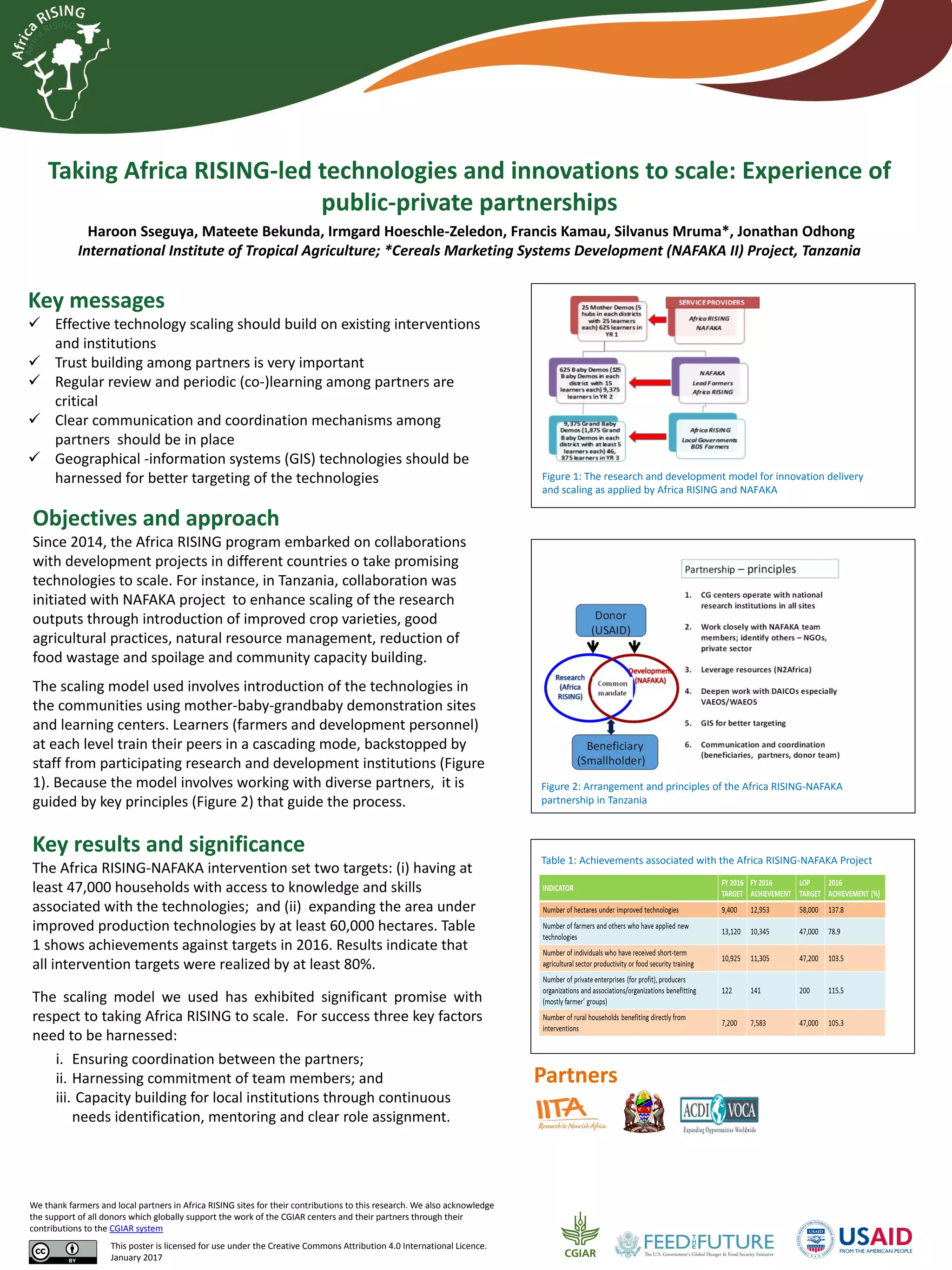
The scaling model used involves introduction of the technologies in
the communities using mother-baby-grandbaby demonstration sites
and learning centers. Learners (farmers and development personnel)
at each level train their peers in a cascading mode, backstopped by
staff from participating research and development institutions (Figure
1). Because the model involves working with diverse partners, it is
guided by key principles (Figure 2) that guide the process.
Key results and significance
The Africa RISING-NAFAKA intervention set two targets: (i) having at
least 47,000 households with access to knowledge and skills
associated with the technologies; and (ii) expanding the area under
improved production technologies by at least 60,000 hectares. Table
1 shows achievements against targets in 2016. Results indicate that
all intervention targets were realized by at least 80%.
The scaling model we used has exhibited significant promise with
respect to taking Africa RISING to scale. For success three key factors
need to be harnessed:
i. Ensuring coordination between the partners;
ii. Harnessing commitment of team members; and
iii. Capacity building for local institutions through continuous
needs identification, mentoring and clear role assignment.
Figure 1: The research and development model for innovation delivery
and scaling as applied by Africa RISING and NAFAKA
Figure 2: Arrangement and principles of the Africa RISING-NAFAKA
partnership in Tanzania
Table 1: Achievements associated with the Africa RISING-NAFAKA Project

Taking Africa RISING-led technologies and innovations to scale: Experience of public-private partnerships

  • 1.
    Taking Africa RISING-ledtechnologies and innovations to scale: Experience of public-private partnerships Haroon Sseguya, Mateete Bekunda, Irmgard Hoeschle-Zeledon, Francis Kamau, Silvanus Mruma*, Jonathan Odhong International Institute of Tropical Agriculture; *Cereals Marketing Systems Development (NAFAKA II) Project, Tanzania Key messages  Effective technology scaling should build on existing interventions and institutions  Trust building among partners is very important  Regular review and periodic (co-)learning among partners are critical  Clear communication and coordination mechanisms among partners should be in place  Geographical -information systems (GIS) technologies should be harnessed for better targeting of the technologies Partners This poster is licensed for use under the Creative Commons Attribution 4.0 International Licence. January 2017 We thank farmers and local partners in Africa RISING sites for their contributions to this research. We also acknowledge the support of all donors which globally support the work of the CGIAR centers and their partners through their contributions to the CGIAR system Objectives and approach Since 2014, the Africa RISING program embarked on collaborations with development projects in different countries o take promising technologies to scale. For instance, in Tanzania, collaboration was initiated with NAFAKA project to enhance scaling of the research outputs through introduction of improved crop varieties, good agricultural practices, natural resource management, reduction of food wastage and spoilage and community capacity building. The scaling model used involves introduction of the technologies in the communities using mother-baby-grandbaby demonstration sites and learning centers. Learners (farmers and development personnel) at each level train their peers in a cascading mode, backstopped by staff from participating research and development institutions (Figure 1). Because the model involves working with diverse partners, it is guided by key principles (Figure 2) that guide the process. Key results and significance The Africa RISING-NAFAKA intervention set two targets: (i) having at least 47,000 households with access to knowledge and skills associated with the technologies; and (ii) expanding the area under improved production technologies by at least 60,000 hectares. Table 1 shows achievements against targets in 2016. Results indicate that all intervention targets were realized by at least 80%. The scaling model we used has exhibited significant promise with respect to taking Africa RISING to scale. For success three key factors need to be harnessed: i. Ensuring coordination between the partners; ii. Harnessing commitment of team members; and iii. Capacity building for local institutions through continuous needs identification, mentoring and clear role assignment. Figure 1: The research and development model for innovation delivery and scaling as applied by Africa RISING and NAFAKA Figure 2: Arrangement and principles of the Africa RISING-NAFAKA partnership in Tanzania Table 1: Achievements associated with the Africa RISING-NAFAKA Project