Extrapolation suitability for improved vegetable
technologies in Babati District, Tanzania
Francis Muthoni1, Justus Ochieng2, Jean-Marc Delore1 & 3, Phillipo J. Lukumay2, and Inviolate Dominic2
1International Institute of Tropical Agriculture, 2WorldVeg Centre, 3Wageningen University & Research
Power on Your Plate Summit
25-28 January 2021, Virtual and In-person, Gran Meliá Arusha, Tanzania
Outline
• Introduction
• Experimental trials of elite vegetable cultivars
• Generating Extrapolation Suitability Index (ESI)
• Relevance of ESI maps in scaling programs
• Future plans
Introduction
• Vegetables are important dietary component rich in essential micro-
nutrients & source of income.
• Investment on sustainable vegetable production technologies enhance
societal benefits & environmental sustainability.
• Two improved vegetable cultivars grown under integrated management
practices (IMP’s) in Babati district of Tanzania produced double the yield
and net income compared to standard farmer’s practice.
• Where to scale-out high yielding cultivars + IMP’s with minimal risk of
failure?
• Solution: Leverage geo-spatial technology & digital agronomy.
• Generate maps on risk of extrapolating to new areas.
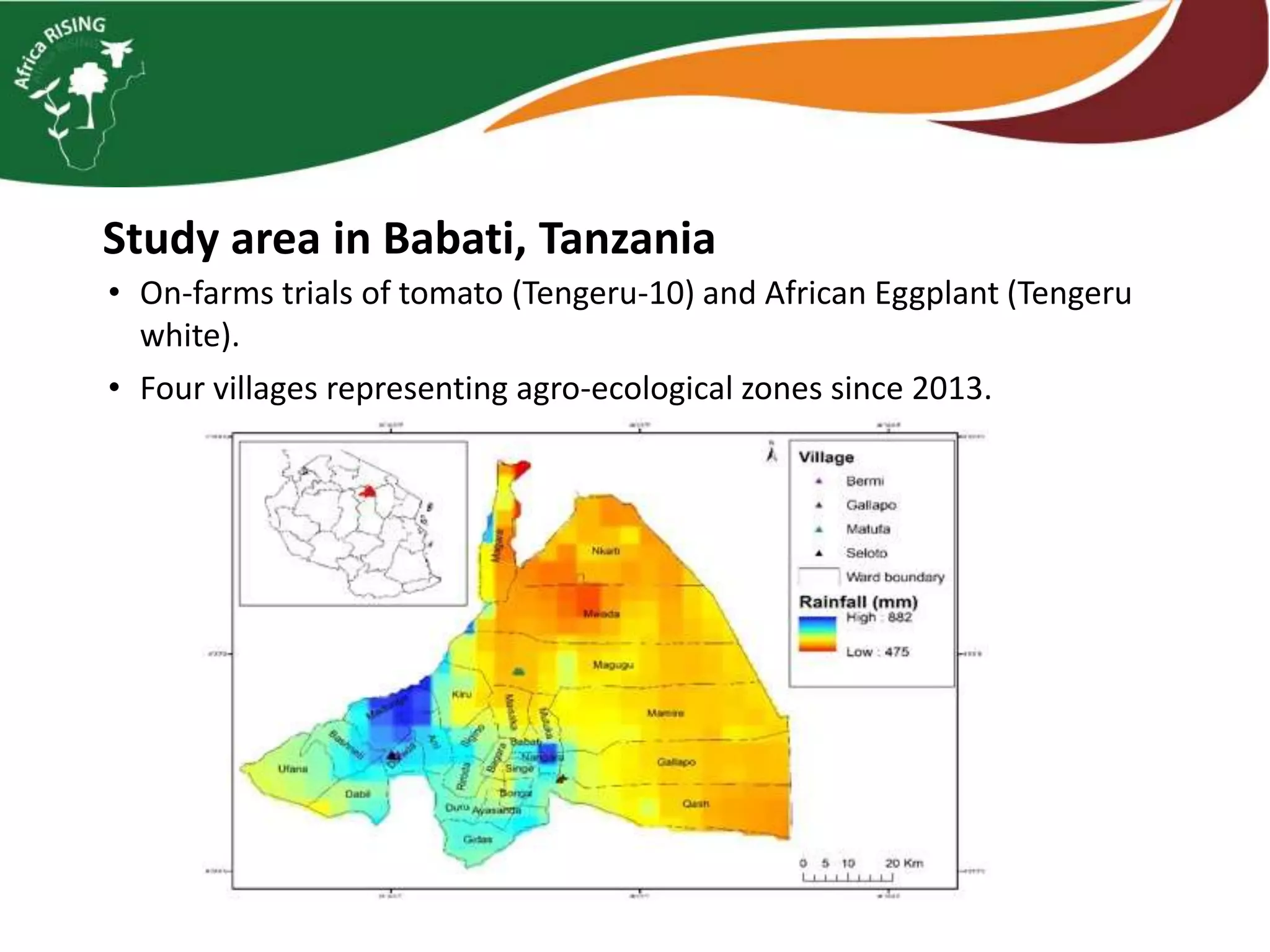
Study area in Babati, Tanzania
• On-farms trials of tomato (Tengeru-10) and African Eggplant (Tengeru
white).
• Four villages representing agro-ecological zones since 2013.
Validation of improved vegetable technologies
• On-farm trials compared cultivars produced under integrated
management practices (IMP) & standard farmers’ practice (control).
Yield & income from on-farm trials
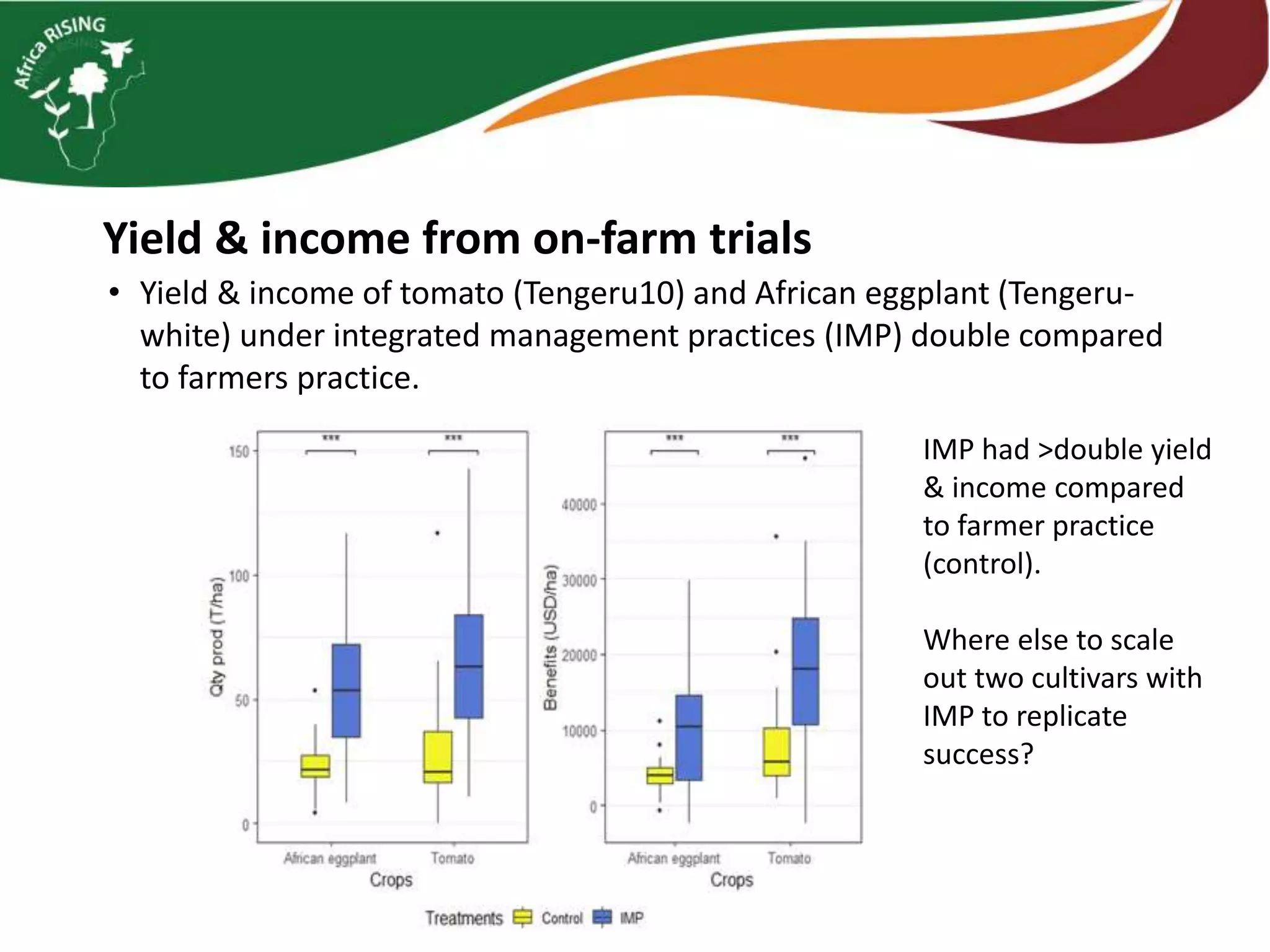
• Yield & income of tomato (Tengeru10) and African eggplant (Tengeru-
white) under integrated management practices (IMP) double compared
to farmers practice.
IMP had >double yield
& income compared
to farmer practice
(control).
Where else to scale
out two cultivars with
IMP to replicate
success?
Input data for developing ESI
• Integrate on-farm trials (reference) & gridded remote sensing
(projection) data.
Characterizing reference environments
• Homogeneity of environmental conditions in field trials examined with
HPCA.
• Discriminated 3 clusters representing population of target environments.
Magug
u
Galapo
Bermi
Seloto
Selection of reference target environments
• Yield & income from different environmental clusters compared to select
the best-bet reference trial sites for extrapolation of vegetable cultivars.
Mapping ESI for Vegetable cultivars
• ESI ranges from 0 to negative infinity with 0 being the most suitable
• Tengeru 10 widely adapted but African eggplant unsuitable in southwest
Babati.
Most important covariates (MIC)
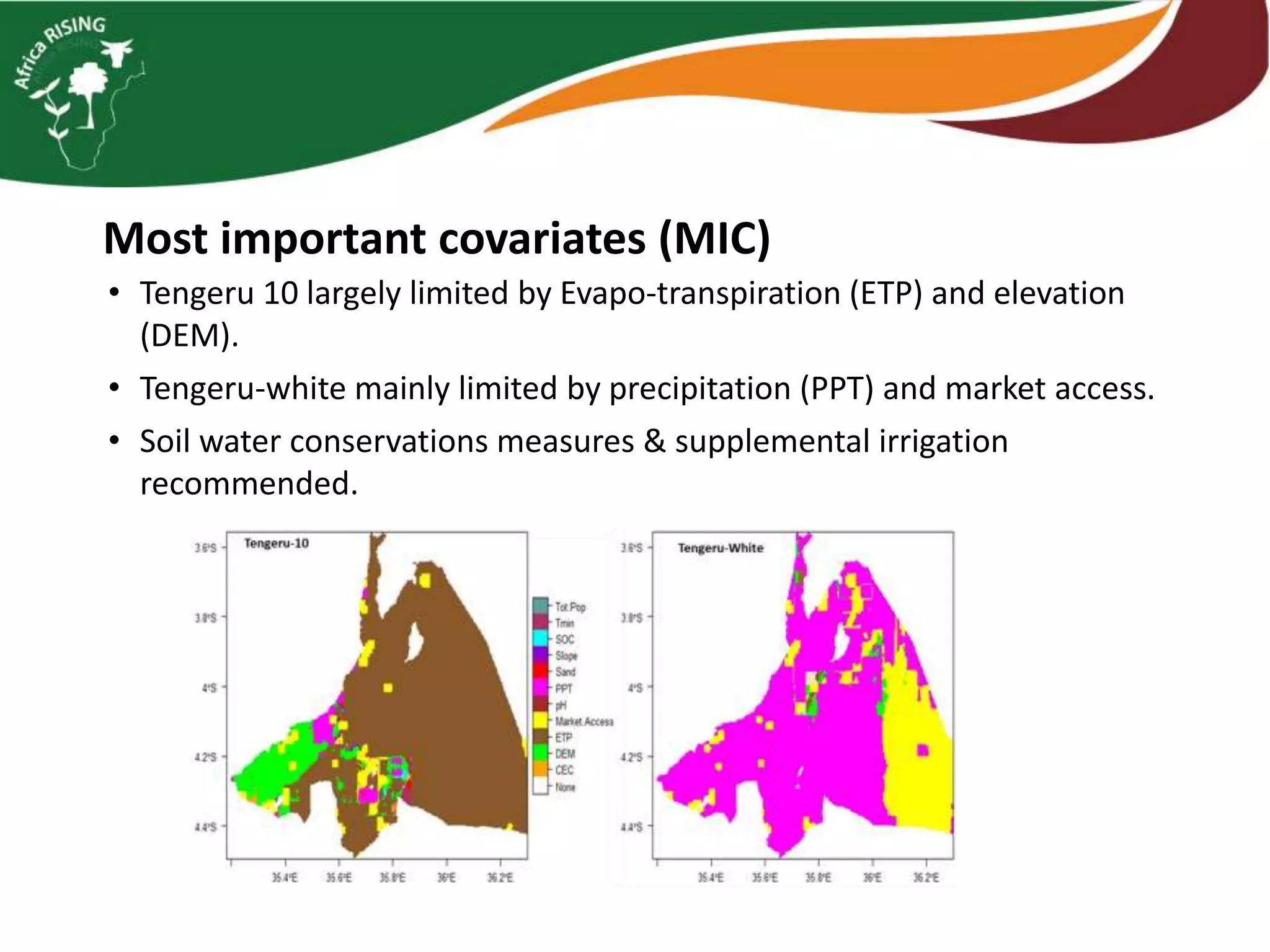
• Tengeru 10 largely limited by Evapo-transpiration (ETP) and elevation
(DEM).
• Tengeru-white mainly limited by precipitation (PPT) and market access.
• Soil water conservations measures & supplemental irrigation
recommended.
Significance of ESI maps
• Extrapolation suitability (ESI) maps produced to guide extension &
development partners on priority sites for targeting scaling intervention.
Application of ESI maps expected to:
• Reduce the risk of failure,
• Prioritize allocation of scarce resources for maximum impact, and
• Possibly enhance adoption at scale.
Future developments
• Design of a simple & user-friendly mobile-based tool for farmers and
extension staff with basic phones.
• Integrate suitability maps with Mwanga Platform for digital agronomic
advisory.
Africa Research in Sustainable Intensification for the Next Generation
africa-rising.net
This presentation is licensed for use under the Creative Commons Attribution 4.0 International Licence.
Thank You

Extrapolation suitability for improved vegetable technologies in Babati District, Tanzania

  • 1.
    Extrapolation suitability forimproved vegetable technologies in Babati District, Tanzania Francis Muthoni1, Justus Ochieng2, Jean-Marc Delore1 & 3, Phillipo J. Lukumay2, and Inviolate Dominic2 1International Institute of Tropical Agriculture, 2WorldVeg Centre, 3Wageningen University & Research Power on Your Plate Summit 25-28 January 2021, Virtual and In-person, Gran Meliá Arusha, Tanzania
  • 2.
    Outline • Introduction • Experimentaltrials of elite vegetable cultivars • Generating Extrapolation Suitability Index (ESI) • Relevance of ESI maps in scaling programs • Future plans
  • 3.
    Introduction • Vegetables areimportant dietary component rich in essential micro- nutrients & source of income. • Investment on sustainable vegetable production technologies enhance societal benefits & environmental sustainability. • Two improved vegetable cultivars grown under integrated management practices (IMP’s) in Babati district of Tanzania produced double the yield and net income compared to standard farmer’s practice.
  • 4.
    • Where toscale-out high yielding cultivars + IMP’s with minimal risk of failure? • Solution: Leverage geo-spatial technology & digital agronomy. • Generate maps on risk of extrapolating to new areas.
  • 5.
    Study area inBabati, Tanzania • On-farms trials of tomato (Tengeru-10) and African Eggplant (Tengeru white). • Four villages representing agro-ecological zones since 2013.
  • 6.
    Validation of improvedvegetable technologies • On-farm trials compared cultivars produced under integrated management practices (IMP) & standard farmers’ practice (control).
  • 7.
    Yield & incomefrom on-farm trials • Yield & income of tomato (Tengeru10) and African eggplant (Tengeru- white) under integrated management practices (IMP) double compared to farmers practice. IMP had >double yield & income compared to farmer practice (control). Where else to scale out two cultivars with IMP to replicate success?
  • 8.
    Input data fordeveloping ESI • Integrate on-farm trials (reference) & gridded remote sensing (projection) data.
  • 9.
    Characterizing reference environments •Homogeneity of environmental conditions in field trials examined with HPCA. • Discriminated 3 clusters representing population of target environments. Magug u Galapo Bermi Seloto
  • 10.
    Selection of referencetarget environments • Yield & income from different environmental clusters compared to select the best-bet reference trial sites for extrapolation of vegetable cultivars.
  • 11.
    Mapping ESI forVegetable cultivars • ESI ranges from 0 to negative infinity with 0 being the most suitable • Tengeru 10 widely adapted but African eggplant unsuitable in southwest Babati.
  • 12.
    Most important covariates(MIC) • Tengeru 10 largely limited by Evapo-transpiration (ETP) and elevation (DEM). • Tengeru-white mainly limited by precipitation (PPT) and market access. • Soil water conservations measures & supplemental irrigation recommended.
  • 13.
    Significance of ESImaps • Extrapolation suitability (ESI) maps produced to guide extension & development partners on priority sites for targeting scaling intervention. Application of ESI maps expected to: • Reduce the risk of failure, • Prioritize allocation of scarce resources for maximum impact, and • Possibly enhance adoption at scale.
  • 14.
    Future developments • Designof a simple & user-friendly mobile-based tool for farmers and extension staff with basic phones. • Integrate suitability maps with Mwanga Platform for digital agronomic advisory.
  • 15.
    Africa Research inSustainable Intensification for the Next Generation africa-rising.net This presentation is licensed for use under the Creative Commons Attribution 4.0 International Licence. Thank You