Forum for Agricultural Research in Africa
FARA’s Strategic Plan and MTOP
for 2014-2018
2
Click to edit Master title style
5/16/2013 2Forum for Agricultural Research in Africa
1. Why a new strategy & MTOP
1. Timing: current MTOP ends Dec 2013
• New MTOP (2014-2018)
• Strategic plan (2007- 2016) revision/overhaul needed
2. Changes in operating environment call for FARA to
reposition itself to:
• respond to emerging challenges and opportunities
• take advantage of lessons learned and build upon
achievements
3
Click to edit Master title style
5/16/2013 3Forum for Agricultural Research in Africa
2. Strategic Directions
Problem tree analysis concluded that FARA’s strategic
priorities should be focussed on:
1. Visioning the kind of agriculture Africa wants and the
collective actions needed to achieve it
2. Developing the capacities needed to achieve it
3. Developing the policy environment to enable effective
implementation of the needed actions
4
Click to edit Master title style
5/16/2013 4Forum for Agricultural Research in Africa
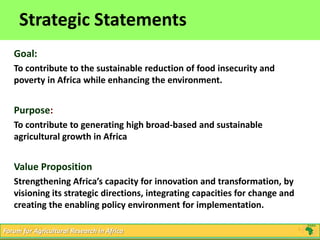
Strategic Statements
Goal:
To contribute to the sustainable reduction of food insecurity and
poverty in Africa while enhancing the environment.
Purpose:
To contribute to generating high broad-based and sustainable
agricultural growth in Africa
Value Proposition
Strengthening Africa’s capacity for innovation and transformation, by
visioning its strategic directions, integrating capacities for change and
creating the enabling policy environment for implementation.
5
Click to edit Master title style
5/16/2013 5Forum for Agricultural Research in Africa
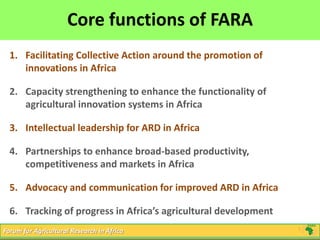
Core functions of FARA
1. Facilitating Collective Action around the promotion of
innovations in Africa
2. Capacity strengthening to enhance the functionality of
agricultural innovation systems in Africa
3. Intellectual leadership for ARD in Africa
4. Partnerships to enhance broad-based productivity,
competitiveness and markets in Africa
5. Advocacy and communication for improved ARD in Africa
6. Tracking of progress in Africa’s agricultural development
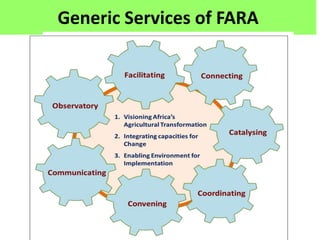
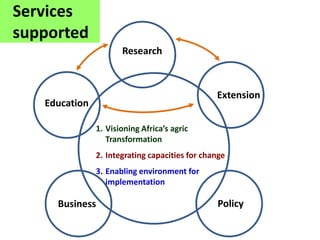
Generic Services of FARAFigure 1. Strategic Priorities and Generic services of FARA
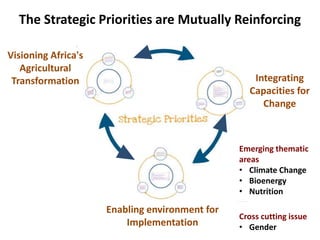
The Strategic Priorities are Mutually Reinforcing
Visioning Africa's
Agricultural
Transformation
Enabling environment for
Implementation
Integrating
Capacities for
Change
Emerging thematic
areas
• Climate Change
• Bioenergy
• Nutrition
Cross cutting issue
• Gender
Networking Support
functions
Services
supported
1. Visioning Africa’s agric
Transformation
2. Integrating capacities for change
3. Enabling environment for
implementation
Business
Research
Extension
Education
Policy
9
Click to edit Master title style
5/16/2013 9Forum for Agricultural Research in Africa
The Results to be Delivered
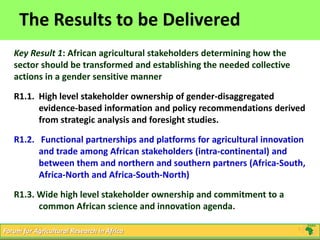
Key Result 1: African agricultural stakeholders determining how the
sector should be transformed and establishing the needed collective
actions in a gender sensitive manner
R1.1. High level stakeholder ownership of gender-disaggregated
evidence-based information and policy recommendations derived
from strategic analysis and foresight studies.
R1.2. Functional partnerships and platforms for agricultural innovation
and trade among African stakeholders (intra-continental) and
between them and northern and southern partners (Africa-South,
Africa-North and Africa-South-North)
R1.3. Wide high level stakeholder ownership and commitment to a
common African science and innovation agenda.
10
Click to edit Master title style
5/16/2013 10Forum for Agricultural Research in Africa
The Results to be Delivered
Key Result 2: Strengthened and integrated continental capacity
responding to stakeholder demands within the agricultural innovation
system in a gender sensitive manner
R2.1. Functional interactions and partnerships for creating capacity among
farmers, research, education, extension, trade and agri-business
organizations
R2.2. Adopted mechanisms for articulating demand and strengthened
capacity to respond to demand
R2.3. Communities of Practice addressing identified capacity deficits (in the
design & implementation of R&D programs) in a gender-sensitive
manner
R2.4. Strengthened human, organizational and institutional capacities for
gender sensitive agricultural innovation.
11
Click to edit Master title style
5/16/2013 11Forum for Agricultural Research in Africa
The Results to be Delivered
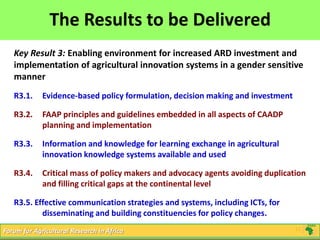
Key Result 3: Enabling environment for increased ARD investment and
implementation of agricultural innovation systems in a gender sensitive
manner
R3.1. Evidence-based policy formulation, decision making and investment
R3.2. FAAP principles and guidelines embedded in all aspects of CAADP
planning and implementation
R3.3. Information and knowledge for learning exchange in agricultural
innovation knowledge systems available and used
R3.4. Critical mass of policy makers and advocacy agents avoiding duplication
and filling critical gaps at the continental level
R3.5. Effective communication strategies and systems, including ICTs, for
disseminating and building constituencies for policy changes.
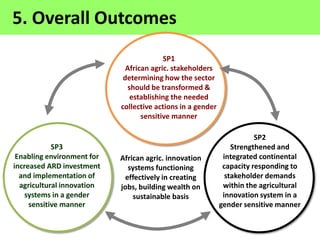
5. Overall Outcomes
African agric. innovation
systems functioning
effectively in creating
jobs, building wealth on
sustainable basis
SP1
African agric. stakeholders
determining how the sector
should be transformed &
establishing the needed
collective actions in a gender
sensitive manner
SP3
Enabling environment for
increased ARD investment
and implementation of
agricultural innovation
systems in a gender
sensitive manner
SP2
Strengthened and
integrated continental
capacity responding to
stakeholder demands
within the agricultural
innovation system in a
gender sensitive manner
13
Click to edit Master title style
5/16/2013 13Forum for Agricultural Research in Africa
Assumptions and risks
1. Political and socio-economic conditions are enabling
2. Complementary and enabling policies and legal frameworks exist,
and are implemented
3. Sufficient or adequate incentives exist to convince the private
sector and youth to engage in agriculture
4. Farmers have access to adequate financial and natural resources (in
particular, land and water)
5. Effective partnerships with the CGIAR, advanced research
institutions and south-south cooperation
6. Potential for market expansion is realised, and gains are accessible
and of benefit to the poor and disadvantaged
7. Strengthened human capacity is retained in Africa
14
Click to edit Master title style
5/16/2013 14Forum for Agricultural Research in Africa
How the results will be delivered
Mobilising Forum Members
– Pool of Experts:
– Core Research and Development
Support team:
– FARA Fellows network:
– Youth and Women:
– Resource Persons with Special
Expertise:
– Africa Agricultural Science Week:
– Internships
– Post-Doctoral Fellowship: Visiting
Scientists:
– Diaspora:
Core principles
The subsidiarity principle
Maintaining the Integrity of the
environment
Inclusiveness of all categories
of stakeholders
Partnerships
Shared responsibility, Sublimity
and Responsiveness
Performing Core functions &
services
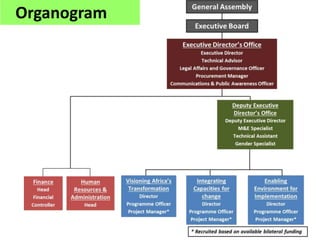
Organogram
16
Click to edit Master title style
5/16/2013 16Forum for Agricultural Research in Africa
Conclusion
• Strategy and MTOP lay out a clear direction for FARA
to respond to challenges and take advantage of
opportunities
• Informed by a problem and objective tree analysis
and extensive stakeholder consultations
• FARA is well positioned to make its mark in
transforming African livelihoods
17
Click to edit Master title style
5/16/2013 17Forum for Agricultural Research in Africa
Thank you

FARA strategy and MTOP 2014-2018

  • 1.
    Forum for AgriculturalResearch in Africa FARA’s Strategic Plan and MTOP for 2014-2018
  • 2.
    2 Click to editMaster title style 5/16/2013 2Forum for Agricultural Research in Africa 1. Why a new strategy & MTOP 1. Timing: current MTOP ends Dec 2013 • New MTOP (2014-2018) • Strategic plan (2007- 2016) revision/overhaul needed 2. Changes in operating environment call for FARA to reposition itself to: • respond to emerging challenges and opportunities • take advantage of lessons learned and build upon achievements
  • 3.
    3 Click to editMaster title style 5/16/2013 3Forum for Agricultural Research in Africa 2. Strategic Directions Problem tree analysis concluded that FARA’s strategic priorities should be focussed on: 1. Visioning the kind of agriculture Africa wants and the collective actions needed to achieve it 2. Developing the capacities needed to achieve it 3. Developing the policy environment to enable effective implementation of the needed actions
  • 4.
    4 Click to editMaster title style 5/16/2013 4Forum for Agricultural Research in Africa Strategic Statements Goal: To contribute to the sustainable reduction of food insecurity and poverty in Africa while enhancing the environment. Purpose: To contribute to generating high broad-based and sustainable agricultural growth in Africa Value Proposition Strengthening Africa’s capacity for innovation and transformation, by visioning its strategic directions, integrating capacities for change and creating the enabling policy environment for implementation.
  • 5.
    5 Click to editMaster title style 5/16/2013 5Forum for Agricultural Research in Africa Core functions of FARA 1. Facilitating Collective Action around the promotion of innovations in Africa 2. Capacity strengthening to enhance the functionality of agricultural innovation systems in Africa 3. Intellectual leadership for ARD in Africa 4. Partnerships to enhance broad-based productivity, competitiveness and markets in Africa 5. Advocacy and communication for improved ARD in Africa 6. Tracking of progress in Africa’s agricultural development
  • 6.
    Generic Services ofFARAFigure 1. Strategic Priorities and Generic services of FARA
  • 7.
    The Strategic Prioritiesare Mutually Reinforcing Visioning Africa's Agricultural Transformation Enabling environment for Implementation Integrating Capacities for Change Emerging thematic areas • Climate Change • Bioenergy • Nutrition Cross cutting issue • Gender
  • 8.
    Networking Support functions Services supported 1. VisioningAfrica’s agric Transformation 2. Integrating capacities for change 3. Enabling environment for implementation Business Research Extension Education Policy
  • 9.
    9 Click to editMaster title style 5/16/2013 9Forum for Agricultural Research in Africa The Results to be Delivered Key Result 1: African agricultural stakeholders determining how the sector should be transformed and establishing the needed collective actions in a gender sensitive manner R1.1. High level stakeholder ownership of gender-disaggregated evidence-based information and policy recommendations derived from strategic analysis and foresight studies. R1.2. Functional partnerships and platforms for agricultural innovation and trade among African stakeholders (intra-continental) and between them and northern and southern partners (Africa-South, Africa-North and Africa-South-North) R1.3. Wide high level stakeholder ownership and commitment to a common African science and innovation agenda.
  • 10.
    10 Click to editMaster title style 5/16/2013 10Forum for Agricultural Research in Africa The Results to be Delivered Key Result 2: Strengthened and integrated continental capacity responding to stakeholder demands within the agricultural innovation system in a gender sensitive manner R2.1. Functional interactions and partnerships for creating capacity among farmers, research, education, extension, trade and agri-business organizations R2.2. Adopted mechanisms for articulating demand and strengthened capacity to respond to demand R2.3. Communities of Practice addressing identified capacity deficits (in the design & implementation of R&D programs) in a gender-sensitive manner R2.4. Strengthened human, organizational and institutional capacities for gender sensitive agricultural innovation.
  • 11.
    11 Click to editMaster title style 5/16/2013 11Forum for Agricultural Research in Africa The Results to be Delivered Key Result 3: Enabling environment for increased ARD investment and implementation of agricultural innovation systems in a gender sensitive manner R3.1. Evidence-based policy formulation, decision making and investment R3.2. FAAP principles and guidelines embedded in all aspects of CAADP planning and implementation R3.3. Information and knowledge for learning exchange in agricultural innovation knowledge systems available and used R3.4. Critical mass of policy makers and advocacy agents avoiding duplication and filling critical gaps at the continental level R3.5. Effective communication strategies and systems, including ICTs, for disseminating and building constituencies for policy changes.
  • 12.
    5. Overall Outcomes Africanagric. innovation systems functioning effectively in creating jobs, building wealth on sustainable basis SP1 African agric. stakeholders determining how the sector should be transformed & establishing the needed collective actions in a gender sensitive manner SP3 Enabling environment for increased ARD investment and implementation of agricultural innovation systems in a gender sensitive manner SP2 Strengthened and integrated continental capacity responding to stakeholder demands within the agricultural innovation system in a gender sensitive manner
  • 13.
    13 Click to editMaster title style 5/16/2013 13Forum for Agricultural Research in Africa Assumptions and risks 1. Political and socio-economic conditions are enabling 2. Complementary and enabling policies and legal frameworks exist, and are implemented 3. Sufficient or adequate incentives exist to convince the private sector and youth to engage in agriculture 4. Farmers have access to adequate financial and natural resources (in particular, land and water) 5. Effective partnerships with the CGIAR, advanced research institutions and south-south cooperation 6. Potential for market expansion is realised, and gains are accessible and of benefit to the poor and disadvantaged 7. Strengthened human capacity is retained in Africa
  • 14.
    14 Click to editMaster title style 5/16/2013 14Forum for Agricultural Research in Africa How the results will be delivered Mobilising Forum Members – Pool of Experts: – Core Research and Development Support team: – FARA Fellows network: – Youth and Women: – Resource Persons with Special Expertise: – Africa Agricultural Science Week: – Africa Agricultural Science Week: – Internships – Post-Doctoral Fellowship: Visiting Scientists: – Diaspora: Core principles The subsidiarity principle Maintaining the Integrity of the environment Inclusiveness of all categories of stakeholders Partnerships Shared responsibility, Sublimity and Responsiveness Performing Core functions & services
  • 15.
  • 16.
    16 Click to editMaster title style 5/16/2013 16Forum for Agricultural Research in Africa Conclusion • Strategy and MTOP lay out a clear direction for FARA to respond to challenges and take advantage of opportunities • Informed by a problem and objective tree analysis and extensive stakeholder consultations • FARA is well positioned to make its mark in transforming African livelihoods
  • 17.
    17 Click to editMaster title style 5/16/2013 17Forum for Agricultural Research in Africa Thank you

Editor's Notes

  • #3 First reason: New MTOP following the end of the current MTOPRevision of the strategy revealed that the changes will be far reaching—hence the decision to develop a new strategic plan covering the MTOP period.
  • #4 These priorities are mutually reinforcing –feed into one another