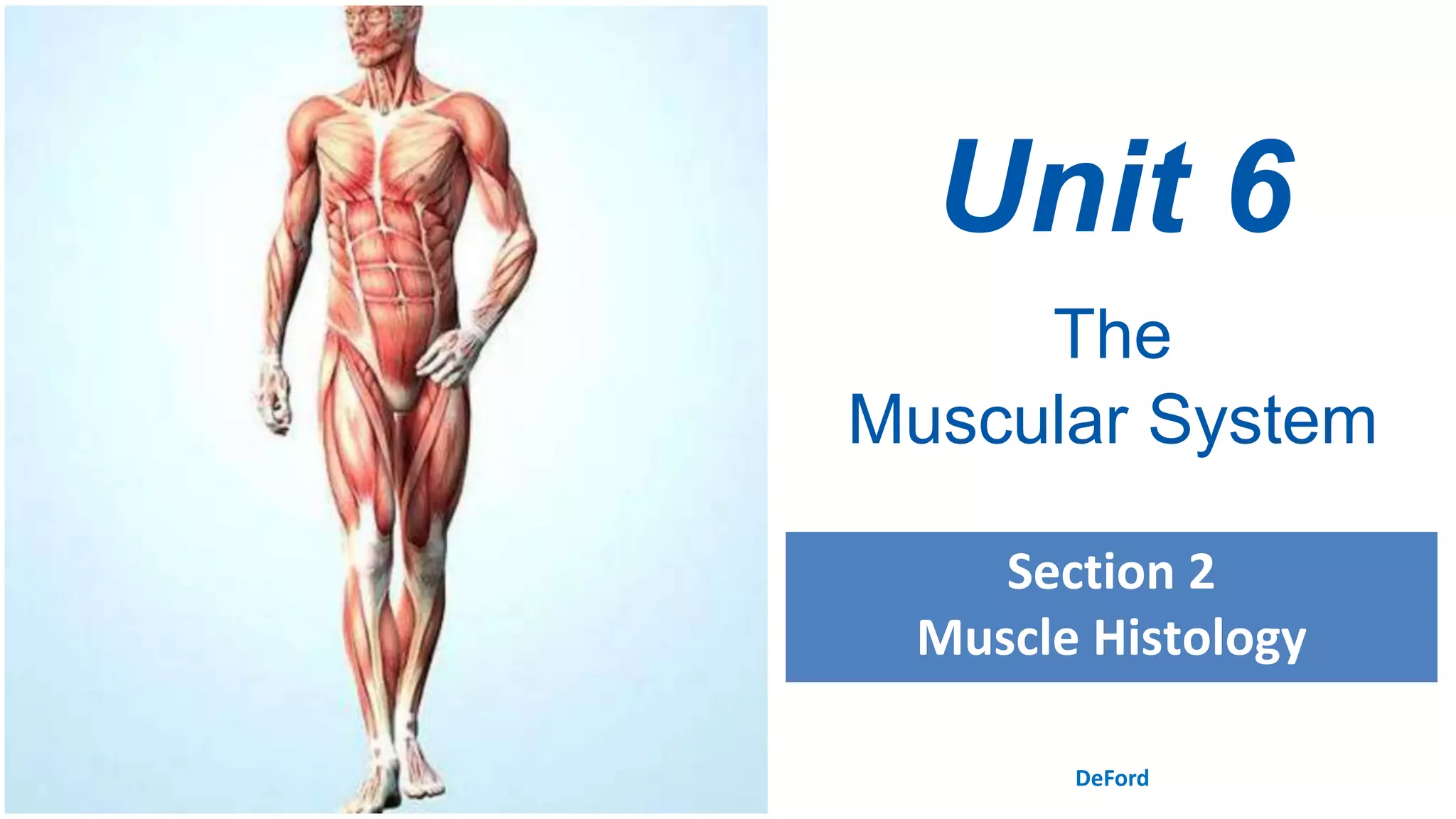
Unit 6
The
Muscular System
DeFord
Section 2
Muscle Histology
Muscular System Tissue Types
•Muscles are responsible for all types of body movement
•There are three basic muscle tissue types found in the
body
•Cardiac Muscle
•Smooth Muscle
•Skeletal (or Striated) Muscle
Cardiac Muscle Tissue
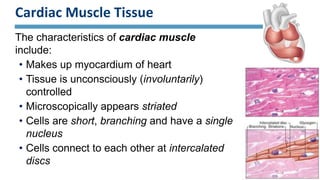
The characteristics of cardiac muscle
include:
• Makes up myocardium of heart
• Tissue is unconsciously (involuntarily)
controlled
• Microscopically appears striated
• Cells are short, branching and have a single
nucleus
• Cells connect to each other at intercalated
discs
Smooth Muscle Tissue
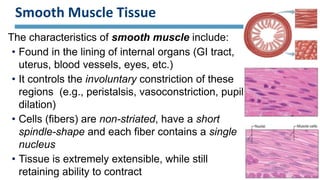
The characteristics of smooth muscle include:
• Found in the lining of internal organs (GI tract,
uterus, blood vessels, eyes, etc.)
• It controls the involuntary constriction of these
regions (e.g., peristalsis, vasoconstriction, pupil
dilation)
• Cells (fibers) are non-striated, have a short
spindle-shape and each fiber contains a single
nucleus
• Tissue is extremely extensible, while still
retaining ability to contract
Skeletal Muscle Tissue
The characteristics of skeletal muscle
include:
• Associated with and attached to the skeleton
• Responsible for moving parts of the body,
such as the limbs, trunk, and face
• Under our conscious (voluntary) control
• Cells (fibers) are long and cylindrical
• Cells (fibers) run in parallel tracts and are
multinucleated and heavily striated
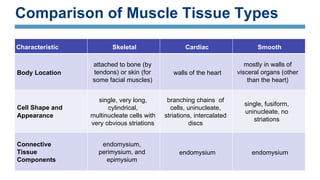
Comparison of Muscle Tissue Types
Characteristic Skeletal Cardiac Smooth
Body Location
attached to bone (by
tendons) or skin (for
some facial muscles)
walls of the heart
mostly in walls of
visceral organs (other
than the heart)
Cell Shape and
Appearance
single, very long,
cylindrical,
multinucleate cells with
very obvious striations
branching chains of
cells, uninucleate,
striations, intercalated
discs
single, fusiform,
uninucleate, no
striations
Connective
Tissue
Components
endomysium,
perimysium, and
epimysium
endomysium endomysium
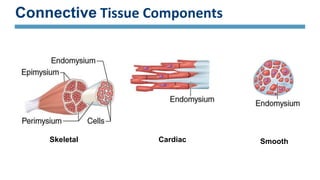
Connective Tissue Components
Skeletal Cardiac Smooth
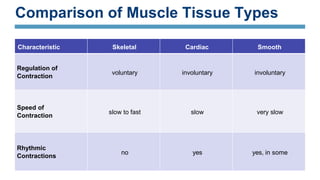
Comparison of Muscle Tissue Types
Characteristic Skeletal Cardiac Smooth
Regulation of
Contraction
voluntary involuntary involuntary
Speed of
Contraction
slow to fast slow very slow
Rhythmic
Contractions
no yes yes, in some

APU6.2 Muscle Histology

  • 1.
  • 2.
    Muscular System TissueTypes •Muscles are responsible for all types of body movement •There are three basic muscle tissue types found in the body •Cardiac Muscle •Smooth Muscle •Skeletal (or Striated) Muscle
  • 3.
    Cardiac Muscle Tissue Thecharacteristics of cardiac muscle include: • Makes up myocardium of heart • Tissue is unconsciously (involuntarily) controlled • Microscopically appears striated • Cells are short, branching and have a single nucleus • Cells connect to each other at intercalated discs
  • 4.
    Smooth Muscle Tissue Thecharacteristics of smooth muscle include: • Found in the lining of internal organs (GI tract, uterus, blood vessels, eyes, etc.) • It controls the involuntary constriction of these regions (e.g., peristalsis, vasoconstriction, pupil dilation) • Cells (fibers) are non-striated, have a short spindle-shape and each fiber contains a single nucleus • Tissue is extremely extensible, while still retaining ability to contract
  • 5.
    Skeletal Muscle Tissue Thecharacteristics of skeletal muscle include: • Associated with and attached to the skeleton • Responsible for moving parts of the body, such as the limbs, trunk, and face • Under our conscious (voluntary) control • Cells (fibers) are long and cylindrical • Cells (fibers) run in parallel tracts and are multinucleated and heavily striated
  • 6.
    Comparison of MuscleTissue Types Characteristic Skeletal Cardiac Smooth Body Location attached to bone (by tendons) or skin (for some facial muscles) walls of the heart mostly in walls of visceral organs (other than the heart) Cell Shape and Appearance single, very long, cylindrical, multinucleate cells with very obvious striations branching chains of cells, uninucleate, striations, intercalated discs single, fusiform, uninucleate, no striations Connective Tissue Components endomysium, perimysium, and epimysium endomysium endomysium
  • 7.
  • 8.
    Comparison of MuscleTissue Types Characteristic Skeletal Cardiac Smooth Regulation of Contraction voluntary involuntary involuntary Speed of Contraction slow to fast slow very slow Rhythmic Contractions no yes yes, in some

Editor's Notes

  • #2 The skeleton and its joints support, protect and provide flexibility for the body, but the skeleton CANNOT move itself. That job is performed by the muscle tissue that makes up the muscular system.
  • #4 The only place in the body where cardiac muscle is found is in the heart. Cardiac cells are striated but they are not under voluntary control. Cardiac muscles contract without direct stimulation by the nervous system. A bundle of specialized muscle cells in the upper part of the heart sends electrical signals through cardiac muscle tissue, causing the heart to rhythmically contract and pump blood through the body. The cardiac muscle cell contains one nucleus located near the center, adjacent cells form branching fibers that allow nerve impulses to pass from cell to cell.
  • #5 Smooth muscles are usually not under voluntary control. Smooth muscle cells are spindle-shaped and have a single nucleus. They are not striated and interlace to form sheets of smooth muscle tissue. Smooth muscles are found in many internal organs, such as the stomach, intestines, and in the walls of blood vessels. Most smooth muscle cells can contract without nervous stimulation. Because most of its movements cannot be consciously controlled, smooth muscle is referred to as involuntary muscle. The contractions in smooth muscles move food through our digestive tract, control the way blood flows through the cardiovascular system, and increases the size of the pupils of our eyes in bright light.
  • #6 The skeletal muscles are responsible for moving parts of the body, such as the limbs, trunk, and face. Skeletal muscles are generally attached to bones via tendons, and are at work every time we make a move. Skeletal muscles are responsible for voluntary (conscious) movement, and are consciously controlled by the central nervous system. A skeletal muscle is made of elongated cells called muscle fibers. Varying movements require contraction of variable numbers of muscle fibers in a muscle. Skeletal muscle fibers are grouped into dense bundles called fascicles. A group of fascicles are bound together by connective tissue to form a muscle. When viewed under a microscope, skeletal muscles appear to have striations (bands or stripes). This gives skeletal muscle the name of striated muscle. Skeletal muscle cells are large and have more than one nucleus. They vary in length from 1 mm to 60 cm (just under 24 inches)
  • #8 We will discuss these later, just wanted you to see what the chart was referring to!