GRP 4
 Imposing functional and anatomic divisions on the
nervous system helps our attempts to understand the
brain’s operations.
 •It also establishes a framework for localizing and
categorizing nervous system diseases.
 • Unfortunately, no rule of nature obligates neurologic
disease to restrict itself to the division we impose upon
it.
 • As a result, the effects of neurologic disease can be
“mixed” and spread across two or more divisions of the
nervous system.
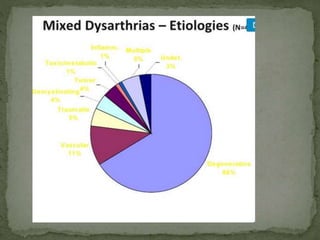
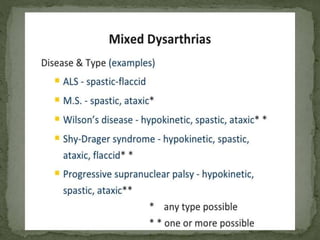
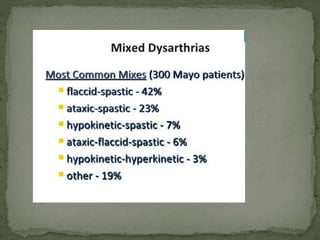
 •Mixed dysarthrias represent a heterogeneous group of
speech disorders and neurologic diseases.
 •Virtually any combination of two or more of the pure
dysarthria types is possible, and in any particular mix
any one of the components may predominate.
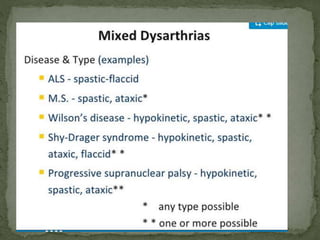
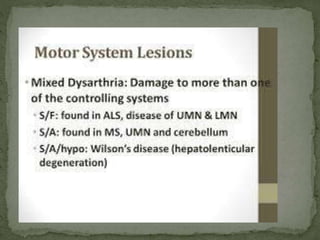
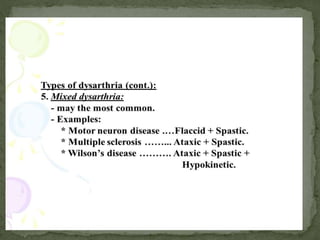
 Several classic neurological disorders, such as multiple
sclerosis, Wilson's disease, and advanced amyotrophic
lateral sclerosis, produce several variations
of dysarthriaconcurrently, including spastic, flaccid,
ataxic, and hypokinetic and hyperkinetic dysarthrias.
 https://www.youtube.com/watch?v=6bbY_yhUmM8

Mixed dysarthria

  • 1.
  • 2.
     Imposing functionaland anatomic divisions on the nervous system helps our attempts to understand the brain’s operations.  •It also establishes a framework for localizing and categorizing nervous system diseases.  • Unfortunately, no rule of nature obligates neurologic disease to restrict itself to the division we impose upon it.
  • 3.
     • Asa result, the effects of neurologic disease can be “mixed” and spread across two or more divisions of the nervous system.  •Mixed dysarthrias represent a heterogeneous group of speech disorders and neurologic diseases.  •Virtually any combination of two or more of the pure dysarthria types is possible, and in any particular mix any one of the components may predominate.
  • 4.
     Several classicneurological disorders, such as multiple sclerosis, Wilson's disease, and advanced amyotrophic lateral sclerosis, produce several variations of dysarthriaconcurrently, including spastic, flaccid, ataxic, and hypokinetic and hyperkinetic dysarthrias.
  • 12.

Editor's Notes

  • #3 We can divide our nervous system functionally or anatomically into various divisions.However these divisions just like the’latitudes and longitudes’that cover the earth are imaginary concepts that helps us in diagnosing,management etc.However,it is not mandatory that a particular disease or injury should limit itself in the boundaries we impose upon it.
  • #4 Hence,a neurologic disease could spread across boundaries and affect more than one division of nervous system.