VALUES EDUCATION
INSTRUCTOR PROFILE:
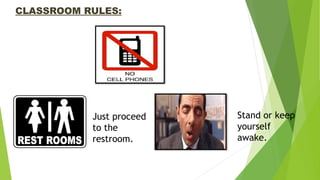
CLASSROOM RULES:
Just proceed
to the
restroom.
Stand or keep
yourself
awake.
At the end of this session, the student(s) must be
able to apply the Values Education (Self Development).
LEARNING OUTCOME
SCOPE OF PRESENTATION
⮚ SELF DEVELOPMENT
⮚ VALUES EDUCATION
⮚ FORCES THAT SHAPES CONTEMPORARY VALUES
⮚ THEORIES OF VALUES FORMATION
⮚ ETHICS AND MORAL EDUCATION
⮚ MORALITY AND OUR CONSCIENCE

SELF DEVELOPMENT
Perceived Self- is composed of a set of self-
cognitions regarding one’s traits, competencies
and values. It is reinforced through feedback.
SELF DEVELOPMENT
The Ideal Self- represents the set of traits,
competencies and values an individual would like
to possess.
SELF DEVELOPMENT
Self Identities- are those aspects of the
individual’s self-concept that are derived from the
social categories to which he or she perceives
him/herself as belonging to. Social identities link
individuals to reference groups, which establish a
set of role expectations and norms that guide the
individual’s behavior within each of the social
identities.
SELF DEVELOPMENT
Self Esteem- is the evaluative component of the self-
concept. It is the function of the distance between the ideal self
perceived self.
VALUES EDUCATION
Values- are the beliefs, which we hold to be true - those
noble ideals we struggle to attain and implement in our daily
lives.. Derived from the natural and moral laws and not from an
individuals opinions and feelings.
Values Education - is based on a rational understanding
of the human person, specifically on understanding of the
Filipino as a human being in society and his/her role in the
shaping of society and the environment.
THEORIES OF VALUES FORMATION
1. Psycho-Analytic Theory (Sigmund Freud)
suggest that unconscious forces act to determine personality
and behavior. To Freud, the unconscious is that part of the
personality about which a person is unaware..
2. Behaviorist View (John B. Watson). The
behavioral perspective suggest that the keys to understanding
developing are observable behavior and outside stimuli in the
environment. If we know the stimuli, we can predict the
behavior.
THEORIES OF VALUES FORMATION
3. Social-cognitive learning theorist Albert
Bandura, when we see the behavior of a model
being rewarded, we are likely to imitate that
behavior. Behavior is learned through
observation and imitation, not conditioning
through reinforcement or punishment.
THEORIES OF VALUES FORMATION
4. Cognitive Theory. The cognitive perspective
focuses on the processes that allow people to
know, understand and think about the world. The
cognitive perspective emphasizes how people
internally represent and think about the world.
THEORIES OF VALUES FORMATION
5. Socio-cultural theory (Russian
psychologist Lev Vygotsky) proposes that a full
understanding of development is impossible
without taking into account the culture in which
children develop.
THEORIES OF VALUES FORMATION
6. Ecological Theory. The Ecological model, the major
proponent of which is Urie Bronfenbrenner, seeks to explain
individual knowledge, development, and competencies in terms
of the guidance, support, and structure provided by society
and to explain social change over time in terms of the
cumulative effect of individual choices (Berger, 2000).
THEORIES OF VALUES FORMATION
7. Humanism Theory. The humanistic
perspective contends that people have a natural
tendency to make decisions about their lives and
control behavior.
THEORIES OF VALUES FORMATION
8. Evolutionary Theory. The Evolutionary
Theory stresses that behavior is strongly
influenced by biology, is tied to evolution, and is
characterized by critical or sensitive periods
(Santrock, 1999).
ETHICS AND MORAL EDUCATION
a. Ethics – comes from the Greek word ethos,
meaning character or custom.
ETHICS AND MORAL EDUCATION
b. Morality
The term morality can be used either:
1. Descriptively to refer to a code of conduct put forward
by a society and that it is used as a guide to behavior by the
members of that society.
2. Normatively to refer to a code of conduct that, given
specified conditions, would be put forward by alL rational
persons for governing the behavior of all moral agents.
MORALITY AND OUR CONSCIENCE
Morality affects our daily choices, and those decisions are
guided by our conscience. The purpose of morality is to provide
a frame work of optimum human survival. The standard of
morality, however, is absolute and immutable – long-term
optimum human survival.
SUMMARY
⮚ SELF DEVELOPMENT
⮚ VALUES EDUCATION
⮚ FORCES THAT SHAPES CONTEMPORARY VALUES
⮚ THEORIES OF VALUES FORMATION
⮚ ETHICS AND MORAL EDUCATION
⮚ MORALITY AND OUR CONSCIENCE

THANK YOU
and
GOOD DAY!!!

Values-Development-MS-1. Values Devepptx

  • 1.
  • 2.
  • 3.
    CLASSROOM RULES: Just proceed tothe restroom. Stand or keep yourself awake.
  • 5.
    At the endof this session, the student(s) must be able to apply the Values Education (Self Development). LEARNING OUTCOME
  • 6.
    SCOPE OF PRESENTATION ⮚SELF DEVELOPMENT ⮚ VALUES EDUCATION ⮚ FORCES THAT SHAPES CONTEMPORARY VALUES ⮚ THEORIES OF VALUES FORMATION ⮚ ETHICS AND MORAL EDUCATION ⮚ MORALITY AND OUR CONSCIENCE
  • 7.
    SELF DEVELOPMENT Perceived Self-is composed of a set of self- cognitions regarding one’s traits, competencies and values. It is reinforced through feedback.
  • 8.
    SELF DEVELOPMENT The IdealSelf- represents the set of traits, competencies and values an individual would like to possess.
  • 9.
    SELF DEVELOPMENT Self Identities-are those aspects of the individual’s self-concept that are derived from the social categories to which he or she perceives him/herself as belonging to. Social identities link individuals to reference groups, which establish a set of role expectations and norms that guide the individual’s behavior within each of the social identities.
  • 10.
    SELF DEVELOPMENT Self Esteem-is the evaluative component of the self- concept. It is the function of the distance between the ideal self perceived self.
  • 11.
    VALUES EDUCATION Values- arethe beliefs, which we hold to be true - those noble ideals we struggle to attain and implement in our daily lives.. Derived from the natural and moral laws and not from an individuals opinions and feelings. Values Education - is based on a rational understanding of the human person, specifically on understanding of the Filipino as a human being in society and his/her role in the shaping of society and the environment.
  • 12.
    THEORIES OF VALUESFORMATION 1. Psycho-Analytic Theory (Sigmund Freud) suggest that unconscious forces act to determine personality and behavior. To Freud, the unconscious is that part of the personality about which a person is unaware.. 2. Behaviorist View (John B. Watson). The behavioral perspective suggest that the keys to understanding developing are observable behavior and outside stimuli in the environment. If we know the stimuli, we can predict the behavior.
  • 13.
    THEORIES OF VALUESFORMATION 3. Social-cognitive learning theorist Albert Bandura, when we see the behavior of a model being rewarded, we are likely to imitate that behavior. Behavior is learned through observation and imitation, not conditioning through reinforcement or punishment.
  • 14.
    THEORIES OF VALUESFORMATION 4. Cognitive Theory. The cognitive perspective focuses on the processes that allow people to know, understand and think about the world. The cognitive perspective emphasizes how people internally represent and think about the world.
  • 15.
    THEORIES OF VALUESFORMATION 5. Socio-cultural theory (Russian psychologist Lev Vygotsky) proposes that a full understanding of development is impossible without taking into account the culture in which children develop.
  • 16.
    THEORIES OF VALUESFORMATION 6. Ecological Theory. The Ecological model, the major proponent of which is Urie Bronfenbrenner, seeks to explain individual knowledge, development, and competencies in terms of the guidance, support, and structure provided by society and to explain social change over time in terms of the cumulative effect of individual choices (Berger, 2000).
  • 17.
    THEORIES OF VALUESFORMATION 7. Humanism Theory. The humanistic perspective contends that people have a natural tendency to make decisions about their lives and control behavior.
  • 18.
    THEORIES OF VALUESFORMATION 8. Evolutionary Theory. The Evolutionary Theory stresses that behavior is strongly influenced by biology, is tied to evolution, and is characterized by critical or sensitive periods (Santrock, 1999).
  • 19.
    ETHICS AND MORALEDUCATION a. Ethics – comes from the Greek word ethos, meaning character or custom.
  • 20.
    ETHICS AND MORALEDUCATION b. Morality The term morality can be used either: 1. Descriptively to refer to a code of conduct put forward by a society and that it is used as a guide to behavior by the members of that society. 2. Normatively to refer to a code of conduct that, given specified conditions, would be put forward by alL rational persons for governing the behavior of all moral agents.
  • 21.
    MORALITY AND OURCONSCIENCE Morality affects our daily choices, and those decisions are guided by our conscience. The purpose of morality is to provide a frame work of optimum human survival. The standard of morality, however, is absolute and immutable – long-term optimum human survival.
  • 23.
    SUMMARY ⮚ SELF DEVELOPMENT ⮚VALUES EDUCATION ⮚ FORCES THAT SHAPES CONTEMPORARY VALUES ⮚ THEORIES OF VALUES FORMATION ⮚ ETHICS AND MORAL EDUCATION ⮚ MORALITY AND OUR CONSCIENCE

  • 24.