DR BIKAL LAMICHHANE
INTERNAL MEDICINE
NAMS
APPROACH TO ANEMIA
ANEMIA
 Anaemia refers to a state in which the level of
haemoglobin in the blood is below the reference
range appropriate for age and sex.
 Pregnancy and altitude, also affect haemoglobin
levels.
 The World Health Organization (WHO) defines
anemia as a hemoglobin level <130 g/L (13 g/dL)
in men and <120 g/L (12 g/dL) in women.
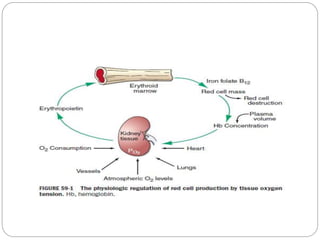
 The critical elements of erythropoiesis—
erythropoietin production, iron availability, the
proliferative capacity of the bone marrow, and
effective maturation of red cell precursors—are
used for the initial classification of anemia.
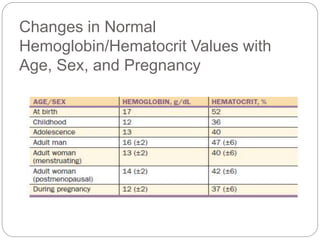
Changes in Normal
Hemoglobin/Hematocrit Values with
Age, Sex, and Pregnancy
CLINICAL PRESENTATION
 Anemia is most often recognized by abnormal
screening laboratory tests.
 Less commonly present with advanced anemia and
its attendant signs and symptoms.
 Acute anemia is due to blood loss or hemolysis.
 If blood loss is mild, enhanced O2 delivery is
achieved through changes in the O2–hemoglobin
dissociation curve mediated by a decreased pH or
increased CO2 (Bohr effect).
 With acute hemolysis, the signs and symptoms depend
on the mechanism that leads to red cell destruction.
 Symptoms associated with more chronic or progressive
anemia depend on the age of the patient and the
adequacy of blood supply to critical organs.
 Symptoms of moderate anemia: fatigue, loss of stamina,
breathlessness, and tachycardia on physical exertion.
 However, because of the intrinsic compensatory
mechanisms that govern the O2–hemoglobin dissociation
curve, the gradual onset of anemia—particularly in young
patients—may not be associated with signs or symptoms
until the anemia is severe (hemoglobin <7–8 g/dL).
 When anemia develops over days or weeks,changes in
cardiac output and regional blood flow helps and
changes in the position of the O2–hemoglobin
dissociation curve account for some of the compensatory
response to anemia.
 With chronic anemia, intracellular levels of 2,3-
bisphosphoglycerate rise, shifting the curve to the right
and facilitate O2 unloading.
 This can only maintain normal tissue O2 delivery in the
face of a 2–3 g/dL deficit in hb. concentration.
 Finally, further protection of O2 delivery to vital organs is
achieved by the shunting of blood away from organs that
are relatively rich in blood supply, kidney, gut, and skin.
APPROACH TO ANEMIA
 The evaluation requires a careful history and
physical examination.
 History :Nutritional history related to drugs or
alcohol intake, family history of anemia,
geographic backgrounds ,ethnic origins, exposure
to certain toxic agents or drugs.
Physical examination:
 Forceful heartbeat, strong peripheral pulses, and a
systolic “flow” murmur.
 The skin and mucous membranes may be pale if the
hemoglobin is <8–10 g/dL.
 On areas where vessels are close to the surface
such as the mucous membranes, nail beds, and
palmar creases.
 If the palmar creases are lighter in color than the
surrounding skin when the hand is hyperextended,
the hemoglobin level is usually <8 g/dL.
 Findings of infection, blood in the stool,
lymphadenopathy, splenomegaly, or petechiae
suggest an underlying disease.
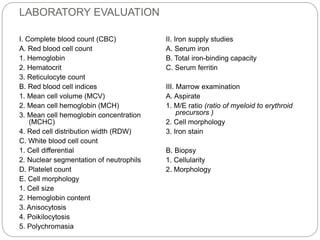
LABORATORY EVALUATION
I. Complete blood count (CBC)
A. Red blood cell count
1. Hemoglobin
2. Hematocrit
3. Reticulocyte count
B. Red blood cell indices
1. Mean cell volume (MCV)
2. Mean cell hemoglobin (MCH)
3. Mean cell hemoglobin concentration
(MCHC)
4. Red cell distribution width (RDW)
C. White blood cell count
1. Cell differential
2. Nuclear segmentation of neutrophils
D. Platelet count
E. Cell morphology
1. Cell size
2. Hemoglobin content
3. Anisocytosis
4. Poikilocytosis
5. Polychromasia
II. Iron supply studies
A. Serum iron
B. Total iron-binding capacity
C. Serum ferritin
III. Marrow examination
A. Aspirate
1. M/E ratio (ratio of myeloid to erythroid
precursors )
2. Cell morphology
3. Iron stain
B. Biopsy
1. Cellularity
2. Morphology
Complete blood count (CBC)
 Physiologic factors like age, sex, pregnancy,
smoking, and altitude affect CBC.
 Help in the classification of anemia.
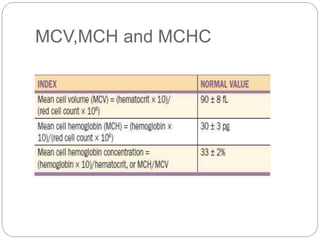
 Microcytosis is reflected by a lower than normal MCV
(<80), whereas high values (>100) reflect
macrocytosis.

 The MCHC reflect defects in hemoglobin synthesis
(hypochromia).
Red cell indices
 Mean cell volume (MCV) in femtoliters.
 Mean cell hemoglobin (MCH) in picograms per
cell.
 Mean concentration of hemoglobin per volume of
red cells (MCHC) in grams per liter.
MCV,MCH and MCHC
Peripheral Blood Smear
 Reveals variations in cell size (anisocytosis) and shape
(poikilocytosis).

 The degree of anisocytosis usually correlates with
increases in the RDW or the range of cell sizes.
 Poikilocytosis suggests a defect in the maturation of red
cell precursors in the bone marrow or fragmentation of
circulating red cells.
 polychromasia—red cells that are slightly larger than
normal and grayish blue in color. These cells are
reticulocytes that have been prematurely released from
the bone marrow and appear in circulation in response
to EPO stimulation or to architectural damage of the bone
marrow (fibrosis, infiltration of the marrow by malignant
Reticulocytes
 Red cells that have been recently released from
the bone marrow.
 Normally, the reticulocyte count ranges from 1 to
2% and reflects the daily replacement of 0.8–
1.0% of the circulating red cell population.
 A corrected reticulocyte percentage or the
absolute number of reticulocytes provides a
reliable measure of effective red cell production.
 In the initial classification of anemia, the patient’s
reticulocyte count is compared with the expected
reticulocyte response.
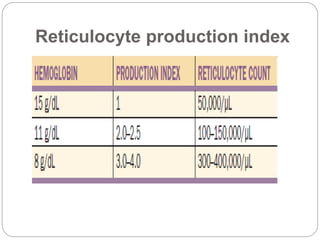
 If the EPO and erythroid marrow responses to
moderate anemia (hemoglobin <10 g/dL) are intact,
the red cell production rate increases to two to three
times normal within 10 days following the onset of
anemia.
 In established anemia, a reticulocyte response less
than two to three times normal indicates an
inadequate marrow response.
 To use the reticulocyte count to estimate marrow
response, two corrections are necessary.
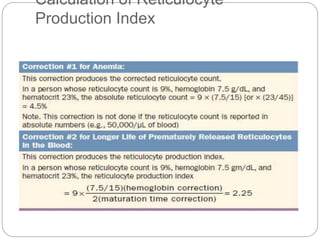
 The first correction adjusts the reticulocyte count
based on the reduced number of circulating red
cells.
 With anemia, the percentage of reticulocytes may
be increased while the absolute number is
unchanged. To correct for this effect, the reticulocyte
percentage is multiplied by the ratio of the patient’s
hemoglobin or hematocrit to the expected
hemoglobin/hematocrit for the age and sex of the
patient. This provides an estimate of the reticulocyte
 Further correction is required,as some of the
reticulocytes in circulation have been released from
marrow prematurely.
 For this second correction, the peripheral blood
smear is examined to see if there are
polychromatophilic macrocytes present.
 These cells, representing prematurely released
reticulocytes, are referred to as “shift” cells.
 The correction is necessary because these
prematurely released cells survive as reticulocytes in
circulation for >1 day, thereby providing a falsely
 If polychromasia is increased, the reticulocyte count,
already corrected for anemia should be corrected again
by 2 to account for the prolonged reticulocyte maturation
time.
 The second correction factor varies from 1 to 3
depending on the severity of anemia. In general, a
correction of 2 is simply used.
 If polychromatophilic cells are not seen on the blood
smear, the second correction is not indicated.
 The now doubly corrected reticulocyte count is the
reticulocyte production index, and it provides an
estimate of marrow production relative to normal .
 If the reticulocyte production index is <2 in the face of
established anemia, a defect in erythroid marrow
Calculation of Reticulocyte
Production Index
Reticulocyte production index
Iron supply studies
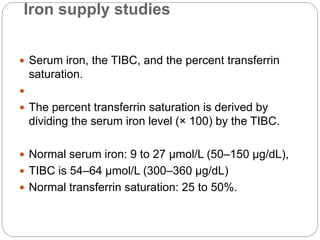
 Serum iron, the TIBC, and the percent transferrin
saturation.

 The percent transferrin saturation is derived by
dividing the serum iron level (× 100) by the TIBC.
 Normal serum iron: 9 to 27 μmol/L (50–150 μg/dL),
 TIBC is 54–64 μmol/L (300–360 μg/dL)
 Normal transferrin saturation: 25 to 50%.
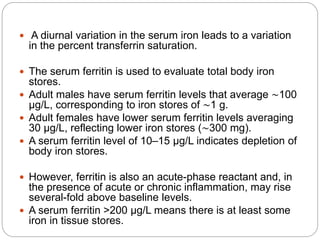
 A diurnal variation in the serum iron leads to a variation
in the percent transferrin saturation.
 The serum ferritin is used to evaluate total body iron
stores.
 Adult males have serum ferritin levels that average ∼100
μg/L, corresponding to iron stores of ∼1 g.
 Adult females have lower serum ferritin levels averaging
30 μg/L, reflecting lower iron stores (∼300 mg).
 A serum ferritin level of 10–15 μg/L indicates depletion of
body iron stores.
 However, ferritin is also an acute-phase reactant and, in
the presence of acute or chronic inflammation, may rise
several-fold above baseline levels.
 A serum ferritin >200 μg/L means there is at least some
iron in tissue stores.
Bone Marrow Examination
 Bone marrow aspirate and smear or a needle biopsy.
 In patients with hypoproliferative anemia and normal iron
status, it is indicated.
 Can diagnose primary marrow disorders such as
myelofibrosis, a red cell maturation defect, or an
infiltrative disease.
 The increase or decrease of one cell lineage (myeloid vs
erythroid) compared to another is obtained by a
differential count of nucleated cells in a bone marrow
smear (the myeloid/erythroid [M/E] ratio).
 Maturation disorders are identified from the discrepancy
between the M/E ratio and the reticulocyte production
index .
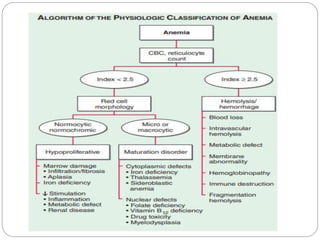
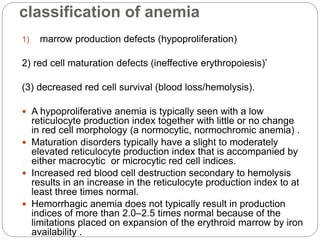
classification of anemia
1) marrow production defects (hypoproliferation)
2) red cell maturation defects (ineffective erythropoiesis)’
(3) decreased red cell survival (blood loss/hemolysis).
 A hypoproliferative anemia is typically seen with a low
reticulocyte production index together with little or no change
in red cell morphology (a normocytic, normochromic anemia) .
 Maturation disorders typically have a slight to moderately
elevated reticulocyte production index that is accompanied by
either macrocytic or microcytic red cell indices.
 Increased red blood cell destruction secondary to hemolysis
results in an increase in the reticulocyte production index to at
least three times normal.
 Hemorrhagic anemia does not typically result in production
indices of more than 2.0–2.5 times normal because of the
limitations placed on expansion of the erythroid marrow by iron
availability .
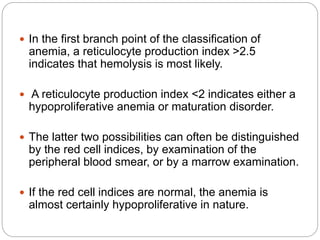
 In the first branch point of the classification of
anemia, a reticulocyte production index >2.5
indicates that hemolysis is most likely.
 A reticulocyte production index <2 indicates either a
hypoproliferative anemia or maturation disorder.
 The latter two possibilities can often be distinguished
by the red cell indices, by examination of the
peripheral blood smear, or by a marrow examination.
 If the red cell indices are normal, the anemia is
almost certainly hypoproliferative in nature.
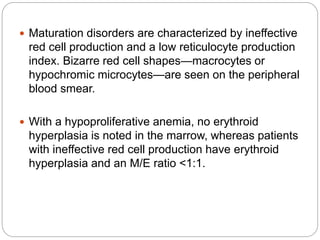
 Maturation disorders are characterized by ineffective
red cell production and a low reticulocyte production
index. Bizarre red cell shapes—macrocytes or
hypochromic microcytes—are seen on the peripheral
blood smear.
 With a hypoproliferative anemia, no erythroid
hyperplasia is noted in the marrow, whereas patients
with ineffective red cell production have erythroid
hyperplasia and an M/E ratio <1:1.
 Hypoproliferative Anemias: Reflects absolute or
relative marrow failure .
 The majority are due to mild to moderate iron
deficiency or inflammation.
 Can result from marrow damage, iron deficiency, or
inadequate EPO stimulation.
 Characterized by normocytic, normochromic red
cells, although microcytic, hypochromic cells may be
observed with mild iron deficiency or long-standing
chronic inflammatory disease.
 Distinguishing between the various forms of
hypoproliferative anemia : serum iron and iron-binding
capacity, evaluation of renal and thyroid function, a
marrow biopsy or aspirate to detect marrow damage or
infiltrative disease, and serum ferritin to assess iron
stores.
 An iron stain of the marrow will determine the pattern of
iron distribution.
 Patients with the anemia of acute or chronic inflammation
show a distinctive pattern of serum iron (low), TIBC
(normal or low), percent transferrin saturation (low), and
serum ferritin (normal or high).
 In mild to moderate iron deficiency (low serum iron, high
TIBC, low percent transferrin saturation, low serum
 Marrow damage by drugs, infiltrative disease
such as leukemia or lymphoma, or marrow
aplasia is diagnosed from the peripheral blood
and bone marrow morphology.
 With infiltrative disease or fibrosis, a marrow
biopsy is required.
 Maturation Disorders :The presence of anemia
with an inappropriately low reticulocyte production
index, macro- or microcytosis on smear, and
abnormal red cell indices.
 Maturation disorders are divided into two categories:
nuclear maturation defects, associated with
macrocytosis, and cytoplasmic maturation defects,
associated with microcytosis and hypochromia usually
from defects in hemoglobin synthesis.
 The inappropriately low reticulocyte production index is a
reflection of the ineffective erythropoiesis. Bone marrow
examination shows erythroid hyperplasia.
 Nuclear maturation defects result from vitamin B12 or
folic acid deficiency, drug damage(methotrexate or
alkylating agents) or myelodysplasia.
 Alcohol, is also capable of producing macrocytosis and a
variable degree of anemia usually associated with folic
acid deficiency.
 Cytoplasmic maturation defects:severe iron
deficiency or abnormalities in globin or heme
synthesis.
 In iron-deficiency anemia,if it is mild to moderate,
erythroid marrow proliferation is blunted and the
anemia is classified as hypoproliferative.
 If the anemia is severe and prolonged, the erythroid
marrow will become hyperplastic despite the
inadequate iron supply, and the anemia will be
classified as ineffective erythropoiesis with a
cytoplasmic maturation defect
 Acute blood loss is not associated with an
increased reticulocyte production index .
 Subacute blood loss may be associated with
modest reticulocytosis.
 Anemia from chronic blood loss presents more
often as iron deficiency than with the picture of
increased red cell production.
 Hemolytic Anemia: red cell production indices ≥2.5
times normal.
 The red cell indices are typically normocytic or slightly
macrocytic.
 In extravascular hemolysis, the efficient recycling of iron
from the destroyed red cells support red cell production.
 Intravascular hemolysis, such as paroxysmal nocturnal
hemoglobinuria, the loss of iron may limit the marrow
response.
 The level of response depends on the severity of the
 Chronic hemolytic disease, such as hereditary
spherocytosis, may present with a complication from
the prolonged hemolysis like symptomatic bilirubin
gallstones or splenomegaly and are also
susceptible to aplastic crises.
 The differential diagnosis of an acute or chronic
hemolytic event requires the careful integration of
family history, the pattern of clinical presentation,
whether the disease is congenital or acquired and
careful examination of the peripheral blood smear.

 For precise diagnosis: hemoglobin electrophoresis or
a screen for red cell enzymes.
 Acquired defects in red cell survival are often
immunologically mediated and require a direct or
indirect antiglobulin test or a cold agglutinin titer to
detect the presence of hemolytic antibodies or
complement-mediated red cell destruction.
 Hemoglobinopathies, such as sickle cell disease
and the thalassemias, present a mixed picture.
 The reticulocyte index may be high but is
inappropriately low for the degree of marrow
erythroid hyperplasia.
REFERENCES
 HARRISON’S PRINCIPLES OF INTERNAL
MEDICINE -20TH EDITION
 DAVIDSON’S PRINCIPLE AND PRACTICE OF
MEDICINE -23RD EDITION
THANK YOU

Approach to anemia bikal

  • 1.
    DR BIKAL LAMICHHANE INTERNALMEDICINE NAMS APPROACH TO ANEMIA
  • 2.
    ANEMIA  Anaemia refersto a state in which the level of haemoglobin in the blood is below the reference range appropriate for age and sex.  Pregnancy and altitude, also affect haemoglobin levels.  The World Health Organization (WHO) defines anemia as a hemoglobin level <130 g/L (13 g/dL) in men and <120 g/L (12 g/dL) in women.  The critical elements of erythropoiesis— erythropoietin production, iron availability, the proliferative capacity of the bone marrow, and effective maturation of red cell precursors—are used for the initial classification of anemia.
  • 4.
    Changes in Normal Hemoglobin/HematocritValues with Age, Sex, and Pregnancy
  • 5.
    CLINICAL PRESENTATION  Anemiais most often recognized by abnormal screening laboratory tests.  Less commonly present with advanced anemia and its attendant signs and symptoms.  Acute anemia is due to blood loss or hemolysis.  If blood loss is mild, enhanced O2 delivery is achieved through changes in the O2–hemoglobin dissociation curve mediated by a decreased pH or increased CO2 (Bohr effect).
  • 6.
     With acutehemolysis, the signs and symptoms depend on the mechanism that leads to red cell destruction.  Symptoms associated with more chronic or progressive anemia depend on the age of the patient and the adequacy of blood supply to critical organs.  Symptoms of moderate anemia: fatigue, loss of stamina, breathlessness, and tachycardia on physical exertion.  However, because of the intrinsic compensatory mechanisms that govern the O2–hemoglobin dissociation curve, the gradual onset of anemia—particularly in young patients—may not be associated with signs or symptoms until the anemia is severe (hemoglobin <7–8 g/dL).
  • 7.
     When anemiadevelops over days or weeks,changes in cardiac output and regional blood flow helps and changes in the position of the O2–hemoglobin dissociation curve account for some of the compensatory response to anemia.  With chronic anemia, intracellular levels of 2,3- bisphosphoglycerate rise, shifting the curve to the right and facilitate O2 unloading.  This can only maintain normal tissue O2 delivery in the face of a 2–3 g/dL deficit in hb. concentration.  Finally, further protection of O2 delivery to vital organs is achieved by the shunting of blood away from organs that are relatively rich in blood supply, kidney, gut, and skin.
  • 8.
    APPROACH TO ANEMIA The evaluation requires a careful history and physical examination.  History :Nutritional history related to drugs or alcohol intake, family history of anemia, geographic backgrounds ,ethnic origins, exposure to certain toxic agents or drugs.
  • 9.
    Physical examination:  Forcefulheartbeat, strong peripheral pulses, and a systolic “flow” murmur.  The skin and mucous membranes may be pale if the hemoglobin is <8–10 g/dL.  On areas where vessels are close to the surface such as the mucous membranes, nail beds, and palmar creases.
  • 10.
     If thepalmar creases are lighter in color than the surrounding skin when the hand is hyperextended, the hemoglobin level is usually <8 g/dL.  Findings of infection, blood in the stool, lymphadenopathy, splenomegaly, or petechiae suggest an underlying disease.
  • 11.
    LABORATORY EVALUATION I. Completeblood count (CBC) A. Red blood cell count 1. Hemoglobin 2. Hematocrit 3. Reticulocyte count B. Red blood cell indices 1. Mean cell volume (MCV) 2. Mean cell hemoglobin (MCH) 3. Mean cell hemoglobin concentration (MCHC) 4. Red cell distribution width (RDW) C. White blood cell count 1. Cell differential 2. Nuclear segmentation of neutrophils D. Platelet count E. Cell morphology 1. Cell size 2. Hemoglobin content 3. Anisocytosis 4. Poikilocytosis 5. Polychromasia II. Iron supply studies A. Serum iron B. Total iron-binding capacity C. Serum ferritin III. Marrow examination A. Aspirate 1. M/E ratio (ratio of myeloid to erythroid precursors ) 2. Cell morphology 3. Iron stain B. Biopsy 1. Cellularity 2. Morphology
  • 12.
    Complete blood count(CBC)  Physiologic factors like age, sex, pregnancy, smoking, and altitude affect CBC.  Help in the classification of anemia.  Microcytosis is reflected by a lower than normal MCV (<80), whereas high values (>100) reflect macrocytosis.   The MCHC reflect defects in hemoglobin synthesis (hypochromia).
  • 13.
    Red cell indices Mean cell volume (MCV) in femtoliters.  Mean cell hemoglobin (MCH) in picograms per cell.  Mean concentration of hemoglobin per volume of red cells (MCHC) in grams per liter.
  • 14.
  • 15.
    Peripheral Blood Smear Reveals variations in cell size (anisocytosis) and shape (poikilocytosis).   The degree of anisocytosis usually correlates with increases in the RDW or the range of cell sizes.  Poikilocytosis suggests a defect in the maturation of red cell precursors in the bone marrow or fragmentation of circulating red cells.  polychromasia—red cells that are slightly larger than normal and grayish blue in color. These cells are reticulocytes that have been prematurely released from the bone marrow and appear in circulation in response to EPO stimulation or to architectural damage of the bone marrow (fibrosis, infiltration of the marrow by malignant
  • 16.
    Reticulocytes  Red cellsthat have been recently released from the bone marrow.  Normally, the reticulocyte count ranges from 1 to 2% and reflects the daily replacement of 0.8– 1.0% of the circulating red cell population.  A corrected reticulocyte percentage or the absolute number of reticulocytes provides a reliable measure of effective red cell production.
  • 17.
     In theinitial classification of anemia, the patient’s reticulocyte count is compared with the expected reticulocyte response.  If the EPO and erythroid marrow responses to moderate anemia (hemoglobin <10 g/dL) are intact, the red cell production rate increases to two to three times normal within 10 days following the onset of anemia.  In established anemia, a reticulocyte response less than two to three times normal indicates an inadequate marrow response.
  • 18.
     To usethe reticulocyte count to estimate marrow response, two corrections are necessary.  The first correction adjusts the reticulocyte count based on the reduced number of circulating red cells.  With anemia, the percentage of reticulocytes may be increased while the absolute number is unchanged. To correct for this effect, the reticulocyte percentage is multiplied by the ratio of the patient’s hemoglobin or hematocrit to the expected hemoglobin/hematocrit for the age and sex of the patient. This provides an estimate of the reticulocyte
  • 19.
     Further correctionis required,as some of the reticulocytes in circulation have been released from marrow prematurely.  For this second correction, the peripheral blood smear is examined to see if there are polychromatophilic macrocytes present.  These cells, representing prematurely released reticulocytes, are referred to as “shift” cells.  The correction is necessary because these prematurely released cells survive as reticulocytes in circulation for >1 day, thereby providing a falsely
  • 20.
     If polychromasiais increased, the reticulocyte count, already corrected for anemia should be corrected again by 2 to account for the prolonged reticulocyte maturation time.  The second correction factor varies from 1 to 3 depending on the severity of anemia. In general, a correction of 2 is simply used.  If polychromatophilic cells are not seen on the blood smear, the second correction is not indicated.  The now doubly corrected reticulocyte count is the reticulocyte production index, and it provides an estimate of marrow production relative to normal .  If the reticulocyte production index is <2 in the face of established anemia, a defect in erythroid marrow
  • 21.
  • 22.
  • 23.
    Iron supply studies Serum iron, the TIBC, and the percent transferrin saturation.   The percent transferrin saturation is derived by dividing the serum iron level (× 100) by the TIBC.  Normal serum iron: 9 to 27 μmol/L (50–150 μg/dL),  TIBC is 54–64 μmol/L (300–360 μg/dL)  Normal transferrin saturation: 25 to 50%.
  • 24.
     A diurnalvariation in the serum iron leads to a variation in the percent transferrin saturation.  The serum ferritin is used to evaluate total body iron stores.  Adult males have serum ferritin levels that average ∼100 μg/L, corresponding to iron stores of ∼1 g.  Adult females have lower serum ferritin levels averaging 30 μg/L, reflecting lower iron stores (∼300 mg).  A serum ferritin level of 10–15 μg/L indicates depletion of body iron stores.  However, ferritin is also an acute-phase reactant and, in the presence of acute or chronic inflammation, may rise several-fold above baseline levels.  A serum ferritin >200 μg/L means there is at least some iron in tissue stores.
  • 25.
    Bone Marrow Examination Bone marrow aspirate and smear or a needle biopsy.  In patients with hypoproliferative anemia and normal iron status, it is indicated.  Can diagnose primary marrow disorders such as myelofibrosis, a red cell maturation defect, or an infiltrative disease.  The increase or decrease of one cell lineage (myeloid vs erythroid) compared to another is obtained by a differential count of nucleated cells in a bone marrow smear (the myeloid/erythroid [M/E] ratio).  Maturation disorders are identified from the discrepancy between the M/E ratio and the reticulocyte production index .
  • 27.
    classification of anemia 1)marrow production defects (hypoproliferation) 2) red cell maturation defects (ineffective erythropoiesis)’ (3) decreased red cell survival (blood loss/hemolysis).  A hypoproliferative anemia is typically seen with a low reticulocyte production index together with little or no change in red cell morphology (a normocytic, normochromic anemia) .  Maturation disorders typically have a slight to moderately elevated reticulocyte production index that is accompanied by either macrocytic or microcytic red cell indices.  Increased red blood cell destruction secondary to hemolysis results in an increase in the reticulocyte production index to at least three times normal.  Hemorrhagic anemia does not typically result in production indices of more than 2.0–2.5 times normal because of the limitations placed on expansion of the erythroid marrow by iron availability .
  • 28.
     In thefirst branch point of the classification of anemia, a reticulocyte production index >2.5 indicates that hemolysis is most likely.  A reticulocyte production index <2 indicates either a hypoproliferative anemia or maturation disorder.  The latter two possibilities can often be distinguished by the red cell indices, by examination of the peripheral blood smear, or by a marrow examination.  If the red cell indices are normal, the anemia is almost certainly hypoproliferative in nature.
  • 29.
     Maturation disordersare characterized by ineffective red cell production and a low reticulocyte production index. Bizarre red cell shapes—macrocytes or hypochromic microcytes—are seen on the peripheral blood smear.  With a hypoproliferative anemia, no erythroid hyperplasia is noted in the marrow, whereas patients with ineffective red cell production have erythroid hyperplasia and an M/E ratio <1:1.
  • 30.
     Hypoproliferative Anemias:Reflects absolute or relative marrow failure .  The majority are due to mild to moderate iron deficiency or inflammation.  Can result from marrow damage, iron deficiency, or inadequate EPO stimulation.  Characterized by normocytic, normochromic red cells, although microcytic, hypochromic cells may be observed with mild iron deficiency or long-standing chronic inflammatory disease.
  • 31.
     Distinguishing betweenthe various forms of hypoproliferative anemia : serum iron and iron-binding capacity, evaluation of renal and thyroid function, a marrow biopsy or aspirate to detect marrow damage or infiltrative disease, and serum ferritin to assess iron stores.  An iron stain of the marrow will determine the pattern of iron distribution.  Patients with the anemia of acute or chronic inflammation show a distinctive pattern of serum iron (low), TIBC (normal or low), percent transferrin saturation (low), and serum ferritin (normal or high).  In mild to moderate iron deficiency (low serum iron, high TIBC, low percent transferrin saturation, low serum
  • 32.
     Marrow damageby drugs, infiltrative disease such as leukemia or lymphoma, or marrow aplasia is diagnosed from the peripheral blood and bone marrow morphology.  With infiltrative disease or fibrosis, a marrow biopsy is required.  Maturation Disorders :The presence of anemia with an inappropriately low reticulocyte production index, macro- or microcytosis on smear, and abnormal red cell indices.
  • 33.
     Maturation disordersare divided into two categories: nuclear maturation defects, associated with macrocytosis, and cytoplasmic maturation defects, associated with microcytosis and hypochromia usually from defects in hemoglobin synthesis.  The inappropriately low reticulocyte production index is a reflection of the ineffective erythropoiesis. Bone marrow examination shows erythroid hyperplasia.  Nuclear maturation defects result from vitamin B12 or folic acid deficiency, drug damage(methotrexate or alkylating agents) or myelodysplasia.  Alcohol, is also capable of producing macrocytosis and a variable degree of anemia usually associated with folic acid deficiency.
  • 34.
     Cytoplasmic maturationdefects:severe iron deficiency or abnormalities in globin or heme synthesis.  In iron-deficiency anemia,if it is mild to moderate, erythroid marrow proliferation is blunted and the anemia is classified as hypoproliferative.  If the anemia is severe and prolonged, the erythroid marrow will become hyperplastic despite the inadequate iron supply, and the anemia will be classified as ineffective erythropoiesis with a cytoplasmic maturation defect
  • 35.
     Acute bloodloss is not associated with an increased reticulocyte production index .  Subacute blood loss may be associated with modest reticulocytosis.  Anemia from chronic blood loss presents more often as iron deficiency than with the picture of increased red cell production.
  • 36.
     Hemolytic Anemia:red cell production indices ≥2.5 times normal.  The red cell indices are typically normocytic or slightly macrocytic.  In extravascular hemolysis, the efficient recycling of iron from the destroyed red cells support red cell production.  Intravascular hemolysis, such as paroxysmal nocturnal hemoglobinuria, the loss of iron may limit the marrow response.  The level of response depends on the severity of the
  • 37.
     Chronic hemolyticdisease, such as hereditary spherocytosis, may present with a complication from the prolonged hemolysis like symptomatic bilirubin gallstones or splenomegaly and are also susceptible to aplastic crises.  The differential diagnosis of an acute or chronic hemolytic event requires the careful integration of family history, the pattern of clinical presentation, whether the disease is congenital or acquired and careful examination of the peripheral blood smear.   For precise diagnosis: hemoglobin electrophoresis or a screen for red cell enzymes.
  • 38.
     Acquired defectsin red cell survival are often immunologically mediated and require a direct or indirect antiglobulin test or a cold agglutinin titer to detect the presence of hemolytic antibodies or complement-mediated red cell destruction.  Hemoglobinopathies, such as sickle cell disease and the thalassemias, present a mixed picture.  The reticulocyte index may be high but is inappropriately low for the degree of marrow erythroid hyperplasia.
  • 39.
    REFERENCES  HARRISON’S PRINCIPLESOF INTERNAL MEDICINE -20TH EDITION  DAVIDSON’S PRINCIPLE AND PRACTICE OF MEDICINE -23RD EDITION
  • 40.