PERFORMANCE
APPRAISAL
SUBMITTED TO – Ms. Farhana Jamal
By:
Vaishali Singh
Vaishnavi Suryavanshi
Utkarsh Singh
Vaibhav Sagar
Trishla Singh
INTRODUCTION
Performance Appraisal is a tool which is used to
evaluate the employees’ performance at the
organization.
It represents how successfully an
individual satisfies the job requirements
or the role he is playing in the
organization.
It is an organised, evaluative, periodic, and futuristic
process.
OBJECTIVES
PROVIDING FEEDBACK
DETERMINING COMPENSATION
IDENTIFYING STAFFING PROCESS’ DEFICIENCIES
FACILITATING PROMOTION AND DOWNSIZIG
DECISIONSSETTING AND MEASURING GOALS
SETTING AND MEASURING GOALS.
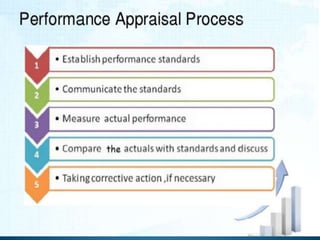
1.ESTABLISHINGPERFORMANCE
STANDARDS
 Setting up of the standards is the first step which will be
used to as the base to compare the actual performance of
employees. The standards set should be clear,
understandable and in measurable terms.
2. COMMUNICATING THE STANDARDS
 Once set, it is the responsibility of the management to
communicate the standards to all employees of the
organisation. Standards should be clearly explained to the
employees
3.MEASURING THE ACTUAL PERFORMANCE
 The most difficult part of performance appraisal process is
measuring the actual performance of employees that is the
work done by the employees during specified period of time.
4.COMPARING ACTUAL PERFORMANCE WITH
DESIRED PERFORMANCE
 The actual performance is compared with the desired or
standard performance .The comparison tells the deviations
in the performance of the employees from the standards set.
5.DISCUSSING RESULT [FEEDBACK]
 The result of the appraisal is communicated and discussed
with the employees on one-to-one basis. Feedback in such a
way helpful to correct mistakes done by employees and help
them to motivate for better performance but not to
demotivate.
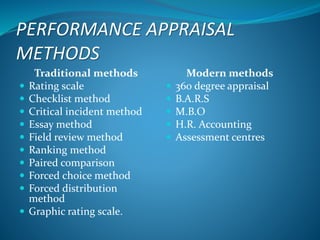
PERFORMANCE APPRAISAL
METHODS
Traditional methods
 Rating scale
 Checklist method
 Critical incident method
 Essay method
 Field review method
 Ranking method
 Paired comparison
 Forced choice method
 Forced distribution
method
 Graphic rating scale.
Modern methods
 360 degree appraisal
 B.A.R.S
 M.B.O
 H.R. Accounting
 Assessment centres
RATING SCALE
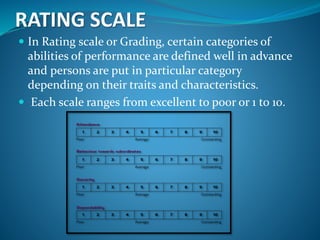
 In Rating scale or Grading, certain categories of
abilities of performance are defined well in advance
and persons are put in particular category
depending on their traits and characteristics.
 Each scale ranges from excellent to poor or 1 to 10.
CHECKLIST METHOD
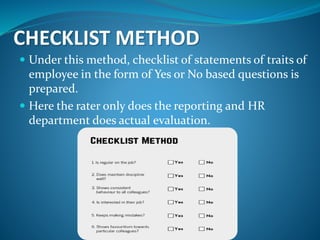
 Under this method, checklist of statements of traits of
employee in the form of Yes or No based questions is
prepared.
 Here the rater only does the reporting and HR
department does actual evaluation.
CRITICAL INCIDENT METHOD
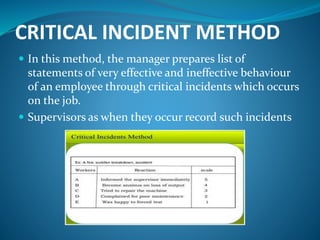
 In this method, the manager prepares list of
statements of very effective and ineffective behaviour
of an employee through critical incidents which occurs
on the job.
 Supervisors as when they occur record such incidents
ESSAY METHOD
 In this method, the rater assesses the employees on
certain parameters in detail like, work performance,
knowlegde about the job, strengths and weaknesses,
training needs, behavioural pattern,etc.
 Advantages: Extremely useful in providing useful
information about employees for appraisal.
 Disadvantages: Each rater may use their own style
and perception in describing a person which produces
difficulty in analysis. Memory power of raters.
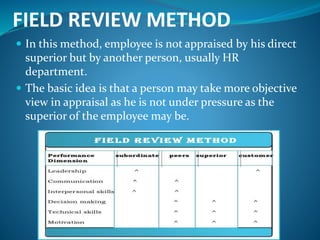
FIELD REVIEW METHOD
 In this method, employee is not appraised by his direct
superior but by another person, usually HR
department.
 The basic idea is that a person may take more objective
view in appraisal as he is not under pressure as the
superior of the employee may be.
RANKING METHOD
 It is the oldest and simplest formal systematic method
of performance appraisal in which employee is
compared with all others for the purpose of placing
order of worth. The employees are ranked from the
highest to the lowest or from the best to the worst.

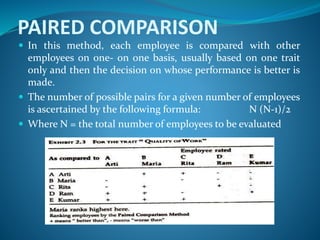
PAIRED COMPARISON
 In this method, each employee is compared with other
employees on one- on one basis, usually based on one trait
only and then the decision on whose performance is better is
made.
 The number of possible pairs for a given number of employees
is ascertained by the following formula: N (N-1)/2
 Where N = the total number of employees to be evaluated
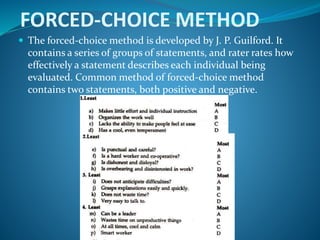
FORCED-CHOICE METHOD
 The forced-choice method is developed by J. P. Guilford. It
contains a series of groups of statements, and rater rates how
effectively a statement describes each individual being
evaluated. Common method of forced-choice method
contains two statements, both positive and negative.
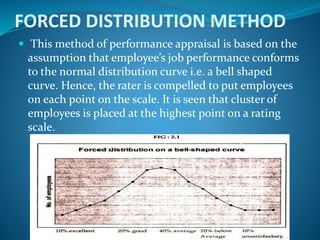
FORCED DISTRIBUTION METHOD
 This method of performance appraisal is based on the
assumption that employee’s job performance conforms
to the normal distribution curve i.e. a bell shaped
curve. Hence, the rater is compelled to put employees
on each point on the scale. It is seen that cluster of
employees is placed at the highest point on a rating
scale.
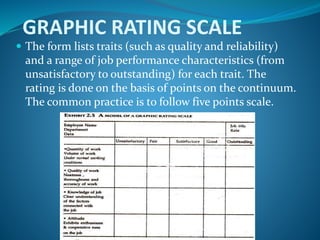
GRAPHIC RATING SCALE
 The form lists traits (such as quality and reliability)
and a range of job performance characteristics (from
unsatisfactory to outstanding) for each trait. The
rating is done on the basis of points on the continuum.
The common practice is to follow five points scale.
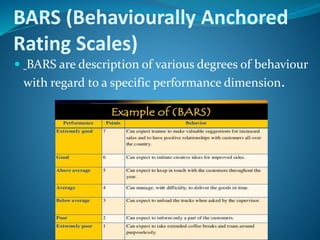
BARS (Behaviourally Anchored
Rating Scales)
 BARS are description of various degrees of behaviour
with regard to a specific performance dimension.
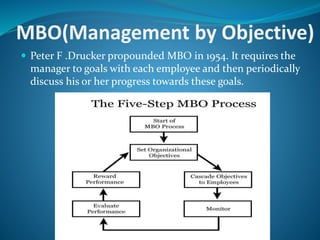
MBO(Management by Objective)
 Peter F .Drucker propounded MBO in 1954. It requires the
manager to goals with each employee and then periodically
discuss his or her progress towards these goals.
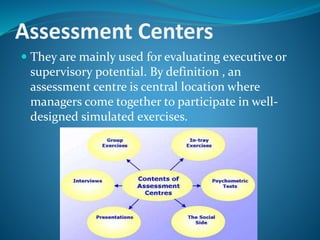
Assessment Centers
 They are mainly used for evaluating executive or
supervisory potential. By definition , an
assessment centre is central location where
managers come together to participate in well-
designed simulated exercises.
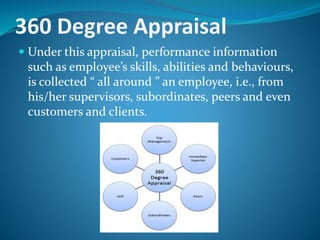
360 Degree Appraisal
 Under this appraisal, performance information
such as employee’s skills, abilities and behaviours,
is collected “ all around ” an employee, i.e., from
his/her supervisors, subordinates, peers and even
customers and clients.
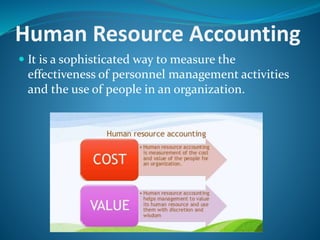
Human Resource Accounting
 It is a sophisticated way to measure the
effectiveness of personnel management activities
and the use of people in an organization.
JOB EVALUATION
A job evaluation is a systematic way of
determining the value/worth of a job in relation
to other jobs in an organization . It tries to make
make a systematic comparison between jobs to
assess their relative worth for the purpose of
establishing a rational pay structure .
Job evaluation begins with job analysis and ends
at that point where the worth of a job is
ascertained for achieving pay equity between
jobs.
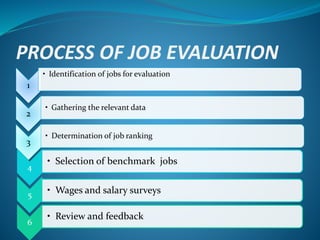
PROCESS OF JOB EVALUATION
1
• Identification of jobs for evaluation
2
• Gathering the relevant data
3
• Determination of job ranking
4
• Selection of benchmark jobs
5 • Wages and salary surveys
6
• Review and feedback
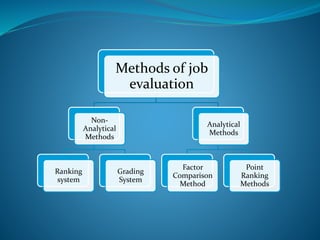
Methods of job
evaluation
Non-
Analytical
Methods
Ranking
system
Grading
System
Analytical
Methods
Factor
Comparison
Method
Point
Ranking
Methods
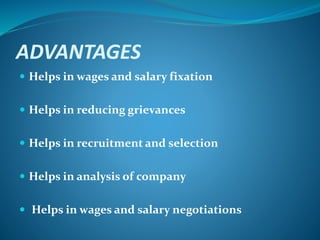
ADVANTAGES
 Helps in wages and salary fixation
 Helps in reducing grievances
 Helps in recruitment and selection
 Helps in analysis of company
 Helps in wages and salary negotiations
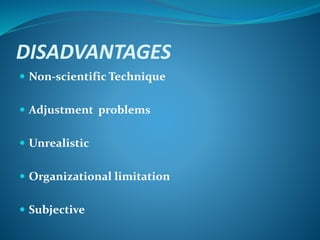
DISADVANTAGES
 Non-scientific Technique
 Adjustment problems
 Unrealistic
 Organizational limitation
 Subjective
THANK YOU

Performance appraisal final ppt.

  • 1.
    PERFORMANCE APPRAISAL SUBMITTED TO –Ms. Farhana Jamal By: Vaishali Singh Vaishnavi Suryavanshi Utkarsh Singh Vaibhav Sagar Trishla Singh
  • 2.
    INTRODUCTION Performance Appraisal isa tool which is used to evaluate the employees’ performance at the organization. It represents how successfully an individual satisfies the job requirements or the role he is playing in the organization. It is an organised, evaluative, periodic, and futuristic process.
  • 3.
    OBJECTIVES PROVIDING FEEDBACK DETERMINING COMPENSATION IDENTIFYINGSTAFFING PROCESS’ DEFICIENCIES FACILITATING PROMOTION AND DOWNSIZIG DECISIONSSETTING AND MEASURING GOALS SETTING AND MEASURING GOALS.
  • 5.
    1.ESTABLISHINGPERFORMANCE STANDARDS  Setting upof the standards is the first step which will be used to as the base to compare the actual performance of employees. The standards set should be clear, understandable and in measurable terms. 2. COMMUNICATING THE STANDARDS  Once set, it is the responsibility of the management to communicate the standards to all employees of the organisation. Standards should be clearly explained to the employees
  • 6.
    3.MEASURING THE ACTUALPERFORMANCE  The most difficult part of performance appraisal process is measuring the actual performance of employees that is the work done by the employees during specified period of time. 4.COMPARING ACTUAL PERFORMANCE WITH DESIRED PERFORMANCE  The actual performance is compared with the desired or standard performance .The comparison tells the deviations in the performance of the employees from the standards set.
  • 7.
    5.DISCUSSING RESULT [FEEDBACK] The result of the appraisal is communicated and discussed with the employees on one-to-one basis. Feedback in such a way helpful to correct mistakes done by employees and help them to motivate for better performance but not to demotivate.
  • 8.
    PERFORMANCE APPRAISAL METHODS Traditional methods Rating scale  Checklist method  Critical incident method  Essay method  Field review method  Ranking method  Paired comparison  Forced choice method  Forced distribution method  Graphic rating scale. Modern methods  360 degree appraisal  B.A.R.S  M.B.O  H.R. Accounting  Assessment centres
  • 9.
    RATING SCALE  InRating scale or Grading, certain categories of abilities of performance are defined well in advance and persons are put in particular category depending on their traits and characteristics.  Each scale ranges from excellent to poor or 1 to 10.
  • 10.
    CHECKLIST METHOD  Underthis method, checklist of statements of traits of employee in the form of Yes or No based questions is prepared.  Here the rater only does the reporting and HR department does actual evaluation.
  • 11.
    CRITICAL INCIDENT METHOD In this method, the manager prepares list of statements of very effective and ineffective behaviour of an employee through critical incidents which occurs on the job.  Supervisors as when they occur record such incidents
  • 12.
    ESSAY METHOD  Inthis method, the rater assesses the employees on certain parameters in detail like, work performance, knowlegde about the job, strengths and weaknesses, training needs, behavioural pattern,etc.  Advantages: Extremely useful in providing useful information about employees for appraisal.  Disadvantages: Each rater may use their own style and perception in describing a person which produces difficulty in analysis. Memory power of raters.
  • 13.
    FIELD REVIEW METHOD In this method, employee is not appraised by his direct superior but by another person, usually HR department.  The basic idea is that a person may take more objective view in appraisal as he is not under pressure as the superior of the employee may be.
  • 14.
    RANKING METHOD  Itis the oldest and simplest formal systematic method of performance appraisal in which employee is compared with all others for the purpose of placing order of worth. The employees are ranked from the highest to the lowest or from the best to the worst. 
  • 15.
    PAIRED COMPARISON  Inthis method, each employee is compared with other employees on one- on one basis, usually based on one trait only and then the decision on whose performance is better is made.  The number of possible pairs for a given number of employees is ascertained by the following formula: N (N-1)/2  Where N = the total number of employees to be evaluated
  • 16.
    FORCED-CHOICE METHOD  Theforced-choice method is developed by J. P. Guilford. It contains a series of groups of statements, and rater rates how effectively a statement describes each individual being evaluated. Common method of forced-choice method contains two statements, both positive and negative.
  • 17.
    FORCED DISTRIBUTION METHOD This method of performance appraisal is based on the assumption that employee’s job performance conforms to the normal distribution curve i.e. a bell shaped curve. Hence, the rater is compelled to put employees on each point on the scale. It is seen that cluster of employees is placed at the highest point on a rating scale.
  • 18.
    GRAPHIC RATING SCALE The form lists traits (such as quality and reliability) and a range of job performance characteristics (from unsatisfactory to outstanding) for each trait. The rating is done on the basis of points on the continuum. The common practice is to follow five points scale.
  • 20.
    BARS (Behaviourally Anchored RatingScales)  BARS are description of various degrees of behaviour with regard to a specific performance dimension.
  • 21.
    MBO(Management by Objective) Peter F .Drucker propounded MBO in 1954. It requires the manager to goals with each employee and then periodically discuss his or her progress towards these goals.
  • 22.
    Assessment Centers  Theyare mainly used for evaluating executive or supervisory potential. By definition , an assessment centre is central location where managers come together to participate in well- designed simulated exercises.
  • 23.
    360 Degree Appraisal Under this appraisal, performance information such as employee’s skills, abilities and behaviours, is collected “ all around ” an employee, i.e., from his/her supervisors, subordinates, peers and even customers and clients.
  • 24.
    Human Resource Accounting It is a sophisticated way to measure the effectiveness of personnel management activities and the use of people in an organization.
  • 25.
    JOB EVALUATION A jobevaluation is a systematic way of determining the value/worth of a job in relation to other jobs in an organization . It tries to make make a systematic comparison between jobs to assess their relative worth for the purpose of establishing a rational pay structure . Job evaluation begins with job analysis and ends at that point where the worth of a job is ascertained for achieving pay equity between jobs.
  • 26.
    PROCESS OF JOBEVALUATION 1 • Identification of jobs for evaluation 2 • Gathering the relevant data 3 • Determination of job ranking 4 • Selection of benchmark jobs 5 • Wages and salary surveys 6 • Review and feedback
  • 27.
  • 28.
    ADVANTAGES  Helps inwages and salary fixation  Helps in reducing grievances  Helps in recruitment and selection  Helps in analysis of company  Helps in wages and salary negotiations
  • 29.
    DISADVANTAGES  Non-scientific Technique Adjustment problems  Unrealistic  Organizational limitation  Subjective
  • 30.