PREMIER UNIVERSITY, CHITTAGONG.
FACULTY OF BUSINESS STUDIES
PRESENTATION ON:
Performance Appraisal
Prepared By:
Sanjida Ashrafi (Ananya)
Department of Accounting,
Premier University, Chittagong.
Definition:
Performance appraisal means evaluating an
employee’s current and/or past performance relative
to his or her performance standards. Effective
appraisal also requires that the supervisor set
performance standards. And it requires that the
employee receive the training, feedback, and
incentives required to eliminate performance
deficiencies.
Performance Appraisal
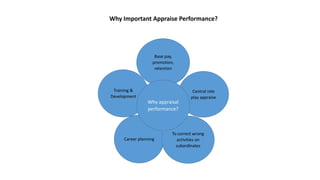
Career planning
Base pay,
promotion,
retention
Training &
Development
To correct wrong
activities on
subordinates
Central role
play appraise
Why appraisal
performance?
Why Important Appraise Performance?
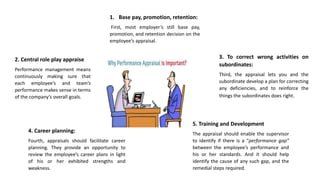
1. Base pay, promotion, retention:
First, most employer’s still base pay,
promotion, and retention decision on the
employee’s appraisal.
2. Central role play appraise
Performance management means
continuously making sure that
each employee’s and team’s
performance makes sense in terms
of the company’s overall goals.
5. Training and Development
The appraisal should enable the supervisor
to identify if there is a “performance gap”
between the employee’s performance and
his or her standards. And it should help
identify the cause of any such gap, and the
remedial steps required.
4. Career planning:
Fourth, appraisals should facilitate career
planning. They provide an opportunity to
review the employee’s career plans in light
of his or her exhibited strengths and
weakness.
3. To correct wrong activities on
subordinates:
Third, the appraisal lets you and the
subordinate develop a plan for correcting
any deficiencies, and to reinforce the
things the subordinates does right.
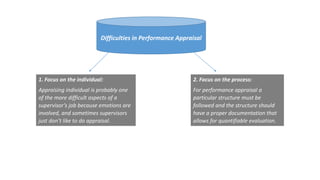
2. Focus on the process:
For performance appraisal a
particular structure must be
followed and the structure should
have a proper documentation that
allows for quantifiable evaluation.
1. Focus on the individual:
Appraising individual is probably one
of the more difficult aspects of a
supervisor’s job because emotions are
involved, and sometimes supervisors
just don’t like to do appraisal.
Difficulties in Performance Appraisal
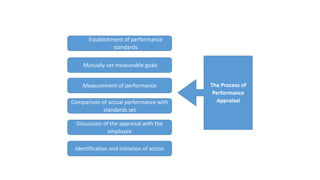
Establishment of performance
standards
Mutually set measurable goals
Measurement of performance
Comparison of actual performance with
standards set
Discussion of the appraisal with the
employee
Identification and initiation of action
The Process of
Performance
Appraisal
1. Establishment of performance standard:
The appraisal process starts with the
establishment of performance
standard in accordance with the goals
set, job analysis and description.
These standards should also be clear
and objective enough to be
understood and measured.
The Process of Performance Appraisal
2. Mutually set measurable goals:
After the performance standards are
established, it is necessary to
communicate them to employees so
that goals, which are not vague but
well understood by all concerned and
are also measurable.
3. Measurement of performance:
It is the third step in the evaluating process. A manager
should be very much concerned with how they measure
and what they measure. To do so the managers have to
acquire information. There are four sources of
information regarding how to measure actual
performance: personal observation, statistical reports,
oral reports, and written reports.
4. Comparison of actual performance with standards:
This is the fourth step in the appraisal process. The
purpose of this step is to note deviations between
standard performance and actual performance so that
we can process to the fifth step in the process.
The Process of Performance Appraisal
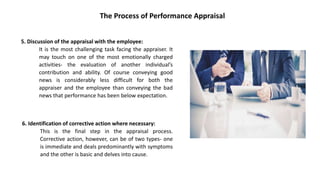
5. Discussion of the appraisal with the employee:
It is the most challenging task facing the appraiser. It
may touch on one of the most emotionally charged
activities- the evaluation of another individual’s
contribution and ability. Of course conveying good
news is considerably less difficult for both the
appraiser and the employee than conveying the bad
news that performance has been below expectation.
6. Identification of corrective action where necessary:
This is the final step in the appraisal process.
Corrective action, however, can be of two types- one
is immediate and deals predominantly with symptoms
and the other is basic and delves into cause.
The Process of Performance Appraisal
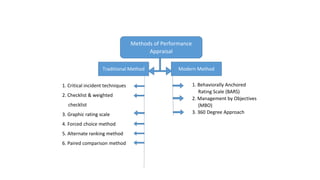
Methods of Performance
Appraisal
Traditional Method Modern Method
1. Critical incident techniques
2. Checklist & weighted
checklist
3. Graphic rating scale
4. Forced choice method
5. Alternate ranking method
6. Paired comparison method
1. Behaviorally Anchored
Rating Scale (BARS)
2. Management by Objectives
(MBO)
3. 360 Degree Approach
Traditional Methods
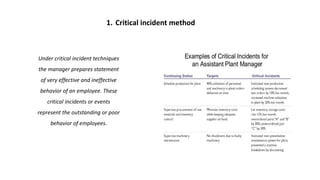
1. Critical incident method
Under critical incident techniques
the manager prepares statement
of very effective and ineffective
behavior of an employee. These
critical incidents or events
represent the outstanding or poor
behavior of employees.
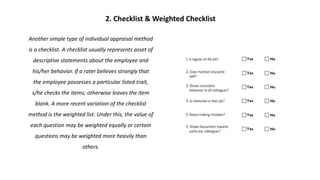
2. Checklist & Weighted Checklist
Another simple type of individual appraisal method
is a checklist. A checklist usually represents asset of
descriptive statements about the employee and
his/her behavior. If a rater believes strongly that
the employee possesses a particular listed trait,
s/he checks the items; otherwise leaves the item
blank. A more recent variation of the checklist
method is the weighted list. Under this, the value of
each question may be weighted equally or certain
questions may be weighted more heavily than
others.
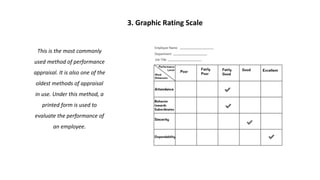
3. Graphic Rating Scale
This is the most commonly
used method of performance
appraisal. It is also one of the
oldest methods of appraisal
in use. Under this method, a
printed form is used to
evaluate the performance of
an employee.
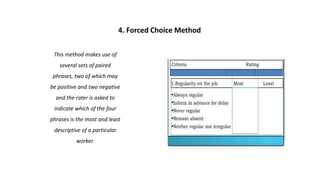
This method makes use of
several sets of paired
phrases, two of which may
be positive and two negative
and the rater is asked to
indicate which of the four
phrases is the most and least
descriptive of a particular
worker.
4. Forced Choice Method
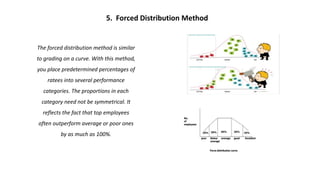
The forced distribution method is similar
to grading on a curve. With this method,
you place predetermined percentages of
ratees into several performance
categories. The proportions in each
category need not be symmetrical. It
reflects the fact that top employees
often outperform average or poor ones
by as much as 100%.
5. Forced Distribution Method
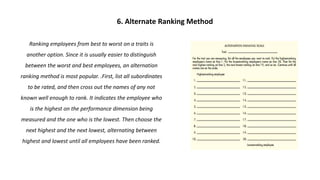
Ranking employees from best to worst on a traits is
another option. Since it is usually easier to distinguish
between the worst and best employees, an alternation
ranking method is most popular. .First, list all subordinates
to be rated, and then cross out the names of any not
known well enough to rank. It indicates the employee who
is the highest on the performance dimension being
measured and the one who is the lowest. Then choose the
next highest and the next lowest, alternating between
highest and lowest until all employees have been ranked.
6. Alternate Ranking Method
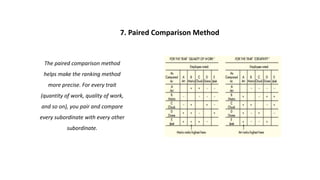
The paired comparison method
helps make the ranking method
more precise. For every trait
(quantity of work, quality of work,
and so on), you pair and compare
every subordinate with every other
subordinate.
7. Paired Comparison Method
Modern Methods
Behaviorally anchored rating scale
(BARS) is an appraisal tool that anchors
a numerical rating scale with specific
illustrative examples of good or poor
performance. Its proponents say it
provides better, more equitable
appraisals than do the other tools
1. Behaviorally Anchored Rating Scales
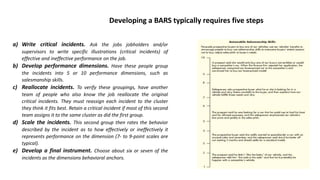
a) Write critical incidents. Ask the jobs jobholders and/or
supervisors to write specific illustrations (critical incidents) of
effective and ineffective performance on the job.
b) Develop performance dimensions. Have these people group
the incidents into 5 or 10 performance dimensions, such as
salesmanship skills.
c) Reallocate incidents. To verify these groupings, have another
team of people who also know the job reallocate the original
critical incidents. They must reassign each incident to the cluster
they think it fits best. Retain a critical incident if most of this second
team assigns it to the same cluster as did the first group.
d) Scale the incidents. This second group then rates the behavior
described by the incident as to how effectively or ineffectively it
represents performance on the dimension (7- to 9-point scales are
typical).
e) Develop a final instrument. Choose about six or seven of the
incidents as the dimensions behavioral anchors.
Developing a BARS typically requires five steps
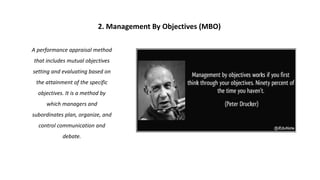
A performance appraisal method
that includes mutual objectives
setting and evaluating based on
the attainment of the specific
objectives. It is a method by
which managers and
subordinates plan, organize, and
control communication and
debate.
2. Management By Objectives (MBO)
A. Tangible, verifiable & measurable,
B. Focuses on how and what to accomplished,
C. Concentrating on key result areas, translates the
abstract philosophy of management into concrete
phraseology. The technique can be put to general use
(non-specialist technique).
The Features of MBO is-
An appraisal device that seeks
performance feedback from such
as the person being rated,
bosses, pears, team members,
customers and suppliers has
become popular in organizations
it is called the 360 degree
appraisal.
3. 360 Degree Approach
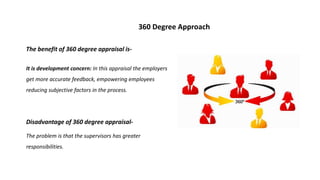
The benefit of 360 degree appraisal is-
It is development concern: In this appraisal the employers
get more accurate feedback, empowering employees
reducing subjective factors in the process.
Disadvantage of 360 degree appraisal-
The problem is that the supervisors has greater
responsibilities.
360 Degree Approach
Potential Appraisal Problems
a) UNCLEAR STANDARDS
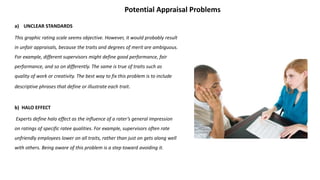
This graphic rating scale seems objective. However, it would probably result
in unfair appraisals, because the traits and degrees of merit are ambiguous.
For example, different supervisors might define good performance, fair
performance, and so on differently. The same is true of traits such as
quality of work or creativity. The best way to fix this problem is to include
descriptive phrases that define or illustrate each trait.
b) HALO EFFECT
Experts define halo effect as the influence of a rater’s general impression
on ratings of specific ratee qualities. For example, supervisors often rate
unfriendly employees lower on all traits, rather than just on gets along well
with others. Being aware of this problem is a step toward avoiding it.
c) CENTRAL TENDENCY
Central tendency means rating all employees’ average. Doing so
distorts the evaluations, making them less useful for promotion,
salary, or counseling purposes. Ranking employees instead of using
graphic rating scales can reduce this problem, since ranking means
you can’t rate them all average.
d) LENIENCY OR STRICTNESS
Other supervisors tend to rate all their subordinates consistently high or
low, just as some instructors are notoriously high or low graders. This
strictness/leniency problem is especially severe with graphic rating
scales. On the other hand, ranking forces supervisors to distinguish
between high and low performers.
Potential Appraisal Problems
e) RECENCY EFFECTS
The recency effect means letting what the employee has done recently
blind you to what his or her performance has been over the year. The
main solution is to accumulate critical incidents all year long.
Potential Appraisal Problems
f) BIAS
The number of things that can lead to bias during appraisals is limitless.
One study focused on the rater’s personality. Raters who scored higher
on conscientiousness tended to give their peers lower ratings they were
stricter, in other words; those scoring higher on agreeableness gave
higher ratings they were more lenient. In another study, performance
appraisal ratings obtained for administrative purposes [such as pay
raises or promotions] were nearly one-third [higher] than those
obtained for research or employee development purposes.
Guidelines for Effective Appraisals
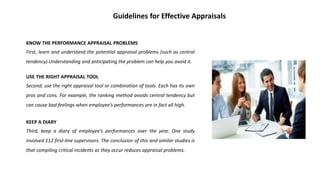
KNOW THE PERFORMANCE APPRAISAL PROBLEMS
First, learn and understand the potential appraisal problems (such as central
tendency).Understanding and anticipating the problem can help you avoid it.
USE THE RIGHT APPRAISAL TOOL
Second, use the right appraisal tool or combination of tools. Each has its own
pros and cons. For example, the ranking method avoids central tendency but
can cause bad feelings when employee’s performances are in fact all high.
KEEP A DIARY
Third, keep a diary of employee’s performances over the year. One study
involved 112 first-line supervisors. The conclusion of this and similar studies is
that compiling critical incidents as they occur reduces appraisal problems.
GET AGREEMENT ON A PLAN
Fourth, the aim of the appraisal should be to improve unsatisfactory
performance (and/or to reinforce exemplary performance). The appraisals end
product should therefore always be a plan for what the employee must do to
improve his or her efforts.
ENSURE FAIRNESS
Fifth, make sure that every appraisal you give is fair. Studies confirm that, in
practice, some managers ignore accuracy and honesty in performance
appraisals. Instead, they use the process for political purposes (such as
encouraging employees with whom they don’t get along to leave the firm).
The employee’s standards should be clear, employees should understand the
basis on which you’re going to appraise them, and the appraisals should be
objective and fair.
Guidelines for Effective Appraisals
Performance Appraisal

Performance Appraisal

  • 1.
    PREMIER UNIVERSITY, CHITTAGONG. FACULTYOF BUSINESS STUDIES PRESENTATION ON: Performance Appraisal
  • 2.
    Prepared By: Sanjida Ashrafi(Ananya) Department of Accounting, Premier University, Chittagong.
  • 4.
    Definition: Performance appraisal meansevaluating an employee’s current and/or past performance relative to his or her performance standards. Effective appraisal also requires that the supervisor set performance standards. And it requires that the employee receive the training, feedback, and incentives required to eliminate performance deficiencies. Performance Appraisal
  • 5.
    Career planning Base pay, promotion, retention Training& Development To correct wrong activities on subordinates Central role play appraise Why appraisal performance? Why Important Appraise Performance?
  • 6.
    1. Base pay,promotion, retention: First, most employer’s still base pay, promotion, and retention decision on the employee’s appraisal. 2. Central role play appraise Performance management means continuously making sure that each employee’s and team’s performance makes sense in terms of the company’s overall goals. 5. Training and Development The appraisal should enable the supervisor to identify if there is a “performance gap” between the employee’s performance and his or her standards. And it should help identify the cause of any such gap, and the remedial steps required. 4. Career planning: Fourth, appraisals should facilitate career planning. They provide an opportunity to review the employee’s career plans in light of his or her exhibited strengths and weakness. 3. To correct wrong activities on subordinates: Third, the appraisal lets you and the subordinate develop a plan for correcting any deficiencies, and to reinforce the things the subordinates does right.
  • 7.
    2. Focus onthe process: For performance appraisal a particular structure must be followed and the structure should have a proper documentation that allows for quantifiable evaluation. 1. Focus on the individual: Appraising individual is probably one of the more difficult aspects of a supervisor’s job because emotions are involved, and sometimes supervisors just don’t like to do appraisal. Difficulties in Performance Appraisal
  • 8.
    Establishment of performance standards Mutuallyset measurable goals Measurement of performance Comparison of actual performance with standards set Discussion of the appraisal with the employee Identification and initiation of action The Process of Performance Appraisal
  • 9.
    1. Establishment ofperformance standard: The appraisal process starts with the establishment of performance standard in accordance with the goals set, job analysis and description. These standards should also be clear and objective enough to be understood and measured. The Process of Performance Appraisal 2. Mutually set measurable goals: After the performance standards are established, it is necessary to communicate them to employees so that goals, which are not vague but well understood by all concerned and are also measurable.
  • 10.
    3. Measurement ofperformance: It is the third step in the evaluating process. A manager should be very much concerned with how they measure and what they measure. To do so the managers have to acquire information. There are four sources of information regarding how to measure actual performance: personal observation, statistical reports, oral reports, and written reports. 4. Comparison of actual performance with standards: This is the fourth step in the appraisal process. The purpose of this step is to note deviations between standard performance and actual performance so that we can process to the fifth step in the process. The Process of Performance Appraisal
  • 11.
    5. Discussion ofthe appraisal with the employee: It is the most challenging task facing the appraiser. It may touch on one of the most emotionally charged activities- the evaluation of another individual’s contribution and ability. Of course conveying good news is considerably less difficult for both the appraiser and the employee than conveying the bad news that performance has been below expectation. 6. Identification of corrective action where necessary: This is the final step in the appraisal process. Corrective action, however, can be of two types- one is immediate and deals predominantly with symptoms and the other is basic and delves into cause. The Process of Performance Appraisal
  • 12.
    Methods of Performance Appraisal TraditionalMethod Modern Method 1. Critical incident techniques 2. Checklist & weighted checklist 3. Graphic rating scale 4. Forced choice method 5. Alternate ranking method 6. Paired comparison method 1. Behaviorally Anchored Rating Scale (BARS) 2. Management by Objectives (MBO) 3. 360 Degree Approach
  • 13.
  • 14.
    1. Critical incidentmethod Under critical incident techniques the manager prepares statement of very effective and ineffective behavior of an employee. These critical incidents or events represent the outstanding or poor behavior of employees.
  • 15.
    2. Checklist &Weighted Checklist Another simple type of individual appraisal method is a checklist. A checklist usually represents asset of descriptive statements about the employee and his/her behavior. If a rater believes strongly that the employee possesses a particular listed trait, s/he checks the items; otherwise leaves the item blank. A more recent variation of the checklist method is the weighted list. Under this, the value of each question may be weighted equally or certain questions may be weighted more heavily than others.
  • 16.
    3. Graphic RatingScale This is the most commonly used method of performance appraisal. It is also one of the oldest methods of appraisal in use. Under this method, a printed form is used to evaluate the performance of an employee.
  • 17.
    This method makesuse of several sets of paired phrases, two of which may be positive and two negative and the rater is asked to indicate which of the four phrases is the most and least descriptive of a particular worker. 4. Forced Choice Method
  • 18.
    The forced distributionmethod is similar to grading on a curve. With this method, you place predetermined percentages of ratees into several performance categories. The proportions in each category need not be symmetrical. It reflects the fact that top employees often outperform average or poor ones by as much as 100%. 5. Forced Distribution Method
  • 19.
    Ranking employees frombest to worst on a traits is another option. Since it is usually easier to distinguish between the worst and best employees, an alternation ranking method is most popular. .First, list all subordinates to be rated, and then cross out the names of any not known well enough to rank. It indicates the employee who is the highest on the performance dimension being measured and the one who is the lowest. Then choose the next highest and the next lowest, alternating between highest and lowest until all employees have been ranked. 6. Alternate Ranking Method
  • 20.
    The paired comparisonmethod helps make the ranking method more precise. For every trait (quantity of work, quality of work, and so on), you pair and compare every subordinate with every other subordinate. 7. Paired Comparison Method
  • 21.
  • 22.
    Behaviorally anchored ratingscale (BARS) is an appraisal tool that anchors a numerical rating scale with specific illustrative examples of good or poor performance. Its proponents say it provides better, more equitable appraisals than do the other tools 1. Behaviorally Anchored Rating Scales
  • 23.
    a) Write criticalincidents. Ask the jobs jobholders and/or supervisors to write specific illustrations (critical incidents) of effective and ineffective performance on the job. b) Develop performance dimensions. Have these people group the incidents into 5 or 10 performance dimensions, such as salesmanship skills. c) Reallocate incidents. To verify these groupings, have another team of people who also know the job reallocate the original critical incidents. They must reassign each incident to the cluster they think it fits best. Retain a critical incident if most of this second team assigns it to the same cluster as did the first group. d) Scale the incidents. This second group then rates the behavior described by the incident as to how effectively or ineffectively it represents performance on the dimension (7- to 9-point scales are typical). e) Develop a final instrument. Choose about six or seven of the incidents as the dimensions behavioral anchors. Developing a BARS typically requires five steps
  • 24.
    A performance appraisalmethod that includes mutual objectives setting and evaluating based on the attainment of the specific objectives. It is a method by which managers and subordinates plan, organize, and control communication and debate. 2. Management By Objectives (MBO)
  • 25.
    A. Tangible, verifiable& measurable, B. Focuses on how and what to accomplished, C. Concentrating on key result areas, translates the abstract philosophy of management into concrete phraseology. The technique can be put to general use (non-specialist technique). The Features of MBO is-
  • 26.
    An appraisal devicethat seeks performance feedback from such as the person being rated, bosses, pears, team members, customers and suppliers has become popular in organizations it is called the 360 degree appraisal. 3. 360 Degree Approach
  • 27.
    The benefit of360 degree appraisal is- It is development concern: In this appraisal the employers get more accurate feedback, empowering employees reducing subjective factors in the process. Disadvantage of 360 degree appraisal- The problem is that the supervisors has greater responsibilities. 360 Degree Approach
  • 28.
    Potential Appraisal Problems a)UNCLEAR STANDARDS This graphic rating scale seems objective. However, it would probably result in unfair appraisals, because the traits and degrees of merit are ambiguous. For example, different supervisors might define good performance, fair performance, and so on differently. The same is true of traits such as quality of work or creativity. The best way to fix this problem is to include descriptive phrases that define or illustrate each trait. b) HALO EFFECT Experts define halo effect as the influence of a rater’s general impression on ratings of specific ratee qualities. For example, supervisors often rate unfriendly employees lower on all traits, rather than just on gets along well with others. Being aware of this problem is a step toward avoiding it.
  • 29.
    c) CENTRAL TENDENCY Centraltendency means rating all employees’ average. Doing so distorts the evaluations, making them less useful for promotion, salary, or counseling purposes. Ranking employees instead of using graphic rating scales can reduce this problem, since ranking means you can’t rate them all average. d) LENIENCY OR STRICTNESS Other supervisors tend to rate all their subordinates consistently high or low, just as some instructors are notoriously high or low graders. This strictness/leniency problem is especially severe with graphic rating scales. On the other hand, ranking forces supervisors to distinguish between high and low performers. Potential Appraisal Problems
  • 30.
    e) RECENCY EFFECTS Therecency effect means letting what the employee has done recently blind you to what his or her performance has been over the year. The main solution is to accumulate critical incidents all year long. Potential Appraisal Problems f) BIAS The number of things that can lead to bias during appraisals is limitless. One study focused on the rater’s personality. Raters who scored higher on conscientiousness tended to give their peers lower ratings they were stricter, in other words; those scoring higher on agreeableness gave higher ratings they were more lenient. In another study, performance appraisal ratings obtained for administrative purposes [such as pay raises or promotions] were nearly one-third [higher] than those obtained for research or employee development purposes.
  • 31.
    Guidelines for EffectiveAppraisals KNOW THE PERFORMANCE APPRAISAL PROBLEMS First, learn and understand the potential appraisal problems (such as central tendency).Understanding and anticipating the problem can help you avoid it. USE THE RIGHT APPRAISAL TOOL Second, use the right appraisal tool or combination of tools. Each has its own pros and cons. For example, the ranking method avoids central tendency but can cause bad feelings when employee’s performances are in fact all high. KEEP A DIARY Third, keep a diary of employee’s performances over the year. One study involved 112 first-line supervisors. The conclusion of this and similar studies is that compiling critical incidents as they occur reduces appraisal problems.
  • 32.
    GET AGREEMENT ONA PLAN Fourth, the aim of the appraisal should be to improve unsatisfactory performance (and/or to reinforce exemplary performance). The appraisals end product should therefore always be a plan for what the employee must do to improve his or her efforts. ENSURE FAIRNESS Fifth, make sure that every appraisal you give is fair. Studies confirm that, in practice, some managers ignore accuracy and honesty in performance appraisals. Instead, they use the process for political purposes (such as encouraging employees with whom they don’t get along to leave the firm). The employee’s standards should be clear, employees should understand the basis on which you’re going to appraise them, and the appraisals should be objective and fair. Guidelines for Effective Appraisals