Applications of
cell lines
By
KAUSHAL KUMAR SAHU
Assistant Professor (Ad Hoc)
Department of Biotechnology
Govt. Digvijay Autonomous P. G. College
Raj-Nandgaon ( C. G. )
Cell culture
 Cell culture is the process by which prokaryotic, eukaryotic or plant cells are grown
under controlled conditions. But in practice it refers to the culturing of cells derived
from animal cells.
 Cell culture was first successfully undertaken by Ross Harrison in 1907
 Roux in 1885 for the first time maintained embryonic chick cells in a cell culture.
Why is cell culture used for?
Areas where cell culture technology is currently playing a major role.
 Model systems for
Studying basic cell biology, interactions between disease causing agents and cells,
effects of drugs on cells, process and triggering of aging & nutritional studies
 Toxicity testing
Study the effects of new drugs
 Cancer research
Study the function of various chemicals, virus & radiation to convert normal cultured
cells to cancerous cells
Conti…..
 Virology
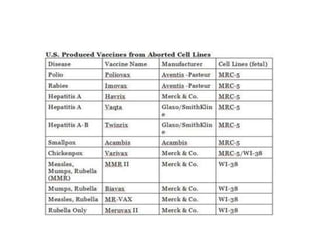
Cultivation of virus for vaccine production, also used to study there infectious cycle. e.g.
polio, rabies, chicken pox, hepatitis B & measles.
 Gene therapy
Cells having a functional gene can be replaced to cells which are having non-functional
gene.
Tissue culture
•In vitro cultivation of organs, tissues & cells at defined temperature using an incubator
& supplemented with a medium containing cell nutrients & growth factors is collectively
known as tissue culture.
•Different types of cell grown in culture includes connective tissue elements such as
fibroblasts, skeletal tissue, cardiac, epithelial tissue (liver, breast, skin, kidney) and many
different types of tumor cells.
Primary culture
•Cells when surgically or enzymatically removed from an organism and placed in suitable
culture environment will attach and grow are called as primary culture.
•Primary cells have a finite life span.
•Primary culture contains a very heterogeneous population of cells.
•Treated by proteolytic enzyme (Trypsin).
Cell lines
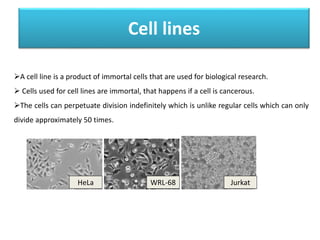
A cell line is a product of immortal cells that are used for biological research.
 Cells used for cell lines are immortal, that happens if a cell is cancerous.
The cells can perpetuate division indefinitely which is unlike regular cells which can only
divide approximately 50 times.
WRL-68HeLa Jurkat
Common cell lines
 Human cell lines
MCF-7 breast cancer
HL 60 Leukemia
HEK-293 Human embryonic kidney
HeLa Henrietta lacks
 Primate cell lines
Vero African green monkey kidney epithelial cells
Cos-7 African green monkey kidney cells
And others such as CHO from hamster, sf9 & sf21 from insect cells.
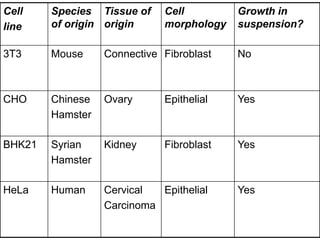
Cell
line
Species
of origin
Tissue of
origin
Cell
morphology
Growth in
suspension?
3T3 Mouse Connective Fibroblast No
CHO Chinese
Hamster
Ovary Epithelial Yes
BHK21 Syrian
Hamster
Kidney Fibroblast Yes
HeLa Human Cervical
Carcinoma
Epithelial Yes
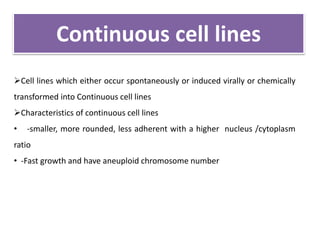
Continuous cell lines
Cell lines which either occur spontaneously or induced virally or chemically
transformed into Continuous cell lines
Characteristics of continuous cell lines
• -smaller, more rounded, less adherent with a higher nucleus /cytoplasm
ratio
• -Fast growth and have aneuploid chromosome number
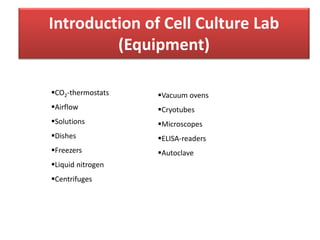
Introduction of Cell Culture Lab
(Equipment)
CO2-thermostats
Airflow
Solutions
Dishes
Freezers
Liquid nitrogen
Centrifuges
Vacuum ovens
Cryotubes
Microscopes
ELISA-readers
Autoclave
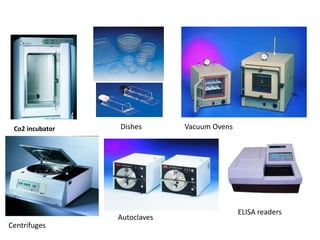
Co2 incubator Dishes
Centrifuges
Autoclaves
Vacuum Ovens
ELISA readers
What is in the media?
 Dulbecco’ Modified Eagle’s Media (DMEM)
 Contains glucose, some proteins, and essential salts
 Contains a pH indicator (phenol red) Media looks pink/red at pH 7.2
 Acidic -yellow or orange (cell growth, bacterial growth)
 Basic -purple (no cell growth, not enough CO2)
 Antibiotics (penicillin and streptomycin)
Prevent bacterial contamination
 Salts and buffers
To simulate in vivo environment
Conti……
Serum
Portion of blood after the cells and fibers have clotted
From cow, horse, sheep
added to media as a nutrient source for growing cells
Lipids, proteins
Use of tissue cultures in toxicity
testing
Mammalian cell cultures can be a suitable alternative for the use of whole animal tests
to establish the potential toxicity of compounds.
This due to many reasons:
•They can overcome the disadvantages of the whole animal tests including:
High cost
Variability of results
•Cell culture tests are ripid,allow more efficient screening of novel compounds and sometimes can
allow identification of metabolic target of inhibition.
Conti…..
 Cell culture tests can be designed to evaluate various effect:
Reduced growth rate
Breakdown of membrane permeability
Tissue specificity response
Ability to metabolize toxic compound
Genetic effect
Use of tissue culture for biological
products
Production of vaccines:
• Two factors stimulated the use of tissue cultures for vaccine production:
▫ The ability to grow viruses in cell culture
Current egg vaccine production require long time(9 month) that hinder the response to
unanticipated demands.
In (1949),Enders discovered that the poliomyelitis virus could be grown from primary
monkey cells in culture.
 The polio vaccine, produced in 1954, was the first human vaccine to be produced using
large-scale cell culture techniques.
Conti…
Animal cell technology is considerably developed for the production of
a range of human and veterinary viral vaccines against a variety of
diseases.
(b) Production of antibodies:
Also, the in vitro methods for production of mABs are the methods of
choice because of:
 The ease of culture for production.
 Less economic consideration compared with the use of animals.
Conti…..
 Practical uses of the in vitro produced mABs:
 Diagnostic tests for the identification of small quantities of specific antigens.
mABs also are used therapeutically: OKT3 recognizes a surface antigen (CD3) on T cell
and is one of the most effective agents in preventing immunological rejection of
transplanted kidneys.
Conti…..
 Various mAbs designed to destruct tumor cells by targeting a membrane bound
protein antigens specifically expressed by these cells.
 The conjugation of radiactive or toxic compounds to the antibody can result in a
localized high concentration resulting in cytotoxicity to the target cells.
Conti….
(c)Recombinant proteins:
Proteins extracted from biological sources have been important for the substitution
therapy.
 since the 1920s when Best and Banting used insulin to treat diabetes.
Conti….
Some examples for these biological products:
 Interferone:
Discovered when Isaacs and Lindenmann (1957) found that culture medium taken from cells that
had supported viral growth could protect non-infected cells from a subsequent viral infection.
 Tissue plasminogen activator (t-PA ):
t-PA was produced in large scale by Genenteck from transfected CHO-K1 cells. It is used to prevent
undesirable formation fibrin clots in the bloodstream.
 Blood clotting factors:
For example, factor VIII is produced in large scale by Bayer through transfection of the mammalian
kidney cell line (BHK) with an appropriate gene.
Cell therapy
Literally, cell therapy means treatment with cells, i.e replacing diseased or
dysfunctional cells with healthy functioning ones.
For example:
•When hematopoietic cells are vulnerable to destruction by any cytotoxic drugs used in
chemotherapy to eradicate residual tumor cells.
Drug screening & development
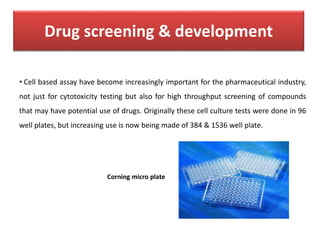
• Cell based assay have become increasingly important for the pharmaceutical industry,
not just for cytotoxicity testing but also for high throughput screening of compounds
that may have potential use of drugs. Originally these cell culture tests were done in 96
well plates, but increasing use is now being made of 384 & 1536 well plate.
Corning micro plate
Respiratory cell line
Alveolar cells
A549 cells
Bronchial epithelial cells
BEAS 2B, DMS53, SHP-77,
NCI-H23, 292, 524, 727,11655,1299
HBE4-E6/E7 etc….. (>140)
Macrophage
Differentiated U937/MonoMac6 cell
Murine RAW264.7
• Respiratory cell lines are useful for evaluating of molecular
mechanisms of inflammation and other physiological /pathological
events.
Pancreatic beta cell lines and their applications
in diabetes mellitus research
During the past 30 years great effort has been put into establishing an insulin-
secreting beta cell line that retains normal regulation of insulin secretion, but only few
of these attempts have been successful.
To overcome the limited availability of primary beta cells into the field of diabetes
mellitus research, numerous investigators used X-rays or viruses to induce insulinomas,
in vitro transformation, derivation of cells from transgenic mice or even non-islet cells to
produce immortalized beta cell lines.
The most widely used insulin-secreting cell lines are RIN, HIT, MIN, INS-1 and TC
cells.
 These cells produce insulin and small amounts of glucagon and somatostatin.
Despite problems associated with beta cell cultures, these cell lines have provided
some valuable information about physiological processes.
However, an urgent need to establish a "normal" beta cell line of human or pig
origin remains.
Vivalis, a Nantes, France-based biotechnology company, has developed EB66®, a
novel cell line derived from duck embryonic stem cells for the cell culture
production of viral vaccines.
As a result, EB66 cells have become a superior industry alternative for the safe,
cost effective manufacturing of viral vaccines.
Cell line in vaccinesCell lines in vaccines
Vivalis offers research and commercial licenses for this cell line to pharmaceutical
and biotechnology companies for the production of prophylactic and therapeutic
vaccines.
Applications of cell lines

Applications of cell lines

  • 1.
    Applications of cell lines By KAUSHALKUMAR SAHU Assistant Professor (Ad Hoc) Department of Biotechnology Govt. Digvijay Autonomous P. G. College Raj-Nandgaon ( C. G. )
  • 2.
    Cell culture  Cellculture is the process by which prokaryotic, eukaryotic or plant cells are grown under controlled conditions. But in practice it refers to the culturing of cells derived from animal cells.  Cell culture was first successfully undertaken by Ross Harrison in 1907  Roux in 1885 for the first time maintained embryonic chick cells in a cell culture.
  • 3.
    Why is cellculture used for? Areas where cell culture technology is currently playing a major role.  Model systems for Studying basic cell biology, interactions between disease causing agents and cells, effects of drugs on cells, process and triggering of aging & nutritional studies  Toxicity testing Study the effects of new drugs  Cancer research Study the function of various chemicals, virus & radiation to convert normal cultured cells to cancerous cells
  • 4.
    Conti…..  Virology Cultivation ofvirus for vaccine production, also used to study there infectious cycle. e.g. polio, rabies, chicken pox, hepatitis B & measles.  Gene therapy Cells having a functional gene can be replaced to cells which are having non-functional gene.
  • 5.
    Tissue culture •In vitrocultivation of organs, tissues & cells at defined temperature using an incubator & supplemented with a medium containing cell nutrients & growth factors is collectively known as tissue culture. •Different types of cell grown in culture includes connective tissue elements such as fibroblasts, skeletal tissue, cardiac, epithelial tissue (liver, breast, skin, kidney) and many different types of tumor cells.
  • 6.
    Primary culture •Cells whensurgically or enzymatically removed from an organism and placed in suitable culture environment will attach and grow are called as primary culture. •Primary cells have a finite life span. •Primary culture contains a very heterogeneous population of cells. •Treated by proteolytic enzyme (Trypsin).
  • 7.
    Cell lines A cellline is a product of immortal cells that are used for biological research.  Cells used for cell lines are immortal, that happens if a cell is cancerous. The cells can perpetuate division indefinitely which is unlike regular cells which can only divide approximately 50 times. WRL-68HeLa Jurkat
  • 8.
    Common cell lines Human cell lines MCF-7 breast cancer HL 60 Leukemia HEK-293 Human embryonic kidney HeLa Henrietta lacks  Primate cell lines Vero African green monkey kidney epithelial cells Cos-7 African green monkey kidney cells And others such as CHO from hamster, sf9 & sf21 from insect cells.
  • 9.
    Cell line Species of origin Tissue of origin Cell morphology Growthin suspension? 3T3 Mouse Connective Fibroblast No CHO Chinese Hamster Ovary Epithelial Yes BHK21 Syrian Hamster Kidney Fibroblast Yes HeLa Human Cervical Carcinoma Epithelial Yes
  • 10.
    Continuous cell lines Celllines which either occur spontaneously or induced virally or chemically transformed into Continuous cell lines Characteristics of continuous cell lines • -smaller, more rounded, less adherent with a higher nucleus /cytoplasm ratio • -Fast growth and have aneuploid chromosome number
  • 12.
    Introduction of CellCulture Lab (Equipment) CO2-thermostats Airflow Solutions Dishes Freezers Liquid nitrogen Centrifuges Vacuum ovens Cryotubes Microscopes ELISA-readers Autoclave
  • 13.
  • 14.
    What is inthe media?  Dulbecco’ Modified Eagle’s Media (DMEM)  Contains glucose, some proteins, and essential salts  Contains a pH indicator (phenol red) Media looks pink/red at pH 7.2  Acidic -yellow or orange (cell growth, bacterial growth)  Basic -purple (no cell growth, not enough CO2)  Antibiotics (penicillin and streptomycin) Prevent bacterial contamination  Salts and buffers To simulate in vivo environment
  • 15.
    Conti…… Serum Portion of bloodafter the cells and fibers have clotted From cow, horse, sheep added to media as a nutrient source for growing cells Lipids, proteins
  • 16.
    Use of tissuecultures in toxicity testing Mammalian cell cultures can be a suitable alternative for the use of whole animal tests to establish the potential toxicity of compounds. This due to many reasons: •They can overcome the disadvantages of the whole animal tests including: High cost Variability of results •Cell culture tests are ripid,allow more efficient screening of novel compounds and sometimes can allow identification of metabolic target of inhibition.
  • 17.
    Conti…..  Cell culturetests can be designed to evaluate various effect: Reduced growth rate Breakdown of membrane permeability Tissue specificity response Ability to metabolize toxic compound Genetic effect
  • 18.
    Use of tissueculture for biological products Production of vaccines: • Two factors stimulated the use of tissue cultures for vaccine production: ▫ The ability to grow viruses in cell culture Current egg vaccine production require long time(9 month) that hinder the response to unanticipated demands. In (1949),Enders discovered that the poliomyelitis virus could be grown from primary monkey cells in culture.  The polio vaccine, produced in 1954, was the first human vaccine to be produced using large-scale cell culture techniques.
  • 19.
    Conti… Animal cell technologyis considerably developed for the production of a range of human and veterinary viral vaccines against a variety of diseases. (b) Production of antibodies: Also, the in vitro methods for production of mABs are the methods of choice because of:  The ease of culture for production.  Less economic consideration compared with the use of animals.
  • 20.
    Conti…..  Practical usesof the in vitro produced mABs:  Diagnostic tests for the identification of small quantities of specific antigens. mABs also are used therapeutically: OKT3 recognizes a surface antigen (CD3) on T cell and is one of the most effective agents in preventing immunological rejection of transplanted kidneys.
  • 21.
    Conti…..  Various mAbsdesigned to destruct tumor cells by targeting a membrane bound protein antigens specifically expressed by these cells.  The conjugation of radiactive or toxic compounds to the antibody can result in a localized high concentration resulting in cytotoxicity to the target cells.
  • 22.
    Conti…. (c)Recombinant proteins: Proteins extractedfrom biological sources have been important for the substitution therapy.  since the 1920s when Best and Banting used insulin to treat diabetes.
  • 23.
    Conti…. Some examples forthese biological products:  Interferone: Discovered when Isaacs and Lindenmann (1957) found that culture medium taken from cells that had supported viral growth could protect non-infected cells from a subsequent viral infection.  Tissue plasminogen activator (t-PA ): t-PA was produced in large scale by Genenteck from transfected CHO-K1 cells. It is used to prevent undesirable formation fibrin clots in the bloodstream.  Blood clotting factors: For example, factor VIII is produced in large scale by Bayer through transfection of the mammalian kidney cell line (BHK) with an appropriate gene.
  • 24.
    Cell therapy Literally, celltherapy means treatment with cells, i.e replacing diseased or dysfunctional cells with healthy functioning ones. For example: •When hematopoietic cells are vulnerable to destruction by any cytotoxic drugs used in chemotherapy to eradicate residual tumor cells.
  • 25.
    Drug screening &development • Cell based assay have become increasingly important for the pharmaceutical industry, not just for cytotoxicity testing but also for high throughput screening of compounds that may have potential use of drugs. Originally these cell culture tests were done in 96 well plates, but increasing use is now being made of 384 & 1536 well plate. Corning micro plate
  • 26.
    Respiratory cell line Alveolarcells A549 cells Bronchial epithelial cells BEAS 2B, DMS53, SHP-77, NCI-H23, 292, 524, 727,11655,1299 HBE4-E6/E7 etc….. (>140) Macrophage Differentiated U937/MonoMac6 cell Murine RAW264.7 • Respiratory cell lines are useful for evaluating of molecular mechanisms of inflammation and other physiological /pathological events.
  • 27.
    Pancreatic beta celllines and their applications in diabetes mellitus research During the past 30 years great effort has been put into establishing an insulin- secreting beta cell line that retains normal regulation of insulin secretion, but only few of these attempts have been successful. To overcome the limited availability of primary beta cells into the field of diabetes mellitus research, numerous investigators used X-rays or viruses to induce insulinomas, in vitro transformation, derivation of cells from transgenic mice or even non-islet cells to produce immortalized beta cell lines.
  • 28.
    The most widelyused insulin-secreting cell lines are RIN, HIT, MIN, INS-1 and TC cells.  These cells produce insulin and small amounts of glucagon and somatostatin. Despite problems associated with beta cell cultures, these cell lines have provided some valuable information about physiological processes. However, an urgent need to establish a "normal" beta cell line of human or pig origin remains.
  • 29.
    Vivalis, a Nantes,France-based biotechnology company, has developed EB66®, a novel cell line derived from duck embryonic stem cells for the cell culture production of viral vaccines. As a result, EB66 cells have become a superior industry alternative for the safe, cost effective manufacturing of viral vaccines. Cell line in vaccinesCell lines in vaccines
  • 30.
    Vivalis offers researchand commercial licenses for this cell line to pharmaceutical and biotechnology companies for the production of prophylactic and therapeutic vaccines.