Introduction
 We examine five different application security models
that are commonly used by the industry to provide
data security and access protection at the table level.
 Database role based.
 Application role based.
 Application function based.
 Application role and function based.
 Application table based.
Security Model Based on Database
Roles
 This model depend on the application to
authentication the application users by maintain all
end users in a table with their encryption password.
 In this model, each end user is assigned a database
role, which has specific database privilege for
accessing application table.
 The user can access whatever privileges are assigned to
the role
Security Model Based on Database
Roles
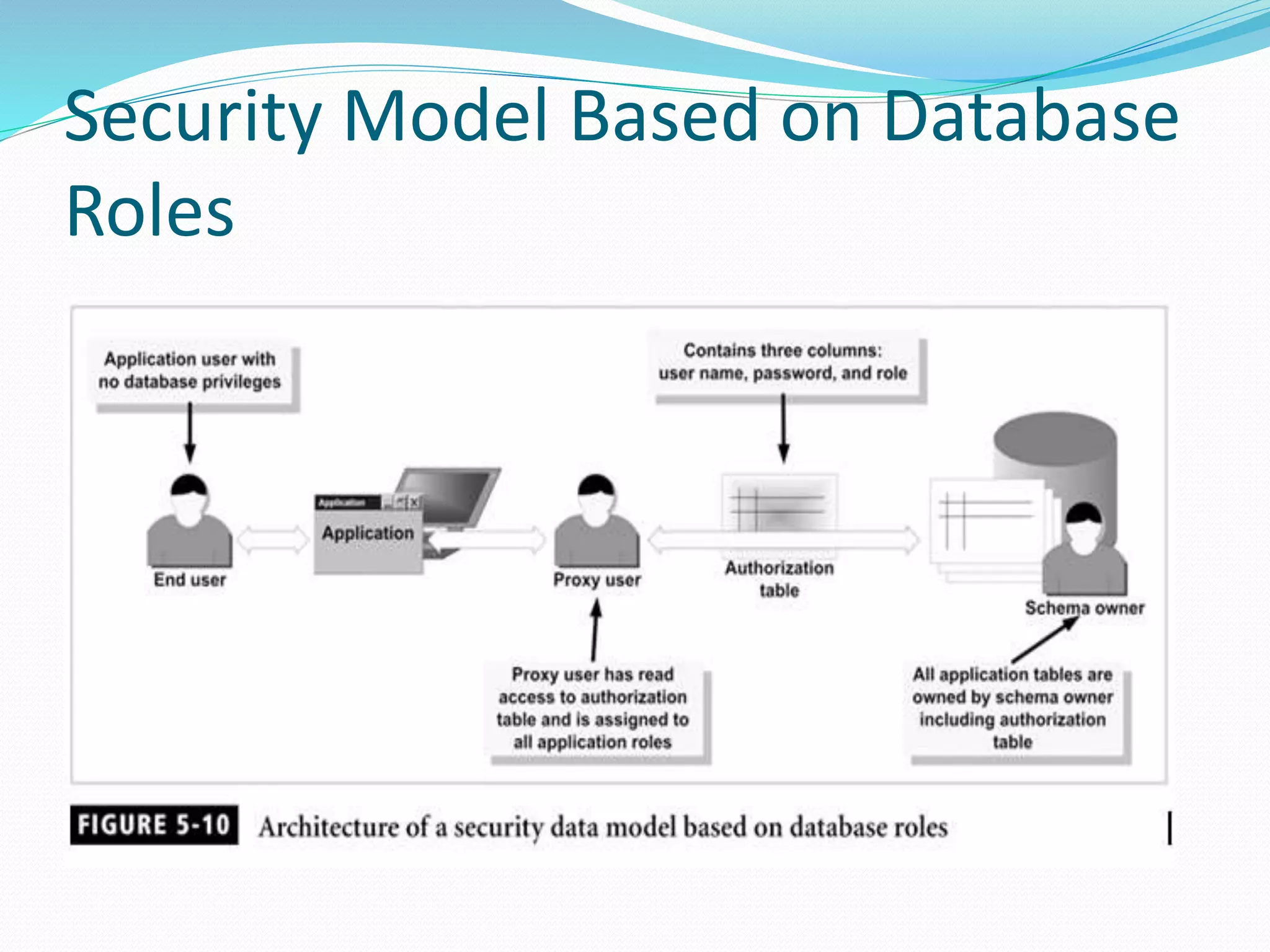
 This model, proxy user is needed to activate assigned
roles.
 All roles are assigned to the proxy user.
Security Model Based on Database
Roles
Security Model Based on Database
Roles
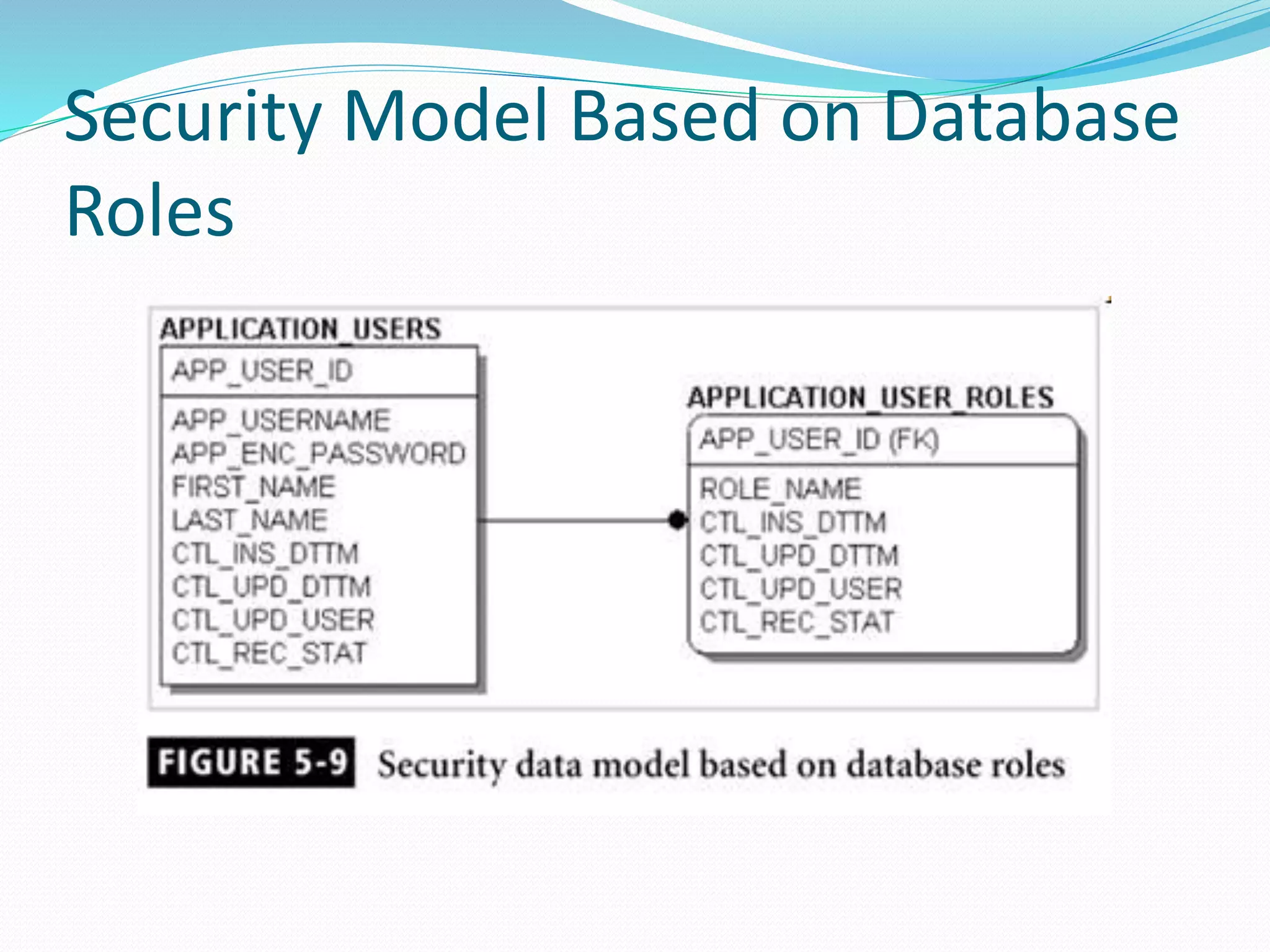
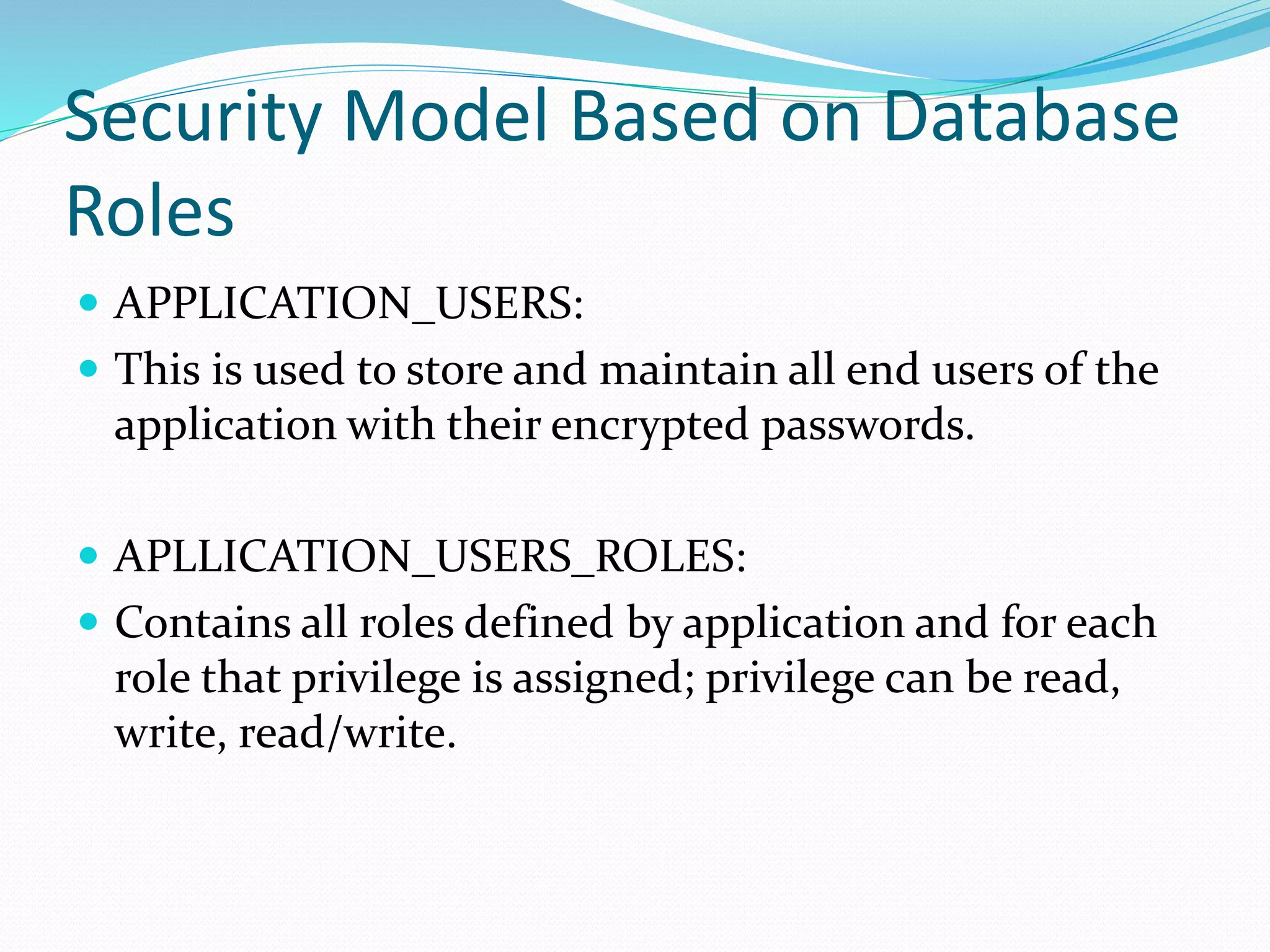
 APPLICATION_USERS:
 This is used to store and maintain all end users of the
application with their encrypted passwords.
 APLLICATION_USERS_ROLES:
 Contains all roles defined by application and for each
role that privilege is assigned; privilege can be read,
write, read/write.
Security Model Based on Database
Roles
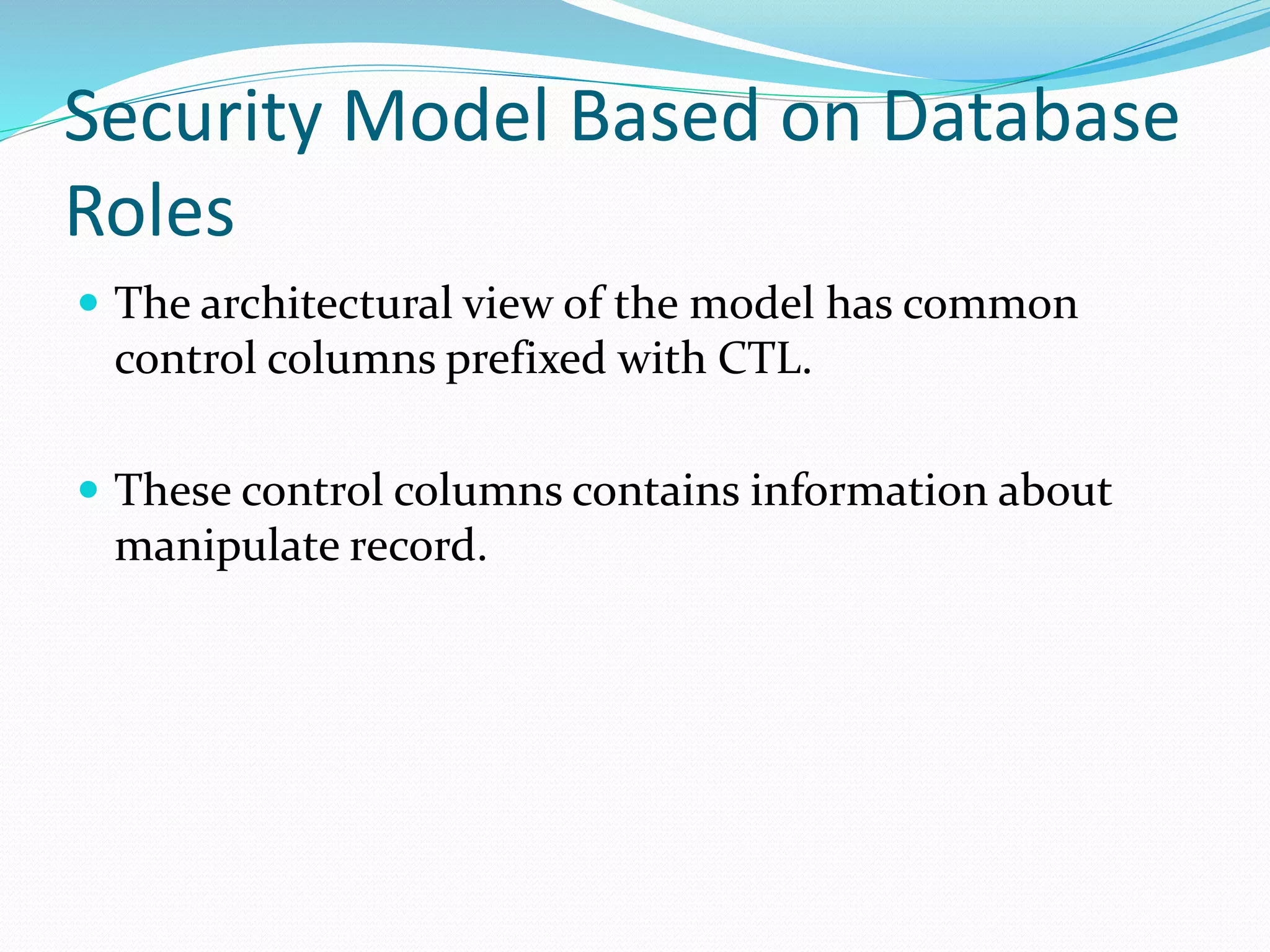
 The architectural view of the model has common
control columns prefixed with CTL.
 These control columns contains information about
manipulate record.
Security Model Based on Database
Roles
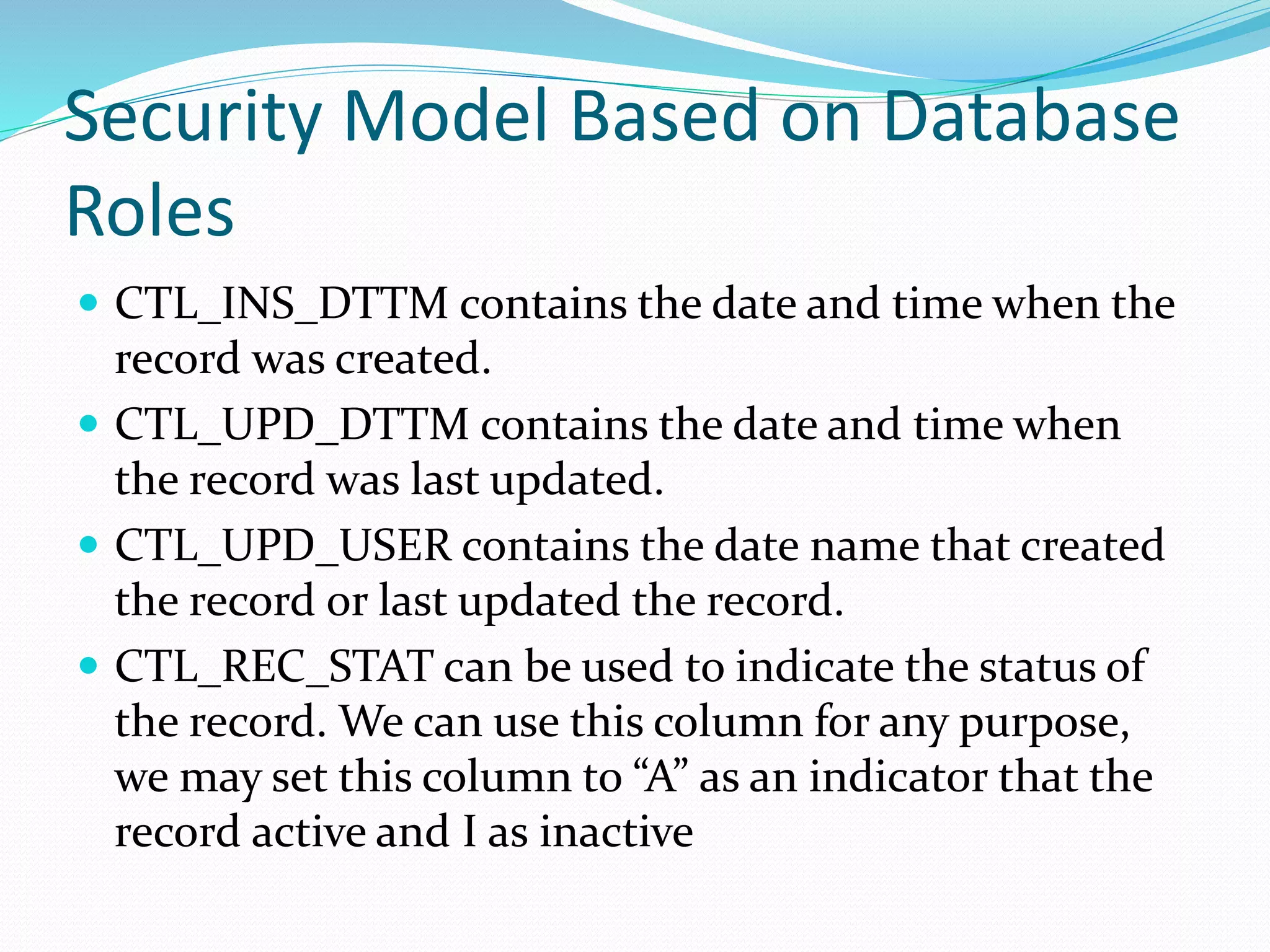
 CTL_INS_DTTM contains the date and time when the
record was created.
 CTL_UPD_DTTM contains the date and time when
the record was last updated.
 CTL_UPD_USER contains the date name that created
the record or last updated the record.
 CTL_REC_STAT can be used to indicate the status of
the record. We can use this column for any purpose,
we may set this column to “A” as an indicator that the
record active and I as inactive
Security Model Based on Database
Roles
Security Model Based on Database
Roles
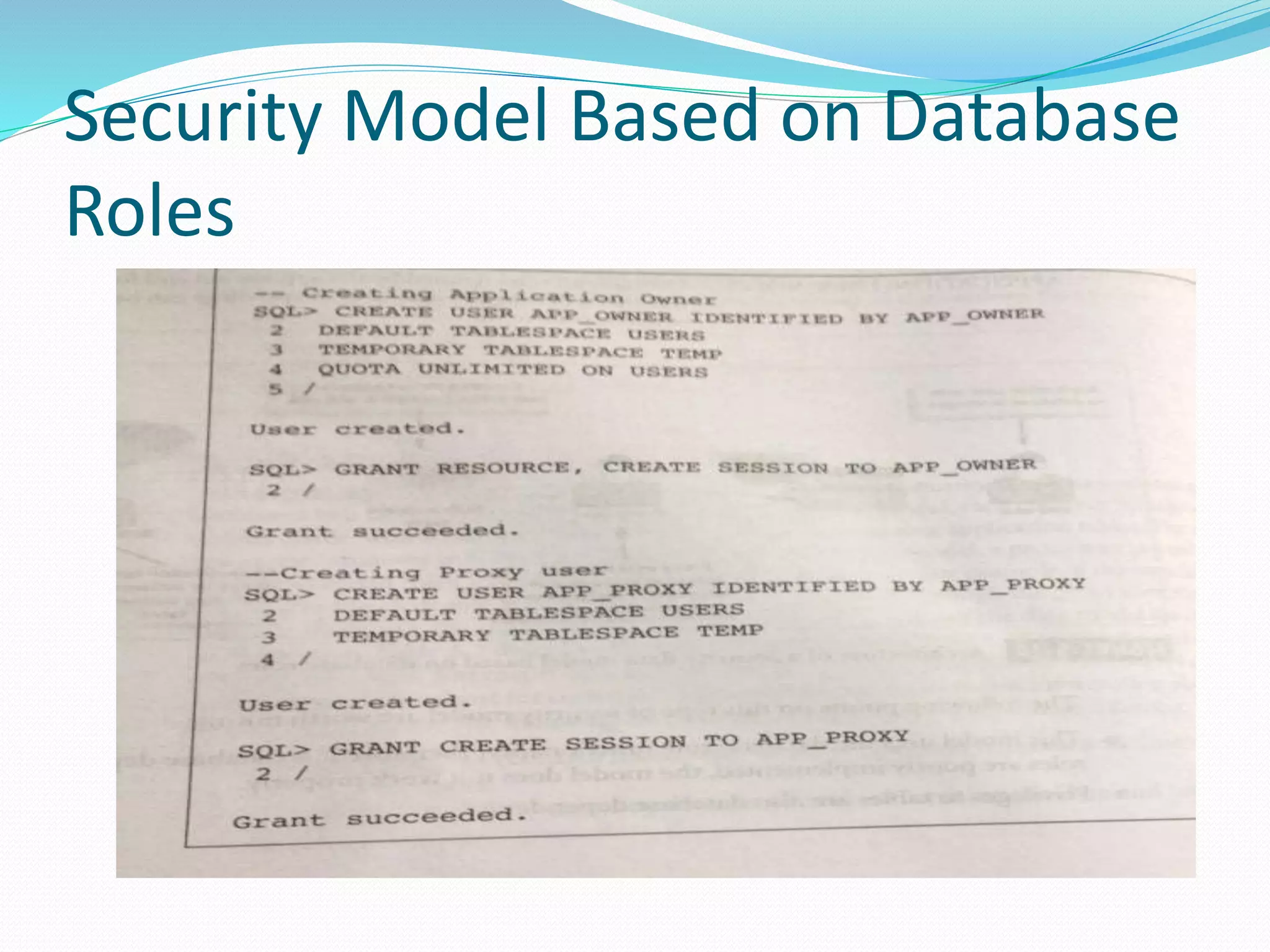
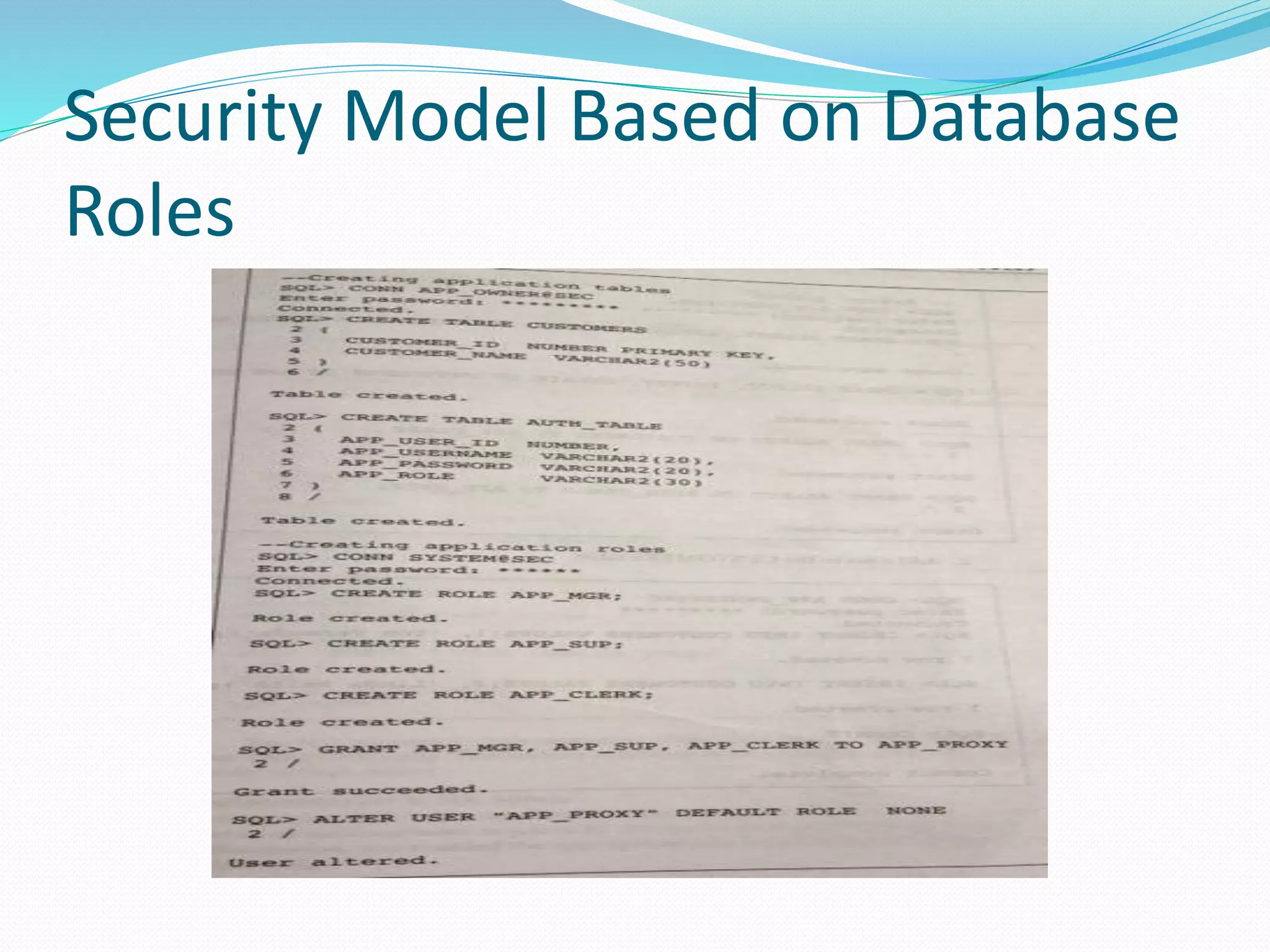
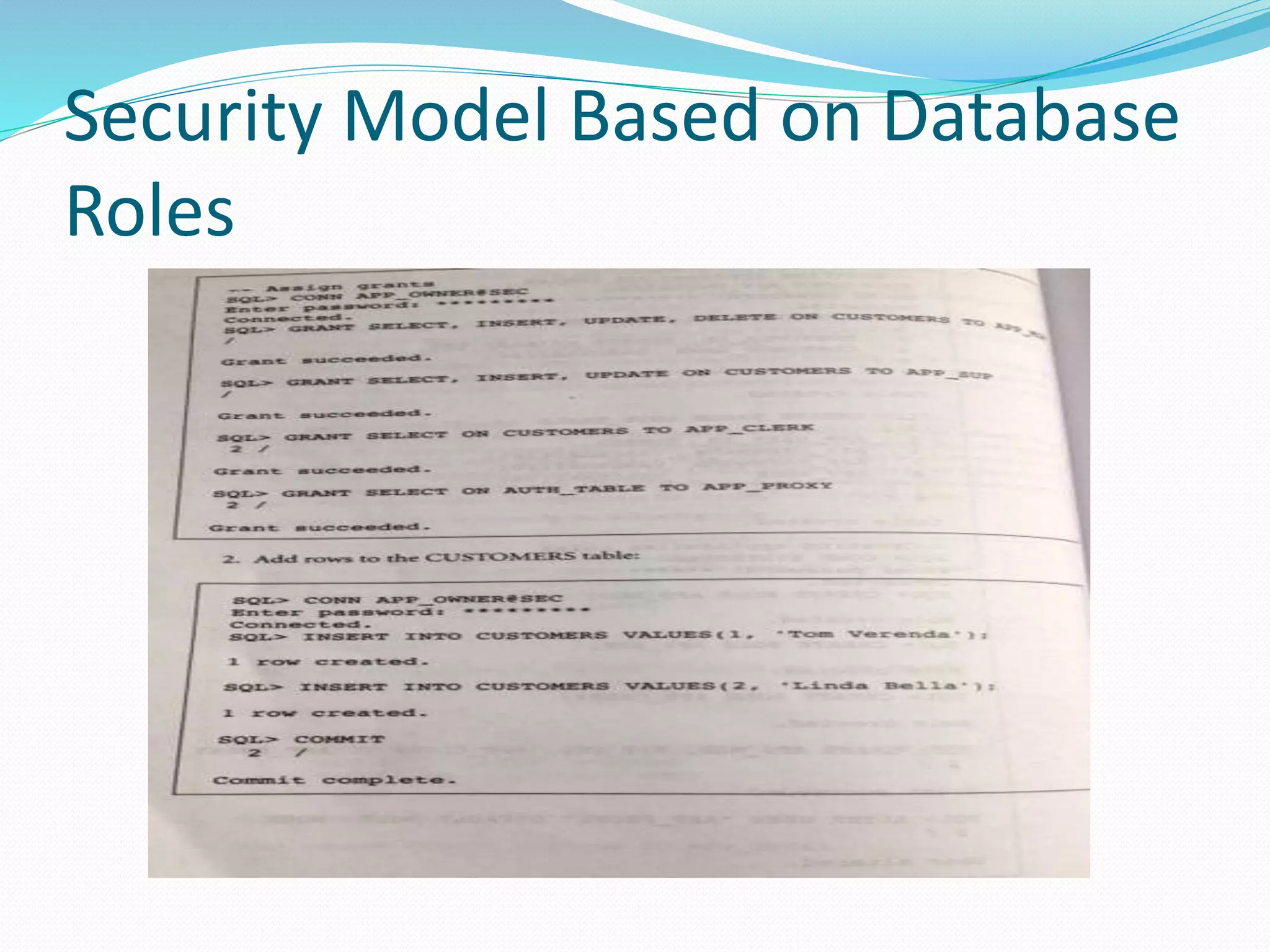
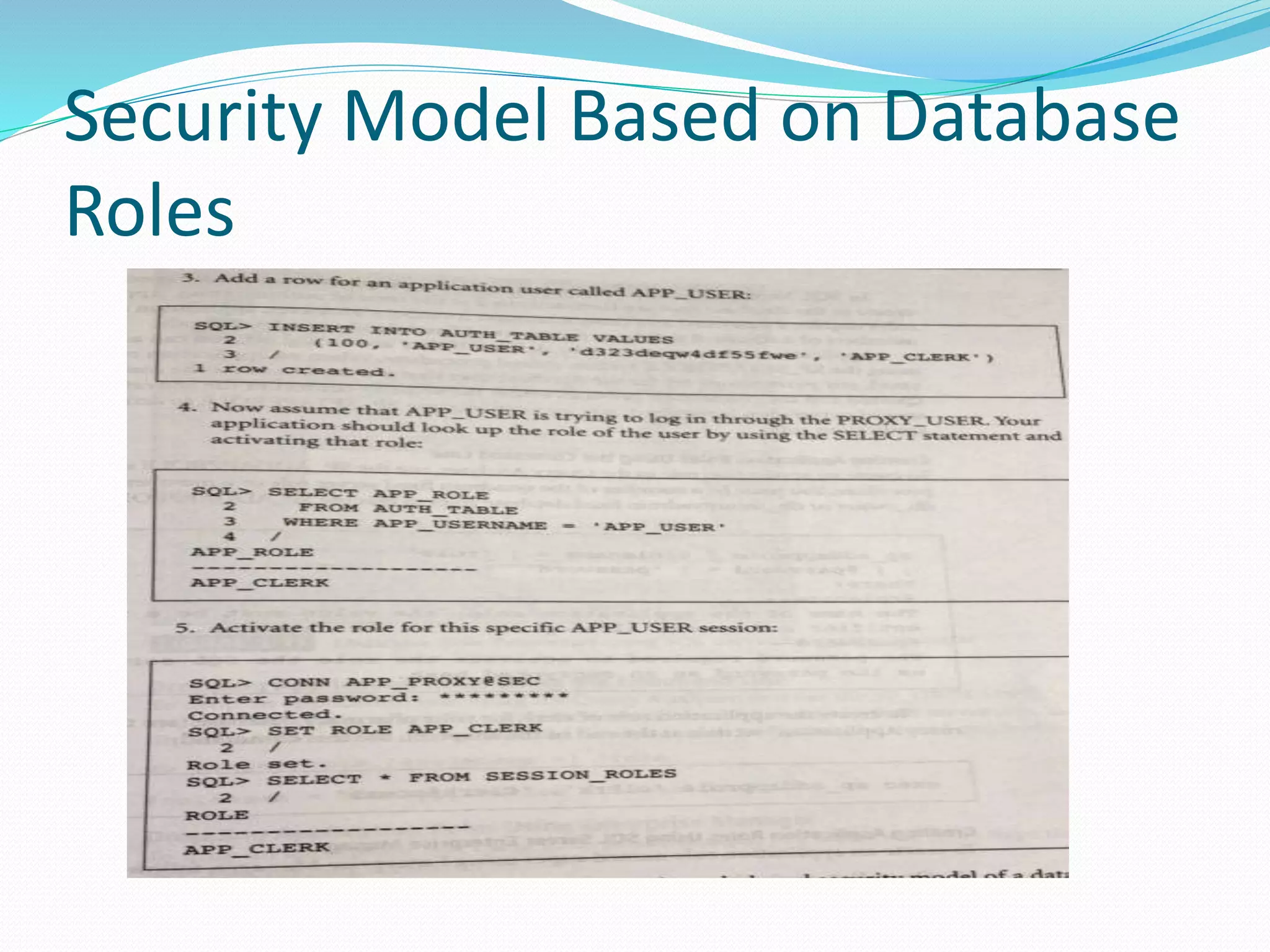
 Implementing in Oracle
 create a proxy user called APP_PROXY that will be
assigned to all application role and will work on behalf
of the application user APP_USER to gain access to all
tables owned by the application owner called
APP_OWNER.
Security Model Based on Database
Roles
Security Model Based on Database
Roles
Security Model Based on Database
Roles
Security Model Based on Database
Roles
Security Model Based on
Application Roles
 The concept of an application role security model are
similar to the concept of database role security model
in that they are both methods for organizing and
administrating privileges.
 Application roles are typically mapped specifically to
real business roles
Security Model Based on
Application Roles
Security Model Based on
Application Roles
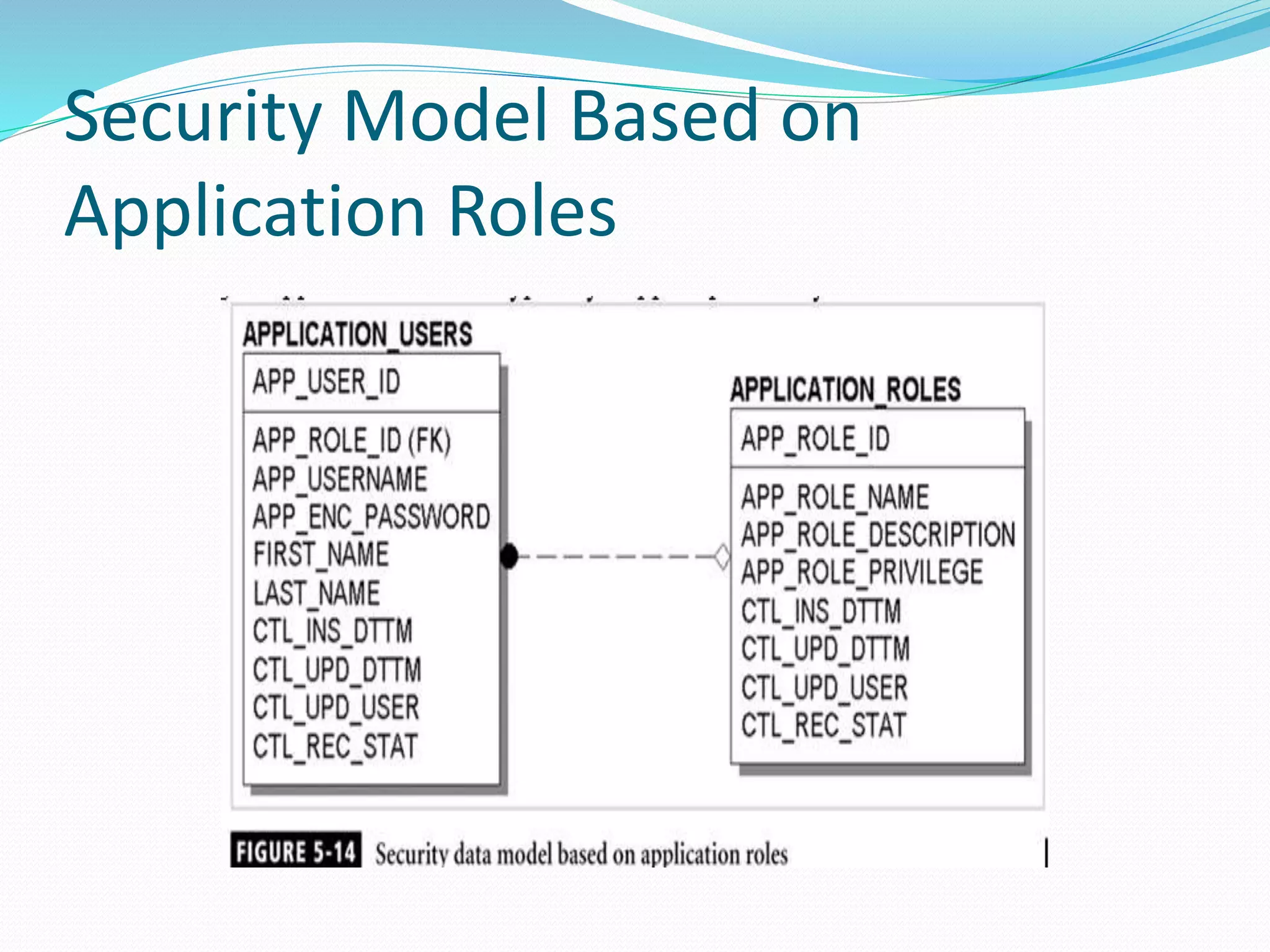
 APPLICATION_USERS:
 This is used to store and maintain all end users of the
application with their encrypted passwords.
 APPLICATION_ROLES
 All roles defined by the application and for each role a
privilege are assigned. The privilege can be read, write,
or read/write
Security Model Based on
Application Roles
 The security model that is based on application roles
depends on the application to authenticate the
application users.
 Authentication is accomplished by maintaining all end
users in a table with their encrypted password.
Security Model Based on
Application Roles
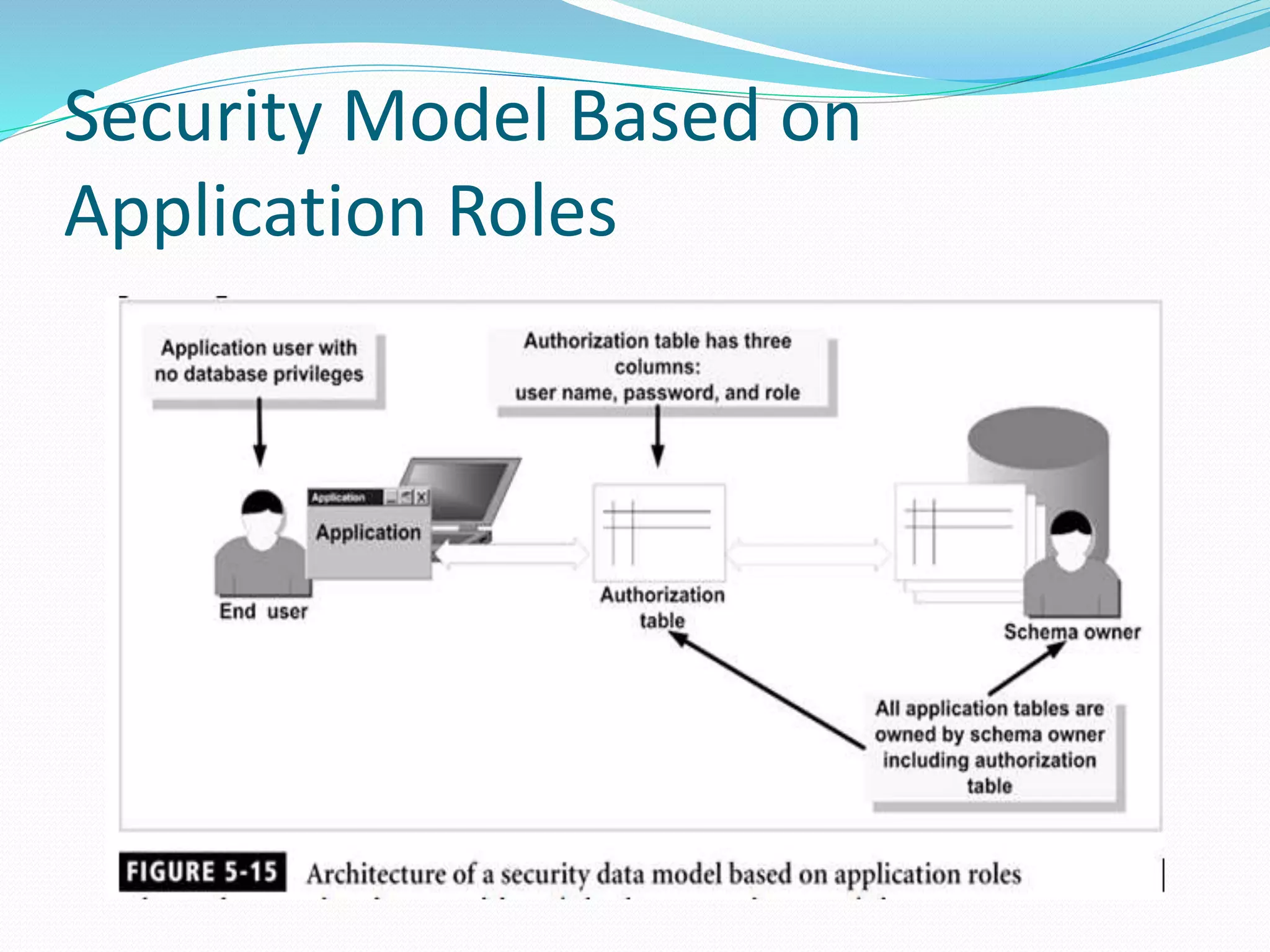
 In this model, each end user is assigned an application
role, and the application role is provided with
application privileges to read/write specific modules of
the application.
Security Model Based on
Application Roles
Security Model Based on
Application Roles
 The point need to be considered during security
Model
 This model does not allow the flexibility required to
make changes necessary for security.
 For example a user called Scott who has a clerk role,
and the clerk has privileges to read, add, and modify.
This means that Scott can perform these operations on
all modules of the application.
Security Model Based on
Application Roles
 Privileges are limited to any combination of the
following.
 read
 add
 delete
 update
 admin
Security Model Based on
Application Roles
 This model isolates the application security from the
database, which make implementation of database
independent.
 Only one role is assigned to an application user.
 Maintenance of the application security does not
require specific database privilege. This lowers the risk
of database violation.
Security Model Based on
Application Roles
 Passwords must be securely encrypted. preferably
using private and public keys
Security Model based on
Application Functions
 The security model that is based on application
function depends on the application to authenticate
the application user by maintaining all end user in a
table with their encrypted password.
Security Model based on
Application Functions
 In this model the application is divided into functions.
 For instance, if you were using an inventory
application we need to have a function name
CUSTOMER that maintain customers and another
function name PRODUCTS for maintain products, and
so on
Security Model based on
Application Functions
Security Model based on
Application Functions
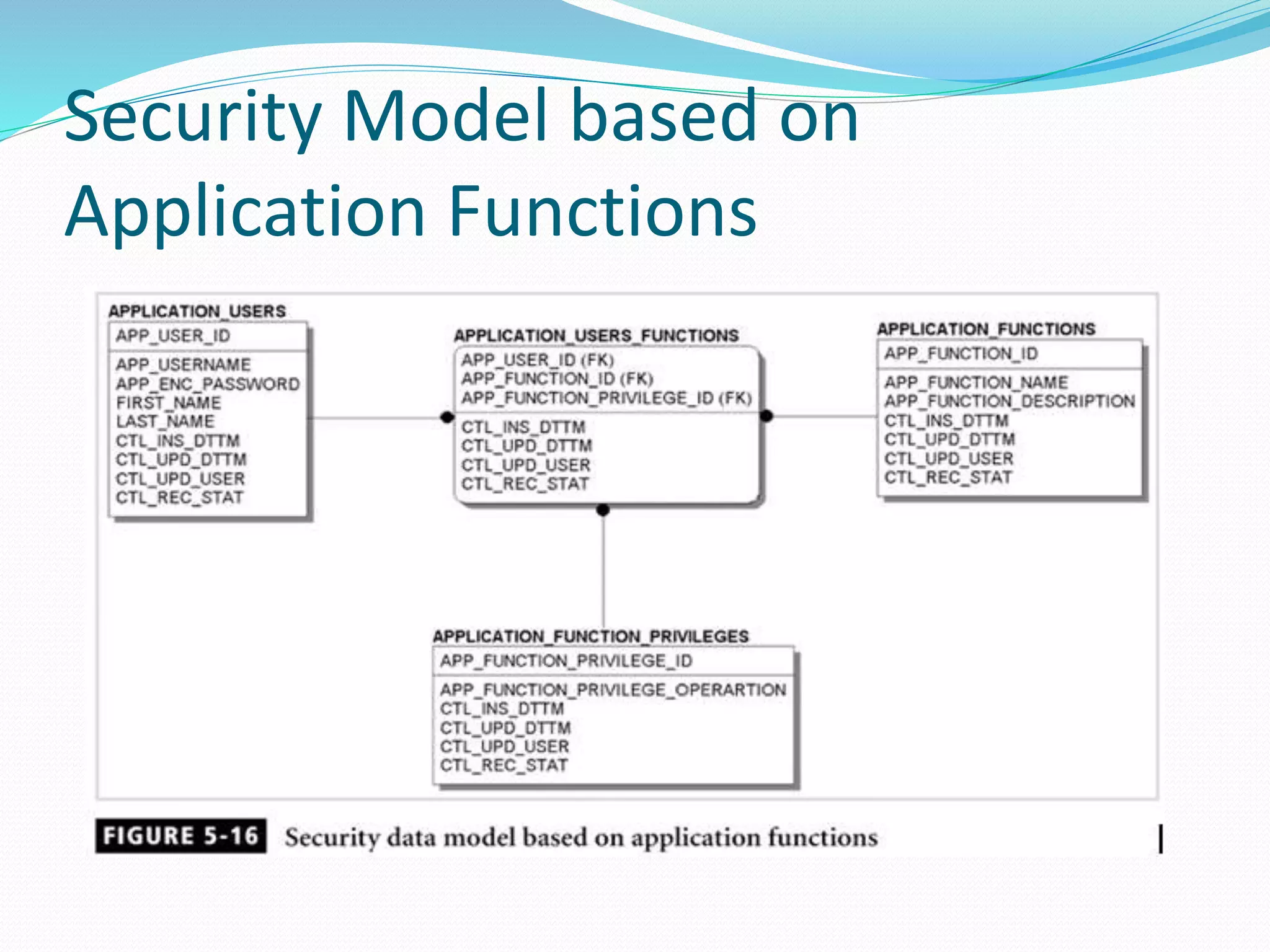
 Tables used in this security model
 APPLICATION_USERS:
 This is used to store and maintain all end users of the
application with their encrypted passwords
 Application Functions:
 This table contains all logical functions of the
application
Security Model based on
Application Functions
 Tables used in this security model
 Application_Functions_Privileges
 This table stores all privileges for functions such as : read,
write, read/write
 Application_Users_Functions
 This table contains all end users and their application
function privileges.
Security Model based on
Application Functions
 The following list presents characteristics of this
security model:
 In this model the application security from the
database, this makes implementation independent.
 Maintenance of the application security does not
require specific database privileges which lower the
risk of database violations.
Security Model based on
Application Functions
 Password must be securely encrypted, preferably using
private and public key. In this case we must modify the
structure of the APPLICATION_USERS table by
adding columns to store public and private keys.
 The application must be designed in a granular
fashion.
 The more granular the privileges, the more effort are
needed to implement them
Security Model based on
Application Roles and Functions
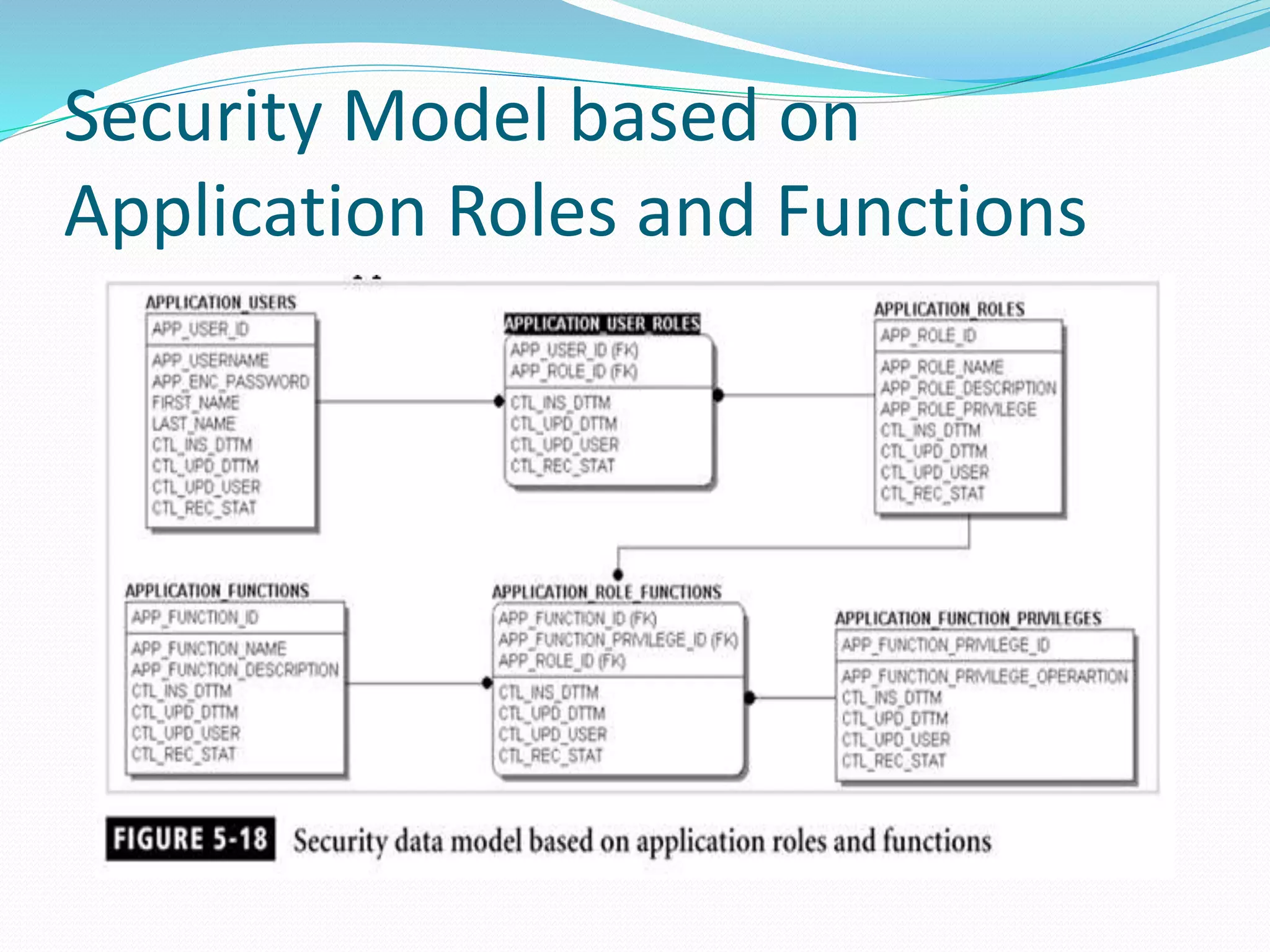
 This security model is a combination of both the role
and function security models.
 The application roles and functions security model
depends on the application to authenticate the
application users.
Security Model based on
Application Roles and Functions
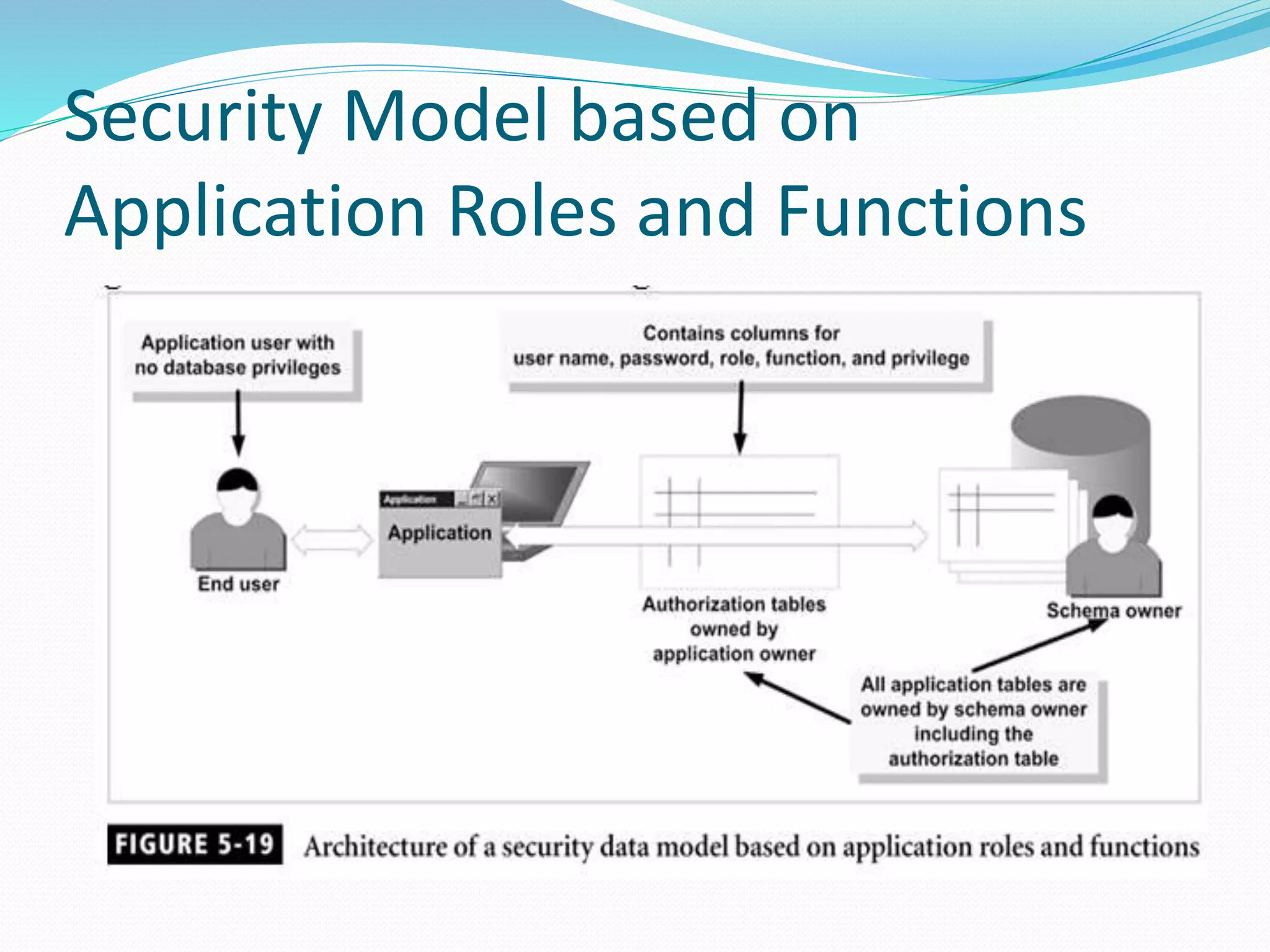
 The application authenticates users by maintaining all
end users in a table with their encrypted passwords.
 In this model the application is divided into function
and roles are assigned to function that are in turn
assigned to users.
Security Model based on
Application Roles and Functions
Security Model based on
Application Roles and Functions
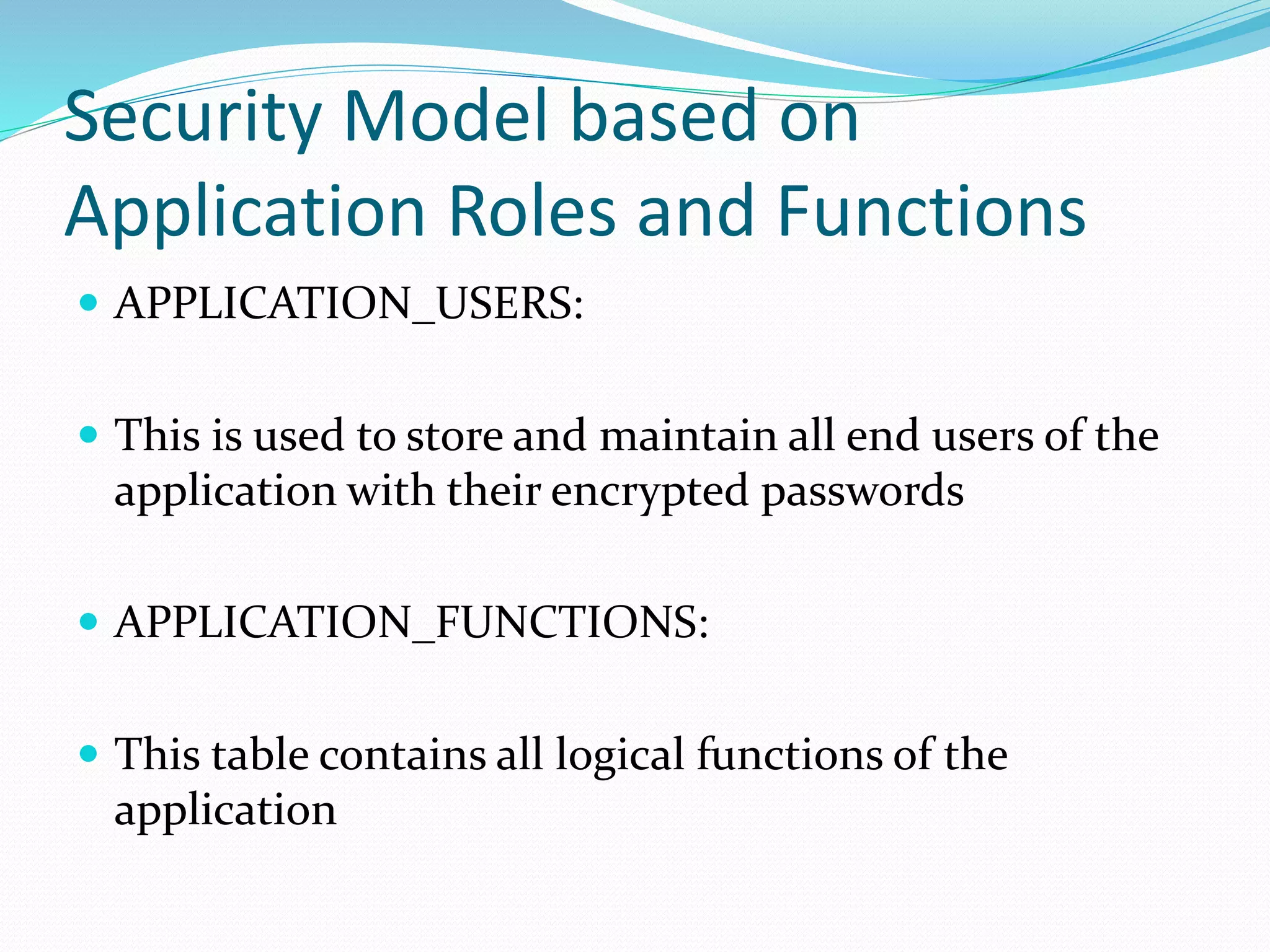
 APPLICATION_USERS:
 This is used to store and maintain all end users of the
application with their encrypted passwords
 APPLICATION_FUNCTIONS:
 This table contains all logical functions of the
application
Security Model based on
Application Roles and Functions
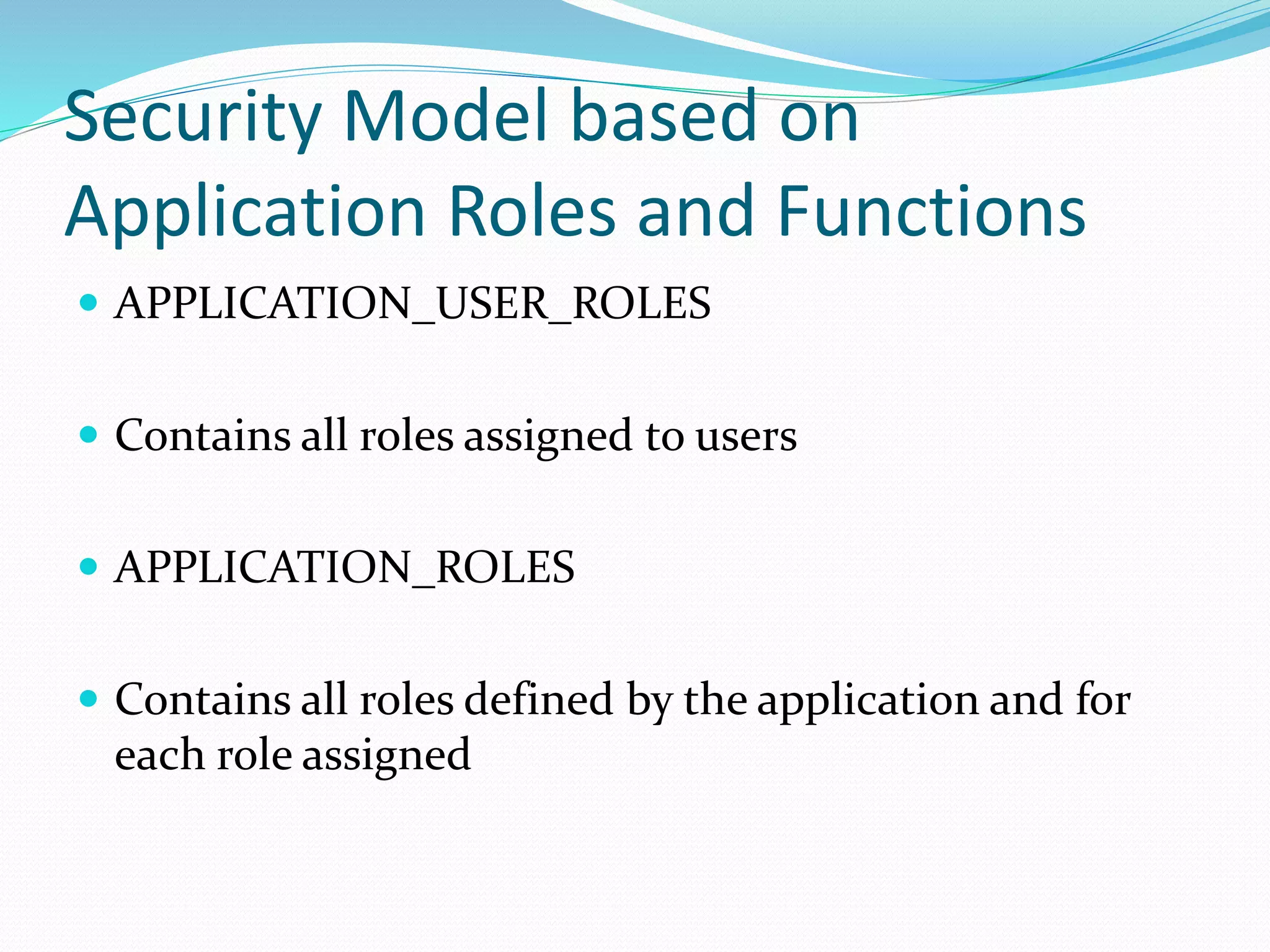
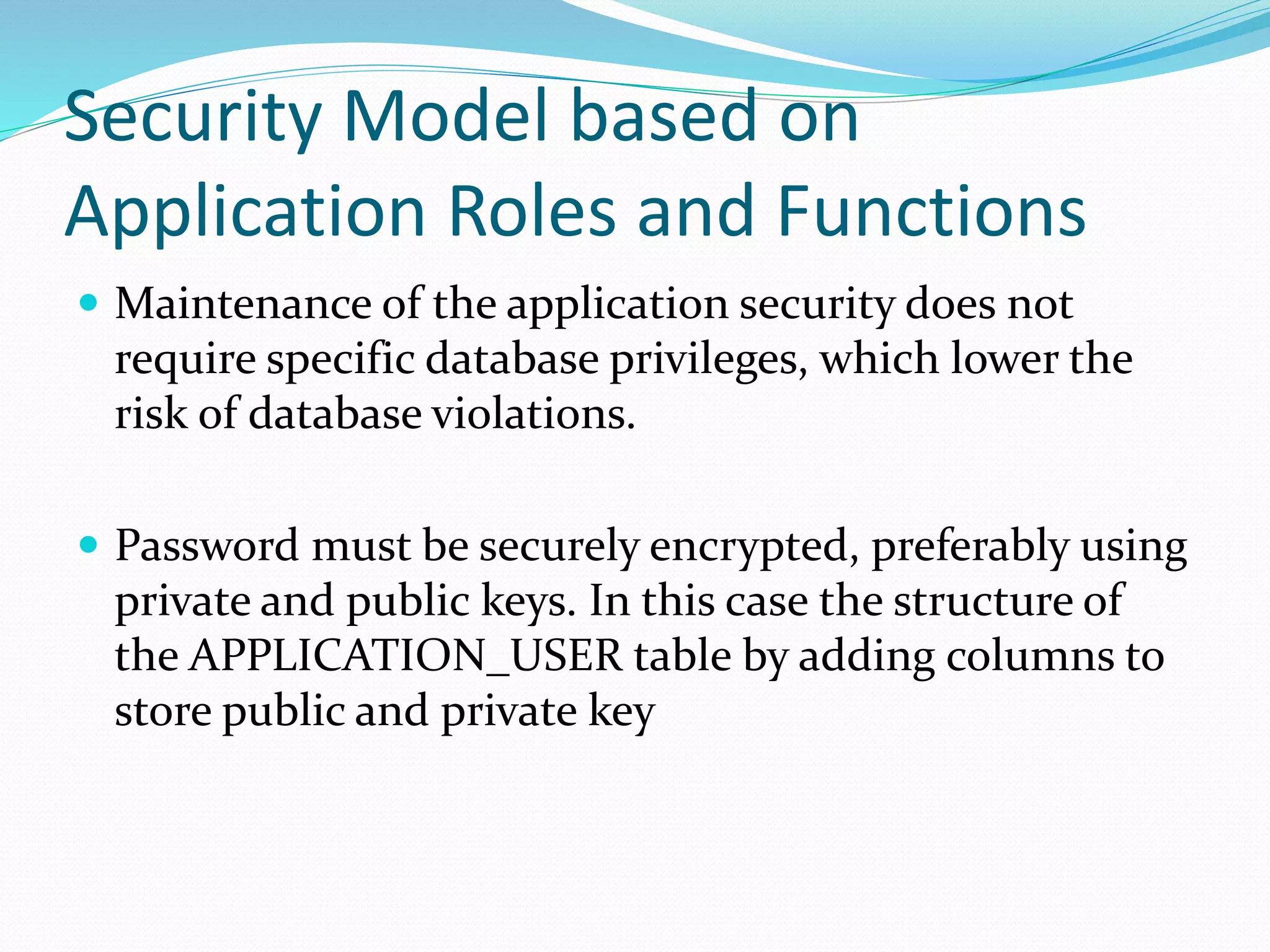
 APPLICATION_USER_ROLES
 Contains all roles assigned to users
 APPLICATION_ROLES
 Contains all roles defined by the application and for
each role assigned
Security Model based on
Application Roles and Functions
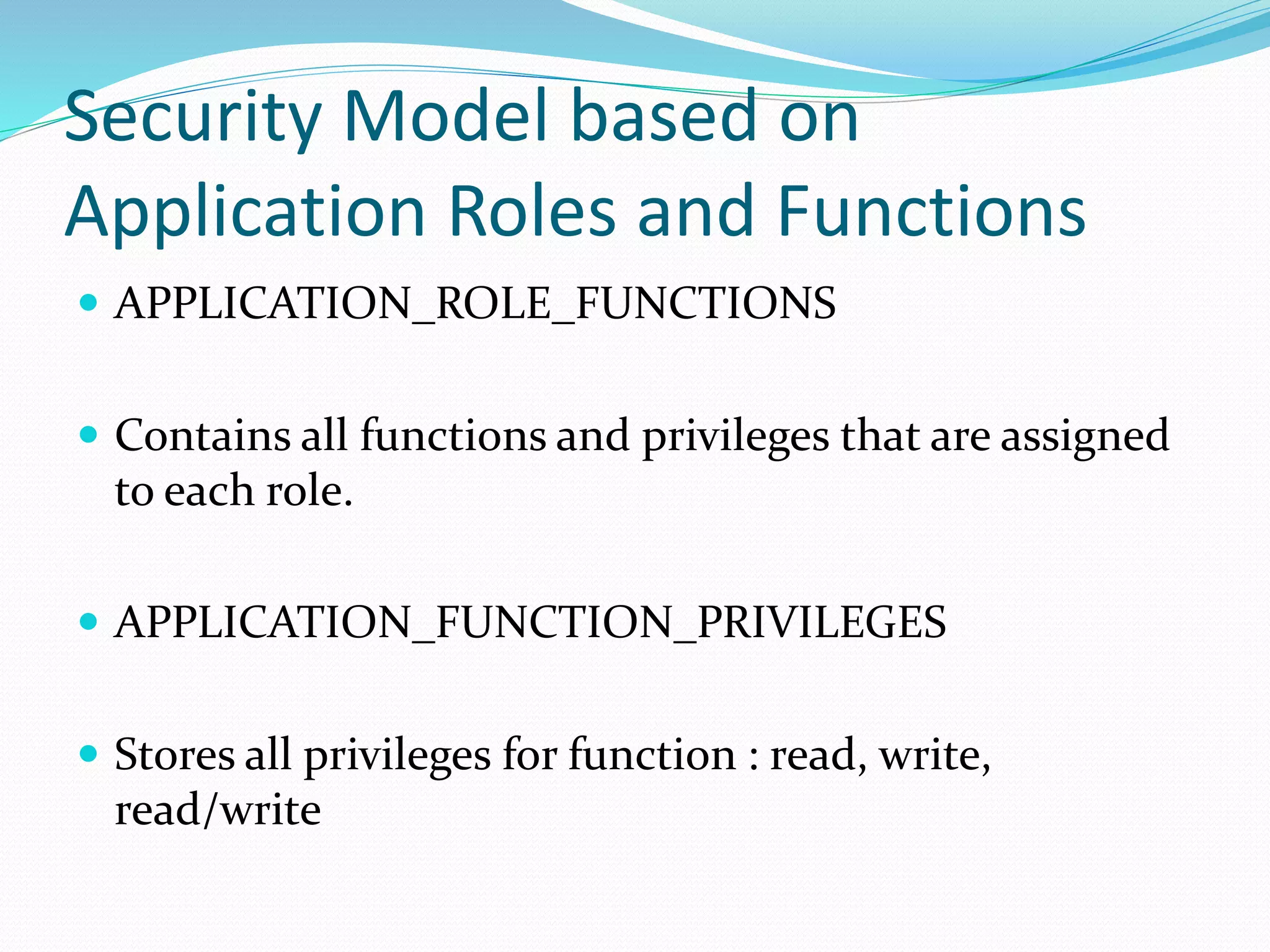
 APPLICATION_ROLE_FUNCTIONS
 Contains all functions and privileges that are assigned
to each role.
 APPLICATION_FUNCTION_PRIVILEGES
 Stores all privileges for function : read, write,
read/write
Security Model based on
Application Roles and Functions
Security Model based on
Application Roles and Functions
 The following list present characteristics of this
security model:
 This model provides flexibility for implementing
application security.
 This model isolates the application security from the
database, which make implementation database
independent
Security Model based on
Application Roles and Functions
 Maintenance of the application security does not
require specific database privileges, which lower the
risk of database violations.
 Password must be securely encrypted, preferably using
private and public keys. In this case the structure of
the APPLICATION_USER table by adding columns to
store public and private key
Security Model based on
Application Roles and Functions
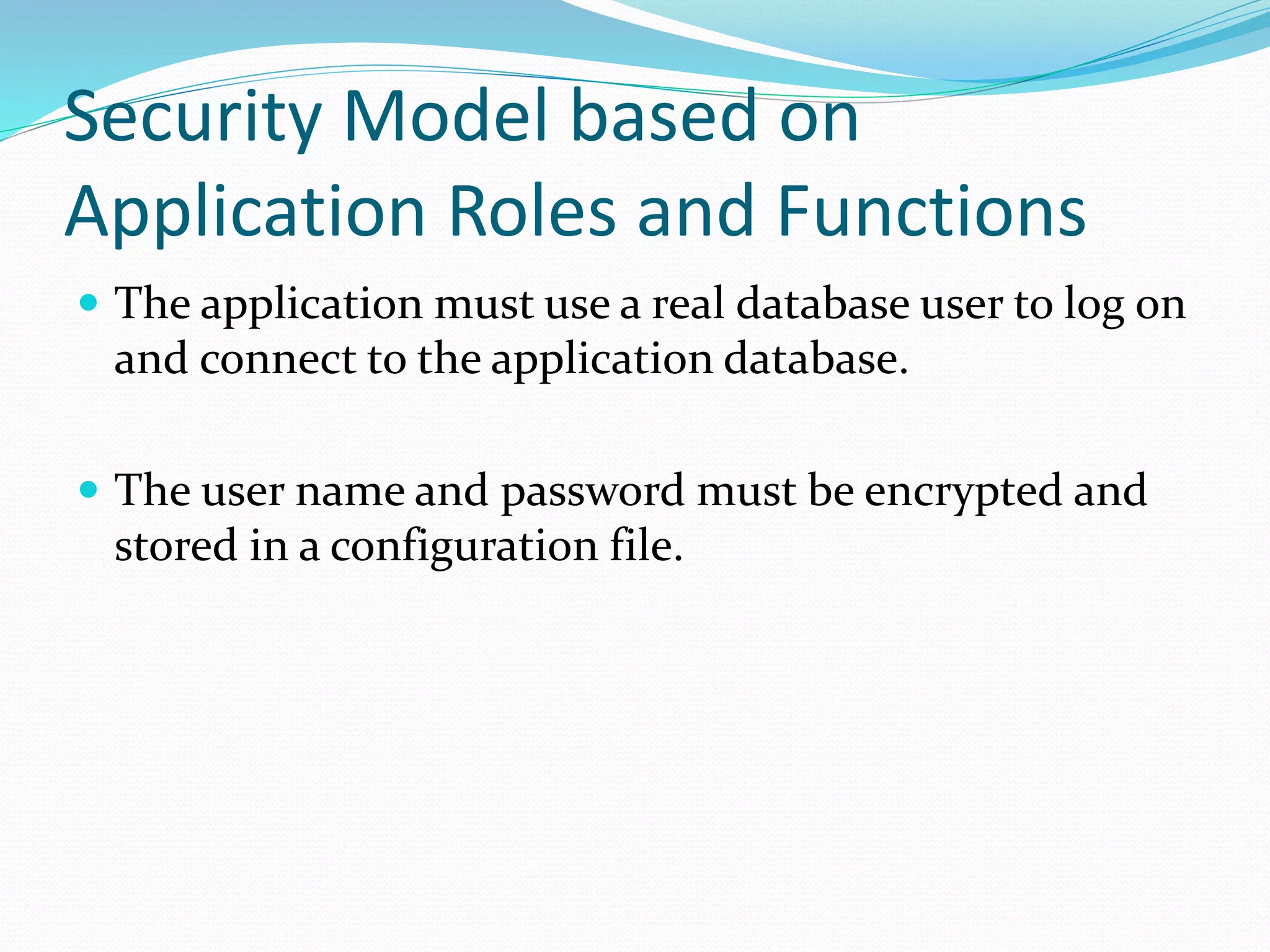
 The application must use a real database user to log on
and connect to the application database.
 The user name and password must be encrypted and
stored in a configuration file.
Security Model based on
Application Roles and Functions
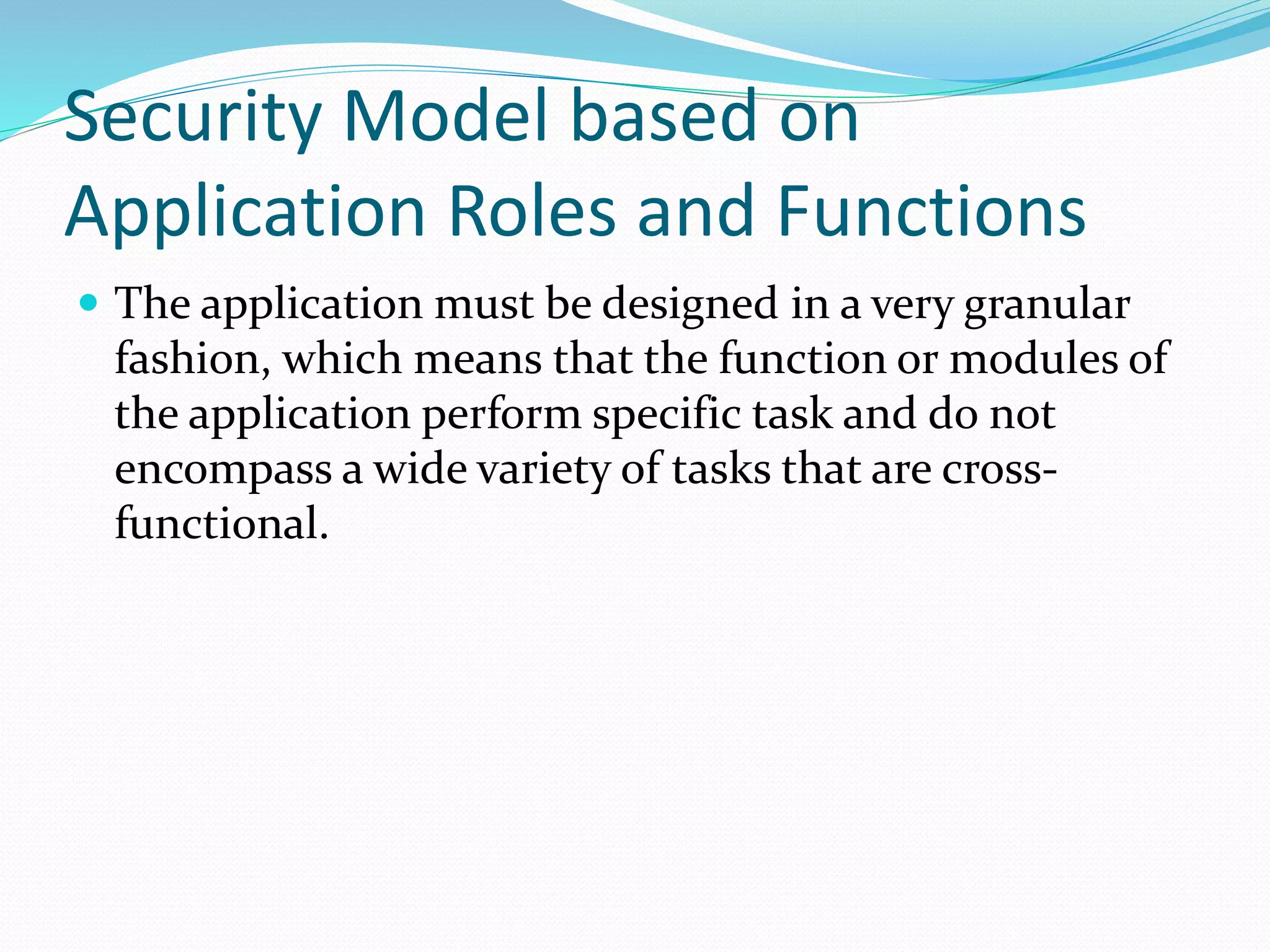
 The application must be designed in a very granular
fashion, which means that the function or modules of
the application perform specific task and do not
encompass a wide variety of tasks that are cross-
functional.
Security Model based on
Application Roles and Functions
 The more granular the privileges, the more effort
needed to implement them.
Security model based on
Application Table
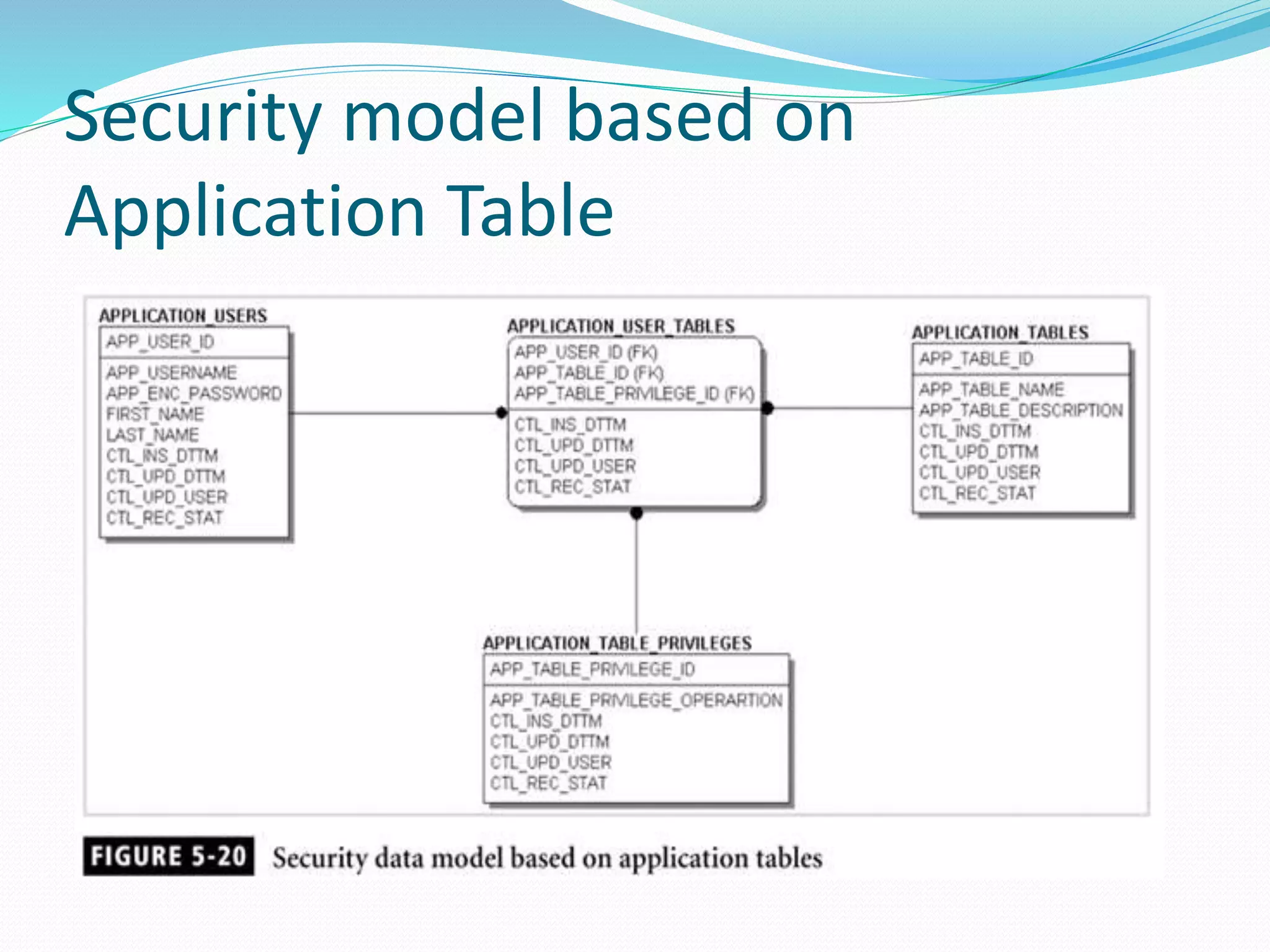
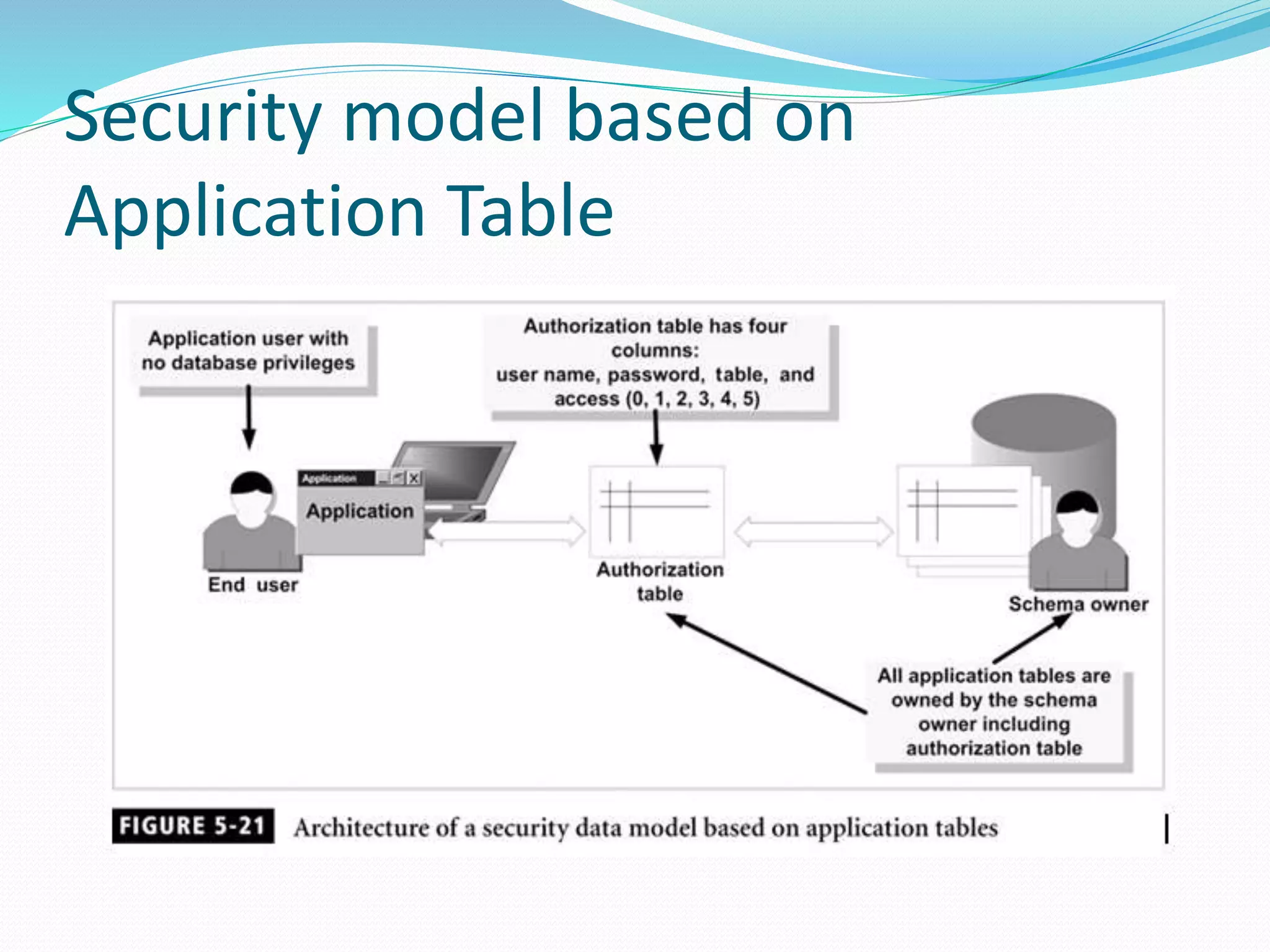
 This application security model depends on the
application to authenticate users by maintaining all
end users in a table with their encrypted passwords.
 The application provides privileges to the user based
on tables, not on a role or a function.
Security model based on
Application Table
Security model based on
Application Table
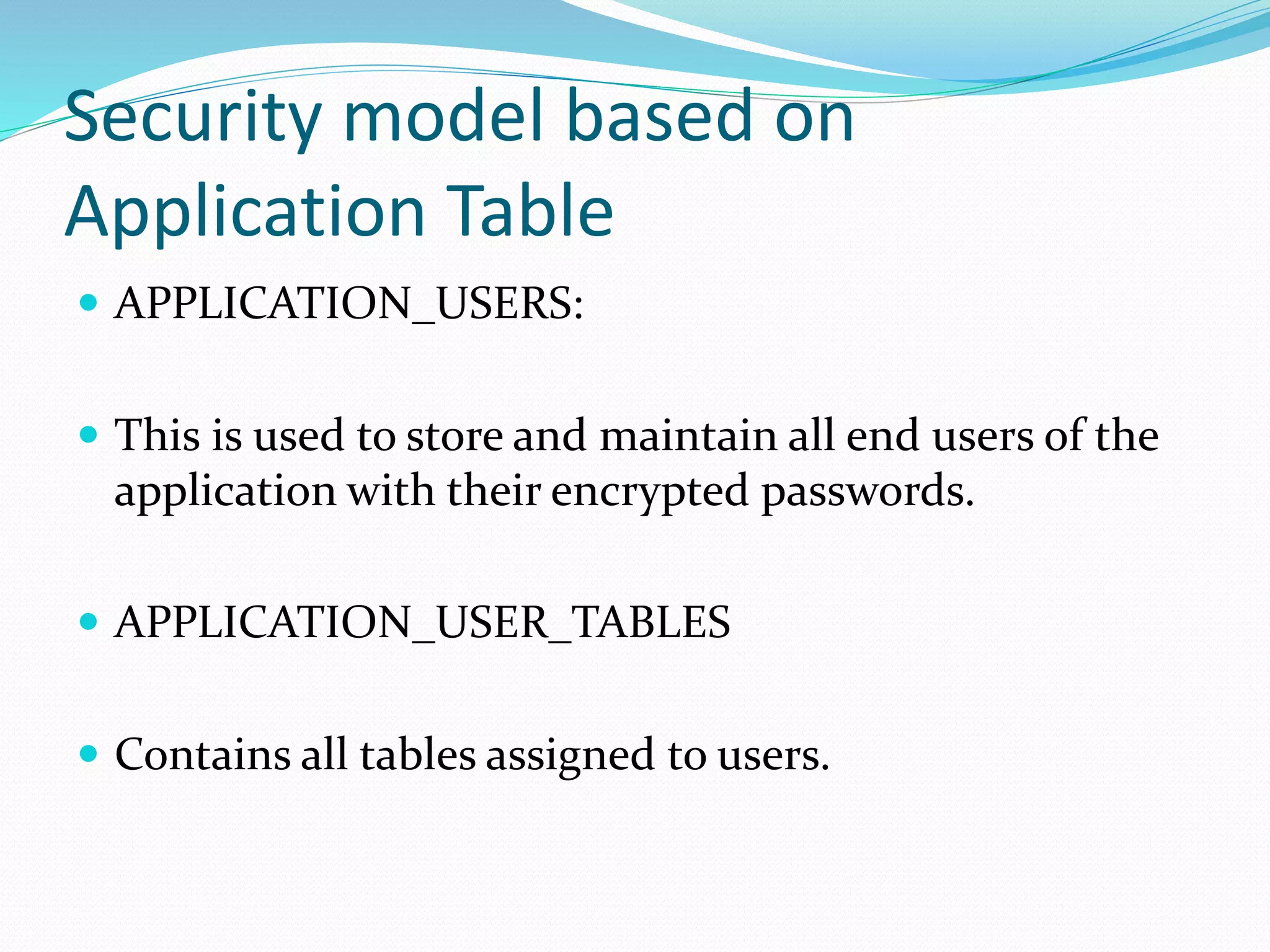
 APPLICATION_USERS:
 This is used to store and maintain all end users of the
application with their encrypted passwords.
 APPLICATION_USER_TABLES
 Contains all tables assigned to users.
Security model based on
Application Table
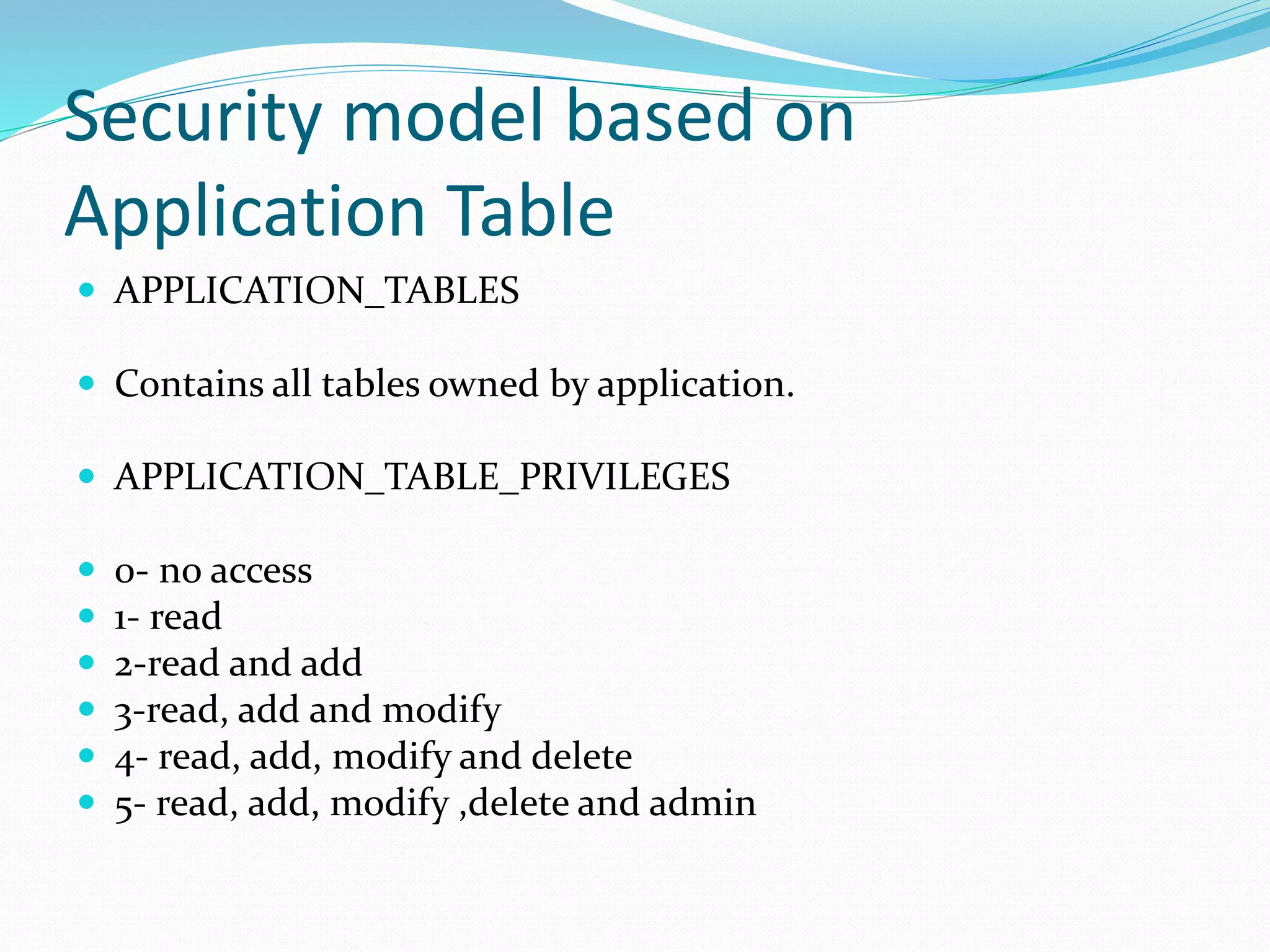
 APPLICATION_TABLES
 Contains all tables owned by application.
 APPLICATION_TABLE_PRIVILEGES
 0- no access
 1- read
 2-read and add
 3-read, add and modify
 4- read, add, modify and delete
 5- read, add, modify ,delete and admin
Security model based on
Application Table
 An application user many be granted a read privilege
on an application bye adding an entry in
APPLICATION_USER_TABLES.
Security model based on
Application Table
Security model based on
Application Table
 The following list present characteristics of this
security model:
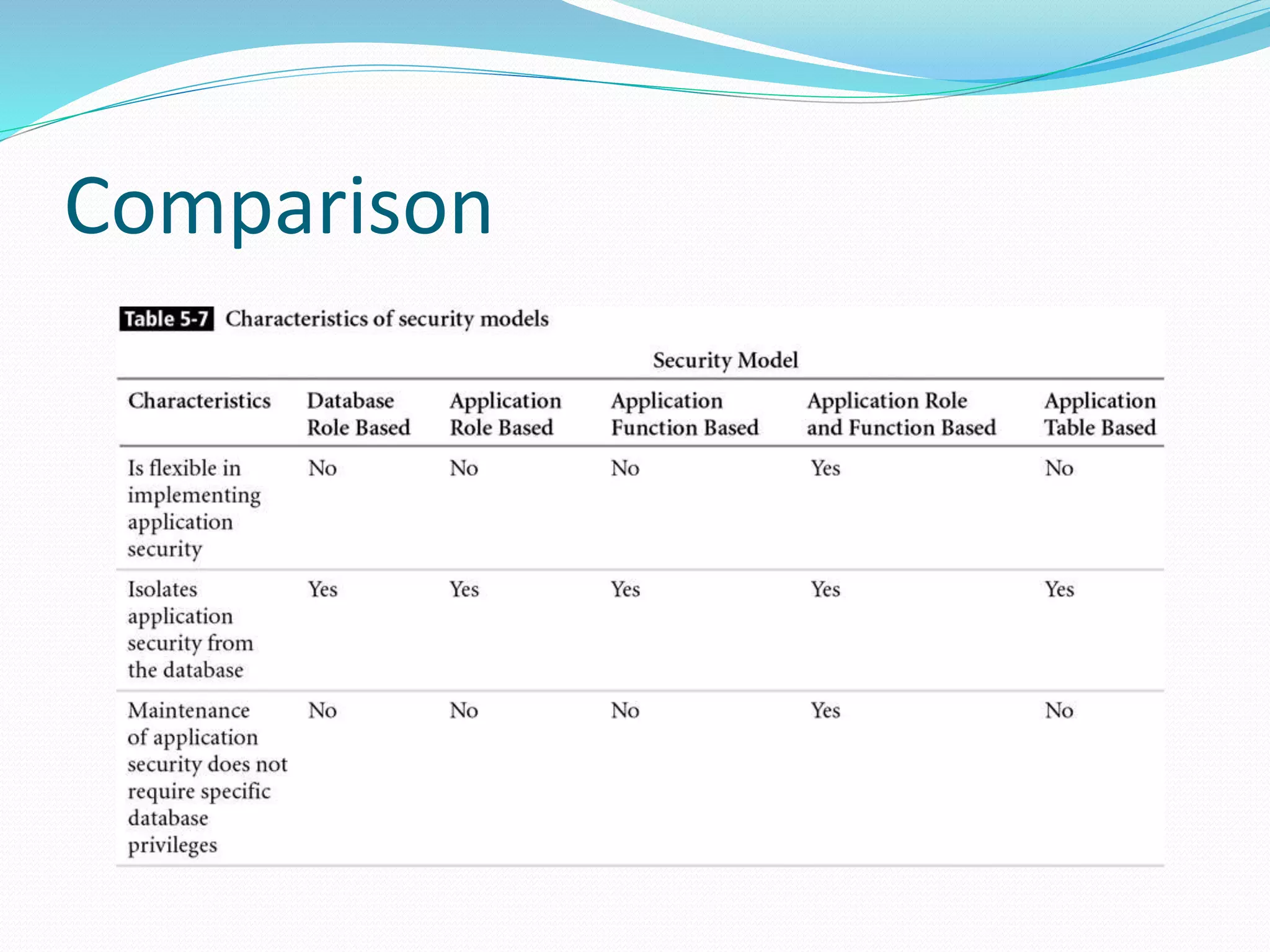
 This model isolates the application security from the
database, which make implementation database
independent.
 Maintenance of the application security does not
require specific database privileges, which lowers the
risk of database violations.
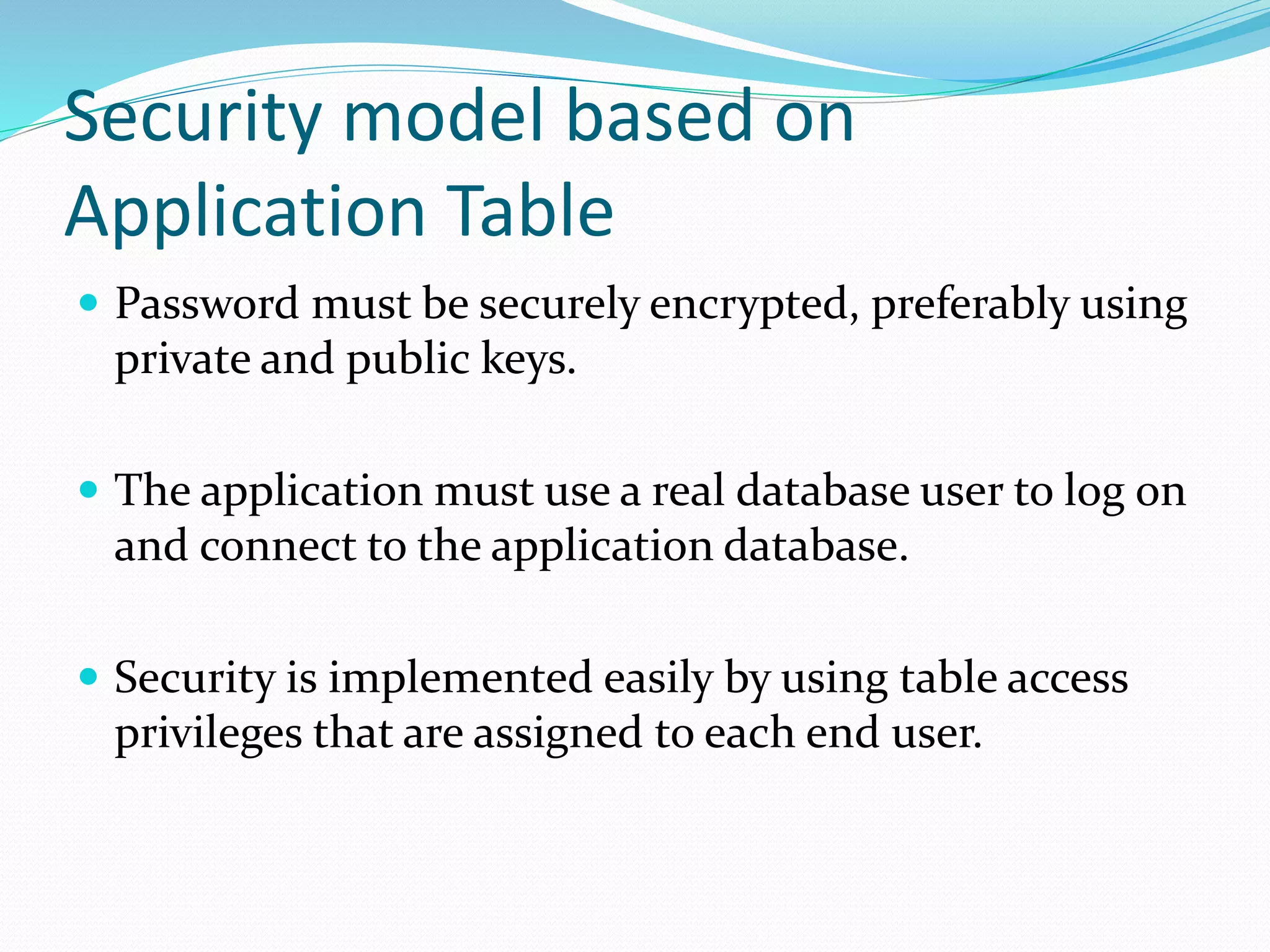
Security model based on
Application Table
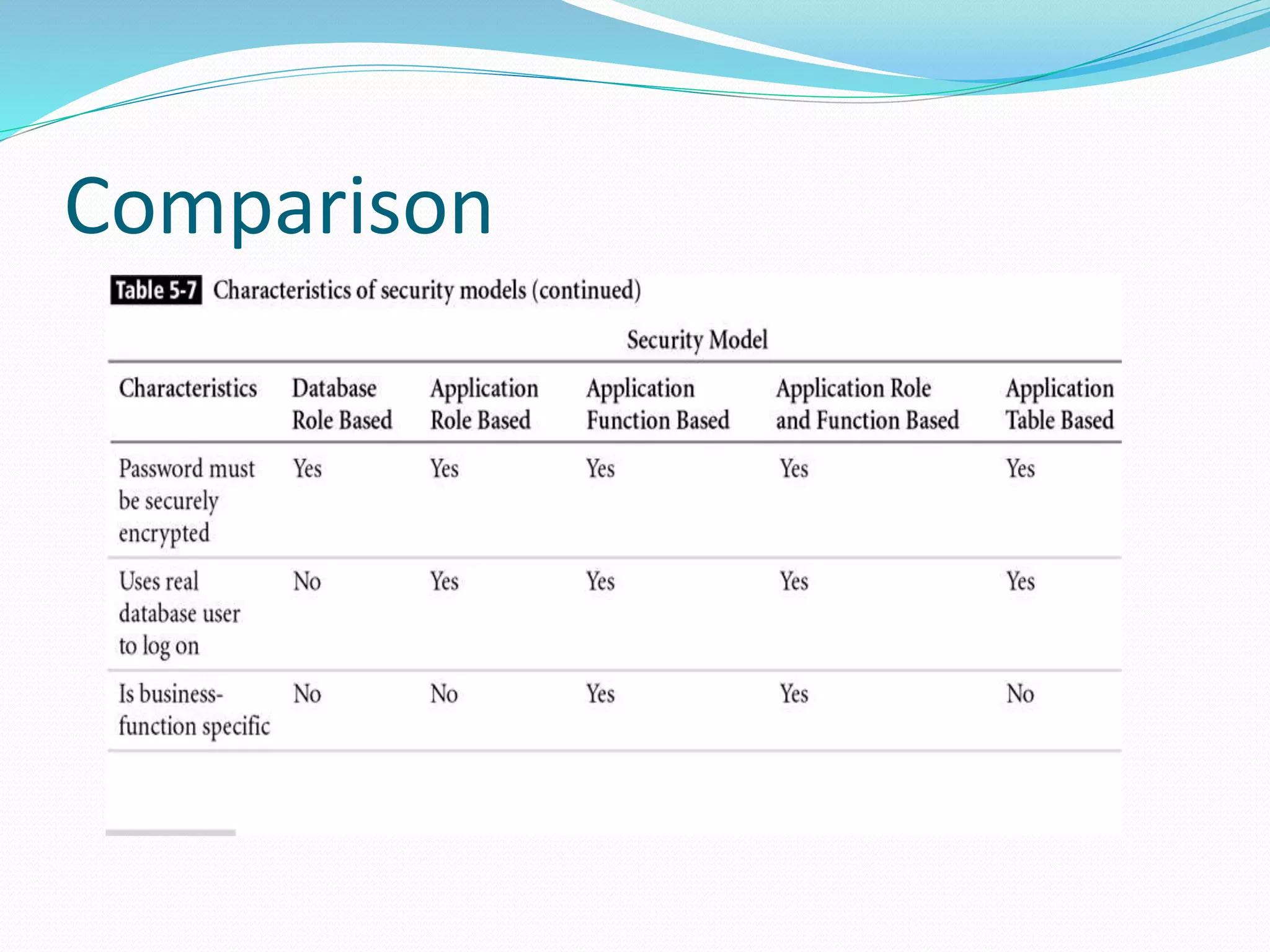
 Password must be securely encrypted, preferably using
private and public keys.
 The application must use a real database user to log on
and connect to the application database.
 Security is implemented easily by using table access
privileges that are assigned to each end user.
Comparison
Comparison
54
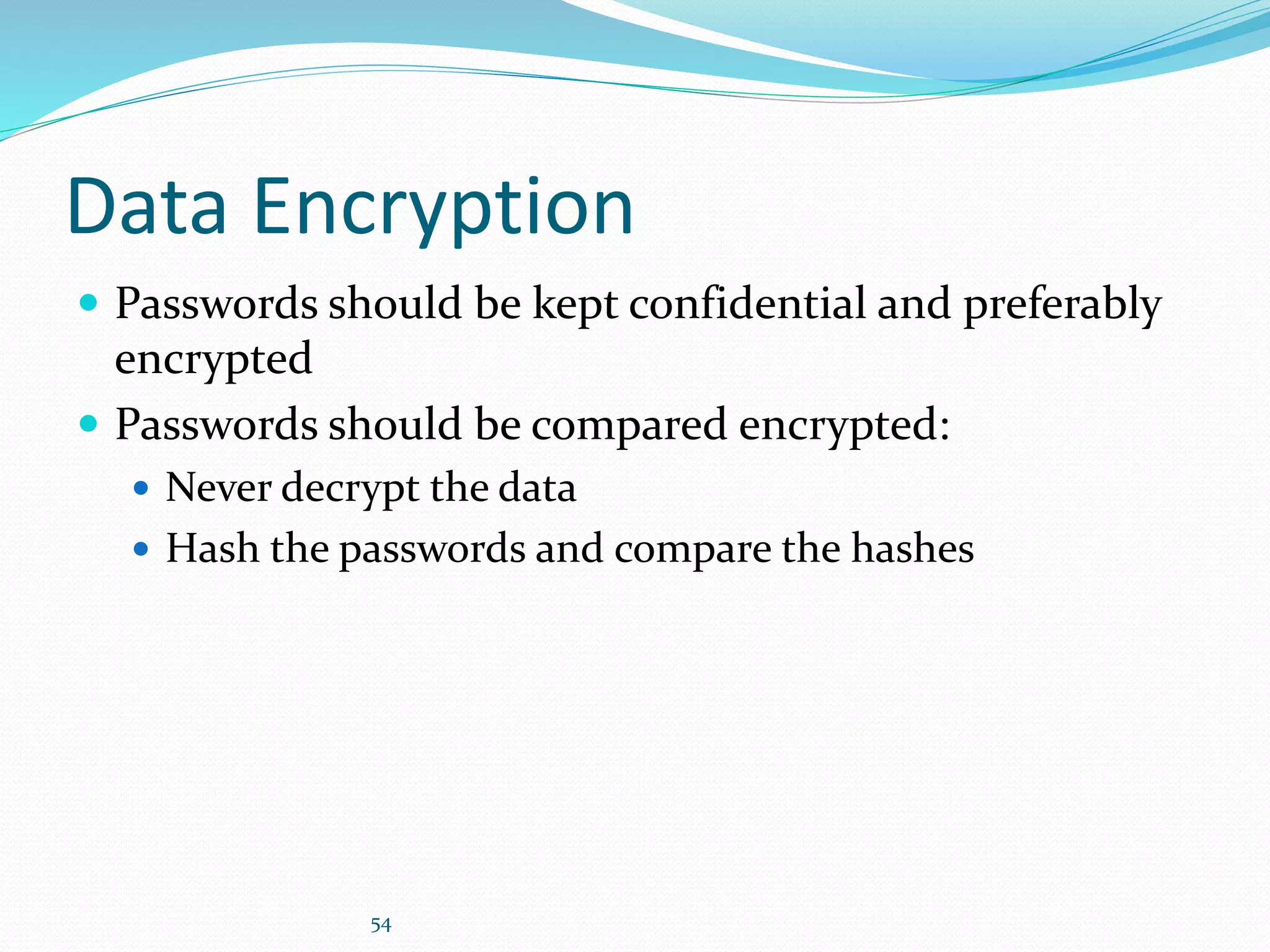
Data Encryption
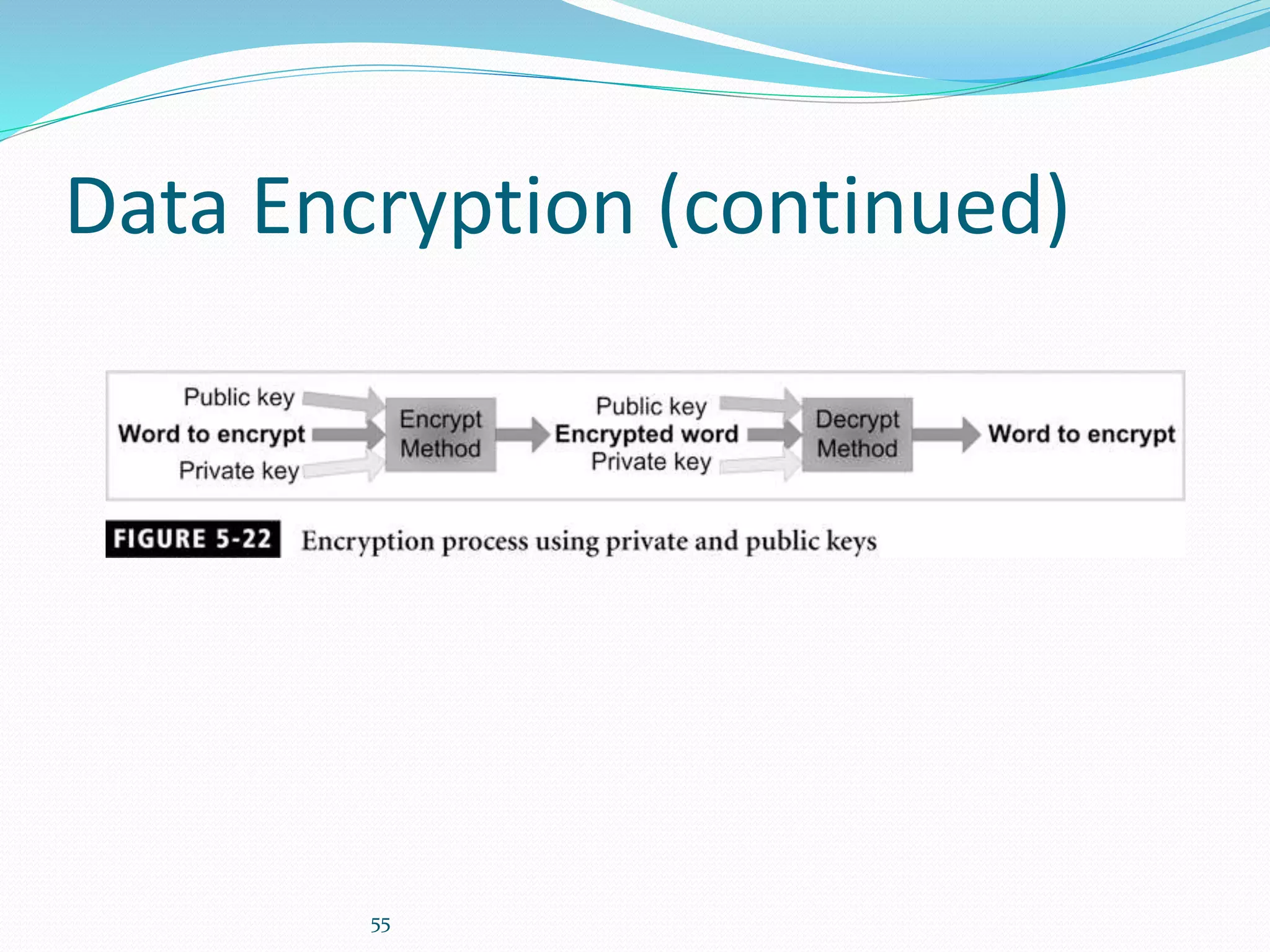
 Passwords should be kept confidential and preferably
encrypted
 Passwords should be compared encrypted:
 Never decrypt the data
 Hash the passwords and compare the hashes
55
Data Encryption (continued)

Application security models

  • 2.
    Introduction  We examinefive different application security models that are commonly used by the industry to provide data security and access protection at the table level.  Database role based.  Application role based.  Application function based.  Application role and function based.  Application table based.
  • 3.
    Security Model Basedon Database Roles  This model depend on the application to authentication the application users by maintain all end users in a table with their encryption password.  In this model, each end user is assigned a database role, which has specific database privilege for accessing application table.  The user can access whatever privileges are assigned to the role
  • 4.
    Security Model Basedon Database Roles  This model, proxy user is needed to activate assigned roles.  All roles are assigned to the proxy user.
  • 5.
    Security Model Basedon Database Roles
  • 6.
    Security Model Basedon Database Roles  APPLICATION_USERS:  This is used to store and maintain all end users of the application with their encrypted passwords.  APLLICATION_USERS_ROLES:  Contains all roles defined by application and for each role that privilege is assigned; privilege can be read, write, read/write.
  • 7.
    Security Model Basedon Database Roles  The architectural view of the model has common control columns prefixed with CTL.  These control columns contains information about manipulate record.
  • 8.
    Security Model Basedon Database Roles  CTL_INS_DTTM contains the date and time when the record was created.  CTL_UPD_DTTM contains the date and time when the record was last updated.  CTL_UPD_USER contains the date name that created the record or last updated the record.  CTL_REC_STAT can be used to indicate the status of the record. We can use this column for any purpose, we may set this column to “A” as an indicator that the record active and I as inactive
  • 9.
    Security Model Basedon Database Roles
  • 10.
    Security Model Basedon Database Roles  Implementing in Oracle  create a proxy user called APP_PROXY that will be assigned to all application role and will work on behalf of the application user APP_USER to gain access to all tables owned by the application owner called APP_OWNER.
  • 11.
    Security Model Basedon Database Roles
  • 12.
    Security Model Basedon Database Roles
  • 13.
    Security Model Basedon Database Roles
  • 14.
    Security Model Basedon Database Roles
  • 15.
    Security Model Basedon Application Roles  The concept of an application role security model are similar to the concept of database role security model in that they are both methods for organizing and administrating privileges.  Application roles are typically mapped specifically to real business roles
  • 16.
    Security Model Basedon Application Roles
  • 17.
    Security Model Basedon Application Roles  APPLICATION_USERS:  This is used to store and maintain all end users of the application with their encrypted passwords.  APPLICATION_ROLES  All roles defined by the application and for each role a privilege are assigned. The privilege can be read, write, or read/write
  • 18.
    Security Model Basedon Application Roles  The security model that is based on application roles depends on the application to authenticate the application users.  Authentication is accomplished by maintaining all end users in a table with their encrypted password.
  • 19.
    Security Model Basedon Application Roles  In this model, each end user is assigned an application role, and the application role is provided with application privileges to read/write specific modules of the application.
  • 20.
    Security Model Basedon Application Roles
  • 21.
    Security Model Basedon Application Roles  The point need to be considered during security Model  This model does not allow the flexibility required to make changes necessary for security.  For example a user called Scott who has a clerk role, and the clerk has privileges to read, add, and modify. This means that Scott can perform these operations on all modules of the application.
  • 22.
    Security Model Basedon Application Roles  Privileges are limited to any combination of the following.  read  add  delete  update  admin
  • 23.
    Security Model Basedon Application Roles  This model isolates the application security from the database, which make implementation of database independent.  Only one role is assigned to an application user.  Maintenance of the application security does not require specific database privilege. This lowers the risk of database violation.
  • 24.
    Security Model Basedon Application Roles  Passwords must be securely encrypted. preferably using private and public keys
  • 25.
    Security Model basedon Application Functions  The security model that is based on application function depends on the application to authenticate the application user by maintaining all end user in a table with their encrypted password.
  • 26.
    Security Model basedon Application Functions  In this model the application is divided into functions.  For instance, if you were using an inventory application we need to have a function name CUSTOMER that maintain customers and another function name PRODUCTS for maintain products, and so on
  • 27.
    Security Model basedon Application Functions
  • 28.
    Security Model basedon Application Functions  Tables used in this security model  APPLICATION_USERS:  This is used to store and maintain all end users of the application with their encrypted passwords  Application Functions:  This table contains all logical functions of the application
  • 29.
    Security Model basedon Application Functions  Tables used in this security model  Application_Functions_Privileges  This table stores all privileges for functions such as : read, write, read/write  Application_Users_Functions  This table contains all end users and their application function privileges.
  • 30.
    Security Model basedon Application Functions  The following list presents characteristics of this security model:  In this model the application security from the database, this makes implementation independent.  Maintenance of the application security does not require specific database privileges which lower the risk of database violations.
  • 31.
    Security Model basedon Application Functions  Password must be securely encrypted, preferably using private and public key. In this case we must modify the structure of the APPLICATION_USERS table by adding columns to store public and private keys.  The application must be designed in a granular fashion.  The more granular the privileges, the more effort are needed to implement them
  • 32.
    Security Model basedon Application Roles and Functions  This security model is a combination of both the role and function security models.  The application roles and functions security model depends on the application to authenticate the application users.
  • 33.
    Security Model basedon Application Roles and Functions  The application authenticates users by maintaining all end users in a table with their encrypted passwords.  In this model the application is divided into function and roles are assigned to function that are in turn assigned to users.
  • 34.
    Security Model basedon Application Roles and Functions
  • 35.
    Security Model basedon Application Roles and Functions  APPLICATION_USERS:  This is used to store and maintain all end users of the application with their encrypted passwords  APPLICATION_FUNCTIONS:  This table contains all logical functions of the application
  • 36.
    Security Model basedon Application Roles and Functions  APPLICATION_USER_ROLES  Contains all roles assigned to users  APPLICATION_ROLES  Contains all roles defined by the application and for each role assigned
  • 37.
    Security Model basedon Application Roles and Functions  APPLICATION_ROLE_FUNCTIONS  Contains all functions and privileges that are assigned to each role.  APPLICATION_FUNCTION_PRIVILEGES  Stores all privileges for function : read, write, read/write
  • 38.
    Security Model basedon Application Roles and Functions
  • 39.
    Security Model basedon Application Roles and Functions  The following list present characteristics of this security model:  This model provides flexibility for implementing application security.  This model isolates the application security from the database, which make implementation database independent
  • 40.
    Security Model basedon Application Roles and Functions  Maintenance of the application security does not require specific database privileges, which lower the risk of database violations.  Password must be securely encrypted, preferably using private and public keys. In this case the structure of the APPLICATION_USER table by adding columns to store public and private key
  • 41.
    Security Model basedon Application Roles and Functions  The application must use a real database user to log on and connect to the application database.  The user name and password must be encrypted and stored in a configuration file.
  • 42.
    Security Model basedon Application Roles and Functions  The application must be designed in a very granular fashion, which means that the function or modules of the application perform specific task and do not encompass a wide variety of tasks that are cross- functional.
  • 43.
    Security Model basedon Application Roles and Functions  The more granular the privileges, the more effort needed to implement them.
  • 44.
    Security model basedon Application Table  This application security model depends on the application to authenticate users by maintaining all end users in a table with their encrypted passwords.  The application provides privileges to the user based on tables, not on a role or a function.
  • 45.
    Security model basedon Application Table
  • 46.
    Security model basedon Application Table  APPLICATION_USERS:  This is used to store and maintain all end users of the application with their encrypted passwords.  APPLICATION_USER_TABLES  Contains all tables assigned to users.
  • 47.
    Security model basedon Application Table  APPLICATION_TABLES  Contains all tables owned by application.  APPLICATION_TABLE_PRIVILEGES  0- no access  1- read  2-read and add  3-read, add and modify  4- read, add, modify and delete  5- read, add, modify ,delete and admin
  • 48.
    Security model basedon Application Table  An application user many be granted a read privilege on an application bye adding an entry in APPLICATION_USER_TABLES.
  • 49.
    Security model basedon Application Table
  • 50.
    Security model basedon Application Table  The following list present characteristics of this security model:  This model isolates the application security from the database, which make implementation database independent.  Maintenance of the application security does not require specific database privileges, which lowers the risk of database violations.
  • 51.
    Security model basedon Application Table  Password must be securely encrypted, preferably using private and public keys.  The application must use a real database user to log on and connect to the application database.  Security is implemented easily by using table access privileges that are assigned to each end user.
  • 52.
  • 53.
  • 54.
    54 Data Encryption  Passwordsshould be kept confidential and preferably encrypted  Passwords should be compared encrypted:  Never decrypt the data  Hash the passwords and compare the hashes
  • 55.