INTRODUCTION :
 Digestibility is the quantification of the digestive

process, it gives a relative measure of the extent to
which ingested food and its nutrient components have
been digested and absorbed by the animal.
 Only a proportion of ingested food is digested and its
nutrients are absorbed, rest is voided as faeces.
 A nutritionally balanced diet will only be a good diet if
it also easily and effectively digested and utilized.
 Therefore, when formulating a diet it is essential to
have a knowledge on the digestibility of ingredients
and final product.
Digestibility Coefficients :
 Digestibility coefficients (DC) allow the

quantification of digestibility.
 For a given food, the apparent digestibility coefficient
(ADC) and true digestibility coefficient (TDC) can be
defined as –
ADC = Ingested -faecal * 100
ingested

TDC = Ingested- (faecal- endogenous faecal) * 100
ingested

 ADC depends on the physiological state of fish and

ingestion rate.
 TDC depends mainly on the type of diet and
digestive capacity of the species.
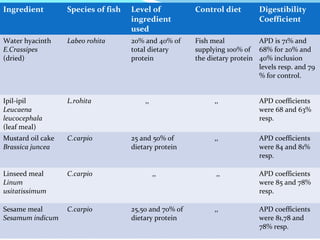
Ingredient

Species of fish

Level of
ingredient
used

Control diet

Water hyacinth
E.Crassipes
(dried)

Labeo rohita

20% and 40% of
total dietary
protein

Fish meal
APD is 71% and
supplying 100% of 68% for 20% and
the dietary protein 40% inclusion
levels resp. and 79
% for control.

Ipil-ipil
Leucaena
leucocephala
(leaf meal)

L.rohita

Mustard oil cake
Brassica juncea

C.carpio

Linseed meal
Linum
usitatissimum

C.carpio

Sesame meal
Sesamum indicum

C.carpio

,,

Digestibility
Coefficient

,,

APD coefficients
were 68 and 63%
resp.

25 and 50% of
dietary protein

,,

APD coefficients
were 84 and 81%
resp.

,,

,,

APD coefficients
were 85 and 78%
resp.

,,

APD coefficients
were 81,78 and
78% resp.

25,50 and 70% of
dietary protein
Determination Of Digestibility :
 Unlike comparable digestibility studies on terrestrial

animals, those on fish have an inherent difficulty by
virtue of the medium in which they live.

 Digestibility of a diet / feed can be determined

directly or indirectly as follows –
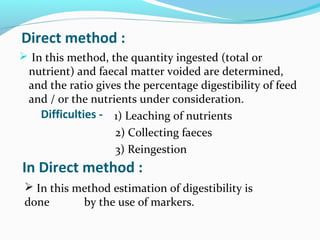
Direct method :
 In this method, the quantity ingested (total or

nutrient) and faecal matter voided are determined,
and the ratio gives the percentage digestibility of feed
and / or the nutrients under consideration.
Difficulties - 1) Leaching of nutrients
2) Collecting faeces
3) Reingestion

In Direct method :
 In this method estimation of digestibility is
done
by the use of markers.
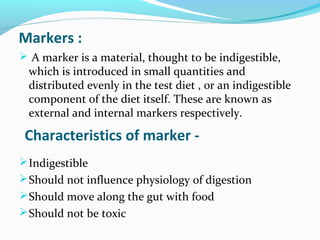
Markers :
 A marker is a material, thought to be indigestible,

which is introduced in small quantities and
distributed evenly in the test diet , or an indigestible
component of the diet itself. These are known as
external and internal markers respectively.

Characteristics of marker  Indigestible
 Should not influence physiology of digestion
 Should move along the gut with food
 Should not be toxic
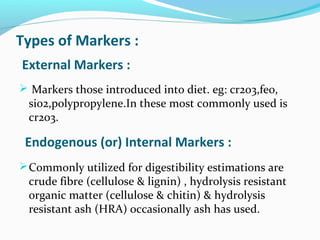
Types of Markers :
External Markers :
 Markers those introduced into diet. eg: cr2o3,feo,

sio2,polypropylene.In these most commonly used is
cr2o3.

Endogenous (or) Internal Markers :
 Commonly utilized for digestibility estimations are

crude fibre (cellulose & lignin) , hydrolysis resistant
organic matter (cellulose & chitin) & hydrolysis
resistant ash (HRA) occasionally ash has used.
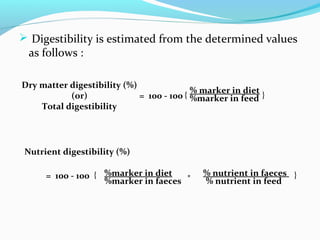
 Digestibility is estimated from the determined values

as follows :

Dry matter digestibility (%)
% marker in diet
(or)
= 100 - 100 { %marker in feed }
Total digestibility

Nutrient digestibility (%)
= 100 - 100 { %marker in diet
%marker in faeces *

% nutrient in faeces }
% nutrient in feed
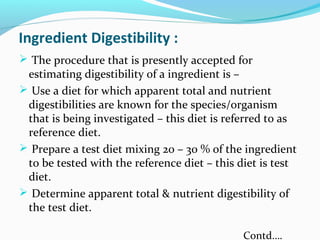
Ingredient Digestibility :
 The procedure that is presently accepted for

estimating digestibility of a ingredient is –
 Use a diet for which apparent total and nutrient
digestibilities are known for the species/organism
that is being investigated – this diet is referred to as
reference diet.
 Prepare a test diet mixing 20 – 30 % of the ingredient
to be tested with the reference diet – this diet is test
diet.
 Determine apparent total & nutrient digestibility of
the test diet.
Contd….
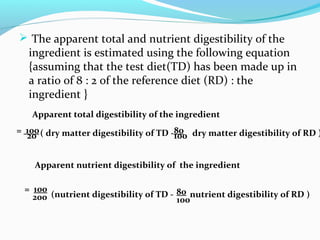
 The apparent total and nutrient digestibility of the

ingredient is estimated using the following equation
{assuming that the test diet(TD) has been made up in
a ratio of 8 : 2 of the reference diet (RD) : the
ingredient }
Apparent total digestibility of the ingredient

= 100 ( dry matter digestibility of TD -80 dry matter digestibility of RD )
20
100
Apparent nutrient digestibility of the ingredient
= 100
80
200 (nutrient digestibility of TD - 100nutrient digestibility of RD )
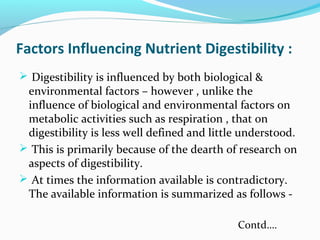
Factors Influencing Nutrient Digestibility :
 Digestibility is influenced by both biological &

environmental factors – however , unlike the
influence of biological and environmental factors on
metabolic activities such as respiration , that on
digestibility is less well defined and little understood.
 This is primarily because of the dearth of research on
aspects of digestibility.
 At times the information available is contradictory.
The available information is summarized as follows Contd….
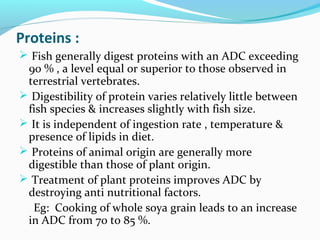
Proteins :
 Fish generally digest proteins with an ADC exceeding

90 % , a level equal or superior to those observed in
terrestrial vertebrates.
 Digestibility of protein varies relatively little between
fish species & increases slightly with fish size.
 It is independent of ingestion rate , temperature &
presence of lipids in diet.
 Proteins of animal origin are generally more
digestible than those of plant origin.
 Treatment of plant proteins improves ADC by
destroying anti nutritional factors.
Eg: Cooking of whole soya grain leads to an increase
in ADC from 70 to 85 %.
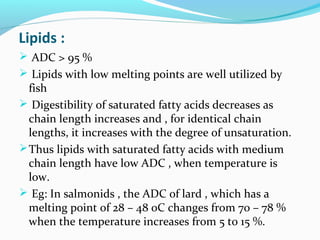
Lipids :
 ADC > 95 %
 Lipids with low melting points are well utilized by

fish
 Digestibility of saturated fatty acids decreases as
chain length increases and , for identical chain
lengths, it increases with the degree of unsaturation.
 Thus lipids with saturated fatty acids with medium
chain length have low ADC , when temperature is
low.
 Eg: In salmonids , the ADC of lard , which has a
melting point of 28 – 48 0C changes from 70 – 78 %
when the temperature increases from 5 to 15 %.
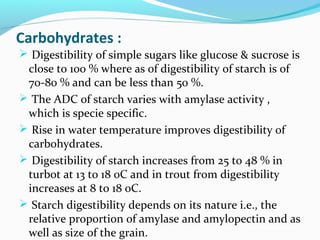
Carbohydrates :
 Digestibility of simple sugars like glucose & sucrose is

close to 100 % where as of digestibility of starch is of
70-80 % and can be less than 50 %.
 The ADC of starch varies with amylase activity ,
which is specie specific.
 Rise in water temperature improves digestibility of
carbohydrates.
 Digestibility of starch increases from 25 to 48 % in
turbot at 13 to 18 oC and in trout from digestibility
increases at 8 to 18 0C.
 Starch digestibility depends on its nature i.e., the
relative proportion of amylase and amylopectin and as
well as size of the grain.
Other Variables :
 It is generally assumed that nutrient digestibility is

independent of the amount ingested.
 In general as temperature increase ADC of protein
and energy increases.
 In euryhaline species, an increase in salinity leads to
a decrease in protein digestibility.
 The effects of salinity on the ADC of lipids and
carbohydrates are less well known.
Conclusion :
In overall terms , from digestive physiology to
nutrient digestibility , which is more difficult to
measure than in terrestrial animals, as fish always
present unique features. Their remarkable aptitude
for digesting proteins contrasts with their low
aptitude for digesting carbohydrates.
Progress in the area of nutrition and feeding is
necessary for a better knowledge of the physiology of
digestion and food digestibility.
4 digestibility and factors

4 digestibility and factors

  • 2.
    INTRODUCTION :  Digestibilityis the quantification of the digestive process, it gives a relative measure of the extent to which ingested food and its nutrient components have been digested and absorbed by the animal.  Only a proportion of ingested food is digested and its nutrients are absorbed, rest is voided as faeces.  A nutritionally balanced diet will only be a good diet if it also easily and effectively digested and utilized.  Therefore, when formulating a diet it is essential to have a knowledge on the digestibility of ingredients and final product.
  • 3.
    Digestibility Coefficients : Digestibility coefficients (DC) allow the quantification of digestibility.  For a given food, the apparent digestibility coefficient (ADC) and true digestibility coefficient (TDC) can be defined as – ADC = Ingested -faecal * 100 ingested TDC = Ingested- (faecal- endogenous faecal) * 100 ingested  ADC depends on the physiological state of fish and ingestion rate.  TDC depends mainly on the type of diet and digestive capacity of the species.
  • 4.
    Ingredient Species of fish Levelof ingredient used Control diet Water hyacinth E.Crassipes (dried) Labeo rohita 20% and 40% of total dietary protein Fish meal APD is 71% and supplying 100% of 68% for 20% and the dietary protein 40% inclusion levels resp. and 79 % for control. Ipil-ipil Leucaena leucocephala (leaf meal) L.rohita Mustard oil cake Brassica juncea C.carpio Linseed meal Linum usitatissimum C.carpio Sesame meal Sesamum indicum C.carpio ,, Digestibility Coefficient ,, APD coefficients were 68 and 63% resp. 25 and 50% of dietary protein ,, APD coefficients were 84 and 81% resp. ,, ,, APD coefficients were 85 and 78% resp. ,, APD coefficients were 81,78 and 78% resp. 25,50 and 70% of dietary protein
  • 5.
    Determination Of Digestibility:  Unlike comparable digestibility studies on terrestrial animals, those on fish have an inherent difficulty by virtue of the medium in which they live.  Digestibility of a diet / feed can be determined directly or indirectly as follows –
  • 6.
    Direct method : In this method, the quantity ingested (total or nutrient) and faecal matter voided are determined, and the ratio gives the percentage digestibility of feed and / or the nutrients under consideration. Difficulties - 1) Leaching of nutrients 2) Collecting faeces 3) Reingestion In Direct method :  In this method estimation of digestibility is done by the use of markers.
  • 7.
    Markers :  Amarker is a material, thought to be indigestible, which is introduced in small quantities and distributed evenly in the test diet , or an indigestible component of the diet itself. These are known as external and internal markers respectively. Characteristics of marker  Indigestible  Should not influence physiology of digestion  Should move along the gut with food  Should not be toxic
  • 8.
    Types of Markers: External Markers :  Markers those introduced into diet. eg: cr2o3,feo, sio2,polypropylene.In these most commonly used is cr2o3. Endogenous (or) Internal Markers :  Commonly utilized for digestibility estimations are crude fibre (cellulose & lignin) , hydrolysis resistant organic matter (cellulose & chitin) & hydrolysis resistant ash (HRA) occasionally ash has used.
  • 9.
     Digestibility isestimated from the determined values as follows : Dry matter digestibility (%) % marker in diet (or) = 100 - 100 { %marker in feed } Total digestibility Nutrient digestibility (%) = 100 - 100 { %marker in diet %marker in faeces * % nutrient in faeces } % nutrient in feed
  • 10.
    Ingredient Digestibility : The procedure that is presently accepted for estimating digestibility of a ingredient is –  Use a diet for which apparent total and nutrient digestibilities are known for the species/organism that is being investigated – this diet is referred to as reference diet.  Prepare a test diet mixing 20 – 30 % of the ingredient to be tested with the reference diet – this diet is test diet.  Determine apparent total & nutrient digestibility of the test diet. Contd….
  • 11.
     The apparenttotal and nutrient digestibility of the ingredient is estimated using the following equation {assuming that the test diet(TD) has been made up in a ratio of 8 : 2 of the reference diet (RD) : the ingredient } Apparent total digestibility of the ingredient = 100 ( dry matter digestibility of TD -80 dry matter digestibility of RD ) 20 100 Apparent nutrient digestibility of the ingredient = 100 80 200 (nutrient digestibility of TD - 100nutrient digestibility of RD )
  • 12.
    Factors Influencing NutrientDigestibility :  Digestibility is influenced by both biological & environmental factors – however , unlike the influence of biological and environmental factors on metabolic activities such as respiration , that on digestibility is less well defined and little understood.  This is primarily because of the dearth of research on aspects of digestibility.  At times the information available is contradictory. The available information is summarized as follows Contd….
  • 13.
    Proteins :  Fishgenerally digest proteins with an ADC exceeding 90 % , a level equal or superior to those observed in terrestrial vertebrates.  Digestibility of protein varies relatively little between fish species & increases slightly with fish size.  It is independent of ingestion rate , temperature & presence of lipids in diet.  Proteins of animal origin are generally more digestible than those of plant origin.  Treatment of plant proteins improves ADC by destroying anti nutritional factors. Eg: Cooking of whole soya grain leads to an increase in ADC from 70 to 85 %.
  • 14.
    Lipids :  ADC> 95 %  Lipids with low melting points are well utilized by fish  Digestibility of saturated fatty acids decreases as chain length increases and , for identical chain lengths, it increases with the degree of unsaturation.  Thus lipids with saturated fatty acids with medium chain length have low ADC , when temperature is low.  Eg: In salmonids , the ADC of lard , which has a melting point of 28 – 48 0C changes from 70 – 78 % when the temperature increases from 5 to 15 %.
  • 15.
    Carbohydrates :  Digestibilityof simple sugars like glucose & sucrose is close to 100 % where as of digestibility of starch is of 70-80 % and can be less than 50 %.  The ADC of starch varies with amylase activity , which is specie specific.  Rise in water temperature improves digestibility of carbohydrates.  Digestibility of starch increases from 25 to 48 % in turbot at 13 to 18 oC and in trout from digestibility increases at 8 to 18 0C.  Starch digestibility depends on its nature i.e., the relative proportion of amylase and amylopectin and as well as size of the grain.
  • 16.
    Other Variables : It is generally assumed that nutrient digestibility is independent of the amount ingested.  In general as temperature increase ADC of protein and energy increases.  In euryhaline species, an increase in salinity leads to a decrease in protein digestibility.  The effects of salinity on the ADC of lipids and carbohydrates are less well known.
  • 17.
    Conclusion : In overallterms , from digestive physiology to nutrient digestibility , which is more difficult to measure than in terrestrial animals, as fish always present unique features. Their remarkable aptitude for digesting proteins contrasts with their low aptitude for digesting carbohydrates. Progress in the area of nutrition and feeding is necessary for a better knowledge of the physiology of digestion and food digestibility.