Yasser Elsedawy
Edoardo Cataldi
Marie Rose Egbreghts
Javier Higuera
Jianing Zhang
Amazon's European Distribution Strategy
Case Study
Supply Chain Management
▪ Amazon.Com was launched on 16th July 1995 by Jeff
Bezos
▪ At the beginning, Amazon.com started as an online
bookstore, With 25 million titles it became the earth's
biggest bookstore, but soon diversified.
▪ In 2008, Amazon had 8 warehouses in the U.S. and
another 15 in the rest of the world.
▪ Amazon now has around 50 warehouses, 20 in US and
rest in Canada, France, Germany, Italy, UK, China,
Japan.
▪ At Present the company is providing three primary
customer sets; consumers, Sellers, and developers.
▪ Amazon balances between cost of distribution and
levels of services by having the efficient distribution
centres and multi-tier inventory networks.
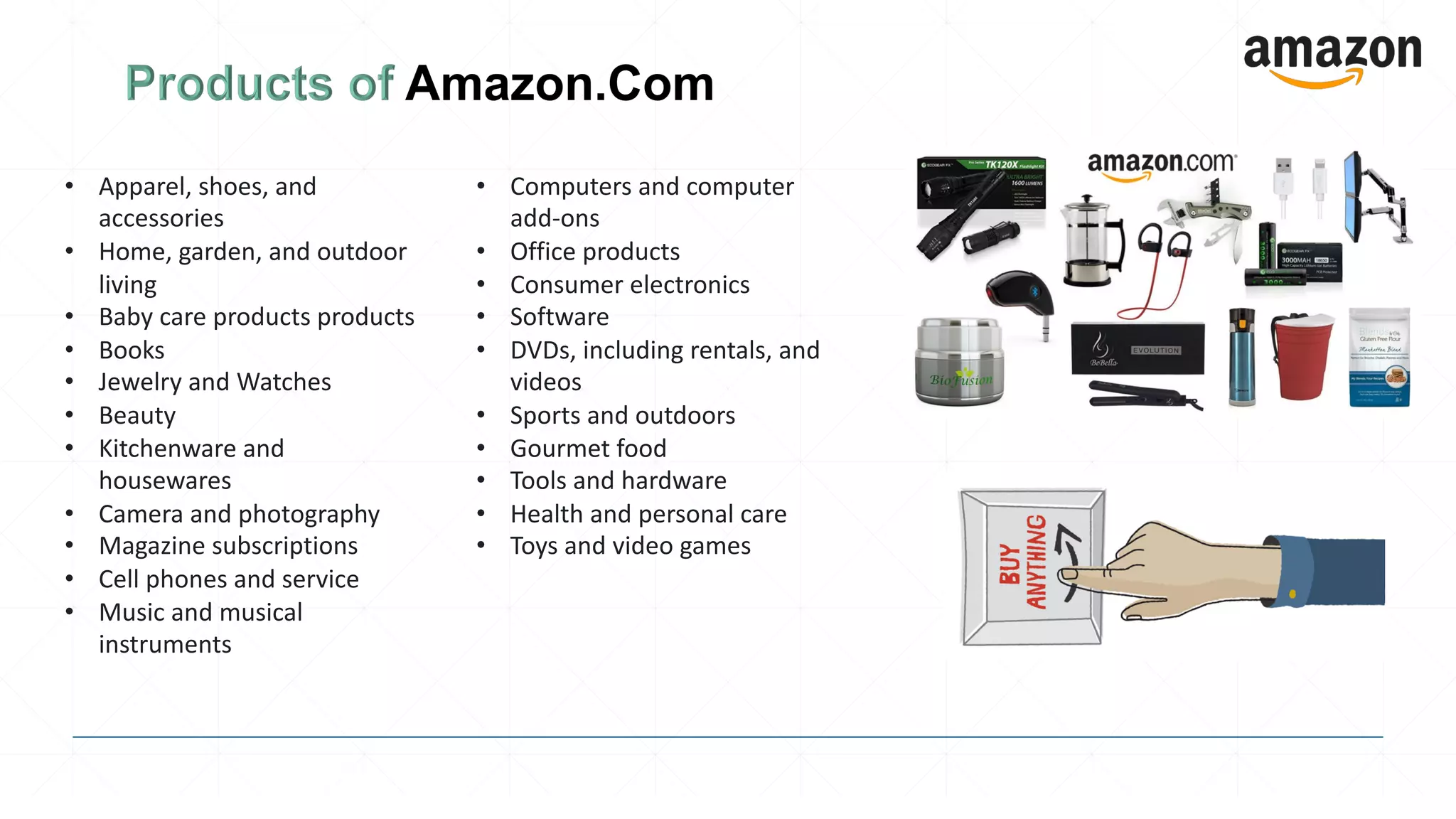
• Apparel, shoes, and
accessories
• Home, garden, and outdoor
living
• Baby care products products
• Books
• Jewelry and Watches
• Beauty
• Kitchenware and
housewares
• Camera and photography
• Magazine subscriptions
• Cell phones and service
• Music and musical
instruments
• Computers and computer
add-ons
• Office products
• Consumer electronics
• Software
• DVDs, including rentals, and
videos
• Sports and outdoors
• Gourmet food
• Tools and hardware
• Health and personal care
• Toys and video games
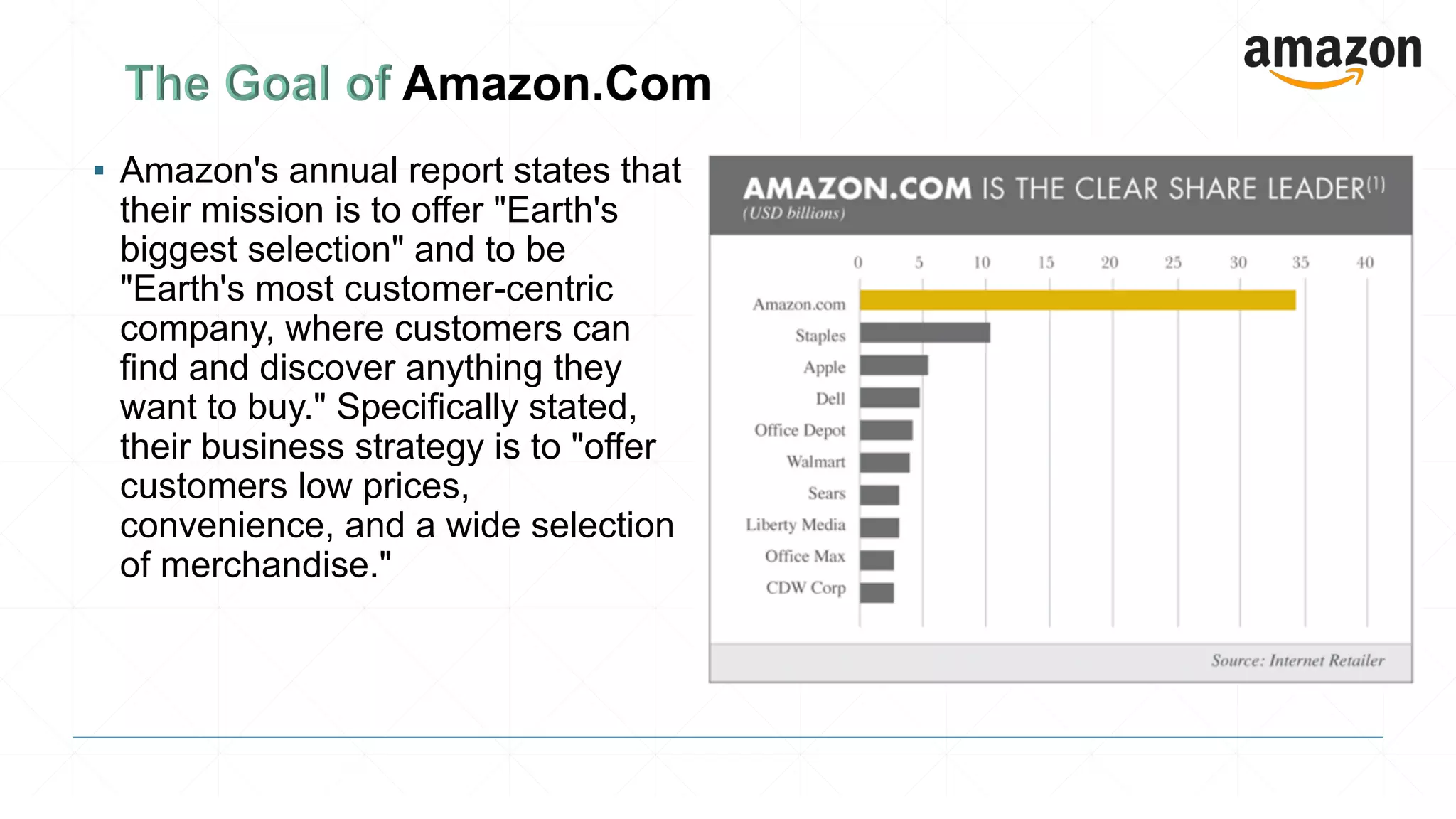
▪ Amazon's annual report states that
their mission is to offer "Earth's
biggest selection" and to be
"Earth's most customer-centric
company, where customers can
find and discover anything they
want to buy." Specifically stated,
their business strategy is to "offer
customers low prices,
convenience, and a wide selection
of merchandise."
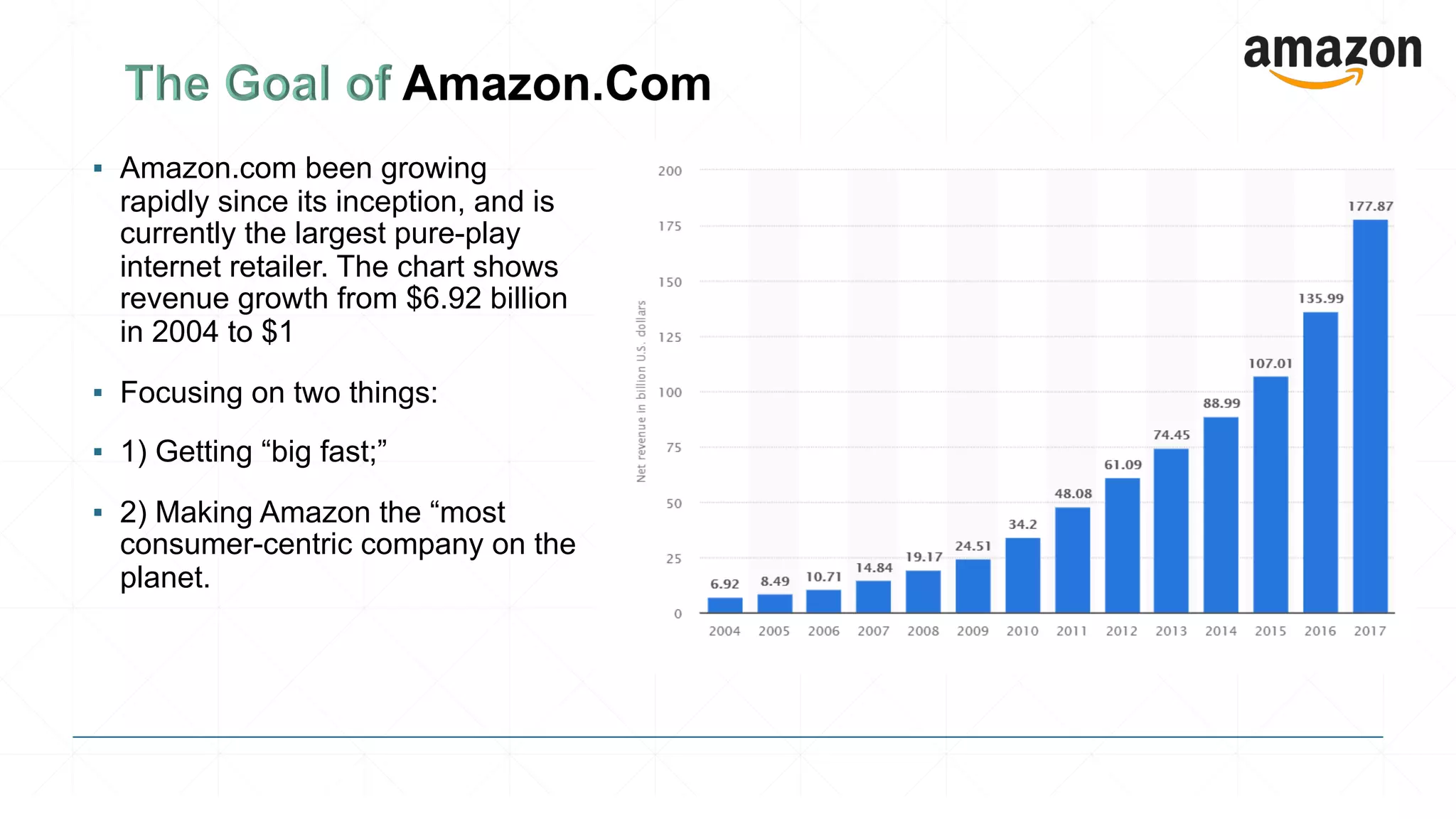
▪ Amazon.com been growing
rapidly since its inception, and is
currently the largest pure-play
internet retailer. The chart shows
revenue growth from $6.92 billion
in 2004 to $1
▪ Focusing on two things:
▪ 1) Getting “big fast;”
▪ 2) Making Amazon the “most
consumer-centric company on the
planet.
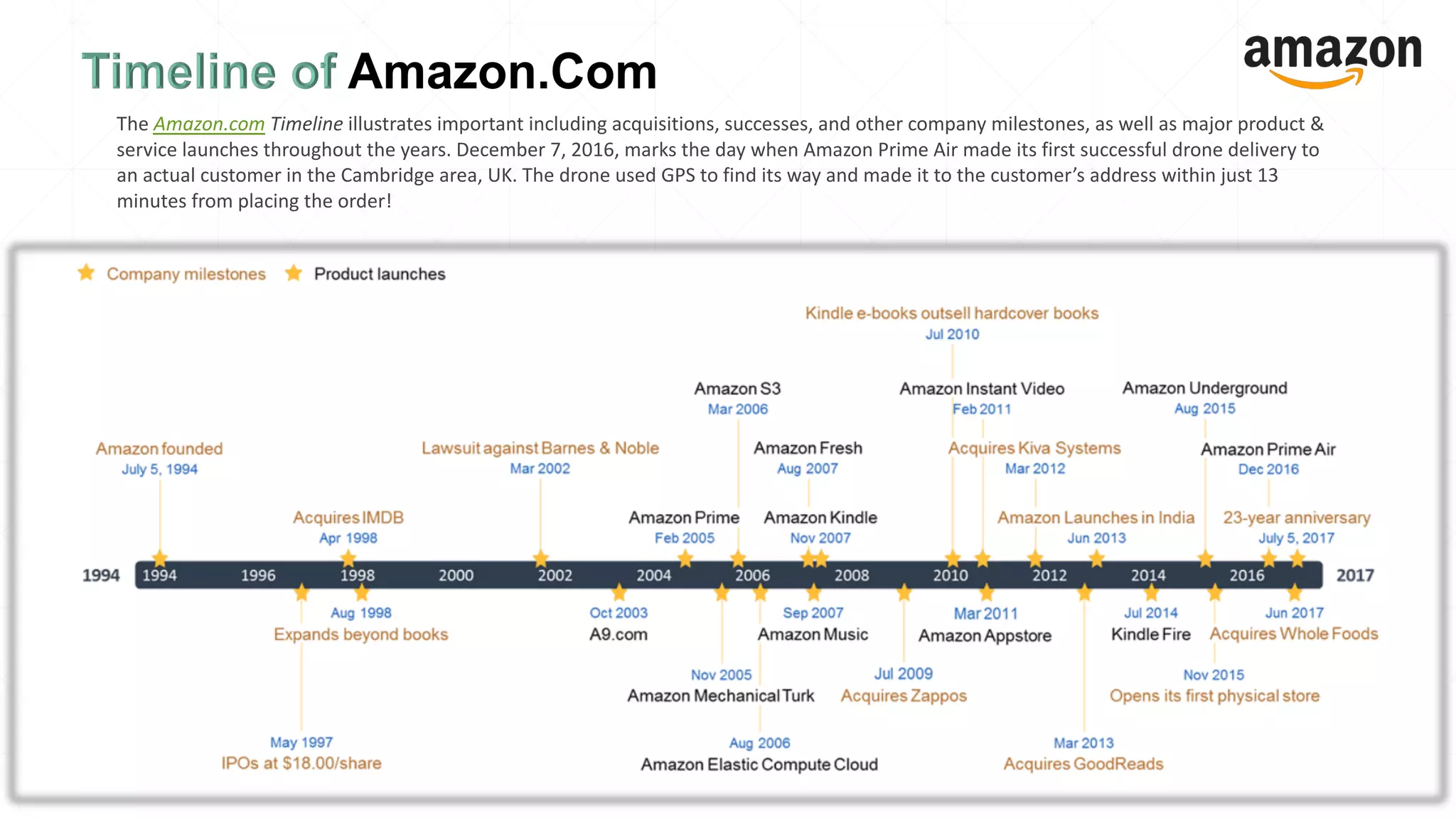
The Amazon.com Timeline illustrates important including acquisitions, successes, and other company milestones, as well as major product &
service launches throughout the years. December 7, 2016, marks the day when Amazon Prime Air made its first successful drone delivery to
an actual customer in the Cambridge area, UK. The drone used GPS to find its way and made it to the customer’s address within just 13
minutes from placing the order!
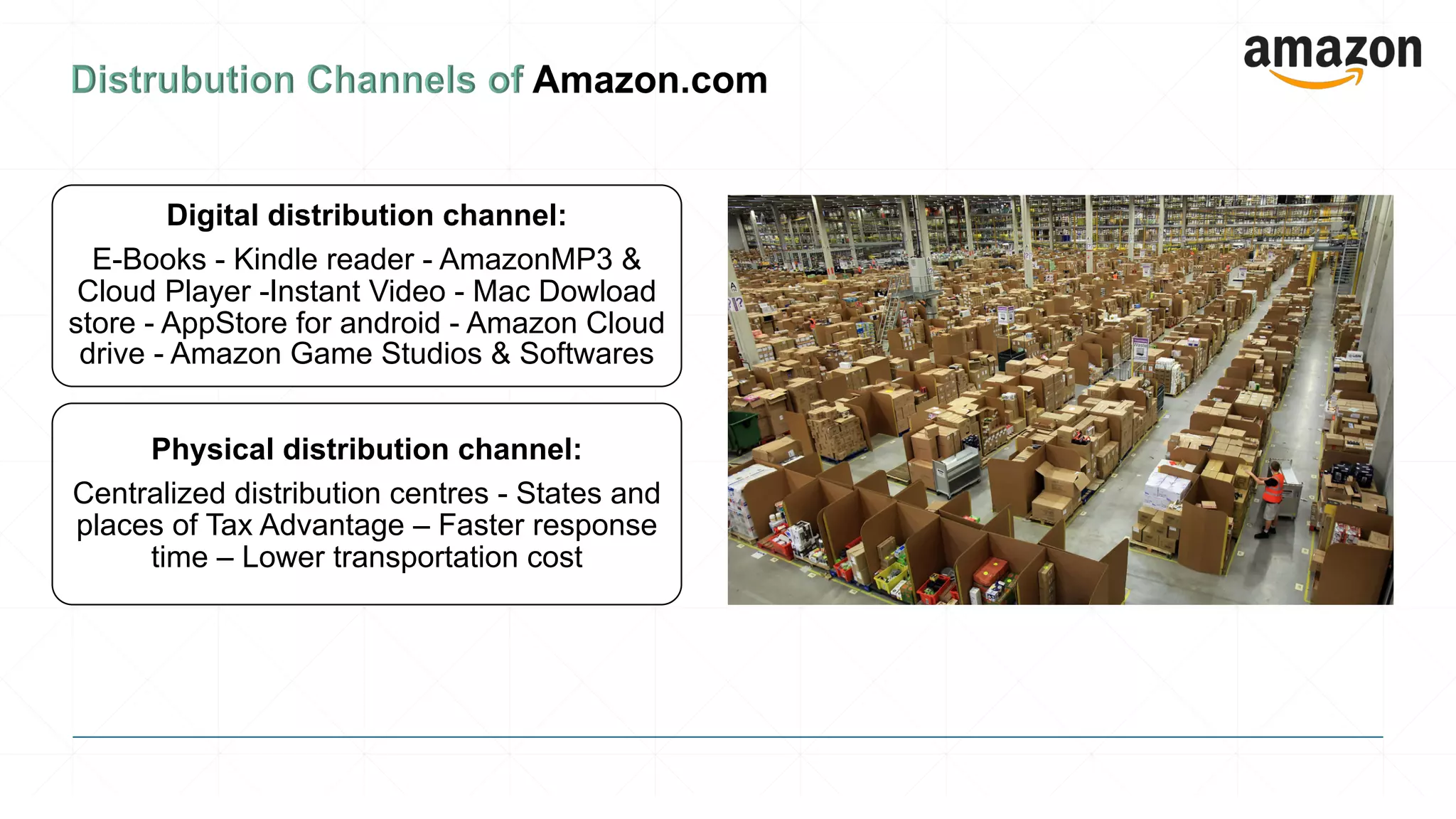
Digital distribution channel:
E-Books - Kindle reader - AmazonMP3 &
Cloud Player -Instant Video - Mac Dowload
store - AppStore for android - Amazon Cloud
drive - Amazon Game Studios & Softwares
Physical distribution channel:
Centralized distribution centres - States and
places of Tax Advantage – Faster response
time – Lower transportation cost
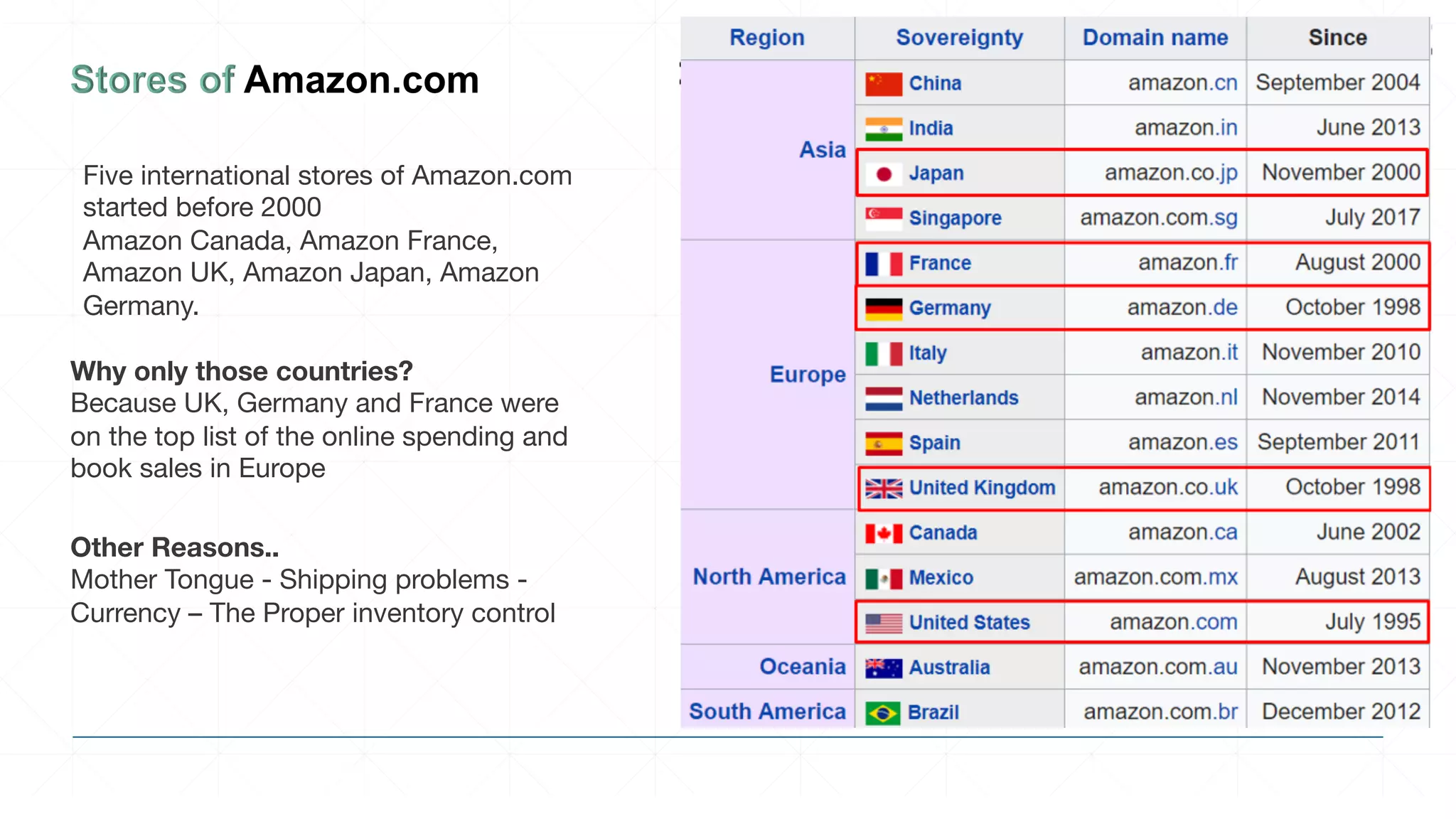
Five international stores of Amazon.com
started before 2000
Amazon Canada, Amazon France,
Amazon UK, Amazon Japan, Amazon
Germany.
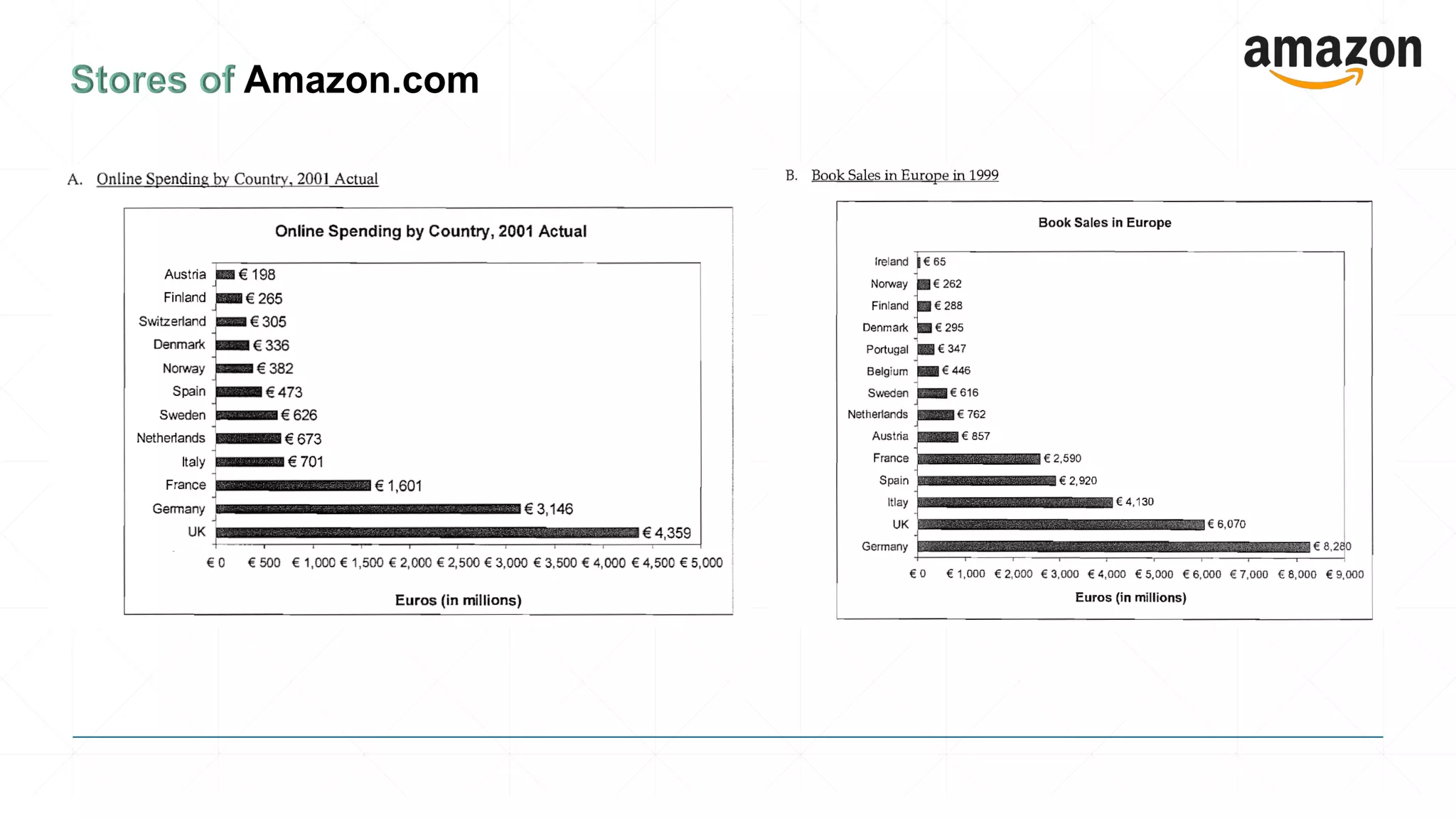
Why only those countries?
Because UK, Germany and France were
on the top list of the online spending and
book sales in Europe
Other Reasons..
Mother Tongue - Shipping problems -
Currency – The Proper inventory control
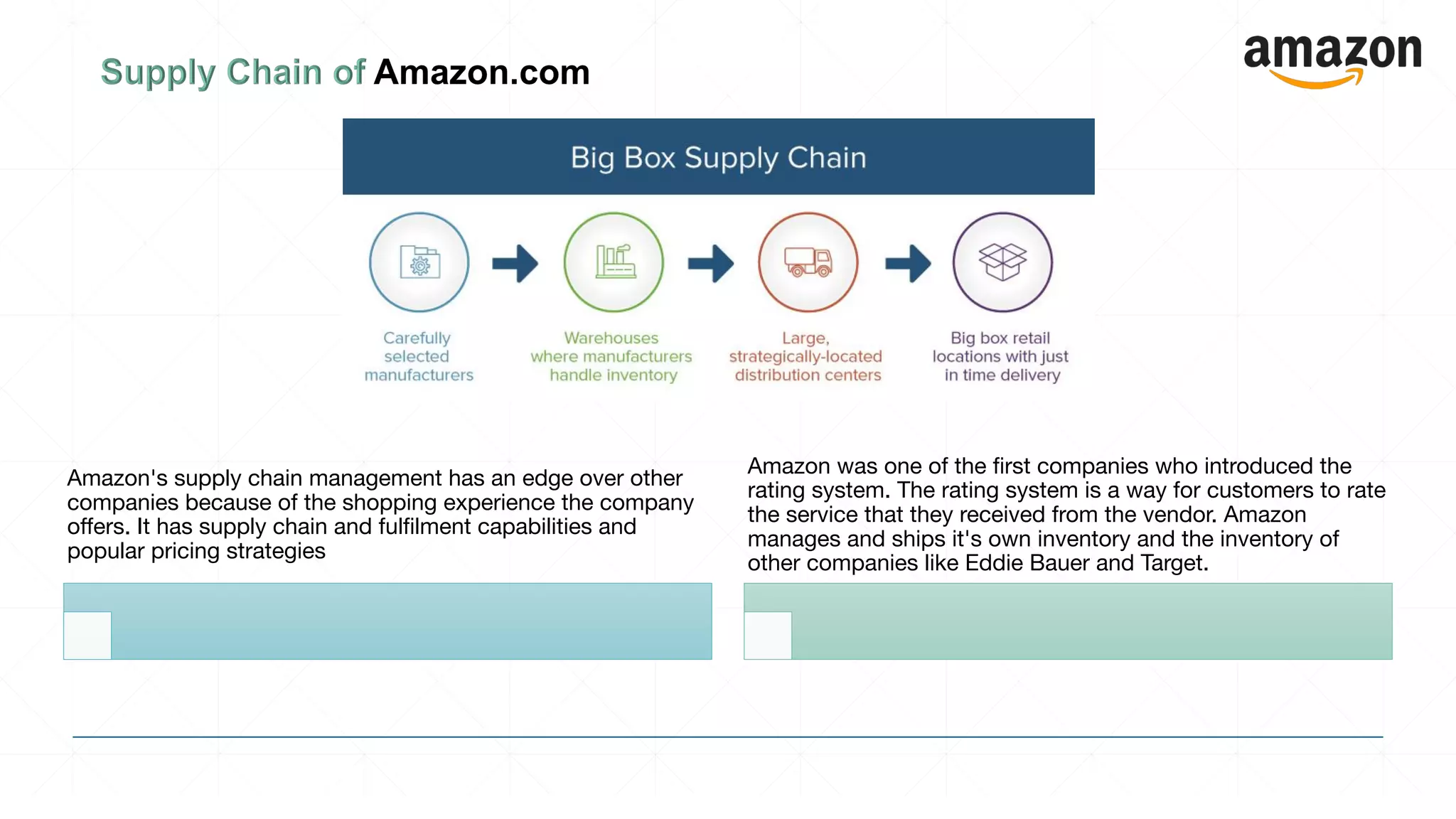
Amazon's supply chain management has an edge over other
companies because of the shopping experience the company
offers. It has supply chain and fulfilment capabilities and
popular pricing strategies
Amazon was one of the first companies who introduced the
rating system. The rating system is a way for customers to rate
the service that they received from the vendor. Amazon
manages and ships it's own inventory and the inventory of
other companies like Eddie Bauer and Target.
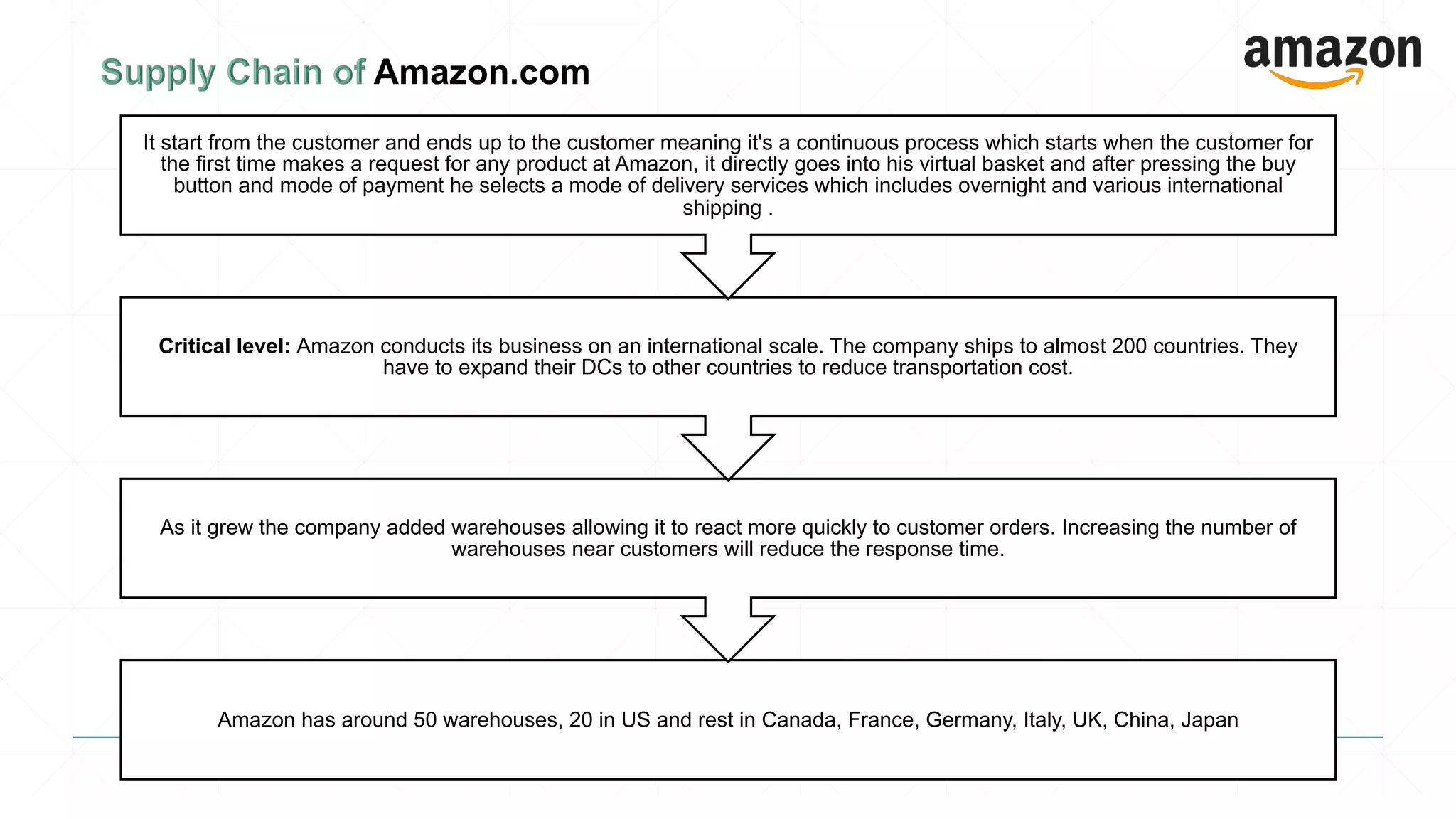
Amazon has around 50 warehouses, 20 in US and rest in Canada, France, Germany, Italy, UK, China, Japan
As it grew the company added warehouses allowing it to react more quickly to customer orders. Increasing the number of
warehouses near customers will reduce the response time.
Critical level: Amazon conducts its business on an international scale. The company ships to almost 200 countries. They
have to expand their DCs to other countries to reduce transportation cost.
It start from the customer and ends up to the customer meaning it's a continuous process which starts when the customer for
the first time makes a request for any product at Amazon, it directly goes into his virtual basket and after pressing the buy
button and mode of payment he selects a mode of delivery services which includes overnight and various international
shipping .
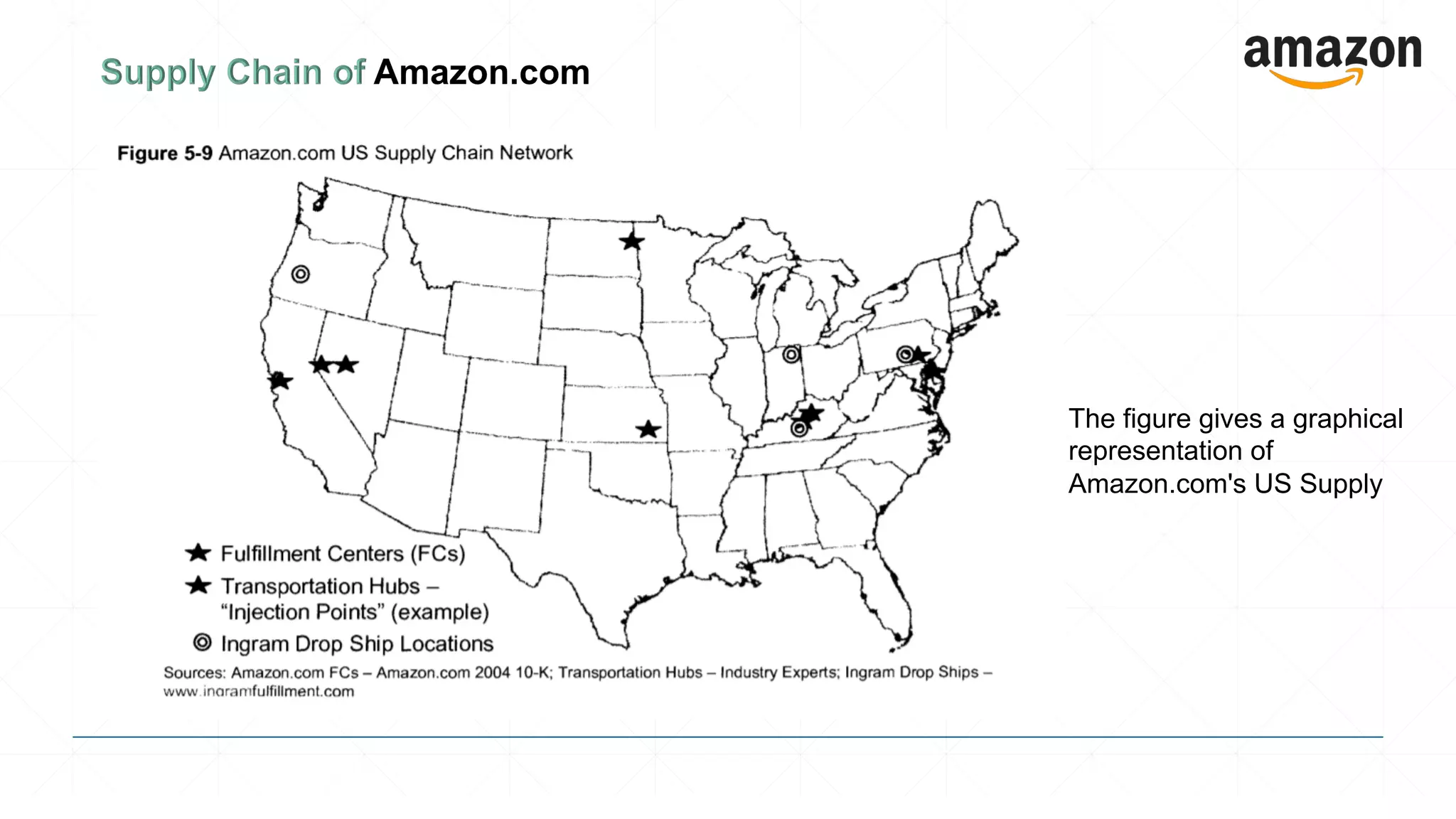
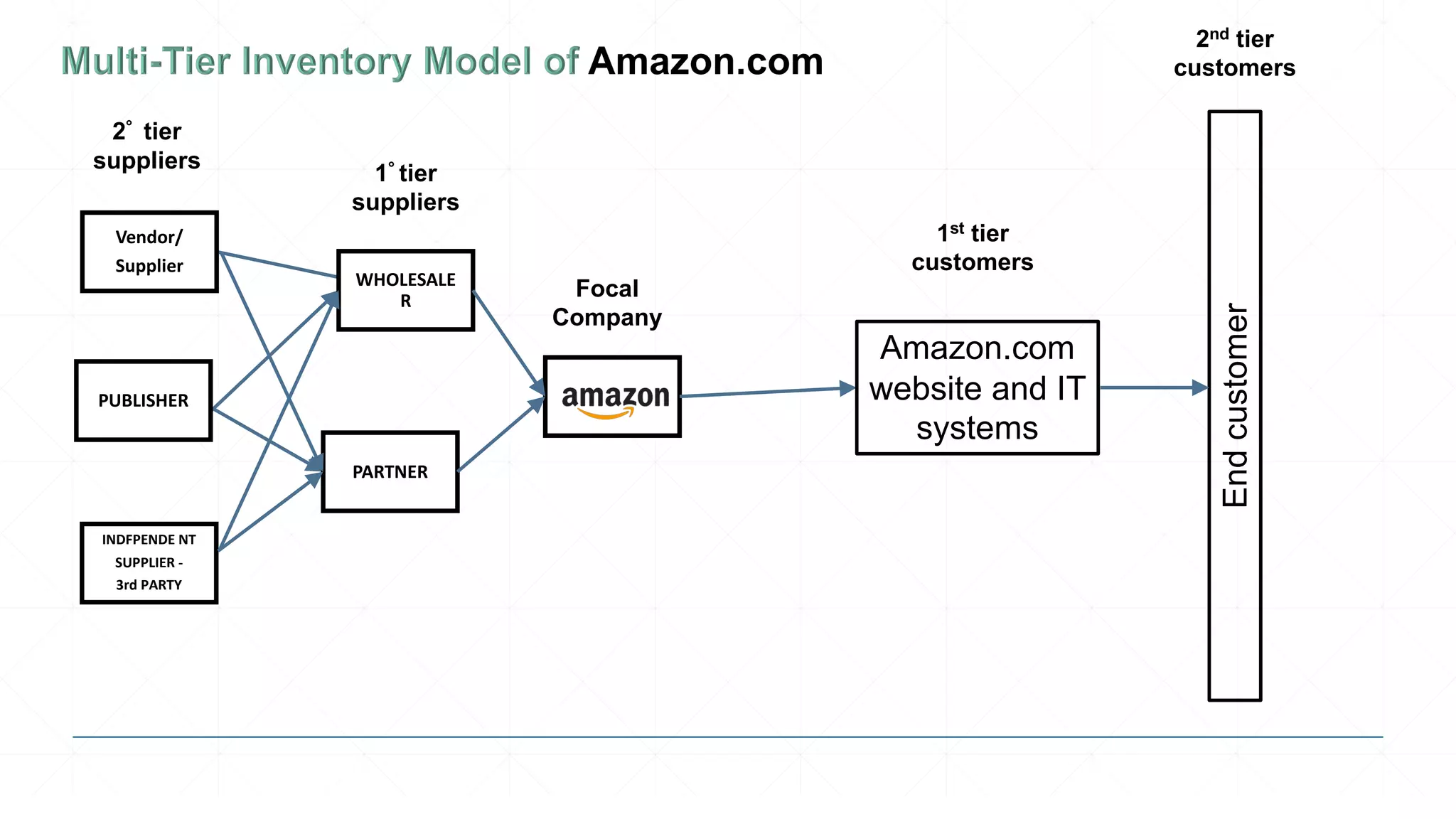
The figure gives a graphical
representation of
Amazon.com's US Supply
1st tier
customers
Endcustomer
2nd tier
customers
2° tier
suppliers
1° tier
suppliers
Focal
Company
Vendor/
Supplier
WHOLESALE
R
INDFPENDE NT
SUPPLIER -
3rd PARTY
PUBLISHER
PARTNER
Amazon.com
website and IT
systems
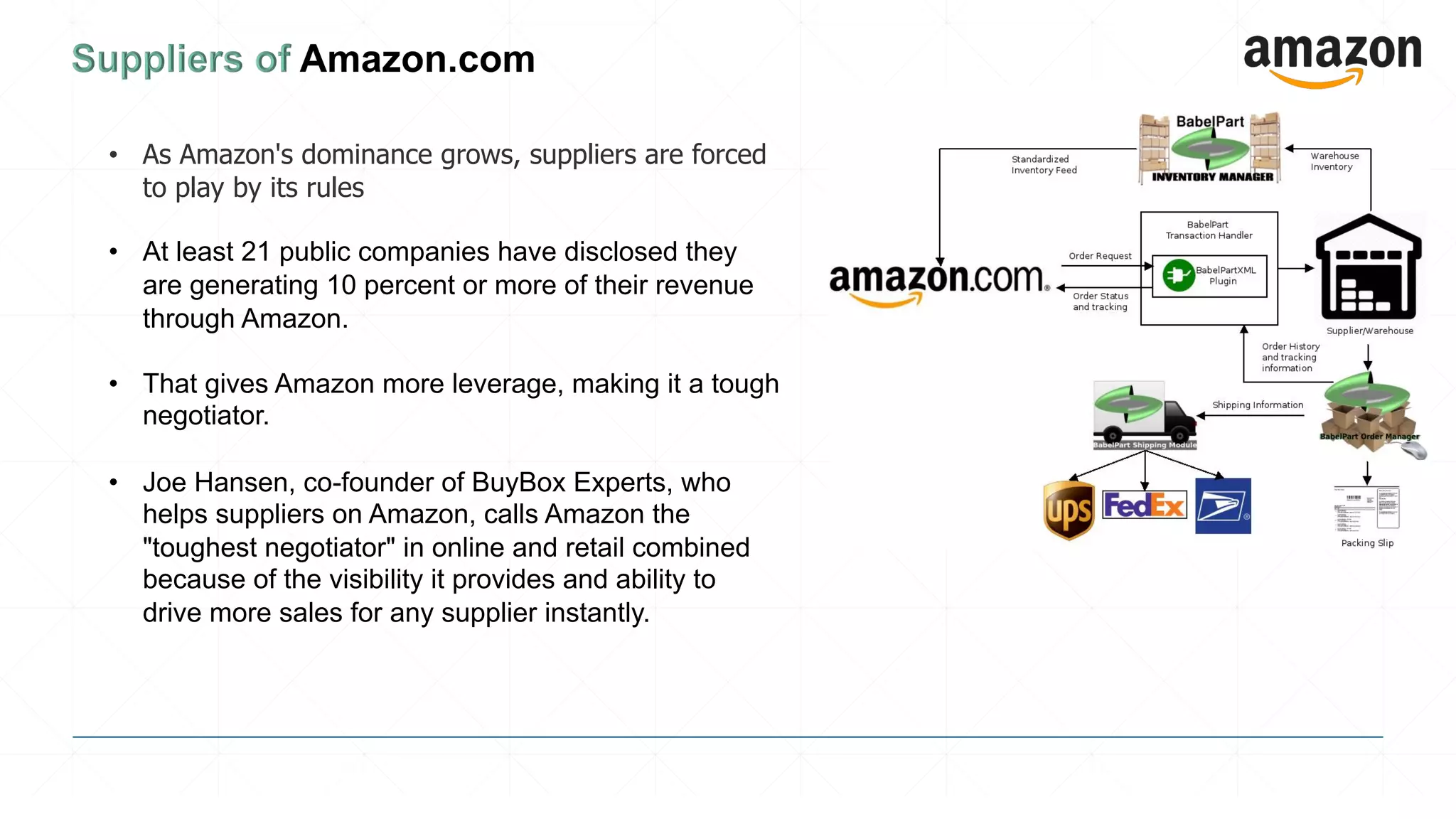
• As Amazon's dominance grows, suppliers are forced
to play by its rules
• At least 21 public companies have disclosed they
are generating 10 percent or more of their revenue
through Amazon.
• That gives Amazon more leverage, making it a tough
negotiator.
• Joe Hansen, co-founder of BuyBox Experts, who
helps suppliers on Amazon, calls Amazon the
"toughest negotiator" in online and retail combined
because of the visibility it provides and ability to
drive more sales for any supplier instantly.
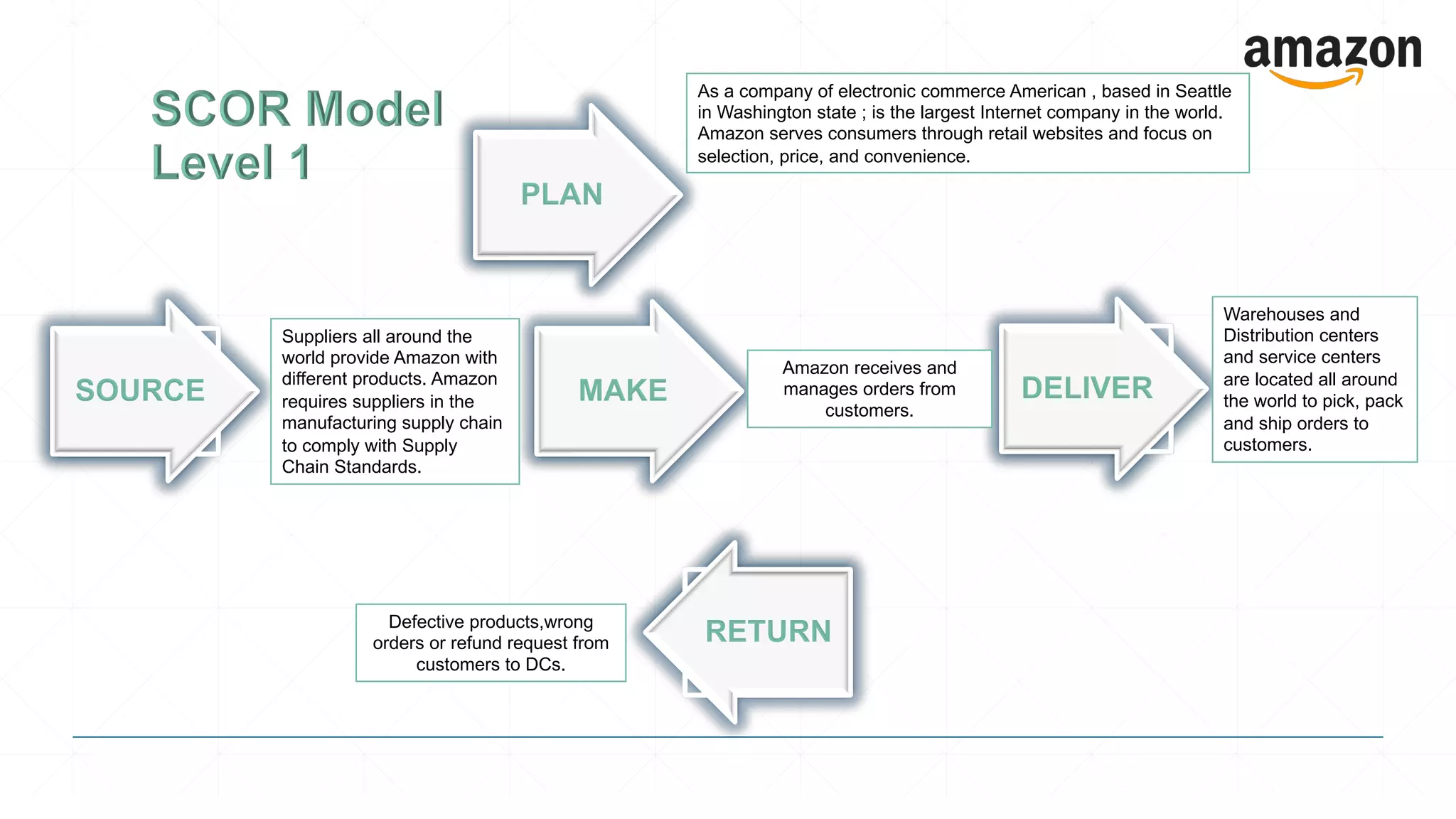
As a company of electronic commerce American , based in Seattle
in Washington state ; is the largest Internet company in the world.
Amazon serves consumers through retail websites and focus on
selection, price, and convenience.
Suppliers all around the
world provide Amazon with
different products. Amazon
requires suppliers in the
manufacturing supply chain
to comply with Supply
Chain Standards.
Amazon receives and
manages orders from
customers.
Warehouses and
Distribution centers
and service centers
are located all around
the world to pick, pack
and ship orders to
customers.
Defective products,wrong
orders or refund request from
customers to DCs.
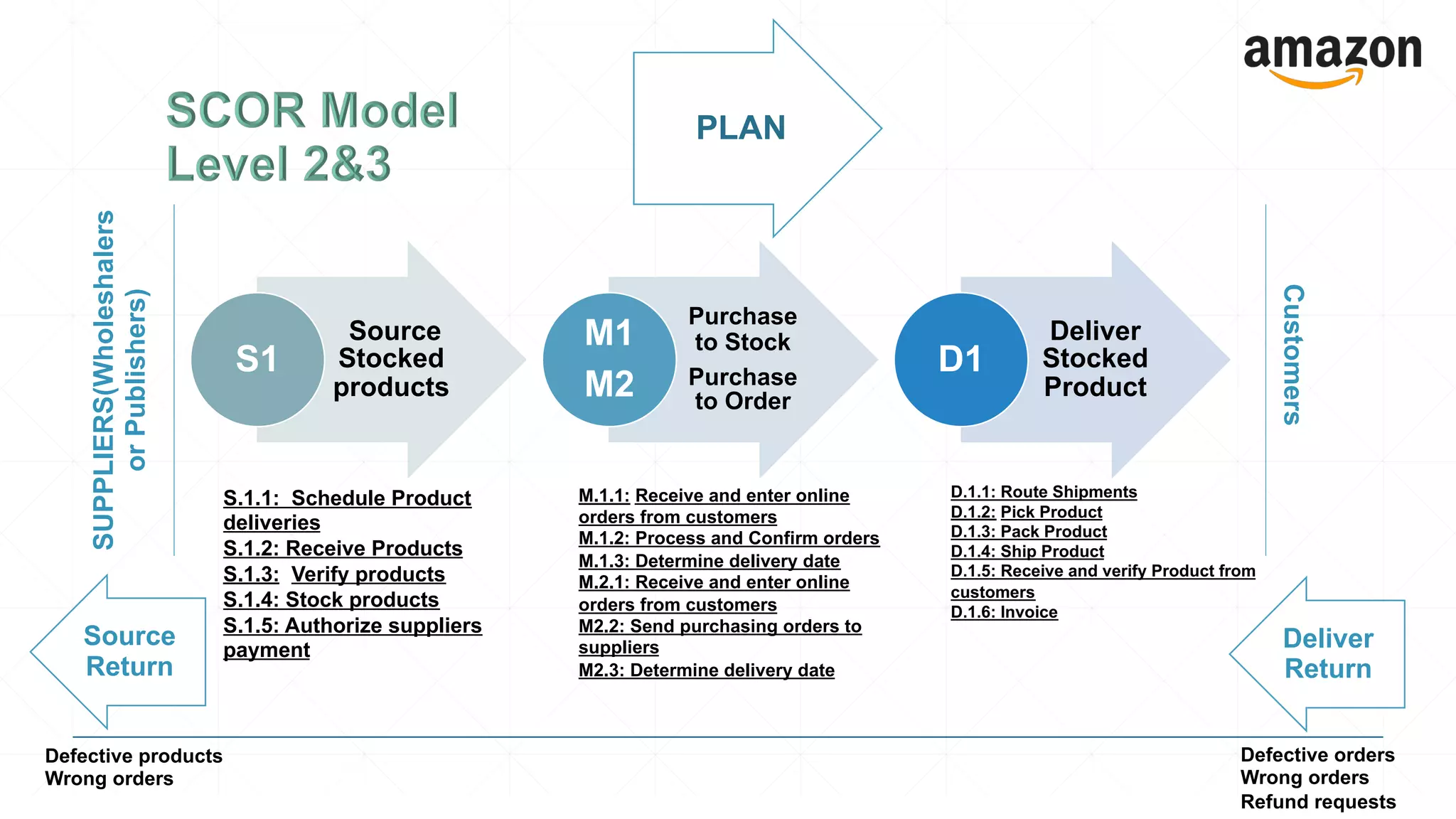
Source
Stocked
products
S1
Purchase
to Stock
Purchase
to Order
M1
M2
Deliver
Stocked
Product
D1
PLAN
Source
Return
Deliver
Return
S.1.1: Schedule Product
deliveries
S.1.2: Receive Products
S.1.3: Verify products
S.1.4: Stock products
S.1.5: Authorize suppliers
payment
SUPPLIERS(Wholeshalers
orPublishers)
Customers
M.1.1: Receive and enter online
orders from customers
M.1.2: Process and Confirm orders
M.1.3: Determine delivery date
M.2.1: Receive and enter online
orders from customers
M2.2: Send purchasing orders to
suppliers
M2.3: Determine delivery date
D.1.1: Route Shipments
D.1.2: Pick Product
D.1.3: Pack Product
D.1.4: Ship Product
D.1.5: Receive and verify Product from
customers
D.1.6: Invoice
Defective orders
Wrong orders
Refund requests
Defective products
Wrong orders
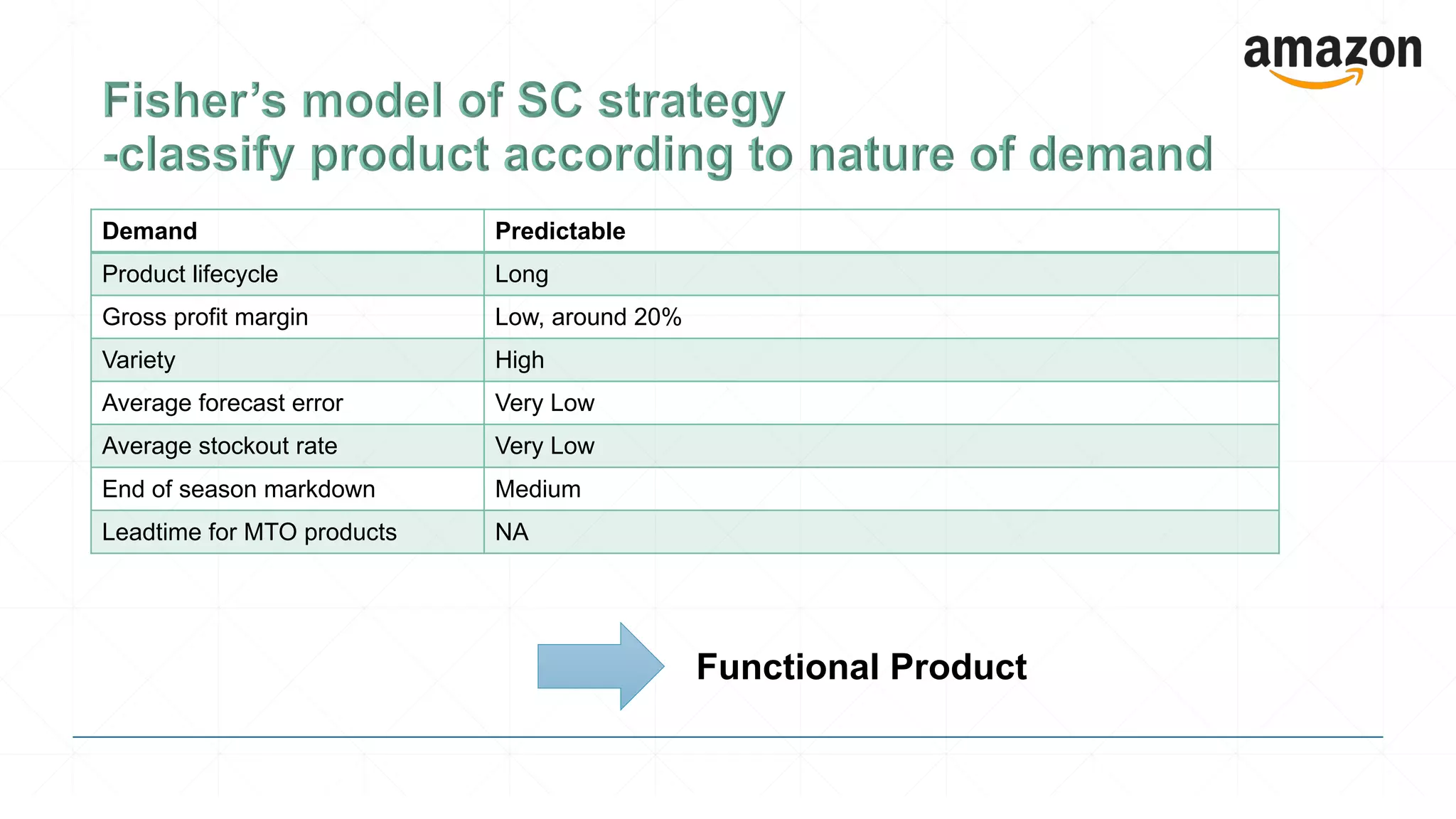
Demand Predictable
Product lifecycle Long
Gross profit margin Low, around 20%
Variety High
Average forecast error Very Low
Average stockout rate Very Low
End of season markdown Medium
Leadtime for MTO products NA
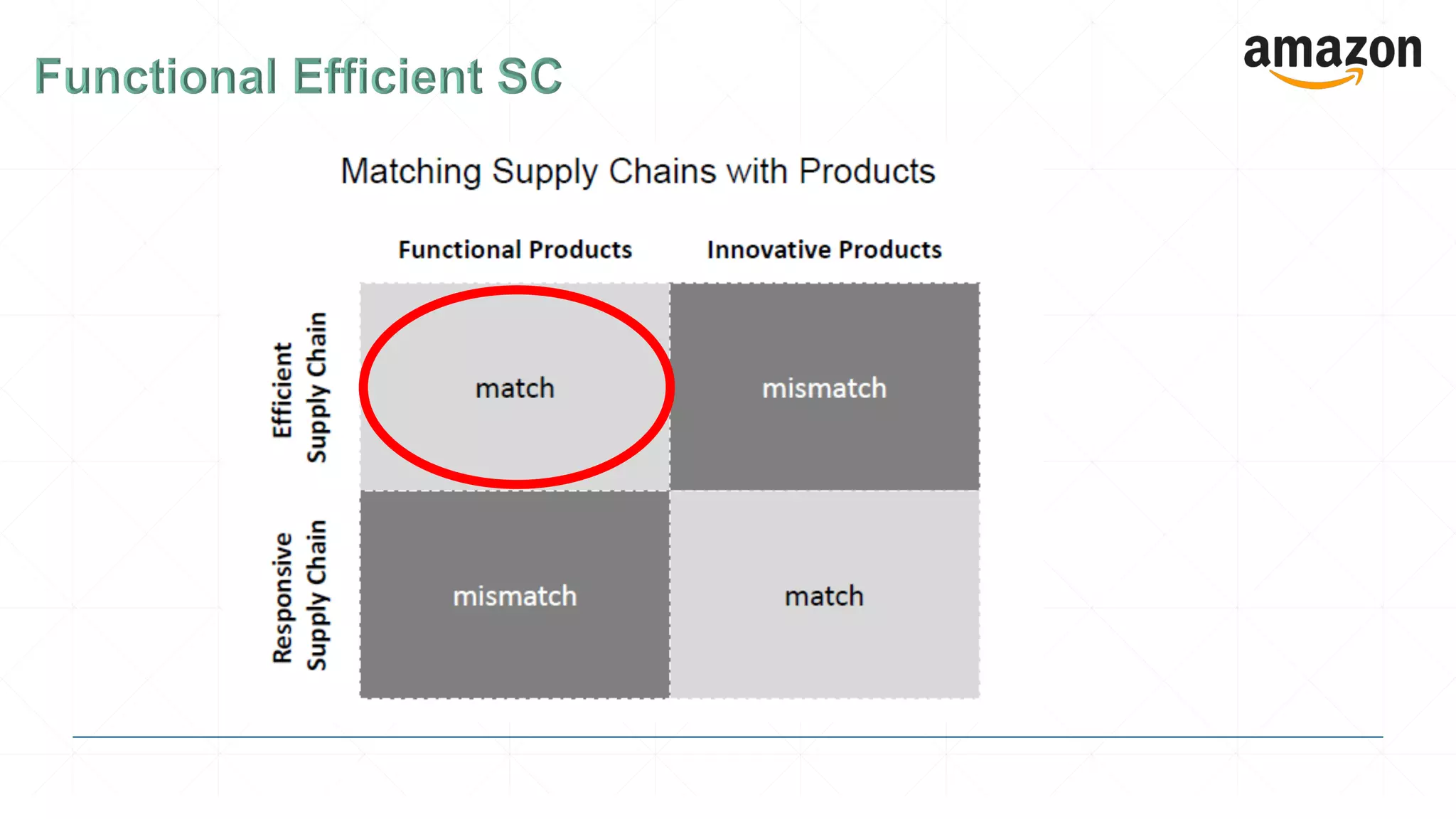
Functional Product
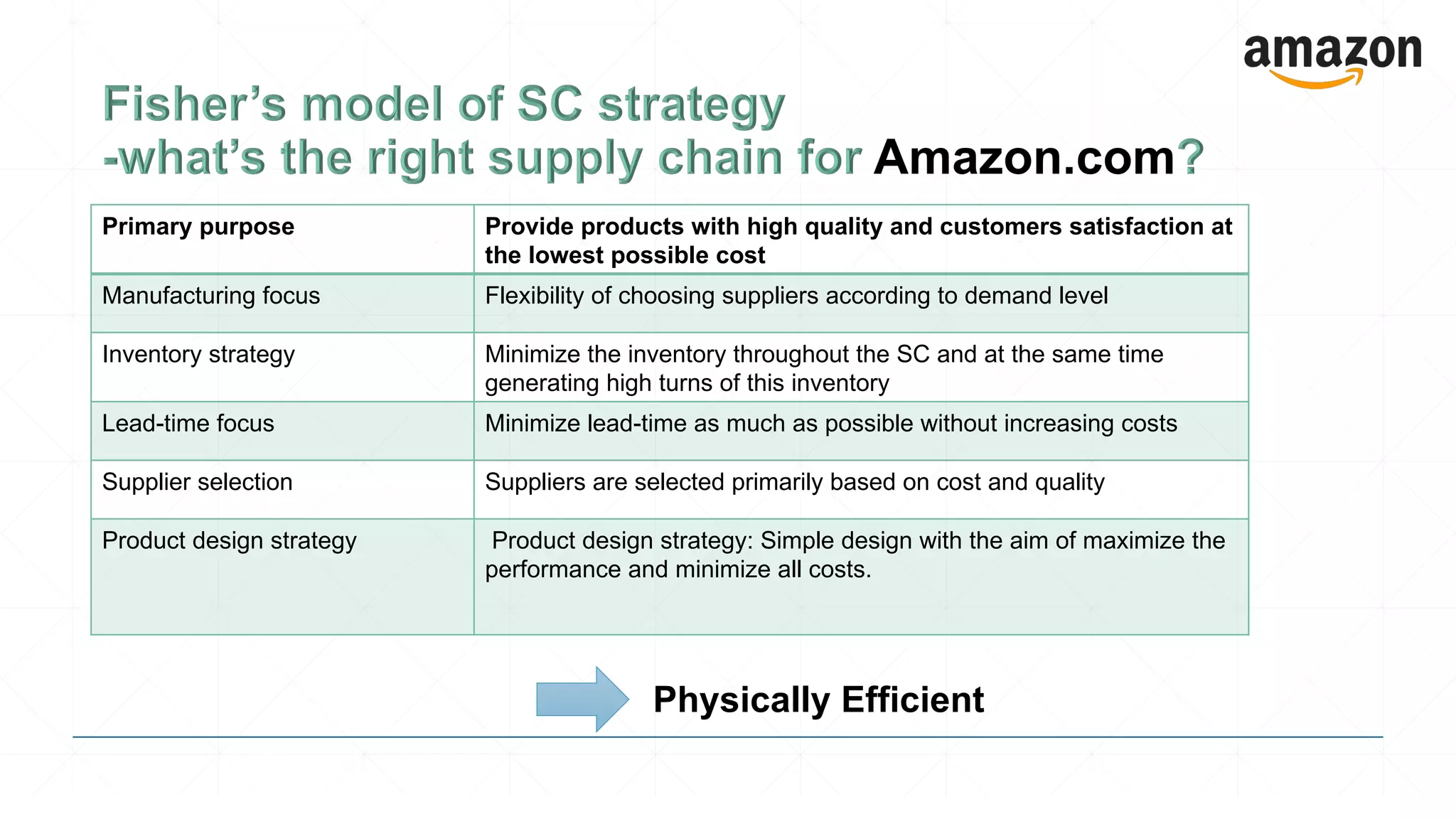
Primary purpose Provide products with high quality and customers satisfaction at
the lowest possible cost
Manufacturing focus Flexibility of choosing suppliers according to demand level
Inventory strategy Minimize the inventory throughout the SC and at the same time
generating high turns of this inventory
Lead-time focus Minimize lead-time as much as possible without increasing costs
Supplier selection Suppliers are selected primarily based on cost and quality
Product design strategy Product design strategy: Simple design with the aim of maximize the
performance and minimize all costs.
Physically Efficient
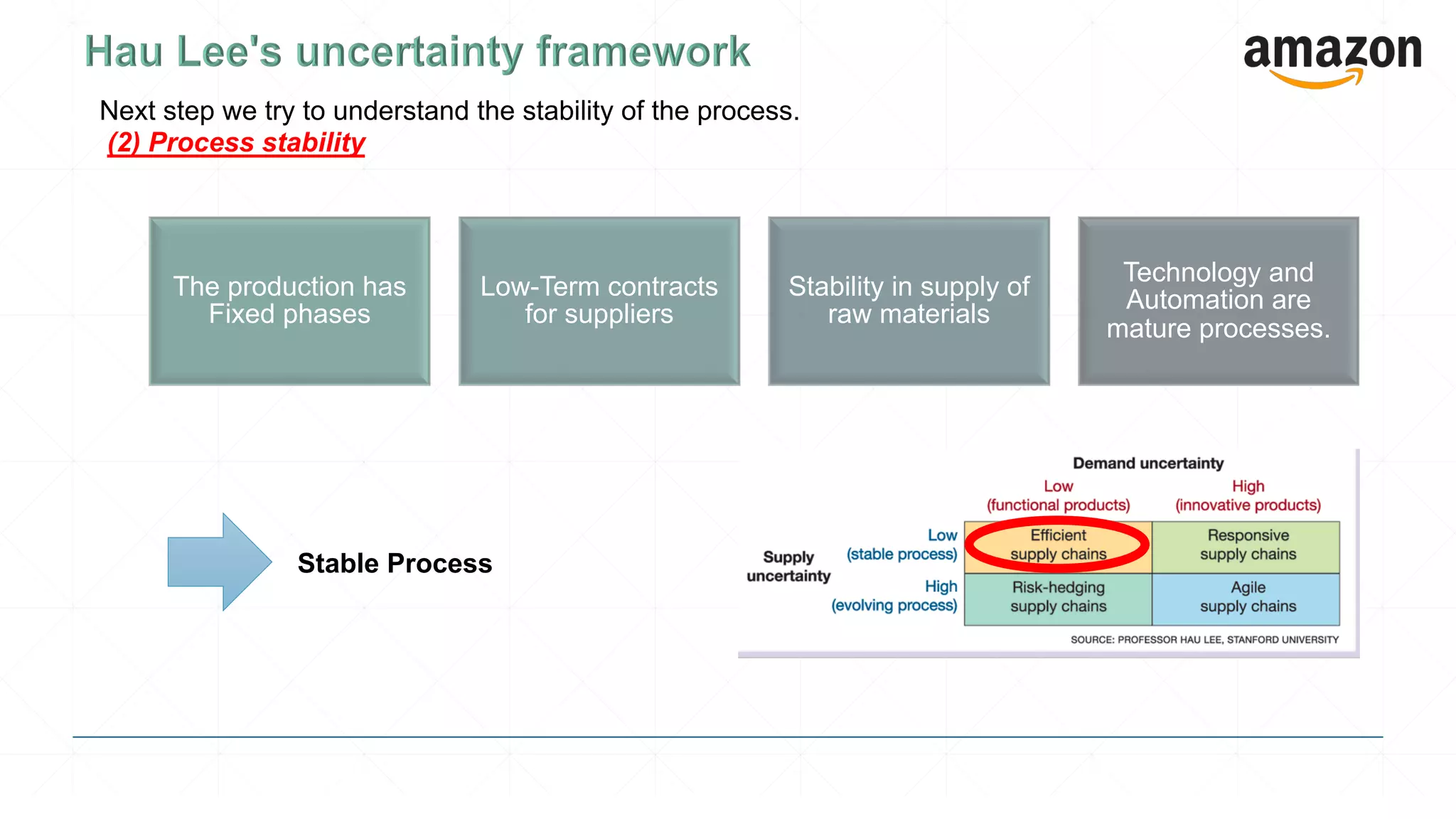
Hau Lee’s model
The production has
Fixed phases
Low-Term contracts
for suppliers
Stability in supply of
raw materials
Technology and
Automation are
mature processes.
Next step we try to understand the stability of the process.
(2) Process stability
Stable Process
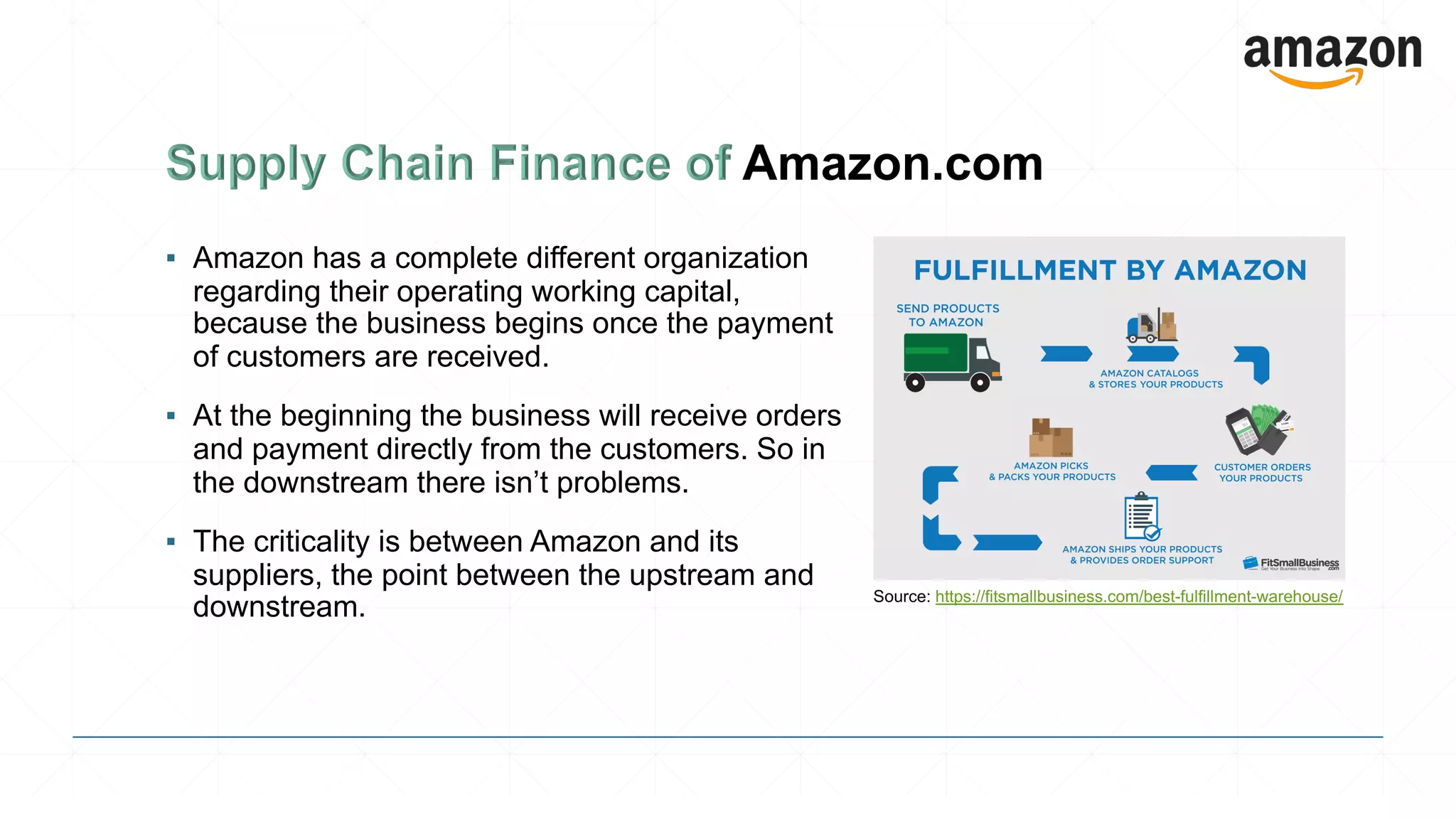
▪ Amazon has a complete different organization
regarding their operating working capital,
because the business begins once the payment
of customers are received.
▪ At the beginning the business will receive orders
and payment directly from the customers. So in
the downstream there isn’t problems.
▪ The criticality is between Amazon and its
suppliers, the point between the upstream and
downstream. Source: https://fitsmallbusiness.com/best-fulfillment-warehouse/
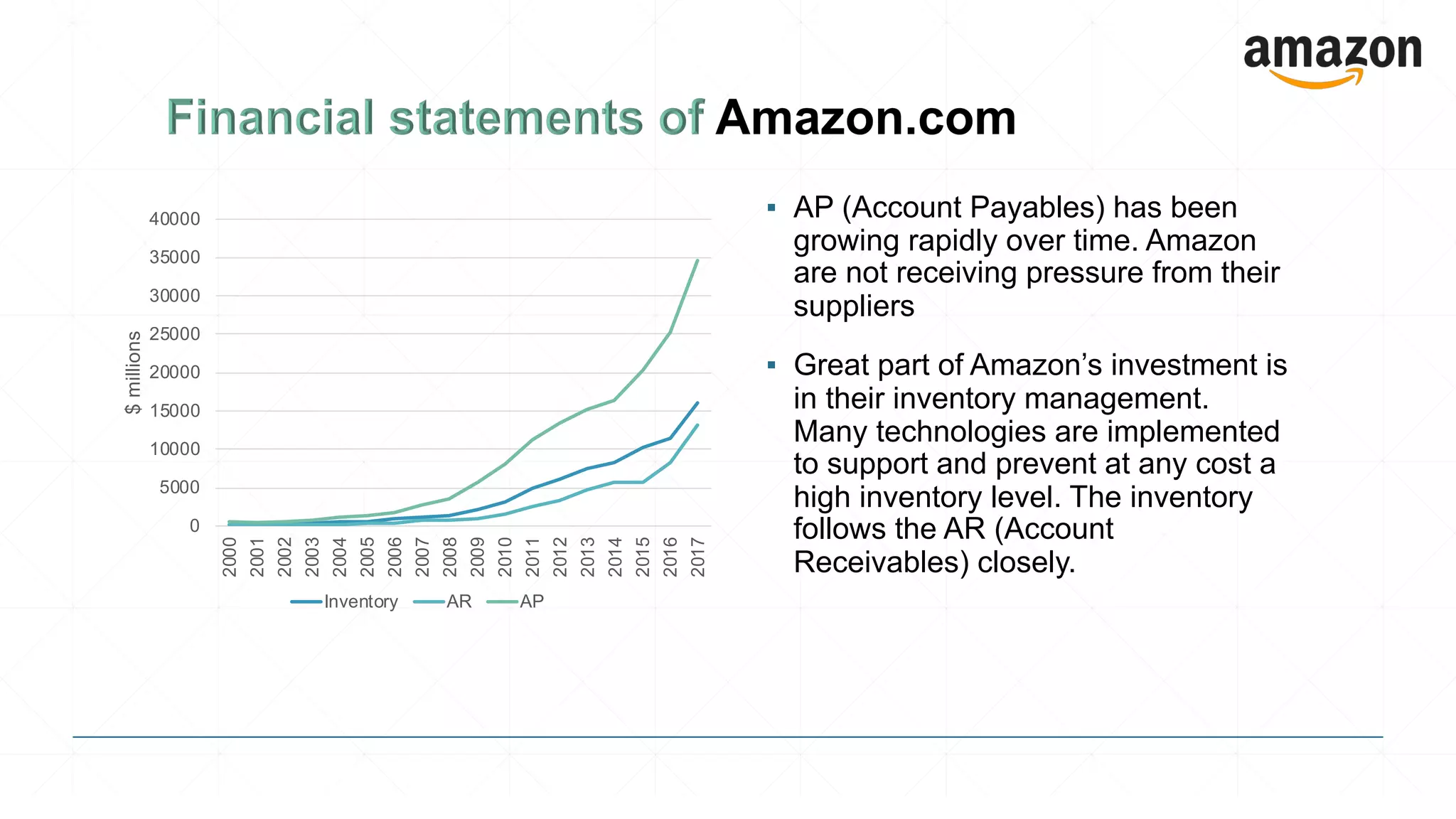
▪ AP (Account Payables) has been
growing rapidly over time. Amazon
are not receiving pressure from their
suppliers
▪ Great part of Amazon’s investment is
in their inventory management.
Many technologies are implemented
to support and prevent at any cost a
high inventory level. The inventory
follows the AR (Account
Receivables) closely.
0
5000
10000
15000
20000
25000
30000
35000
40000
2000
2001
2002
2003
2004
2005
2006
2007
2008
2009
2010
2011
2012
2013
2014
2015
2016
2017
$millions
Inventory AR AP
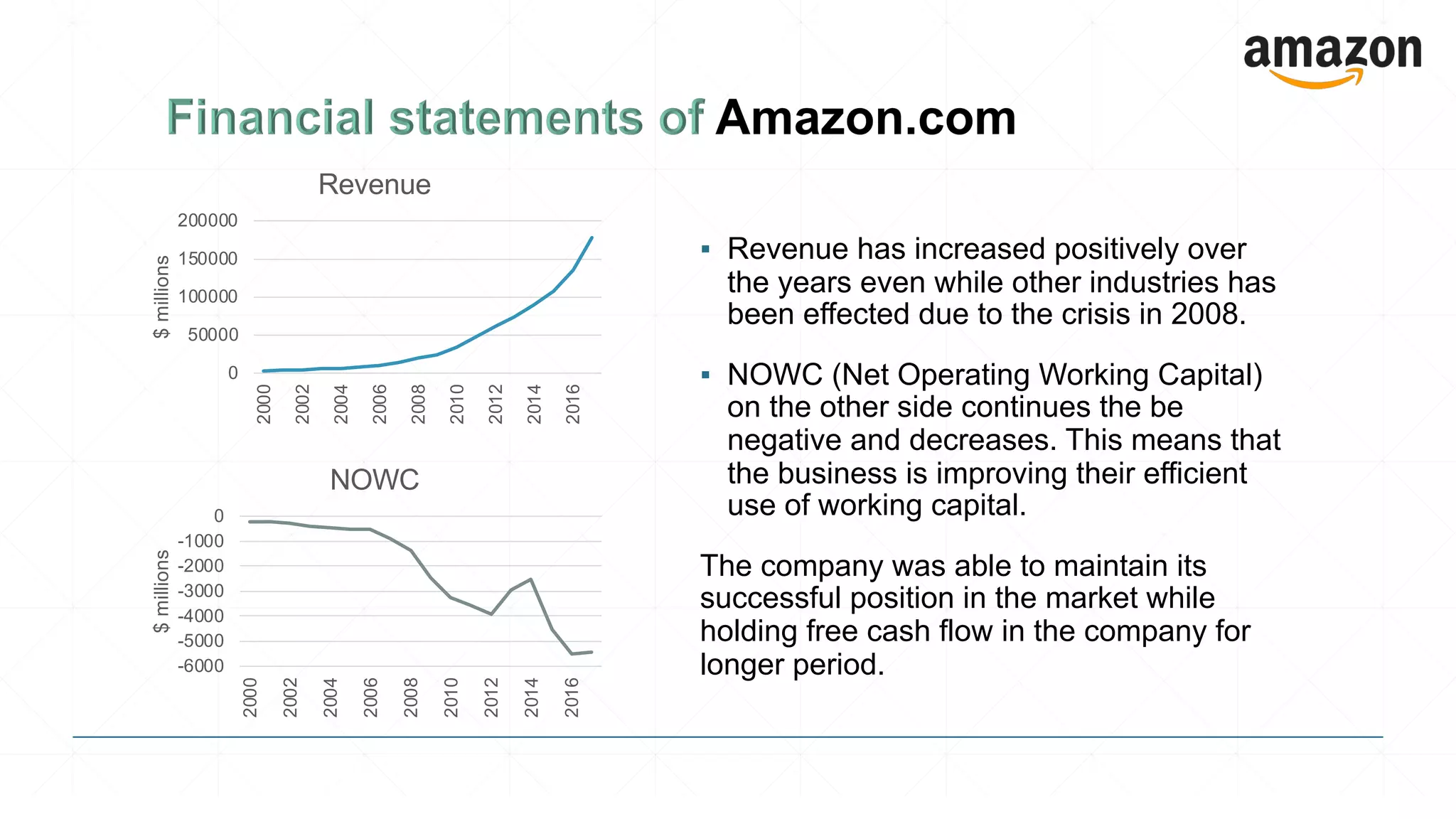
▪ Revenue has increased positively over
the years even while other industries has
been effected due to the crisis in 2008.
▪ NOWC (Net Operating Working Capital)
on the other side continues the be
negative and decreases. This means that
the business is improving their efficient
use of working capital.
The company was able to maintain its
successful position in the market while
holding free cash flow in the company for
longer period.
0
50000
100000
150000
200000
2000
2002
2004
2006
2008
2010
2012
2014
2016
$millions
Revenue
-6000
-5000
-4000
-3000
-2000
-1000
0
2000
2002
2004
2006
2008
2010
2012
2014
2016
$millions
NOWC
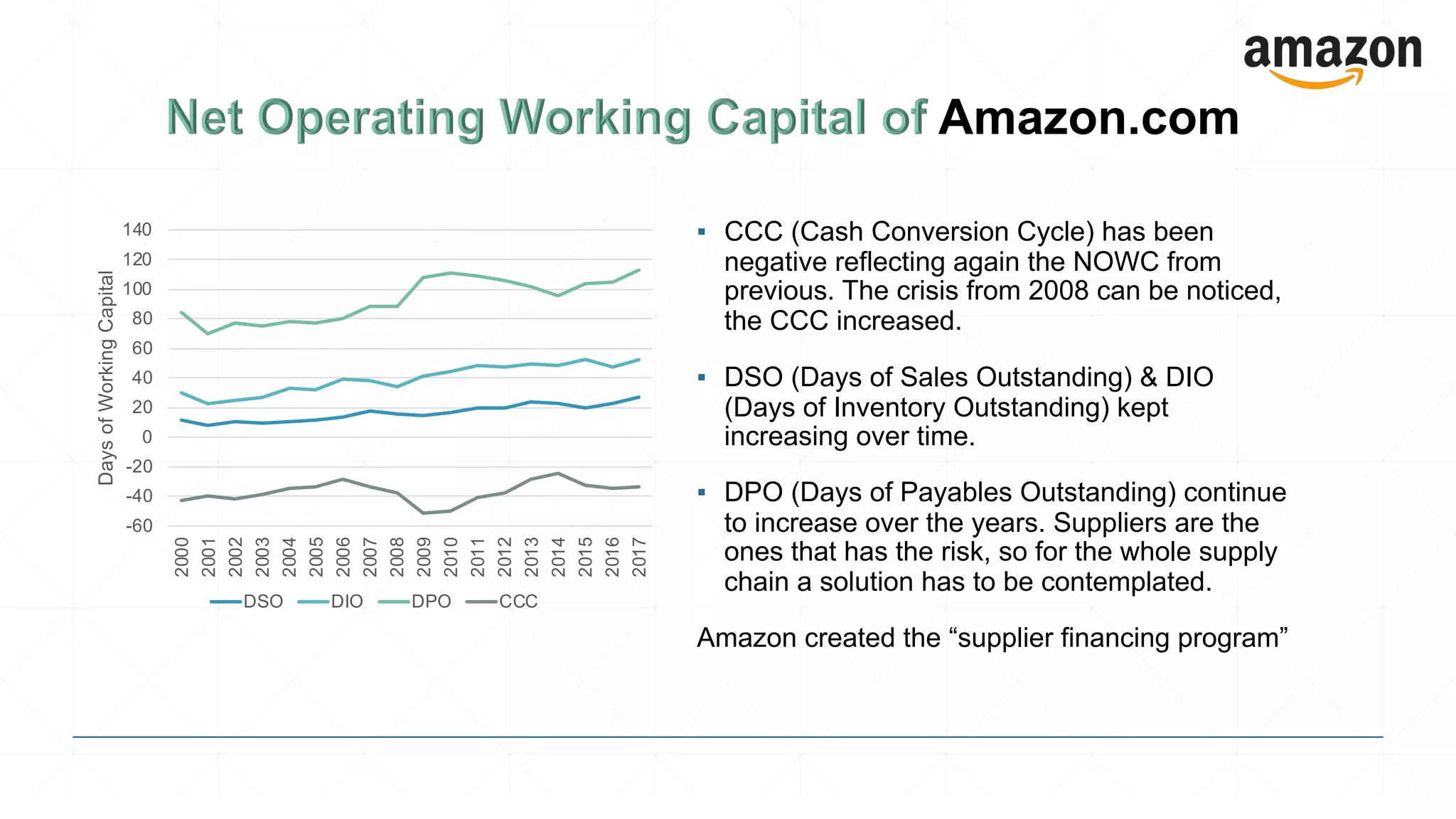
▪ CCC (Cash Conversion Cycle) has been
negative reflecting again the NOWC from
previous. The crisis from 2008 can be noticed,
the CCC increased.
▪ DSO (Days of Sales Outstanding) & DIO
(Days of Inventory Outstanding) kept
increasing over time.
▪ DPO (Days of Payables Outstanding) continue
to increase over the years. Suppliers are the
ones that has the risk, so for the whole supply
chain a solution has to be contemplated.
Amazon created the “supplier financing program”
-60
-40
-20
0
20
40
60
80
100
120
140
2000
2001
2002
2003
2004
2005
2006
2007
2008
2009
2010
2011
2012
2013
2014
2015
2016
2017
DaysofWorkingCapital
DSO DIO DPO CCC
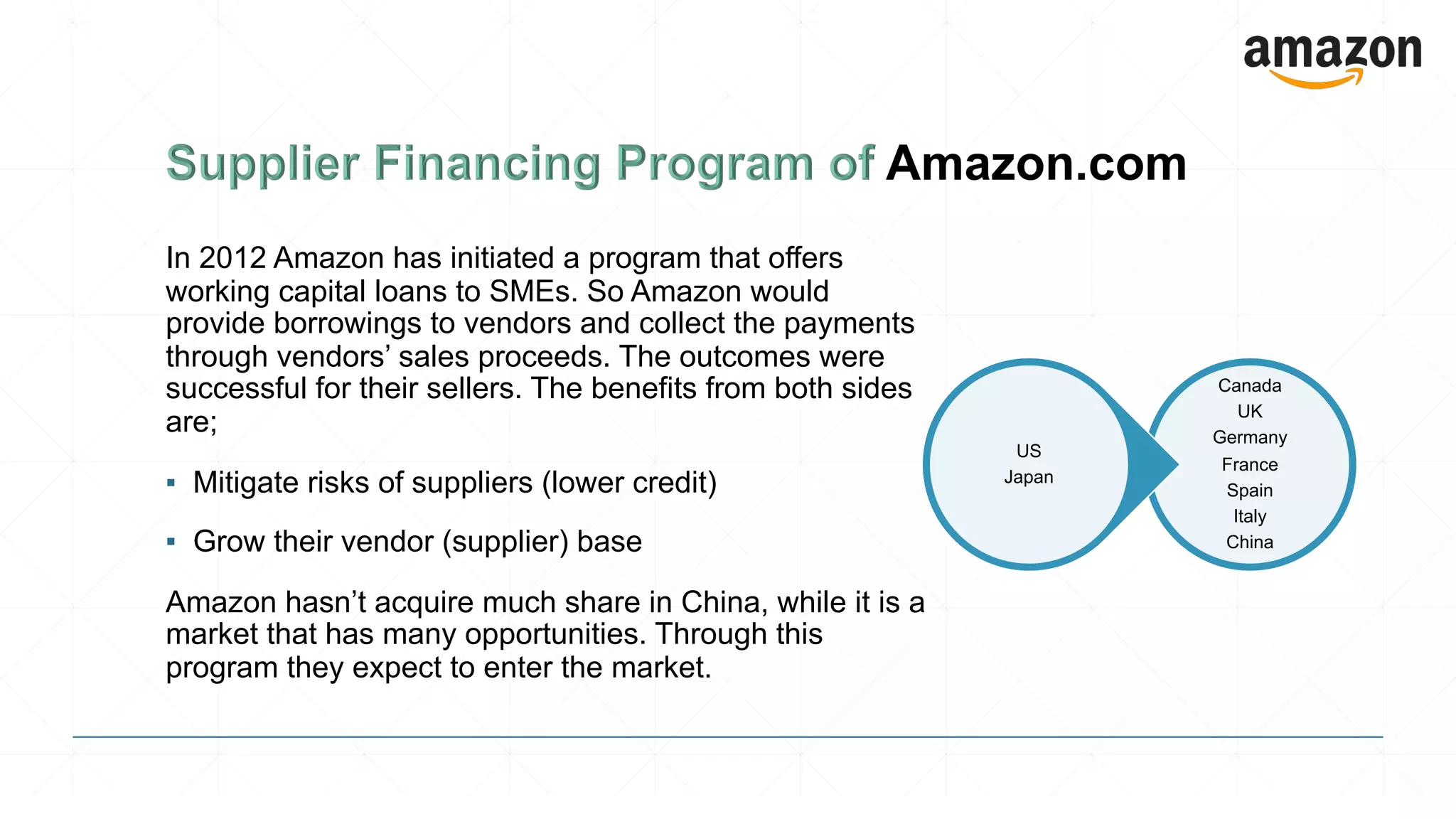
In 2012 Amazon has initiated a program that offers
working capital loans to SMEs. So Amazon would
provide borrowings to vendors and collect the payments
through vendors’ sales proceeds. The outcomes were
successful for their sellers. The benefits from both sides
are;
▪ Mitigate risks of suppliers (lower credit)
▪ Grow their vendor (supplier) base
Amazon hasn’t acquire much share in China, while it is a
market that has many opportunities. Through this
program they expect to enter the market.
Canada
UK
Germany
France
Spain
Italy
China
US
Japan
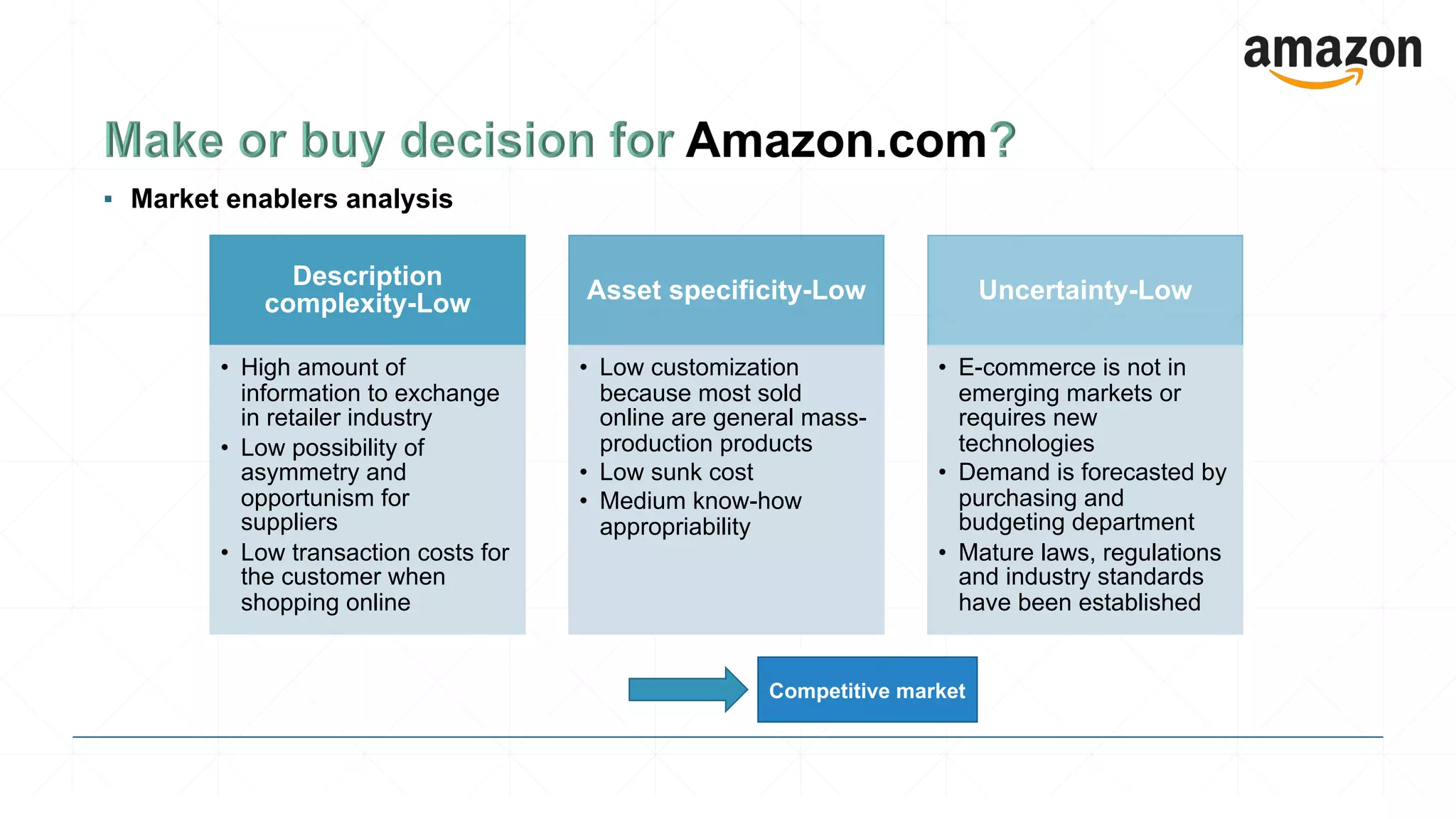
▪ Market enablers analysis
Description
complexity-Low
• High amount of
information to exchange
in retailer industry
• Low possibility of
asymmetry and
opportunism for
suppliers
• Low transaction costs for
the customer when
shopping online
Asset specificity-Low
• Low customization
because most sold
online are general mass-
production products
• Low sunk cost
• Medium know-how
appropriability
Uncertainty-Low
• E-commerce is not in
emerging markets or
requires new
technologies
• Demand is forecasted by
purchasing and
budgeting department
• Mature laws, regulations
and industry standards
have been established
Competitive market
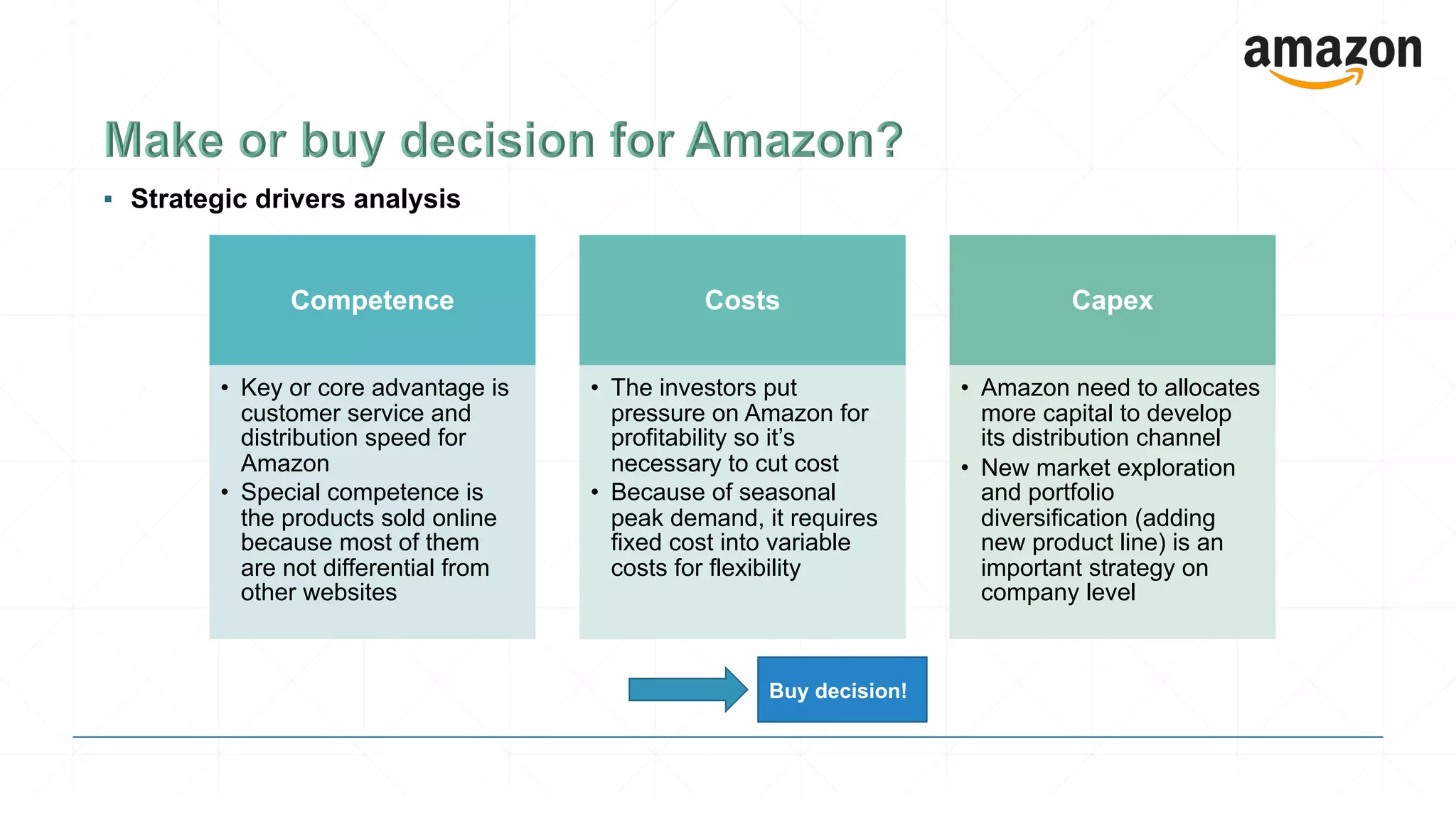
▪ Strategic drivers analysis
Competence
• Key or core advantage is
customer service and
distribution speed for
Amazon
• Special competence is
the products sold online
because most of them
are not differential from
other websites
Costs
• The investors put
pressure on Amazon for
profitability so it’s
necessary to cut cost
• Because of seasonal
peak demand, it requires
fixed cost into variable
costs for flexibility
Capex
• Amazon need to allocates
more capital to develop
its distribution channel
• New market exploration
and portfolio
diversification (adding
new product line) is an
important strategy on
company level
Buy decision!
▪ No long-term arrangements with most of suppliers
▪ Amazon has significant suppliers, including licensors, and in some cases, limited or
single-sources of supply, that are important to sourcing, services, manufacturing, and
any related ongoing servicing of merchandise and content. They do not have long-
term arrangements with most of suppliers to guarantee availability of merchandise,
content, components, or services, particular payment terms, or the extension of credit
limits. If the current suppliers were to stop selling or licensing merchandise, content,
components, or services on acceptable terms, or delay delivery, including as a result
of one or more supplier bankruptcies due to poor economic conditions, as a result of
natural disasters, or for other reasons, Amazon may be unable to procure alternatives
from other suppliers in a timely and efficient manner and on acceptable terms, or at
all. In addition, if the suppliers or other vendors violate applicable laws, regulations,
code of standards and responsibilities required by Amazon, or implement practices
regarded as unethical, unsafe, or hazardous to the environment, it could damage
Amazon’s reputation, limit growth, and negatively affect operating results of Amazon.
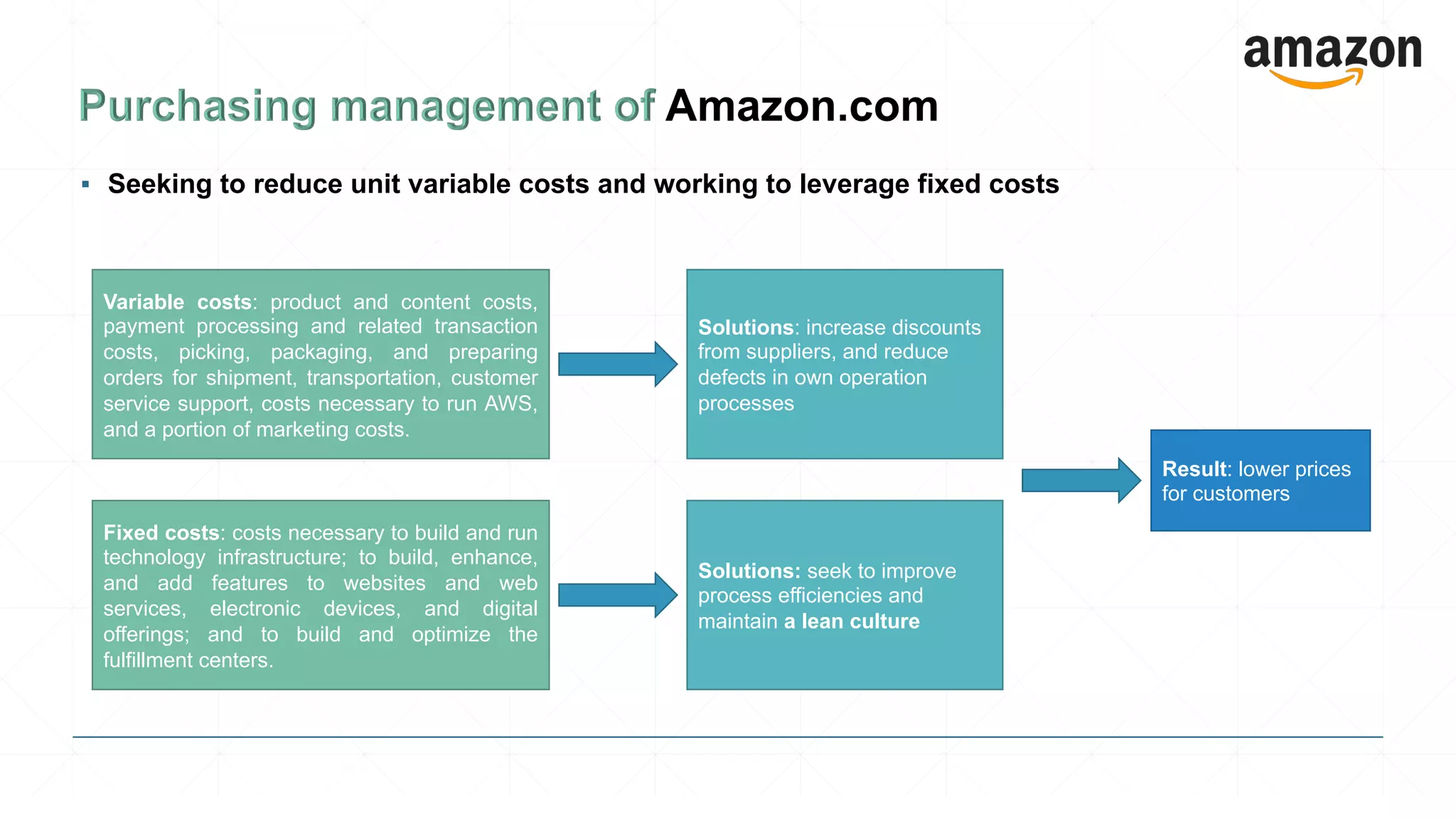
▪ Seeking to reduce unit variable costs and working to leverage fixed costs
Variable costs: product and content costs,
payment processing and related transaction
costs, picking, packaging, and preparing
orders for shipment, transportation, customer
service support, costs necessary to run AWS,
and a portion of marketing costs.
Fixed costs: costs necessary to build and run
technology infrastructure; to build, enhance,
and add features to websites and web
services, electronic devices, and digital
offerings; and to build and optimize the
fulfillment centers.
Solutions: increase discounts
from suppliers, and reduce
defects in own operation
processes
Solutions: seek to improve
process efficiencies and
maintain a lean culture
Result: lower prices
for customers
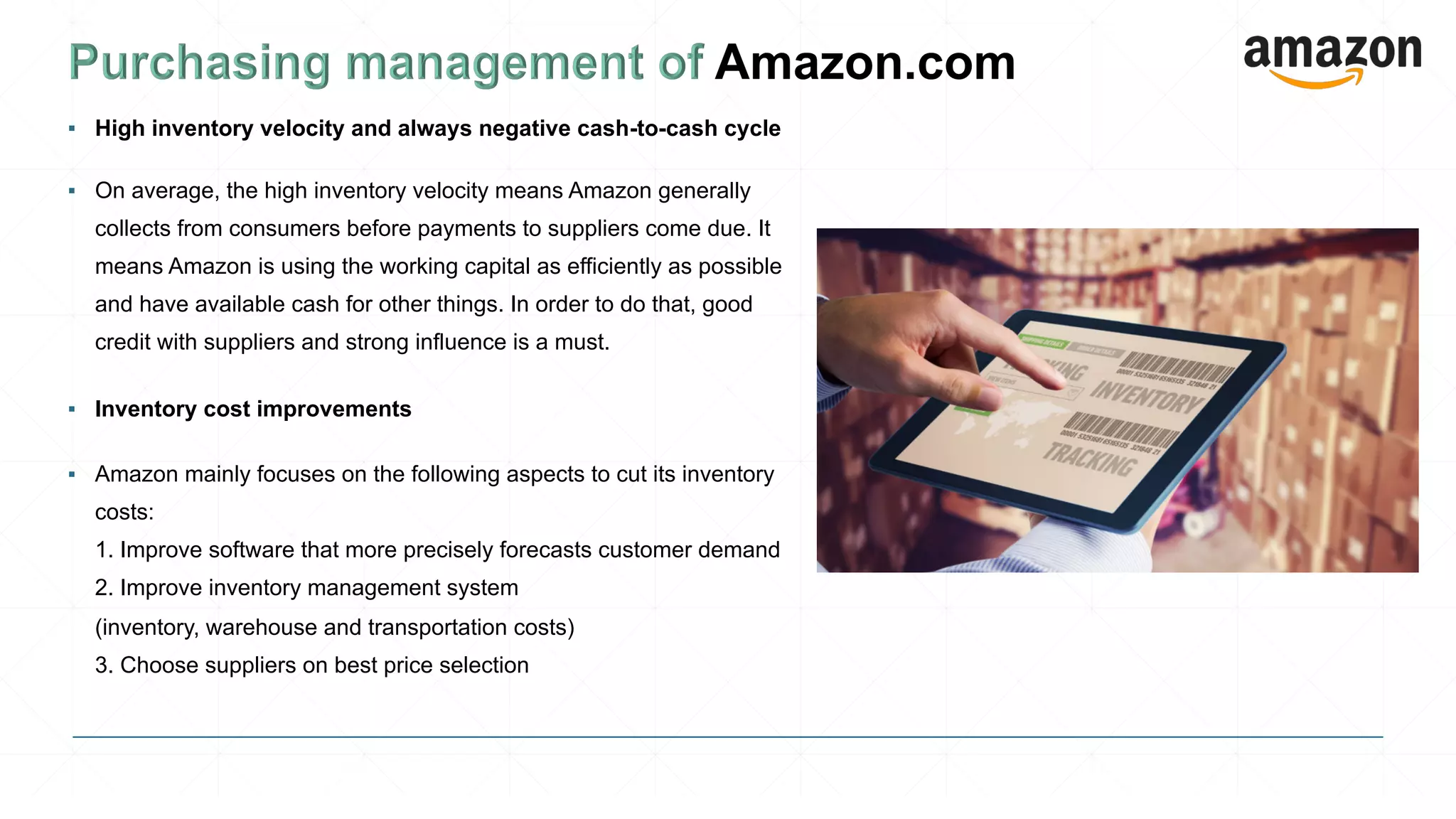
▪ High inventory velocity and always negative cash-to-cash cycle
▪ On average, the high inventory velocity means Amazon generally
collects from consumers before payments to suppliers come due. It
means Amazon is using the working capital as efficiently as possible
and have available cash for other things. In order to do that, good
credit with suppliers and strong influence is a must.
▪ Inventory cost improvements
▪ Amazon mainly focuses on the following aspects to cut its inventory
costs:
1. Improve software that more precisely forecasts customer demand
2. Improve inventory management system
(inventory, warehouse and transportation costs)
3. Choose suppliers on best price selection
▪ Inventory management
▪ It provides Fulfillment by Amazon services in connection with certain of our sellers’ programs. Third-party sellers maintain
ownership of their inventory, regardless of whether fulfillment is provided by Amazon or the third-party sellers, and
therefore these products are not included in our inventories, which reduce inventory management costs for Amazon.
▪ Amazon also purchases electronic device components from a variety of suppliers and uses several contract manufacturers
to provide manufacturing services for their products. During the normal course of business, in order to manage
manufacturing lead times and help ensure adequate component supply, Amazon enters into agreements with contract
manufacturers and suppliers. A portion of their reported purchase commitments arising from these agreements consists of
firm, non-cancellable commitments. These commitments are based on forecasted customer demand. If Amazon reduces
these commitments, that may incur additional costs.
▪ Vendor Agreement
▪ Amazon has agreements with the vendors to receive funds for advertising services, cooperative marketing
efforts, promotions, and volume rebates, which can be seen as one of their cost-reduction strategies. The
amounts received from vendors can be seen as a reduction of the prices they pay for their goods, including
property and equipment, or services, and therefore record those amounts as a reduction of the cost of
inventory, cost of services, or cost of property and equipment. Vendor rebates are typically dependent upon
reaching minimum purchase thresholds. Amazon evaluates the likelihood of reaching purchase thresholds
using past experience and current year forecasts. When volume rebates can be reasonably estimated, they
record a portion of the rebate as we make progress towards the purchase threshold. When Amazon
receives direct reimbursements for costs incurred by itself in advertising the vendor’s product or service, the
amount is as an offset to the marketing expense.
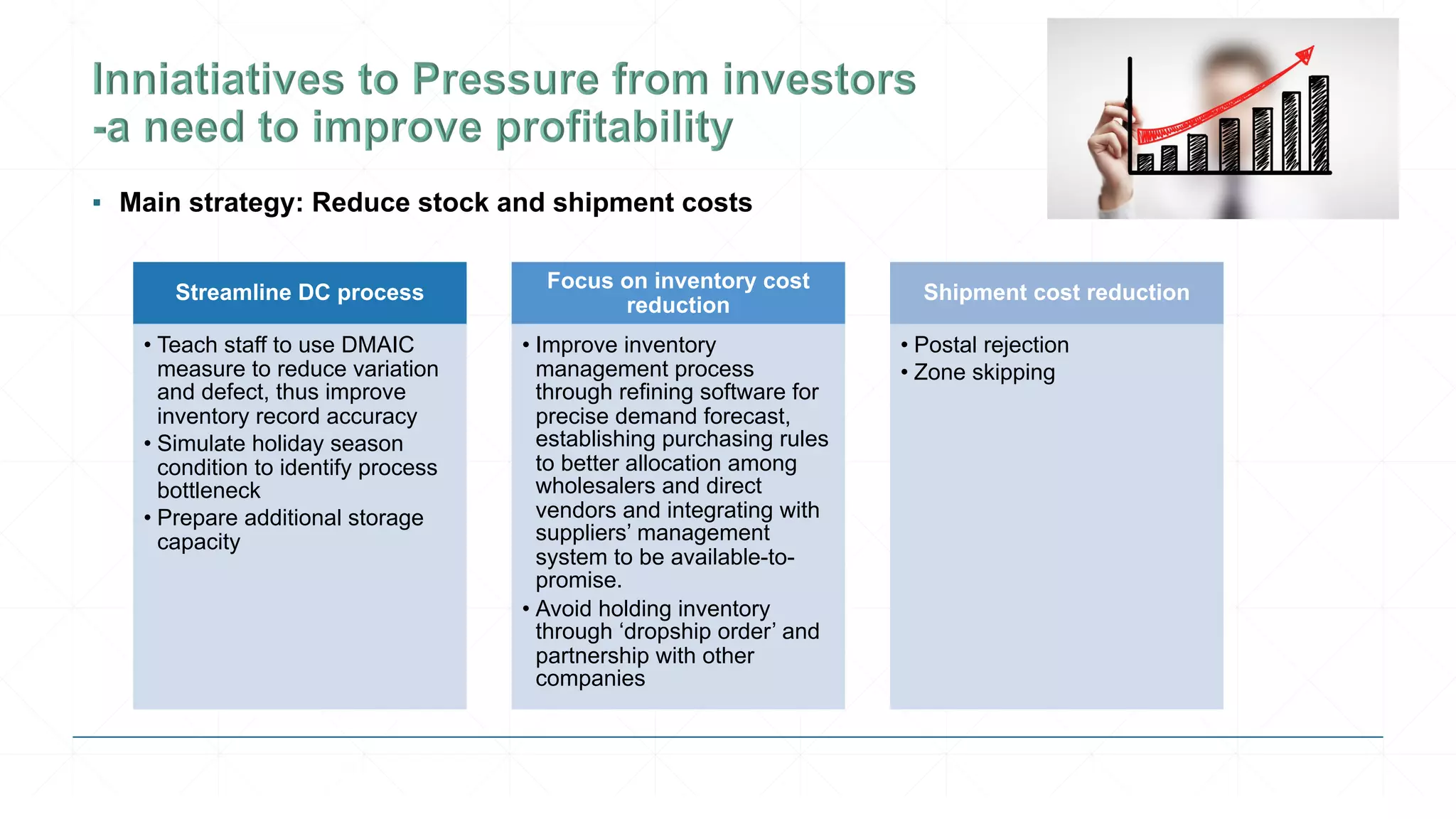
▪ Main strategy: Reduce stock and shipment costs
Streamline DC process
• Teach staff to use DMAIC
measure to reduce variation
and defect, thus improve
inventory record accuracy
• Simulate holiday season
condition to identify process
bottleneck
• Prepare additional storage
capacity
Focus on inventory cost
reduction
• Improve inventory
management process
through refining software for
precise demand forecast,
establishing purchasing rules
to better allocation among
wholesalers and direct
vendors and integrating with
suppliers’ management
system to be available-to-
promise.
• Avoid holding inventory
through ‘dropship order’ and
partnership with other
companies
Shipment cost reduction
• Postal rejection
• Zone skipping
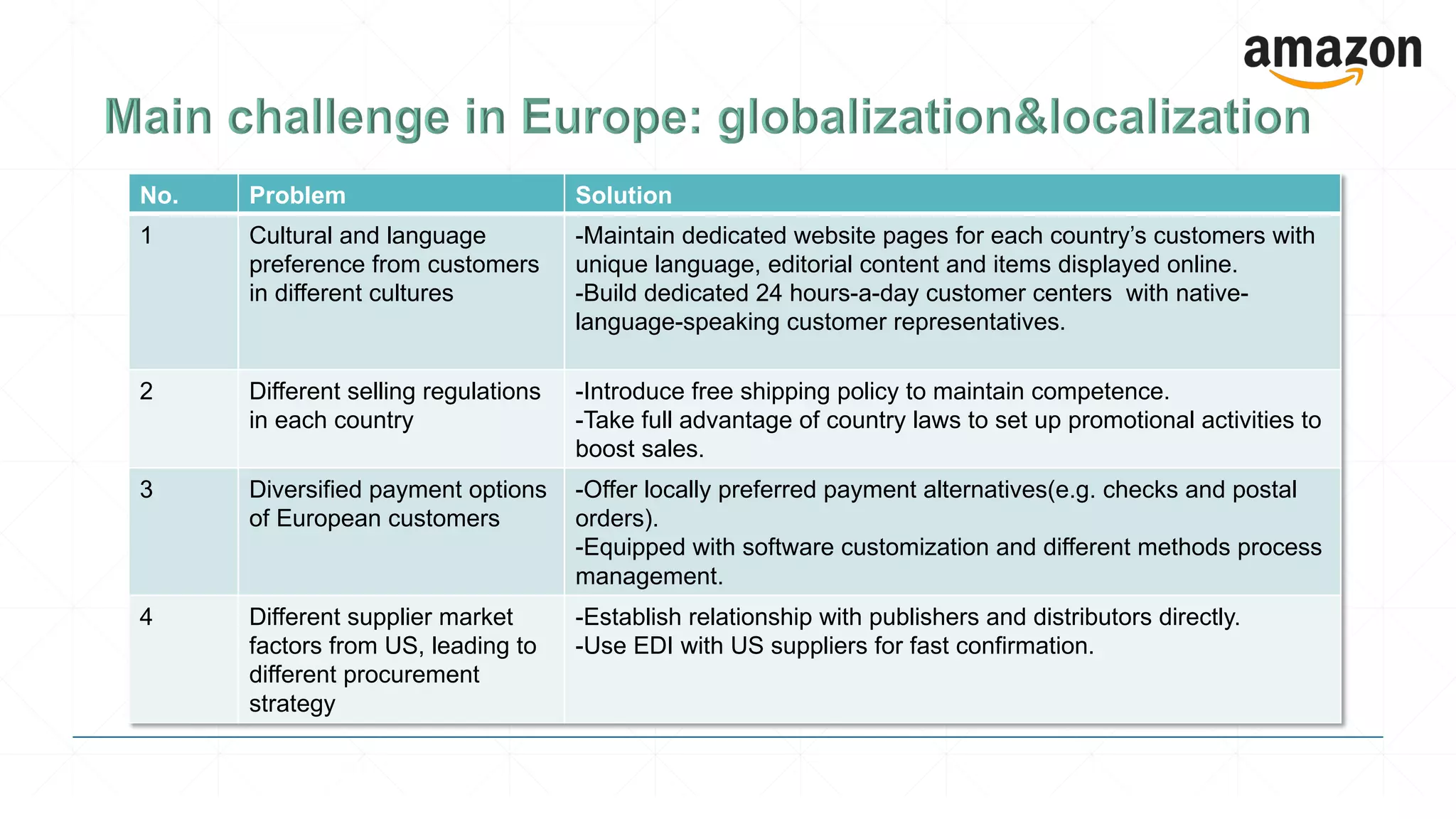
No. Problem Solution
1 Cultural and language
preference from customers
in different cultures
-Maintain dedicated website pages for each country’s customers with
unique language, editorial content and items displayed online.
-Build dedicated 24 hours-a-day customer centers with native-
language-speaking customer representatives.
2 Different selling regulations
in each country
-Introduce free shipping policy to maintain competence.
-Take full advantage of country laws to set up promotional activities to
boost sales.
3 Diversified payment options
of European customers
-Offer locally preferred payment alternatives(e.g. checks and postal
orders).
-Equipped with software customization and different methods process
management.
4 Different supplier market
factors from US, leading to
different procurement
strategy
-Establish relationship with publishers and distributors directly.
-Use EDI with US suppliers for fast confirmation.
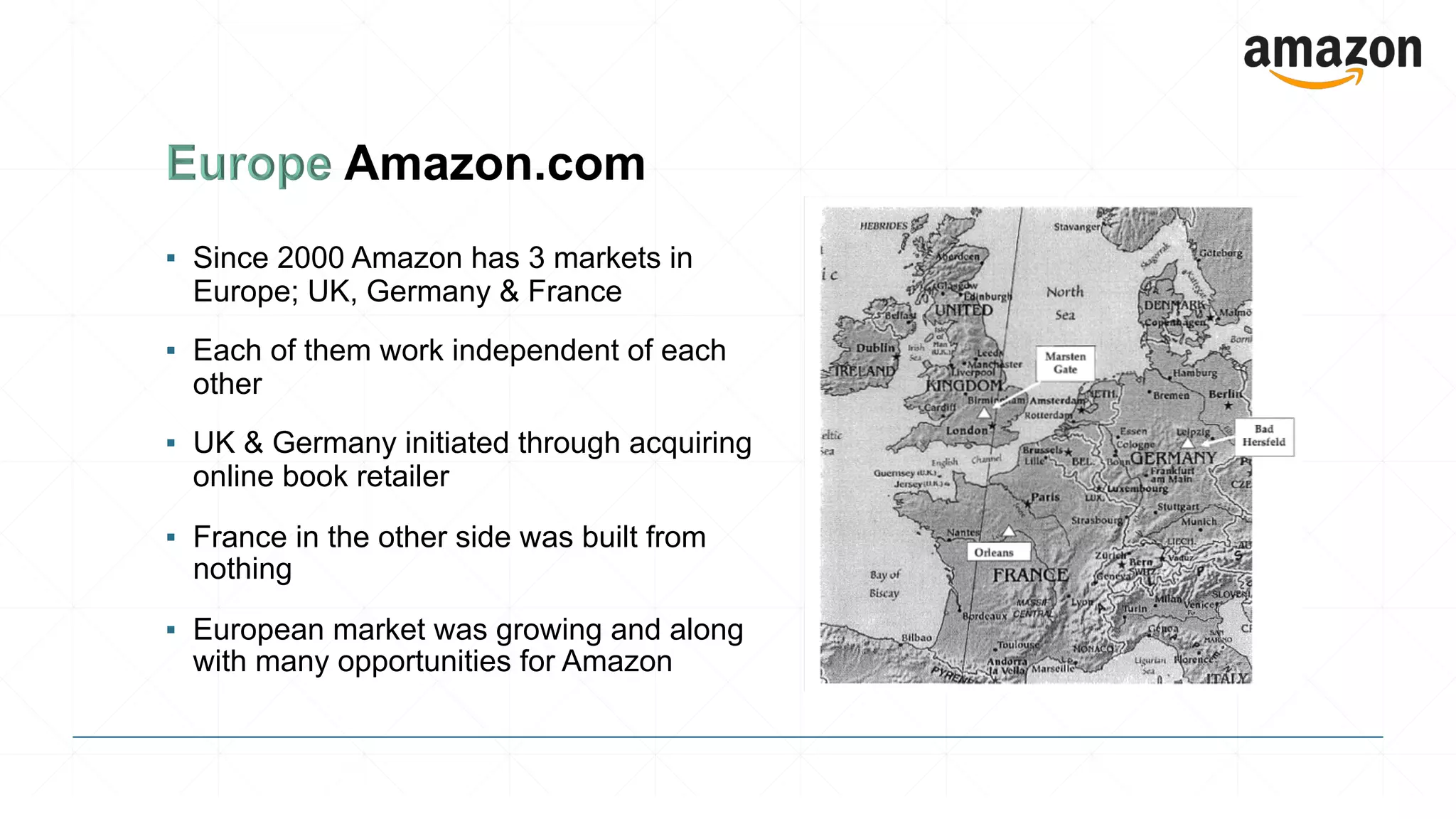
▪ Since 2000 Amazon has 3 markets in
Europe; UK, Germany & France
▪ Each of them work independent of each
other
▪ UK & Germany initiated through acquiring
online book retailer
▪ France in the other side was built from
nothing
▪ European market was growing and along
with many opportunities for Amazon
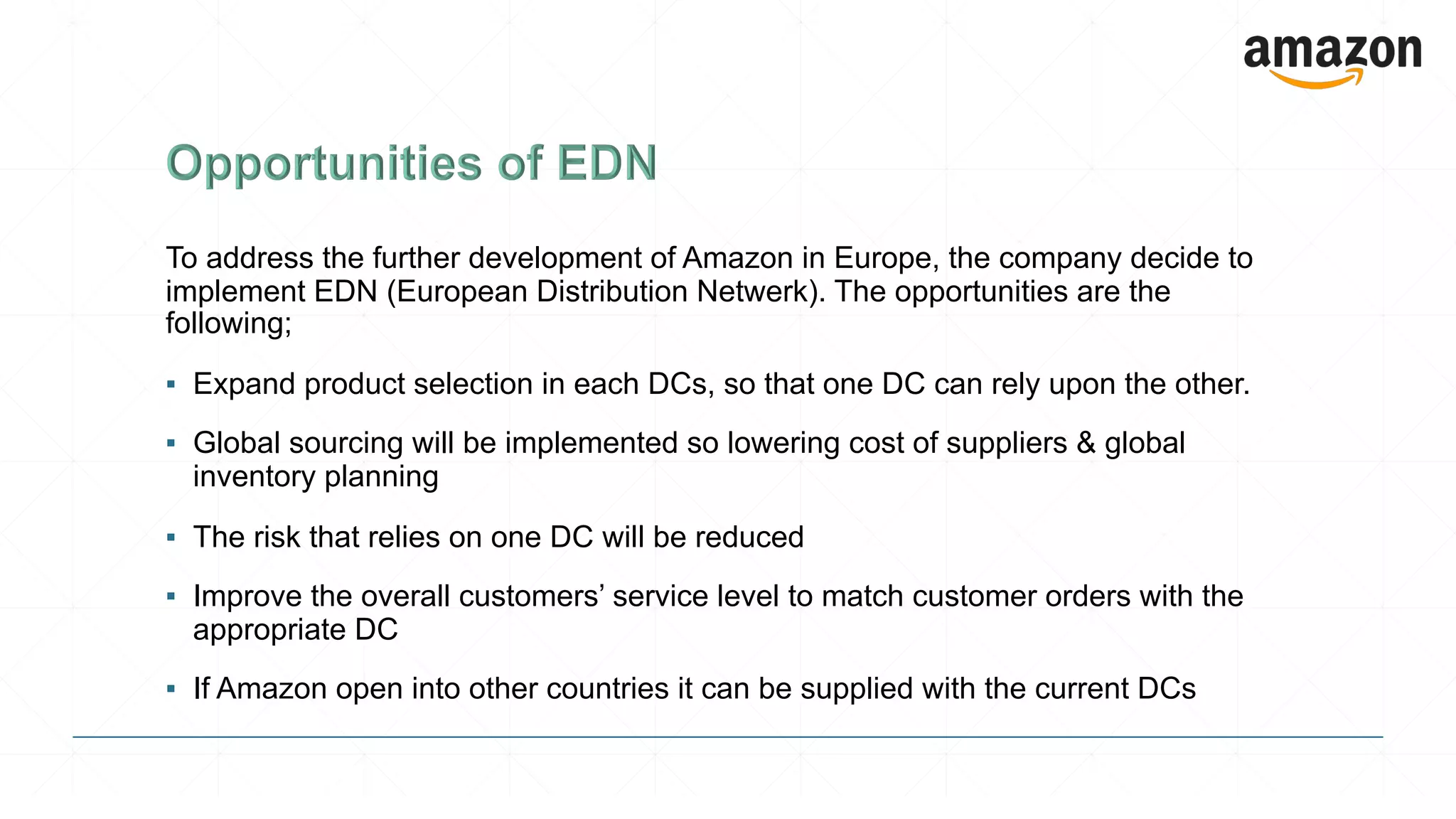
To address the further development of Amazon in Europe, the company decide to
implement EDN (European Distribution Netwerk). The opportunities are the
following;
▪ Expand product selection in each DCs, so that one DC can rely upon the other.
▪ Global sourcing will be implemented so lowering cost of suppliers & global
inventory planning
▪ The risk that relies on one DC will be reduced
▪ Improve the overall customers’ service level to match customer orders with the
appropriate DC
▪ If Amazon open into other countries it can be supplied with the current DCs
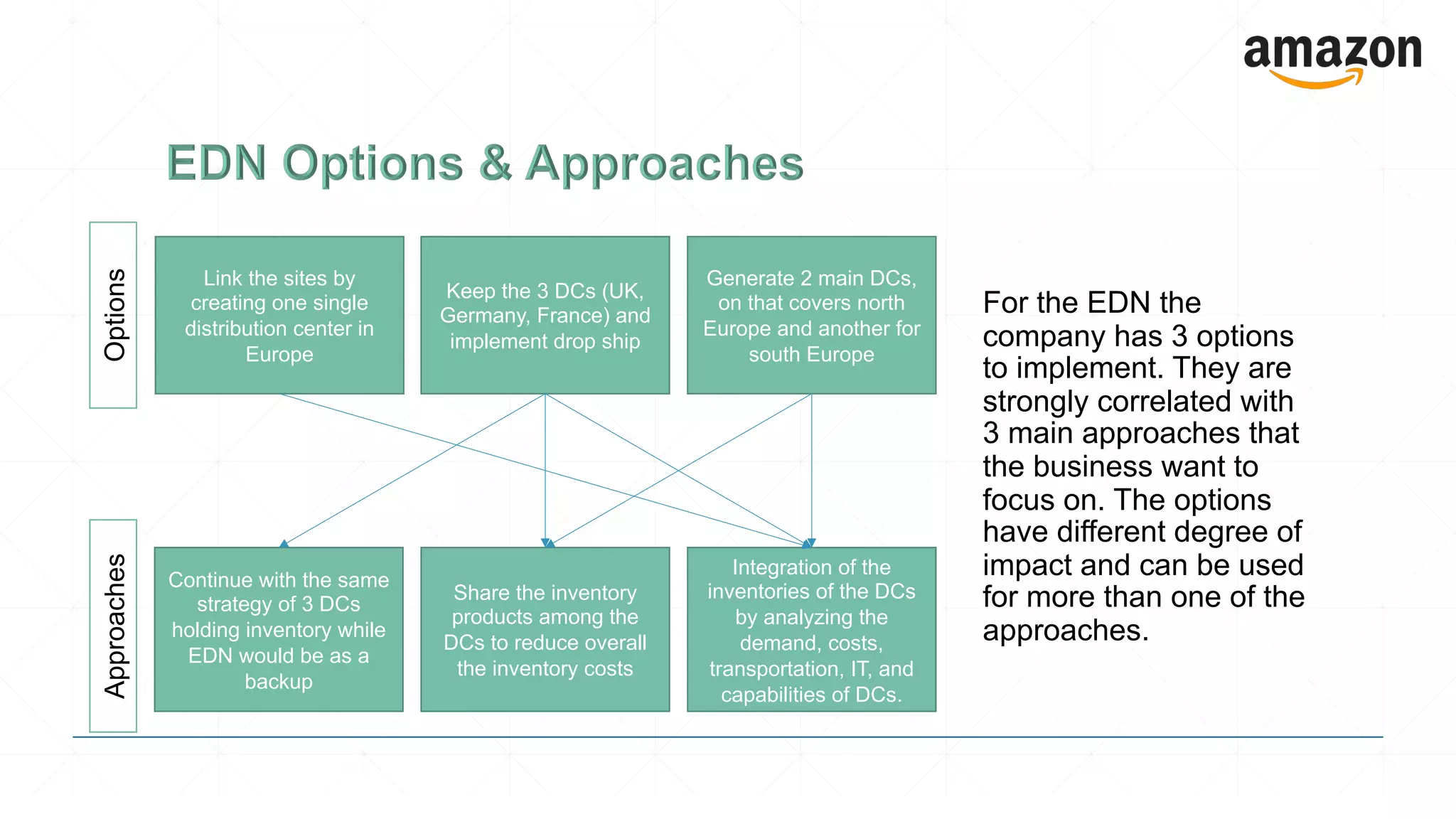
For the EDN the
company has 3 options
to implement. They are
strongly correlated with
3 main approaches that
the business want to
focus on. The options
have different degree of
impact and can be used
for more than one of the
approaches.
Link the sites by
creating one single
distribution center in
Europe
Generate 2 main DCs,
on that covers north
Europe and another for
south Europe
Keep the 3 DCs (UK,
Germany, France) and
implement drop ship
Integration of the
inventories of the DCs
by analyzing the
demand, costs,
transportation, IT, and
capabilities of DCs.
Share the inventory
products among the
DCs to reduce overall
the inventory costs
Continue with the same
strategy of 3 DCs
holding inventory while
EDN would be as a
backup
ApproachesOptions
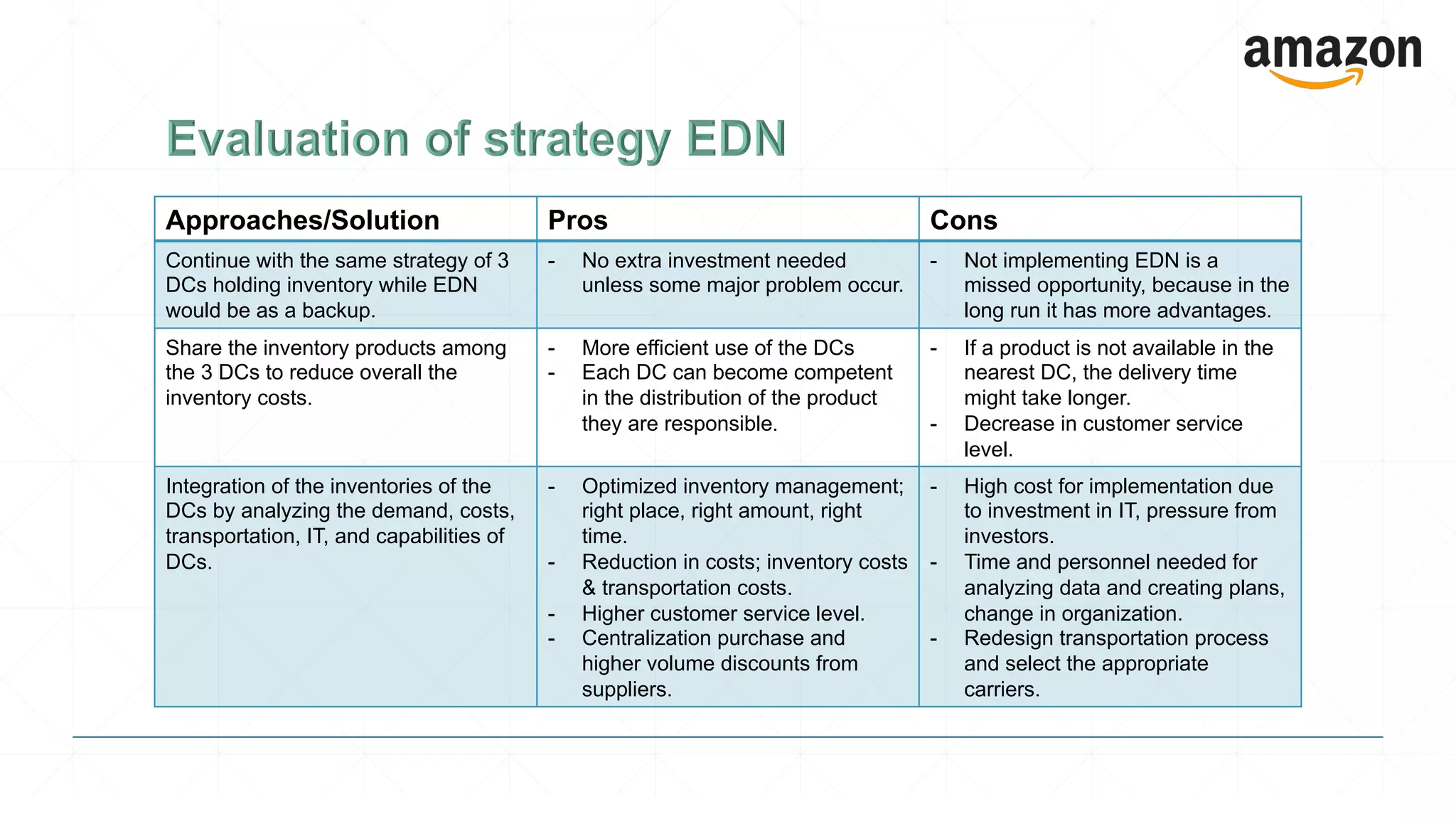
Approaches/Solution Pros Cons
Continue with the same strategy of 3
DCs holding inventory while EDN
would be as a backup.
- No extra investment needed
unless some major problem occur.
- Not implementing EDN is a
missed opportunity, because in the
long run it has more advantages.
Share the inventory products among
the 3 DCs to reduce overall the
inventory costs.
- More efficient use of the DCs
- Each DC can become competent
in the distribution of the product
they are responsible.
- If a product is not available in the
nearest DC, the delivery time
might take longer.
- Decrease in customer service
level.
Integration of the inventories of the
DCs by analyzing the demand, costs,
transportation, IT, and capabilities of
DCs.
- Optimized inventory management;
right place, right amount, right
time.
- Reduction in costs; inventory costs
& transportation costs.
- Higher customer service level.
- Centralization purchase and
higher volume discounts from
suppliers.
- High cost for implementation due
to investment in IT, pressure from
investors.
- Time and personnel needed for
analyzing data and creating plans,
change in organization.
- Redesign transportation process
and select the appropriate
carriers.
▪ http://www.therobinreport.com/amazon-from-earths-biggest-bookstore-to-the-biggest-store-on-earth/
▪ https://www.officetimeline.com/blog/amazon-history-timeline
▪ https://www.scribd.com/document/319551224/A-Case-Study-of-Amazon-on-Its-Supply-Chain-Management
▪ https://en.wikipedia.org/wiki/Timeline_of_Amazon.com
▪ https://www.scribd.com/doc/44247837/Amazon-Supply-Chain-Case-Study
▪ http://delight.us/earths-most-customer-centric-company/
▪ https://www.slideshare.net/soruban_e/amazon-distribution-channel
▪ https://www.slideshare.net/GreeshmaRadhakrishnan1/amazoncom-supply-chain-management-case-study
▪ https://www.marketwatch.com/investing/stock/amzn/financials/balance-sheet
▪ http://phx.corporate-ir.net/phoenix.zhtml?c=97664&p=irol-reportsannual
▪ https://www.statista.com/statistics/266282/annual-net-revenue-of-amazoncom/
▪ https://seekingalpha.com/article/3528986-understanding-amazons-cash-conversion-cycle?page=2
▪ https://medium.com/lightspeed-venture-partners/what-startups-can-learn-from-amazons-cash-machine-353aadf62133
▪ https://www.pymnts.com/news/2015/amazon-expands-business-loan-program-for-sellers/
▪ https://www.aboutamazon.com/sustainability/responsible-sourcing
▪ http://phx.corporate-ir.net/phoenix.zhtml?c=97664&p=irol-reportsannual
▪ https://fitsmallbusiness.com/best-fulfillment-warehouse/
▪ https://prezi.com/of12ak4uvk4d/amazons-european-distribution-strategy/

Amazon's European Distribution Strategy Case Study

  • 1.
    Yasser Elsedawy Edoardo Cataldi MarieRose Egbreghts Javier Higuera Jianing Zhang Amazon's European Distribution Strategy Case Study Supply Chain Management
  • 2.
    ▪ Amazon.Com waslaunched on 16th July 1995 by Jeff Bezos ▪ At the beginning, Amazon.com started as an online bookstore, With 25 million titles it became the earth's biggest bookstore, but soon diversified. ▪ In 2008, Amazon had 8 warehouses in the U.S. and another 15 in the rest of the world. ▪ Amazon now has around 50 warehouses, 20 in US and rest in Canada, France, Germany, Italy, UK, China, Japan. ▪ At Present the company is providing three primary customer sets; consumers, Sellers, and developers. ▪ Amazon balances between cost of distribution and levels of services by having the efficient distribution centres and multi-tier inventory networks.
  • 3.
    • Apparel, shoes,and accessories • Home, garden, and outdoor living • Baby care products products • Books • Jewelry and Watches • Beauty • Kitchenware and housewares • Camera and photography • Magazine subscriptions • Cell phones and service • Music and musical instruments • Computers and computer add-ons • Office products • Consumer electronics • Software • DVDs, including rentals, and videos • Sports and outdoors • Gourmet food • Tools and hardware • Health and personal care • Toys and video games
  • 4.
    ▪ Amazon's annualreport states that their mission is to offer "Earth's biggest selection" and to be "Earth's most customer-centric company, where customers can find and discover anything they want to buy." Specifically stated, their business strategy is to "offer customers low prices, convenience, and a wide selection of merchandise."
  • 5.
    ▪ Amazon.com beengrowing rapidly since its inception, and is currently the largest pure-play internet retailer. The chart shows revenue growth from $6.92 billion in 2004 to $1 ▪ Focusing on two things: ▪ 1) Getting “big fast;” ▪ 2) Making Amazon the “most consumer-centric company on the planet.
  • 6.
    The Amazon.com Timelineillustrates important including acquisitions, successes, and other company milestones, as well as major product & service launches throughout the years. December 7, 2016, marks the day when Amazon Prime Air made its first successful drone delivery to an actual customer in the Cambridge area, UK. The drone used GPS to find its way and made it to the customer’s address within just 13 minutes from placing the order!
  • 7.
    Digital distribution channel: E-Books- Kindle reader - AmazonMP3 & Cloud Player -Instant Video - Mac Dowload store - AppStore for android - Amazon Cloud drive - Amazon Game Studios & Softwares Physical distribution channel: Centralized distribution centres - States and places of Tax Advantage – Faster response time – Lower transportation cost
  • 8.
    Five international storesof Amazon.com started before 2000 Amazon Canada, Amazon France, Amazon UK, Amazon Japan, Amazon Germany. Why only those countries? Because UK, Germany and France were on the top list of the online spending and book sales in Europe Other Reasons.. Mother Tongue - Shipping problems - Currency – The Proper inventory control
  • 10.
    Amazon's supply chainmanagement has an edge over other companies because of the shopping experience the company offers. It has supply chain and fulfilment capabilities and popular pricing strategies Amazon was one of the first companies who introduced the rating system. The rating system is a way for customers to rate the service that they received from the vendor. Amazon manages and ships it's own inventory and the inventory of other companies like Eddie Bauer and Target.
  • 11.
    Amazon has around50 warehouses, 20 in US and rest in Canada, France, Germany, Italy, UK, China, Japan As it grew the company added warehouses allowing it to react more quickly to customer orders. Increasing the number of warehouses near customers will reduce the response time. Critical level: Amazon conducts its business on an international scale. The company ships to almost 200 countries. They have to expand their DCs to other countries to reduce transportation cost. It start from the customer and ends up to the customer meaning it's a continuous process which starts when the customer for the first time makes a request for any product at Amazon, it directly goes into his virtual basket and after pressing the buy button and mode of payment he selects a mode of delivery services which includes overnight and various international shipping .
  • 12.
    The figure givesa graphical representation of Amazon.com's US Supply
  • 13.
    1st tier customers Endcustomer 2nd tier customers 2°tier suppliers 1° tier suppliers Focal Company Vendor/ Supplier WHOLESALE R INDFPENDE NT SUPPLIER - 3rd PARTY PUBLISHER PARTNER Amazon.com website and IT systems
  • 14.
    • As Amazon'sdominance grows, suppliers are forced to play by its rules • At least 21 public companies have disclosed they are generating 10 percent or more of their revenue through Amazon. • That gives Amazon more leverage, making it a tough negotiator. • Joe Hansen, co-founder of BuyBox Experts, who helps suppliers on Amazon, calls Amazon the "toughest negotiator" in online and retail combined because of the visibility it provides and ability to drive more sales for any supplier instantly.
  • 15.
    As a companyof electronic commerce American , based in Seattle in Washington state ; is the largest Internet company in the world. Amazon serves consumers through retail websites and focus on selection, price, and convenience. Suppliers all around the world provide Amazon with different products. Amazon requires suppliers in the manufacturing supply chain to comply with Supply Chain Standards. Amazon receives and manages orders from customers. Warehouses and Distribution centers and service centers are located all around the world to pick, pack and ship orders to customers. Defective products,wrong orders or refund request from customers to DCs.
  • 16.
    Source Stocked products S1 Purchase to Stock Purchase to Order M1 M2 Deliver Stocked Product D1 PLAN Source Return Deliver Return S.1.1:Schedule Product deliveries S.1.2: Receive Products S.1.3: Verify products S.1.4: Stock products S.1.5: Authorize suppliers payment SUPPLIERS(Wholeshalers orPublishers) Customers M.1.1: Receive and enter online orders from customers M.1.2: Process and Confirm orders M.1.3: Determine delivery date M.2.1: Receive and enter online orders from customers M2.2: Send purchasing orders to suppliers M2.3: Determine delivery date D.1.1: Route Shipments D.1.2: Pick Product D.1.3: Pack Product D.1.4: Ship Product D.1.5: Receive and verify Product from customers D.1.6: Invoice Defective orders Wrong orders Refund requests Defective products Wrong orders
  • 17.
    Demand Predictable Product lifecycleLong Gross profit margin Low, around 20% Variety High Average forecast error Very Low Average stockout rate Very Low End of season markdown Medium Leadtime for MTO products NA Functional Product
  • 18.
    Primary purpose Provideproducts with high quality and customers satisfaction at the lowest possible cost Manufacturing focus Flexibility of choosing suppliers according to demand level Inventory strategy Minimize the inventory throughout the SC and at the same time generating high turns of this inventory Lead-time focus Minimize lead-time as much as possible without increasing costs Supplier selection Suppliers are selected primarily based on cost and quality Product design strategy Product design strategy: Simple design with the aim of maximize the performance and minimize all costs. Physically Efficient
  • 20.
    Hau Lee’s model Theproduction has Fixed phases Low-Term contracts for suppliers Stability in supply of raw materials Technology and Automation are mature processes. Next step we try to understand the stability of the process. (2) Process stability Stable Process
  • 21.
    ▪ Amazon hasa complete different organization regarding their operating working capital, because the business begins once the payment of customers are received. ▪ At the beginning the business will receive orders and payment directly from the customers. So in the downstream there isn’t problems. ▪ The criticality is between Amazon and its suppliers, the point between the upstream and downstream. Source: https://fitsmallbusiness.com/best-fulfillment-warehouse/
  • 22.
    ▪ AP (AccountPayables) has been growing rapidly over time. Amazon are not receiving pressure from their suppliers ▪ Great part of Amazon’s investment is in their inventory management. Many technologies are implemented to support and prevent at any cost a high inventory level. The inventory follows the AR (Account Receivables) closely. 0 5000 10000 15000 20000 25000 30000 35000 40000 2000 2001 2002 2003 2004 2005 2006 2007 2008 2009 2010 2011 2012 2013 2014 2015 2016 2017 $millions Inventory AR AP
  • 23.
    ▪ Revenue hasincreased positively over the years even while other industries has been effected due to the crisis in 2008. ▪ NOWC (Net Operating Working Capital) on the other side continues the be negative and decreases. This means that the business is improving their efficient use of working capital. The company was able to maintain its successful position in the market while holding free cash flow in the company for longer period. 0 50000 100000 150000 200000 2000 2002 2004 2006 2008 2010 2012 2014 2016 $millions Revenue -6000 -5000 -4000 -3000 -2000 -1000 0 2000 2002 2004 2006 2008 2010 2012 2014 2016 $millions NOWC
  • 24.
    ▪ CCC (CashConversion Cycle) has been negative reflecting again the NOWC from previous. The crisis from 2008 can be noticed, the CCC increased. ▪ DSO (Days of Sales Outstanding) & DIO (Days of Inventory Outstanding) kept increasing over time. ▪ DPO (Days of Payables Outstanding) continue to increase over the years. Suppliers are the ones that has the risk, so for the whole supply chain a solution has to be contemplated. Amazon created the “supplier financing program” -60 -40 -20 0 20 40 60 80 100 120 140 2000 2001 2002 2003 2004 2005 2006 2007 2008 2009 2010 2011 2012 2013 2014 2015 2016 2017 DaysofWorkingCapital DSO DIO DPO CCC
  • 25.
    In 2012 Amazonhas initiated a program that offers working capital loans to SMEs. So Amazon would provide borrowings to vendors and collect the payments through vendors’ sales proceeds. The outcomes were successful for their sellers. The benefits from both sides are; ▪ Mitigate risks of suppliers (lower credit) ▪ Grow their vendor (supplier) base Amazon hasn’t acquire much share in China, while it is a market that has many opportunities. Through this program they expect to enter the market. Canada UK Germany France Spain Italy China US Japan
  • 26.
    ▪ Market enablersanalysis Description complexity-Low • High amount of information to exchange in retailer industry • Low possibility of asymmetry and opportunism for suppliers • Low transaction costs for the customer when shopping online Asset specificity-Low • Low customization because most sold online are general mass- production products • Low sunk cost • Medium know-how appropriability Uncertainty-Low • E-commerce is not in emerging markets or requires new technologies • Demand is forecasted by purchasing and budgeting department • Mature laws, regulations and industry standards have been established Competitive market
  • 27.
    ▪ Strategic driversanalysis Competence • Key or core advantage is customer service and distribution speed for Amazon • Special competence is the products sold online because most of them are not differential from other websites Costs • The investors put pressure on Amazon for profitability so it’s necessary to cut cost • Because of seasonal peak demand, it requires fixed cost into variable costs for flexibility Capex • Amazon need to allocates more capital to develop its distribution channel • New market exploration and portfolio diversification (adding new product line) is an important strategy on company level Buy decision!
  • 28.
    ▪ No long-termarrangements with most of suppliers ▪ Amazon has significant suppliers, including licensors, and in some cases, limited or single-sources of supply, that are important to sourcing, services, manufacturing, and any related ongoing servicing of merchandise and content. They do not have long- term arrangements with most of suppliers to guarantee availability of merchandise, content, components, or services, particular payment terms, or the extension of credit limits. If the current suppliers were to stop selling or licensing merchandise, content, components, or services on acceptable terms, or delay delivery, including as a result of one or more supplier bankruptcies due to poor economic conditions, as a result of natural disasters, or for other reasons, Amazon may be unable to procure alternatives from other suppliers in a timely and efficient manner and on acceptable terms, or at all. In addition, if the suppliers or other vendors violate applicable laws, regulations, code of standards and responsibilities required by Amazon, or implement practices regarded as unethical, unsafe, or hazardous to the environment, it could damage Amazon’s reputation, limit growth, and negatively affect operating results of Amazon.
  • 29.
    ▪ Seeking toreduce unit variable costs and working to leverage fixed costs Variable costs: product and content costs, payment processing and related transaction costs, picking, packaging, and preparing orders for shipment, transportation, customer service support, costs necessary to run AWS, and a portion of marketing costs. Fixed costs: costs necessary to build and run technology infrastructure; to build, enhance, and add features to websites and web services, electronic devices, and digital offerings; and to build and optimize the fulfillment centers. Solutions: increase discounts from suppliers, and reduce defects in own operation processes Solutions: seek to improve process efficiencies and maintain a lean culture Result: lower prices for customers
  • 30.
    ▪ High inventoryvelocity and always negative cash-to-cash cycle ▪ On average, the high inventory velocity means Amazon generally collects from consumers before payments to suppliers come due. It means Amazon is using the working capital as efficiently as possible and have available cash for other things. In order to do that, good credit with suppliers and strong influence is a must. ▪ Inventory cost improvements ▪ Amazon mainly focuses on the following aspects to cut its inventory costs: 1. Improve software that more precisely forecasts customer demand 2. Improve inventory management system (inventory, warehouse and transportation costs) 3. Choose suppliers on best price selection
  • 31.
    ▪ Inventory management ▪It provides Fulfillment by Amazon services in connection with certain of our sellers’ programs. Third-party sellers maintain ownership of their inventory, regardless of whether fulfillment is provided by Amazon or the third-party sellers, and therefore these products are not included in our inventories, which reduce inventory management costs for Amazon. ▪ Amazon also purchases electronic device components from a variety of suppliers and uses several contract manufacturers to provide manufacturing services for their products. During the normal course of business, in order to manage manufacturing lead times and help ensure adequate component supply, Amazon enters into agreements with contract manufacturers and suppliers. A portion of their reported purchase commitments arising from these agreements consists of firm, non-cancellable commitments. These commitments are based on forecasted customer demand. If Amazon reduces these commitments, that may incur additional costs.
  • 32.
    ▪ Vendor Agreement ▪Amazon has agreements with the vendors to receive funds for advertising services, cooperative marketing efforts, promotions, and volume rebates, which can be seen as one of their cost-reduction strategies. The amounts received from vendors can be seen as a reduction of the prices they pay for their goods, including property and equipment, or services, and therefore record those amounts as a reduction of the cost of inventory, cost of services, or cost of property and equipment. Vendor rebates are typically dependent upon reaching minimum purchase thresholds. Amazon evaluates the likelihood of reaching purchase thresholds using past experience and current year forecasts. When volume rebates can be reasonably estimated, they record a portion of the rebate as we make progress towards the purchase threshold. When Amazon receives direct reimbursements for costs incurred by itself in advertising the vendor’s product or service, the amount is as an offset to the marketing expense.
  • 33.
    ▪ Main strategy:Reduce stock and shipment costs Streamline DC process • Teach staff to use DMAIC measure to reduce variation and defect, thus improve inventory record accuracy • Simulate holiday season condition to identify process bottleneck • Prepare additional storage capacity Focus on inventory cost reduction • Improve inventory management process through refining software for precise demand forecast, establishing purchasing rules to better allocation among wholesalers and direct vendors and integrating with suppliers’ management system to be available-to- promise. • Avoid holding inventory through ‘dropship order’ and partnership with other companies Shipment cost reduction • Postal rejection • Zone skipping
  • 34.
    No. Problem Solution 1Cultural and language preference from customers in different cultures -Maintain dedicated website pages for each country’s customers with unique language, editorial content and items displayed online. -Build dedicated 24 hours-a-day customer centers with native- language-speaking customer representatives. 2 Different selling regulations in each country -Introduce free shipping policy to maintain competence. -Take full advantage of country laws to set up promotional activities to boost sales. 3 Diversified payment options of European customers -Offer locally preferred payment alternatives(e.g. checks and postal orders). -Equipped with software customization and different methods process management. 4 Different supplier market factors from US, leading to different procurement strategy -Establish relationship with publishers and distributors directly. -Use EDI with US suppliers for fast confirmation.
  • 35.
    ▪ Since 2000Amazon has 3 markets in Europe; UK, Germany & France ▪ Each of them work independent of each other ▪ UK & Germany initiated through acquiring online book retailer ▪ France in the other side was built from nothing ▪ European market was growing and along with many opportunities for Amazon
  • 36.
    To address thefurther development of Amazon in Europe, the company decide to implement EDN (European Distribution Netwerk). The opportunities are the following; ▪ Expand product selection in each DCs, so that one DC can rely upon the other. ▪ Global sourcing will be implemented so lowering cost of suppliers & global inventory planning ▪ The risk that relies on one DC will be reduced ▪ Improve the overall customers’ service level to match customer orders with the appropriate DC ▪ If Amazon open into other countries it can be supplied with the current DCs
  • 37.
    For the EDNthe company has 3 options to implement. They are strongly correlated with 3 main approaches that the business want to focus on. The options have different degree of impact and can be used for more than one of the approaches. Link the sites by creating one single distribution center in Europe Generate 2 main DCs, on that covers north Europe and another for south Europe Keep the 3 DCs (UK, Germany, France) and implement drop ship Integration of the inventories of the DCs by analyzing the demand, costs, transportation, IT, and capabilities of DCs. Share the inventory products among the DCs to reduce overall the inventory costs Continue with the same strategy of 3 DCs holding inventory while EDN would be as a backup ApproachesOptions
  • 38.
    Approaches/Solution Pros Cons Continuewith the same strategy of 3 DCs holding inventory while EDN would be as a backup. - No extra investment needed unless some major problem occur. - Not implementing EDN is a missed opportunity, because in the long run it has more advantages. Share the inventory products among the 3 DCs to reduce overall the inventory costs. - More efficient use of the DCs - Each DC can become competent in the distribution of the product they are responsible. - If a product is not available in the nearest DC, the delivery time might take longer. - Decrease in customer service level. Integration of the inventories of the DCs by analyzing the demand, costs, transportation, IT, and capabilities of DCs. - Optimized inventory management; right place, right amount, right time. - Reduction in costs; inventory costs & transportation costs. - Higher customer service level. - Centralization purchase and higher volume discounts from suppliers. - High cost for implementation due to investment in IT, pressure from investors. - Time and personnel needed for analyzing data and creating plans, change in organization. - Redesign transportation process and select the appropriate carriers.
  • 39.
    ▪ http://www.therobinreport.com/amazon-from-earths-biggest-bookstore-to-the-biggest-store-on-earth/ ▪ https://www.officetimeline.com/blog/amazon-history-timeline ▪https://www.scribd.com/document/319551224/A-Case-Study-of-Amazon-on-Its-Supply-Chain-Management ▪ https://en.wikipedia.org/wiki/Timeline_of_Amazon.com ▪ https://www.scribd.com/doc/44247837/Amazon-Supply-Chain-Case-Study ▪ http://delight.us/earths-most-customer-centric-company/ ▪ https://www.slideshare.net/soruban_e/amazon-distribution-channel ▪ https://www.slideshare.net/GreeshmaRadhakrishnan1/amazoncom-supply-chain-management-case-study ▪ https://www.marketwatch.com/investing/stock/amzn/financials/balance-sheet ▪ http://phx.corporate-ir.net/phoenix.zhtml?c=97664&p=irol-reportsannual ▪ https://www.statista.com/statistics/266282/annual-net-revenue-of-amazoncom/
  • 40.
    ▪ https://seekingalpha.com/article/3528986-understanding-amazons-cash-conversion-cycle?page=2 ▪ https://medium.com/lightspeed-venture-partners/what-startups-can-learn-from-amazons-cash-machine-353aadf62133 ▪https://www.pymnts.com/news/2015/amazon-expands-business-loan-program-for-sellers/ ▪ https://www.aboutamazon.com/sustainability/responsible-sourcing ▪ http://phx.corporate-ir.net/phoenix.zhtml?c=97664&p=irol-reportsannual ▪ https://fitsmallbusiness.com/best-fulfillment-warehouse/ ▪ https://prezi.com/of12ak4uvk4d/amazons-european-distribution-strategy/