Apple Inc.
Company Background
1
Apple Inc.
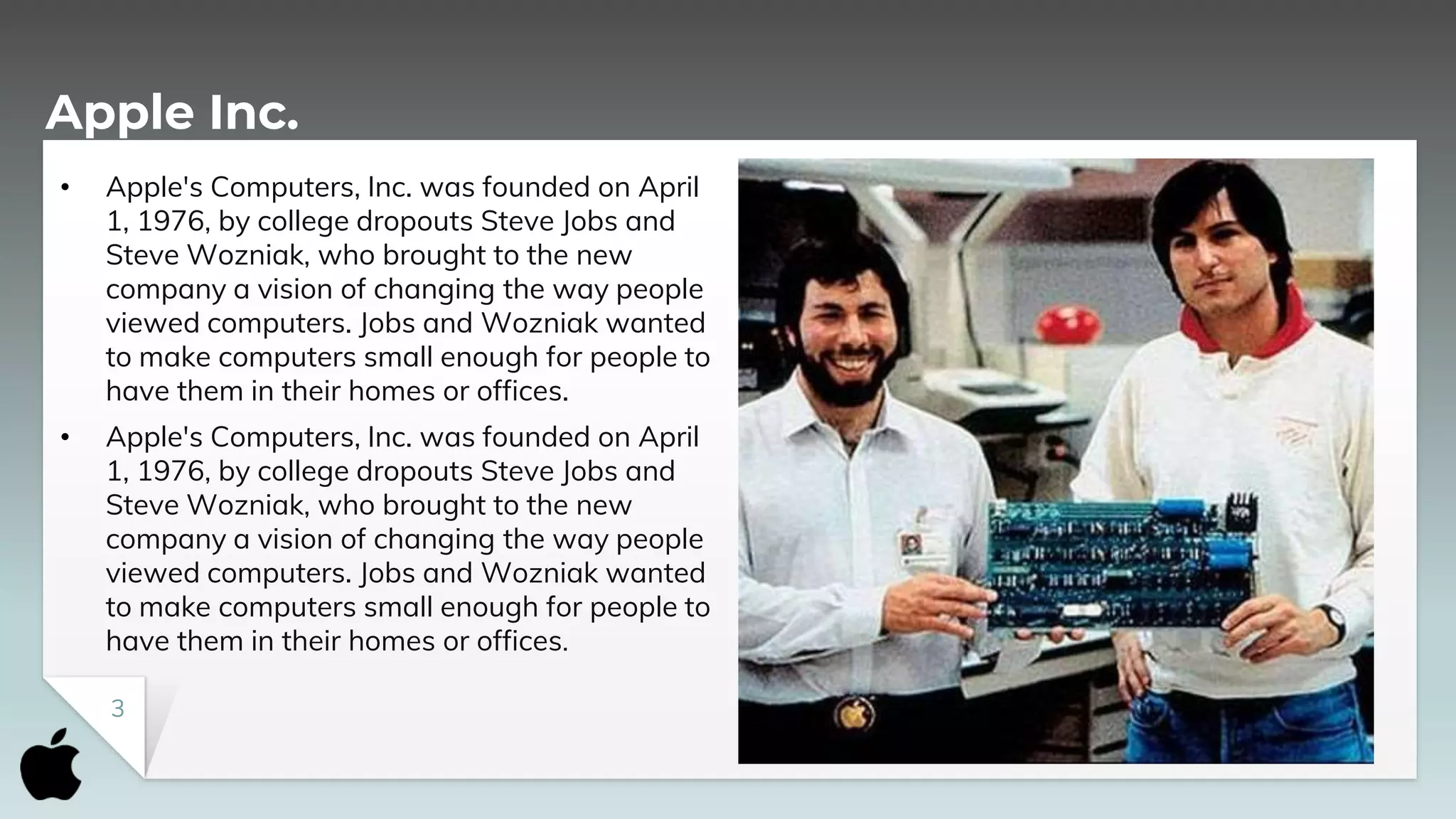
• Apple's Computers, Inc. was founded on April
1, 1976, by college dropouts Steve Jobs and
Steve Wozniak, who brought to the new
company a vision of changing the way people
viewed computers. Jobs and Wozniak wanted
to make computers small enough for people to
have them in their homes or offices.
• Apple's Computers, Inc. was founded on April
1, 1976, by college dropouts Steve Jobs and
Steve Wozniak, who brought to the new
company a vision of changing the way people
viewed computers. Jobs and Wozniak wanted
to make computers small enough for people to
have them in their homes or offices.
3
Apple Inc.
• Wozniak left Apple in 1983 due to
a diminishing interest in the day-
to-day running of Apple
Computers. Jobs then hired
PepsiCo's John Sculley to be
president.
• Due to the plans that Jobs had
already set in motion before he left,
most notably his deal with a tiny
company by the name of Adobe,
creator of the Adobe Portable
Document Format (PDF). Together
the two companies created the
phenomenon known as desktop
publishing.
4
Apple Inc.
• Back in 1985 Sculley turned down
an appeal from Microsoft founder
Bill Gates to license its software.
• Over the course of a few years,
Apple's market share suffered
slowly after its peak in 1990 and by
1996, experts believed the
company to be doomed.
• Apple bought out NeXT Software
(Jobs' company) and the board of
directors decided to ask for some
help from an old friend: Steve Jobs.
• Jobs decided to make some
changes around Apple.
5
Apple Inc.
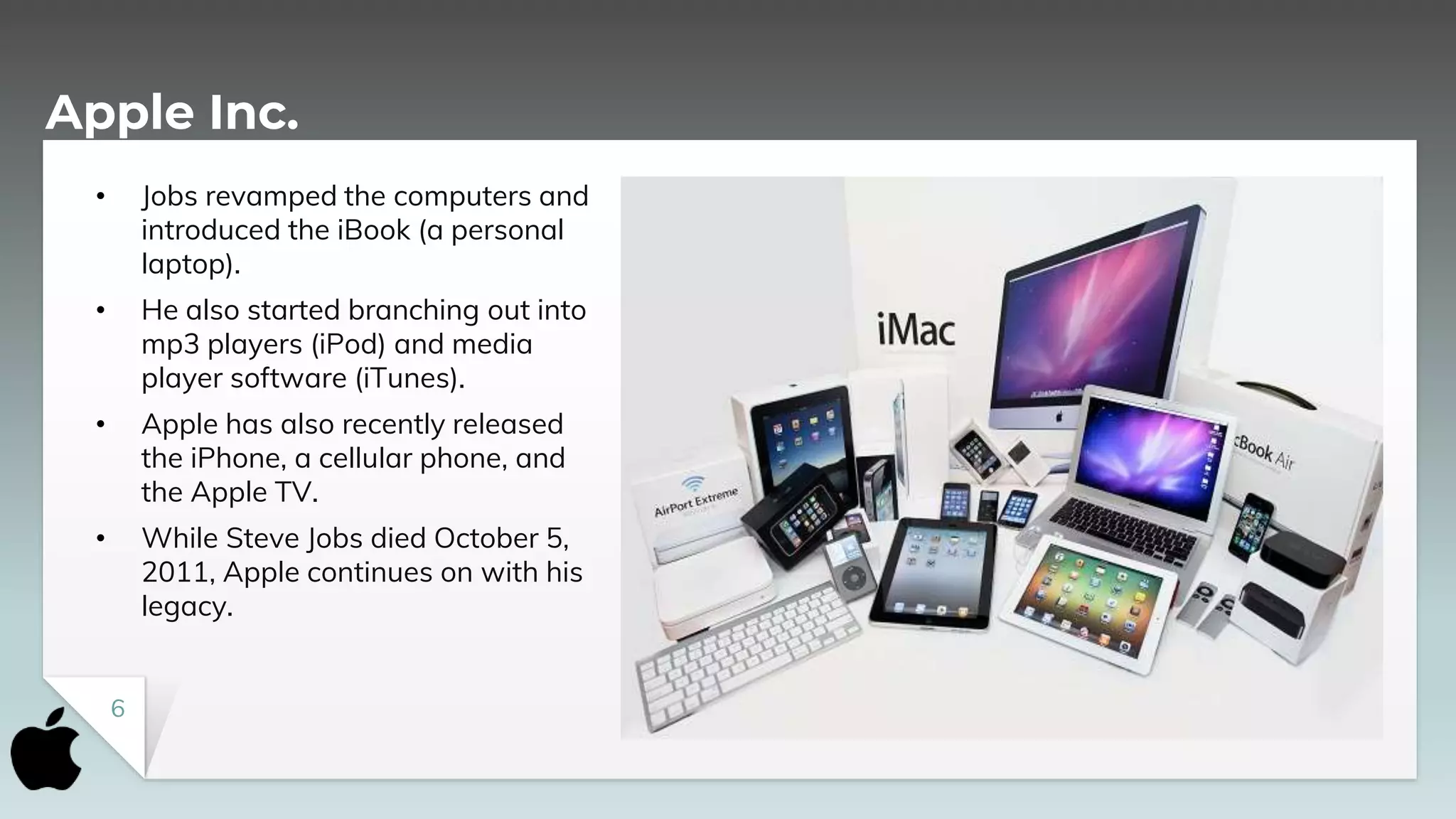
• Jobs revamped the computers and
introduced the iBook (a personal
laptop).
• He also started branching out into
mp3 players (iPod) and media
player software (iTunes).
• Apple has also recently released
the iPhone, a cellular phone, and
the Apple TV.
• While Steve Jobs died October 5,
2011, Apple continues on with his
legacy.
6
Apple Inc.
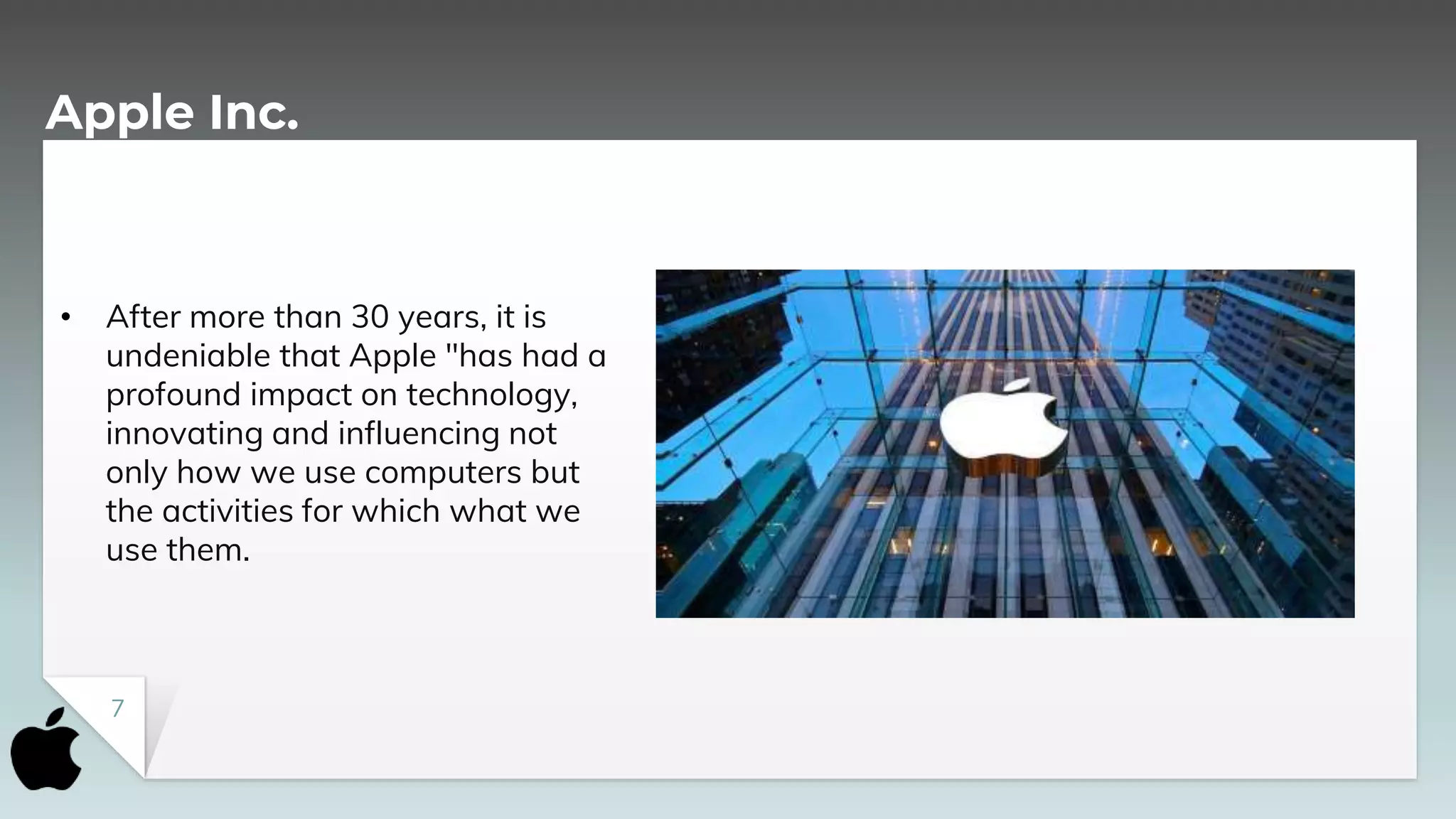
• After more than 30 years, it is
undeniable that Apple "has had a
profound impact on technology,
innovating and influencing not
only how we use computers but
the activities for which what we
use them.
7
“
Mission
Apple designs Macs, the best
personal computers in the world,
along with OS X, iLife, iWork and
professional software. Apple
leads the digital music revolution
with its iPods and iTunes online
store. Apple has reinvented the
mobile phone with its
revolutionary iPhone and App
store, and is defining the future of
mobile media and computing
devices with iPad.8
“ Vision
We believe that we are on the
face of the earth to make great
products and that’s not changing.
We are constantly focusing on
innovating. We believe in the
simple not the complex. We
believe that we need to own and
control the primary technologies
behind the products that we
make, and participate only in
markets where we can make a
significant contribution.9
“ Goals
To obtain stellar products and
services within tight
timefrmaes, at a cost that
represents the best possible
value to our customers and
shareholders.
10
SWOT
7
Strengths
▪ Strong brand image
▪ High profit margins
▪ Effective rapid innovation processes
12
Weaknesses
▪ Limited distribution network
▪ High selling prices
▪ Dependence of sales on high-end market
segments
13
Opportunities
▪ Expansion of the distribution network
▪ Higher sales volumes based on rising
demand
▪ Development of new product lines
14
Threats
▪ Aggressive competition
▪ Imitation
▪ Rising labor cost in various countries
15
Global
Strategies
16
▪ The company sells its products worldwide through its retail stores,
online stores, and direct sales force, as well as through third-party
cellular network carriers, wholesalers, retailers, and resellers.
▪ The company operates in five segments: Americas, Europe, Japan,
Asia-Pacific and Retail.
▪ Apple Inc uses differentiation strategy as its major international
strategy to deliver high customer value through its innovative
brands in overseas market.
▪ Licensing, exporting and importing strategies are preferred by
Apple Inc as a market entry mode for particular country.
17
▪ Strategic choices differ depending on the country.
▪ Level of technological advancement also decides about the
strategic choice.
▪ Licensing, exporting and importing strategies are preferred by
Apple Inc as a market entry mode for particular country.
▪ Apple Inc. performs exporting and importing activities to buy and
sell the goods with the international market.
▪ It also does international arrangement through incensing to use
intangible properties in the international market such as patent,
logo, formula, process, etc.
▪
18
What, why, when, how the
company joined the
international market?
1
What?
▪ Apple has diverse Range of
Products
▪ Dynamic Business Plan
▪ Branded Retail Store and
Experience
▪ Opening up Job Opportunities
20
When?
Founders Steve Jobs and Steve Wozniak
created Apple Computer on April 1, 1976.
To mark its expansion in consumer
electronic market. Apple nearly has 35,000
employees worldwide and its sales
recording nearly US$42.90 billion by 26th
September, 2009.
21
Place your screenshot here
How?
▪ Offering products that has a wide
scope of target market
▪ Services compliment high sales
▪ Own operating system
▪ Exclusivity and intuitive designs
▪ Luxury Status
Place your screenshot here
22
Why?
▪ Because of globalization
▪ To maximize profit
▪ Competing for new sales
▪ To increase market size
▪ Greater returns on major capital investments in new
products and processes
▪ Improve profit margins
▪ To recruit new talent
Place your screenshot here
23
Supply Chain Strategies
25
10 Strategic Operations
Management Decisions
“1. Design of Goods and
Services.
Apple’s processes in the
design of its products are
handled through a number of
organizational components
and officials.
27
“2. Quality Management.
This decision area of
operations management
emphasizes quality standards
and controls. Apple Inc.’s
Senior VP for Operations
coordinates with eight other
Senior VPs to ensure
compliance with the
company’s quality standards.28
“3. Process and Capacity
Design.
The company works with
suppliers to ensure efficient
processes and adequate capacity
in this decision area of operations
management. For instance,
suppliers are given directives for
process design, as well as the
Apple Supplier Code of Conduct to
optimize their human resource
management.
29
“4. Location Strategy.
Most authorized sellers are
located in urban centers to
maximize foot traffic and
brand exposure. At present,
the company has hundreds of
stores in more than 20
countries around the world.
30
“5. Layout Design and
Strategy.
Apple’s layout design and
strategy emphasize customer
expectations. Creativity is a
critical factor among
employees involved in product
design and development
processes at Apple Inc.
31
“6. Job Design and Human
Resources.
Job design and HR strategies
are based on Steve Jobs’
original emphasis on
excellence. However, the
company has been gradually
changing its HR strategies
under Tim Cook to reflect a
more sociable workplace for
optimum employee morale.
32
“7. Supply Chain Management
The company uses automation
of processes and regular
monitoring of suppliers. This
monitoring evaluates supplier
capacity and productivity, as
well as compliance with the
Apple Supplier Code of
Conduct.
33
“8. Inventory Management.
The company uses the first in,
first out (FIFO) method, which
ensures that most old-model
units are sold before new
Apple product models are
released to the market. Apple
Store managers also handle
the inventory management of
their respective stores.34
“ 9. Scheduling
Automation is used for
scheduling activities in the
supply chain and production
processes. Manual scheduling
is used for individual Apple
Stores and in some aspects of
the company’s offices.
35
“ 10. Maintenance.
Apple Inc. addresses
maintenance needs through
dedicated maintenance teams.
36
Thank you!

Apple Company

  • 1.
  • 2.
  • 3.
    Apple Inc. • Apple'sComputers, Inc. was founded on April 1, 1976, by college dropouts Steve Jobs and Steve Wozniak, who brought to the new company a vision of changing the way people viewed computers. Jobs and Wozniak wanted to make computers small enough for people to have them in their homes or offices. • Apple's Computers, Inc. was founded on April 1, 1976, by college dropouts Steve Jobs and Steve Wozniak, who brought to the new company a vision of changing the way people viewed computers. Jobs and Wozniak wanted to make computers small enough for people to have them in their homes or offices. 3
  • 4.
    Apple Inc. • Wozniakleft Apple in 1983 due to a diminishing interest in the day- to-day running of Apple Computers. Jobs then hired PepsiCo's John Sculley to be president. • Due to the plans that Jobs had already set in motion before he left, most notably his deal with a tiny company by the name of Adobe, creator of the Adobe Portable Document Format (PDF). Together the two companies created the phenomenon known as desktop publishing. 4
  • 5.
    Apple Inc. • Backin 1985 Sculley turned down an appeal from Microsoft founder Bill Gates to license its software. • Over the course of a few years, Apple's market share suffered slowly after its peak in 1990 and by 1996, experts believed the company to be doomed. • Apple bought out NeXT Software (Jobs' company) and the board of directors decided to ask for some help from an old friend: Steve Jobs. • Jobs decided to make some changes around Apple. 5
  • 6.
    Apple Inc. • Jobsrevamped the computers and introduced the iBook (a personal laptop). • He also started branching out into mp3 players (iPod) and media player software (iTunes). • Apple has also recently released the iPhone, a cellular phone, and the Apple TV. • While Steve Jobs died October 5, 2011, Apple continues on with his legacy. 6
  • 7.
    Apple Inc. • Aftermore than 30 years, it is undeniable that Apple "has had a profound impact on technology, innovating and influencing not only how we use computers but the activities for which what we use them. 7
  • 8.
    “ Mission Apple designs Macs,the best personal computers in the world, along with OS X, iLife, iWork and professional software. Apple leads the digital music revolution with its iPods and iTunes online store. Apple has reinvented the mobile phone with its revolutionary iPhone and App store, and is defining the future of mobile media and computing devices with iPad.8
  • 9.
    “ Vision We believethat we are on the face of the earth to make great products and that’s not changing. We are constantly focusing on innovating. We believe in the simple not the complex. We believe that we need to own and control the primary technologies behind the products that we make, and participate only in markets where we can make a significant contribution.9
  • 10.
    “ Goals To obtainstellar products and services within tight timefrmaes, at a cost that represents the best possible value to our customers and shareholders. 10
  • 11.
  • 12.
    Strengths ▪ Strong brandimage ▪ High profit margins ▪ Effective rapid innovation processes 12
  • 13.
    Weaknesses ▪ Limited distributionnetwork ▪ High selling prices ▪ Dependence of sales on high-end market segments 13
  • 14.
    Opportunities ▪ Expansion ofthe distribution network ▪ Higher sales volumes based on rising demand ▪ Development of new product lines 14
  • 15.
    Threats ▪ Aggressive competition ▪Imitation ▪ Rising labor cost in various countries 15
  • 16.
  • 17.
    ▪ The companysells its products worldwide through its retail stores, online stores, and direct sales force, as well as through third-party cellular network carriers, wholesalers, retailers, and resellers. ▪ The company operates in five segments: Americas, Europe, Japan, Asia-Pacific and Retail. ▪ Apple Inc uses differentiation strategy as its major international strategy to deliver high customer value through its innovative brands in overseas market. ▪ Licensing, exporting and importing strategies are preferred by Apple Inc as a market entry mode for particular country. 17
  • 18.
    ▪ Strategic choicesdiffer depending on the country. ▪ Level of technological advancement also decides about the strategic choice. ▪ Licensing, exporting and importing strategies are preferred by Apple Inc as a market entry mode for particular country. ▪ Apple Inc. performs exporting and importing activities to buy and sell the goods with the international market. ▪ It also does international arrangement through incensing to use intangible properties in the international market such as patent, logo, formula, process, etc. ▪ 18
  • 19.
    What, why, when,how the company joined the international market? 1
  • 20.
    What? ▪ Apple hasdiverse Range of Products ▪ Dynamic Business Plan ▪ Branded Retail Store and Experience ▪ Opening up Job Opportunities 20
  • 21.
    When? Founders Steve Jobsand Steve Wozniak created Apple Computer on April 1, 1976. To mark its expansion in consumer electronic market. Apple nearly has 35,000 employees worldwide and its sales recording nearly US$42.90 billion by 26th September, 2009. 21 Place your screenshot here
  • 22.
    How? ▪ Offering productsthat has a wide scope of target market ▪ Services compliment high sales ▪ Own operating system ▪ Exclusivity and intuitive designs ▪ Luxury Status Place your screenshot here 22
  • 23.
    Why? ▪ Because ofglobalization ▪ To maximize profit ▪ Competing for new sales ▪ To increase market size ▪ Greater returns on major capital investments in new products and processes ▪ Improve profit margins ▪ To recruit new talent Place your screenshot here 23
  • 24.
  • 25.
  • 26.
  • 27.
    “1. Design ofGoods and Services. Apple’s processes in the design of its products are handled through a number of organizational components and officials. 27
  • 28.
    “2. Quality Management. Thisdecision area of operations management emphasizes quality standards and controls. Apple Inc.’s Senior VP for Operations coordinates with eight other Senior VPs to ensure compliance with the company’s quality standards.28
  • 29.
    “3. Process andCapacity Design. The company works with suppliers to ensure efficient processes and adequate capacity in this decision area of operations management. For instance, suppliers are given directives for process design, as well as the Apple Supplier Code of Conduct to optimize their human resource management. 29
  • 30.
    “4. Location Strategy. Mostauthorized sellers are located in urban centers to maximize foot traffic and brand exposure. At present, the company has hundreds of stores in more than 20 countries around the world. 30
  • 31.
    “5. Layout Designand Strategy. Apple’s layout design and strategy emphasize customer expectations. Creativity is a critical factor among employees involved in product design and development processes at Apple Inc. 31
  • 32.
    “6. Job Designand Human Resources. Job design and HR strategies are based on Steve Jobs’ original emphasis on excellence. However, the company has been gradually changing its HR strategies under Tim Cook to reflect a more sociable workplace for optimum employee morale. 32
  • 33.
    “7. Supply ChainManagement The company uses automation of processes and regular monitoring of suppliers. This monitoring evaluates supplier capacity and productivity, as well as compliance with the Apple Supplier Code of Conduct. 33
  • 34.
    “8. Inventory Management. Thecompany uses the first in, first out (FIFO) method, which ensures that most old-model units are sold before new Apple product models are released to the market. Apple Store managers also handle the inventory management of their respective stores.34
  • 35.
    “ 9. Scheduling Automationis used for scheduling activities in the supply chain and production processes. Manual scheduling is used for individual Apple Stores and in some aspects of the company’s offices. 35
  • 36.
    “ 10. Maintenance. AppleInc. addresses maintenance needs through dedicated maintenance teams. 36
  • 37.

Editor's Notes

  • #2 VANESSA
  • #3 VANESSA
  • #4 VANESSA Started out building the Apple I in Jobs' garage The Apple II revolutionized the computer industry with the introduction of the first-ever color graphics. Sales jumped from $7.8 million in 1978 to $117 million in 1980, the year Apple went public.2
  • #5 VANESSA
  • #6 VANESSA
  • #7 VANESSA
  • #8 VANESSA
  • #9 ALLEA Apple Inc.’s corporate mission has changed over time. The company considers the changing business landscape, which influences the possibilities of what the business can do. The company recognizes the changing market and industry environment. Apple’s current mission statement is as follows: (read mission) In this regard, the mission statement highlights the company’s focus on computing devices and related online services. The business outputs enumerated in the corporate mission partly determine Apple Inc.’s marketing mix or 4Ps.
  • #10 ALLEA: Apple Inc.’s corporate vision influences strategic management in terms of the decisions that the company’s managers make to reach a future of leadership in the various industries where the business operates.  Apple Inc.’s vision statement provides specific details about various areas of the multinational business. For example, the company specifies innovation in product development.  The corporate vision helps set the strategic objectives for different areas of the computer technology, consumer electronics, online digital distribution services, cloud computing, and semiconductors business.
  • #11 ALLEA: (explain)
  • #12 ALLEA
  • #13 ALLEA (EXPLAIN EACH)
  • #14 ALLEA (EXPLAIN EACH)
  • #15 ALLEA (EXPLAIN EACH)
  • #16 ALLEA(EXPLAIN EACH)
  • #17 FINAH: A global strategy refers to the plans an organization has developed to target growth beyond its borders. Specifically, it aims to increase the sales of goods or services abroad.
  • #18 FINAH:( explain, indi pag basaha tanan)
  • #19 FINAH:(explain indi pag basaha tanan)
  • #20 FINAH:
  • #21 FINAH: Diverse Range of Products New releases of products, and even updates to its operating systems, inspire excitement among customers, developers, and the industry. Though the showmanship aspect of Apple announcements has waned slightly with the passing of Jobs, interest in what Apple will revolutionize next continues to energize the company's events. Dynamic Business Plan  Apple originally started as just another computer company. But Jobs always knew that it was meant for much bigger things. Apple had to expand its offerings if it was to grow. The team, therefore, changed its business plan to introduce a greater variety of products. Branded Retail Store and Experience Apple felt that traditional retail outlets were not providing the experience with its products that Apple knew would drive sales and inspire customer loyalty, and decided to open its own retail store. The launch of their brick-and-mortar stores proved to be a huge turning point for Apple.  Opening up Job Opportunities Entering markets in Asia and Africa, Apple opened up new job opportunities for iPhone app developers in those continents as well. The company hired employees from diverse fields, such as musicians, artists, historians, and so on, infusing its culture with different and unique perspectives.
  • #22 FINAH:
  • #23 FINAH:
  • #24 FINAH:
  • #25 APOL
  • #26 APOL In a nutshell, Apple purchases components and materials from various suppliers, then gets them shipped to the assembling plant in China. From there, products are shipped directly to consumers (via UPS/Fedex) who bought from Apple's Online Store. For other distribution channels such as retail stores and other distributors, Apple keeps products at Elk Grove, California (where central warehouse and call center are located) and ships products from there. At the end of product's life, customer can send products back to nearest Apple Stores or dedicated recycling facilities. apple has beenpracticing a more sophisticated “agile supply chain strategy” which aims at being responsive and flexible to customer needs while the risk of supply shortage or disruption is hedged by poolinginventory and other capacity resources.
  • #27 APOL: Apple Inc.’s o In Apple’s case, the 10 decisions of operations management are carefully implemented through coordinated efforts in product design and development, sales and marketing, and the firm’s supply chain, along with the company’s other business areas. perations management (OM) involves the application of the 10 decisions of OM to ensure that all aspects of the business are running smoothly. 
  • #28 APOL :  For example, the development and production of Macs involve a Senior VP for Mac Hardware Engineering and a VP for Mac Software Engineering. This coordination reflects the nature and characteristics of the corporate structure of Apple Inc. In this decision area of operations management, these VPs coordinate with the company’s Senior VP for Operations. The system of interactions ensures that the outputs in this operational area are successful in making Apple excel in the design of its technological products.
  • #29 APOL: The company is known for high quality standards that permeate different areas of the business, including product design and development, retail, marketing, online sales, industrial design, and human resource management. Thus, Apple has a holistic approach in ensuring quality to address this decision area of operations management.
  • #30 APOL: Apple Inc. strives for innovation in its facilities to optimize capacity and process efficiency. Thus, the company has a comprehensive approach for this decision area of operations management.
  • #31 APOL:  At present, the company has hundreds of stores in more than 20 countries around the world. Despite this limited approach to seller authorization, the company is now among the most profitable in the world
  • #32 APOL: this decision area of operations management is addressed through innovative office layouts that encourage creativity and efficiency of workflows. 
  • #33 APOL: Apple Inc. has mastered job design and human resource strategies to ensure continued support for its industry leadership.
  • #34 APOL: Apple’s supply chain is among the most efficient and streamlined in the world. o address this decision area of operations management, the company uses automation of processes and regular monitoring of suppliers.  The automation aspect serves as the main strength of the corporation’s approach to supply chain management.
  • #35 APOL: Apple Inc. uses different methods of inventory management, such as the serialized method for effective tracking and control of products. The company also uses the first in, first out (FIFO) method, which ensures that most old-model units are sold before new Apple product models are released to the market. Apple Store managers also handle the inventory management of their respective stores.
  • #36 APOL: Apple Inc. applies this decision area of operations management through a combination of automation and manual processes. The main aim of the firm in this decision area of operations management is to maximize the capacity utilization of facilities, equipment and human resources.
  • #37 APOL: For example, the company has different maintenance teams for its various facilities. Apple’s IT teams also function as maintenance teams for the firm’s servers and other IT assets. The VP for Human Resources ensures that the company’s personnel are always at adequate capacity to maintain high performance at the company’s facilities. Thus, Apple effectively addresses this decision area of operations management.