Apple in 2010
Ankur Mukherjee 2014007
Ehrlich Pereira 2014013
Mark Gonsalves 2014027
Mayank Kalia 2014029
Varun Sharma 2014124
Dianna Godiwalla 2014142
Akarsha Kadam 2014192
Kshitij Mishra 2015213
Problem Statement
• What have been Apple’s competitive advantage?
• Is Apple’s strategy sustainable?
• Competitive Analysis of Apple’s different products
• What are the prospects for Ipad?
• Continuous change in leadership
• Google’s foray into the smartphone market
• Distribution Strategy
Situation Analysis
• With the iPad, Apple stands on the brink of another revolutionary
product launch
• Since Job’s return, Apple has been at the forefront of the digital
revolution
• Apple recorded sales of $43 billion in fiscal year 2009. Exemplary
performance despite the economic recession
• Despite lower market shares, Apple dominated the premium segment
(91% of sales in the $1000+ segment in the US were of Macs)
• Industry Overview
• Competing across several consumer electronics product categories
• Primary competitors being Microsoft, Dell, HP, Samsung, Nokia, Blackberry,
Amazon, etc
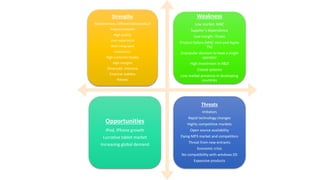
Strengths
Revolutionary, Differentiated product
Product breadth
High quality
User experience
Well integrated
Innovation
High customer loyalty
High margins
Steve jobs charisma
Financial stability
Patents
Weakness
Low market: MAC
Supplier’s dependence
Low margin: iTunes
Product failure (MAC mini and Apple
TV)
Unpopular decision to have a single
operator
High investment in R&D
Closed systems
Low market presence in developing
countries
Opportunities
IPod, iPhone growth
Lucrative tablet market
Increasing global demand
Threats
Imitators
Rapid technology changes
Highly competitive markets
Open source availability
Dying MP3 market and competitors
Threat from new entrants
Economic crisis
No compatibility with windows OS
Expensive products
No product differentiation
Low customer loyalty
Low margins(iTunes)
Increasing online music stores
Large white box players
Short product lifecycle
Evolving smartphone industry
(Direct:iPhone, Indirect:Ipod)
Notebooks, laptops replacing
traditional PC use
Undifferentiated products
More educated customers seeking
VFM
Price sensitive customers
Low brand loyalty
Dominated by few players
(Microsoft and Intel)
Policies of Digital Rights
Management
Threat of Entry: Low
Bargaining power of
Suppliers: High Threat of Rivalry: Moderate
Threat of Substitutes:
ModerateBargaining power of
Buyers: High
Porter’s 5
Forces
Alternatives
• Shift to cloud based model moving from computer digital hub model
• Tap growing markets in developing nations such as India and China
• Continue with product differentiation strategy with high margins
• Partner with more online electronic retailers
• Expand apples carrier network to other operators
• Maintain competitive edge of app store to tackle Google’s android
• Apple Ipad to target mobile computing
Thank You

Apple in 2010

  • 1.
    Apple in 2010 AnkurMukherjee 2014007 Ehrlich Pereira 2014013 Mark Gonsalves 2014027 Mayank Kalia 2014029 Varun Sharma 2014124 Dianna Godiwalla 2014142 Akarsha Kadam 2014192 Kshitij Mishra 2015213
  • 2.
    Problem Statement • Whathave been Apple’s competitive advantage? • Is Apple’s strategy sustainable? • Competitive Analysis of Apple’s different products • What are the prospects for Ipad? • Continuous change in leadership • Google’s foray into the smartphone market • Distribution Strategy
  • 3.
    Situation Analysis • Withthe iPad, Apple stands on the brink of another revolutionary product launch • Since Job’s return, Apple has been at the forefront of the digital revolution • Apple recorded sales of $43 billion in fiscal year 2009. Exemplary performance despite the economic recession • Despite lower market shares, Apple dominated the premium segment (91% of sales in the $1000+ segment in the US were of Macs)
  • 4.
    • Industry Overview •Competing across several consumer electronics product categories • Primary competitors being Microsoft, Dell, HP, Samsung, Nokia, Blackberry, Amazon, etc
  • 6.
    Strengths Revolutionary, Differentiated product Productbreadth High quality User experience Well integrated Innovation High customer loyalty High margins Steve jobs charisma Financial stability Patents Weakness Low market: MAC Supplier’s dependence Low margin: iTunes Product failure (MAC mini and Apple TV) Unpopular decision to have a single operator High investment in R&D Closed systems Low market presence in developing countries Opportunities IPod, iPhone growth Lucrative tablet market Increasing global demand Threats Imitators Rapid technology changes Highly competitive markets Open source availability Dying MP3 market and competitors Threat from new entrants Economic crisis No compatibility with windows OS Expensive products
  • 7.
    No product differentiation Lowcustomer loyalty Low margins(iTunes) Increasing online music stores Large white box players Short product lifecycle Evolving smartphone industry (Direct:iPhone, Indirect:Ipod) Notebooks, laptops replacing traditional PC use Undifferentiated products More educated customers seeking VFM Price sensitive customers Low brand loyalty Dominated by few players (Microsoft and Intel) Policies of Digital Rights Management Threat of Entry: Low Bargaining power of Suppliers: High Threat of Rivalry: Moderate Threat of Substitutes: ModerateBargaining power of Buyers: High Porter’s 5 Forces
  • 8.
    Alternatives • Shift tocloud based model moving from computer digital hub model • Tap growing markets in developing nations such as India and China • Continue with product differentiation strategy with high margins • Partner with more online electronic retailers • Expand apples carrier network to other operators • Maintain competitive edge of app store to tackle Google’s android • Apple Ipad to target mobile computing
  • 9.